



Abstract
International relations are made up of thick layers of meaning and big streams of data. How can we capture the nuances and scales of increasingly digitalised world politics, taking advantage of the possibilities that come with ‘big data’ and ‘digital methods’ in our discipline of International Relations (IR)? What is needed, we argue, is a methodological twin-move of making big data thick and thick data big. Taking diplomacy, one of IR's core practices as our case, we illustrate how anthropological and computational approaches can be merged in IR research. We report from our experiences with the project DIPLOFACE: Diplomatic Face-Work between Confidential Negotiations and Public Display, investigating how digital communication technologies influence both the study and conduct of age-old and traditionally analogue practices of inter-state diplomacy.
Keywords
This article is a part of special theme on Machine Anthropology. To see a full list of all articles in this special theme, please click here: https://journals.sagepub.com/page/bds/collections/machineanthropology
When diplomats tweet
Social media blur distinctions between the public and confidential spaces of international relations. When citizens follow their leaders’ negotiations of international agreements ‘live’ on Twitter, Facebook and Instagram, the diplomatic meeting room can no longer convincingly function as discrete ‘back-stage’. 1 Yet while confidentiality is challenged by the all-too-easy sharing of sensitive details, diplomatic language, even when compressed into a 280 characters tweet, is still rich with subtleties and assumed understandings shared by an exclusive group of negotiators. How do we analyse the millions of social media messages that political leaders produce while taking account of their politically negotiated and indeterminate meaning?
Most international relations (IR) scholars studying international diplomacy follow the ‘digital divide’ conducting either large-N studies of digital datasets (e.g. Barberá and Zeitzoff, 2017; Grimmer, 2010; Iakhnis and Badawy, 2019; King et al., 2013) or thick description of offline practices (e.g. Neumann, 2012; Sharp, 2009). 2 This division of labour between computational and analogue approaches risks reproducing the long-haunting divide between qualitative and quantitative methods in our discipline. Some scholars of diplomacy attempt to measure a state's diplomatic reach through, for example, the number of their embassies’ Twitter followers (e.g. Manor, 2019). Others analyse digital communication as external to diplomatic closed-door meetings, thus risking overlooking its actual contemporary mediation (e.g. Sharp, 2009; Wiseman, 2015). There is still little clarity of what ‘big data’ could do to illuminate our understanding of contemporary diplomacy. Yet we cannot simply disregard the massive amount of digital data produced by diplomats every day (which they themselves are deeply consumed with, also during negotiations) and ignore that this data is patterned in socially significant ways. Following this special issue's quest for ‘machine anthropology’, understood as a fusion between anthropological and data sciences, we see the need for a merger of methodologies and sensitivities to capture the nuances and scales of increasingly digitalised international relations.
Below, we show the value of combining big and thick (data) analysis to expand our understanding of world politics. We illustrate with examples from our research project “DIPLOFACE: Diplomatic Face-Work between Confidential Negotiations and Public Display” (see Adler-Nissen and Drieschova, 2019; Eggeling and Adler-Nissen, 2021). Funded by the European Research Council (ERC), the DIPLOFACE project brings together scholars specialised in natural language processing, social network analysis, machine learning, ethnographic fieldwork and discourse analysis.
We suggest two methodological moves for ‘machine anthropology’ to become productive in our field of IR. First, we need to ‘make big data thick’ – i.e., complement digital information with what happens at the social production site of ‘big data’ (see Christin, 2020). Paying homage to Clifford Geertz's famed ‘thick description’ (see Brooker, this issue), ‘thick data’ adds layers to single units of data, documenting the context and experiences around it (Latzko-Toth et al., 2017). We begin to thicken data by seeing the ‘digital’ and the ‘analogue’ as integrated wholes in a ‘flat hierarchy’ (Orgad, 2006, 63) or ‘flat ontology’ (Wight, 2006: 135–7). Second, we need to ‘make thick data big’ – i.e. embrace the hermeneutic moment in ‘big data’ analysis and thereby render polysemy analytically productive, rather than trying to overcome it as an inconvenience (see also Elish and Boyd, 2018; Sloane and Moss, 2019). In the end, we argue, our twin-move still leaves fundamental ontological questions unanswered, including how to make computational approaches sensitive to the ambiguity of meaning.
Making big data thick …
The advent of ‘big data’ and rapidly evolving computational methods (Lazer et al., 2009) have been met with widespread intellectual excitement. However, it also bears the danger of pushing data- or method-driven research agendas at the expense of phenomena less amenable to the current ‘big data’ methods toolkit (see also Boyd and Crawford, 2012; Kitchin, 2014). This feels almost too painfully accurate for diplomatic studies where social media updates are now analysed not just as the ‘frontstage’ of negotiations, but also as somehow revealing what political leaders and diplomats have been up to in the confidential ‘back-stage’. The following recounting of a piece of fieldwork data underlines this problem, but also illustrates how ethnographic methods can be weaved together with ‘big data’ research to produce analyses that take the polysemy and complexity of digital diplomatic practices seriously (see also Blok et al., 2017).
On 21 March 2019, the Twitter account of the Irish permanent representation to the EU posted a picture of a meeting of the European Union ministers and labelled it “The Art of Diplomacy?” (see Figure 1). While it did not exactly ‘go viral’ in the Brussels Twittersphere, it spoke to quips and banter in EU and diplomatic circles at the time. The Irish tweet is a re-fashioned version – through a filter app – of a photo first tweeted by the Bulgarian Ambassador to the EU with the original caption reading “from the corridors of the European Council.” It shows members of Task Force 50 – the EU's group tasked with negotiating the UK's exit from the Union (Brexit) – as well as diplomats from the EU27 hovering together in a hallway, supposedly informally discussing negotiations with the UK a week before the first anticipated Brexit date on 29 March 2019.
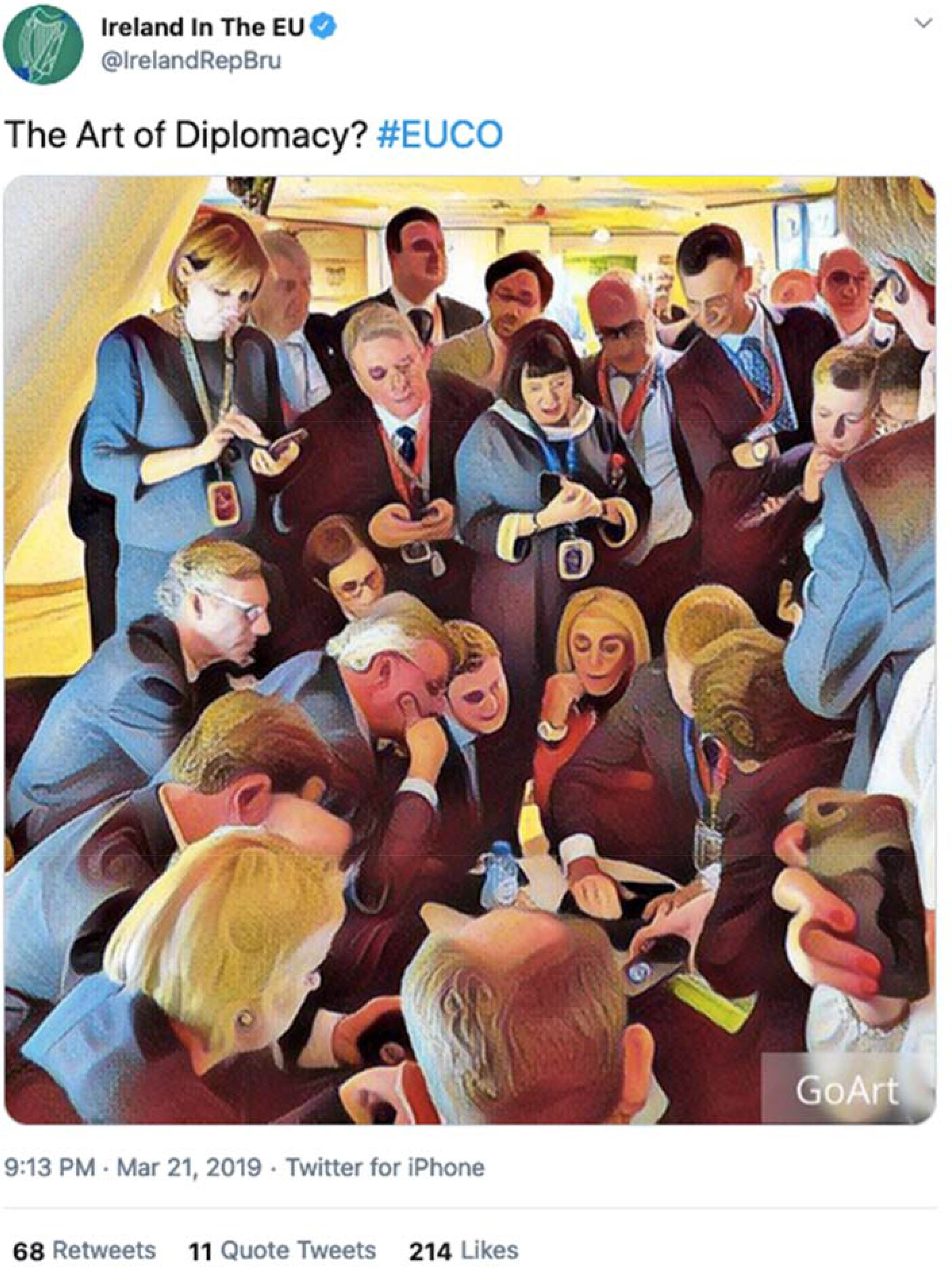
A picture of the European council at work, image-processed and tweeted by a diplomat from the Irish permanent representation to the EU.
The tweet is one observation in our dataset (or corpus of material) consisting of more than 300 million Twitter status updates engaging with diplomatic or international relations topics, hundreds of pages of fieldnotes from six months of observations conducted intermittently in the EU quarters of Brussels between the autumns of 2018 and 2021, as well as 45 semi-structured interviews with ambassadors, spokespeople, EU officials, etc. Seen as part of this pool, the image can be approached in multiple ways. On the one hand, as an instance of the diplomatic ‘frontstage’, that is, the public translation of diplomatic negotiations. This is the level at which IR and diplomatic studies scholars usually analyse such digital data (e.g. Manor, 2019): as data points that reveal the conduct of politics more broadly. If we approach the tweet on this level, we can ‘mine’ its sentiment, look at who liked it, who commented on it, who shared it, etc. – in other words, how it was engaged with on Twitter. Analysing the image, we find that it was interpreted as an example of how ‘Britain must get used to being outside of the room’. The UK version of this tweet would be the ‘British PM in a room by herself”– a clear line of analysis persists: what the tweet can tell us about diplomacy is that the EU is united and the UK is side-lined in Brexit negotiations.
On the other hand, approaching the image in this way sheds light only on what can be read off-the-screen – or ‘off-the-API’ as it were – and thus at best how a digital public has possibly reacted to and interpreted the post What this approach misses is both how the image and its caption were produced and what role it played in the context we are trying to understand: across the front- and the backstages of EU diplomacy. It is not enough to study only one side of these constellations (Duncombe, 2017). To get a deeper understanding of what a tweet does diplomatically, we need to examine the local settings where the production of such official tweets takes place. These settings, crucially, are sites of social hierarchies, norms and rules. Our example illustrates this: it is an ambassador who published the first image, and a lower-ranked diplomat who re-produced and re-fashioned it to share the spirit of the post (explained below) on his account. We can begin to uncover such dynamics by identifying and talking to the people who produced what becomes (part of big) data, and by observing the social interactions in the meeting rooms, offices, hallways, cafés, restaurants, and bars where international negotiations and their communication to public audiences take place. The aim of the analysis would then be to compare various instances of communication – in relation to, for example, style, intention, framing - to paint a broader image of how digital communication fits into the political ecology of the diplomatic site.
One of us did exactly that, and this way stumbled upon the person who posted the “Art of Diplomacy”. A serendipitous encounter in an extensive ethnographic and qualitative data collection effort rather than a targeted tracking down through digital detective work (see again also Brooker, this issue and Eggeling 2021), this below excerpt from our fieldnotes sheds a different light on the tweet. By talking to the Irish diplomat, we get a thicker and broader interpretation of what this ‘data point’ means for the actual practice of diplomacy, rather than just the selective traces of the latter on the ‘frontstage’ of the internet. The owner of the Twitter account, a diplomat just under rank of Ambassador told us the following story: “This image … got retweeted a lot as a symbol of the unity of the EU27 in the Brexit negotiations. The funny thing is that they were not even discussing something very important in this moment … and then he [the ambassador] told me to upload and retweet it again because he was so central in it … One of my colleagues came up with [the caption ‘The art of diplomacy?’], it brings together art and diplomacy – two things I do and like … The question mark is so that it does not read like we are trying to say that diplomacy is art. That would be boasting … The point of my version was the funny twist, but the point of the original photo I assume was to show on the one hand that they are actually working, then unity, and then also to show what goes on behind the security barriers, what goes on behind the closed doors. Stuff like this is an act of making diplomacy more human.” (Fieldnotes March 2019)
This example highlights how stories of the ‘data point’ multiply, with accounts of conflicting intentions and local interpretations often far from the public debate around these tweets. Sometimes this misalignment is banal, but sometimes it can have serious repercussions for the negotiation process as both parties in a sensitive process such as Brexit aim to maintain diplomatic decorum or ‘save face’ that is difficult to convey in 280 characters. Making big data thick, providing the context, the considerations of social hierarchy, the timing and intended audience to paint a fuller picture of its potential meanings, has proven useful in highlighting the polysemous nature of a tweet (see also Bornakke and Due, 2018). Moreover, it has shown that the contestation over the meaning of social media posts is now core to the diplomacy we are examining and should thus form part of its analysis.
… and making thick data big
Political language is polysemous not just because words mean different things in different contexts – as computational approaches such as topic modelling try to address – but also because the meanings of politically charged signifiers like ‘Brexit’ are actively negotiated. This is a challenge for computational approaches to text analysis as they are designed to capture stability in semantic structures rather than ruptures and struggles over meaning (see, e.g. Kozlowski et al., 2019). Yet, understanding diplomacy in this moment of time inevitably involves exploring the large-scale patterns in the immense amount of data and digital traces produced by diplomats. How can we use computational methods in ways that reflect the negotiated nature of political and diplomatic language, including social media engagements, rather than simply program contested meaning out of the picture? Making thick data big is about trying to incorporate the complexity of politicized meaning structures into the quantification of the kind of textual and visual data that is at the centre of computational approaches. This move is key if ‘big data’ is to deliver meaningful insights for the study of international relations. To substantiate this point, we briefly recount the interpretive challenges we faced while coding thousands diplomatic tweets from diplomatic EU circles, similar to the one in Figure 1. Here, we ended up mobilising a standard quantitative validity check in a completely new way to capture particularly contentious language.
Our aim in this part of the project was to build a dataset for a social network analysis of relations between countries, international organizations, and other collective entities on Twitter. Taking the notion of ‘facework’ to the international level, we were interested in going beyond sentiment analysis to explore variations of positive (e.g. giving face) or negative (e.g. saving face) facework by diplomats on social media – i.e., a research agenda that, at least initially, lends itself more easily to computational methods than what we described above. To this end, we collected every original tweet by 150 EU-related diplomatic Twitter accounts between March 2019 and March 2020. While training a machine learning algorithm to code the diplomatic facework in such tweets might be a long-term goal, it is the manual hand-coding of the resulting 30.000 tweets that has occupied us so far. Doing so, we had to tread a thin line between optimizing inter-coder reliability (increasing the agreement among ourselves and 11 research assistants on how to code the same data) and remaining sensitive to the complexity and layered significances of the tweets.
Speaking to the theme of this special issue, our intent was not to apply ‘out-of-the-box’ computational methods, but to explore how such methods can be re-thought in a way that leverages the sensitivity about semantic nuances and situated readings we developed in our ethnographic studies of the same diplomats. This endeavour invites us to reconsider what ‘intercoder reliability’ might mean in an interpretive methodological context. Here, aiming to improve inter-coder reliability is not about training cod < ers to distil the ‘official meaning’, but more about capturing a hegemonic interpretation sensitive to the diplomatic context. Even in international diplomacy where social media users use ambiguous langue to avoid upsetting either side, we found that most of the tweets in our dataset were quickly understood by our coders to express a specific political message (and with a high inter-coder agreement). While ethnographic methods tend to highlight semantic variation, computational approaches serve as an important reminder that there is a significant amount of semantic stability – hegemonic ‘common knowledge’– which computational methods can help us to map and monitor over time (see also Bayram and Ta, 2020).
More interestingly though, our coders were also able to coherently identify specific tweets that could be interpreted in different ways by different audiences. We asked them to highlight particularly ambiguous tweets that might take on different meaning depending on which side of a political conflict the reader stands. In our case, these were mostly tweets related to the Brexit negotiations. Not surprisingly, inter-coder reliability increased significantly if we exclude these tweets that our coders flagged as too polysemous to be coded according to our coding scheme.
One paradoxical methodological take-away, then, is when combining computational methods and situated interpretivism, improving inter-coder reliability becomes less of a goal to improve validity, but rather a benchmark for assessing the degree of ambiguity in textual data. In other words, we used a quantitative benchmark of ‘valid’ research’ as indictor of the degree of political polysemy and dispute in the data. Knowing from our coders which kinds of tweets are contentious provides for an interpretively thick dataset that enables us to also analyse the moments when international relations are most contested. After all, the tweets on which coders agree were rarely those that would grab the attention of political observers. Where diplomatic tweeting becomes interesting is when it translates, shapes or performs political conflicts, yet we could not possibly have detected these tweets without applying our codes to the entire dataset. In our case, the manually coded dataset containing both hegemonically stable and polysemic diplomatic social media updates is a rich starting point for a ‘machine anthropology’ of digital diplomacy. The future aim would be to integrate polysemy and interpretivism into computationally driven approaches to coding and analysing textual data.
Conclusion
Combining computational and ethnographic methods involves methodological mergers in the study of diplomacy, and possibly international relations more broadly, going beyond complementarity (see Pretnar and Pojed, this issue). Merging implies that the respective approaches acquire new meaning. For example, particular techniques such as assessing intercoder reliability and being open to serendipitous encounters begin to serve new purposes within the larger research endeavor. Beyond methodological innovation, approaching the diplomatic tweet as both a singular data point in a larger pattern and fluid object within ongoing social processes inevitably also expands our understanding of what diplomacy is. The twin-move of thickening big data and making thick data big shows just how much the digital is embedded into world politics. We can then begin to see how social media presents new ways of performing diplomacy, as in the case of curated tweets, engendering new forms self-expression and tactical transgressions of confidential boundaries. As such, the agenda of machine anthropology is not just pushing methodological boundaries, but also enabling a deepening of our understanding of contemporary diplomacy. Yet our combining of fieldwork with computational, large N-studies, still leaves fundamental questions unanswered that future research needs to turn to, especially whether it is possible to make computational approaches compatible with the indeterminacy and ambiguity of political meaning?
Footnotes
Acknowledgments
We would like to thank all participants in the SODAS data discussion on 20 February 2020, the DIPLOFACE research team, Ann Towns, Katarzyna Jezierska, Morten Axel Pedersen, the editors of Big Data & Society and the two anonymous reviewers for their very helpful comments.
Declaration of conflicting interests
The author(s) declared no potential conflicts of interest with respect to the research, authorship, and/or publication of this article.
Funding
The author(s) disclosed receipt of the following financial support for the research, authorship, and/or publication of this article: This work was supported by the H2020 European Research Council (grant number DIPLOFACE, grant no: 680102).
