




Abstract
The ambition and proposal for data modeling of myths presented in this paper is to link contemporary technical affordances to some canonical projects developed in structural anthropology. To articulate the theoretical promise and innovation of this proposal, we present a discrete-event system specification modeling and simulation approach in order to perform a generative analysis and a dynamic visualization of selected narratives, aimed at validating and revitalizing the transformational and morphodynamic theory and methodology proposed by Claude Lévi-Strauss in his structural analysis of myth. After an analysis of Lévi-Strauss’s transformational methodology, we describe in detail how discrete-event system specification models are implemented and developed in the framework of a DEVSimPy software environment. The validation of the method involves a discrete-event system specification simulation based on the extension of discrete-event system specification models dedicated to provide a dynamic Google Earth visualization of the selected myth. Future work around the discrete-event system specification formalism in anthropology is described as well as future applications regarding the impact of computational models (discrete-event system specification formalism, Bayesian inferences, and object-oriented features) to new contemporary anthropological domains.
Keywords
This article is a part of special theme on Machine Anthropology. To see a full list of all articles in this special theme, please click here: https://journals.sagepub.com/page/bds/collections/machineanthropology
Introduction
Claude Lévi-Strauss’s ambitions of a cybernetic and machine anthropology were informed by the scientific and political context of the 1950s and 1960s. Its appeal, in his view, was partly how to intervene in a much global scientific and political scene, in order to overturn the privilege of established methods and philosophies in light of new findings that could confront the global problems arisen by the expansion of European capitalism and colonialism. In the absence of full technical resources to realize his project, he made highly speculative claims that deftly dodged and disguised the acute problems and limitations of his working conditions. In this paper, we offer some comments and suggestions on how to revitalize Lévi-Strauss’s methods in the contemporary context of technological developments, which may allow not only realizing his ambitions, but also radically revising our methods and goals to confront the pressing problems of the contemporary world. A broader theoretical reflection and critical revision of structural anthropology to address the new broader technological and political context is nevertheless beyond scope at this time. In this article, we use the formalism of discrete-event systems specification (DEVS), introduced by Zeigler, which provides a way to specify any system as a mathematical object, and enables modeling and computer simulation of complex discrete-event systems by means of a formal method mathematically demonstrated (Zeigler, 1976).
DEVS formalism is a simple way in order to characterize how discrete-event simulation languages may specify discrete-event system parameters. It is more than just a means of constructing simulation models. It provides a formal representation of discrete-event systems capable of mathematical manipulation just as differential equations serve this role. By allowing an explicit separation between modeling and simulation phases, DEVS formalism is one of the best ways to perform a simulation of systems using a computer. The finite probabilistic DEVS is another interesting developed property of DEVS extension (Seo et al., 2015). It allows the transition out of a state to be one of a finite set of possible states where the choice is made probabilistically (Capocchi et al., 2019)
Several generic tools allowing M&S execution of complex systems are developed in different applications dealing with industrial processes modeling. They deal with industrial tools of which the main representative is Matlab/Simulink© (Choi and Liu, 2016), or they use modeling languages of which the main representative is Modelica© (Fritzson, 2015), allowing the simulation of systems containing mechanical, electrical, electronic, hydraulic, thermal, control, electric power, or process-oriented subcomponents. Overall, they are mainly used for the simulation of industrial processes and they have difficulties to take into account human-centered systems.
DEVS formalism and M&S environments allowing the M&S of complex systems (Van Tendeloo and Vangheluwe, 2017) are extended in their PythonDEVS kernel to provide an open source python-oriented framework, of which DEVSimPy is the representative environment (Capocchi et al., 2011; Capocchi, 2020). In previous papers, we further used such recent elaboration of computer M&S concepts to deal with dynamic variable structures applied in several approaches from social sciences and the humanities to object-oriented models for the analysis of narrative transformations, including the analysis of myths following Lévi-Strauss’s structural analysis of myths (Santucci et al., 2010, 2020).
According to Lévi-Strauss, transformational analysis may account for the localization of myths and their transformations in “larger unsuspected entities” (Lévi-Strauss, 1964, 1971; Barbosa-Almeida, 1990; Marcus, 2001; Morava, 2005; Lafontaine, 2007; LeRoux, 2009; Geoghegan, 2011; Rauff, 2016; Harrod, 2018). To realize Lévi-Strauss’s ambitions regarding the link between mythical transformations and their localization in a given landscape, we propose a M&S approach based on DEVS formalism using the DEVSimPy environment for the visualization of a given myth using Google Earth. In section “Levi-Strauss Transformational Methodology,” Lévi-Strauss transformational and morphodynamic analysis of myths is presented, including a discussion of its relevance for contemporary anthropology and digital social science. In section “DEVS,” we summarize the basic notions of DEVS formalism and we introduce DEVS extensions to develop a computer software approach to the structural analysis of myths and to allow the dynamic variable structure modification of models useful for myths visualization. We also introduce the DEVSimPy software environment as a DEVS software framework selected in order to implement DEVS models allowing both the generation of myths and the visualization of a given myth using Google Earth. In section “Implementation of DEVS MS of Levi-Strauss Myth Analysis,” we summarize the software approach that we developed in more detail elsewhere (Santucci et al., 2020), regarding the modeling of a given myth issued from the oral literature of a given culture and the simulation of myth transformations as described by Lévi-Strauss. In section “Visualization of a Given Myth Using Google Earth,” we develop a DEVS simulation approach for the visualization of myth in a given geographical context. In section “Validation of the visualization of a given myth,” we provide a validation test of the DEVS dynamic formalism allowing to model the structure of a given myth and to sequentially display the visualization of the selected myth on a map.
The use of a computational approach and the simulation of myth analysis and validation are based on the development of a DEVS modeling library dedicated to myth transformation and visualization, which can allow the analysis of a great number of myths belonging to a given culture that could be difficult to do manually. Furthermore, the generic simulation features of the formal approach and the resulting software mechanism make it possible to take into account a set of different cultures and could be used to propose the automatic validation of hypotheses set up by researchers in anthropology.
DEVS formalism does not only model and simulate perfectly the transformations of the armature of a given myth as defined by Lévi-Strauss. We rather argue to provide a computational validation and revitalization of Lévi-Strauss’s transformational approach and morphodynamic methodology. As we anticipate in section “Future applications and extensions,” the concepts and properties of DEVS formalism can be useful for addressing contemporary issues. An important feature for further anthropological applications is the possibility to develop families of DEVS models using their explicit transition and time advance structure. It can be argued that the new features allowing to introduce and dynamically manage probabilities both on state transitions and on time transitions into DEVS M&S can be a key point for developing and implementing software mechanisms dedicated to novel anthropological investigations in contemporary social and political domains.
Lévi-Strauss transformational methodology
Structural legacy
In previous works on the reassessment of structural legacy in anthropology (Doja, 2008b) and the critique of postmodernist rhetoric of post-structuralism (Doja, 2006), we have demonstrated the relevance of morphodynamic approach and transformational analysis (Doja, 2010a), including the development of neo-structural models and software mechanisms to deal with morphodynamic structures applied to object-oriented narrative transformations (Santucci et al., 2020). Actually, among the numerous stellar thinkers, whose contributions over the past century have had revolutionary impacts upon the theoretical foundations of anthropology, there is almost none comparable with Lévi-Strauss, even though there may remain much misunderstanding regarding the substance and merit of Lévi-Strauss’s thought.
His reception in the Anglo-American world was always mixed and we have examined elsewhere the intellectual context in which both anti-structural critique and structural enthusiasm proliferated. More importantly, Levi-Strauss had remained a source of fascination and inspiration for a younger generation of anthropologists, who over the last decades have sought to reintroduce and revitalize his work. Lévi-Strauss’s legacy has certainly been a victim of the generational and cultural changes happening within the academy, where he might have been perceived as another “dead white male.” In turn, in a combative and passionate review, we lay out again a critical argument against some recent grandiloquent and single-minded narratives of his work and life. Especially in light of his later writings, we support Lévi-Strauss’s scientific legacy as eminently relevant to the contemporary world plagued by the fundamentalist doctrinal threats of cultural, racial, political, ecological, and epidemic crises (Doja, 2020).
While establishing the theoretical and methodological foundations of a scientific revolution in anthropology, his ambition was not only to provide a new epistemology, involving a new approach to methodology and a set of novel assumptions and procedures for the acquisition of knowledge, but also a new ethics and the global awareness of a new humanism (Doja, 2008a). In particular, in his works on mythical thought, it can be argued that Lévi-Strauss contribution is far-reaching and represents the most compelling challenge to the future of anthropology in the 21st century. Indeed, many attempts to revitalize his methods show that the structural analysis initiated by Lévi-Strauss may innovatively account for the ways in which social relations are ever more mediated by and implicated in broader political processes (see Doja, 2010a). In addition, the critical approach of pivotal scholars of new turns in anthropology can be well understood as productively tracing their interest back to Lévi-Strauss, in particular scholars “reconfiguring kinship studies” (Carsten and Hugh-Jones, 1995; Franklin and McKinnon, 2002), or scholars “intensifying certain trains of thought” about deep ontologies (Holbraad and Pedersen, 2017). Lévi-Strauss may still be a source of inspiration even for highbrow ideas of our days, albeit sometimes without proper acknowledgment. As we have seen elsewhere, many scholars parallel his insights, which are often thought in these scholars’ minds, at best, as Lévi-Strauss would have put it, without their being aware of the fact (see Doja, 2020).
Turing test of larger unsuspected entities
By famously stating about the myths that “think each other (
In his thorough analysis of indigenous American myths, Lévi-Strauss insisted on the identification of much more complex and “larger unsuspected entities” (Lévi-Strauss, 1971: 545) than functionalist methods of phenomenological and hermeneutical analysis could allow. He suggested that what ethnographers study by participant observation, that is, the real-life experiences of phenomenology, are the temporally and spatially limited meeting points of these larger entities.
Lévi-Strauss’s “larger unsuspected entities” are no mere theoretical postulates, but can be uncovered by synchronic and diachronic analysis, and reflect genuine social processes occurring between their component communities over time and space. Such processes are unlikely to be observable by methods of participant observation, and they are still less likely to be recorded in the documentary archive. Already anticipating the advent of trans-local and global ethnography in current anthropology, they can be seen in curious and unexpected features of ethnographically known lived worlds. For instance, as Lévi-Strauss claimed, in the extreme differences between the Salish and Kwakiutl versions of what both peoples claim to be the same mask, or in the function of ritual and myth to articulate that past outside time at the rhythm of life cycle, seasons and the sequence of generations.
Lately, in his Japanese musings, he vigorously provided a clear justification for another “larger unsuspected entity” based on the logic of symmetric histories and mythologies, both similar and opposite, across Japanese, South American and West European cultures (Lévi-Strauss, 2011). He advanced his structural claims by weaving a mesmerizing set of patterns and transformations to construct a system of invariant differences between Europe and the Americas across the indigenous populations of the Pacific Rim. Thereby, the opposite ends of the Eurasian and American continents are deemed to meet together in an emergent realization of the massively constructed, but logically possible, inversions along a multiplicity of concrete dimensions (Doja, 2020).
We argue that these processes can be modeled and simulated by means of a software mechanism using DEVS formalism and Google Earth API. This mechanism, presented in section “Visualization of a given myth using Google Earth” is aimed to visualize on a map how a given myth is embedded into the geographically distributed life worlds of neighboring people.
Anthropologists often convey how descriptive placenames and related narratives bring graphically to mind the locations they depict (Basso, 1988). In particular, mapping a territory by means of mythical narratives brings about a cultural meaning and temporal experience of space on which people rely to act. When a myth is told, the people who are listening to the story are able to connect places to old individual and collective experiences. For instance, an arid place referred to by a spring name in Corsican folktales, which we use for computer simulation and visualization on a map, evokes how the ancient world was like and the probable reasons that might have led to its transformation. While referring to Neolithic places, sacred mountains and important springs, mythical narratives allow people to be in the position of their ancestors dwelling at the places referred. The myth makes them travel in their minds mental images that convey ancestral experiences. Linked to specific locations, it provides symbolic reference points for the moral imagination and its practical bearing on the actualities of people’s lives. In this sense, the larger unsuspected entities people construct in their myths out of the immediate locations in which they dwell can be said to dwell in them, as Lévi-Strauss would have put it again, without their being aware of the fact.
Structural analysis of myth
Many commentators, either admirers or critics, have retained from the structural analysis of myth its capacity to disclose stable, common, and probably universal frameworks. Fundamentally, Lévi-Strauss preferred to look for rules that would ideally make it possible to generate, starting from a myth of reference, the finite or infinite whole of all other real or possible myths. In the structural study of myths, Lévi-Strauss demonstrated the transformational morphodynamics of mythical networks. One of the most powerful of Lévi-Strauss’s ideas is his description of the generative engine of myths on the basis of the set of their own transformations.
As a myth is spread and retold in different contexts, new variations occur. While the basic mythical structures (
The description of these transformations relies on the concepts of terms and functions. When analyzing myths, Lévi-Strauss often talks of terms that are qualified with different functions. Terms can be persons (in the forms of humans, animals, divinities), or things, which have the ability to take up roles. Functions are the different roles carried by these terms. In myths, we encounter a number of characters (terms), all of which have a great number of possible roles (functions). A myth, understood as a group of transformations occurring from one to another of its variants, is further decomposed into a set of basic elements called mythemes, which are also characterized by the notions of terms and functions. Throughout the
When Lévi-Strauss introduced the structural analysis of myth (Lévi-Strauss, 1955), he did not relate it to the linguistic model, even though the great emphasis on binary oppositions he had developed earlier in his
A basic assumption of Lévi-Strauss is that, in a myth, the same narrative pattern is expressed through different codes, which are generally used to convey the message of the myth, at the geographic, economic, social, gender, cosmological, and other levels. When a myth is told, it can be understood according to several codes that have to be taken into account all together. Ultimately, Lévi-Strauss showed why myths must be read vertically according to their various codes like a musical score. Like the synchronic connection between several keys that produce the musical harmony, the myths offer an interpretative grid and can be regarded as a bundle of relations between several codes (Lévi-Strauss, 1971). They are only translatable into each other in the same way as a melody is only translatable into another that retains a relationship of homology with the former.
The set of images and reflections that mirror each other across different codes shifted the quest for the meaning of myth, like for that of music, from the signified they contain to the signifying framework or the mirror play that orders them. In other words, music and myths must be received in their own order, that of the operations induced by their own forms. That is why, against the naivety of looking for some morality in myths, the analysts must confine themselves to an exposure that will reveal the mythical devices in the manner of an orchestra conductor reading the score and leading its execution. Like the reader is invited to let themselves be “carried toward that music which is to be found in myth” (Lévi-Strauss, 1964: 40), it is not a question of making available some meaning but of carrying out an operation.
To simulate this operation, in section “DEVS dynamic variable structure extension,” we argue an extension of DEVS formalism aimed at generating a given myth according to different codes. The code analysis of a given myth leans on a dynamic variable structure simulation approach: the supervisor atomic model will be connected to an empty coupled model. As the coupling information of the network (the interconnection of mythemes belonging to the given myth under study) is located in the state of the supervisor component, transition functions will be used to modify this state and transform sequentially the structure of the network. Following Lévi-Strauss’s parallelism between mythical codes and musical clefs, we print the simulation results of a given myth’s codes by using a musical score format. The solution will have to check dynamically during the simulation which mytheme of the myth under study is related to one of the codes to be considered. Each time a mytheme is related to one code, it will have to be stored into an atomic model which will be in charge of the visualization of the results under a music score format. Each code corresponds to a line and each column represents alternatively a term and a function that are computed according to the corresponding code using the simulation.
Morphodynamic approach
According to Lévi-Strauss, the basic operations of the convertibility, the mediation and the combinatorial permutations of codes and axes between terms and functions can be controlled by means of a special relationship that he formulated in a canonical way through various mathematical expressions. Canonical formulations demonstrate how the transformations of the myths can be captured and how new myths are generated from any specified myth of reference. Lévi-Strauss’ canonical formulae that articulate the transformational dynamics of mythical networks transcend a simple analogical relation to a quadratic equation, as shown in the following equation:

For a mathematical catastrophist operation of this kind to take place, the very idea of canonical relation requires a third operating condition as a boundary condition external to canonical formalization. In all cases, boundary condition refers to the empirical evidence from outside the realm of the myths being analyzed, which Lévi-Strauss carefully identified in each case as the necessity of the crossing of a spatiotemporal boundary, defined in territorial, ecological, linguistic, cultural, social, or whatever other terms. Boundary condition is also a formal mathematical concept, required to be satisfied at the boundary of a topological domain in which a set of differential equations is to be solved. A boundary condition of this kind is claimed by Lévi-Strauss to be important in determining the mathematical solutions to various mythical problems. In his further canonical formalization, boundary condition is used to account for the morphogenetic and morphodynamic transformation of myths across the boundaries existing between one people and another. Namely, a series of variations inherent in the myths of a given people cannot be fully understood without going through myths belonging to other people, which are in a relation of inverse transformation with the formers.
The requirement of this operating condition can be thought to anticipate the discursive activation of a particular cultural ideology acting as a hidden agency of instrumental politics. In section ‘Future applications and sxtensions’, we argue for developing a neo-structural model of canonical formalization based on discourse analysis and transformational morphodynamics, which may account for hidden instrumental ideologies in current social and political processes.
Structural analysis and computational experiments
It is commonly believed that Lévi-Strauss received his method from the structuralism of the Prague School, where mathematics was not particularly emphasized, and many Anglo-American anthropologists learnt it as a pseudo-mathematical mystification (Diamond, 1974; Turner, 1990; Launay, 2013). Lévi-Strauss recruited mathematics to validate and revise a preexisting schema when in the 1950s a certain amount of pseudo-mathematical mystification might have animated cybernetics, information theory, and behavioral sciences. His scientific ambitions might appear quite naive today, especially his proposals about the “hardware” of the study of myths and similar initiatives to “computerize” the study of social behavior using index punched cards and associated algorithms (Lévi-Strauss 1962: 117–118). However, he also dealt with applied group theory and the algebraic models of kinship structures, which were endorsed with a postface by one of the most known mathematicians of his time (Lévi-Strauss, 1949[1967]). Afterwards, his method went on to be received seriously by modern scholars seeking to study culture and society by formal means (Barbosa-Almeida, 1990; Cargal, 1996; Marcus, 2001; Morava, 2005; Lafontaine, 2007; LeRoux, 2009; Geoghegan, 2011; Rauff, 2016; Harrod, 2018).
In the early 1950s, Lévi-Strauss himself expressed doubts, albeit in private, about his ambitions for a kind of a structural-informatics project (Jakobson and Lévi-Strauss, 2018). In addition, after he introduced the method for the structural study of myth (Lévi-Strauss, 1955), the generative virtues of the so-called “double twist” of canonical transformation have remained non understood for a long time. He almost never mentioned explicitly his formulation of transformational dynamics, even though this was implicit in the massive work of his
Another logical-mathematical methodology, based on Lévi-Strauss’s claim of an algebraic structure to human mind and cognition derived from his structural analysis of myths, is used to map sub-literal meanings of narrative and discourse analysis. The new method is validated by findings of research on a set of systemic numeric references found in oral narratives and forming mathematically constructive algebraic groups, such as the specifically commutative Abelian semi-group with identity (Haskell, 2003; Haskell and Badalamenti, 2003; Haskell, 2008). Yet another new Internet research strategy, inspired from big data algorithms of narrative texts, is recently adjusted to more general categories of Bayesian inference and ontological transformativity in anthropology and narrative analysis (Kockelman, 2013).
In particular, existing works have already explored the links between computer science and structural anthropology, focused on the structural study of narratives (Greimas, 1966), or on myth transformation modeling (Petitot, 2011; Jason and Segal, 1977; Richard and Jaulin, 1971; Klein et al., 2010), including attempts to formalize not only Lévi-Strauss’s structural analysis of myths but also Vladimir Propp’s morphology of folktales (Propp, 1968).
Arguably, the software approach to myth analysis needs further developments, which we propose elaborating based on the extension of DEVS formalism. In the next section, we summarize the main concepts involved in the DEVS formalism useful to the software approach.
DEVS formalism
Description
Basically, DEVS formalism defines two kinds of models: atomic models and coupled models. An atomic model is a basic model with specifications for the dynamics of the model. It describes the behavior of a component, which is indivisible, in a timed state transition level. Coupled models tell how to couple several component models together to form a new model. This kind of model can be employed as a component in a larger coupled model, giving rise to the construction of complex models in a hierarchical fashion. As in general systems theory (Wymore, 1967), a DEVS model contains a set of states and transition functions that are triggered by the simulator.
A simulator is associated with DEVS formalism to send instructions of coupled model that actually generate its behavior. The architecture of a DEVS simulation system is derived from the abstract simulator concepts (Zeigler, 1990) associated with the hierarchical and modular DEVS formalism.
DEVSimPy environment
DEVSimPy (Python Simulator for DEVS models) (Capocchi et al., 2011; Capocchi, 2020) is a user-friendly interface for collaborative M&S of DEVS systems implemented in Python language. The DEVSimPy project uses the Python language and provides a General User Interface based on PyDEVS API (Bolduc and Vangheluwe, 2001) in order to facilitate both the coupling and the reusability of PyDEVS models.
DEVSimPy allows the extension (or overwriting) of their functionalities in using special plug-ins managed in a modular way. The user can enable/disable a plug-in using a simple dialog window (Figure 1).
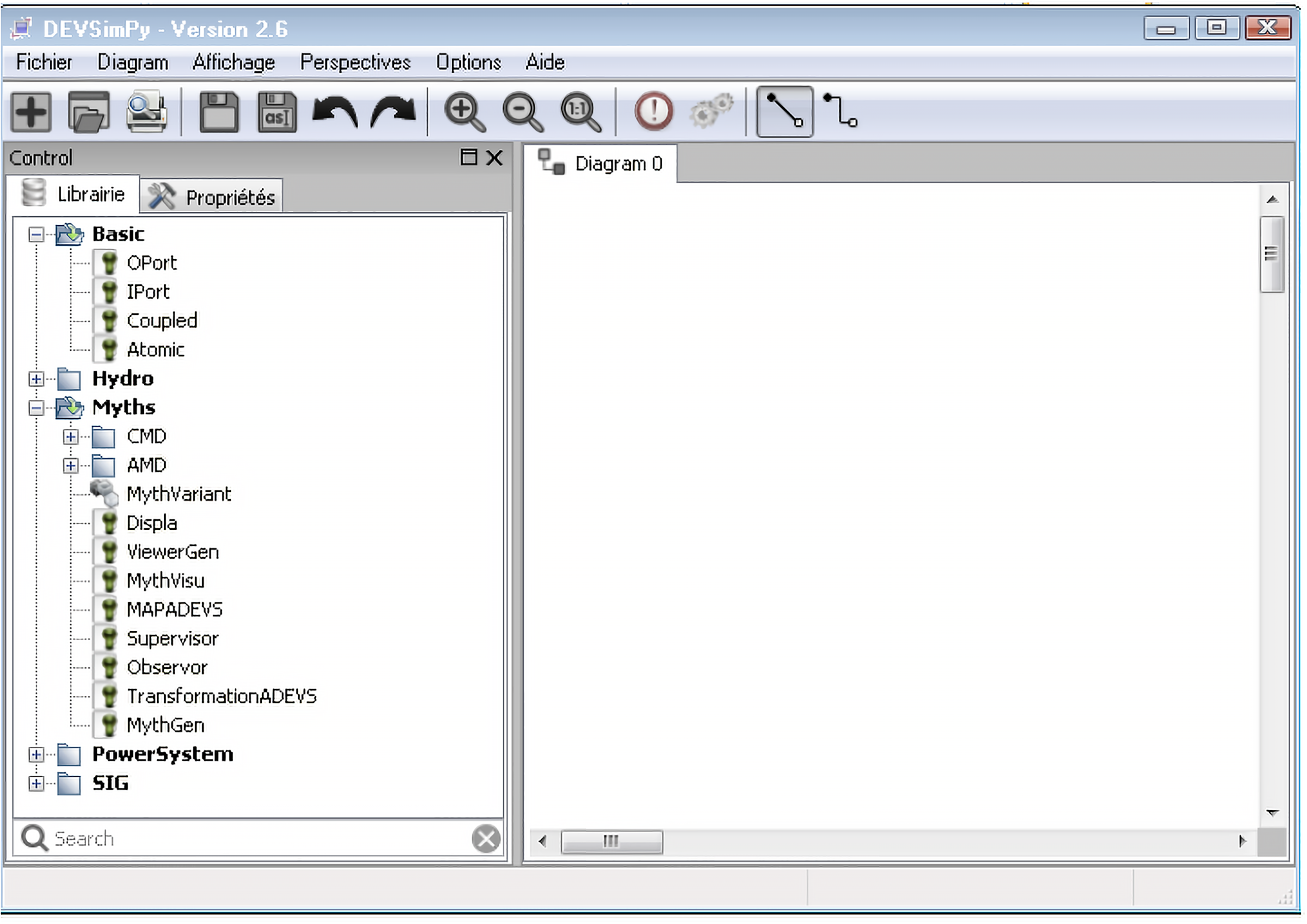
DEVSimPy general interface when first opened with the Libraries panel (left part) and the diagram panel (right part).
We propose the DEVS modeling of Lévi-Strauss myths analysis method through DEVSimPy by implementing a specific dynamic library. The visualization of a given myth using google Earth is based on the extension of DEVS concepts known as dynamic structural modification of DEVS models.
DEVS dynamic variable structure extension
In order to deal with the modeling of dynamic variable structure system a set of scholars have proposed in the recent past to extend DEVS formalism (Baati et al., 2007; Barros, 2003). The implementation of the dynamic structure DEVS (DSDEVS) formalism (Barros, 2003) requires the definition of a completely new abstract simulator dedicated to such formalism. Other approaches allow to simulate their variable structure models as classical DEVS coupled models (Baati et al., 2007), or they define a dynamic reconfiguration, specifically a variable structure and interface changing capability, in DEVS component-based M&S (Hu et al., 2005). The proposed implementation relies on the definition of a special coupled model involving a classical atomic model called supervisor component (Baati et al., 2007), which drives the dynamic structure discrete-event system modifications and coupled models representing the set of potential structures. This modeling feature is important since it is compatible with Lévi-Strauss relational theory of myth transformation and visualization as pointed in section “Visualization of a Given Myth Using Google Earth.” An example of interconnection of a network structure is given in Figure 2, where the Supervisor and the CoupledModel are interconnected with the input and output ports of the CoupledDEVS component.

A variable structure in a coupled DEVS model with its supervisor.
DEVS implementation of Lévi-Strauss myth analysis
In this section, we summarize how DEVS formalism is used in software approach to myth transformation as we detailed elsewhere (Santucci et al., 2020). The implementation is realized using the DEVSimPy environment presented in the previous section. In order to model the transformation of myths based on Lévi-Strauss theory we developed a M&S approach allowing to implement the following functionalities:
Modeling of a given myth through a set of mythemes. The software will allow a user to define a myth as an interconnection of mythemes. Definition of an initial myth as a reference myth. Generation of a new myth from the reference myth by performing a set of transformations. Visualization of the set of generated transformations in graph representation.
In this implementation, we defined the following DEVS atomic models:
The initial myth is defined by an instantiation of the
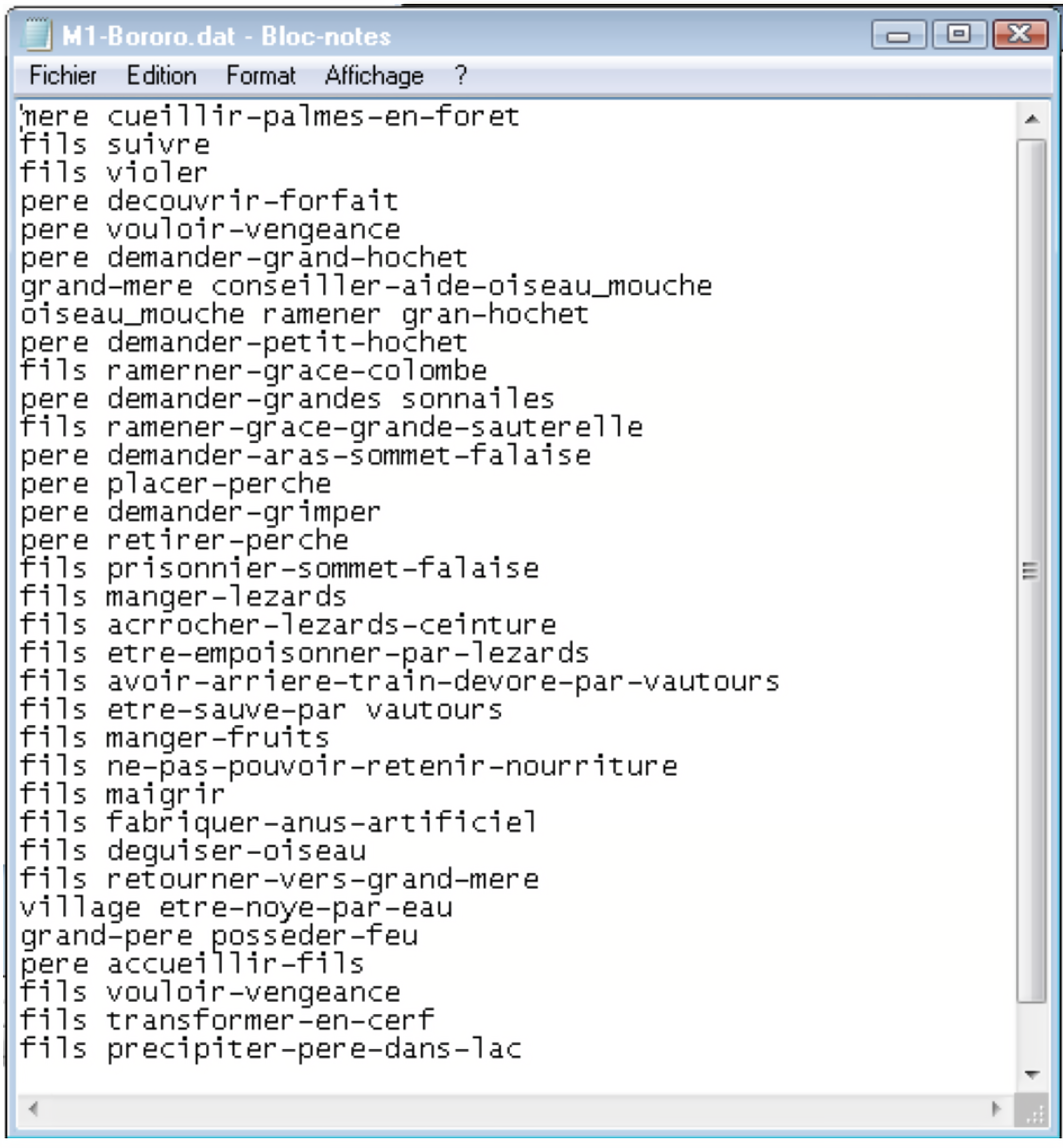
Examples of mythemes belonging to the myth called
The generation of a new myth leans on the atomic model class called

The generation of a new myth.
To obtain visualization of the set of transformations of the myths generated from the reference myth, we used a graph representation. Graph visualization is a way of representing the relations between myths as diagrams where nodes are labelled with a given myth. Oriented arcs between two nodes represent the fact that the successor node of the arc corresponds to a myth which is generated from the myth corresponding to the predecessor node of the same arc. An example of the automatic generation of a graph of myths is given in Figure 5.

The resulting graph after myths generation.
Visualization of a given myth using Google Earth
In this section, we use Google Earth (Gorelick et al., 2017) to present the dynamic visualization on a map of the unfolding of a given myth generated with myth transformation software. In particular, we offer the possibility to locate all the mythemes of a given myth on a map when the localization of any given mytheme is available. The simulation process displays all the numbered mythemes on the map. To this aim, we combine the simulation of DEVS variable dynamic structures involved in the DEVSimPy framework with some features of the Google Earth API.
DEVS modeling scheme for map visualization
In order to perform the dynamic visualization of a folktale we defined a DEVS modeling scheme by implementing the following set of specific atomic models:

DEVS modeling for dynamic visualization.
The goal of the atomic model
Algorithm 1.

The files can be loaded using two attributes:
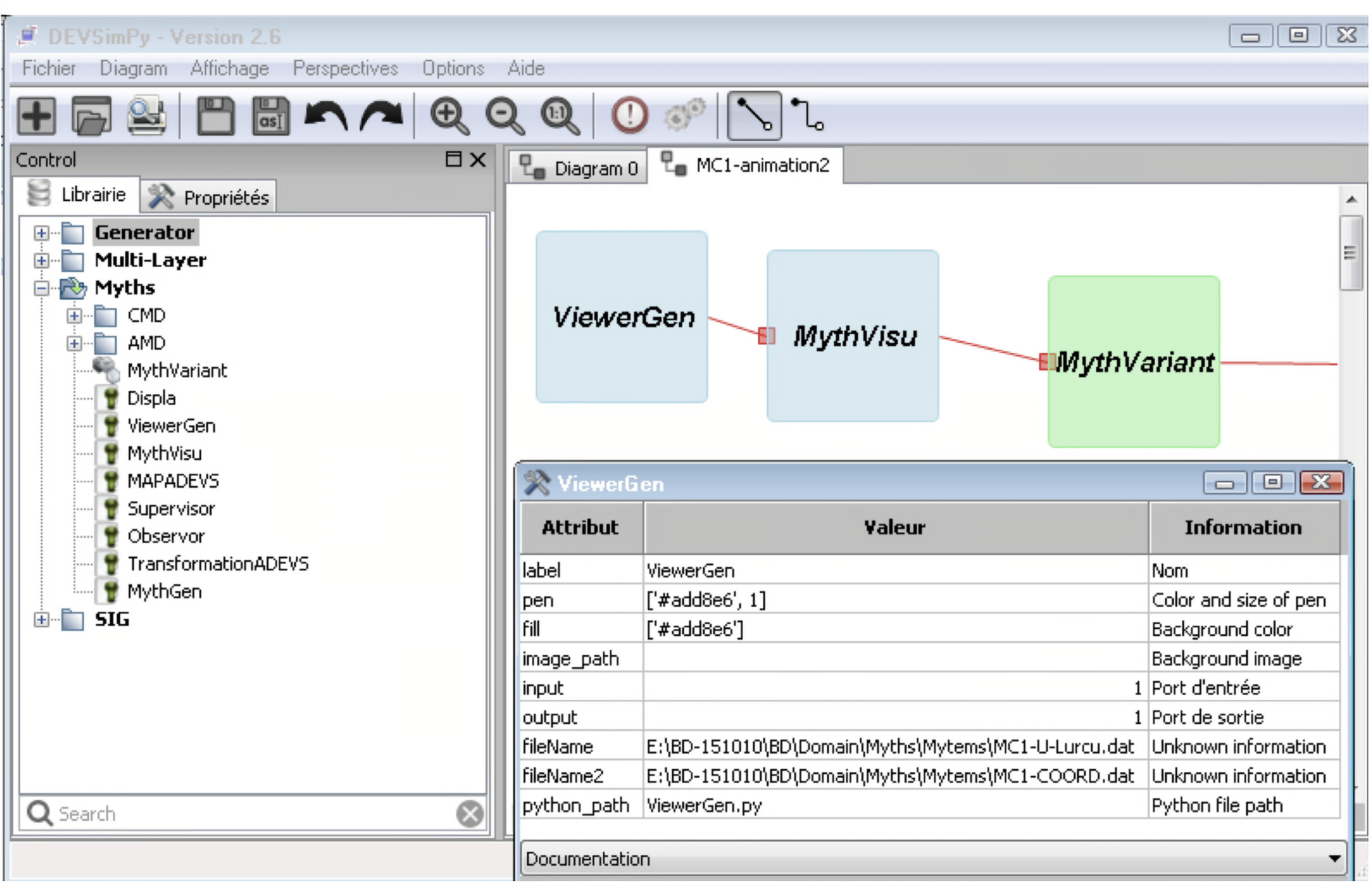
Properties of the

The 20 mythemes in Corsican language of the myth under test.
The
The goal of the
Variable dynamic structure
Our approach supports changes in structure by the introduction of a special atomic model that keeps in its internal state the structure of a network of models. Changes in state are automatically mapped into changes in structure. For this application, the special

Illustration of the
The management of dynamic variable structures using the DEVSimPy framework is aimed to dynamically modify the
Google Earth invocation
The Google Earth invocation leans on the following atomic models:
The dynamic visualization is performed using the plugin

Dynamic visualization
The dynamic visualization of the placement of points on the map is realized by setting a refreshment of the KML file associated with the
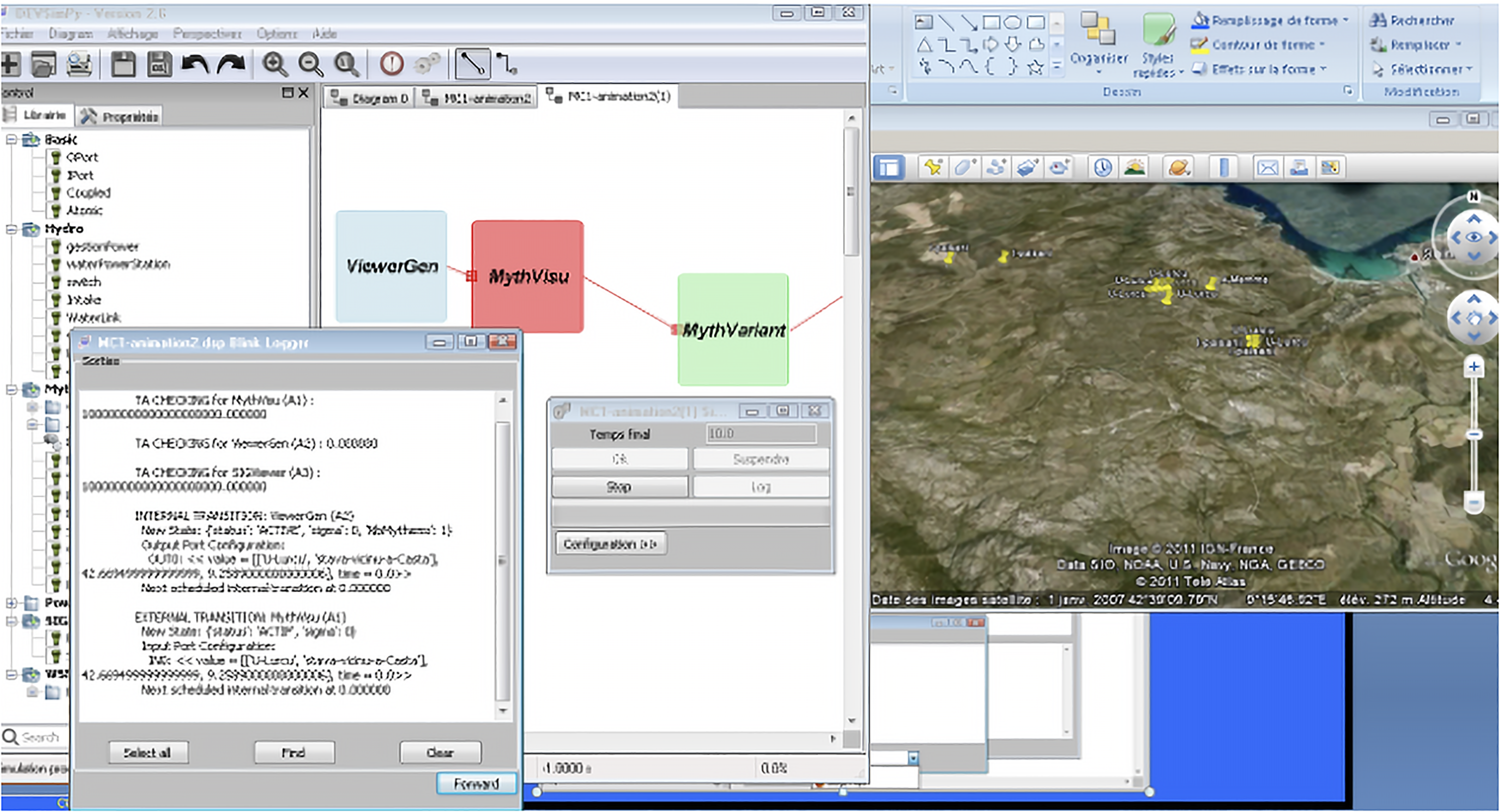
Step-to-step simulation of the generation of points on the map.
In this simulation, the time basis is not related to the historical time. The temporal aspects are only used in order to represent the progress of the narrative through the mythemes involved in the specified myth. These aspects depend either on the user who decide when a new mytheme should be seen on the map or on the way the apparition of the mythemes is ordered on the map, as described in the next section showing how the DEVS models library is validated.
Validation of the visualization of a given myth
In this section, we described how DEVS models of myth visualization are validated by considering an important myth belonging to Corsican oral literature. This myth, entitled

Map of the places of the myth called U Lurcu pointing to megaliths associated with the myth.
In Figure 12, we present the northwest view of one dolmen (Casa di Lurca) referred to in the narrative in direction of another dolmen (Casa di Lurcu).

Picture of the megalith of the myth (Casa di Lurcu) with view on a sacred mountain (Monte Ghjenuva) behind.
The 20 mythemes belonging to this myth given in Figure 13 are spelled in Corsican language and each mytheme is numerated.
The result of the simulation of the myth is presented in Figure 14. The screenshot describes the sequence of points that are automatically generated during the simulation process. All the mythemes are represented on the map and identified through a number pointing out the order of generation corresponding to the order of the mythemes in the narrative. By clicking on the information button of one of the generated point, the user may read the content of the mytheme as shown in Figure 14.
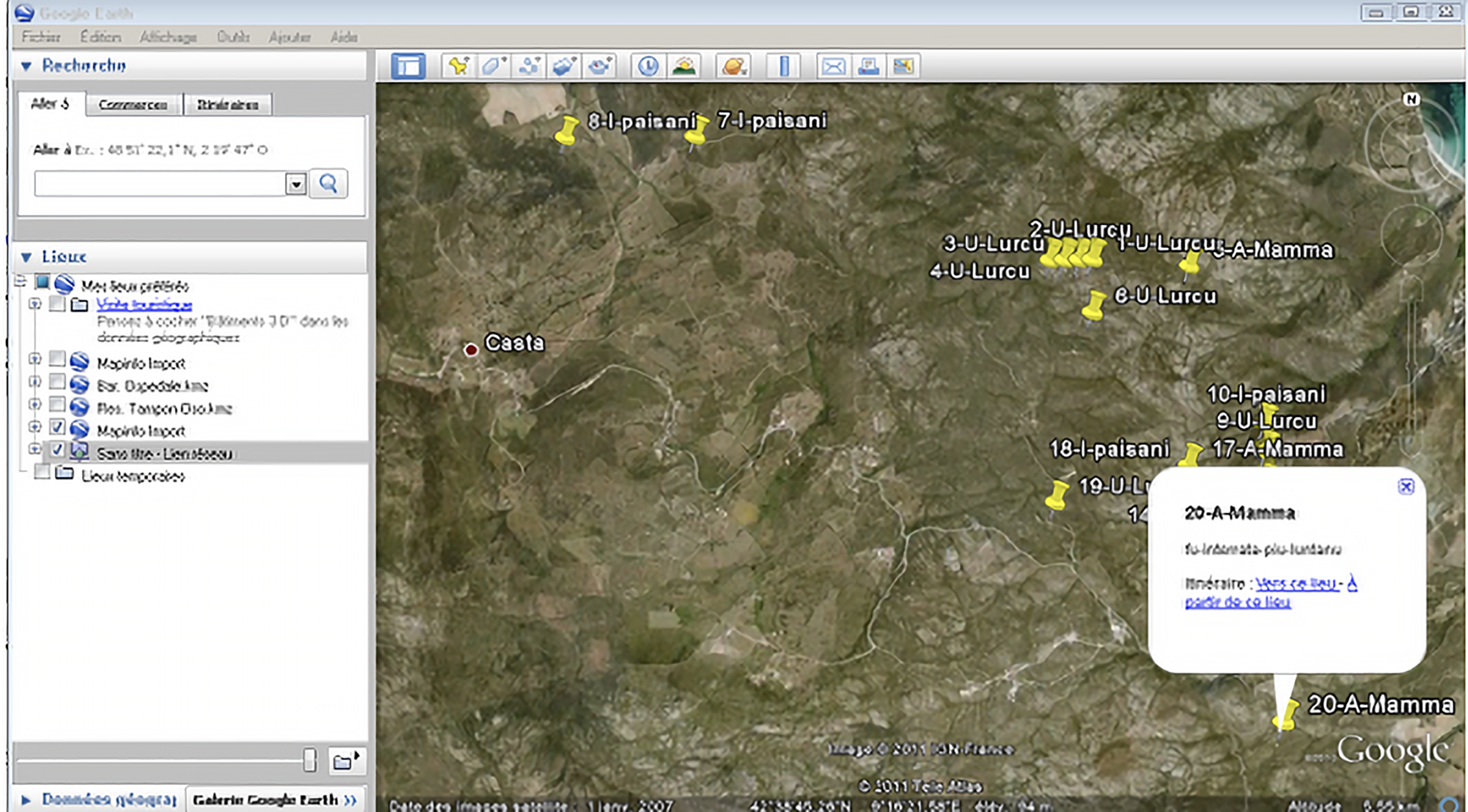
Screenshot of the result of generation on the map of the points involved in the folktale under test.
There are two ways of using the simulation: either selecting the step-to-step simulation or performing a complete simulation. In the first case, the user chooses the Blink plugin as described in subsection “Dynamic visualization” and is able to discover the unfolding of the myth interactively by clicking on the forward button. In the second case, the user owns the enumeration of the generated points on the map and is able to read the unfolding of the myth by clicking on the different points of the narrative one after the other. The main interest for an anthropologist is to be able to visualize how the narrative takes place in its natural environment. Linked to these specific locations, the myth evokes sacred places and ancestral experiences in the considered territory. The dynamic visualization of the myth on a map is aimed at showing how myth and territory are linked together through the unfolding of the narrative.
Arguably, the interest of performing a computational simulation and visualization of myth transformations on a map lies in the potential to extend the modeling and simulation software approach to the anthropological investigations of contemporary issues in the social and political domain.
Future applications and extensions
Lévi-Strauss’s combinatorial analysis of morphogenetic and morphodynamic transformations make it possible to attempt once again a new syncretism, encompassing structural methodology, mathematics, computer science, information theory, cybernetics, cognition, and reasoning. It is indeed possible to show that structural anthropology may innovatively account both for the dynamic process of
While the key categories that Lévi-Strauss developed are embodied in the anthropological objects he studied (myths and mythical networks), they have the potential to be productively and critically applied to other domains if radically tweaked. It could be argued that some aspects of Lévi-Strauss’s theory could be advanced as a new workable methodology to help us build innovative anthropological approaches to agency and politics. This does not mean that we should be looking for what the “myths” would be that one could study contemporary political issues, but proposing to apply to instrumental politics the same method as that used by Lévi-Strauss for the structural study of myth.
In particular, the requirement of an operating condition that in the study of myth is expressed as a boundary condition in mathematical sense can be thought to anticipate the discursive activation of a particular cultural ideology acting as a hidden agency of identity politics. The idea is to develop a neo-structural model of canonical formalization based on discourse analysis and transformational morphodynamics, which may take lead from the abstract mathematical operations and the evolution rules of canonical transformations suggested by Lévi-Strauss for the structural study of myth, and which make it necessary to isolate an analytical device as a boundary condition for mathematical validation.
Based on this epistemological insight, it can be argued that we may establish a more sophisticated approach following structural procedures of transformational analysis and formalization. This means that we may be correct in asserting that from an empirical situation of social change, including social conflict, identity construction and ethnic identification, transcribed in a canonical way, we can in theory deduce the possibly hidden reality of an external boundary, borderland existence, or border-crossing movement. As we argued elsewhere, the concept of boundary condition could be expanded to account for the social morphodynamics of this reality, which would reveal itself in the form of a particular cultural ideology that might be discursively activated and amplified to act as a hidden agency of instrumental politics in actual sociocultural situations (see (Doja, 2018)).
Namely, a comparative analysis of transformations resulting from intercultural dynamics, especially in processes of identity construction and identity politics (Doja, 2014), could make it possible to convey such a conceptual extension. In particular, this is the case with morphodynamic analyses substantiated in actual instances of women's agency (Doja, 2008c), family structures and fertility rates (Doja, 2010b), mass rapes in ethnic conicts (Doja, 2019), transformational history from a religious movement into established religion (Doja, 2003), international representations in the European context (Abazi and Doja, 2016), or mytho-logics in international politics (Doja and Abazi, 2021). They all provide some illustrative examples of an instrumental agency of hidden politics, revealing the workings of the respective cultural ideologies of gender, familism, honor and blood, religious mystification, corporate identity, and strategic othering. The hidden reality so revealed is necessarily organized around a specific category of social hierarchy associated with the value of one identity element, human agency and social action, but having inverse propositional characteristics to that element, course of action and agency. To put it the other way around, the morphodynamic formalization of cultural activism may allow us to identify instrumental ideologies and to anticipate new social change and identity construction as a result of the mediating logical operation of a boundary condition within the same sociocultural systems or institutional frameworks. We may then become able to set off in their search and their appreciation.
We foresee a new research committed to reformulate Lévi-Strauss’s structural analysis in order to elaborate a neo-structural model of canonical formalization based on transformational morphodynamics. The aim is to conceptualize and measure recursively the structural dynamics and the recurrent patterns of current identity transformations in liberal democracies, especially in the US and EU contexts, where ethnic/racial divisions and migration challenges are becoming more acute than ever. The new approach is based on a complex research strategy, including the use of Bayesian inference for the construction of object-oriented sets of systemic numeric references to identity discursive practices and the use of DEVS formalism for their specification as discrete-event systems that form constructive and commutative groups with identity.
The expected results will be achieved through the implementation of collaborative work between social, political, communication and computer scientists. We plan to explore normatively and empirically how core values and identity transformations are justified in political, national, cultural, societal, ethnic-religious, or gender-based terms and how they affect liberal democracy and EU integration outcomes. In this perspective, the task of sociocultural anthropologists and political scientists will be to analyze discursive practices and their relationship to cultural communities in order to identify and explore the permutation of indexical terms and functional values within the identity field of discursive practices. The task of computer scientists will be to develop computational instruments for encoding discursive categories in indexical terms and functional values, develop clustering and agentive algorithms for detecting the permutations of indexical and functional series, apply object-oriented DEVS models for narrative transformations and refine logical-mathematical structural methodology for analysis and validation.
The new research strategy can boost anthropological investigations to draw predictions for the future, given that computational simulation allows taking into account a large amount of big data that are becoming increasingly available through connected objects and cloud dissemination. Stochastic aspects also seem important for predicting identity transformations, in particular DEVS Markov simulations that allow processing discrete-event models with a probabilistic dimension. In addition, visualization is becoming increasingly significant. As many of the big data available in the identity field derive meaning from their location within particular social networks, the visualization of their distribution on maps may facilitate analysis and investigation.
As we demonstrated in the case of the structural analysis of myths (Santucci et al., 2020), DEVS formalism is a powerful generative machine allowing the integration of concepts such as fuzzy logic, probabilities, machine learning, and maps manipulation. It is particularly operational for performing simulation and visualization processes that could be effectively extended to the anthropological investigation of identity transformations. The outcome of this extension can allow for a critical understanding of core values and identity transformations, which eventually may anticipate policy insights and provide a powerful decision-making instrument to be used by scholars and policy practitioners for identifying and following up the structural dynamics and the recurring patterns of identity transformations in the contemporary world.
Conclusions
We presented in this paper an approach to dynamically visualize the unfolding of a narrative. This approach is based on the concept of mytheme. Each folktale (or myth) is decomposed into a set of mythemes which are the basic elements of a given story. The proposed approach leans on an association of the DEVS formalism and the Google Earth API. We have detailed the set of DEVS models which has been defined in order to: (i) dynamically read a text file containing the story where each line of the file corresponds to a mytheme (ii) dynamically print on a map each mytheme using the Google Earth API. We presented how the DEVSimPy software environment has been used in order to implement the set of DEVS models required for processing the dynamic visualization of myths. We also described the validation of these DEVS models using a concrete folktale from Corsican oral literature. Our current work consists in developing and implementing DEVS concepts for the propagation of messages through myths according to the different codes pointed out by Lévi-Strauss in his myth analysis. The work has been introduced as well as the interest and benefits of DEVS formalism is stressed for future application and extensions in anthropology.
Footnotes
Declaration of conflicting interests
The authors declared no potential conflicts of interest with respect to the research, authorship, and/or publication of this article.
Funding
The authors received no financial support for the research, authorship, and/or publication of this article.
