




Abstract
This article presents a conceptual and methodological framework to study heritage-based tribalism in Big Data ecologies by combining approaches from the humanities, social and computing sciences. We use such a framework to examine how ideas of human origin and ancestry are deployed on Twitter for purposes of antagonistic ‘othering’. Our goal is to equip researchers with theory and analytical tools for investigating divisive online uses of the past in today’s networked societies. In particular, we apply notions of heritage, othering and neo-tribalism, and both data-intensive and qualitative methods to the case of people’s engagements with the news of Cheddar Man’s DNA on Twitter. We show that heritage-based tribalism in Big Data ecologies is uniquely shaped as an assemblage by the coalescing of different forms of antagonistic othering. Those that co-occur most frequently are the ones that draw on ‘Views on Race’, ‘Trust in Experts’ and ‘Political Leaning’. The framings of the news that were most influential in triggering heritage-based tribalism were introduced by both right- and left-leaning newspaper outlets and by activist websites. We conclude that heritage-themed communications that rely on provocative narratives on social media tend to be labelled as political and not to be conducive to positive change in people’s attitudes towards issues such as racism.
This article is a part of special theme on Heritage in a World of Big Data. To see a full list of all articles in this special theme, please click here: https://journals.sagepub.com/page/bds/collections/heritageinworldbigdata
Introduction
In this article, we present a conceptual and methodological framework for studying heritage-based tribalism in Big Data ecologies by combining approaches from the humanities, social and computing sciences. We use such a framework to examine how ideas of human origin and ancestry are deployed on Twitter for purposes of antagonistic ‘othering’. Our goal is to equip researchers in heritage, archaeology, history, sociology, anthropology and digital humanities with robust theory and analytical methods for investigating divisive online uses of the past in today’s networked societies. We also aim to build reflexivity within archaeology and heritage and propose ways of developing counter-narratives and counter-practices of tolerance and inclusivity. Our study adds an important contribution to interdisciplinary debates on ‘othering’ and ‘otherness’ from a digital heritage perspective informed by Big Data.
Archaeology and heritage have a long tradition of investigating the influence of individual and collective experiences of the past on identity construction (e.g. Lowenthal, 1985). Since 2016, however, studies on this topic seem to have increased in response to widespread manifestations of national-populist sentiment in Europe and the US as well as in other regions of the world (Brubaker, 2017: 1–2). Researchers have analysed how objects, places and practices from the past have been leveraged in order to antagonise specific groups in contemporary society (Bonacchi et al., 2018; De Cesari and Kaya, 2020). A few of these works have focused particularly on online platforms (Bonacchi et al., 2018; Farrell-Banks, 2020), acknowledging the important function that social media frequently have within populist and authoritarian projects (Fuchs, 2018b; Gerbaudo, 2018; Govil and Baishya, 2018: 67). Furthermore, debates held on the pages of key sector journals have questioned how archaeologists and heritage professionals should respond in situations where the past is evoked to exclude others (e.g. Blakey, 2020; Brophy, 2018; Gardner and Harrison, 2017; and the special issue edited by Sykes et al., 2019). A first group of scholars have advocated an activist role for researchers, inviting them to foreground the political relevance of their work (Gardner, 2017; Popa, 2019), while a second group have urged their colleagues to communicate more accurately. Commentary pieces have also reflected on whether archaeologists’ exploitation of topical themes and buzzwords through media-sexy narratives can exacerbate social divisions and extremism (Brophy, 2018). In relation to this, Bonacchi (2018) has emphasised the limited control that academics can exercise over the ultimate framing of their discoveries when these are disseminated by news media outlets; and Gardner (2018) has raised the issue of a possible tension between the increased availability of information online and growing distrust of archaeology and heritage experts. Finally, it has been argued that neoliberal agendas in higher education have created an environment where scholars may feel more compelled than ever to adopt sensationalist approaches to public engagement in order to obtain news coverage and visibility (Barclay and Brophy, 2020; González-Ruibal et al., 2018). In summary, published literature has stressed that the public communication and experience of archaeology today are affected by: neoliberal academies pushed to claim major social impact; the information deluge enabled by the Internet; the persistent influence of news media industries; and a supposed erosion of trust in academic expertise.
In this article, we study the relationships between these phenomena and the kinds of public ‘uses’ of the past that hinder social cohesion in Big Data ecologies. Here the term ‘ecologies’ refers to ecosystems of ‘distributed’ ‘practices and relations’ that underpin ‘big data’ (Ruppert, 2016: 19–20). We also leverage the notion of heritage-based tribalism and apply both data-intensive and qualitative methods to analyse the case of people’s engagements with the news of Cheddar Man’s ancient DNA on Twitter. Heritage is understood as any processes and outcomes of interacting with objects, places and practices from the past, and assigning cultural and social meanings to them in the present (Bonacchi and Krzyzanska, 2019; Harrison, 2013). Based on this premise, we define heritage-centred tribalism as the processes and outcomes of attributing meanings to the human past that work to create boundaries between ‘selves’ and ‘others’ with the aim of excluding certain outgroups. Although heritage-based tribalism may emerge in relation to various uses of the past – deep or recent – it is particularly visible when linked with myths of origins and ideas of ancestry. The Mesolithic individual called ‘Cheddar Man’, discovered in the UK, is one such myth and therefore constitutes an ideal example to investigate. Twitter is an important field site to examine heritage-based tribalism in Big Data ecologies for a number of reasons. First, it is one of the social media preferred by archaeology and heritage academics in the UK to make announcements and disseminate their findings, either directly or by re-distributing content published on other online platforms (e.g. news websites and aggregators, blogs and academic journals or repositories; see Ke et al., 2017; Richardson, 2012, 2015). Second, Twitter is used by 16.65 million users – or 25% of the population – in the UK to access or exchange information (Ke et al., 2017; Statista, 2020). In the next two sections, we introduce the Cheddar Man controversy and our proposed theoretical framework, building on notions of heritage, othering and neo-tribalism. Subsequently, we present the methodology designed to analyse a corpus of 201,458 unique tweets that contain the terms ‘Cheddarman’ or ‘Cheddar Man’ and were collected from 7 February 2018 to 28 March 2018. This corpus was analysed with a view to answering two specific questions: (RQ1) How was the news about Cheddar Man’s ancient DNA deployed on Twitter to draw exclusionary boundaries between ‘selves’ and ‘others’? (RQ2) Which framings of the news on Twitter were most influential in shaping these boundaries and whose framings were these?
Cheddar man: From ancient DNA analysis to origin myth
‘Cheddar Man’ is the name that was given to the nearly complete skeleton of a man who suffered a violent death nearly 10,000 years ago and was found at the beginning of the 20th century in Cheddar Gorge, UK. In 2018, a team of researchers from the Natural History Museum and University College London extracted and analysed nuclear DNA from his temporal bone. The findings informed a reconstruction of the face of Cheddar Man that featured in the Channel 4 documentary ‘First Brit: Secrets of the 10,000 Year Old Man’, first shown on 18 February 2018. This work and its outcomes were announced to the press on 7 February 2018 (UCL News, 2018). The news of the research on Cheddar Man’s ancient DNA gained high visibility very rapidly and the story was covered by an array of news outlets, experts and activists through their websites and social media accounts. The UCL press release, entitled ‘Face of first Brit revealed’, stated that ‘the face of “Cheddar Man”, Britain’s oldest nearly complete skeleton at 10,000 years old’ was ‘revealed for the first time and with unprecedented accuracy’ (UCL News, 2018). The ‘results [of the analysis]’ – the press release continued – ‘indicated that Cheddar Man had blue eyes, dark coloured curly hair and “dark to black” skin pigmentation’, whereas previously, ‘many assumed that he had reduced skin pigmentation’ (UCL News, 2018).
The primary focus of the press release was on the physical characteristics of Cheddar Man. Concentrating on the outcome of the genome studies concerning Cheddar Man’s facial traits allows denouncing the socially constructed nature of ideas of race. However, it is worth noting that Britishness is also a modern construct and yet the press release referred to Cheddar Man as the ‘first Brit’ (Frieman and Hofmann, 2019). This reference might have not been helpful especially if we consider that, in Europe and North America, the idea that DNA analysis can inform about the ‘ancient origins’ of a living individual is not uncommon. Such a belief is increasingly widespread amongst the general public as a result of advertising pursued by companies selling DNA testing kits (Hingley et al., 2018; Richardson and Booth, 2017). Furthermore, some of the geographically dispersed communities that come together on social media to share the results of DNA testing (Stevens, 2015) seek self-legitimisation in terms of racial purity and openly support white nationalist agendas (Panofsky and Donovan, 2019; Stevens, 2015). Scully et al. (2013) have underlined that the problematic aspect of what they call ‘popular population genetics’ is that it refers to discrete peoples in the deep past, connecting them to discrete peoples in the present; this in turn feeds a fictitious and binary opposition between ‘natives’ and ‘incomers’. As effectively summarised by Thomas (2013), nobody is ‘pure’ and ‘a substantial proportion of human ancestry is common to all’, so claims of direct lineage with certain ‘peoples’, from Roman legions to Vikings, may be regarded as ‘genetic astrology’.
The press release only briefly mentioned that the genome of Cheddar Man had been sequenced together with several other Mesolithic-era individuals from Spain, Hungary and Luxembourg. To provide context for the deployment of the news of Cheddar Man’s DNA, however, it is important to note that the genome sequencing had been carried out within a wider research framework that shed new light on a long-debated topic in archaeology: the transition to farming, which, in Britain, occurred with a delay compared to continental Europe (Brace et al., 2018). Researchers had argued different positions regarding the extent to which migration, admixture with local populations or acculturation had contributed to this transition (Brace et al., 2018). Novel research on genome-wide data from six Mesolithic and 67 Neolithic individuals found in Britain – including Cheddar Man – helped to re-assess those stances (Brace et al., 2018). The findings were communicated in a pre-print of an article on ‘Population Replacement in Early Neolithic Britain’, which was released on 18 February 2018 and subsequently published in Nature Ecology & Evolution (Brace et al., 2018, 2019). The results showed ‘persistent genetic affinities between Mesolithic British and Western European hunter-gatherers’, and ‘genetic affinities with Iberian Neolithic individuals indicate[d] that British Neolithic people were mostly descended from Aegean farmers who followed the Mediterranean route of dispersal’ (Brace et al., 2019).
The public communication of news such as that of the ancient appearance of Cheddar Man and of the reasons behind the transition to farming is complex because it revolves around the potentially polarising themes of origin and ancestry. In addition, variable ideas of progress may be associated with the transition to farming, and migration into Britain had been debated very intensely in the public sphere before the referendum on the UK’s membership of the European Union (Share, 2018). It can therefore be very informative to investigate how the myth of origin and ancestry expressed by Cheddar Man was leveraged on Twitter and which framings of the news about his DNA influenced the emergence of heritage-based tribalism.
Heritage and neo-tribalism
In 1996, the sociologist Michel Maffesoli published The Time of the Tribes: the Decline of Individualism in Mass Society. There, the author argued that the ambience of the era, at the end of the 20th century, was characterised by a dynamic ‘shift and tension’ between increasing massification, on the one hand, and the surge of micro-groups – ‘affectual tribes’ – on the other (Maffesoli, 1996: 6, 72). Also core to Maffesoli’s theorisation is the taking over of myths on linear history. Myths serve as empty ‘containers’ that shape the aesthetic of the group, not least through the mediation of mass communication (Maffesoli, 1996: 11). Neo-tribes are portrayed as fluid and connotated by ‘occasional gathering and dispersal’, a definition that also suits Big Data ecologies. People come together to discuss shared topics of interest – including their ancestry – through hashtags on Twitter, by posting to public Facebook pages, or via ad hoc platforms set up by DNA testing companies. In a similar way, Zygmunt Bauman (2007, 2017) has considered the re-appearance of tribes as marking the passage to a ‘liquid’ phase of modernity that displays qualities of heightened uncertainty and mobility. These features result, in Bauman’s analysis, from several new turns that have characterised what he has reductively referred to as the ‘“developed” part of the planet’ (Bauman, 2007: 1). Such shifts include a disconnect between power and politics, globalisation, the dissolution of material boundaries in the more interconnected and neoliberal society and an idea of progress that has come to signify the threat of continuous change and restlessness (Bauman, 2007). Like Maffesoli, Bauman has stressed that people’s restorative handling of a mythical past plays a demiurgic role in the emergence of neo-tribalism (2017). The latter is presented as a form of resistance to neoliberalism and globalisation, which are viewed as forces that dissolve physical boundaries and disorientate the individual (Bauman, 2017). As the future is uncertain, utopias cease to provide alleviation and human beings prefer to find refuge in idealised pasts that can be known, manipulated, and controlled and which thus represent safer places to which to escape. Partly building on these seminal works, other social scientists have empirically studied the links between globalisation, nationalism and neo-tribalism (James, 2006) as well as their relationships with social networking sites and Big Data. Recently, for example, North et al. (2019) have investigated Twitter discussions about Brexit, noting that ‘the digital age has exacerbated political tribalism’ due to the ‘network effect of homophily’, which facilitates the polarisation of users (Bakshy et al., 2015: 1130; North et al., 2019: 27; Yardi and Boyd, 2010).
Although it may be argued that conflict and tribalism are intrinsically human (Clark et al., 2019), the neo-tribe is a useful heuristic to examine how heritage is used to activate exclusionary identities on social media. People have found solace and legitimisation through the past for centuries (Lowenthal, 1985). However, on the one hand, such a process is acutely triggered today by the erasure of security and materiality at the global scale described by Bauman (2007, 2017). On the other hand, calling upon retrotopias can now occur in faster-paced and hyper-visible ways in ecologies where high volumes of commercially controlled, rapidly moving and ever-changing data are produced. Furthermore, we have already highlighted how public communications of the past can be influenced by neoliberal agendas, the relationalities between social media and ‘traditional’ news media industries and the frictions between information availability and expertise. These are the distinctive characters of heritage-based tribalism in Big Data ecologies that we will explore in our analysis. Importantly, we will not define ‘tribes’ a priori, but conceive of them as constructed, drawing on social anthropology approaches derived from the Barthian ‘school’ of otherness (Barth, 1969). Barth (1969) describes ‘othering’ as the process of drawing boundaries between ‘self’ and ‘other’. The outcome of ‘othering’ is ‘otherness’, or ideas of the other. In our study, we conceptualise tribes as negatively connotated otherness. Tribes are generated from antagonistic forms of othering that are assessed via the Big Data associated with social media practices. Our analysis shows how tribes emerge from the mobilisation of specific cultural and social meanings assigned to Cheddar Man on Twitter.
Methodology
Over the period from 7 February to 28 March 2018, we collected 201,458 unique tweets containing the keyword ‘Cheddarman’ or ‘Cheddar Man’ via the public Twitter streaming API. The API returns a sample consisting of 1% of the total volume of public tweets at any given moment. We also extracted an additional 2,414 tweets which were retweeted or retweeted as quote tweets while the data collection was in progress, but which were either created before the streaming commenced or missed due to interruptions in the connection. These interruptions are a common issue in studies relying on Twitter data streaming. They were detected automatically and handled with the immediate attempt at reconnection and the resumption of data collection; to do this, we developed an approach that can be implemented with limited computational resources and deployed at short notice. Given the brief and infrequent occurrence of the interruptions, it is unlikely that the number of tweets missed was large enough to impact on the results of the aggregate analysis. Furthermore, since the breaks in the connection were random and the data was collected in real time, it is also improbable that the missing tweets were biased towards a specific type of content. All usernames, handles and tweet IDs were anonymised by replacing each of them with a unique random number. Thereafter, we adopted a suite of quantitative and qualitative methods to answer our research questions. Our approach can be applied again in future to any corpus of Big Data in order to assess heritage-based tribalism on social media. The workflows followed for data collection and analysis were implemented in R, Python and Mongo Database and are available from GitHub. 1
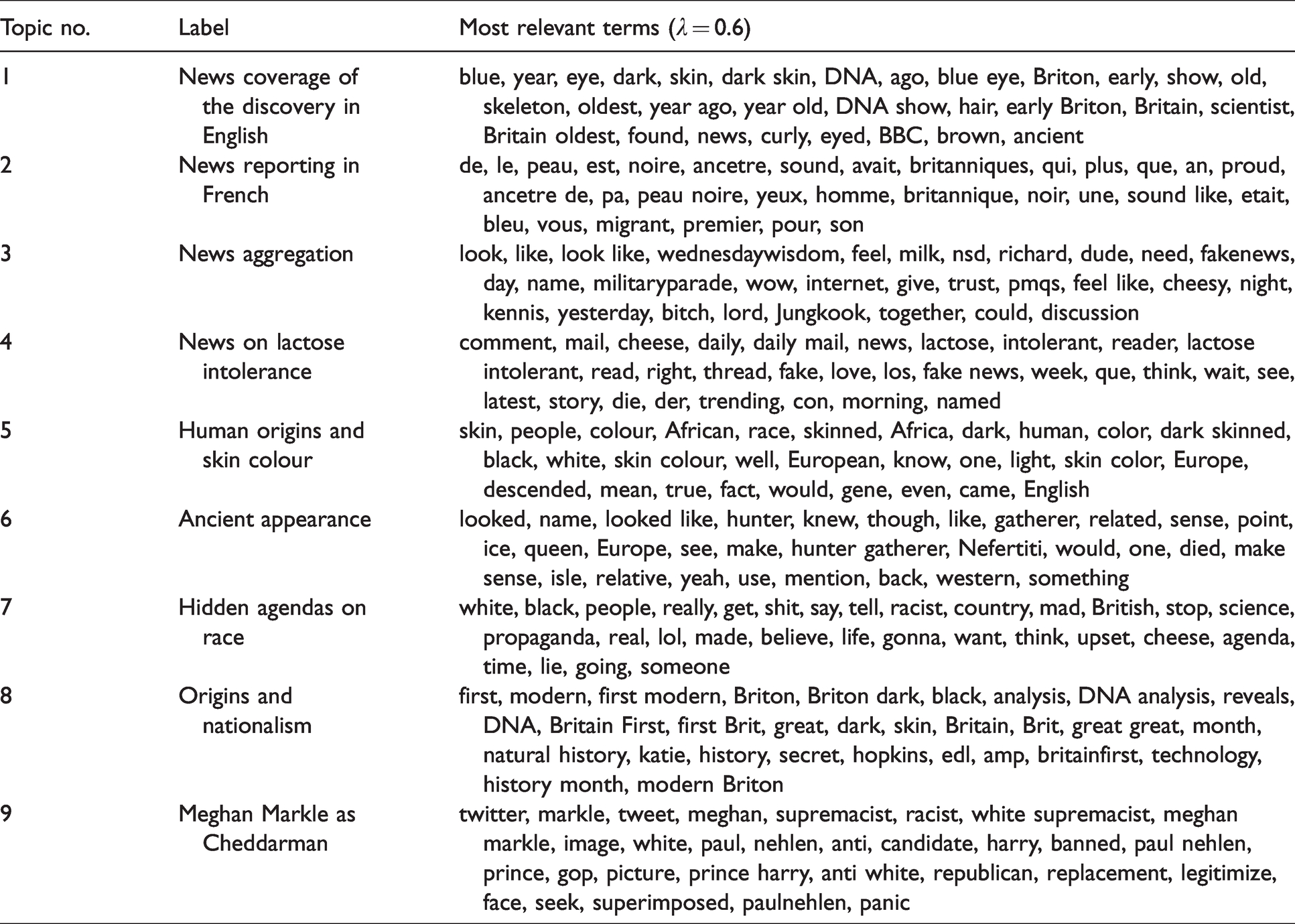
RQ1 asked: how was the news about Cheddar Man’s ancient DNA deployed on Twitter to draw exclusionary boundaries between ‘selves’ and ‘others’? To provide an answer, we first leveraged topic modelling to identify the key cultural and social meanings associated with the news of Cheddar Man’s DNA on Twitter. We constructed the models using Latent Dirichlet Allocation (LDA), a popular algorithm that has been successfully applied to map the content of big and unstructured textual data across disciplines ranging from software engineering to linguistics and political science (Jelodar et al., 2019). LDA is a generative probabilistic model; it assumes that the documents in a corpus are represented by random mixtures of topics and each document is therefore modelled as a probability distribution over a set of topics (Jelodar et al., 2019). A topic is, in turn, defined as a probability distribution over the terms observed in the set of documents, so topics are represented by term probabilities (Jelodar et al., 2019) (see Table 1). We implemented LDA on the whole corpus of tweets in the Python library gensim (Hoffman et al., 2010). Each tweet was treated as a document. Since LDA requires the number of topics n to be pre-defined, we initially constructed 28 models with n ranging from 2 to 29 and used the measure of coherence (CV) to select the best model (Röder et al., 2015). The coherence score (CV) measures the degree of semantic similarity between highest probability words for each topic and ranges between 0 and 1, with higher scores indicating higher similarity and therefore resulting in topics that are easier to interpret (Röder et al., 2015). We selected the model with nine topics, since it was the one with the highest coherence score. We then used LDAvis to aid with the interpretation of the topics (Supplementary Material 1). 2 LDAvis is a topic visualisation method that shows the relative prevalence of topics in a corpus, the semantic distance between them and the most relevant terms for each topic (Sievert and Shirley, 2014). The relevance of each term, in LDAvis, is the weighted average of the log probability of the term under the topic and the log ratio of the term’s probability under the topic to its marginal probability in the entire corpus. We set the weight (λ) of the log probability of the term under topic to 0.6, the optimal value for the interpretation of topics determined by Sievert and Shirley (2014). Applying a method that had been successfully used previously (Bonacchi et al., 2018), each author independently assigned a label to every topic. Each label was subsequently discussed with a view to confirming the one that best synthesised the theme described by the joint presence of the 30 most relevant terms in a given topic. Attention was paid not to over-focus on any subset of those 30 terms.
Most relevant terms for each topic.
Thereafter, we analysed the exclusionary boundaries drawn between ‘selves’ and ‘others’. We first determined the most prevalent topic in each tweet (henceforth, ‘dominant topic’), based on the probability distribution of terms in the tweet over topics. Some topics covered descriptive reporting of the news, whereas others expressed the attribution of cultural and social meanings to the discovery. We focused on this second group and, for each dominant topic, we identified the ‘most interacted with tweets’: tweets that received at least 50 interactions as a result of being retweeted, retweeted as quote tweets, or replied to. Every outgroup that was antagonistically mentioned by the authors of the ‘most interacted with’ tweets in terms of ‘them’ (opposed to ‘us’) was regarded as a tribe. For each tribe, we extrapolated the identity boundary marker (key quality) based on which the outgroup was antagonised. Subsequently, the exact terms used by Twitter users to define tribes were located in the entire corpus of tweets and this allowed mapping the boundary markers associated with those terms. Finally, we calculated the frequency of co-occurrence between each pair of boundary markers within tweets by the same users to construct a feature co-occurrence matrix (FCM). We plotted the FCM as a semantic network (Benoit et al., 2018), in which the width of the edges is proportional to the frequency of boundary markers (features) co-occurrence; the default minimum proportion of 0.5 was used for the co-occurrence frequencies of features.
Having established the cultural and social meanings assigned to news stories about Cheddar Man’s DNA and how these were deployed to generate tribes, we turned to the second research question: which framings of the news on Twitter were most influential in activating exclusionary boundaries between ‘selves’ and ‘others’ and whose framings were these? We addressed this question by plotting the daily frequencies of tweets for each topic. Each tweet counted only for the topic found to be dominant in that tweet. This allowed us to understand on what days topics expressing the attribution of cultural and social meanings to the discovery reached a peak. We then identified the web links that were shared the most on those days, as a result of featuring in a tweet, a retweet, a retweet as quote tweet or a reply; we excluded, however, links pointing to the Twitter profiles or personal webpages of private individuals. The content of linked webpages was analysed qualitatively to isolate the frames that were used to draw exclusionary boundary markers. These frames were then compared with those that appeared in the ‘most interacted with tweets’ to determine which ones were most influential in triggering the emergence of tribes. Here the term ‘frame’ refers specifically to interpretative lenses recognisable by ‘patterns in the use of certain words, phrases, images, and sources of information’ (Carver et al., 2013: 9; Uren and Dadzie, 2015).
Finally, the authorship of influential frames contained in the ‘most interacted with tweets’ and in the webpages that had been analysed was assessed and compared.
News deployment and the emergence of tribes
The nine topic models were first examined in order to uncover the hidden thematic structures of the corpus of tweets (Table 1 and Supplementary material 1). Two main types of leveraging of the news about Cheddar Man were evidenced. The first type was descriptive and comprised a first sub-type focusing on news reporting specifically (Topics 1, 2, 3 and 4). Topic 1, in particular, was concerned with media reporting of the discovery of Cheddar Man’s appearance in English, in terms that were very close to those used in the original press release; Topic 2 concentrated on reporting in French. It should be noted that, while skin colour appeared in all nine topics, ‘eye’ and ‘blue eye’ featured exclusively amongst the terms that are most relevant to Topics 1 and 2. This indicates that eye-related characteristics were not selected as elements of interest as much as skin colour. Similarly, the word ‘curly’, used to describe Cheddar Man’s hair in the press release, is amongst the most relevant terms only in Topic 1. Topic 3 was labelled ‘news aggregation’, due to the high relevance to this topic of very diverse hashtags (‘wednesdaywisdom’, ‘militaryparade’, ‘pmqa’, ‘jungkook’). Topic 4 dealt with Daily Mail reporting on the dangers of lactose intolerance for humans, a theme linked to the information that Cheddar Man was affected by this condition, as stated in the university press release. Topics 5 and 6 pertained to the second sub-type of news deployment because, despite being descriptive, they concentrated on a particular aspect of the original news coverage: skin colour and its relation to human evolution. Topic 5 addressed skin colour – ‘light’ and ‘white’ to ‘dark’ and ‘black’ – with reference to ideas of diachronic change and descent (terms: ‘came’, ‘descended’). Topic 6 covered ancient human appearance using terms such as ‘looked’, ‘looked like’, ‘ancestor’, ‘hunter-gatherer’ and ‘Nefertiti’.
The second type of mobilisation of the news of Cheddar Man’s DNA is represented by Topics 7, 8 and 9, which connected past and present by attaching contemporary meanings to the scientific discovery (Table 1 and Supplementary material 1). We will focus on these topics in order to detect heritage-based tribalism. Topic 7 covered hidden agendas on race with terms such as ‘agenda(s)’ and ‘propaganda’ being more relevant to this than any other topic. Topic 8 related to the entanglements of human origins, DNA analysis and national populism. Most relevant terms such as ‘first modern’ and ‘first brit’, which are more specific to this topic than to any other, feature together with DNA related terms (‘dna’, ‘dna analysis’, etc.) and terms such as the political organisations ‘britain first’, ‘edl’ (English Defence League) and the commentator ‘katie’ ‘hopkins’. Hopkins has been often described as ‘far-right’ for her strong right-wing opinions and was permanently suspended from Twitter in June 2020 for ‘violations of our [Twitter’s] hateful conduct policy’ (Slawson and Waterson, 2020). The English Defence League is an Islamophobic socio-political movement that emerged in 2009 in Britain and portrays ‘Islam as the other’ (Allen, 2011). Britain First presents itself as a ‘a movement of British Unionism’, of ‘patriotism, nationalism, conservatism and traditionalism’ (Britain First, 2021a, 2021b). If we consider only the most salient terms (λ = 0), ‘bnp’ also features. The British National Party (BNP) specifically states identity is ‘the smartest recruitment-driven literature in your arsenal’ and stresses that ‘now more than ever before, we need to prioritise, preserve and protect our unique and precious British identity’ (BNP, 2020). These three entities express facets of what Fuchs (2018a) has defined as the nationalistic drawing of exclusionary boundaries to defend the privileges of ingroups and protect ‘our country’, ‘our economy’ and ‘our ways of life’. Finally, Topic 9 was distinctively centred on the comparison between the appearance of Meghan Markle and that of Cheddar Man, made by the (then) Republican US congressional contender Paul Nehlen. We note that terms that are most relevant to this topic include ‘supremacist’, ‘white supremacist’ and ‘racist’ as well as ‘anti-white’. This suggests two opposite uses of the comparison.
Through close reading, we identified the negatively connotated outgroups mentioned in those tweets that had Topics 7, 8 or 9 as a dominant topic and with which people had most interacted (see section ‘Methodology’). Thereafter, we extrapolated the nine identity boundary markers, or key qualities, based on which these outgroups were excluded (Table 2). It is important to stress that the same boundary marker could be played out in opposite ways. For example, ‘Newspaper Readership’ was used to antagonise readers of The Sun and Daily Mail by some Twitter users, but also readers of The Guardian by other users. ‘Views on Race’ delimited tribes framed as ‘white supremacists’, ‘keep Britain white’ activists, ‘white genocide nerds’, ‘white nationalists’ and ‘pro-white’ people, etc.; however, they also defined tribes qualified negatively as ‘anti-white racists’, ‘non-white Britain’ and ‘blacks’. ‘Political Leaning’ was a boundary marker activated to attack and exclude ‘far-right’ individuals, ‘UKIP members’, ‘Britain First people’ and ‘magats’ (term used to refer to Make America Great Again Trump supporters). On the opposite side, ‘Political Leaning’ demarcated tribes such as ‘leftist’, ‘left-liberalists’, ‘Twitter left’, ‘Marxists’ and ‘demented left’. Other exclusionary boundary markers worked in a more one-sided way. ‘Trust in Experts’, for instance, was leveraged primarily to antagonise ‘mainstream media’ and scientists by calling them ‘nonces’ or ‘politically motivated junk science’. ‘Anti-Semitism’ was also mostly played out to frame negative ideas of others as ‘Jewish experts’ or ‘Jewish researchers’. Similarly, ‘Values’ along the liberal to conservative spectrum were leveraged to call out tribes opposing the ‘gender pay gap’, ‘accept[ing] science on climate change’ as well as ‘vegan male feminist[s]’, and ‘bisexuals’. Ideas on the relationship between the UK and the European Union (‘UK-EU Position’) were mobilised to antagonise tribes of both ‘Brexiteers’ and ‘pro-EU’ advocates. The boundary marker of attitudes towards ‘Mobility’ was deployed to exclude those in favour of ‘mass-immigration’ and ‘open borders’, together with ‘3rd world immigrants’. Finally, ‘Nazis’ were also attacked and antagonised along a boundary marker that we labelled ‘Neo-nazism’.
Exclusionary boundary markers used to antagonise specific outgroups, or tribes.

Some of these markers have a direct connection with aspects of the discovery that was reported – for example in the case of mobility or race – but most do not. This latter group stemmed from values attached to the original framing of the discovery by Twitter users. In some cases, users crafted more than one kind of antagonistic otherness and the exclusionary boundary markers that most frequently co-occurred were ‘Racial Views’, ‘Trust in Experts’ and ‘Political Leaning’ (Figure 1). This finding suggests that racial views are not easily transformed via expert communications, because such interventions are challenged by the same people who exclude ‘others’ on racial grounds. Additionally, and crucially, ‘Trust in Experts’ frequently co-occurred with all other boundary markers with the exception of ‘Neo-Nazism’, even though it co-occurred more often with anti-semitism, and with views on race and on the UK’s membership of the European Union (Figure 1). This shows that, whatever the outgroups people antagonised in the context of our case study, they often also antagonised experts.
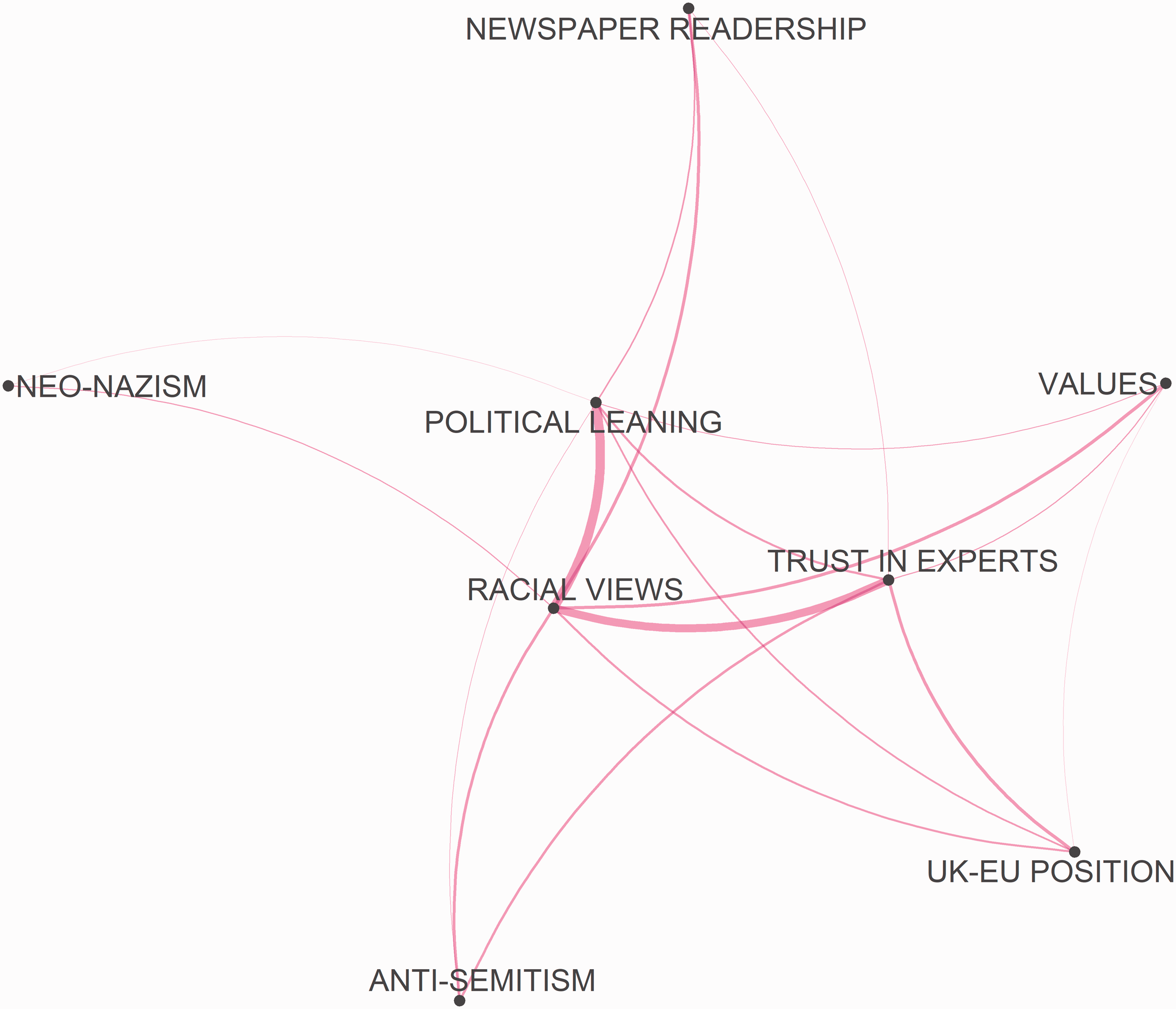
Co-occurrence of exclusionary boundary markers within tweets by the same users. Each node represents an exclusionary boundary marker.
In some of the tweets where exclusionary markers were activated, the discovery of Cheddar Man was presented as a retrotopia: a safe and controllable past that provides security from present-day events and situations that are perceived as undesirable (Bauman, 2017). However, other Twitter users framed Cheddar Man as the opposite of a retrotopia: an imagined past that is feared and rejected, and which we propose to call ‘retrofobia’. Retrofobias portrayed Cheddar Man as a politically correct stunt, a fraud, bullshit, a tool, a revelation, a foundation myth, a deliberate attack, a perversion, war, politically motivated science, a psy-op, the legitimisation of a take-over and nonsense. These frames express a sense of deceit and the perception of a manipulative intent that is seen as politically motivated and perpetrated by a conspiracy of media institutions and scientists in order to promote specific agendas. The latter included: multiculturalism and immigration, erasure of identity, anti-white agendas, mass-migration, undermining of White man’s continued existence, hate against white people, ethnic cleansing of Europeans, and uncontrolled migration. If retrofobias were framed as suffering from an attack, a number of retrotopias were crafted through the language of taking aggressive action. There are cases, for example, where Cheddar Man was described as a way to annoy white supremacists, something that will make racists cry out in terror, or their heads explode and their blood pressure boil up, while supremacists and nationalists are getting mad and will gnash their teeth or eat their hearts. For this group of people, Cheddar Man represented a welcome myth of origin, but was nevertheless leveraged in exclusionary ways. Of the 90 tweets that contained mentions of tribes, 71 had authors whose profile descriptions could be analysed. In this way, it was possible to establish that the majority of those engaged in tribalism were activists (35), whereas 5 authors were academic or heritage professionals, 15 were media personalities or media websites, 3 were politicians and 11 were other private users who do not fall in any of the previous categories. ‘Activists’, in this context, are any Twitter users who defined themselves as such or mentioned political, social or environmental causes in their profile descriptions.
Influential framings in triggering exclusionary boundary markers
To understand the kinds of framing of the news that were influential in triggering antagonistic processes of othering, we qualitatively analysed the web links that were shared the most on days when heritage-focused topics peaked. We will now discuss those links that are most distinctive of each peak and draw on additional telling examples that can help to shed light on the emergence of heritage-based tribalism. The majority of tweets across all topics dated to the first two days following the release of the news by the Twitter profile of the Associated Free Press (AFP) on 7 February 2018 (Figure 2). In this time span, however, tweets concerned with descriptive reporting were more numerous and most of the web links that were shared consisted of media webpages. The latter comprised online articles published by AFP, The Guardian, the BBC, The Independent and Al Jazeera (Table 3). The AFP piece ‘DNA shows first modern Briton had dark skin, blue eyes’ was shared more times than any other web item (Table 3, no. 3A, 3C). The article mirrors quite closely the content of the university press release, but also includes a quote from one of the two professionals who built the model of Cheddar Man’s face; his words emphasised the contemporary relevance of the ancient DNA study that had been undertaken and linked the results to ideas of present-day mobility and identity:

Daily number of tweets per topic over time.
Ten most frequently shared web links on 7 February 2018.

‘It’s a story all about migrations throughout history’, he told Channel 4 in a documentary aired on 18 February. ‘It may be gets rid of the idea that you have to look a certain way to be from somewhere. We are all immigrants’, he added.
The second web link that was shared the most between 7 and 9 February was an article published in The Guardian on 7 February 2018 (Table 3, no. 3B). Like the AFP piece, this news item presented the discovery in terms that were not dissimilar to the UCL press release, with additional emphasis placed on the current significance of the study findings: ‘people of white British ancestry alive today are descendants of this population’; and ‘it really shows up that these imaginary racial categories that we have are really very modern constructions, or very recent constructions, that really are not applicable to the past at all’ (reported as a quote by one of the researchers involved in the study). References were also included to Cheddar Man’s ‘hunter-gather lifestyle’ and to the broader context of migration and transition to farming that the ancient DNA research had helped to re-assess. The fourth most shared web item was the video ‘Cheddar Man: DNA shows early Brit had dark skin’, tweeted by the BBC (Table 3, no. 3D). As others have noted before, the most controversial aspect of this coverage was perhaps the reference to Cheddar Man as ‘the first Brit’. Britishness is a modern creation just like race. Yet the former was promoted through the title of the article in order to condemn the imaginary nature of the latter. This decision was perceived as political and contributed to the activation of boundary markers relating to mobility and views on race. Antagonistic othering based on political leaning was, however, triggered by more belligerent framings of the news story, authored by news media who released communications that were somewhat removed from the content of the original press release. Amongst these was the indi100 article ‘Some people can’t handle the fact that the earliest man in Britain had dark skin’ (Table 3, no. 3E), which briefly reported that ‘With depressing predictably [sic], trolls came crawling out of the woodwork in an anti-science frenzy’. This example shows how news media highlighted the tribalism that had emerged on Twitter up to that point and exacerbated it. Finally, articles published in The Independent on 7 and 8 February 2019 were responsible for some of the most emotionally charged and negative characterisation of ‘others’ (they are not listed in Table 3 because they were not amongst the ten most shared web items). These articles comprise: ‘The discovery of Cheddar Man means that when Ukip gets into power, they’ll now deport all white people’ (shared 19 times on 8 February and 73 times between 9 and 25 February); ‘After the discovery of Cheddar Man, white supremacists should eat their hearts out’ (shared 59 times on 7 February and 9 times the following day); and ‘Cheddar Man seems like the punchline to a very long joke about our obsession with racial identity’ (shared 23 times on 7 February and 15 times between 8 and 11 February). These results show that outputs by more left-leaning press outlets contributed significantly to fuelling tribalism.
Returning to the patterns shown in Figure 2, at the end of the first two days following the release of the news by AFP, we register a fall both in the total number of tweets and in the frequency of tweets across all topics, with the exception of Topics 2 and 3 relating, respectively, to ‘News Coverage in French’ and ‘News Aggregation’. From this point onwards, we will focus on Topics 7 (‘Hidden agendas on race’), 8 (‘Origins and nationalism’) and 9 (‘Meghan Markle as Cheddarman’), where links between past and present were established. The number of tweets for Topic 8 tended to be much lower than for Topics 7 and 9, but all three topics peaked to different extents between 18 and 19 February and on 23 February; Topic 7 also peaked on 3 March. The peak between 18 and 19 February was the most heavily ‘pushed’ by scientists’ communications, either directly or through their featuring in Channel 4 videos. The two types of web links that were shared the most on 19 February were broadcast video content (68 times; Table 4, no. 4B) and an academic publication (84 times; Table 4, no. 4A). The latter was a manuscript on ‘Population Replacement in Early Neolithic Britain’ that was published as a pre-print in bioRxiv (Brace et al., 2018; Table 4, no. 4A; see also section ‘Cheddar Man: from ancient DNA analysis to origin myth’). Another web item that was linked in a high volume of tweets was a micro-blog where Channel 4 News shared a video publicising the Channel 4 documentary on Cheddar Man that was released the same day (Table 4, no. 4B). A quote from a geneticist involved in the research was used to caption the video where she also featured: ‘Skin colour is a bad marker for ethnicity – there is no one way a British person looks’. A direct response to this video, the post ‘Cheddar Man: Channel 4 attacks British identity’ (Table 4, no. 4C), was published on the Defend Europa website, an activist, volunteer-run platform that claims commitment to ‘spreading information about the current state of Europe that the mainstream media refuses to publish’. In their ‘About us’ page Defend Europa declare their concerns for the ‘migrant crisis’, and vow to speak on issues such as the European Union and globalisation, and to promote and support nationalist movements. The piece argued in favour of being ‘ethnically British’; it rejected the content of the Channel 4 video as reducing the idea of ‘Britishness’ to something that can be ‘skin deep’, while at the same time making the contradictory point that: ‘Just as many have predicted already, Cheddar Man’s suspected dark skin has been weaponized in order to attack the concept of whiteness’.
Links that were shared over ten times on peak days.

a4F and 4G are two distinct tweets. The Twitter profile of the New Scientist tweeted the same content twice.
The second peak, on 23 February, followed the New Scientist publication ‘Ancient “dark-skinned” Briton Cheddar Man find may not be true’, which stated: ‘one of the geneticists who performed the research says the conclusion is less certain, and according to others we are not even close to knowing the skin colour of any ancient human’ (Table 4, no. 4E to 4G, 4K, 4M). The most shared online source after this item is Defend Europa’s post ‘Cheddar Man’ Theory Rebuffed: The TRUTH About Ancient Europeans’ (Table 4, no. 4I). The author/s of that text argued that ‘Cheddar Man has become the weapon of choice for the media to beat white Britons with’. They also referenced outgroups that featured in the tweets we examined – particularly the ‘lying media’ and ‘Jewish scientist[s]’. More generally, this second wave of tribalism was activated by the toning down of claims made in the first cycle of reporting and by both the media’s and the public’s difficulties of dealing with varying degrees of uncertainty in scientific research. Finally, the third peak, on 3 March, consisted in the tweeting of links to the Daily Mail response to the New Scientist article (Table 4, no. 4N).
Discussion
Our analysis aimed to examine heritage-based tribalism in Big Data ecologies through the example of the diffusion and interpretation of news about Cheddar Man’s ancient DNA on Twitter. The first research question asked how this news was deployed to draw exclusionary boundaries between ‘selves’ and ‘others’ that resulted in the creation of tribes. We showed that there were two main kinds of deployments. The first was largely descriptive and subdivided into two subtypes. Topics 1 (‘News coverage of the discovery in English’), 2 (‘News reporting in French’), 3 (‘News aggregation’) and 4 (‘News on lactose intolerance’) made up subtype 1. These topics were concerned with media coverage of the news, both in English and in French. They provided us with information about the media industry contexts that impacted on the leveraging of information about our case study. Subtype 2 consisted of Topics 5 (‘Human origins and skin colour’) and 6 (‘Ancient appearance’), which concentrated on just one theme among those that were touched upon in the media coverage: the relationship between skin colour and human evolution. In the second kind of deployment of the news (Topic 7 ‘Hidden agendas on race’; Topic 8 ‘Origins and nationalism’; and Topic 9 ‘Meghan Markle as Cheddarman’), Twitter users engaged in the creation of heritage by assigning cultural and social meanings to the finding of Cheddar Man’s skin colour and to long-term changes in human appearance. People interacting with the discovery on Twitter selected the aspects of the news that they valued as most relevant to their lives and the society of which they were part. ‘Valuing’ is used here as a neutral verb that can express either the welcoming or the rejection of Cheddar Man as a myth of origin and ancestry. More specifically, we found that the idea of Cheddar Man as having ‘dark’ to ‘black’ skin – was treated as a retrotopia by some, whereas it was feared and rebutted as a retrofobia by others. We also showed that whether Cheddar Man represented a retrotopia or a retrofobia depended on individual understanding of and attitudes towards race and various components of national populism (Brubaker, 2017: 1–2; Fuchs, 2018a).
The communication of the news triggered antagonistic forms of othering on a number of related levels beyond views on race and mobility. These included newspaper readership, political leaning, views on the UK–EU relationship, but also trust in experts, anti-semitism and neo-nazism. A tribal assemblage was created by Twitter users who often leveraged more than one exclusionary boundary marker at a time. The fact that a high number of the Twitter users involved in antagonistic othering presented themselves as activists in their user profiles suggests that tribes were often forged by people who already held strong beliefs regarding the political and social issues at stake. However, we argue that heritage-based tribalism emerged on Twitter rather than simply becoming more visible. It was in fact uniquely shaped by the coalescing of different forms of antagonistic othering. Assessing heritage-based tribalism in Big Data ecologies can help to develop a fuller understanding of the multiple and linked facets of intolerance, where tolerance is defined as a three-dimensional concept entailing ‘acceptance of, respect for and appreciation of diversity’ (Hjerm et al., 2019).
We have demonstrated that the nature of heritage-based tribalism is not mono- or bi-dimensional but articulated and assembled. As such, it can be better comprehended if we identify and study the words and framings of those who leverage information about the past to exclude others, rather than aprioristically searching for discrete and artificially predefined tribes. This leads us to discuss our second research question: which framings of the news on Twitter were most influential in triggering exclusionary boundary markers and tribal assemblages and whose framings were these? The initial press release and news coverage triggered boundary markers related to race and mobility. The choice to focus the press release and initial news coverage on Cheddar Man’s appearance and to characterise it as that of the ‘first Brit’ while simultaneously condemning the constructed nature of ideas of race came across as ‘political’ and this contributed to entice antagonistic othering. However, most of the exclusionary boundary markers were not related to the content of the original press release or of academic publications in any way. They emerged primarily due to the influence of news media publications that built on existing tribalism by quoting it and foregrounding it on their pages. Activists responded on their websites, in a cycle of antagonistic production and consumption of ‘digital memory’ that suited the neoliberal logics of both traditional media industries and Twitter (Stevens, 2015).
As archaeologists and heritage professionals, we sometimes still hope that social media can offer us ground to act as accurate communicators or as openly ‘political’ forces for social good in ‘unimplicated’ and almost independent ways. It is, however, important to take into account the reality of heritage-based tribalism in liquid modern times and Big Data ecologies. Archaeology and heritage professionals operate within a fundamentally neoliberal eco-system (Twitter) where academy, media industries and social networking sites co-act in ways that may ultimately result in the supercharging of negative othering. In relation to news media outlets specifically, it is also crucial to be aware of the fact that it is not only more right-wing newspapers who push frames that strongly influence tribalism on Twitter through their deployments of the past. The Independent, for example, created some of the most aggressive frames that were copied by Twitter users in our dataset, while amplifying the tribalism that had already been triggered. In doing so, the newspaper fuelled further divisions and sold these as news.
Finally, we can briefly reflect on the afterlives of heritage-based tribalism in the form of future (data) heritages. The data we used to undertake our research is more than just a source of information: it is also heritage in the making (Bonacchi and Krzyzanska, 2019). It was deployed and re-hashed to generate social divisions, but its agency is curtailed over time, when a topic is no longer the centre of public attention and Twitter discussions have moved elsewhere. In our case, this happened after about two months from the start of the data collection; by then the number of tweets containing the keyword ‘cheddarman’ or ‘Cheddar Man’ had dropped dramatically. Moreover, data is progressively sanitised, since the most controversial tweets are deleted by Twitter if found in breach of their policies. An activist-critical curation of research data on heritage-based tribalism would therefore help the public at large and specific stakeholders to interpret tribal assemblages and the distributed agency of news media, scientists and other invested users in generating them.
Conclusion
This article has proposed a theoretical framework and a methodology for studying heritage-based tribalism in Big Data ecologies. We have exposed the tribal assemblage stemming from the dissemination and interpretation of news about ancient DNA analysis that revealed the likely facial appearance of Cheddar Man, a Mesolithic individual who was initially presented to the public as ‘the first Brit’. We demonstrated how investigating heritage-based tribalism as an assemblage of co-occurring forms of antagonistic othering can help us to better understand intolerance and the ways in which myths of origin and ancestry are used to activate it. The frames that were influential in triggering most facets of heritage-based tribalism were somewhat removed from the content of the original press release, and were primarily introduced by newspaper outlets with variable political leaning and by activist websites. However, heritage professionals and researchers were part of the tribal assemblage rather than external to it. They were antagonised as a tribe, with the most frequent co-occurrence of exclusionary boundary markers being the one between ‘Racial Views’, ‘Trust in Experts’ and ‘Political Leaning’. We conclude that archaeology- and heritage-themed communications that rely on provocative narratives or frames on social media risk to be labelled as political. This does not enhance but hinders their potential of generating positive change in people’s attitude towards issues such as the socially constructed nature of ideas of race and Britishness. A more fruitful approach to dismantling these constructions – should this be the aim of archaeologists and heritage professionals – might be that of avoiding news coverage in Big Data ecologies and embedding nuanced heritage narratives within formal and informal education offline. We argue that this pathway, alongside the critical curation of heritage data as future heritage, is a patient investment in longer-term transformations that are more likely to strengthen social cohesion. Such a strategy may also contribute to detribalise the perception of experts and increase trust in scientific research and communication.
Supplemental Material
sj-pdf-1-bds-10.1177_20539517211003310 - Supplemental material for Heritage-based tribalism in Big Data ecologies: Deploying origin myths for antagonistic othering
Supplemental material, sj-pdf-1-bds-10.1177_20539517211003310 for Heritage-based tribalism in Big Data ecologies: Deploying origin myths for antagonistic othering by Chiara Bonacchi and Marta Krzyzanska in Big Data & Society
Supplemental Material
sj-pdf-2-bds-10.1177_20539517211003310 - Supplemental material for Heritage-based tribalism in Big Data ecologies: Deploying origin myths for antagonistic othering
Supplemental material, sj-pdf-2-bds-10.1177_20539517211003310 for Heritage-based tribalism in Big Data ecologies: Deploying origin myths for antagonistic othering by Chiara Bonacchi and Marta Krzyzanska in Big Data & Society
Footnotes
Acknowledgments
We would like to thank Mark Altaweel (UCL), Enrico Crema (University of Cambridge), Alessio Palmisano (LMU München), the three anonymous reviewers and the editor for commenting on earlier versions of this article and helping us to improve it. We are also grateful to the UK Arts and Humanities Research Council for funding the project Ancient Identities in Modern Britain that allowed us to undertake the analysis presented here (grant number: AH/N006151/1). Finally, we are indebted to colleagues from the Ancient Identities in Modern Britain project for the many discussions on contemporary uses of the pre-modern past that have inspired this research: Richard Hingley, Thomas Yarrow and Kate Sharpe (Durham University).
Authors’ contribution
CB developed the conceptual framework; CB and MK developed the methodology and conducted the analysis; CB and MK interpreted the results; CB wrote the article; and MK commented on the article.
Declaration of conflicting interests
The author(s) declared no potential conflicts of interest with respect to the research, authorship, and/or publication of this article.
Funding

Notes
References
Supplementary Material
Please find the following supplemental material available below.
For Open Access articles published under a Creative Commons License, all supplemental material carries the same license as the article it is associated with.
For non-Open Access articles published, all supplemental material carries a non-exclusive license, and permission requests for re-use of supplemental material or any part of supplemental material shall be sent directly to the copyright owner as specified in the copyright notice associated with the article.
