




Abstract
Despite research establishing emojis as sites of critical racial discourse, there is a paucity of literature examining their importance in the increasingly popular context of mobile payments. This is particularly important as new forms of social payment platforms such as Venmo bridge the seamlessness of mobile payments with the vibrant communicative practices of social networks. As such, they provide a unique medium to examine how emojis are used within the context of digital consumption, and by extension, self-representation. This study analyzes approximately 325 million public transactions on the U.S. payment platform Venmo to understand whether emoji usage in mobile payments is more hedonic or utilitarian. We then explore how race is represented across emoji usage on Venmo via tone-modified emojis, a subset of emojis whereby users can choose a skin tone. We found that while emojis in general are used for more hedonic purposes than utilitarian ones, darker tone-modified emojis indicate a proportionately higher use in hedonic consumption as compared to lighter tone-modified emojis, and also show a higher representation of utilitarian categories in transactions. Thematic analysis revealed that subsets with darker tone-modified emojis have a greater lexical variety and engage in more playful uses of emoji in mobile payments
Introduction
The ubiquity of smartphones and their rapid technological advancement has enabled a new generation of convenience and immediate methods for payment. Mobile wallets and payment applications (apps) provide an alternative to physical means of payments (such as cash or credit cards). There is an array of mobile payment apps that provide quick and seamless transactions (Oliveira et al., 2016). Of note is the trend of mobile payment platforms and apps that blend financial payments and social media capabilities. This facilitation of social transactions (Acker and Murthy, 2020) is particularly accompanied by vibrant emoji usage (Barbieri et al., 2018). This practice provides new forms of social interaction, and though there is rich literature emerging around mobile payment platforms, there is a dearth of studies exploring the increasing prevalence of emoji and payments, providing us with a gap to explore their intersection.
Emojis serve as digital shorthand that convey gestural cues (Babin, 2016) and provide a modality to understand contemporary interactional communication in digital practices (Kaye et al., 2017). However, the origins of emoji as yellow-colored have been embedded into issues of “technological neutrality” and colorblindness (Sweeney and Whaley, 2019). The lack of diversity in representation (e.g., skin tone, race and ethnicity) led to calls for the creation of a new class of emoji. The Unicode consortium in 2015 introduced tone-modified emojis (TMEs), allowing users to choose emojis by applying any of the five skin tones on the Fitzpatrick dermatological scale. While the introduction of TMEs was seen by some as a move toward equal representation, it raised new challenges for others.
Much of the tension around TMEs stem from the fact that American technoculture has historically centered itself around the assertion of “long-standing… racial practices” (Brock, 2012: 532) whereby “default whiteness” is rendered onto technology, but onto users as well (Nakamura, 2002). Consequently, non-whiteness is simultaneously rendered both absent (through lack of representation) and hyper-visible (via any declaration of non-white identity) (Sweeney and Whaley, 2019). In their analysis of users’ responses toward TMEs, Sweeney and Whaley (2019) document that for white users “who were not accustomed to confronting their whiteness as both a racial identity, and as an ideological infrastructure that undergirds their technology environment” (Sweeney and Whaley, 2019: 1) it created skepticism and anxiety toward using TMEs. For example, some white users with non-blonde hair feel left out and others exercise caution, believing that the white emoji might be perceived as an exercise of white pride (McGill, 2016). On the other hand, although the skin-tone modifiers have been criticized by some as being shallow, describing them as “white emoji wearing masks” (Tutt, 2015), they have been found to have opened new avenues of self-expression for people of color (Sweeney and Whaley, 2019).

We seek to extend the literature by examining how such contrasting attitudes toward TMEs translate into actual usage. Empirical work has already established that TMEs are reflective of a user’s physical skin tone and perceived as important to self-representation (Robertson et al., 2018). Using data from the U.S.-based mobile social payment platform Venmo, we evaluate the particular functions of TMEs in mobile payments by applying the classical consumer behavior dichotomy of hedonic and utilitarian motivations. In addition, while there is extensive work established on emoji usage and racial representation in the context of Twitter (Coats, 2018; Matamoros-Fernández, 2017), our study is an early, pioneering start on examining this within the context of a social payment platform. While we do not engage in a deeper reading of race and the usage of TMEs on Venmo, we believe that there is value in a descriptive statistical analysis of emoji and racial representation (this follows the approach of Coats (2018)). We also expect future work will develop and refine from this to produce new and diverse codebooks of emoji.
Therefore, we seek to examine (1) whether darker emojis are used more hedonically compared to lighter tone emojis; (2) if certain tones are associated with particular themes; and (3) more generally, how emojis are used on mobile social payment platforms. Venmo is particularly unique as public transaction data is accessible via an application programming interface (API) and at least 90% of transactions on Venmo contain at least one emoji (Venmo Blog, 2016). This far outnumbers the rate at which emojis are used on more traditional social media such as Twitter, which has at least one emoji present in 14% of all tweets (Robertson et al., 2018). Therefore, we hypothesize that communication on Venmo is distinct from other platforms. Given that the vast majority of research on emojis is based on Twitter (Barbieri et al., 2016; Li et al., 2019; Na’aman et al., 2017), we believe that our study not only provides a unique context for studying emojis, but sheds light on how mobile platforms are increasingly integrating social functions and how users’ communicate in such unique contexts as digital consumption.
TMEs
Unicode 6.0, released in October 2010, was the first version of the Unicode Standard to support emoji (Emojipedia, n.d.). Since then, the Unicode Consortium has sought to add new emojis every year to an approved list. This proliferation of emojis has not been without problems. The lack of diversity in terms of race, gender, and culture has been severely criticized by people of color for reinforcing white supremacy (Sweeney and Whaley, 2019). Caucasian as the default for human emoji characters demonstrated American technoculture that normalizes whiteness as the status quo (Sweeney and Whaley, 2019). Consequently, this has led to efforts toward rectifying the situation, such as incorporating suggestions from users and organizations all over the world in order to take steps toward combating “platformed racism” (Matamoros-Fernández, 2017: 930). Companies such as Apple have been active in expanding the diversity of emojis since they were explicitly criticized (Sweeney and Whaley, 2019). Cultural inequalities—such as having multiple options for sushi and having none for African foods like injera or fufu—are, albeit slowly, being corrected (Pardes, 2018). Moreover, religions, cultural practices, gender neutrality, international politics, and disabilities are actively being contested within emoji adoption (Apple, 2019).
The first major steps toward inclusivity and diversity were taken in 2015, when the Unicode Consortium allowed users the flexibility to change the skin tone of certain emoji from amongst five options, in order to better reflect human diversity (Davis and Edberg, 2014). Derived from the Fitzpatrick scale (Pathak, 2004), the skin tones are applied to a face or body-part emoji by appending an emoji’s Unicode identifier. These TMEs are not just representations of affective attitudes but also play various roles related to society and culture (Hakami, 2017). Broadly speaking, skin tone emoji use has been found to be part of self-representation (Abbing et al., 2017) and a means to depict some level of diversity (Robertson et al., 2018). Given that TME usage typically tends to correspond to some level of phenotypic representation (Ljubešić and Fišer, 2016), TMEs can and have been used as a proxy for inferring some demographic attributes.
The rise of mobile payments: Venmo
Mobile payments are defined as the use of a mobile instrument (such as a mobile phone, smartphone, or personal digital assistant) to conduct a payment transaction in which money or funds are transferred from a payer to a receiver for purchases and payments of bills over various wireless technologies (Oliveira et al., 2016). The technology to support such systems has only recently become widely available, and the ubiquity of smartphones has enabled them as an access channel to existing payment means (such as cash, check, or credit cards) via the Internet (Mallat, 2007). The subsequent rise of online payment platforms and digital wallets—e.g., Venmo, PayPal, Apple Pay, Alipay, and Samsung Pay—have further stimulated the growth of non-cash payments. Furthermore, features such as tap/text to pay, smartphone sensors, or importing existing metadata stored on a mobile phone enable a more “seamless” experience and encourage new practices such as the exchange of special monies, gifts, and jokes (Ferreira et al., 2015; Pritchard et al., 2015). As Acker and Murthy (2020) note, this enables transactions to facilitate new forms of social communication beyond strict financial exchange.
Venmo has similarities with other social payment apps such as Zelle, PayPal, WeChat Pay, Facebook Messenger, and JustDial (in India) that are blurring the boundaries between traditional social networking sites and online payment systems by merging “quick” transactions (Sidel and Demos, 2016) within a “symbiotic” social network (Zhang et al., 2017). A major part of how Venmo is enabling this transformation of the transaction experience beyond financial exchange is its integration within a social network (Bird, 2015). The platform’s popularity is part of a larger global trend motivated by the potential for companies to increase consumption by enmeshing the social with the financial (the Chinese platform WeChat and Indian JustDial are prominent global examples of this).
However, Venmo is particularly unique in its broadcasting of payments into a public activity stream (much like a Twitter feed). The core of the platform’s social engagement is facilitated through the existence of the “memo” field, a stand-in for a transaction note that is required to charge or remit payment. Users may pay or request money by going to a payee’s profile where they are able to begin a transaction by clicking on the “Pay or Request” button. Once the “Pay or Request” screen appears, users are able to input the payment amount and describe the payment (e.g., sharing a meal with friends). Upon completing the request or payment, receivers are notified in the form of push notifications, text message, or email. Both the sender and receiver of the transaction can further interact with the transaction content through “fave” hearts or commenting on it on the platform (Acker and Murthy, 2018; Unger et al., 2020). These payments appear on Venmo in a social awareness stream (SAS) similar to Facebook, Twitter, and Instagram, whereby users can see the activities of their network (Caraway et al., 2017). Depending on the platform, a SAS can also be public.
The communication within these memo notes often takes place as a combination of emoji and text. Venmo’s emoji autocomplete further accentuates the potential for more contextual information. Starting to type “Halloween,” for instance, would immediately result in an array of three co-occurring emojis (Candy  , Skull
  , and Pumpkin
  ). As Acker and Murthy (2020) note, some of these sequences of emoji and text are readily discernible and other combinations yield group-level and subcultural meanings that manifest in unique sociolinguistic expressions. A simple representation has been given in Figure 1, where a transaction is being made for taking part in an activity involving running and rock-climbing.

A public feed on Venmo depicting a transaction using various emojis.
Venmo, which is used for transactions with acquaintances as well as strangers (Zhang et al., 2017), integrates financial activities with more playful social uses. This has led to new behaviors like “penny-poking,” an activity particular to Venmo whereby people send or charge payments less than $1 to a friend or celebrity to get their attention (Newcomb, 2019). The prevalence of such phenomena highlights how the platform frames payment in terms of social exchange, using playfulness as a mode to lighten the traditionally heavier air surrounding payments. The role of emojis in Venmo’s autocomplete feature, first introduced on this specific platform in 2015 (Reader, 2015), also happened to coincide with the use of TMEs, which were also introduced the same year. Given that prior research has established a dominant whiteness in many American social media platforms (Matamoros-Fernández, 2017), yellow-toned emojis have also assumed to be a white default until “diversity” efforts, including the TME updates, were introduced (Sweeney and Whaley, 2019). TMEs become an important site of research into how specific skin tones of self-representation manifest online. Furthermore, Venmo’s public API provides ample opportunities to understand the evolution of mobile payments into a social platform as well as to explore how users’ communication practices differ compared to more established social media.
Themes of TME usage: Hedonic versus utilitarian
One of the central dichotomies in the literature on consumer behavior is that between hedonic and utilitarian consumption (Holbrook and Hirschman, 1982; Voss et al., 2003). Research in the field hinges on the idea that consumer behaviors follow two primary instincts based on their affective content and motives: (a) affective (hedonic) gratification and (b) instrumental (utilitarian) gratification (Strahilevitz and Myers, 1998). Hedonic consumption relates to those aspects of consumer behavior that is centered around pleasure or luxury, and tend to relate to multiple sensory modalities such as tastes, sounds, scents, tactile impressions, and visual images, which function as stimulants for emotional arousal (Hirschman and Holbrook, 1982; Strahilevitz and Myers, 1998). On the other hand, utilitarian products are categorized as relatively more “functional, necessary, and effective” (Alba and Williams, 2013), or what in Western culture is deemed as “practical” and “sensible” (Strahilevitz and Myers, 1998). Hedonically driven consumption types include arts-related experiences (e.g., performing arts, visual arts); entertainment including movies, concerts, sporting events (Hirschman and Holbrook, 1982); celebrations like holidays, matrimony, and festivals (Gursoy et al., 2006); and leisure including vacation and sports (Hyde, 1999). Utilitarian consumption comprises such categories as transportation (e.g., minivans, bikes); household goods or services such as utilities like electricity, microwaves, detergents, toothpaste (Dhar and Wertenbroch, 2000); and work-related tools (e.g., personal computers, notebooks) (Strahilevitz and Myers, 1998).
It is critical to note that these distinctions are by no means mutually exclusive. Numerous products, services, and experiences fall within the purview of both categories, especially as their usage is subject to individual needs and motivations. The distinctions are applied not just at a product level, but at an attribute level as well. For example, a detergent may be prized more for its scents that evoke pleasurable feelings (hedonic attribute) than its cleaning abilities (utilitarian attribute) (O’Curry and Strahilevitz, 2001). In other words, the same product cannot objectively be classified as either imbued with hedonic or utilitarian values, but is instead context and person-dependent. Regardless, the consensus in current marketing practice seems to be that, notwithstanding their eventual usage, hedonic products must necessarily involve an element of pleasure in the consumption experience, while for utilitarian products the pleasure element is either missing or neutral (Alba and Williams, 2013). Although still subject to interpretation, this definition provides a fundamental grounding for categorization within multiple contexts. Within the context of examining digital consumption practices on Venmo, the hedonic/utilitarian (HED/UT) dichotomy serves as a useful framework for studying emojis. Specifically, in reference to TMEs, the dichotomy represents a method to examine facets of digital consumption that involve race.
Given our study’s objectives, we propose three research questions:
RQ1: What emojis are associated with hedonic and utilitarian values?
RQ2: Are certain TMEs associated with more hedonic usage as opposed to utilitarian usage? Moreover, what categories of usage do they comprise of?
RQ3. Are there discernible differences in the themes manifested within TME usage? In other words, are certain tones of emoji more strongly associated with certain themes?

Process diagram for data collection and analysis. API: application programming interface; TME: tone-modified emoji.
Methodology
The description of the methods we used has been arranged to reflect the chronological steps that we undertook for data collection, processing, analysis, and interpretation. The methods outlined in this section were developed and implemented using our University’s specialized supercomputing cyberinfrastructure, given the large size and complexity of our dataset and the fact that processing tasks such as topic models needed to be loaded into memory due to their probabilistic nature.
Data collection
Venmo transactions were derived directly from the public Venmo API endpoint using a custom designed Python script executed on a virtual Amazon EC2 server instance (via Amazon Web Services). Data was collected for a period of three years (2013–2016), which amounted to nearly 325 million U.S. transactions. These transactions were unfiltered. Given the remit of our study, we then selected only transactions containing at least one emoji. Roughly 39.45% of transactions (or about 128 million transactions) were selected for study via this criterion.
Data analysis
We next tested for the level of lexical diversity in our corpus of Venmo “memo” fields to examine how diverse emoji usage actually is (i.e., whether just a handful of emoji were used by everyone). We then could: (a) evaluate whether the emoji distribution in our dataset followed an exponential distribution, and (b) if given an exponential distribution, we would study only the most frequent emoji and classify them as either hedonic or utilitarian. After an exponential distribution was found, we tested whether it fit Zipf’s law, which states that in any corpus, the frequency of any word (or in our case, emojis) is inversely proportional to its rank in the frequency table. Most natural languages satisfy Zipf’s law, a conclusion demonstrated in the context of Twitter (Eysenbach, 2011; Pak and Paroubek, 2010). In a typical Zipf distribution, the rank versus the frequency in a logarithmic scale enables transformation of the relation to a linear correlation; however, using a log-log scale, the reference rank distributions of all these emojis have a fat head and a long tail, which cannot be fitted with a straight line (Guo et al., 2008). The stretched exponential (SE) function enables fitting the distribution of these emojis into a straight line and this is visualized in Figure 3. Giving this particular exponential fit, we identified the top 100 emojis used within the corpus and classified them as either hedonic or utilitarian.

Log-log plot illustrating our sample’s SE distribution.
Sequential item analysis
Our next step was to conduct an n-gram analysis of the corpus in order to study the most frequently used sets of emojis, and emojis co-occurring with text. N-grams represent sequences of number of n items (number, digits, words, letters, or emojis) (Cavnar and Trenkle, 1994). In natural language processing, an n-gram is a contiguous sequence of n items from a given sample of text or speech, essentially an n-character slice of a longer string (Cavnar and Trenkle, 1994). The strings can be letters, words, or base pairs (in our case, one set of strings was single emojis, and another set of strings was a pair of emoji and text) according to the application. An n-gram of size 1 is referred to as a “unigram,” size 2 is a “bigram,” and a size 3 is a “trigram.” We first performed n = 1–4 gram analysis on the whole dataset for all emojis. This n-gram analysis only included emojis and no text. We then conducted an n = 1–4 gram analysis of two subsets of data. One subset only included posts with modifiable emojis. The other subset included posts with only non-modifiable emojis. This n-gram analysis included both emojis and text. Given the size of our corpus, there is no adverse effect to limiting our analysis to two results of the n-gram analysis (an n = 1 of emojis and an n = 2 of emojis with text). The first method we employed, however, was an n = 1 analysis of emojis, done in conjunction with the simultaneous development of a codebook for categorization of the emojis as either hedonic or utilitarian. This enabled us to more effectively perform an n = 2 analysis of emojis with text, since a classification of emojis would have been established.
Codebook development
We hand-coded the most frequently used emojis within categories of hedonic versus utilitarian to further study our n-gram-derived results. Demarcating products and experiences as clearly hedonic versus utilitarian is not straightforward, as they are affected by individual needs and motivations. To ameliorate this, we draw on Hirschman and Holbrook’s (1982) seminal work on hedonic consumption as that which relates “to the multisensory, fantasy and emotive aspects of product usage experience,” while keeping in mind the pleasure element in the consumption experience (Alba and Williams, 2013). Next, we sought to classify emojis within this hedonic versus utilitarian framework by evaluating the key factors involved. If they seemed more affect-driven (i.e., has elements of emotional arousal involved in the consumption experience, such as video games), they were to be coded hedonic. Emoji were coded as utilitarian if they were firmly categorized as motive-driven (i.e., very specifically directed toward attainment of certain goals, like detergent for cleaning). In addition, we derived clear parameters of coding hedonic versus utilitarian from Voss et al. (2003) who developed a validated HED/UT scale to measure the hedonic and utilitarian dimensions of consumer attitudes toward product categories. Other parameters that helped us to code emojis as hedonic were that they needed to denote products/experiences that are perceived as luxurious, indulgent, excessive, or implying surplus. For utilitarian values, we followed conceptual definitions from Batra and Ahtola (1991), Hirschman and Holbrook (1982), Strahilevitz and Myers (1998), and Dhar and Wertenbroch (2000), which defined utilitarian consumption as motivated by the desire to satisfy a functional or sensible need.
The next layer of our guiding principles came directly from the emojis themselves—by first looking at which categories they belonged to (food and drinks, transportation, home, entertainment, etc.), and then examining them per their usage. A thematic analysis of emojis revealed 14 broad categories, which were derived from a pre-existing list of topics of emoji transactions on Venmo as reported by Zhang et al. (2017), but further adopted and extended as described in Table 1. Zhang et al. (2017) classified transaction messages to identify the types of payments in Venmo, by analyzing the 500 most frequently used keywords (e.g., “uber” and “food”) in which they were able to derive categories largely connected with economic transactions. They then subsequently assigned emoji pairs under these payment categories. This classification yielded such categories as Food & Drinks, Transportation, Utilities, Entertainment, Life, and Home. Our classification focuses more specifically on emojis as we take a more bottom-up approach by studying individual emojis instead of payment types. This results in a more comprehensive list of categories, which includes Leisure (arts, vacation, relaxing, etc.), Fashion (shopping, make up, etc.), Emotions (hearts, smiley, etc.), Money (currencies, money bag, etc.), Animals (monkey, cat, etc.), Plants (herbs, leaves, etc.), Flags, and Others that need more contextual information (see Table 1 for the full list of categories and examples). Zhang et al. (2017) categorized many of these into their six categories, but our examination of keywords and emojis indicated that they could be classified into their own distinct categories. Therefore, from Zhang et al. (2017), we only included Food & Drinks, Transportation, Home, and Life and Entertainment; we included Utilities within the broader category of Home (see Table 1 for examples).
Classification of emoji categories and example emoji.

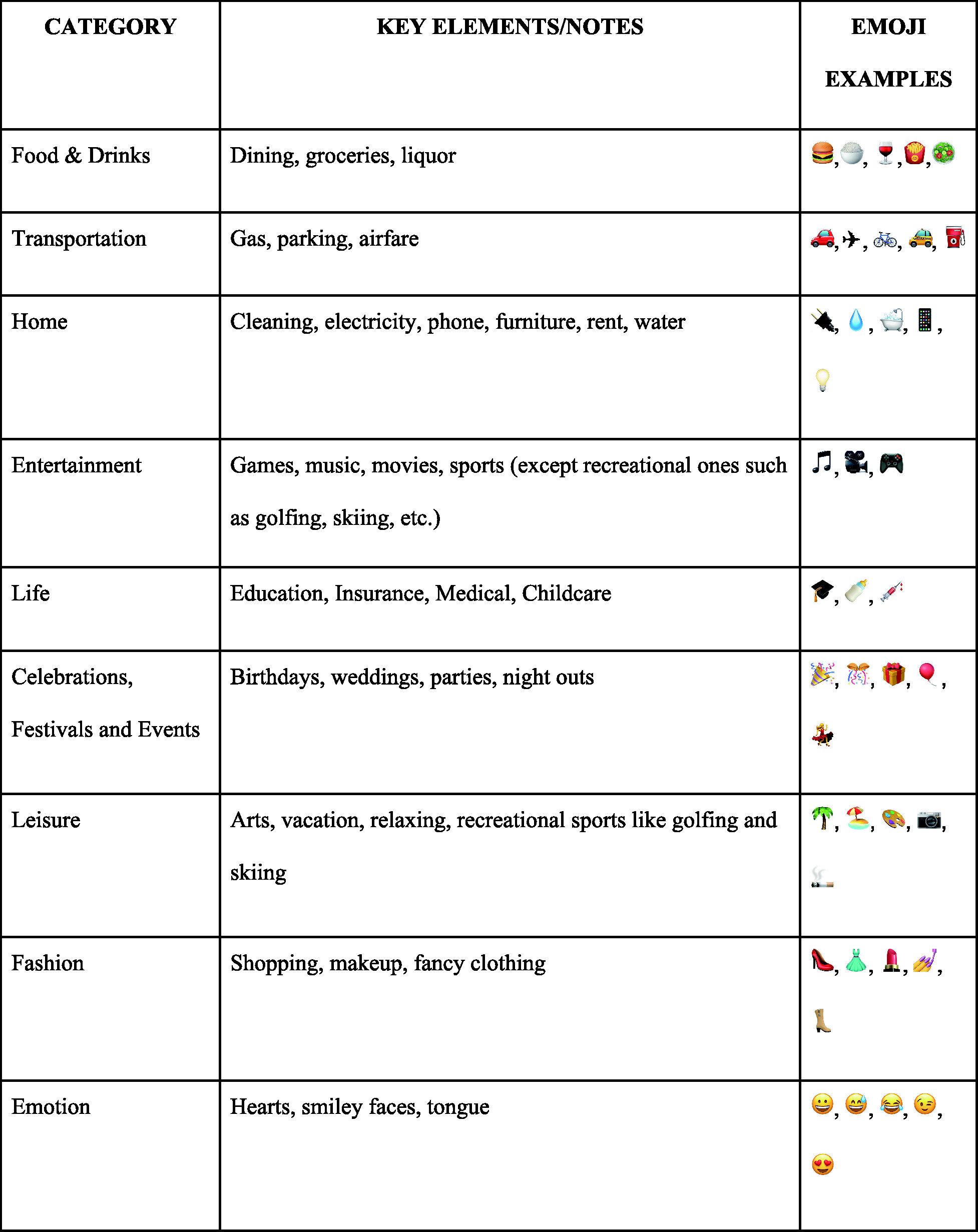
While some categories could be more easily coded as hedonic (such as entertainment), other categories had to have more specific instances of hedonic versus utilitarian consumption. While fashion as a whole could arguably be coded as hedonic, we made subjective exceptions for certain emojis like  (pants or jeans),
  (shirt) and
  (haircut), given that these are the basics of one’s appearance and hygiene, while fashion-related emojis that tended to fall on the hedonic side of the spectrum had to do with more non-essential aspects, such as
  (heels),
  (lipstick), etc. Similarly, within a food context, hedonic products are often represented as treats or indulgent items (e.g.,
  French fries) (Alba and Williams, 2013; Bagchi and Block, 2011), and are commonly perceived as better in taste relative to healthier, non-hedonic counterparts (Wertenbroch, 1998), such as salads (
 ) which we coded as utilitarian. (Of course, we acknowledge the gaps and limitations of any categorization like this.) The entire coding rubric can be found at https://github.com/F1356AK/Understanding-the-Meaning-of-Emoji-in-Mobile-Social-Payments/blob/master/Emoji_Code_Book.pdf, and two coders were trained for coding purposes. Before coding, the two coders reviewed the coding rubric and practiced coding 100 randomly chosen emojis from the dataset. Minor discrepancies that existed between the coders were resolved by discussion. The overall results of this n−1 dataset indicate greater representation of hedonic consumption (59%), followed by utilitarian consumption (32%) and then context-dependent (9%). To ensure intercoder reliability, we used Cohen’s k and aimed to achieve “substantial reliability” at .80 (Landis and Koch, 1977). The intercoder reliability was established at .87, indicating a high level of agreement.
In order to gain more insight into the consumption experience, the same individuals coded an n−2 (bigram) dataset comprising of emojis with text (i.e., two emoji or text occurring in sequence rather than just co-occurring in a transaction; N = 100). The 100 most frequent bigrams constitute a heavy percentage of emoji pair use as suggested by Wijeratne et al. (2017). Thanks to textual information, we were able to categorize information more firmly within either of the two primary categories of hedonic versus utilitarian consumption. The overall pattern of results was similar to the frequency of unigrams, indicating greater representation of hedonic consumption (61%), followed by utilitarian consumption (20%) and then context-dependent (19%). The overall intercoder reliability for the n−2 dataset was found to be .91 (Cohen’s k), indicating a high level of agreement.
TME usage patterns on Venmo
While human coding enabled us to get an indicative representation of hedonic versus utilitarian transactions for our dataset, it could not be applied on the entire dataset for the obvious reason of scalability. We therefore developed a heuristic-based algorithmic model. Based on our n−1 coded emoji dataset, we wrote Python scripts to read the message field for each transaction, extract the emojis, and then for each emoji, performed a lookup to see how that emoji has been encoded—either as hedonic, utilitarian, or context-dependent. When an emoji was not found in our lookup table of the n−1 coded dataset, it was machine-labeled as context-dependent. So, for each of the categories, our algorithm assigned them a unique integer value. This would then generate a total score for the transaction. Every time a hedonic emoji appeared, the score would increase by 1. Every time a utilitarian emoji appeared, the score would decrease by 1. So, if at the end, the score was positive, the post would be labeled as hedonic. If the score was negative, it would be labeled as utilitarian. And if the score was 0, it would be labeled as context-dependent. A simple formulaic representation is provided in Figure 4, where the score is defined to return one of three values as described above. i is the ith emoji in a transaction with n emojis.

Scoring formula.
This was done for all transactions in the dataset, which we divided into two subsets—one consisted of TMEs, and the other comprised non-modifiable emojis. The values were counted for each category and are represented in Figure 6. Further representation of hedonic and utilitarian emojis was rendered for the datasets containing the six skin tones as per the Fitzpatrick scale: (a) light, (b) light medium, (c) yellow, (d) medium, (e) medium dark, and (f) dark.
Topic modeling for extracting TME usage themes
The topic models were rendered using latent Dirichlet allocation (LDA): “a generative probabilistic model for collections of discrete data such as text corpora” (Blei et al., 2003). Topic modeling is a text mining tool that provides a formal structure to discern patterns in a corpus by revealing semantic structures. Posner (2012) has defined topic modeling as a “method for finding and tracing clusters of words (or ‘topics’) in large bodies of texts.” This method has been immensely useful for navigating large corpora in a variety of contexts—from discovering the political agenda of the European Parliament over a long period of time (Greene and Cross, 2017) to identification of patterns in population genetics (Shringarpure and Xing, 2008). Within LDA, each document is viewed as a combination of numerous topics that are assigned to it—using the Dirichlet prior. Latent topic variables are often inferred using the “bag-of-words” (BOW) assumption (Wallach, 2006), in which word order is ignored. The reference to “bag” relates to the fact that information about the order or structure of words (even grammar) in the document is discarded, and the model concerns itself only with whether known words occur in the document (Gensim, 2017). Given the size of our dataset and that our primary focus was to observe overall consumption patterns, the BOW model was determined to be a good fit to study the overall nature of the usage of TMEs. A BOW model partitioning each dataset into 50 topics was applied using the Python package GENSIM (Khosrovian et al., 2008). It should be noted that the decision to partition each dataset into 50 topics emerged from a trial-and-error process, wherein we first produced a partition of 10 topics and then 25 topics. Manual inspection of both 10 and 25 topics partitioning failed to give us meaningful insights into the thematic composition of our collected data. Expanding the scope of our manual inspection to 50 topics enabled us to discern emergent themes for each TME. The big data scale of our dataset, just the tone-modifiable corpus represents ∼ 17.8 million transactions, contributed to the complexities we faced in achieving productive topic models.
Results
Emoji usage within a hedonic versus utilitarian framework
To answer RQ1, as seen in Figure 5, context-dependent emojis comprise a majority of the composition for the tone-modifiable corpus (9.6 million transactions ∼ 54%), followed by hedonic-coded emojis (6.26 million transactions ∼ 35%). On the other hand, hedonic emojis form a major portion of the non-modifiable dataset (56 million transactions ∼ 44%), followed by context-dependent emojis (41 million transactions ∼ 32%). Emojis coded as utilitarian comprise the smallest portion of both datasets, accounting for just 1.8 million (∼18%) transactions for the tone-modifiable corpus, and 30 million transactions for the non-modifiable dataset (∼24%).

Emoji composition classified as HED/UT/context-dependent, applied to the modifiable as well as non-modifiable emoji datasets.
However, in the tone-modifiable subset, a noteworthy pattern emerges: the proportion of hedonic emojis versus utilitarian is greater for the darker skin tones as compared to the lighter skin tones. First, looking at the dataset comprising the three lightest skin tones (light, light medium, and yellow) in Figure 6(a), we see that for each of these three skin tones, context-dependent emojis comprise the highest share, followed by hedonic and utilitarian. A further inspection of the hedonic versus utilitarian composition for each skin tone reveals that the proportion is 3:1 for the light skin tone, 4.3:1 for the light medium skin tone, and 3:1 for the yellow skin tone.

(a) Emoji composition classified as HED/UT/context-dependent, applied to the yellow, light, light medium-toned emojis dataset and (b) emoji composition classified as HED/UT/context-dependent, applied to light, light medium, and yellow-toned emoji dataset.
Next, while answering RQ2, we studied the dataset comprising the three darkest skin tones (medium, medium dark, and dark). In Figure 7(a), we see that the overall composition of context-dependent, hedonic and utilitarian emojis follows the same pattern as in the three lightest skin tones, though the overall number of emojis present in the medium skin tone far exceeds those of the other two. More specifically, as Figure 7(a) illustrates, for the dark TME (the darkest skin tone), hedonic emojis are present almost 5.9 times compared with utilitarian ones. This is in contrast to the light TME (the lightest skin tone) which displays a proportion of 3:1 for hedonic versus utilitarian, as seen in Figure 6(a). This also emerges while comparing the medium TME as seen in Figure 7(a) (the lightest skin tone on the dark spectrum) and the yellow TME, as seen in Figure 6(a) (the darkest skin tone on the light spectrum). Hedonic is represented 4.2 times more than utilitarian for the former and 3.12 times more for the latter. There was a slight deviation from this pattern for the light medium TME seen in Figure 6(a) and medium dark TME observed in Figure 7(a). The light medium (in Figure 6(a)), which falls in the middle of the light skin tone spectrum, had hedonic represented 4.3 times more than utilitarian emojis. Medium dark (seen in Figure 7(a)), which falls in the middle of the dark skin tone spectrum, was found to have hedonic represented 3.8 times more than utilitarian. Combining the datasets into two broad classes of skin tones, light and dark, we found a 3:1 ratio overall for light (see Figure 6(b)) and 4:1 overall for dark (see Figure 7(b)).

(a) Emoji composition classified as HED/UT/context-dependent, applied to the medium, medium-dark, and dark-toned emoji dataset and (b) emoji composition classified as HED/UT/context-dependent, applied to the medium, medium-dark, and dark-toned emoji dataset.
In addition to the overall representation of emojis in the datasets, we also sought to evaluate emoji categories, especially within the context of the varying tone-modified light, light medium, yellow, medium, medium dark, and dark-toned datasets (see Table 1). For each transaction, our Python script kept a count of the emojis that occurred for each category. For emojis not present in our codebook, we assigned them to “CONTEXT-DEPENDENT.” Our script then assigned each transaction a final category that represented the category that had the highest count. For ties, a transaction was assigned as “CONTEXT DEPENDENT.” Then, for the whole dataset, we counted how many transactions were assigned to each category. Figures 8(a) to (c) and 9(a) to (c) illustrate the tabulated categories for each skin tone. Those labeled as “Context-Needed” have been redacted as they accounted for the greatest proportion of the dataset as a catch-all category and would dwarf visualization of all other categories.
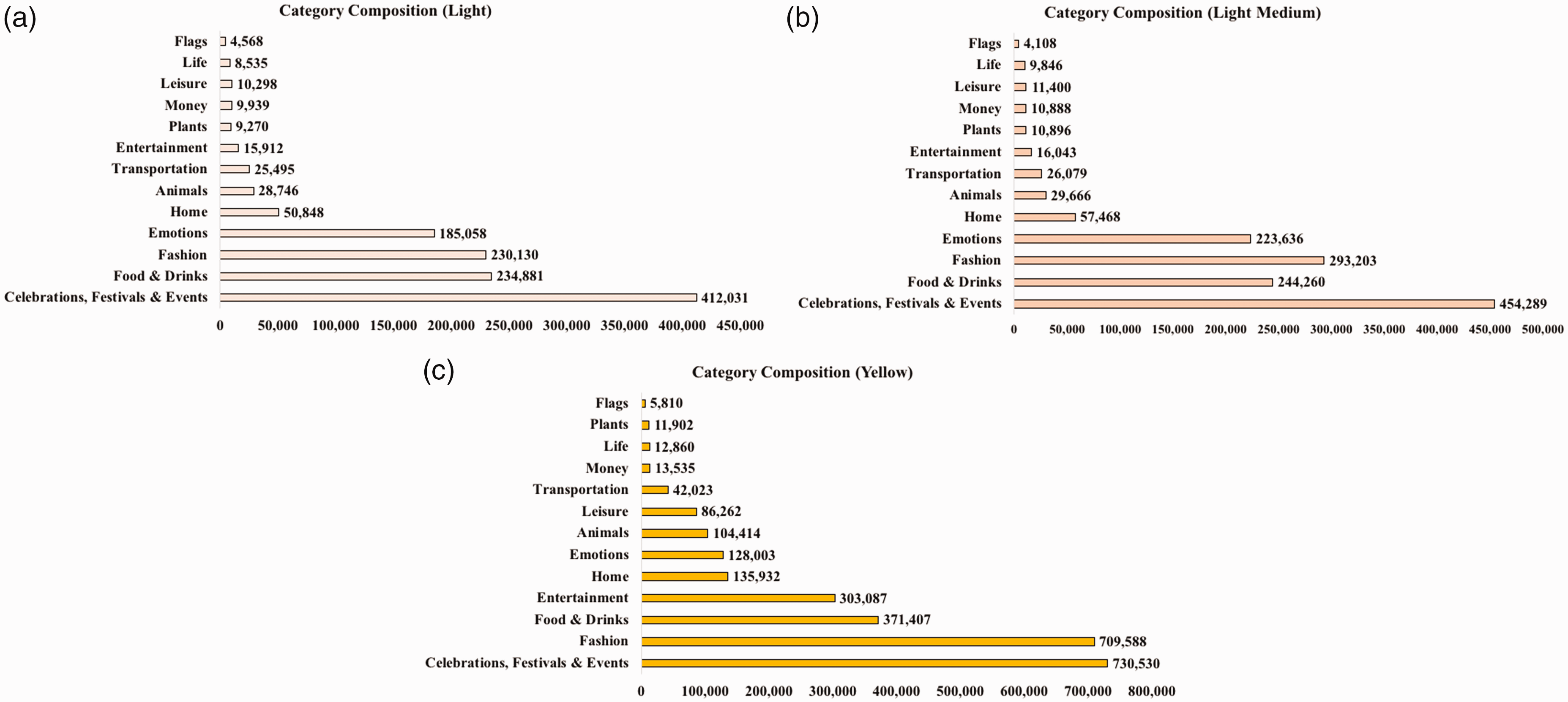
(a) Key emoji categories represented in light-toned emoji dataset, (b) key emoji categories represented in light medium-toned emoji dataset, and (c) key emoji categories represented in yellow-toned emoji dataset.
Emoji categories within TME
As Figures 8(a) to (c) and 9(a) to (c) illustrate, we found that the top categories do vary significantly by emoji skin tone. In our analysis below, we describe our results by tones (i.e., light, light medium, medium, medium-dark, dark and yellow). We found that the top 3 categories of consumption for the three lightest skin tones (light, light medium, and yellow) tend to fall within the categories that are considered more hedonic in nature: (a) celebrations, festivals, and events (29% for light, 29% for light medium, and 25% for yellow, respectively); (b) food and drinks (22% for light, 20% for light medium, and 16% for yellow, respectively); and (c) fashion (18% for light, 20% for light medium, and 25% for yellow, respectively). Figure 8(a) to (c) illustrates these results.

(a) Key emoji categories represented in medium-toned emoji dataset, (b) key emoji categories represented in medium dark-toned emoji dataset, and (c) key emoji categories represented in dark-toned emoji dataset.
While the darkest skin tones (medium, medium dark, and dark) also demonstrate the dominance of celebrations, festivals, and events, the medium dark and dark tones show a marked difference in subsequent categories. For the medium dark category more specifically, both the home (which corresponds to more utilitarian values) and the emotions (categorized as hedonic due to the component of affective arousal) categories precede celebrations in terms of composition, while for the dark category, home and emotions closely trail behind celebrations and fashion. Home comprised about 7% of the dataset for the lightest skin tones, but accounted for nearly 7–10% for each of the darkest skin tones; emotions comprised ∼15% of the dataset categories for the lighter skin tones but went up to ∼18% for the darker skin tones. In addition, more utilitarian-oriented categories like transportation (about 2% for all the lightest skin tones, and 2–5% for the darker skin tones) and life (represented by just about 1% of the dataset for each of the lightest skin tones and at least 2% for each of the darker skin tones) also show greater prominence within the darkest three skin tones compared with their three lightest skin tones counterparts. These results are illustrated in Figure 8(a) to (c).
Addressing our second layer of exploratory research on TMEs, we see that while the darker skin tones proportionately display more hedonistic tendencies, they also seem to weight utilitarian categories more than their lighter counterparts.
Theme manifestation by tone modifiable emoji
In order to discern broader themes within TME usage and address RQ3, we used LDA, a form of topic modeling, to study each dataset using the methods outlined previously. Words/emoji were subsequently clustered together via observation into broad “themes” as represented in Table 2.
Sample of topics of consumption patterns observed by each skin tone; the first column is used in line to denote rows of the table (i.e., line, column).

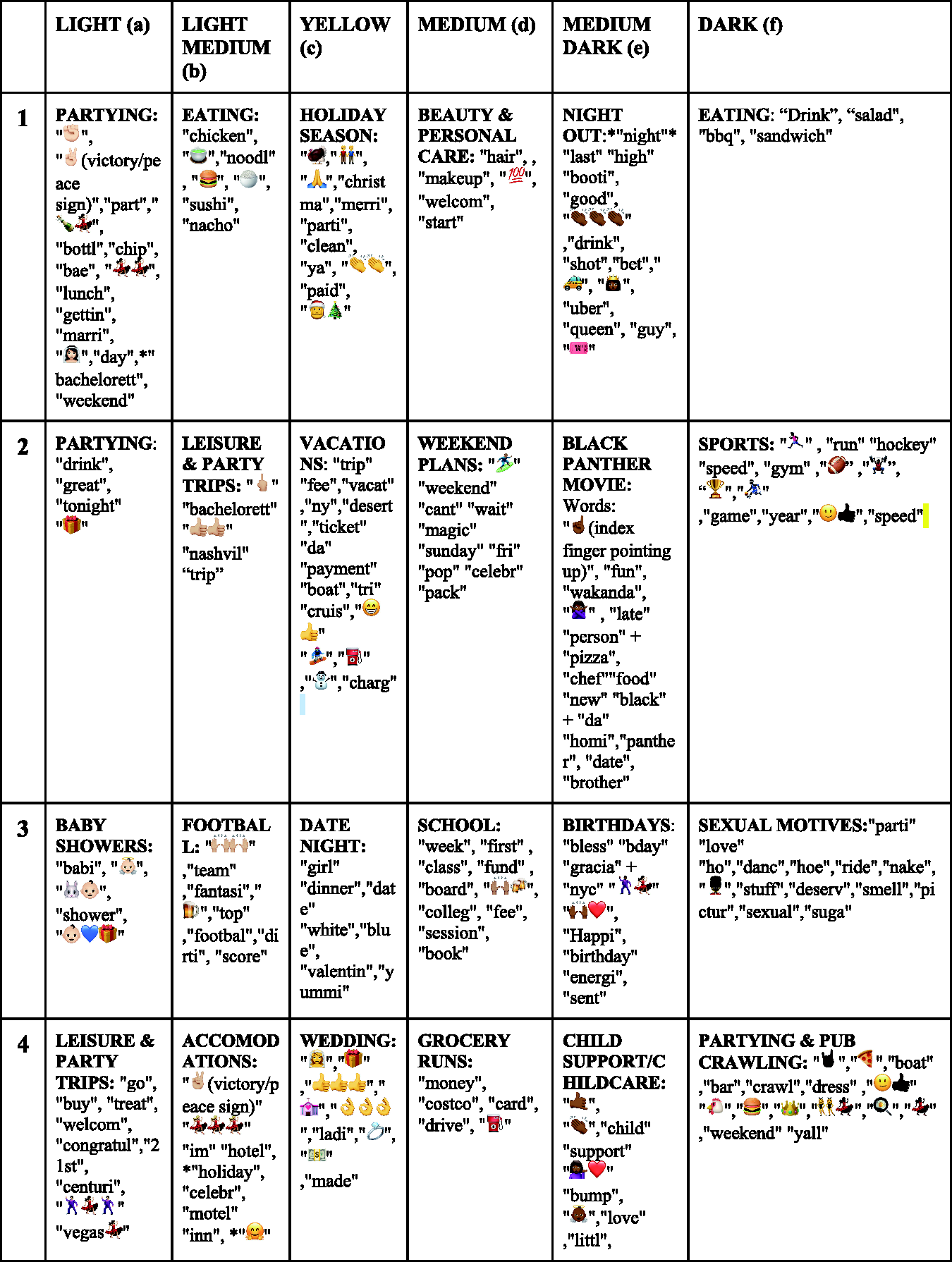

The themes were easier to distinguish for some skin tones than others. We found that the lightest skin tone, for example, had just 5 discernible topics, while the medium dark skin tone had 10 topics; these also had a greater variety of emoji and text combinations. Nearly all the skin tones had noticeable themes of eating and drinking, and the emoji and word combinations had trends within hedonic (“bbq,” “ ,” “noodl,” “
 ”) and utilitarian (“salad,” “chicken,” “rice,” “
 ”) themes. The themes for the light skin tone had celebratory leanings, with baby showers (Table 2, row 3, column a; subsequent parenthetical notations are all from Table 2 and reflect the same order), general partying (2a) and leisure/party trips (4a) dominating the conversation, while the light medium skin tone also showcased some specific instances of playfulness—weddings (5b), football (3b), and holiday accommodations (4b). The yellow skin tone also had noticeable patterns: date nights (3c), holiday season (1c), and beauty and self-care (5c), though these patterns were moderated by more utilitarian categories such as grocery shopping (7c) and work-related transactions (8c).
While consisting of many of the same themes as observed in the lightest skin tones, the emoji and word usage amongst the three darkest skin tones indicated a greater variety. For medium dark, partying was indicated by nights out (1e) and weekend celebrations (9e), while the movie Black Panther dominated the conversation in terms of entertainment (2e). Similarly, for the dark skin tone, partying and celebrations emerged in the form of pub crawling (4f), birthdays (5f), and holiday season (9f). The distinction between the darker skin tones and lighter ones was particularly marked by a greater predominance of utilitarian themes, such as school (3d) and grocery runs (4d) in medium; child support/childcare (4e), utilities (6e), and moving to school (8e) in medium dark; and payment methods (8f) in dark. Even within the utilitarian themes such as child support and payment methods, one can observe a greater variety in terms of playful language as compared to the utilitarian themes in the yellow skin tone. The datasets for the darker skin tones also reflect a higher lexical variety in both hedonic and utilitarian themes.
Topic modeling answers our last set of questions pertaining to key themes in TMEs. Specifically, these findings indicate that greater playfulness manifests more prominently amongst the darker skin tones and is not limited to hedonic themes such as night outs, Spring Break, concerts and festivals, etc., but also extends to utilitarian themes such as school, grocery runs, payment methods, and even childcare.
Future work and limitations
Due to the volume of data involved, there are limitations to our approach. The coding process was intentionally limited to the most frequently used n-grams as usage dropped sharply (as measured by frequency). This lack of n-gram variation could possibly be attributed to the emoji autocomplete feature and future work could aim to identify all instances of emoji autocomplete on Venmo as an additional codebook, an area beyond the scope of our study.
We also acknowledge that all classification of emoji poses challenges and limitations, as previous work has found (Rodrigues et al., 2018). One of the inherent limitations of classifying emoji is that they have limited cues in many contexts, including the HED/UT dichotomy. Indeed, even for sentiment analysis, emojis present real challenges and have high levels of ambiguity in terms of classification. Moreover, studying emoji and TME within digital consumption frameworks presents challenges. Following others, we understand that a researcher’s reading of emojis/emoticons always does not always conform to a user’s interpretations of them (Rodrigues et al., 2018). As such, our justifications for why certain emojis should be classified as hedonic while classifying others as utilitarian need to be considered within the framework of ambiguity that surrounds their meaning. In addition, while there is extensive work established on emoji usage and racial representation in the context of Twitter (Coats, 2018; Matamoros-Fernández, 2017), our study represents an early, pioneering start on examining this within the context of a social payment platform like Venmo. Our work therefore represents a starting rather than an end point and we hope future work will develop and refine from this, including producing diverse readings/codebooks of emoji.
Given our research questions, we were limited in the depth of our study of the TME dataset. This meant that: (a) we were unable to reduce the number of context-dependent TMEs, preventing us from getting a more concrete understanding of hedonic versus utilitarian TMEs, and (b) we were not able to look into TME usage vis-à-vis senders and receivers. The latter would have been particularly useful in evaluating the usage of TMEs in terms of the racial representation of users on Venmo, ultimately affording us further insights into how race, ethnicity, and emoji usage intersect. Future work, which we plan to undertake, will explore how people with varying skin tones use TMEs, and in what conversational contexts. Moreover, cross-language, cross-national, and cross-cultural contexts provide further avenues to explore if adoption of platforms by users is dependent on emoji inclusivity and diversity.
Lastly, our scope of analysis of emojis was limited to the most frequently used unigrams and bigrams on Venmo. Emojis that are hedonic such as pizza and beer are the most frequent form of n−1 and n−2 emojis, increasing over time in Venmo transactions. However, emojis released in later versions of the ISO standard (e.g., flying money  and electric plug
  that Venmo autocomplete suggests to signify electricity bills
  )) are not accounted for, but could be studied in future work through a time series. Additionally, many of the TMEs have not been released in uniform updates such as
  (couple with heart) and
  (family). We hope that future work in these areas can build upon our findings.
Conclusion
Using the U.S. mobile social payment platform Venmo as a case study, we have explored how emojis form a key component of emergent mobile communicative practices. By extending the classic consumer dichotomy of hedonic versus utilitarian values, we have used TMEs, an understudied subset of emoji to investigate the role of race and ethnicity in digital consumer motivations. Previous work found that both hedonic and utilitarian features of mobile payment technology are important components of how consumers experience a platform (e.g., Jamshidi et al., 2018; Li et al., 2012) and emojis have been recognized for their expressive importance by social media researchers (e.g., Robertson et al., 2018). Our research uniquely moves these strands of research together and evaluates whether emoji usage in mobile social payments is more hedonic or utilitarian, what categories emojis represent, and whether there are differences in usage depending on whether a user employs an emoji modified with skin tones.
By bridging interdisciplinary literature from marketing to digital communication studies, we developed a codebook to categorize emojis within a HED/UT framework, which we hope others will extend and develop from. As such, our public repository includes our code base and codebook. 1 Using a combination of content analysis and computational methods (n-gram analysis, topic modeling, and machine classification), our study is also able to speak about emoji use in social platforms more broadly as we investigated the platform at scale using ∼ 325 million transactions.
Our findings indicate that emojis in general are used for more hedonic purposes than utilitarian ones overall. While darker skin TMEs indicate a proportionately higher use in hedonic consumption as compared to lighter TMEs, which show a higher representation of utilitarian categories in transactions. Further thematic analysis revealed that both emoji and text for the darker skin tones also indicate a greater lexical variety. We also find that the use of darker TMEs displays a wider variety of themes within transactions.
Importantly, our results provide evidence of self-representation through the use of TMEs. While our study does not claim that TME usage corresponds to a user’s physical skin tone, prior work in online spaces has established a strong correlation (Robertson et al., 2018) in this regard. TMEs have been shown to harbor subjective biases regarding racial and gender representations in their usage (Coats, 2018; Ljubešić and Fišer, 2016). Emojis have also been found to pivot around whiteness, touching upon deeper issues of “technological neutrality” and colorblindness (Sweeney and Whaley, 2019). Given the continued importance of questions of skin tone, race, and ethnicity in human–computer interaction research (Hankerson et al., 2016; Schlesinger et al., 2017), understanding how skin-tone modifiers on emojis are related to racial and affective attitudes can help our understanding of how people express themselves in digital communication.
This is particularly true as we situate our findings within the context of American technoculture, characterized by Dinerstein (2006) as being influenced by notions of whiteness, masculinity, and religion. Given Carey’s (2008) assertion that the information transmitted by communication technologies has encoded cultural beliefs, technology can and does reinscribe dominant, white-centric discourses. This is despite technology’s purported value neutrality (Sweeney and Whaley, 2019). Consequently, even the “standard” yellow emoji has been theorized as a default white, thereby acting as an “infrastructure substrate” (Sweeney and Whaley, 2019) that reproduces hegemonic ideologies like whiteness into code form and establishing it as the status quo.
Our work therefore speaks to how TME usage impacts the end user. Twitter and Apple have been actively making attempts to diversify emoji representation, and clearly they have a role in influencing emoji adoption amongst users. Representation via emoji can be a meaningful part of identity (Baca, 2019), and as calls for diversity and inclusion increasingly gain traction in public discourse through #BlackLivesMatter, the George Floyd protests, and other activist movements, emojis have emerged as a site of contention for these calls to play out. Emojis demonstrate a high degree of contextual sensitivity (Bai et al., 2019) and their widespread adoption raises questions of how they are employed by users from varying racial and cultural backgrounds.
Our study observes the frequency of TME usage from within a framework of the HED/UT dichotomy. Though we make no inferences about who is using them, our study provides an impetus for a larger conversation on race, ethnicity, and representation on social platforms. Ultimately, our study serves as a springboard in engendering critical reflections on American technoculture and whether TMEs challenge what Nakamura (2002) sees as the default whiteness of the American Internet.
Footnotes
Declaration of conflicting interests
The author(s) declared no potential conflicts of interest with respect to the research, authorship, and/or publication of this article.
Funding
The author(s) disclosed receipt of the following financial support for the research, authorship, and/or publication of this article: The authors would like to thank The University of Texas at Austin (Moody College of Communication and School of Information) for funding support of this research.
