




Abstract
Social scientists increasingly use (big) social media data to illuminate long-standing substantive questions in social science research. However, a key challenge of analyzing such data is their lower level of individual detail compared to highly detailed survey data. This limits the scope of substantive questions that can be addressed with these data. In this study, we provide a method to upgrade individual detail in terms of ethnicity in data gathered from social media via the use of register data. Our research aim is twofold: first, we predict the most likely value of ethnicity, given one's first name, and second, we show how one can test hypotheses with the predicted values for ethnicity as an independent variable while simultaneously accounting for the uncertainty in these predictions. We apply our method to social network data collected from Facebook. We illustrate our approach and provide an example of hypothesis testing using our procedure, i.e., estimating the relation between predicted network ethnic homogeneity on Facebook and trust in institutions. In a comparison of our method with two other methods, we find that our method provides the most conservative tests of hypotheses. We discuss the promise of our approach and pinpoint future research directions.
Introduction
Research on social media is rapidly expanding in the social sciences. Studies on social media (e.g., Bond et al., 2012; boyd and Ellison, 2008; Ellison et al., 2007; Lewis et al., 2008) are among the most highly cited articles in the social sciences. An increasing number of scientific journals cover social media, Big Data, and their relationship to society (e.g., Big Data & Society, Social Media + Society, Journal of Computer-Mediated Communication, New Media & Society). Even in science's most prestigious outlets—e.g., Science, Nature, and PNAS—there are a number of studies using Big Data from social media (e.g., Bakshy et al., 2015; Bond et al., 2012; Hobbs et al., 2016; Kramer et al., 2014).
This increased scholarly interest in social media is no surprise, as social media data provides scholars with novel ways to analyze human social interactions. On social media, for instance, individuals have new ways to communicate, to spread information, and to coordinate collective action (cf. Corten, 2012; see Gonzàlez-Bailòn and Wang, 2016). Furthermore, individuals increasingly use these platforms to maintain their interpersonal social relationships (Ellison et al., 2011). In addition, computational approaches to social science make it relatively easy to collect data on online interactions, such as those documented on Facebook or Twitter, because these interactions generate digital time-stamped footprints of large social networks (Golder and Macy, 2014).
It has been argued that the networked footprints these platforms automatically archive as part of their daily operations have revolutionized social science (Lazer et al., 2009; Spiro, 2016; Watts, 2011). These features of social media data make it relatively straightforward to study larger networks that reach beyond the small number of core ties (e.g., fewer than five network contacts) and the closed social contexts (e.g., classrooms or departments) usually under consideration in the study of social relationships, i.e., in social network analyses (cf. Hofstra et al., 2017; see, e.g., Hofstra et al., 2015a; Kalmijn and Van Tubergen, 2006; Marsden, 1987; Smith et al., 2014). These types of data are occasionally labeled “big,” as they often contain information about the online behavior of millions of users (McFarland and McFarland, 2016). However, Big Data obtained from social media has yet to reach its full potential regarding its use in social science research.
Analyzing such online social media data comes with major challenges. One of the core challenges is that the level of individual detail in data gathered by researchers from social media is often considerably lower when compared to information gathered in survey research (Golder and Macy, 2014; Spiro, 2016; Stopczynski et al., 2014). For instance, key individual characteristics such as gender, age, ethnicity, education, or occupation are often either missing or even misreported by respondents in Big Data gathered by researchers online (Golder and Macy, 2014; Spiro, 2016). Individual privacy considerations may be one reason why social media data are often broad but shallow, as people might close their social media profiles to safeguard their personal information (e.g., see Hofstra et al., 2016). Therefore, these data may be big, but the level of detail is thin. This low level of detail limits the scope of the substantive questions that can be addressed when studying data obtained from social media platforms. Ethnicity and gender, for instance, are key individual characteristics by which social network analysts often study the patterns in their data (e.g., Hofstra et al., 2017; Mayer and Puller, 2008; McPherson et al., 2006; Smith et al., 2014; Van Tubergen, 2015; Wimmer and Lewis, 2010).
Hence, a key question in the growing field of analyzing online social network data is how one can use the plethora of opportunities of these data while at the same time maintaining (at least some of) the “richness” that is usually found in survey data. Effectively dealing with this issue increases the number of substantive questions one is able to answer. These considerations motivate the two aims of this study:
We propose a procedure to upgrade the level of individual detail in online social network data by predicting the most likely value of ethnicity, given one's first name using register data. We propose a procedure on how to test hypotheses using these “upgraded” social media data.
It is well established that names are a clear signal of ethnicity. There are profound differences in how people from different ethnic backgrounds name their children (Lieberson, 2000; see, e.g., Bloothooft and Onland, 2011; Chang et al., 2010; Coldman et al., 1998; Fiscella and Fremont, 2006; Lauderdale and Kerstenbaum, 2000; Mateos et al., 2011). Scholars seem to increasingly use this empirical regularity to enrich social media data (see Cesare et al., 2017 for a recent overview). Logically, because (first) names are often among the only indicators researchers have about individuals in social media data. We follow this burgeoning line of research and thus make use of names as a signal of ethnicity.
We make two key contributions to this growing field. First, we extend prior work because we consider the possibility that those who carry the same first name can each have a different ethnicity. There are two studies that are most related to our procedure, that of Chang et al. (2010), who use a probabilistic Bayesian approach, and that of Hofstra et al. (2017), who use a supervised learning approach. Chang et al. (2010) and Hofstra et al. (2017) assign the most likely value of ethnicity to people on Facebook, given their surnames (Chang et al., Hofstra et al.) and first names (Hofstra et al.). While both studies aim to validate their ethnicity predictions using a source of ground truth (Chang et al.: MySpace data; Hofstra et al.: survey data), they do not model the possibility of different ethnicities among people carrying the same names. Or, as Chang et al. (2010: 25) put it: “we […] have not yet theoretically modeled error throughout our calculations.” We statistically take this uncertainty into account for a more realistic representation of the relationship between ethnicity and (first) names. To show the promise of our approach, we directly compare the Hofstra et al. (2017) method with the method described in this study and show which method is the least prone to false-positive results. Reducing such false-positives is crucial in order to obtain more meaningful hypotheses tests and correct statistical inference. By testing whether our method is less prone to false-positive results than other methods, we may show the importance of future implementation of our work in substantive empirical studies that aim to make knowledge claims using online social media data.
Second, we show how to use the predicted values of ethnicity among Facebook networks in standard regression models to tests hypotheses. More specifically, we show how to test hypotheses with the predicted variable as an independent variable while simultaneously accounting for the uncertainty in the predicted values of this new variable. 1 To show the promise of our approach, we provide a toy example. In recent years, there has been a sharp increase in studies investigating the claim that ethnic diversity has detrimental effects on trust and social cohesion (Abascal and Baldassarri, 2015; Putnam, 2000; Van der Meer and Tolsma, 2014). As societies increasingly grow ethnically diverse, it is crucial to understand whether and how ethnic diversity across different contexts—e.g., in cities, neighborhoods, workplaces, and among social contacts—affects trust. As an example, we explore and engage some of the claims regarding the relationship between ethnic diversity and social cohesion. Specifically, we consider ethnic homogeneity in Facebook networks and investigate its relationship to trust in institutions. Note that we do not aim to test theoretically derived hypotheses. In tying our method to this substantive example, we merely push future work to theoretically consider the consequences of the (ethnic) composition of online (Facebook) networks. Apart from ethnic diversity online and trust, ethnic diversity relates to a myriad of socially relevant issues. One classic argument is that (ethnic) diversity in social networks facilitates the free flow of ideas through networks (e.g., Granovetter, 1973, 1983). Another argument is that a higher level of ethnic diversity in networks may reduce interethnic prejudice (Allport, 1954; Pettigrew and Tropp, 2006). Furthermore, the coevolution of ethnic homophily online and social influence may cause “echo chambers” (Halberstam and Knight, 2016) and intergroup polarization of attitudes and opinions (Mäs and Flache, 2013). Here, we provide a statistically plausible method to test hypotheses with predicted individual characteristics (i.e., ethnicity) in online Big Data as independent variables. As an engaging starting point in doing so, we consider trust in institutions, while the other abovementioned examples are similarly relevant.
Therefore, we contribute to the growing field of analyzing online Big Data by showing how to enrich and make innovative use of such data to test hypotheses in a novel way. We aspire to make the description of the procedure as accessible as possible so that the applied empirical scientist can adopt the method with relative ease using free and open source software.
To illustrate our approach, we use three data sources. However, the approach that we describe is general in nature and is not limited to the data sources that we use. At the end of this article, we propose some alternative, but similar data sources one may use to implement our approach. Here, we use (1) survey data from a large, diverse sample of adolescents; (2) online social network data containing more than a million network members downloaded from the Facebook pages of these same adolescents; and (3) register data that capture the frequency of first names and the proportion of the name carriers and their parents who have been born in specific countries. The specific data sets we use are: (1) survey data from the “Children of Immigrants Longitudinal Survey in Four European Countries” (CILS4EU; Kalter et al., 2016) and the “Children of Immigrants Longitudinal Survey in the Netherlands” (CILSNL; Jaspers and Van Tubergen, 2017), (2) Facebook data from the “Dutch Facebook Survey” (Hofstra et al., 2015b), and (3) register data of the Dutch Civil Registration (DCR) of 2010 (Bloothooft and Schraagen, 2011).
The concept of ethnicity in the Dutch context
Some define ethnicity based on an individual's self-identification (e.g., Verkuyten and Kwa, 1994), such that is up to individuals to decide whether they “identify as a member of group X.” Others use objective measures of ethnicity, occasionally based on parents' birth countries (e.g., Stark and Flache, 2012; Vermeij et al., 2009). Here, for simplicity, we use the regularly applied definition by Statistics Netherland, which is standard practice in research on ethnicity and social networks in the Netherlands (e.g., Statistics Netherlands, 2012; Vermeij et al., 2009). This means that we classify individuals' ethnicity by their biological parents' birth country (cf. Stark and Flache, 2012; Vermeij et al., 2009). When individuals have one parent born in the Netherlands, we classify them as belonging to the ethnicity of the parent not born in the Netherlands, and when they have parents born in two different non-Dutch countries, we classify them in the birth country of the mother.
Because the data we use is from a sample of adolescent respondents in the Netherlands, it is informative to define the ethnic groups most salient in Dutch society. Dutch adolescents can be classified among six large ethnic origin groups (Castles et al., 2013). The first group comprises adolescents whose parents were born in the Netherlands and who are members of the Dutch majority. The second and third groups consist of children of immigrants from Turkey and Morocco. These children's parents originated from the low-educated labor force that the Netherlands recruited in the 1950s and 1960s from Turkey and Morocco or from parents who arrived more recently (e.g., because of family reunions). These two groups constitute the largest minority group in the Netherlands. Another group originates from postcolonial countries in the Dutch Caribbean (e.g., Aruba and Suriname). A fifth group originates from other Western countries (e.g., neighboring countries such as Germany), and a sixth group originates from other non-Western countries (e.g., conflict areas such as Afghanistan). These ethnic groups are rather similar across Western European countries in the type of immigrants that settled there, despite varying specific countries of origin of the ethnic groups that are present (Smith et al., 2014).
Ethnic background is thus occasionally defined by classifying individuals into one of these six large ethnic background groups in the Netherlands: Dutch, Turkish, Moroccan, Dutch Caribbean, other Western backgrounds, and other non-Western backgrounds. We also use this categorization throughout this study.
Data sources
CILS4EU and CILSNL
We use the third, fourth, and fifth waves of the CILS4EU and CILSNL on adolescents in the Netherlands (Jaspers and Van Tubergen, 2017; Kalter et al., 2016).2,3 In the CILS4EU, adolescents were followed for three consecutive years (2010–2013). Data were collected in the Netherlands, Sweden, Germany, and England. The CILSNL followed the Dutch panel of the CILS4EU for an additional four years (2014–2017). We analyze the Dutch part of the data because our variables of interest are only included in the Dutch section. We analyze waves 3, 4, and 5 because these waves are the anchor of and the closest in time to the Facebook data. Essentially, the Facebook data is collected via respondents' survey answers in waves 3 and 4 (elaborated below). All surveys include detailed information on respondents' background, attitudes, and leisure time activities.
The wave 1 sample was stratified by the proportion of immigrants of non-Western origin within a school. Within these strata, schools were chosen with a probability proportional to their size (using the number of pupils in the relevant educational level), and two classes were randomly sampled within the schools. In wave 1 (2010–2011), 4963 Dutch pupils participated. 4 There were 4272 respondents in wave 3 (2012–2013), 4072 in wave 4 (2013–2014), and 3836 in wave 5 (2014–2015). In waves 3, 4, and 5, respondents could self-complete the questionnaire online, on paper, or via telephone interview. 5
The Dutch Facebook survey
The Dutch Facebook Survey (DFS) (Hofstra et al., 2015b) was collected to enrich the Dutch part of the CILS4EU survey. It consists of behavioral data obtained from Facebook. 6 The data were collected between June 2014 and September 2014. In waves 3 and 4 of the surveys, participants were asked about their membership on Facebook. In waves 3 and 4 combined, 4864 respondents indicated that they had a membership on Facebook in at least one of these waves (wave 3 N = 3423, wave 4 N = 3595). Seven coding assistants manually tracked down Facebook profiles. This manual tracking process was based on the respondents' names and their cities of residence which were obtained from the CILS4EU survey. The coding assistants tracked down Facebook profiles on the basis of these two indicators—names and cities—and were able to match respondents to Facebook profiles with substantial certainty. The cases in which coding assistant were unsure whether the Facebook profile matched to a respondent (N = 47; .96%, Hofstra et al., 2015b: 11) were not taken into account in this study. A total of N = 4463 (91.8%) Facebook profiles were tracked. From these tracked profiles, the coding assistants downloaded the complete friend lists of the respondents in HTML code. These Facebook friend lists are the focus of this study, i.e., the first names of the individuals found among these friend lists. 7
Approximately 73% of the respondents kept a public friend list, and we collected the first names out of these friend lists (i.e., we parsed their names out of the HTML code). See Hofstra et al. (2016) for a discussion of these respondents' privacy settings. We have information on complete Facebook networks of 3352 respondents, and they had a combined total of 1,156,285 Facebook friends. 8 Together, these individuals have 52,651 unique first names. We refer to the technical report of these data for information about how the random sample of the CILS4EU respondents compares to the sample of Facebook users (Hofstra et al., 2015b).
The Dutch civil registration
An overview of the three data sources that are used for this study.

The CILS4EU and CILSNL are the same data source only under a different name, as the CILSNL continued to survey the Dutch panel of the CILS4EU four additional waves.
First names and ethnicity
The misclassification ratio
We calculate a weighted misclassification ratio for assigning ethnicity based on first names using the register data. This is done to provide an indication of how feasible it is to predict ethnicity using first names. As an example, we use a simple majority rule to assign ethnicity. Per first name, we assign ethnicity (i.e., a categorization into one of the six ethnicity groups mentioned before) based on the largest proportion of the name carrier's mother's country of birth (which we obtain from the register data). Next, we subtract the maximum proportion of mother's birth countries per name. For instance, if 90% of mothers of individuals named John are born in the Netherlands, we assign a Dutch ethnicity to John. However, this would mean that 10% of all John's are misclassified as Dutch. We calculate a weighted average of this number based on all of the first names. We weigh the average by how many times a name occurs in the register data. Hence, names that occur few times have less impact on this ratio than names that occur many times. The weighted misclassification rate is 1.3% (unweighted = 5.1%). This figure implies that predicting ethnicity via first names is (in our view) sufficiently accurate and can be used as such, even though it may be somewhat driven by the Dutch majority members. To make our estimates as precise as possible, we try to further adjust for misclassifications by using a procedure that accounts for further uncertainties arising from assigning ethnicity based on first names.
The diversity of first names in the Netherlands
Especially in the Netherlands, the diversity of first names is large. There are many different spellings of nearly similar names across ethnic backgrounds and social status groups (Meertens Institute, 2016). Given that there is much variation within the set of first names in the Netherlands makes them a suitable signal of ethnicity in our study context. This is also evidenced by the low misclassification ratio discussed above. However, we acknowledge that in different contexts, last names may be more suitable signal of ethnicity (our method is not restricted to using either first or last names). Scholars, in their decision to use either first or last names, should contemplate on the diversity of the set of first and last names and how they signal ethnicity in the specific country under consideration. For instance, see Mislove et al. (2011) who use last names are used to predict ethnicity in the USA and Rao et al. (2011) who used both names to predict ethnicity in Nigeria.
Outline of the procedure
General outline
Next, we outline the general procedure we use to predict ethnicity. The idea is to predict ethnicity on the basis of people's first names. This new variable (i.e., predicted ethnicity of a Facebook friend) can then be used as an independent variable for hypothesis testing. However, when one wants to test hypotheses with predicted independent variables, one should seek to take into account the uncertainty in the predicted values of this independent variable. The uncertainty about the predictions should be adjusted for in the model coefficients of interest as well.
In our specific case, we need to consider two types of uncertainty. First, the analyses should consider the possibility that different individuals who carry the same first names can each have a different ethnicity. Hence, the most likely prediction of ethnicity, given one's first name is not always correct. For instance, a specific first name can be popular across more than one ethnic subgroup. Second, the analyses should consider that the parameters (i.e., the model coefficients) of the prediction model may also carry uncertainty, as the prediction model is estimated from the register data. The fact that we use register data that cover nearly the entire Dutch population may imply that the parameters are less uncertain than if they had been estimated from sampled data. Nevertheless, to elaborate our example and to be as precise as possible, we do adjust for uncertainty in the model parameters. In our example, the parameters of the prediction model are the conditional probabilities of one's ethnicity, given one's first name.
A convenient way to consider the first type of uncertainty is to use bootstrap standard errors for hypothesis testing. A bootstrap sample is a sample from the original sample of the same size drawn with replacement. In our method, in each bootstrap sample, a newly predicted data set is used to obtain the parameter estimates of the hypothesis testing model of interest. The bootstrap standard error is the standard deviation (SD) of all parameter estimates obtained by estimating the model using data from the different bootstrap samples.
If we predict the ethnicity for each Facebook friend repeatedly for each bootstrap sample, we consider the possibility that the most likely ethnicity for this Facebook friend, given his or her name may not be correct. Hence, each time a new bootstrap sample is used to estimate the parameters of our model of interest, we consider the possibility of different ethnicities among similar names.
We also take into account the second type of uncertainty, i.e., the fact that the estimates in our prediction model of interest carry uncertainty. For each bootstrap sample, we use different probabilities to predict ethnicity conditional upon one's first name. These conditional probabilities are obtained from a Dirichlet posterior distribution (see Tu, 2017 for an explanation of the Dirichlet distribution) estimated from the register data (i.e., the DCR). If we use different conditional probabilities in our prediction model to predict ethnicity for each of the bootstrap samples, we account for the uncertainty of the parameters used in the prediction model.
Model specification
Here, we describe the full estimation model in more detail. First, we outline the prediction model; subsequently, we describe the bootstrap procedure. For our prediction model, we assume that someone's ethnicity y1, …, y
L
is distributed according to a multinomial distribution Mult(θ1,…, θL), where y1, …, y
L
denote indicator variables of the L ethnicity categories and θ1,…, θL denote the probabilities of belonging to the Lth ethnicity category, given one's first name. We assume
As an example, consider a posterior distribution of people named John, where L is 3 (i.e., there are three ethnic categories). When the posterior distribution f(
To obtain realistic bootstrap confidence intervals for our model parameters of interest, we predict ethnicity, given one's first name for each k = 1, …, K bootstrap sample using a freshly drawn 
Our estimation procedure is summarized in Figure 1. We aggregate the data because the Facebook networks are nested in individuals (i.e., Facebook friends of respondents in the surveys). Therefore, we obtain one value for the ethnic composition of Facebook networks per respondent (which we will elaborate upon later). We adjust the model parameters for confounding respondent-level variables (e.g., respondent's own gender and ethnicity).
A graphical outline of the method to predict ethnicity.
Relation to imputation of missing data
We briefly note how our described procedure relates to the missing data literature. Procedures of data enrichment can be seen as a missing data problem, specifically, not having certain information about subjects while still aiming to use the missing information in an analysis. In our example, ethnicity is completely unobserved. We predict ethnicity based on a prediction model, and this prediction model resembles a missing data imputation model. For an imputation model to perform well, it should be specified according to the missing data assumption. Here, we adopt the missing at random (MAR) assumption (Rubin, 1976). Essentially, this implies that the missing data can be accounted for by the observed variables. We assume that, conditional upon one's first name, we can determine ethnicity and that there is no correlation between ethnicity and other variables. MAR is a rather strong assumption, but one that is made generally in the imputation of missing data. In our case, MAR is indeed a strong assumption, and we do not expect it to hold entirely. However, we think that the imputation model is reasonable because a first name is a strong signal of ethnicity (e.g., Bloothooft and Onland, 2011; Chang et al., 2010; Lieberson, 2000; Mateos et al., 2011) and because the weighted misclassification ratio is low.
Additionally, imputation models should account for the uncertainty in their parameters (Schafer and Graham, 2002). We do this by keeping the parameters of our imputation model random (instead of fixed). Moreover, each time a new data set is imputed, the parameters of our imputation model are sampled again from the posterior distribution.
Application of the procedure to our data
In this section, we describe the application of our procedure. As an example, we examine to what extent we can statistically relate trust in institutions to a predicted measure of ethnic diversity in Facebook networks. There is an ongoing discussion about whether ethnic diversity is detrimental or beneficial to social trust (see Abascal and Baldassarri, 2015; Van der Meer and Tolsma, 2014). 9 As such, we think it is engaging to explore relations between ethnic diversity on Facebook and trust using our method. However, the choice of this dependent variable is arbitrary and may as well be something different, i.e., it serves as an example. No specialized software is needed to replicate this approach, nor is the approach limited to the data we described. All computations of the procedure were performed using custom code written for the software package R (R Core Team, 2016).
Dependent and control variables
The variable that we thus want to relate to our predicted values of ethnicity is trust in institutions. We define trust in institutions as a specific form of generalized trust. Where generalized trust is occasionally specified as whether individuals trust “most others” (e.g., Paxton, 2007), we define trust in institutions as the extent to which individuals trust “institutions.” This variable is constructed as follows. In wave 5 of the CILSNL, respondents indicated on a 10-point scale on four items how much confidence (1, no confidence whatsoever—10, a lot of confidence) they had in politicians, judges, scientists, and the police. We took the mean score out of these four to calculate trust in institutions (M = 6.358; SD = 1.413; Cronbach's α = .803).
Next, we construct five control variables from the third and fourth waves of the CILS4EU and CILSNL to examine whether we can isolate the effect of our newly predicted variable from confounding factors. In constructing these variables, we took the survey answers from wave 4. If these survey answers were missing, we took answers from wave 3. First, we construct the ethnicity of the respondents themselves. We classify respondents into one of the six largest ethnic groups in the Netherlands: “Native Dutch” (76.9%), “Turkish” (3.7%), “Moroccan” (3.5%), “Dutch Caribbean” (3.9%), “Other Western” (5.4%), and “Other non-Western” (6.6%). As we mentioned before, this is based on their parents' country of birth (Statistics Netherlands, 2012; Vermeij et al., 2009) that they reported in the surveys. Second, we measured whether the respondents indicated whether they were a girl (59.6%) or a boy (40.4%). Third, we measured how satisfied respondents reported being with their “life in general” (1, very dissatisfied—10, very satisfied; M = 7.585; SD = 1.613). Fourth, we measured whether respondents were in a romantic relationship (38.7%) or not (62.3%). We adjust for these factors according to their availability, and the questions were posed in a similar way to respondents across the multiple waves of survey data. Finally, using dummy variables, we measured in which of the waves the respondents participated (waves, 3, 4, and 5 = 78.4%; waves 4 and 5 = 15.8%; or waves 3 and 5 = 57.5%). We listwise delete missing values across these six variables and realize a data set consisting 3445 cases.
Predicting ethnicity and estimation results
Next, we want to obtain the most likely value of ethnicity, given the first name of each of the Facebook friends of a respondent. We have register data for 36,151 of the first names on Facebook (95% of all friends). These register data contain (1) the number of occurrences of each of these first names in the Netherlands and (2) for each first name, the fraction of the name carriers' mothers who were born in the six major origin countries (the Netherlands, Turkey, etc.). We thus predict the ethnicity of friends on Facebook via the birth country of the mothers. This is a small deviation from the regularly applied definition in the cases where the mothers were born in the Netherlands, but the fathers were born elsewhere. To keep our method parsimonious, we consider only mothers' birth countries. For 2208 out of the 3445 of respondents (from which we have all values across the dependent and control variables), we can observe the first names in their Facebook friend lists, i.e., these respondents have public friend lists. This final set of 2208 respondents have a combined total of 776,135 Facebook friends for which we want to predict ethnicity.
For each bootstrap sample, we draw the conditional probabilities for ethnicity, given one's first name on Facebook using the posterior distribution obtained with the register data. Next, we count the number of friends who have the same predicted ethnicity as the ethnicity of the respondent himself or herself and divide this count by the total number of friends and multiply it by 100. As such, we calculate the percentage of co-ethnic Facebook friends per respondent, or co-ethnic
This aggregated predicted variable is then used as an independent variable in a linear regression model—also adding the control variables mentioned before—with trust in institutions as the dependent variable. We repeat this process 10,000 times, each time bootstrapping new conditional probabilities for ethnicity and each time bootstrapping the model coefficients from the linear regression models. We obtain a distribution of 104 bootstrap coefficients per variable in the linear regression model. Assessing these 104 bootstrap coefficients, we can obtain the bootstrap confidence interval and observe whether the middle 95% of the bootstrapped coefficients are either above or below zero. If we plot these 104 coefficients, they visually resemble normal distributions. Addressing this bootstrap confidence interval is a nonparametric alternative to standard null-hypothesis significance testing.
Regression results of co-ethnic

If the middle 95% of the coefficients do not contain zero, we can safely assume that the coefficient is nonzero.
Model performance
Next, we provide an indication of the performance of our method. We provide confidence intervals for three methods of estimating the effects of co-ethnic
A comparison of three methods for predicting ethnicity, presented are confidence intervals for effects of co-ethnic
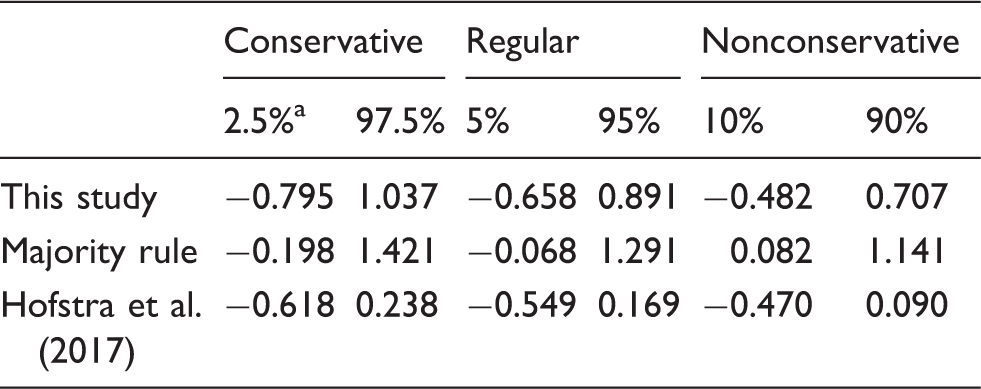
These are the confidence intervals for the different methods.
We observe that the method outlined in this study provides the most-conservative tests of the effects of the predictor on the dependent variable. Using a simple majority rule for only one predicted data set may lead more often to false-positive results. One may conclude that the more homogeneous Facebook networks are the more trust individuals have in institutions (in the consideration of the third panel of results). However, when we take into account the two types of uncertainty incorporated in our method, i.e., the possibility of different ethnicities among similar first names and the uncertainty in the model coefficients in the prediction model, we no longer observe such a relationship. The method provided in Hofstra et al. (2017) does not seem to lead to false inferences using this example. However, the confidence intervals are more conservative using the method provided in this article. These findings suggest that using our method in the process of hypothesis testing may provide more-conservative tests of hypotheses that are less prone to false-positive results. 11
Conclusions and discussion
The research aim of this study was twofold. First, we outlined a procedure to predict ethnicity in social media data using register data. Second, we showed how to use these predicted values in standard regression models to tests hypotheses. As such, we contributed to an expanding amount of prior work aiming to enrich social media data (e.g., Chang et al., 2010; Hofstra et al., 2017) based on the idea that names are a signal of individual characteristics such as ethnicity (Bloothooft and Onland, 2011; Fiscella and Fremont, 2006; Lieberson, 2000). We provided a contribution that accounted for (1) the possibility of people with similar names having different ethnicities and (2) uncertainty in model estimates when using predicted values as independent variables in linear regression models. We did so by bootstrapping conditional probabilities, given one's first name and bootstrapping standard errors from a set of 104 linear regression models. The percentage of misclassifications of ethnic background using a simple majority rule was approximately 1.3%, which is relatively low and may be a further illustration of the promise of our approach.
We provided a toy example showcasing how we could predict the ethnicity of respondents' friends on Facebook (usually not readily available) and related respondents' percentage of co-ethnic friends on Facebook to trust in institutions. As such, we provided a way to illuminate long-standing substantive discussions in future research. In this example, we explored the relation between ethnic diversity and trust (e.g., Abascal and Baldassarri, 2015; Van der Meer and Tolsma, 2014). We found no significant relation between trust in institutions and the predicted values of the percentage of co-ethnic Facebook friends.
We compared the method outlined in this study with two other, more straightforward ways to predict ethnicity on the basis of first names. First, we compared it with a simple majority rule within the register data and, second, with a supervised learning method. The results suggest that the method outlined in this study is the least prone to false-positive results. We showed that using more-straightforward ways to assign ethnicity based on first names may lead to the conclusion that the percentage of co-ethnic Facebook friends positively predicts trust in institutions. However, we showed that this result may be a false-positive finding as a consequence of not accounting for the two types of uncertainty in the analyses. This comparison highlights the crucial importance of a nuanced data-analytic approach to enrich social media data; if one relies on simpler methods to do so, statistical inference may be incorrect.
Limitations of this study
Five limitations of this study merit acknowledgement. First, there may be selection biases in these data. Previous work, however, showed that ethnic homogeneity estimates on Facebook do not differ when taking into account sample selections or not (Hofstra et al., 2017). Furthermore, the observed results from the Facebook data may be driven by the fact that those of non-Dutch ethnic background more often have opted for private Facebook profiles (see Hofstra et al., 2016). According to the homophily principle (Lazarsfeld and Merton, 1954; McPherson et al., 2001), individuals prefer to befriend ethnically similar others above those of ethnically dissimilar backgrounds. When Dutch majority members more often have open profiles and they more often befriend Dutch friends on Facebook (which they do, see Hofstra et al., 2017), this will be reflected in an oversampling of Dutch majority members and Dutch first names among the Facebook friend lists. In itself, this is an interesting intuition, because then the question arises of which individuals we as researchers by design can study in online social media data. Future researchers in the field should be aware of such selection patterns. The goal of this paper was to outline our method, but an oversampling of typical Dutch first names may have led to insufficient variation in the ethnic homogeneity measure. However, the two alternative methods we compared our method with experienced this same issue. The finding that our method was the least prone to false-positives strongly underlines the importance of the method, assuming that one aims for conservative hypotheses tests.
Second, we lumped “Other Western” and “Other non-Western” roots together as ethnic background categories, whereas it is only reasonable to assume that there is substantial variation in naming habits within these categories. For instance, those of Afghan origin are labeled under other non-Western ethnicities, as are those with Chinese roots. However, the naming practices between these countries vary substantially. In future research, scholars should consider how to strike a compromise between sufficient observations within ethnic-racial background categories and the precision of the ethnicity predictions. This is also highly dependent on the substantive question the researcher aspires to address. One can, for instance, decide to only study groups for which the data cells are sufficiently filled, without examining possible residual categories. Another example would be to use more-precise “Other Western” categories if one is interested in interethnic ties on Facebook between majority and minority members from neighboring countries to the Netherlands. In this study, we used these categories because studies on ethnicity in the Netherlands usually apply this categorization (Statistics Netherlands, 2015).
Third, there were approximately 16.6 million inhabitants in the Netherlands in 2010. This means that the number of cases in the register data cover ∼95% of all inhabitants in the Netherlands. Moreover, there were approximately 800,000 inhabitants in the Netherlands in 2010 not carrying a Dutch nationality. There may be situations where first names of ethnic minorities who do not have a Dutch nationality vary from those of ethnic minorities who do. This may result in predictions for these first names that are less precise because we do not have register data on their mothers' country of birth. Unfortunately, we cannot adjust for these situations with the current data.
Fourth, our proposed method relies on the reliability of names in social media platforms. This seems particularly suited to study social network sites where the ratio of non-fictive versus fictive names is high—e.g., Facebook or LinkedIn. However, there may be platforms where oftentimes aliases are used (e.g., Twitter, a microblogging website, see also Pennacchiotti and Popescu, 2011) and where our method may be less suited for. Furthermore, a related issue is the noise that fictive accounts and bots may add to the data. In this study, we used a controlled data set of Facebook profiles which likely reduces such noise and if the distribution of fictive accounts and bots is similar across ethnicities this will further reduce noise.
Finally, register data on the prevalence of names and their associated demographics might not be readily available in every study context. However, register data that contains demographic information on names is not unique to the register data from the Netherlands and does exist in other (country-specific) contexts. For instance, the US Census Bureau provides a list of first names and last names in the US (occurring >100 times) and the percentage of these first and last name carriers' racial backgrounds (United Status Census Bureau, 2014). One could implement our method using these data and compare how the predictions across first and last names are similar. Another context would be Germany, where Statistics Germany provides lists of first names by region and gender (Statistics Germany, 2016). Furthermore, the US Social Security Administration (2017) provides a list of nearly all given names and their genders from 1900 to 2016. These alternative data sources might be suitable points of departure for replication of our study and implementation of our method.
Implications and future research directions
Next, we discuss implications and future research directions, and we pinpoint alternative data sources. We urge scholars to use (variants of) this method for future scientific endeavors, especially because of the growing use of online social network data and the challenges that come with it. A first key future research path we would commend is replicating the method using register data on social class. Social class is related to names as well, as parents from different societal strata name their children differently (Bloothooft and Schraagen, 2011; Lieberson, 2000). Defining social class disparities in online behavior relates to issues of digital inequalities (e.g., DiMaggio et al., 2001; Hargittai, 2002). Moreover, investigating online social network segregation or integration by social class is an understudied area that directly merits further investigation. One way to do this is to obtain register data on names and information on parents' educational background about these names. Another feature of first names is that they vary in their popularity over time. This may provide possibilities to study age cleavages in online social networks, i.e., one may aim to predict age or age-cohort based on first names.
A second future research endeavor would be to directly test hypotheses using “upgraded” social media data. Here, we provided an example using trust in institutions as the dependent variable. However, another example that may directly relate to ethnic homogeneity on Facebook (predicted via first names on Facebook) is ethnic prejudice. Literature suggests that even superficial contacts between members of different ethnic groups potentially reduce intergroup prejudice (Allport, 1954; Pettigrew and Tropp, 2006). Implementing our method using ethnic prejudice instead of trust in institutions as the dependent variable would be a direct test of the hypothesis of whether ethnic diversity among Facebook friends hampers ethnic prejudice.
Finally, we pinpoint data sources other than the ones we used. Using these data sources, scholars can replicate our method across different contexts and using different sources of data. Gathering network data form social media is relatively easy (Golder and Macy, 2014), and our predicted values of ethnicity are not limited to Facebook (nor are they to limited to ethnicity). For instance, the Application Programming Interface of Twitter is straightforward to access via custom-tailored packages in the statistical package R. Although, a consideration for future scholars is the extent to which Twitter users use aliases instead of real (first) names. Another data source would be the networks found on LinkedIn, which tend to be related to the professional, work-related networks people have. An interesting question would be to what extent (ethnic) diversity in these networks by, for instance, social status is related to labor market outcomes (e.g., Granovetter, 1973, 1983). Additionally, predicting measures of gender diversity may be beneficial to examine relationships between gender diversity and gender attitudes. We described a method to predict the ethnic background of members in Facebook networks—which is unavailable in many cases (Cesare et al., 2017; Spiro, 2016)—on the basis of people's first names, but our procedure is not necessarily limited to specific individual characteristics. We recommend future replication efforts of our procedure on different individual characteristics and in different national contexts.
Footnotes
Acknowledgments
We thank Lukas Norbutas, Rense Corten, and Frank van Tubergen for invaluable feedback on an earlier draft of this study.
Declaration of conflicting interests
The author(s) declared no potential conflicts of interest with respect to the research, authorship, and/or publication of this article.
Funding
The author(s) disclosed receipt of the following financial support for the research, authorship, and/or publication of this article: This research benefited from the support of the NORFACE research program on Migration in Europe—Social, Economic, Cultural, and Policy Dynamics and from the support of several grants from the Dutch Scientific Organization (NWO): NWO onderzoekstalent (grant number: 406-12-004), NWO middelgroot (grant number: 480-11-013), and NWO veranderingsstudies (grant number: 481-11-004).
