



Abstract
To date, research examining the socio-spatial effects of smart city technologies have charted how they are reconfiguring the production of space, spatiality and mobility, and how urban space is governed, but have paid little attention to how the temporality of cities is being reshaped by systems and infrastructure that capture, process and act on real-time data. In this article, we map out the ways in which city-scale Internet of Things infrastructures, and their associated networks of sensors, meters, transponders, actuators and algorithms, are used to measure, monitor and regulate the polymorphic temporal rhythms of urban life. Drawing on Lefebvre, and subsequent research, we employ rhythmanalysis in conjunction with Miyazaki’s notion of ‘algorhythm’ and nascent work on algorithmic governance, to develop a concept of ‘algorhythmic governance’. We then use this framing to make sense of two empirical case studies: a traffic management system and sound monitoring and modelling. Our analysis reveals: (1) how smart city technologies computationally perform rhythmanalysis and undertake rhythm-making that intervenes in space-time processes; (2) distinct forms of algorhythmic governance, varying on the basis of adaptiveness, immediacy of action, and whether humans are in-, on-, or, off-the-loop; (3) and a number of factors that shape how algorhythmic governance works in practice.
This article is a part of special theme on Algorithms in Culture. To see a full list of
all articles in this special theme, please click here: http://journals.sagepub.com/page/bds/collections/algorithms-in-culture.
Can I understand the heartbeat of a city? That is really what it is. Whether it comes
down to the smart lighting or some app that tells me where I can park or where I can’t
park, all of that stuff, rail, transport, any of that information that I have just got at
the touch of a button… So when I see a smart city it is basically understanding the
heartbeat of the city, being informed about it; that if there is any issues with it that
it is quite easy to find where those issues are. (Start-up entrepreneur #1)
Introduction
Since the 1950s, with the introduction of Supervisory Control and Data Acquisition (SCADA) systems, technology has been utilized to manage and control urban systems in real-time, especially with respect to transportation, utilities and security, and to mediate the rhythms of city life. In recent years, such dynamic regulation and mediation has been widened and deepened with the rollout of ubiquitous and pervasive computing wherein computation is built into the fabric of urban infrastructure and is accessible from any location and on the move. As a consequence, a range of studies have noted how the deployment of smart city technologies is reconfiguring the production of space, spatiality and mobility, and how urban space is governed (e.g., Crang and Graham, 2007; Gordon and de Souza e Silva, 2011; Kitchin and Dodge, 2011; Thrift and French, 2002). However, while some research has considered the effects of information and communication technologies (ICTs) on time and space – e.g., creating time–space compression, convergence and distanciation and altering socio-temporal relations (Castells, 1996), scant attention has been paid to how the temporality of cities is being reshaped by city systems that capture, process and act on real-time data (cf. Kitchin, 2014; Townsend, 2000; Willis, 2016). Moreover, time geography has little considered the role of code and new forms of urban Big Data in reshaping the temporality of urban processes, systems and life (c.f. Crang et al., 2007; Schwanen, 2007).
Smart city technologies – such as city operating systems, urban control rooms, smart grids, sensor networks, smart parking, smart lighting, city dashboards and real-time information apps – have a number of transformative temporal effects (such as altering temporal relations with respect to flexibility, nimbleness, pace, stasis/inertia, prioritization, distanciation, tracking trends, forecasting, nowcasting, scheduling, anticipation, and short-term/long-term planning), and are open to framing and analysis through different space/time perspectives – e.g., time geography (Hagerstrand, 1970), space-time (Massey, 1992), rhythmanalysis (Lefebvre, 2004[1992]) and timespace (May and Thrift, 2001). In this article, we focus attention on how systems that utilize or form part of the Internet of Things, and their associated networks of sensors, meters, transponders, actuators and algorithms, are being used to measure and regulate the concatenated rhythms of the city. Drawing on Lefebvre (2004[1992]), and subsequent research, we employ rhythmanalysis in conjunction with Miyazaki’s (2012, 2013a, 2013b) notion of ‘algorhythm’ and nascent work on algorithmic governance, to develop a concept of ‘algorhythmic governance’ – the way in which code and Big Data are used to intervene and regulate the polymorphic temporal rhythms of urban life.
To illustrate our argument, we detail two brief case studies. First, traffic management and the on-going work within a traffic control centre to gather real-time data on traffic conditions and the rhythms of traffic flow in order to dynamically manage a complex network in flux and to keep traffic moving. Here, our analysis utilizes ethnographic fieldwork in which one of the authors spent time in a traffic control room observing the work of the intelligent transport system and its controllers and managers, and on a set of related interviews. Second, real-time sound monitoring utilizing a network of sensors, wherein the data are fed back to city managers and analyzed, and shared with the public through a city dashboard. Here, our analysis draws on a set of interviews with system developers and those that analyze, utilize and share the data. In both cases, the interviews are drawn from a larger set of 77 conducted with city workers and stakeholders involved in smart city initiatives in Dublin, Ireland. These two case studies illustrate two different types of algorhythmic governance: the first more interventionist, adaptive and direct, wherein the on-going management of a city system is over-determined by code; the second more contextual or performance management orientated, wherein the rhythms are measured, monitored, recorded and modelled, with interventions more periodic and indirect.
Rhythmanalysis and the (smart) city
Rhythmanalysis (2004[1992]) was the fourth and final instalment in Henri Lefebvre’s multi-volume work, ‘Critique of Everyday Life’ which was published between 1947 and 1992. The book, published posthumously, and was a key contribution, along with The Production of Space (Lefebvre, 1991[1974]), to his ‘attempt to get us both to think space and time differently, and to think them together’ (Elden, 2004: ix, original emphasis). Lefebvre’s 2004[1992]: 15) core argument is that ‘[e]verywhere where there is interaction between a place, a time and an expenditure of energy, there is rhythm’, meaning that everyday life unfolds within ‘patterns of flow that possess particular rhythmic qualities’ which produce a sense of continuity and stability, or disjuncture (Edensor, 2010a: 3). Peoples’ lives therefore take place within a set of oscillating space-times, some of which are encountered regularly, some more periodically; or to put it another way: ‘what we live are rhythms’ (Lefebvre, 1991[1974]: 206).
Lefebvre identifies two main types of rhythms, linear and cyclical repetition (Lefebvre, 2004[1992]: 8). As he notes, people are often encountering and co-producing several of rhythms simultaneously such that cities host a series of ‘intersecting rhythms, including the polyrhythmic [multiple], eurhythmic [harmonious and stable], isorhythmic [equal and in sync] and even arrhythmic [out of sync and disruptive] measures as well as secret, public, internal and external beats that comprise the symphonic everyday’ (Conlon, 2010: 72–73). In other words, cities consist of a ‘multiplicity of temporalities, some long run, some short term, some frequent, some rare, some collective, some personal, some large-scale, some hardly noticed’ (Crang, 2001: 190). These rhythms ‘may clash or harmonize, producing reliable moments of regularity or less consistent variance’ (Edensor and Holloway, 2008: 484). Thought of in this way, places – the conjoining of space and time – unfold as events, wherein multiple constellations of trajectories, processes and temporalities ‘collide, synchronise and interweave’ (Jiron, 2010: 131).
A key aspect of how rhythms unfold, are maintained and are discernible from noise, and also
mutate, is repetition. Basic elements of a rhythm are repeated to create an order, a
refrain. In Deleuze and Guattari’s term (1987[1980]), a refrain consists of ‘any aggregate
of matters of expression that draws a territory and develops into territorial motifs and
landscapes’. Refrain is rhythm that becomes expressive, and it is this refrain, individually
and collectively reproduced, that produces ordered space-time (Spinney, 2010). As Brown and Capdevila (1999: 36–37, cited in May and Thrift, 2001) explain, ‘[a]
refrain… is a rhythmic series… that creates, by its very repetition, a sense of the
familiar, a sense of place.’ They elaborate that: [a]s the territory becomes secured, so the refrain is ‘picked up’ or reiterated by
others who come to occupy the same space, much like the bird songs or, they argue,
cultural myths. Each time the refrain is picked up, it is articulated anew, yet it still
remains recognisably the same repetitive series. (pp. 36–37)
As Elden (2004) details, Lefebvre uses rhythm not just as an object of study, but also as a mode of analysis. Rhythmanalysis thus seeks to unpack the ways in which time, space and lived experience are folded into, conditioned by, and produced through various rhythms (Edensor, 2010a; Lefebvre, 2004; May and Thrift, 2001). Lefebvre is fairly vague on what rhythmanalysis looks like in practice, and those that have sought to deploy his ideas empirically have used a range of different methods (see Edensor, 2010b for examples). As noted, our approach has been to use a combination ethnography and interviews that have sought to understand how city managers and the software-enabled systems they use measure and manage the polyrhythmic city. Lefebvre (2004[1992]: 8) places particular focus on measure contending that while ‘rhythm seems natural, spontaneous, with no law other than its unfurling.… Rhythm, always particular, (music, poetry, dance, gymnastics, work, etc.) always implies a measure. Everywhere where there is rhythm, there is measure, which is to say law, calculated and expected obligation, a project.’
The relationship between calculation and management in producing urban rhythms is the empirical focus of this article, with particular attention paid to how new smart city technologies are being used to mediate and regulate the multiple rhythms of cities; to conduct a rhythmanalysis of the measure, work and effects of Internet of Things infrastructures that seek to limit arrhythmia and produce eurhythmic systems than maintain refrain. As noted by a number of commentators, the monitoring, planning and coordination of urban systems and services are increasingly being mediated by software-enabled technologies processing real-time data (Kitchin and Dodge, 2011; Luque-Ayala and Marvin, 2016; Townsend, 2013). Here, governance is delegated to digital infrastructures (DeNardis and Musiani, 2016) and enacted through forms of ‘automated management’ (Dodge and Kitchin, 2007), wherein human and social action are increasingly mediated by black-boxed algorithms that are inaccessible to public scrutiny (Gillespie, 2014; Janssen and Kuk, 2016; Pasquale, 2015). As a consequence, software is re-framing time and temporality (Hassan and Purser, 2007), and the space-times of cities are undergoing significant change.
Although Lefebvre in his later years showed strong interest in ICTs and their role in the capitalist mode of production (Lefebvre, 1996), it is only in the last few years that rhythmanalysis has been deployed for studying the work of algorithms, for example in environmental (Palmer and Jones, 2014), energy (Walker, 2014) and financial processes (Borch et al., 2015). However, as noted by Borch et al. (2015) in their account of high frequency trading in financial markets, ‘the bodily focus of Lefebvre’s project makes it unsuitable for fully grasping the development toward algorithmic trading’ (p. 1084), and by extension sensing infrastructures. This is because, they explain, high-frequency trading algorithms are ‘designed to detect and respond to market rhythms’ and the ‘rhythmic interactions among algorithms take place in ways that are not bodily founded or related’ (p. 1084: original emphasis). This is not to say that the rhythm of human bodies is not attuned to trading markets, but algorithms are largely working in ways independent of body rhythms. A further shortcoming in Lefebvre’s rhythmanalysis – as noted by Kofman and Lebas (1996: 48) – is the lack of ‘a sustained analysis of the production of time, although his analysis… certainly yield significant insights on presence and absence, multiple temporalities and the interplay of time and space’. If measure and calculations are consitituve aspects of rhythms and there is ‘no rhythm without repetition in time and in space’, and if repetition entails difference (Lefebvre 2004[1992]: 6), then a focus on algorithms suggests to us a need to rethink measures, linearity and cycles as effects of rhythm-making processes. Accordingly, the multiple and entangled character of rhythms requires the interaction between human bodies and everyday life on the one hand and code and organizational processes on the other to be accommodated, to which we now turn.
Algorithms, governance and rhythms
Fundamentally, software is composed of algorithms – ‘sets of defined steps structured to process instructions/data to produce an output’ (Kitchin, 2017: 14). Gillespie (2014) thus notes that all digital technologies are ‘algorithm machines’, able to tackle a diverse set of tasks automatically, quickly, efficiently, effectively, and inscrutably. Given these qualities, many aspects of everyday life are increasingly being mediated, augmented, produced and regulated by digital devices and networked systems. As noted, this includes a diverse set of city systems and infrastructure, where algorithms are deployed to ‘search, collate, sort, categorise, group, match, analyse, profile, model, simulate, visualise and regulate people, processes and places’ (Kitchin, 2017: 18). In turn, this has enabled new forms of algorithmic governance to be enacted, whereby ‘algorithm machines’ are used to actively measure, monitor, manage and control populations and the space-times of cities.
In recent years there has been an increased focus on the nature, working and effects of algorithmic governance across a range of domains (e.g., finance, health, education, work). This has included research that has examined and theorised how various forms of algorithmic governance is reshaping the management, control and governmentality of space and mobility. For example, Graham (2005) detailed processes of algorithmic spatial sorting in which people are classified with respect to place and differentially treated, and in later work (2011) set out how cities were increasingly under siege through various forms of automated surveillance and regulation (e.g., CCTV, transactions, satellites, drones, etc.). Amoore (2006, 2013) examined the use of algorithmic regulation in border security, and in the calculation and management of socio-spatial risks. Kitchin and Dodge (2011) documented the various ways in which people, objects, territories and transactions are algorithmically tracked and acted upon, and detailed forms of automated management in which ‘algorithm machines’ are ceded the power to act in automatic, autonomous and automated ways. More recently, Klauser et al. (2014) have examined the changing nature of governmentality enacted through the use of smart metering and smart grids and Luque-Ayala and Marvin (2016) have documented how new centralized urban control rooms enact new forms of real-time governmentality; Leszczynski (2015) has explored anxieties of surveillance and control in an age of spatial Big Data practices and dataveillance; Kitchin et al. (2015) have detailed how new streams of urban Big Data and city dashboards are enabling forms of new managerialism, performance management and technocratic modes of governance; and Kitchin (2016) has examined the ethics of governing through smart city technologies and issues of profiling, discrimination, bias, due process, accountability.
In general, these studies have little considered the ways in which algorithms are temporal in nature, and at best only implicitly note the temporal as well as spatial work of algorithmic governance and how they mediate the rhythms of urban life. Here, we want to consider the temporal dimensions of algorithms and their work, reframing them as algorhythms that produce modes of algorhythmic governance; that is, structured forms of knowledge designed to create euryhtmia – a familiar, desired refrain.
Miyazaki (2012, 2013a, 2013b) introduced the concept of an ‘algorhythm’, blending together the notion of an algorithm’s sequence of step-by-step instructions with rhythm’s time-based order of movement to consider how computation ‘manifests itself as an epistemic model of a machine that makes time itself logically controllable and, while operating, produces measurable time effects and rhythms’ (2012: 5). Miyazaki (2013b: 520) contends ‘[a]lgorhythms are vibrational, pulsed and rhythmized signals constituted both by transductions of physical fluctuations of energy and their oscillations as well as by abstract and logical structures of mathematic calculations.’ He shows how the micro-temporal ‘agencement’ of such algorhythms – namely the technical and social linkages creating the condition for actions (Hardie and MacKenzie, 2007) – produce and mediate everyday life, but can also generate major failures in networks and services, such as in the cases of the AT&T telephone network crash in 1990 or the Flash Crash of the New York Stock Exchange in 2010. Likewise, Introna (2016: 21, original emphasis) argues that algorithms have a temporal flow consisting of ‘a continuous string or stream of interpenetrating – prior and subsequent – actions that compare, swap, sort, allocate, administer, and so forth’ where ‘[e]very particular “doing” happening in the present already assumes some inheritance from antecedent “prior-to” actions, and it already anticipates, or imparts to, the subsequent “in-order-to” actions’.
While Introna (2016) emphasizes the polyrhythmic concatenation of multiple computational systems, wherein a number of algorhythms and temporal flows intersect and interact, we are more interested in how sequences and concatenations are repeated. Likewise, while Miyazaki is concerned with conducting media archaeologies of algorhythms and computing infrastructures, we focus on how the rhythms of urban systems and the space-time unfolding of place are algorhythmically mediated; how forms of algorhythmic governance are being produced that explicitly measure and modulate urban rhythms – in our case the flow of traffic and the fluctuations of noise. The challenge here is to connect what Miyazaki (2012: 7) calls ‘the time-boundedness of computational culture’ to the time-boundedness of governance cultures in order to account for the interplay, interference and synchronization of the multiple refrains of smart urbanism. As Mackenzie (2005: 91) puts it, ‘[t]he problem, therefore, is to find ways of articulating the uneven, mixed timings that emerge within real networks of inter-operating systems,’ acknowledging that algorithms are an essential part of a larger framework, entangled and displaced in a wide network of epistemic practices, organizations and infrastructures (Dourish, 2016). Our approach is thus to deploy a form of rhythmanalysis at the level of an assemblage of related governmental technologies – the control room, a sound network – rather than individual algorhythms; to examine how inter-related sets of digital technologies work together or in conflict, perform synchronization and interact through diverse calculations and repetitions. Thus conceived, algorhythmic governance can be considered as one of the multifarious forms of urban governmentality enacted by algorithms. As we detail elsewhere, urban informatics are shifting governmentality from disciplinary forms to those of social control; rather than governmentality molding subjects and restricting action within spatial enclosures, it seeks to modulate affects and channel action across space (Kitchin et al., 2018).
Algorhythmic governance in practice
Traffic management
The Dublin Traffic Management and Incident Centre (TMIC) provides a single, integrated,
24/7 control room to house the core traffic management systems for monitoring and
controlling the road transportation network and traffic flow in the Greater Dublin Area,
including dealing with major events and incidents. The TMIC is located on the top floor of
the Wood Quay Building and access is restricted to selected personnel. The control room
has nine main desks for operators, each provided with a computer, telephone, CCTV control
and three displays (see Figure 1),
that all face a large wall display with screens arranged in multiple sections that show
live traffic conditions and allow controllers to share one of their screens with the room.
One of the desks is reserved for the control room supervisor, one for a AA Roadwatch
operator (who communicates traffic news to radio stations throughout the day), and three
of the desks are reserved for the Gardaí (police service), Dublin Bus and ITS (Intelligent
Transportation System) staff. Three smaller desks are located in the back left corner of
the room and hosts Dublin City FM’s live broadcast of traffic news and music between
7–10 a.m. and 4–7 p.m., Monday to Friday (staffed by a presenter, assistant and producer;
http://www.dublincityfm.ie/). In addition to the main control room there is
a smaller situation room with further screen and equipment to manage special events, and a
small kitchen. The view at a traffic controller’s desk.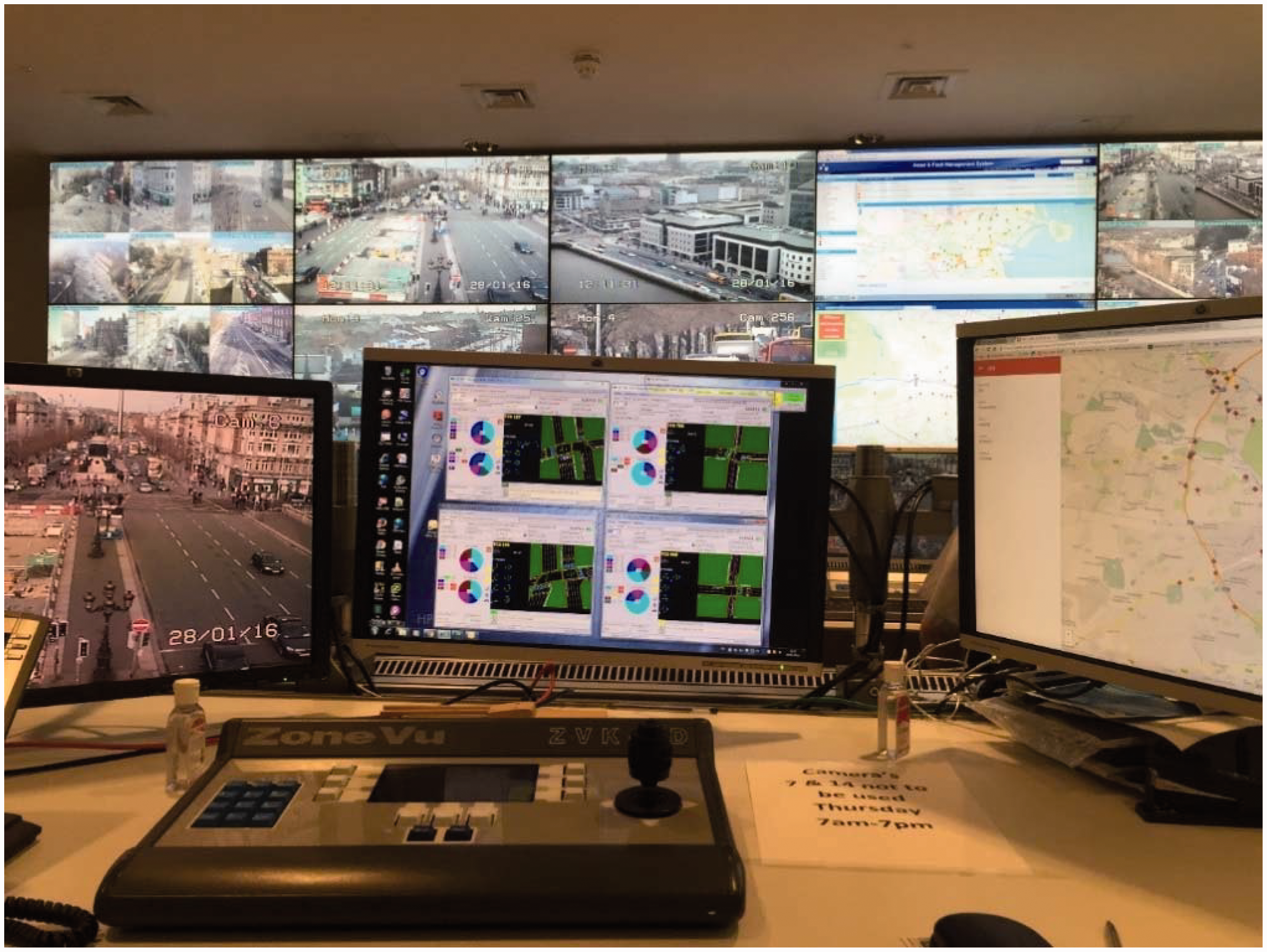
The TMIC is a busy, time-critical environment, with its own overlapping and intertwining
everyday, work, machinic and algorithmic polyrhythms operating on different temporal
cycles: the peaks of morning and evening rush-hour; people entering or leaving the room at
breaks or as shifts change; the voice and music on the radio; the operators typing at
keyboards and switching between cameras; and hurried conversations or jokes and the
sharing of screens as a situation unfolds. At all times, real-time information is flowing
into the centre from a fixed network of 380 CCTV cameras, 800 sensors (induction loops), a
small number of Traffic Cams (traffic sensing cameras) used when induction loops are
faulty or the road surface is not suitable for them, a mobile network of approximately
1,000 bus transponders (controllers can also directly contact drivers if needed; see Figure 2), phone calls and messages by
the public to radio stations and the operators, and social media posts, which contingently
and relationally shaping the core patterns of activity. At the centre of this activity is
the adaptive traffic management system, Sydney Coordinated Adaptive Traffic System
(SCATS). Real-time visualization of Dublin public transportation vehicles; yellow dots: Luas
trams, blue dots: buses (source: Travic).
SCATS is an automated and adaptive system for managing the flow of traffic through a
city. It synchronises traffic lights automatically, calculating the timing of signal
cycles and phases at junctions depending on traffic conditions in order to ensure the
optimal flow of vehicles and minimize congestion and manage incidents. In so doing, it
dynamically manage the polyrhythms of road transportation and pedestrian crossings. A
cycle is the wait time at a junction and is subdivided into phases for different
directions and types (e.g., vehicles, cycles, pedestrians) of flow. It is adaptive in the
sense that the system automatically adjusts the cycles and phases dependent on a set of
programmed rules and the volume of traffic in previous cycles and phases. As McCann (2014: 8) details: ‘SCATS has a hierarchical structure, featuring two distinct levels or layers of
control: strategic and tactical. At the tactical level, control is undertaken by the
local controller, allowing green phases to be terminated early and omitting phases for
which there is no demand. Decisions are made based on information from vehicle
detectors at the junction. At the strategic level, the regional computers use flow and
occupancy data collected from vehicle detectors to give coordination between groups of
junctions. Optimum cycle length, phase splits, and offsets are determined on an area
basis, and not just for one junction.’
Across the subsystems and system, the adjustment of time is based on the degree of saturation (DS), a traffic demand measure, and managed strategically at a regional computer. The DS algorithm measures how effectively the road is used and what should be the maximum flow allowed based on the number of vehicles flowing through a junction in a given time period. The DS indicates if the road usage is under or over-saturated, which is then used by SCATS to self-calibrate. 1
As explained by the centre manager: The SCAT system is set up with the various different phases, the various different
approaches it can run so it can run the main road, side road, pedestrian, right turns,
whatever, so that is all set up by the staff here. That is programmed into the traffic
controller. When the traffic controller gets switched on then there is an initial set
of times, but once it gets that initial set of timings, SCATS itself will start to
calibrate to the traffic flow. So it self-calibrates to the traffic
flow. And then what it is looking to do is it is looking to equalize, to balance the
competing demands at junctions. So that is the first thing it is trying to do. The
second thing is, depending on where those junctions are, we may then decide they
should be linked to each other to provide progressional flow from one to the other. So
it has got to maintain coordination with its neighbors. […] During the heavy, busy
hours, you might have a lot of junctions along the road all linked to each other for
cordination purposes, but as the traffic need dies down they could revert back to
smaller and smaller clusters of traffic controllers who just respond more to their
local needs, so they perform better just at their local needs. (Senior executive
officer #1, Local Authority, our emphasis) ‘So then that means that throughout the day when it is not busy the cycle goes
between 60 and 80 seconds which just means that if a person is waiting at the side of
the road they are not waiting too long, or the people at the side roads are not
waiting too long. Because if you have everything at 120 and all the additional [time]
goes to the main road you could be sitting on the side road for maybe 80 seconds which
is a very long time.’ (Senior execuive officer #2, Local Authority) Four month average of traffic flow through a junction phase.
On the management side, operators can intervene and override the original SCATS settings,
as well as its present conditions. Figure
4 shows the SCATs interface as interacted with by a controller, with the
right-hand part of the screen showing a junction and its phases, and the left hand part
the length of time for each phase. Interventions are circumscribed by the configuration of
the system by ITS staff, which in turn refer to the Traffic Signs Manual by the National
Roads Authority,
3
which
gives rules on the minimum and maximum times for phases. If, for example, operators try to
go below the minimum safety times for green or red time on a different phase SCATS will
automatically override the modification attempt with the original configuration: We have a number of rules and a number of different elements that you do, so you draw
a diagram of what your phasing is going to be, you then define what signal groups can
run at the same time as the other, you give basic timings, you give minimal times for
your pedestrian crossings, you calculate what the critical collision point is, so what
phases. How long the inter-green time has been the different phases and any other
requirements that you want to have, i.e. if you want phases to be allowed to be
controlled by different factors, so if you turn on switches or turn on different
things, different things happen. (Senior executive officer #2, Local Authority) SCATS interface, the pie charts represent the cycles and each colored slice of
the different phases and the proportional time allocation. SCATS: Sydney
Coordinated Adaptive Traffic System. Real-time passenger information sign at a bus stop. Travel times for selected road segments, available bikes in bike-share stations,
and available car parking spaces as presented in the Dublin Dashboard (http://www.dublindashboard.ie/pages/DublinTravel).


Sound monitoring and modelling
In 2002 the EU Environmental Noise Directive (2002/49/EC
7
) was issued, designed to measure noise
pollution levels in urban areas and on major roads and to trigger necessary noise
reduction measures. The directive requires member states to monitor noise levels and share
these with the public, and prepare and publish every five years noise maps and noise
management action plans. The directive was enshrined in Irish law as the Environmental
Noise Regulations (Statutory Instrument No. 140 of 2006). As a consequence, Dublin City
Council (DCC) (as well as the other three Dublin local authorities) is obliged to measure,
model and publish noise levels across its jurisdiction. DCC sub-contracts this service to
a private, Dublin-based start-up company, Sonitus Systems, who deploy an Internet of
Things solution using networked sound sensors located in 14 locations (40 across the city
as a whole). The sound levels recorded by the monitoring stations are displayed via an
interactive map
8
and
specific site graphs,
9
enabling the public to read daily and longer-term sound levels for each station, and
compare different locations (see Figure
7). As one our interviewees explained: ‘[O]ur system is constantly measuring noise levels, 24/7, it makes an average every
five minutes, or every five minutes it logs a reading, and then it uploads that
automatically to our server. And we take all that data coming in, a reading every five
minutes from 40 sites all over the city, and we turn that into useful information
about what is happening in areas around the city by processing it, by averaging it, by
comparing it with other sites and by providing a set of tools online to let either our
customer or the general public analyze what is happening one day to the next, over
time, and look at it in longer-term trends over time. (Start-up entrepreneur #2) Sound levels at Drumcondra Library, Dublin. Noise model for part of Dublin (source: http://dublincitynoise.sonitussystems.com/noise-maps.php).

Here, quite literally we have a set of algorhythms at work, algorithmically measuring,
processing and analyzing urban sound and its rhythms. As with the traffic management
system, the rhythms detected are affected by calibration, initial settings and the
equipment used. As one of our interviewees describes with respect to an air quality sensor network: Interviewee: It takes time to understand whether sensors work or not. You need to
choose the interval in which you retrieve the data. Because if you retrieve them at
the second scale, you have plenty of information, but there also can be much noise. If
you retrieve them at the hour scale it is more normal but you can lose information, so
you need to find a compromise, the right balance. Interviewer: Also in relation with the times of the city: morning, peak hours,
evening… Interviewee: Exactly. Then the higher the resolution, the higher the consumption of
battery; the more you keep data in the flashcard, the more you have to transmit them.
There is a whole series of compromises you need to deal with. (Environmental engineer,
University)
Discussion and conclusions: Algorhythmic governance, refrains and rhythm-making
The concept of algorhythmic governance expresses the existence of scalable dynamics generated by the interplay of calibration and repetition that create refrains that make computation, management and policies accountable and actionable. Rhythm-making takes place in different organizations and they are ongoing, open, dispersed, loosely connected, performative, prescriptive and manipulable. In rhythmanalytical terms, the SCATS software and the operators in the TMIC, and the Sonitus sound monitoring network and sound modellers, are undertaking rhythmanalysis – that is, they are seeking to measure and reveal the polyrhythms of the city. But they are also rhythm-makers, in that they actively seek to mediate and calibrate repetitions and rhythms in the world – to try and minimize difference and arrhythmia (disruptive, out-of-sync disjunctions) and produce eurhythmia (harmonious, stable, familiar refrain) which in turn produces further difference and possible arrhythmia enacting particular (and unstable) space-times. Similarly, people who access the data produced within both domains through apps, websites and on-street signs seek to undertake their own rhythmanalysis that shapes their space-time decision-making, and whose subsequent actions collectively and cumulatively alter the rhythms of the city.
Our analysis highlights that while both the traffic control room and the sound network enact algorhythmic governance, it is clear that they do so in different ways. Both systems are highly automated with respect to data generation, transmission, processing, analysis and sharing. They differ, however, with respect to their adaptiveness and action.
SCATS is an adaptive system in two respects. First, the regulation of the phases and cycles adapts to the demand at junctions and across the road network and certain priority rules. This process is a form of automated management as defined by Dodge and Kitchin (2007), in which the system makes and enacts automated, automatic and automated decisions. Second, unlike automated management in its pure form, a human controller can intervene, within certain parameters, to over-ride the automated adaptions and re-calibrate the system. In this sense, the system is one of human-on-the-loop (rather than human-off-the-loop), wherein the system works in an automated fashion but under the watch of a human controller who can intervene (Docherty, 2012). Moreover, the system enacts real-time actions and has real-time effects, with the phases and cycles of traffic lights at key junctions being dynamically changed. As a result, every two cycles the length of time vehicles wait at junction updates; the system has immediate material actions designed to produce a desired space-time rhythm. However, due to the polyrhythmic and complex nature of cities, and the mutable cyclicality and linearity of algorhythms, the results are never a perfect flow, but rather a semi-optimal concatenation that seeks to stave off inertia or chaos.
In contrast, the sound network is fixed and non-adaptive beyond periodic system upgrades. The system simply generates sensor measurements, transmits them back to a central database, and updates a set of web-based visualizations. Moreover, it engenders no immediate material action. Instead, the data is used to build up sound profiles of key locations over time and is combined with other data to produce sound models for the city. These data and models are then used as the basis for identifying and implementing noise reduction policies. In other words, algorhythms form the basis of measuring and monitoring noise levels, and for justifying governance interventions, but the system does not directly intervene in action. As such, the noise monitoring networks constitutes a form of algorhythmic governance that is not yet fully automated or self-calibrating.
The two case studies thus reveal two different forms of algorhythmic governance which each enact a different type of rhythmanalysis and perform different kinds of rhythm-making. It is our contention that there are many more forms of algorhythmic governance. The most obvious third form is one where humans are off-the-loop, wherein an algorhythmic system has been delegated the responsibility and authority to process data and make decisions and act upon them without any human input or interaction (Docherty, 2012). Indeed, there is a need to explore further the ways in which algorhythmic governance is co-created by algorithms and actors and the ways in which each shapes the other. Within each form of algorhythmic governance, there will be variability in how the mode of governance of operates and how it is actioned, dependent on a number of factors – data generated, technology (e.g., sensors used, network infrastructure, battery life), epistemic practices, epistemology (mode of analysis, visualization), and forms of regulation and control exercised (in the case of human-off-the-loop varying from automated fines, to altering phases and cycles, to killing people as with military drones).
In each case, a combination of heterogeneous and layered timings and devices, and practices of continuous maintenance and calibration designed to balance and equalize repetitions and minimize difference, is enacted. As our case studies highlight, a number of other issues are also raised. For example, how and where the networks of sensors are set up and calibrated: decisions that establish a traffic cycle of 2 minutes with different phases, or a time frequency of 5 minutes, affects the actionability of data and the capability of actors to monitor, detect and intervene. The sensitivity of sensors, local conditions, scientific norms and handling procedures can add noise to the measurements, which can also be biased and contain error (Kitchin et al., 2015). Indeed, there are always concerns over data fidelity, precision, representativeness, cleanliness, consistency, and reliability of measurements, and the extent to which these affect calculations. Moreover, calibration and filtering the signal from noise is reliant on computational procedures to extract meaningful information, which influence the derived data. And given the polyrhythms and unfolding nature of cities, there is no established or stable norm against which such calibrations are being made; to degree then, adaptive systems such as traffic management are self-organizing, with system rules and human interventions based on a rule of thumb garnered from controller experience.
There are also questions of transparency and accountability with respect to such algorhythmic governance. Within automated systems, the rules for acting on data and making decisions is largely black-boxed, especially for ordinary citizens. Yet it is known that programmers routinely, if unintentionally, change the substance of rules when translating them into computer code, thus altering the regulatory work they do (Citron, 2007–2008). Moreover, weak algorithms and dirty or error-prone data can generate high rates of false positives and baseless decision making. As a result, the result, the ‘transparency, accuracy, and political accountability of administrative rulemaking’ are potentially lost and are difficult to challenge (Citron, 2007–2008: 1254).
To conclude, there is clearly much more research to be undertaken to more fully chart the
nature, workings and forms of algorhythmic governance, the various issues shaping and
arising from their use, and how they perform rhythmanalysis and rhythm-work in order to
mediate the polymorphic temporal rhythms of urban life. Indeed, the city itself has an
institutional and historical ‘heartbeat’ that interact and is difficult to attune with the
real-time one of smart urbanism, as one of our interviewee remarked: When you think about the physical city you have to think in terms of the pulse rate
being 30 years, a heartbeat in Dublin terms is 30 years because that is how long it
takes to conceive of and build a bridge. You are looking at timelines that are not
driven by electronic Internet time clocks.… Whereas you talk through problems like
homelessness… and that is a very immediate sharp focus problem, depending on government
policy it may be more or less of a problem in a particular month, year and so on. So
there are many different timelines and tracks within a city. (Manager, large
company)
Footnotes
Acknowledgements
We would like to thank our interviewees and the staff of the traffic control room for their help in conducting the empirical research and answering additional questions. We are also grateful to Charlotte Cabasse Mazel, Marcus Owen, Beth Reddy as well as the editors and the anonymous reviewers for their helpful comments and constructive feedback.
Declaration of conflicting interests
The author(s) declared no potential conflicts of interest with respect to the research, authorship, and/or publication of this article.
Funding
The author(s) disclosed receipt of the following financial support for the research, authorship, and/or publication of this article: the Programmable City project, funded by a European Research Council Advanced Investigator award (ERC-2012-AdG-323636-SOFTCITY).