




Abstract
This paper explores the politics of representing events in the world in the form of data points, data sets, or data associations. Data collection involves an act of seeing and recording something that was previously hidden and possibly unnamed. The incidences included in a data set are not random or unrelated but stand for coherent, classifiable phenomena in the world. Moreover, for data to have an impact on law and policy, such information must be seen as actionable, that is, the aggregated data must show people both something they can perceive and something that demands interrogation, explanation, or resolution. Actionable data problematize the taken-for-granted order of society by pointing to questions or imbalances that can be corrected or rectified, or simply better understood, through systematic compilations of occurrences, frequencies, distributions, or correlations. The paper describes and analyzes three different modes of authorized seeing that render data on global environmental phenomena such as climate change both visible and actionable. It argues that the political force of environmental data compilations derives from the divergent epistemological standpoints and expert practices associated with producing views from nowhere, everywhere, and somewhere.
Numbers and justice have long kept company, as the paired words counting and accounting attest. If you can count something, you can also account for it (Desrosières, 1991; Porter, 1995). Enumerating is thought to be the most objective instrument we have for holding those in power accountable, whether for financial misdeeds in a company (Power, 1997), civilian casualties in conflict zones (Seybolt et al., 2013), police brutality in a community, health disparities around a country, pollution hotspots across regions, or harms caused by the world’s changing climate (IPCC, 2014). In these and countless other situations, good societies have governed themselves by acknowledging how many instances there are of questionable conduct, where they took place, who is responsible for them, and how they relate to other norms and values of human concern.
Inevitably, then, today’s explosion of data, a by-product of the computer revolution, has created new conjunctions between numbers and norms. Social and natural phenomena can be counted and stored in previously unimaginable quantities and on ever larger scales, allowing correlations to be made and patterns to be discerned where ignorance, speculation, and conjecture formerly prevailed. Phenomena of potential normative interest that may once have escaped detection—because they were too intangible, too dispersed, too costly to measure, or too jurisdictionally bounded, and hence not anyone’s duty to call to someone else’s attention—have become less elusive. Across a host of legal and policy domains, from environmental degradation to human rights abuses, once undetectable phenomena are now being recorded, their distributions mapped and plotted, and their interconnections investigated, laying the groundwork for new claims and appeals to conscience, if not to demands for formal justice. 1 Simultaneously, it has become possible to combine inputs from multiple large data sources to generate new hypotheses about the way the world works and prescriptions for how to act upon that knowledge.
The institutional capacity to count and correlate has also exploded. Compiling big data was once the business of states. The bureaucratic resources of national governments were needed to produce census-like counts of populations, biological species, or more complex social and natural phenomena (e.g., poverty, violence, drug abuse, educational attainments, desertification, or antimicrobial resistance). States, moreover, had an interest in reliable enumerations of where people and goods could be found for purposes of population management, domestic security, health protection (Foucault, 2007, 2010), tax collection (Scott, 1998), or calling people up for military service. Infamously, Germany’s Nazi regime used Herman Hollerith’s tabulating machine, originally developed in response to an 1888 challenge from the US Census Bureau, 2 to record data on the Jewish population in the 1930s; one such machine is among the first objects to greet the visitor to the US Holocaust Memorial Museum in Washington, D.C. Today, with the ease of crowd-sourcing and the ubiquity of recording instruments of all kinds, many nonstate actors have also acquired the means to become de facto census takers. Indeed, one no longer needs governments to generate imagined communities (Anderson, 1983) that perceive themselves or are perceived to be bound together through new forms of data-associated identity and sociality—data about shared genetic markers (Rabinow, 1992), socioeconomic status (Picketty, 2014), disease risk factors, toxic exposures, protection of biological diversity (Waterton et al., 2013), or purchasing preferences, to name just a few.
Early commentary on the social justice implications of the big data age tended to oscillate between celebratory and cautionary: celebration focused on bringing formerly invisible clusters of inequality and injustice to light; caution dwelled instead on the loss of control that comes from individuals being turned into data points and hence into governable subjects (US PCAST, 2014)—through unwitting transfers of personal information to big corporations, through invasions of privacy or errors of classification by public and private institutions of governmentality (Foucault, 1978), and through algorithms whose accuracy and lawfulness are not open to public questioning. In this paper, I take a somewhat different tack, asking not whether data are always reliable as reported (clearly, they are not), nor whether modes of data collection and interpretation can give rise to injustice claims (clearly, they can), but rather about the epistemic presumptions that shape the making of data in the first place. This, then, is not an inquiry into the validity of particular data claims or correlations. It is a more foundational exploration of how power works in rerepresenting things that happen in the world in the form of data points, data sets, or data associations.
Any form of data collection involves, to begin with, an act of seeing and recording something that was previously hidden and possibly nameless. Random observations do not add up to data; the aggregated incidences represented by a data set have to have meaning, as standing for a classifiable, coherent phenomenon in the world. At the same time, for data to have an impact on law and policy, information must be seen as actionable, that is, numbers or other quantitative representations, such as charts and graphs, must show people both something actual and something that begs to be investigated, explained, or solved. In short, if a data set is to elicit a social response, knowledge of something that matters and principles for understanding why it matters must be generated together, or coproduced (Jasanoff, 2004). Put still differently, to be actionable, data must be seen as problematizing the taken-for-granted order of society (on problematization, see Foucault, 1998): by pointing to questions or imbalances that can, in the ideal case, be corrected or rectified, or simply better understood, through the systematic compilation of occurrences, frequencies, distributions, or correlations that make up a meaningful data set.
Disputes about the significance or relevance of data frequently cluster around the legitimacy of the processes of making the invisible visible. Who authorized the seer and is what the seer shows persuasive enough to compel remedial action? Such questions may focus on simple acts of registering (as with births, deaths, or size of populations); alternatively, they may relate to the reliability of technical instruments, such as algorithms, that presume to find causally significant correlations within masses of data (as with predictions of life expectancy or voting behavior based on subjects’ personal characteristics). Seeing with data, in other words, is a means of making sense of complexity, for discovering stories that matter in a field of infinite happenings, as when a world of randomly colored points resolves itself into figure and ground through the artistry of the pointillist painter. In this paper, I ask how practices of authorized seeing are organized around environmental degradation, a focal point for the evolution of the very idea of “the global” over the past century, and hence a topic of key concern for global governance (Jasanoff, 2001; Jasanoff and Martello, 2004; Miller and Edwards, 2001). The framing question for the paper can be put this way: What is made visible in diverse practices of environmental data collection and what, by contrast, remains unperceived? In effect, this is an exploration of the politics and expert practices of collective witnessing of environmental problems, through data generation and pattern recognition, especially at the supranational level.
A well-known example of persuasive environmental data collection is the monthly record of atmospheric carbon dioxide from Hawaii’s Mauna Loa observatory, showing a steady increase from about 310 ppm in 1955 to about 400 ppm by 2015. Correlated with the rise in global mean temperatures, the Mauna Loa data helped identify carbon dioxide as a proximate cause of climate change. In this case, illumination came through measuring a particular thing—atmospheric carbon dioxide—regularly over time. This is the familiar technique of epidemiology, a science that depends on producing counts of noteworthy events, often infectious diseases or human and animal mortality, whose ontologies are relatively unquestioned, even if blurred at the margins. 3 Sometimes, however, the thing to be counted is less well delineated in advance: for example, mood disorders, poverty, cybercrime, even acts of terrorism or war. In these cases choices must be made as to which instances will be taken as the same, or commensurated (Espeland, 1998), so that they can be meaningfully grouped together under a single ontological umbrella and accepted as representing the same object or phenomenon. Such sameness–difference judgments can be made through inspection when a census or similar count compiles a single kind of thing, like gun deaths in an inner city; or it may be the watchful eye of a mathematical algorithm that does the sorting and grouping when multiple data sets are put together to study complex phenomena, such as unlawful movements of money or transactions. In both cases, the result is a visibilizing of what was concealed before, or to use the parallel auditory metaphor, an extraction of signal from noise. In still other cases, the data and the objects they claim to represent are one and the same, in that the object exists only through the application of agreed-upon methods of observation and measurement. This category includes many of the modern state’s objects of governance, such as the economy, growth, the gross domestic product, bull and bear markets, education, public health, and indeed the environment.
Regimes of sight.

Each also carries its own mechanisms of legitimation, including discourses of valid seeing and practices of consensus building. The first is the view from nowhere. This is the gaze of science as traditionally imagined: impartial, objective, seeing or making sense of facts as if from a neutral viewpoint that renders what is seen devoid of distortion and human bias. The second is the view from everywhere. This is the typical gaze of expert advisory bodies in modern democracies, claiming to represent all relevant aspects of the problem put before them, and capable of aggregating them into a credible, reliable whole. The third, and least conventionally scientific, is the view from somewhere. This is the subjective gaze of the eyewitness, and even more the experienced knower, who has not only seen but possibly endured in person the consequences of the facts attested to. Here, legitimacy derives from discourses of authenticity and, often, suffering. What counts as good data within each regime of seeing, counting, and accounting for depends on prior normative choices about such matters as what is worth recording, who is best positioned to collect and report data, and what forms of analysis and representation are taken to be compelling.
Building on this base, I trace three ways in which the “global environment” emerged as an actionable object for law and policy in the last quarter of the 20th century, along with new modes of counting and accountability. Climate change provides a paradigmatic case, as a global environmental phenomenon constituted through data, and through the proliferation of data institutions and instruments that have underwritten this issue of common human concern. Using contrasting examples from the United States, India, and Europe, I explore what is at stake when different modes of “seeing” phenomena such as climate change come into contact and, occasionally, conflict. Whose seeing counts, under which rules of the game, and what gets relegated to the margins of invisibility and inaction? Which perspective dominates in a given context is a matter of institutional choice or habit; however, although private organizations such as museums may choose to represent a data association simultaneously in multiple ways, powerful public agencies are often much more constrained by law and traditions of administrative practice. To illustrate how perspectival differences matter, however, let us first take a brief detour through a well-known nongovernmental organization, the International Committee of the Red Cross (ICRC), which deploys all three modes of seeing in order to gain public support for another object of global concern: human rights. This case nicely illustrates the epistemic and normative stakes associated with each representational approach, as well as the power that derives from representing the same issue through all three strategies of data gathering.
Strategic representations: The Red Cross and the universal victim
Opened in Geneva in 1988, the ICRC’s Red Cross and Red Crescent Museum enrolls multiple viewpoints and modes of representation to make a transnational social problem—in this case human rights abuses—visible and actionable. Over its 150 years of existence, the ICRC has attained a status akin to that of many international governmental agencies, although it positions itself largely outside politics: 4 its flag is universally known, the safety of its workers generally respected, and its presence tolerated even in the most extreme conflict situations. The ICRC museum seeks to represent its parent agency as an unimpeachable authority on the protection of human rights, and it does so in part by embracing (just as science does) the rhetoric of neutrality. Indeed, of the ICRC’s seven governing principles, four are strikingly similar to the signature norms of science described by the sociologist Robert Merton—impartiality, neutrality, independence, and universalism (Merton, 1973). Criticized as mere rhetoric and divorced from scientists’ actual practices (Mulkay, 1976), these self-proclaimed norms have nonetheless effectively shielded modern science against charges of bias and partiality. Yet the museum skillfully combines in its displays all three ideal–typical regimes of data visualization described above, implicitly acknowledging that data can achieve universality not only through the impersonal mode of aggregation and statistical analysis characteristic of modern science and the view from nowhere, but also through what the historian John Forrester (1996) described as “thinking in cases.” This is the narrative tactic familiar to journalists and writers of fiction: making an individual case appear universal, through appeals to empathy, so that one person’s experience becomes in effect everyone’s story (Jasanoff, 2010).
The ICRC’s aim is to draw visitors into supporting the project of international humanitarian relief regardless what prior ideas of rights, abuses, human needs, or political legitimacy the viewer brought into the museum’s exhibition rooms. One display uses historical records on some two million World War I prisoners from the Western Front to create the quintessential view-from-nowhere, big data resource. The ICRC’s neutrality during the war made its International Prisoners-of-War Agency a credible collection point for information sent by all combatant states. For each reported prisoner, the agency created a file card to enable indexing by nationality and military or civilian status. Today, long boxes of those cards, a veritable lost and found of bygone human identities, line shelf upon shelf in the museum, mute witnesses to a cataclysm that in four short years tore apart millions upon millions of individual lives and families, along with the empires that housed them. The 7-million item card file, now digitized, was at one time a treasure trove for agonized relatives seeking information about husbands, sons, and fathers missing in action. 5 It became a parastatal database, born of the residual desire of nations that had sleepwalked into disaster not to abandon common humanity, by giving notice of the fate of the captured to a private relief agency turned into data central. Today, that record still has the power to impress, through the sheer number of lives whose residues are collected in those drawers of the dead.
At the same time, the museum positions the ICRC as offering a view from everywhere, with the capacity to encompass the entire condition of disaster-stricken humanity within its universally therapeutic gaze. Even the name of the museum speaks to inclusion, appropriating two of the world’s best known religious symbols, the cross and the crescent, to signal religious ecumenicism. 6 Inside, too, the exhibits strive to draw together an entire world of experience, from every region where war has claimed victims, dictatorial rulers have inflicted torture, or natural disasters have driven people from shelter and home. One exhibit even invites visitors to play the role of the canonical emergency management expert by imagining the right responses to scenarios from an unfolding natural disaster and observing the results of their choices. In this game, the data serves to generate universally plausible scenarios and responses; the purpose is not to record, let alone commemorate, individual or idiosyncratic experiences.
Still other displays in the museum follow the third approach, of personal witnessing and storytelling. The visitor enters the museum through a darkened Hall of Witnesses, where a dozen brightly lit, life-sized but mute figures look out at viewers with eyes that move, as if inviting them to start a conversation. Later in the exhibition, these same figures all acquire voice, telling their stories in their own native languages through an audio guide activated by placing the palm of one’s hand on the hand of the image. These individual victims represent the varieties of injustice and injury the ICRC is called upon to remedy the world over. They serve as personalized conduits through a display that some have criticized as putting style above substance. Another device, again foregrounding the situated somewhere of individual experience, is a roomful of folk art objects, often intricate and beautiful, painstakingly crafted in captivity by political prisoners. These were presented to the ICRC as tokens of gratitude, as well as material testaments to the human capacity for survival and redemption under the worst of circumstances.
The ICRC’s museum-makers had the luxury of shopping the world for exhibition architects who would help them realize a multilayered approach to public fact-making. Three designers, from Brazil, Burkina Faso, and Japan, created environments that juxtapose rather than separate different styles of presenting data on human rights abuses. There was no need in the museum to favor any one register above another. Indeed, the museum benefits from appealing to as wide a range of sympathies by as many means as possible. The museum is not, after all, only a pedagogical device for raising awareness on human rights but a public statement designed to build support for the ICRC and feed its constant need for infusions of political, cultural, and financial capital. The use of multiple registers allows the museum to reach out to deeper, more diverse pockets. Very different constraints and opportunities come into play when political actors with diverse institutional histories and cultures, most particularly national governments, take up projects of data production to define public problems and motivate public action. Such political fact-making often reflects choices about which standpoint to adopt in generating data, but those choices are conditioned in part by preexisting legal and policy cultures.
Making public information
Both political analysis and political activism have tended to focus more on making information public (i.e., ensuring transparency, disseminating known facts) than on making public information (i.e., producing information germane to solving public problems). This orientation reflects the extent to which, in modernity, information, along with its close correlate data, has been taken for granted as a set of truth claims about the way the world is. Information, as conventionally understood, quite simply is what is: it consists of valid observations about what the world is like. Data represents a specific form of information, a compilation of particular types of facts designed to shed light on identifiable issues or problems. As representations of reality, both public information and public data were seen until recently as lying to some extent outside the normal domains of political inquiry. What mattered more to democratic politics was to make sure that the information needed for rational self-governance was not concealed or unjustly controlled by those in power—hence the recurrent campaigns for transparency and the right to know in many democratic societies. Economists, too, have long insisted that open access to information is needed to level the playing field for actors expected to make rational choices. In that market-based logic, the emphasis again is on making information available as a shared commodity, not on the preconditions for producing that commodity in the first place. But as scholarship on science and technology has repeatedly shown (Jasanoff et al., 1995), information is a social construct—not a mirror of the world but a human-made representation of matters in that world. Under this reading, the production of information for public purposes is embedded in social relations that raise their own challenges for democracy and legitimacy. Since informational claims carry enormous persuasive power, how such claims are constructed, how they are made robust, and how they achieve public buy-in all become topics of critical concern for law and politics. The information wars of the early 21st century—already dubbed the era of posttruth politics—have brought home this point as never before.
Information production is often intrusive, even extractive, and can be costly on multiple dimensions. Even the most benign forms of data compilation require observation, and some high-tech methods such as remote sensing are so expensive that access to their use tends to be limited. Someone must look steadily at something and systematically record the results in order to generate numerical or other representations that count as actionable information for public purposes. Observation may border on invasion of privacy if, for example, it relates to behavior within the home or in other protected spaces, 7 or in intimate interpersonal relations such as those involving sexuality or parental conduct, or in strictly disciplined environments such as hospitals, prisons, and schoolrooms. Observation can be unethical and abusive when there is an unbridgeable power differential between observer and observed (Visvanathan, 1997); or the act of observation inflicts harm on monitored persons or groups, as in biomedical research and experimentation (Foucault, 2010; Proctor, 1990). From Nazi experimentation through the notorious Tuskegee syphilis studies in Alabama and the infamous treatment of prisoners by US soldiers at Iraq’s Abu Ghraib prison, observational environments have repeatedly demonstrated the potential for violence in translating unorganized, possibly unauthorized, seeing into data carrying the stamps of scientific method and objectivity.
It should be noted that intrusiveness does not disappear simply because, as in many contemporary uses of multiple large data sets, the impersonal “eye” of an algorithm takes over from the more familiar intrusion of a human eye or camera lens. Though conceptualized in mathematical terms, an algorithm does the same kind of work that a human eye might do in principle, combing and raking through masses of information to discern patterned activities and transactions that would not arouse notice unless sorted and aggregated. Power most obviously undergirds the mathematized search when it is conducted at the behest of a government or other authority, just as power guided the traditional panoptic gaze of the state in its quest for legibility (Scott, 1998). Power is exercised in the design of algorithms, in the choice of conducts to be identified or punished, and in decisions to deploy such instruments, particularly to record the unwitting traces, or “exhaust,” left by individuals through their increasingly frequent interactions in the digital environment.
Yet, the story of data compilation can also be told in positive terms as one of growth in the capacity of human societies to generate systematic knowledge about themselves. Data can empower ruling institutions to act, proactively and protectively, for society as a whole on the basis of facts rather than mere conjecture (Desrosières, 1991; Foucault, 2007; Hacking, 1983; Porter, 1995). The very notion of an economy in modern times depends on knowledge of the behavior of collectives at high levels of aggregation (Mitchell, 2002; Scott, 1998). Most big problems that states and international organizations have taken upon themselves—poverty, malnutrition, infant mortality, epidemics, refugees, loss of biodiversity, sustainability, or the global burden of disease—would be neither visible nor actionable unless millions of individuals all over the world had agreed to open up some aspects of their lives to being monitored and counted. Becoming objects of observation seems to be the price we pay for being members of societies attentive to collective well-being. A certain diminishing of control over the self, through information provision, is the flip side of belonging to a well-ordered community. One might call this the Hobbesian bargain—giving up individual informational sovereignty in return for living lives that are not doomed to be solitary, poor, nasty, brutish, or short.
Not surprisingly, then, a goodly portion of the legal imagination of modern societies has been directed toward ensuring that powerful acts of information generation and use by states and quasi-states are carried out in ways that do not violate fundamental democratic norms of fairness, transparency, and accountability. There is no unanimity, however, in law or political culture on the precise nature of these norms or the means by which they are articulated into practice. As I have documented in detail elsewhere (Jasanoff, 2005), political cultures today derive their distinctive flavor in part from stylized, culturally legitimated approaches to producing public facts and public reason. I refer to these ways of knowing as civic epistemologies. Understanding these very general patterns allows us to address a number of key questions about political accountability for data. Who is responsible for fact-gathering and who sets the standards of credibility and reliability for such facts? How are datasets mined, how are disputes resolved, and what forms of reasoning are held to be adequate for these purposes? What recourse is there for those whose knowledge is excluded from processes of making public information, whether by neglect or intention? These questions arise in all but the most moribund or otherwise challenged and dysfunctional political systems, but the answers are disparate.
Comparative research on public controversies involving science and technology indicates that, far from being merely abstract models of institutionalized ways of seeing, the three epistemic standpoints described in Table 1 have been reproduced in the knowledge practices of modern states. The US approach to making public facts, for example, has tended to align closely with the view-from-nowhere model. Much political energy is devoted to securing the impartiality of science through institutional practices that aim to demarcate science from politics (Jasanoff, 1990); yet political adversaries regularly criticize each other’s policy positions on the ground that the science underlying them is biased or flawed in ways that reflect subjective preferences. This ritual of continual appeals to science for legitimation, coupled with extreme skepticism toward opponents’ scientific arguments, has produced a policy culture marked as much by exceptionally high investment of resources in producing new public knowledge as by protracted technical controversies about the reliability of such knowledge (Nelkin, 1979). Conflicts erupt around attempts to introduce new technologies, such as genetically modified crops or animals, as well as to regulate older ones, such as nuclear or coal-fired power plants. Uniquely in the United States, party politics—specifically, the clash between Democratic and Republican imaginaries of the state’s role vis-à-vis society—has come to be identified with positions for and against science (Krugman, 2015; Mooney, 2012). Adherents of both parties, however, call upon science to settle, or unsettle, public problematizations, as seen in long-running debates over evolutionary theory (Numbers, 1992), climate change (Oreskes and Conway, 2010), and a host of less visible public health and environmental controversies (McGarity and Wagner, 2008; Michaels, 2008).
By contrast, European decision-making environments have tended to cultivate one or another version of the view from everywhere. Science generated for policy purposes is not held apart from policy-making but is often incorporated into the process of building consensus on contested issues. Scientific and technical input into policy debates thus tends to follow broader patterns of collective—rather than, as in the United States, adversarial—forms of evidence-making and reasoning (Jasanoff, 2005). In Germany, technical consensus on potentially divisive issues is typically achieved through representation of multiple interests on key advisory bodies (Lentsch and Weingart, 2011; NRC, 2007). In Britain, elite bodies play a similar consensus-building role, although trust is more often placed in tested individuals with known “safe hands” than in established social groups (as in Germany); the effect, in any case, is to generate a consensus on the facts that accommodates most important points of view and hence resists politically driven deconstruction. The result in both European nations is that the public scientific controversies that repeatedly roil the US policy scene are virtually unknown; as we will see, the climate case is no exception.
Lastly, public fact-making in India has tended to privilege the voices of experience in attesting to the nature of social problems, thus affirming the power of the view from somewhere. To be sure, state authorities in many cases claim and assert superior expertise based on their objective, scientific knowledge, but those assertions often do not command public trust; indeed, as the government undertakes exercises in biometric data collection and mass digital monitoring—such as Aadhaar, the world’s largest national identification number project—trust may diminish further. Arguments from experience, however, still carry significant weight in Indian politics, and the testimony of people personally affected by illness, displacement, or environmental degradation has generated movements that delay, if not derail, policies built on the government’s expert arguments about feasibility and need. Pertinent examples include the Chipko movement against deforestation, the anti-Narmada dam movement, and most recently the agitation against genetically modified crop plants such as brinjal. 8 In each case, public debate pitted not science against science (as so commonly in the United States), but claims of embodied understanding and experience against claims based on the nowhere of science’s impersonal observation. On the playing field of Indian politics, position-specific moral arguments and arguments based on technical knowledge intertwine in ways that have propelled to power the voices of women, farmers, rural populations, and tribal groups injured or displaced by state-sponsored development projects.
Knowing nature
Environmental threats have been explicitly and formally on the agenda of international policy since the 1972 Stockholm Conference on the Human Environment. The decades since then were marked as much or more by attempts to build up the knowledge base for concerted international action as by the actions themselves. Global environmental knowledge, of course, has been a long time in the making, and global bodies such as the World Meteorological Organization and UN agencies looking at problems of food and health have histories reaching back decades, if not centuries (Edwards, 2010; Friedman, 1989; Miller, 2015; Miller and Edwards, 2001). The period since Stockholm, however, can be seen as one of heightened recognition that environmental knowledge is not merely factual but also purposive, in that it calls for action from a planet united in its vulnerability to natural forces, even while the humanity the Earth supports is altering nature’s courses (Bonneuil and Fressoz, 2016).
International collaboration on the environment took shape for the most part without explicit agreement on how to form a compelling knowledge base for global collective action. As a result, knowledge emerged piecemeal and uncoordinated, around specific objects of concern such as desertification, biodiversity loss, high dams, and of course climate change (Jasanoff and Martello, 2004; Rayner and Malone, 1998). Scientific inputs ranged from countless national and regional efforts to study environmental problems at scales below the global to the powerful reports of the Intergovernmental Panel on Climate Change (IPCC). These efforts generated unprecedented amounts of data on environmental phenomena, along with questions about human–nature relations that seemed at times to grow only more confusing as data accumulated. Causal relations and place-specific impacts, for example, remained elusive even when the phenomena themselves were well established. Historians and anthropologists studying events as disparate as the Dust Bowl in the United States (Cronon, 1992) and deforestation in sub-Saharan Africa (Fairhead and Leach, 1996) called attention to the ambiguity of the environmental record—a record that allows multiple narratives of responsibility to be constructed in keeping with preexisting moral judgments about the kinds of behaviors that lead to crises of depletion and deprivation.
By the early 1960s, data generation to establish the existence of environmental problems began to spill out of local and national contexts, and within a few decades the planetary environment came to be seen as an object of worldwide study and concern. To some extent, new technologies for viewing Earth from airplanes (Anker, 2007), and eventually satellites (Sachs, 1999), enabled this shift of scale. New extraterrestrial standpoints for seeing the Earth gained power as they partnered with new techniques for manipulating and representing data through advanced computing and modeling (Edwards, 2010; Meadows et al., 1972). Importantly, however, technologically assisted representations of the environment formed only one component of a symmetrically coproductionist dynamic that also included parallel normative shifts: seeing Earth whole emerged hand in hand with ideologies of Cold War competition and imaginaries of panoptic, global governance (Ashley, 1983; Jasanoff, 2001). Many new scientific organizations sprang up during this period of intensifying examination by human societies of their imprint on Earth. A closer look at some of these activities not only illustrates the continued relevance of all three stylized regimes of envisioning data described above but also helps highlight the value commitments involved in each.
Views from somewhere and nowhere
One strand of the story began some 30 years ago, in 1982, when two knowledge-making organizations, situated half a world apart, in India and the United States, respectively, embarked on extraordinarily influential environmental data collection projects. The first project took shape at the New Delhi-based Center for Science and Environment (CSE), an NGO formed by the late Indian environmental activist Anil Agarwal. In 1982, CSE published its First Citizens’ Report, entitled The State of India’s Environment. Linking environment with development, as Prime Minister Indira Gandhi had insisted upon doing back at the 1972 Stockholm conference, the CSE report aimed to show how “changes in the environment have a direct impact on the lives of the people, particularly the poor, who are dependent on their immediate environment for their basic needs” (Agarwal et al., 1982: v).
The second project, also launched in 1982, was led by the World Resources Institute (WRI), whose founder James Gustave Speth enjoyed a long career of leadership in and services to environmental management. WRI’s goal was to be apolitical and independent in offering scientific expertise to policymakers. In its own terms, WRI “avoided the prevailing activist model in favor of a science and evidence-based organization.” Its contribution would be “to carry out policy research and analysis on global environmental and resource issues and their relationship to population and development goals.” Importantly for WRI: “That research and analysis had to be both scientifically sound and practical to create real change on the ground.” 9 In other words, whereas CSE sought to bring the plight of neglected populations into plainer view, WRI aimed to serve distributed global needs by building a bridge to connect expert scientific knowledge to governmental policy.
There were noteworthy points of convergence between CSE and WRI. Both organizations produced important milestones for environmental policy in the same year. Both were committed to compiling data to provoke environmental action. Both, in other words, explicitly sought to influence politics through knowledge. But beyond those commonalities, what worlds of difference! For CSE, the crucial gap was one that yawned between lived lives and official knowledge; for WRI the gap lay rather between objective knowledge and its consumers in the policy world. That divergence remains material and palpable even a generation later. The look and feel of CSE’s First Citizens’ Report speaks to its homemade, cottage-industry origins even before one dips into the content. The last page of the report’s first edition actually turns out to be the intended first page, an upside-down, hand-written list of the names of all those involved in producing the path-breaking document. Sunita Narain, Anil Agarwal’s successor as CSE’s director general, is one of those listed. The puzzle takes a moment to resolve. Between its over-sized, inexpensively finished, slightly warped, and wrinkled covers, the book was bound upside down.
Politics of knowing nature.
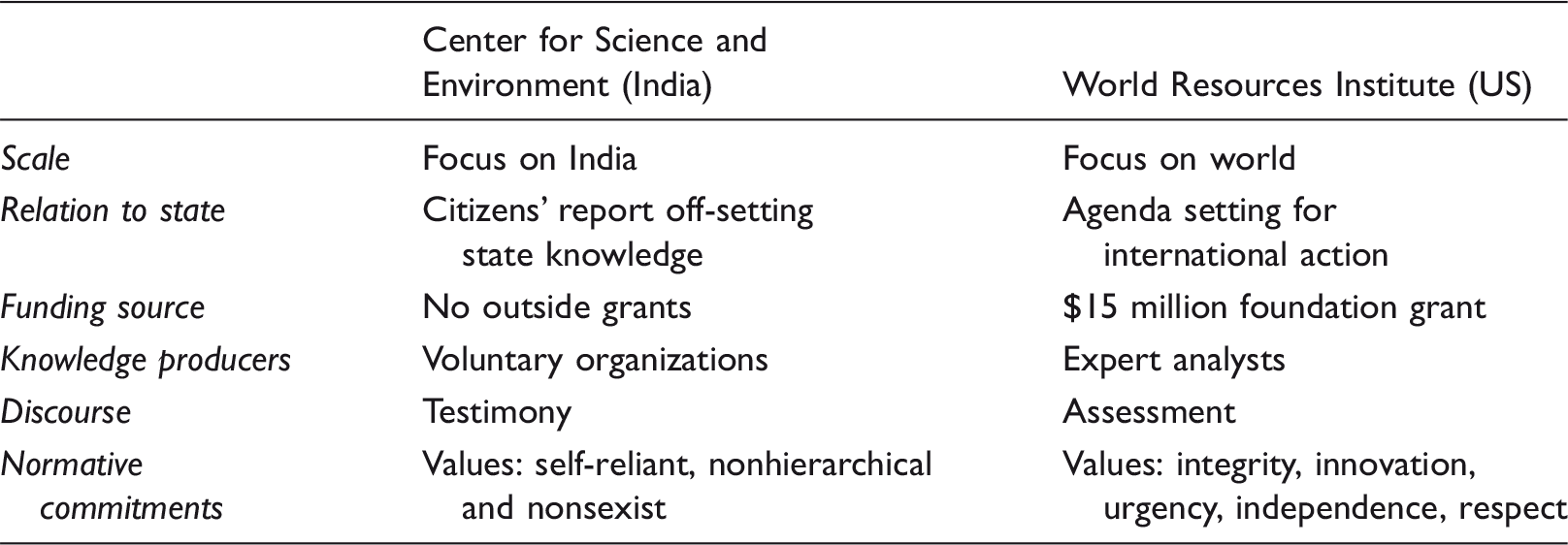
WRI’s history from the start was more technically proficient and more self-confident, and WRI saw and imagined the environment in radically different terms from the Indian NGO. Whereas CSE focused on India from the bottom-up perspective of ordinary citizens, WRI, as its name implies, focused on the world from the standpoint of a presumptively universal scientific expertise. WRI’s aim was to set the agenda for international policy organizations to pay more attention to the global environment; the problems identified by the data were by definition everybody’s problems because they spanned the planet. The Institute was launched with a $15 million dollar grant from the US-based MacArthur Foundation. It hired highly trained analysts to carry out policy-relevant assessments. Like CSE, WRI acknowledged that it had values, but these were consistent with a markedly different, globalist view of what was needed in environmental policy: not a citizens’ manifesto with an insistent political message, but an independent voice of reason standing, American-fashion, aside and apart from politics. In keeping with this stance of aloofness, WRI lists its core values on its website as “integrity, innovation, urgency, independence, and respect.” 10
Setting the CSE and WRI projects from 1982 side by side makes one point very clear (see Table 2). Data gathering about the environment can never be detached and apolitical, no matter what the gatherers may claim: it is always embedded in a series of prior assumptions that affect what we know, how we should know it, and how we put knowledge to work in securing political buy-in. For both CSE and WRI, knowledge-making was normative from the start, in ways that each explicitly acknowledged through its listing of values. How the two organizations went about producing knowledge resonated, in turn, with organization-specific understandings of how, at which scale, and by what kinds of appeals knowledge should influence policy.
These two examples point to the need to thicken descriptions of the relationship between data and politics that take as their baseline a tacit presumption of informational purity, founded on the view-from-nowhere account of science—one in which facts and values are thought not to intersect in either the production or interpretation of knowledge. Analysts trained to think in this separatist mode often presume that politics comes into contact with science only through corruption, typically when corporate actors “buy science” to distort the truth. The most notorious example of such knowledge for hire is “tobacco science,” research that the American tobacco industry paid for over decades in its initially successful efforts to counteract mounting evidence that smoking causes lung cancer and other deadly diseases (Brandt, 2007). The largely US-based phenomenon of climate denial has been attributed to similar efforts by the fossil fuel industry to undermine the IPCC’s consensus on anthropogenic climate change by paying for biased and qualitatively weak scientific research (Krugman, 2015; Oreskes and Conway, 2010).
The view-from-nowhere approach endorsed and practiced by US science and policy elites, however, risks falling victim to the very same account of purity and danger that it so uncritically embraces. Corruption charges, after all, can be symmetrically leveled against public as well as private sector research funders, and undue influence can be attributed to varied political interests. 11 As long as science relies on any sponsors for support (and sponsorship has been essential to the modern scientific enterprise from its beginnings), critics can cry foul because whoever is paying the pipers of science seems also to be calling the tunes. A counter-narrative that has gained ground among conservative US politicians holds that it is mainstream environmental science that is biased and out of control and needs to be more closely supervised. Publicly funded science, these critics argue, has been captured by state interests and, in return for continued largesses of taxpayer money, provides warrants for runaway state intervention in areas such as education, public health, urban violence, and of course climate change.
Skepticism toward state-funded science, simmering in the hinterground of American politics since at least the turn of the century, boiled over during the so-called Climategate episode preceding the 15th Conference of the Parties (COP) in Copenhagen in 2009. 12 Hacked e-mails from Britain’s prestigious Climatic Research Unit at the University of East Anglia showed scientists engaging in petty personal accusations and even apparent data “cooking,” or selective misrepresentation, that seemed to untutored eyes to impugn the credibility of climate science. It took a UK parliamentary inquiry, conducted by the House of Commons Science and Technology Committee, and numerous internal investigations by the scientific community to quell the disruption (InterAcademy Council, Committee to Review the Intergovernmental Panel on Climate Change, 2010). Even then peace was never fully restored in the US context. Accusations of bias resurfaced during the COP 21 negotiations in Paris in December 2015 around a significant question of data interpretation. At issue was the so-called climate “hiatus,” an unpredicted and (to some) unexplained slowdown in the rise of global mean temperatures since 1998. A June 2015 article in Science by researchers at the National Oceanic and Atmospheric Administration (NOAA) claimed that, based on a reanalysis of the data, the “hiatus” appeared to be an artifact of errors in earlier measurements, especially ship-based records of sea surface temperatures (Karl et al., 2015). A Republican-led committee of the US House of Representatives immediately launched inquiries into the article’s history. Timing its investigation to coincide with the Paris talks, the committee demanded more information, such as e-mails and raw data, from NOAA. Government scientists, House investigators argued, had published a convenient, politically correct and questionable reanalysis of the data so as to help advance the administration’s agenda in Paris (Gillis, 2015).
A third way: Climate and views from everywhere
While the views from nowhere and somewhere have drawn the most attention in the political sphere, global policymakers have often preferred the third standpoint, the view from everywhere. Increasingly, global environmental policy relies neither on the ingenuity of brilliant researchers nor on the testimony of injured individuals, but on bodies of experts devoted to the work of drawing robust conclusions from heterogeneous records about the world. Such exercises seldom rest on a pure consensus on what is worth studying, according to which protocols, with what forms of instrumentation, or under what principles for resolving discrepant assessments. Instead, expert bodies such as the IPCC subscribe to a regime of vision that attempts to include all relevant viewpoints. These bodies are, in a sense, integration devices (rather than merely inscription devices, as Latour (1987, 1990) describes normal science). Their epistemic authority (if not always their rhetoric) rests on the political virtues of broad representation and shared efforts to make sense of what is known, rather than on science’s alleged capacity to neutrally mirror nature or the authenticity of individual experience.
On the whole, such broadly representative expert bodies have had more influence on European climate policy than in the United States, where, as the popularity of the “science for hire” narrative (Oreskes and Conway, 2010) and the virulence of the climate “hiatus” debate evidence, national policy continues to be conducted in the discourses of purity (of science) and danger (to science). It is striking that two European countries heavily involved in climate modeling, Germany and the United Kingdom, 13 have not experienced anything like the backlash against the climate consensus that developed in the United States. Both countries maintain well-resourced centers that combine scientific assessment with the delivery of policy-relevant insights to national and international ruling institutions: the Potsdam Institute for Climate Impact Research in Germany and the Tyndall Center in Britain. Significantly, climate findings endorsed by the Potsdam Institute and other advisory bodies were among the factors that prompted Germany to take a costly lead in developing renewable energy while also phasing out nuclear power (Kunzig, 2015). Despite high energy prices, Germans by and large have not challenged the validity of the anthropogenic climate change hypothesis. And although Climategate erupted in Britain, its effects proved less durable there than in the United States. The Tyndall Center’s founding director, Mike Hulme, is on record stressing the scientific uncertainties of climate modeling (Hulme, 2009, 2014), but he has not wavered in supporting precautionary policies against climate change.
How standpoint matters
Science circulates by simplifying complexity. It produces inscriptions that render complex phenomena flat, readable, portable, and tractable (Latour, 1987, 1990; Latour and Woolgar, 1979). Equally, science produces masses of data, and stories derived from those data, that carry weight as if they truthfully mirror the world and are valid beyond the circumstances that produced them. The cases discussed above suggest that binary divisions over public knowledge—holding that data in particular are either unbiased and valid or biased and corrupt—rest on simplistic, indeed untenable, assumptions about the purity of policy-relevant science. The examples suggest, to the contrary, that politics need not be denied or kept at arms’ length in legitimating data for policy-making but can instead be accepted and held accountable as an essential and unavoidable feature of producing “serviceable truths” to inform public reason (Jasanoff, 2015). Multilateral bodies that enroll experts from diverse political as well as disciplinary standpoints illustrate such mergers of epistemic and political perspectives, and they have often proved effective in consensus building. But even the more controversial examples of India’s CSE and the US-based WRI suggest at least three ways in which politics can intervene not to “distort” putatively impartial data sets and associations but to create the conditions of possibility for making reliable public knowledge.
The first significant entry point for politics is framing: how were the questions formulated that science was then invited to answer with data? In the climate case, for instance, how did scientists characterize the environmental problems to be investigated? Was it the unexpected rise in the earth’s surface temperature, the gap between model predictions and actual measurements, the loss of sea ice, the survival of keystone species, the vulnerability of a fishing community, or a combination of these and other factors? 14 The scale at which a scientific problem is defined matters profoundly for the instruments, methods, and human resources used in data collection. It makes a political as well as an epistemic difference, for example, whether a scientific project compiles data on India’s environment or the world’s environment. In the former case, as seen in the CSE report, the information gatherers are accountable to a local or national public in accordance with relatively well-established civic epistemologies, or cultural norms of evidence testing and public persuasion. In the latter case, as Climategate dramatically illustrated, it is far from clear whose rules are legitimating the production of public information, and challenges to the reliability of data may come from many directions. Further, whereas WRI sought to enroll impartial science, CSE’s intervention into information politics called upon citizens’ voices and observations to fill perceived gaps in state-sponsored knowledge. It makes a difference to the credibility of both knowledge and politics whether subjective, experiential, and historical ways of knowing are accorded this kind of status, complementing objective instrumental measurements, or whether the results of abstract simulations and models alone are accepted as valid data.
Second, there is the politics of selection, whereby some topics and hypotheses are deemed to deserve scientific study while others are overlooked or set aside. The links between poverty and environment that the 1982 CSE report highlighted fell into the latter category, neglected by the Indian government and also by established science. A later confrontation between CSE and WRI demonstrated the downstream implications of the two organizations’ perspectives on climate change. In a 1991 publication, Global Warming in an Unequal World, Agarwal and Narain (1991: 3) vehemently took issue with the proposition that all carbon emissions should be treated alike for mitigation purposes regardless how they entered into the earth’s atmosphere: Can we really equate the carbondioxide contributions of gas guzzling automobiles in Europe and North America or, for that matter, anywhere in the Third World with the methane emissions of draught cattle and rice fields of subsistence farmers in West Bengal or Thailand?
Through subsequent decades, however, it was the quantity and impact of emissions, and neither the consumption patterns that produced them nor the socioeconomic impact of solutions, that commanded scientific attention and served as the basis for gathering more data. A report from Copenhagen in Scientific American, written shortly after the 2009 e-mail hacking episode, showed how completely US policy discourse had ignored the message that Agarwal and Narain wished to convey: Even under this city’s low, leaden skies, at least one thing remained clear as leaders from 193 countries gathered to negotiate climate agreements: one ton of carbon dioxide emitted in the U.S. has the same effect as one ton emitted in India or anywhere else. (Biello, 2010)
Third, there is the politics of nonknowledge, with decision makers often overrelying on what science knows while ignoring the significance what science does not yet know. Science progresses by building on what is already known; indeed, this is the essence of what Thomas Kuhn called “normal science,” the body of incrementally accumulating results produced by researchers operating within a well-understood paradigm and, in the ideal case, contributing to its increased robustness (Kuhn, 1962). Sensitivity to the extra-paradigmatic world of “unknown unknowns,” by contrast, might lead to more engagement with persistent information gaps about human–nature interactions, for example, synergies among multiple hazardous exposures or feedbacks between social and natural processes. Such boundary-shifting explorations, however, are hampered by the very absence of collectively agreed questions, methods, and practices that shore up the credibility and legitimacy of normal science.
All three forms of politics—framing, selection, and nonknowledge—have permeated efforts to generate actionable environmental knowledge, and they have all left their imprint on the bodies of data that are produced, as well as the problems left undocumented. The view-from-nowhere approach tends to obscure the fact that such influences are at work behind allegedly neutral protocols for generating policy-relevant knowledge. By denying the influence of values and judgment, this approach leaves itself open to charges of corruption whenever the stage curtain of science slips and the values behind are unexpectedly revealed. The view from somewhere insists on making the politics of knowledge-making visible, but potentially at the expense of rigor and sustained intellectual self-critique. The view from everywhere appears in some instances at least to strike a more judicious balance, but ideological tunnel vision can develop within even broadly representative bodies such as the IPCC, and no such committee’s observations should win complete immunity from outsider critique.
Conclusions
The bare term “data” tends to sanitize the world of observation, erasing from view the observational standpoints and associated political choices that accompany any compilation of authoritative information. The notion of “big data,” even more sweeping in its scope and ambition, implies a panoptic viewpoint from which the entire diversity of human experience can be seen, catalogued, aggregated, and mined, so that the narratives derived from the data speak as if for themselves, compelling reasonable people to action.
In this paper, I probed the political commitments at work behind the façade of impersonal power conjured up by the concept of data. This analysis brings into relief three ideal–typical standpoints—the views from nowhere, everywhere, and somewhere—from which the collection, manipulation, and interpretation of data typically proceed. The very persistence of these divergent positions in national policy practices indicates that the seeming neutrality of data sets, and algorithms for extricating meaning from them, is always a construct, an achievement of particular ways of organizing relations between the observer, the things observed, and the consumers or users of the observations. Data sets emerge from this account of public knowledge-making as situated forms of storytelling that vary across scientific disciplines, organizations, and political cultures. In the context of national law and policy-making, the viewpoints from which data are generated are conditioned, as we have seen, by long-standing cultural practices of public witnessing and persuasion. Most interestingly, the view-from-nowhere approach—which strenuously insists on the disinterested purity of science—also produces frequent contention, since all sides in this regime are primed to seek out and challenge what they see as inappropriate intermingling of science and values. The example of the WRI suggests, moreover, that experts operating within such regimes may not be highly self-aware of the political foundations of their assertions of neutrality. By contrast, systems in which multiple viewpoints come together to coproduce epistemic and normative consensus, as in many European political cultures, may lead to more stable interpretations of contested data and, concurrently, policy decisions on how to act upon them.
The case of India’s CSE, finally, serves as a reminder that bottom-up approaches to data gathering may offer the most effective counterweight to systematic official forgetfulness and underestimation or neglect of marginal viewpoints in the data practices of ruling institutions. Repeatedly in the Indian context, political mobilization at the grassroots—as in the Chipko and Narmada movements—provided the most effective resistance against official, data-driven, cost–benefit calculations, whether those of the Indian state or the World Bank. As in Geneva’s Red Cross and Red Crescent Museum, authenticity and personal witnessing remained the most eloquent registers for bringing into view the complex forms of life that data collection theoretically aims to comprehend, but whose pleas for justice and public acknowledgment are at best imperfectly represented in even the most robust of data sets.
Footnotes
Declaration of conflicting interests
The author(s) declared no potential conflicts of interest with respect to the research, authorship, and/or publication of this article.
Funding
The author(s) received no financial support for the research, authorship, and/or publication of this article.
