




Abstract
Citizen sensing, or the use of low-cost and accessible digital technologies to monitor environments, has contributed to new types of environmental data and data practices. Through a discussion of participatory research into air pollution sensing with residents of northeastern Pennsylvania concerned about the effects of hydraulic fracturing, we examine how new technologies for generating environmental data also give rise to new problems for analysing and making sense of citizen-gathered data. After first outlining the citizen data practices we collaboratively developed with residents for monitoring air quality, we then describe the data stories that we created along with citizens as a method and technique for composing data. We further mobilise the concept of ‘just good enough data’ to discuss the ways in which citizen data gives rise to alternative ways of creating, valuing and interpreting datasets. We specifically consider how environmental data raises different concerns and possibilities in relation to Big Data, which can be distinct from security or social media studies. We then suggest ways in which citizen datasets could generate different practices and interpretive insights that go beyond the usual uses of environmental data for regulation, compliance and modelling to generate expanded data citizenships.
From Fitbit to the Air Quality Egg, there are an increasing number of devices and practices now available for generating data. Whether monitoring a pulse or capturing the daily patterns of air pollution, users are able to measure, track and analyse environments and health. Yet despite the proliferation of these technologies, the practices and objectives for collecting data are diverse and are oriented toward different monitoring objectives. In this paper, we consider how the rise of citizen sensing, or the use of low-cost and accessible digital technologies to monitor environments, has contributed to new types of environmental data and data practices. Through a discussion of participatory research into air pollution sensing with residents of northeastern Pennsylvania concerned about the effects of hydraulic fracturing, we examine how new technologies for generating environmental data give rise to new problems for analysing and making sense of citizen data.
We use the term ‘citizen data’ here to refer to data that citizens generate and gather typically outside the domain of scientific research, using a broad range of monitoring technologies and techniques. We also employ ‘citizen data’ to refer to the challenging claims that citizens can make with data, which is a key distinction when addressing types of citizen science that are not only referring to amateur accounts, but which are deliberately invoking the political possibilities of this data (cf. Irwin, 1995). In the course of collecting data, multiple questions inevitably emerge about the validity of citizen data. Regulators, scientists and polluters for different reasons at times attempt to discredit citizen data, due to concerns about the monitoring instruments used, the data protocols followed, and the supposed introduction of ‘bias’ that is seen to skew monitoring results (cf. Nature, 2015). However, questions about validity do not pertain to citizen data alone, since numerous datasets could be dismissed for similar reasons (cf. Wallis et al., 2007). At the same time, citizen data is now contributing to the multiple data streams that can give rise to Big Data and its emerging analytic techniques.
We mobilise the term ‘just good enough data’ to discuss the ways in which citizen data gives rise to alternative ways of creating, valuing and interpreting datasets (Gabrys and Pritchard, 2015). Just good enough data refers to the ways in which data generated through low-tech and low-cost instruments, as well as data that might be observational or experiential (including ‘eyes on the ground’ data), can be mobilised to create different accounts and different forms of evidence for engaging with environmental problems. Citizen data might fall outside of the usual practices of legitimation and validation that characterise scientific data (which also has its own processes for determining if data is good enough). However, it could be just good enough to initiate conversations with environmental regulators, to make claims about polluting processes, or to argue for more resources to be invested in regulatory-standard monitoring infrastructure. Such just good enough citizen data could also contribute to different data practices and data stories to generate more open and democratic engagements with environmental data and environmental problems (cf. Corburn, 2005; Gabrys, 2016a). It is these practices that we see as constitutive of data citizenships, not as a designation of membership (such as to a nation state), but rather as data-related engagements that activate political subjects and collectives in relation to environmental problems (cf. Gabrys, 2016b). Rather than attempt to establish a definition of citizenship, we instead look at how particular modes of democratic engagement with environmental problems are facilitated, organised and expressed through the generation and analysis of environmental sensor data. This is a way to tune into the political subjects and relations that emerge through processes of monitoring environments, and to consider how democratic data practices are created and articulated.
By operationalizing the concept of just good enough data through citizen data practices in northeastern Pennsylvania, we then ask: What different practices and capacities emerge through citizen-generated data that create different ways for making accounts of environmental problems and generating evidence? How do understandings of and approaches to Big Data transform in relation to environmental citizen data, particularly when one of the primary concerns about Big Data within social media and security studies is that it exploits data about users? And how could citizen datasets generate interpretive insights that tell different data stories that go beyond the usual uses of environmental data for regulation, compliance and modelling to generate expanded data citizenships?
We take up these questions in relation to the citizen data that developed through a seven-month citizen monitoring study on air pollution. We look more closely at the citizen data and data practices along with the modes of data interpretation that developed. In order to make sense of the citizen-gathered data, we worked with residents undertaking monitoring, as well as developed a collaboration with an atmospheric scientist co-authoring this paper who contributed to the analysis of the citizen-gathered air pollution data. As part of this collaboration and in order to generate and develop interpretive methods for working with citizen data, we further developed ‘Airsift’, a data analysis toolkit that uses and adapts ‘openair’ open-source software for interpreting and visualising air quality data (Carslaw, 2014; Carslaw and Ropkins, 2012). Together with participants, we then created data stories to establish a method and technique for composing the multiple modes of citizen data.
We consider how the data stories, which include data visualisations and analysis produced from our ‘Airsift’ data toolkit, provide different ways of parsing and operationalizing citizen data. We also discuss processes for drawing out patterns about possible air pollution sources from the citizen data. We approach these patterns as storying processes that contribute to collective modes of making sense of and developing responses to environmental data, and for inventing alternative ways of generating, valuing and interpreting datasets. These data stories drew on multiple forms of data and were written through the input of multiple actors and entities, including researchers and residents, policymakers and regulators, as well as sensors and algorithms. As a method and technique, the data stories seek to situate environmental sensor data in its lived material conditions. The data stories present a way to account more fully for the stories we already tell with data, across the range citizen or scientist engagements, while also engaging with storying as an inventive practice.
From democratization of sensing to democratization of data
Many citizen sensing projects often express their commitment to undertaking the democratization of environmental monitoring through the development of low-cost and low-tech devices. We use the term ‘citizen sensing’ here as a way to distinguish these monitoring practices in relation to a long-standing set of citizen science practices. In its original use, citizen sensing referred to volunteered geographic information (Goodchild, 2007). However, it has now come to describe the wider set of participatory, DIY and digital sensing practices that are proliferating through newer sensor technologies. While there are clear similarities across citizen science and citizen sensing in the ways in which citizens monitor environments, the rise of new sensor technologies has generated new technical capabilities and practices, including the generation of new types and quantities of environmental data. It is these technical practices that we focus on as forms of citizen sensing.
Indeed, the increasing number of low-cost digital sensors are said to be revolutionising air quality science (US Environmental Protection Agency (US EPA), 2013, 2015; cf. Snyder et al., 2013). Technologists and environmental regulators suggest that environmental sensors can augment more official readings and/or provide environmental data where there is an absence of monitoring networks and infrastructure. For instance, in one of its reports on the topic of ‘next generation monitoring’, the US EPA specifically attends to the ways in which ‘more, but less precise, air quality measurements can supplement the measurement data from established monitoring stations’ (2013: 1). The increasing amount of environmental data is often described as providing more ‘indicative’ measurements about events such as air pollution. Indicative monitoring typically demonstrates patterns and changes in data, rather than absolute numerical values in relation to regulatory standards. Indicative monitoring can take place not only through low-cost sensors, but also through organisms such as lichens, as long as the patterns generated through these various indicators can be understood in relation to an index and set of monitoring protocols. With low-cost sensors, indicative monitoring can be undertaken and more data generated over a wider spatial area. While such an approach can lead to an increase in the quantity of environmental data – even contributing to Big Data practices and its problematics – this is not necessarily to the same level of numerical precision or accuracy as data produced for regulatory compliance. Nevertheless, the indicative qualities of citizen data do express patterns about whether air pollution is occurring at certain times of day, in shared or distinct locations, and in relation to emissions sources, for instance.
While some agencies such as the EPA outline the possible benefits of citizen monitoring, such a shift toward acknowledging the contributions that citizen data could make would also require a transformation in monitoring networks and practices to be able to accommodate citizen data. Moreover, in order to effect such changes, an attention to data and data analysis becomes key. In their drive to facilitate new techniques for citizens to address environmental problems, many citizen sensing projects focus on sensor devices, primarily in the form of hardware and platform development (for example, see Air Quality Egg and Smart Citizen). At the same time, within citizen sensing projects there can be a comparative lack of attention given to the question of how to work with the citizen data captured through and alongside these technologies (although see Aoki et al., 2009; Elwood, 2008; Safecast; Taylor et al., 2014). As users of the Air Quality Egg, Smart Citizen kit, or any number of other devices monitor and map their environments, it is not always clear how they are meant to interpret, analyse and mobilise their data. The ‘citizen’ engaged with monitoring is notionally meant to be a political subject able to attend to and act on environmental problems not only from the position of a non-expert, but also from the position of a more enabled global user. While data gathered through citizen sensing practices is meant to translate into new forms of political action, the specific ways in which citizens could activate new stores of environmental data often remains ambiguous. Such a situation raises questions about the extent to which citizen data can readily effect political change, and about what new forms of data citizenship could emerge through these attempts to account for and address environmental problems.
Within the so-called democratization of environmental monitoring technologies and practices, a key question then emerges as to how the democratization of environmental data could also develop. The democratization of data practices could generate alternative approaches to data content and analysis. At the same time, these altered data practices could generate different modes of evidence for making claims and effecting political change by corroborating and combining data with a range of data types, including observations and experience. As the US EPA (2013) suggests, ‘types of data’ and ‘types of uses’ are interlinked (cf. Gabrys and Pritchard, 2015). In other words, there is a co-constitutive dynamic that develops across the range of ways in which data are parsed, processed and put to use (Gabrys, 2016b: 157–181). The entanglements of data, data practices and forms of use are informative for how citizens could generate and operationalize environmental data in a more expansive set of registers, and in such a way that speaks to their lived experiences.
In this way, when undertaking monitoring, citizens can capture different registers of experience that might ordinarily not be documented. From exposures experienced at specific times, patterns of industry activity in an unmonitored area, or shared pollution events across a community, there are a range of environmental events that do not typically register in an air pollution dataset used for regulatory compliance. Citizen data and data practices concretize along with the events about which citizens are attempting to make sense. As Ruppert et al. suggest in their discussion of the ‘social lives of data’, a focus on the ‘specific socio-technical practices through which data is generated’ (2015: 1), whether that data is Big Data or otherwise, can further indicate the values and decisions involved in making data. Paying attention to the co-constitutive dynamics of data could also be a way to begin to value citizen data and data practices that are overlooked or disregarded, and to note the contexts in which data citizenships take shape, often through practices of contestation.
While citizen sensor data is one of many data streams contributing to stores of Big Data for environmental monitoring, this data can often be relatively patchy or even quite diverse, whether because the form and formatting of data, or because of the inconsistency of monitoring. Big Data in this sense is not an all-encompassing quantification. Although the research we undertook was in one way situated in relation to the generation of new types and quantities of citizen data, we also encountered the initial problem of a perceived absence of data. In this region of rural northeastern Pennsylvania, there is a relative lack of air quality monitoring infrastructure, since most regulatory-focused air quality monitoring is undertaken where there are higher population densities and is concentrated in urban areas. At the same time, fracking as an industry is exempt from many federal-level environmental regulations for protecting air and water quality (the so-called ‘Halliburton Loophole’), and so responsibility falls on states to monitor and industry to self-report air emissions. Furthermore, relatively little is known about the ongoing impacts and effects of fracking on air quality in this region, since the nearest air quality monitor measuring criteria air pollutants was located 55 miles away in the small city of Scranton. While there is an increasing attention to Big Data as it is being generated and circulated, typically within social media and security spaces, here are environments where there is a scarcity of data, and that scarcity has political effects.
Some writers suggest that with the availability of expanding quantities and different types of data such as citizen sensor data, the credibility of data as well as the perceived validity of science can deteriorate (cf. Lagoze, 2014: 4–5). Yet rather than argue for new types of standards and metrics to reinforce the validity and credibility of data, Michael and Lupton (2016) propose that we adopt a ‘manifesto for the public understanding of Big Data (PUBD)’. This would be a project of attending to the ways in which multiple data streams can contribute to new knowledge projects, while creating ‘new ways of thinking about data and data practices’ (2016: 110). In this way, we suggest that citizen-gathered data can be analysed along with other datasets to generate new observations and understandings of air pollution and other environmental events, especially where that data is lacking. By making, rather than merely accessing data, citizens generate distinct relations to types and uses of data (cf. Vis, 2013), which can in turn be expressive of new data citizenships. We further suggest that qualities of ‘bigness’ can shift in relation to citizen data practices, where Big Data on one level might describe an unwieldiness of data – a characteristic at times attributed to Big Data (cf. Kitchin and McArdle, 2016) – that might create new practices in the process of attempting to understand environmental problems.
If we consider how Big Data emerges not as an absolute designation but instead through particular data practices (cf. Ruppert et al., 2015), the citizen data gathered in this research became ‘big’ in part because there was an absence of data about environmental pollution in this region, and in part because citizen-based capacities and infrastructure for managing, analysing and communicating the data were not established. Here was more data than had previously been generated about this topic. Although our datasets in the end measured in the gigabytes rather than the tera- or petabytes, size by this measure of Big Data was not the defining characteristic. Instead, this dataset provided a new indication of what might be in the air, since individual reports of health effects did not count as sufficient or conclusive evidence of problems with pollution or exposure.
The data gathered was also a comparatively more extensive dataset than previous monitoring projects might have produced: it was not a one-page report on air or water quality sent from a laboratory, or a scientific paper generated by a university researchers who had asked residents to gather samples and then later produced results. Instead, this was data in its unwieldy form as it was being generated. Yet its unwieldiness was not due to the formal characteristics of volume, velocity or even variety (Laney, 2001), but rather had more to do with the citizen-based aspects of this research, where established infrastructures for data analytics or evidential verification were not in place. The unwieldiness of data can then emerge in relation to the resources – and distribution of those resources – for making sense of and mobilising data.
Rather than ask what Big Data is and how to classify it, we are more attentive to these points where the co-constitutive dynamics of environmental data transform the encounters, experiences and politics of monitoring, in part because of a (momentary) lapse in the ability to make sense of data, and in part because the capacities for analysing data might not exist in more citizen-led initiatives. Indeed, there were multiple other qualities that citizens undertaking air quality monitoring in Pennsylvania sought for their data, which could be just as thoroughly examined, including: hardness, veracity, effectiveness and irrefutability. Rather than append a new descriptor to data, however (cf. Uprichard, 2013), we instead investigate the emergence of citizen data and data practices that, whether because the amount of data proves to be unwieldy or because the modes of collection transform along with the formation of evidence, demand alternate and even inventive strategies for making sense of that data. It is through these processes of making and making sense of citizen data that new data citizenships could also emerge, both as attempts to establish infrastructures in common for documenting environmental problems, and for forming evidence in pursuit of environmental justice.
From data practices to data stories
Turning now to discuss the citizen-gathered air quality data and data stories in more detail, we work through the ways in which we found types of data and data practices to be co-constitutive. We also demonstrate how citizen data required multiple different encounters and ways of making sense of collective datasets and observations as they were emerging and had already been documented. Indeed, we initially came to work with this community because residents were already engaged in environmental and air quality monitoring, whether through self-initiated projects, environmental justice campaigns or sample collection for university-based scientists. The first part of our research focused on learning more about these existing monitoring techniques and the data gathered. However, our research primarily engaged with practice-based and participatory methods for identifying environmental problems to monitor, and developing techniques through the use of sensors to document and evidence claims about those problems. We describe these practice-based and participatory methods in relation to the monitoring process, data practices and data stories, as our focus here is also specifically on the issues that arose in relation to citizen data.
Developing a data stories method
Stories, as Bell (2015: 19) suggests in her discussion of Big Data, are a way of generating and accounting for responsibilities that might emerge in relation to data. In this sense, we understand data stories as we develop them here to be more than a visual or even narrative technique, as they articulate forms of relevance and responsibility that might be activated through data. In composing these stories, we also draw on Haraway (1997) who suggests that stories are not only integral to the politics of composing technoscience, but are also a technique for making worlds. In other words, ‘to “figure” means to count or calculate and also to be in a story, to have a role’ (Haraway, 1997: 11). Figurations, from this perspective, include language and mathematics, the verbal and the visual: they cross the boundaries of the qualitative and the quantitative, which in themselves are figurations of data. They also ‘can be condensed maps of contestable worlds’ (Haraway, 1997), and thereby capture and express the different worlds that are at stake in these figurations.
In composing these data stories, we developed a distributed ‘authoring’ process, where citizen data and observations, text and images, assemble along with visualizations and analyses, generated through digital sensors and computational algorithms, human senses and more-than-human detection techniques, which were also worked and reworked by researchers and residents, designers and programmers. Drawing on Haraway, we develop these data stories as modes of ‘interpretive practice’ that ‘map universes of knowledge, practice and power’ (Haraway, 1997).
Working in northeastern Pennsylvania, we collectively identified air pollutants to monitor based on residents’ expressed concern about specific emissions and sources, as well as in relation to available low-cost technology. The citizen sensing kits that participants used to monitor air quality in northeastern Pennsylvania consisted of an analogue badge for monitoring benzene, toluene, ethylbenzene and xylene (or BTEX, which are hazardous chemicals associated with petroleum industries), a digital ‘Speck’ device for ‘real-time’ monitoring of particulate matter (or PM2.5 which are small particles from carbon to pollen, and which are a criteria air pollutant of particular concern for cardiac, pulmonary and respiratory disease), a logbook and an online platform for mapping, viewing and downloading data. These kits were distributed to 30 participants, who monitored consistently and/or sporadically over a seven-month period. At the same time, three ‘Frackboxes’ that we developed as custom sensing beacons housed in standard-issue mailboxes were installed near fracking infrastructure. The ‘Frackboxes’ monitored criteria air pollutants, including nitrogen oxides and ozone, together with volatile organic compounds, wind, temperature and humidity. The primary dataset that we worked with consisted of air quality monitoring from sensors, especially from the particulate monitors, since these were the most extensive datasets developed over the course of the research. However, the forms of data that assembled into data stories did not in all cases exist as standardised units of measure, but also included experiences, observations and accounts that we collectively gathered as part of the composing process for developing data stories.
Once we had distributed the monitoring kit to residents and as the citizen monitoring unfolded over the space of several months, an increasing sense of urgency emerged not just to undertake air quality monitoring but also to analyse the data. Residents lived with the day-to-day visceral experience and abject response to a number of industry activities underway, from the ‘stink’ of infrastructure to the constant truck traffic and the din of compressor stations. They were concerned about their health, and about the impact of this industry on the community. The citizen data collection then became one way to look for patterns that might corroborate or explain what was happening on the ground.
Given the disjuncture between the expertise needed to analyse the data and the researchers’ and residents’ skills in undertaking data analysis, we developed this collaboration across disciplines and including atmospheric science in order to analyse the particulate data that residents were collecting. In the process of establishing techniques for making sense of the citizen-gathered data, we generated five data stories in five different townships that we developed as a method for making sense of the data (Figures 1 to 5). We used townships as the location identifier for the stories so as to blur the exact monitoring locations while still maintaining a clear relation to infrastructure and sites of possible pollutants.
Data Story 1: Bridgewater Township citizen air quality monitoring, Citizen Sense. datastories.citizensense.net. Data Story 2: Brooklyn Township citizen air quality monitoring, Citizen Sense. datastories.citizensense.net.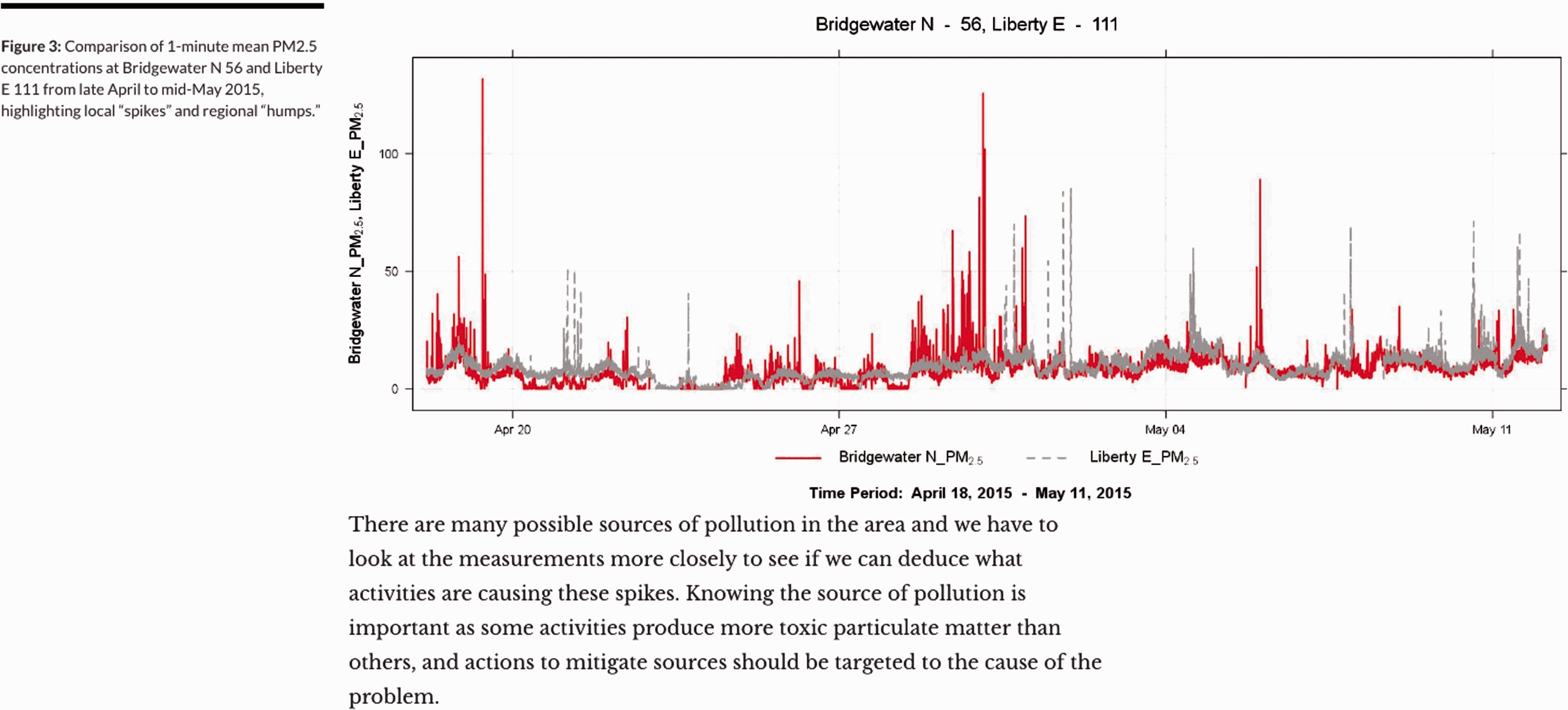

The data included in the data stories was complex and multi-faceted, coming from a variety of sources and practices. Using our ‘Airsift’ data analysis toolkit, we generated visualizations that indicated time of day when pollution might be occurring, as well as location, emission source, and relationship to temperature, humidity and wind speed and direction. We worked with residents to gather observations and to compare ‘data’ to ‘data’, or in other words, to assess how numerical data aligned (or not) with experience on the ground, for instance, of industry operations or experiences of emissions. We also identified points where what would ordinarily be overlooked as not data-worthy or as incalculable could be included in the interpretive practices of the data stories. Data stories can present a way to encounter the points where data becomes seemingly intractable. It is at these points where new data practices and data stories could also emerge.
Using the data stories as a method and technique, we then developed these as forms of evidence that could be ‘just good enough’ to suggest that more attention should be given to ensuring air quality is protected in relation to fracking activities. In the three sections that follow, we discuss the five data stories in more detail, including the types of data and data practices engaged with, as well as the ways in which citizen data expanded understandings of and approaches to the problem of air pollution through developing new forms of evidence. We discuss the process of forming these stories, and include some of the content that contributed to these figurations. The full stories are available through the figures, which link to our data stories website.
Data stories: Forming evidence through citizen data
Paul lives in Dimock Township (Figure 3), an area well known for its cases of contamination (and disputes over that contamination) of groundwater (Osborn et al., 2011). His home has become increasingly enclosed by fracking infrastructure, so that he is now living within what he calls a ‘death triangle’, where three compressor stations surround his home. The sound and smells from the stations are felt most acutely at night, where noise that Paul likens to the sound of an airport permeates the walls of his house. No matter which way the wind blows, Paul receives emissions from this nearby infrastructure – and compressor stations have been described by some residents as similar to refineries in the intensity of their operation. Using a handheld decibel monitor Paul had previously attempted to monitor the noise of the nearby compressor stations, highlighting moments when the noise was higher than the permitted 55 decibels. However, the township government rejected his data, claiming that he had not taken into account the noise of local bullfrogs, which made the data inadmissible. As just one example, regulators routinely dismissed the many attempts by citizens to document environmental problems by collecting data and presenting it as evidence.
Data Story 3: Brooklyn Township citizen air quality monitoring, Citizen Sense. datastories.citizensense.net.
Paul’s experience points to the ways in which noise, smell, air pollution and negative health effects become part of a changing environment in which he is living and attempting to adapt, while also hoping to develop modes of accountability and redress. Yet how does one begin to account for these events? If environmental monitoring is one way to track and document possible air pollution episodes, how should this data be gathered, and what form does it need to take in order to be presented as ‘evidence’ of the effects and impacts of fracking? In this respect, just as many questions could be raised about how these forms of data and evidence focus attention in particular ways, while potentially also occluding other types of experience. In undertaking this citizen sensing research and working with citizen-gathered data in order to document and demonstrate the effects of fracking on bodies, communities and environments, we were on the one hand working with attempts to generate forms of evidence that might have some traction as air pollution data. On the other hand, we were addressing the potential limitations of ‘official’ modes of evidence that often ignore or overlook observations and experiences of health effects and changing landscapes (cf. Ottinger and Zurer, 2011).
With these challenges in mind, we then began to work through citizen-gathered data by looking at emission sources. As part of the process of gathering observations and building up patterns of evidence, along with residents we put together an extensive inventory of possible particulate emission sources, from pollen events, road traffic and lawn mowing in the Dimock Township site, to the details of when compressor station engines might have been in full operation (including the typical emissions output of the Caterpillar engines in the facilities) at the Liberty (Figure 5) Township site, to the spudding of new well pads at several other sites.
We also attended to the timing of pollution events, as we established patterns in what could be causing higher readings in the data at different times of day, where for instance, spikes in the morning and evening could be due to traffic, but patterns at other times could be related to events such as industry processes. We then compared emissions inventories and temporal patterns with the particulate data as visualized through our ‘Airsift’ data toolkit, analysing spikes and peak events in the datasets, homing in to understand the temporal and spatial distribution of the pollution events, and attempting to piece together the likely causes of local pollution events.
Through this process of contextualising the measurement data in relation to observations and events, certain patterns settled into forms of evidence through the use of multiple data types, which further indicated links between pollution events and industry sources. We found at the Bridgewater site (Figure 1) that a nearby compressor station was likely causing significant pollution events, even though there was also a fracking site directly across the road less than 500 feet from the monitoring site. We found that given the density of infrastructure in the Dimock area, there was an array of pollution signals that were not always easy to attribute to particular sources. However, the three compressor stations surrounding the Dimock site were each contributing to air pollution at the monitoring location depending upon the prevailing wind direction. And we found at the Liberty site there were elevated particulate levels that exceeded the residents’ expectations since they lived in a relatively remote and wooded location and did not typically feel affected by air pollution. These elevated levels were also not easy to attribute to a source, but were most likely related to a nearby compressor station and well pad, as these were the only possible emission sources nearby.
The datasets from which these forms of evidence were drawn together were more or less continuous, depending upon the length of time and duration of monitoring that residents undertook. Yet these at-time partial datasets were still ‘just good enough’ to bring together multiple streams of data to make a case for pollution events. Even with these preliminary forms of evidence, more work was still required to establish patterns in the data so that stories could be generated, and so that citizens’ concerns could be figured into a collective account.
Data stories: Finding patterns, attributing sources
Although the citizen data did not assemble into a complete or continuous dataset, by working across different types of data that could be compared and cross referenced, we could begin to detect patterns and tell stories about the data. While our ‘Airsift’ toolkit processed the citizen-gathered data to produce charts and plots of pollution patterns, we also began to cross-reference the visualizations and to piece together evidential stories that could describe whether and when pollution events might be occurring.
This process required establishing the regional baseline, or average pollution level, that might be expected as part of the background or regional pollution for this area. Based on the overall community datasets, we established that the regional particulate baseline was around 15 µg m−3. We were then able to establish patterns where particulate levels exceeded this baseline in order to detect possible pollution events attributable to local sources. We also identified patterns where pollution levels exceeded the World Health Organisation (WHO) guideline of 25 µg m−3 for 24-hour daily mean concentration of PM2.5 in order to note where pollution levels might be of particular concern (WHO, 2006; cf. US EPA, n.d.). 1
Using line graphs to home in on these patterns that occurred above the regional baseline and WHO guidelines, we could cross-reference pollution events using wind speed and wind direction data in order to establish the likely source of pollution. Although we looked into the possibility of using weather data from official monitoring stations, the historical data resolution that was available was not detailed enough. Weather Underground data (which is also a source of primarily citizen-generated weather data) provided a way to access higher resolution weather data, and to link with the other datasets that had been collected. Using weather data from Weather Underground, we then looked at how pollution events could be read in relation to wind speed to understand the dispersion of pollutants as travelling from regional or local sources (depending upon the strength of the wind speed), and through looking at wind direction to establish a pollution signal from a direction and likely source based on the citizen inventory of emission sources. In establishing these patterns, we repeatedly worked with and across a range of data types, including the citizen-generated air quality data, Weather Underground data, and eyes-on-the-ground contextual data in the form of observations and experiences of industry sites and activity.
Alongside the identifications that required that we sift through line graphs and scatter plots visually, we also worked with openair polar plots. By predicting the spatial and temporal path between data points, polar plots enable the identification of a pollution event at a particular wind speed or direction, and also predict the spatial movements of the pollutant. For instance, rather than understanding particulate data as only individual points where emissions are located, the predictive modelling enables an understanding of emissions as they circulate. In this practice, data based on prediction fills the gaps and uncertainties in the collected data, thereby giving more value to the ‘just good enough data’.
These polar plots enabled us to study more closely the extent to which clear pollution signals emerged from the data. Differing from the visual sifting and searching for pollution events discussed above, the polar plot script integrates two of the mathematical features of Big Data: statistical analysis and smoothing. Bivariate polar plots model the way that two variables change together. Using the ‘Airsift’ data analysis toolkit, we demonstrated how the polar plot models the variation of particulates together with the variation of wind direction and speed. The resulting graphical plot visualizes the partially predicted distribution of surrounding sources of particulates. The polar plot is used for graphical interpretation – a sort of just good enough data technique – rather than quantifiable measurement. These sorts of ‘overfitting’ functions often lead to a mistrust of Big Data, especially as used in security studies and social media (cf. Aradau and Blanke, 2015). However, environmental data in many ways can benefit from the predictive techniques of Big Data, where spatial and temporal patterns can be generated from just good enough data and to enhance understandings from that data, for instance, by attributing pollution events to sources.
By running polar plots for a number of sites, predictive modelling could be overlaid with the citizen-generated data. We could then use the spatially dense data together with observational data from residents to study the patterns plotted using the polar plot function. These comparisons of data also allowed us to identify disjunctures in data, which were often quite nuanced and entangled with the capacities of sensors. In some cases, particularly with the Bridgewater, Brooklyn (Figure 2) and Dimock Township sites, observations about industry sites suspected of contributing air pollution emissions were supported by the data. At other times, there was a disjuncture with observations. The Mehoopany (Figure 4) Township site had numerous fracking-related activities underway at the time of monitoring, and a sense that pollution must be present, but no clear pattern was found in the citizen-generated data to establish whether there were notable pollution events or if they could be attributed to any particular source. In the case of the Liberty Township site, participants felt that they did not have a particular problem with air quality because of their remote location, and yet their monitoring data indicated otherwise, with frequent elevated levels of particulates as well as a signal produced through the polar plots and wind rose plots that suggested nearby fracking infrastructure could be a likely source. This led the participants at the Liberty Township site to investigate further possible sources. Interestingly, it was through the process of mapping the details of all possible emission sources, such as types of fracking infrastructure, quarries, dust tracks and roads, that one of the participants at this site described feeling more like a citizen scientist than when using digital monitoring devices. This citizen-based contribution stemmed from a sense that he could bring his situated analysis and understanding to the data visualized by the polar plots in a way that generalised science would not. The different ways in which observational data and a range of other citizen-gathered data then concretize to form patterns are not always straightforward or predictable, and can provide different ways of generating stories from the data.
Data Story 4: Mehoopany Township citizen air quality monitoring, Citizen Sense. datastories.citizensense.net. Data Story 5: Liberty Township citizen air quality monitoring, Citizen Sense. datastories.citizensense.net.

Data stories: Activating data as relevant
Working through these just good enough forms of data, we found that it was possible to establish patterns of evidence from which claims could be made about local sources of air pollution. The citizen-gathered data is unique in that it not only provides air quality data in a region where there is relative absence of monitoring, but also because it is spatially dense and occurs over a longer monitoring period than most episodic ‘expert’ monitoring. This allowed neighbouring data to be compared, and sensor data could be corroborated and augmented with observations. Rather than seeking to match the regulatory practices of monitoring in order to arrive at precise measurements of air pollutant levels, the citizen-gathered data indicated whether pollution events might be occurring and how they might be identified. These different forms of citizen data and data practices are intertwined and co-constitutive, but they also point to the ways in which data might be further activated to arrive at points of relevance and action-ability through the data stories that capture multiple experiences of pollution.
But these ways of activating data are also deeply entangled with the ways in which stories about data are told. Two residents, Meryl and Rebecca, who were somewhat anxious to begin analysing the data being gathered and to determine whether any clear patterns were emerging, began their own process of examining the particulate data by developing spreadsheets showing elevated levels of pollutants as well as the frequency of these events. Using this analysis, Meryl and Rebecca then contacted a number of state and federal environmental and health regulators. The residents organised a teleconference and invited us to join to discuss the preliminary patterns emerging from the data, and to make a case for follow-up monitoring to be undertaken by these agencies. While both the monitoring instruments and citizen-gathered data were questioned by regulators, and a clear power dynamic emerged around who might be authorized to undertake environmental monitoring, at the same time one of the regulators undertook follow-up monitoring in the area on the basis of this teleconference and the preliminary citizen data findings (Gabrys and Pritchard, 2015; Pritchard and Gabrys, 2016). This agency, the Agency for Toxic Substances and Disease Registry (ATSDR), produced a report (2016) documenting monitoring undertaken near the Brooklyn location. Similar to the citizen monitoring findings, their report documented elevated levels of particulates, which were partially attributable to fracking infrastructure in the area.
Citizen monitoring prompted the ATSDR follow-up study, and the ATSDR results were published at the same time as the citizen monitoring data and data stories. Following on from these events, the Pennsylvania Department of Environmental Protection (PA DEP) (2016) also announced that it was undertaking an ‘unprecedented expansion’ of its particulate monitoring network, and investing nearly 1.6 million USD in monitoring infrastructure and maintenance. While the PA DEP noted in its press release that it had listened to the concerns of citizens of Pennsylvania, it also suggested elsewhere that the timing of these events was ‘coincidental’ (as cited in Hurdle, 2016). Yet the concerns of citizens were expressed largely in the form of citizen data and evidence that was both individually communicated to the PA DEP (Colaneri, 2014), and collectively sent to this agency in April 2016. The citizen monitoring efforts contributed to a number of responses by regulatory bodies that included increasing investment in air quality infrastructure. The then Secretary John Quigley noted that the investment reflected an interest in obtaining data where there was a relative absence of such data (PA DEP, 2016). In this context, citizens should arguably receive greater recognition for the ways in which they have developed their own data practices and data stories that not only provide unique insights across different forms of data, but also draw attention to the limitations of ‘official’ regulatory practices and the possible contributions to be made by citizen data and data practices.
While residents were not following a regulatory process for undertaking environmental monitoring, they argued that their data was still relevant as it provided often clear and consistent patterns indicating that pollution events were occurring. As they further argued, their data was unique in the perspectives it offered and the ways in which it matched up different forms of data that might not ordinarily be cross-referenced. This different approach to environmental data and evidence then activated different types of data relations. It effectively was involved in co-constituting new practices and environments in and through which the citizen-gathered data could begin to have relevance. Rather than replicating regulatory processes, citizen environmental data was transforming the types of data gathered, the modes of comparing and synthesizing data, and the practices for creating stories and relevance from datasets – as ‘more than empirical’ records (Gabrys, 2016c; cf. Bell, 2015). In other words, the data stories were developing new interpretive practices that could operationalize data so as to take account of lived experiences, yet through distinctly non-linear and entangled engagements (cf. Garnett, 2016). The data stories are not necessarily a way of revealing results. Instead, as a process of ‘figuring’ data stories generate other worlds and worlding processes from citizen data, in which citizens’ experiences matter.
Conclusion: Just good enough data and creative data citizenships
Citizen sensing practices are inventive and diverse, mobilising many different devices, protocols and infrastructures. Although much environmental monitoring takes place in organised structures and projects, our research has shown that ‘informal’ sensing practices are an important aspect of sensing and data infrastructures (Gabrys and Pritchard, forthcoming). A crucial part of these practices is the generation of new and alternative types of data and data stories that emerge along with citizen monitoring practices. This citizen-gathered data is often ‘just good enough’ to establish patterns of evidence that can mobilise community responses in terms of communicating with regulators, requesting follow-up monitoring, making the case for improved regulation and industry accountability, and keeping track of exposures both on an individual and collective level.
Despite the fact that many experts refer to regulatory standards as the primary if not only way in which to undertake monitoring, we suggest that if citizens were to proceed with the use of technologies and protocols that simply follow regulators’ practices they could shut down the very possibilities that citizen monitoring might have the potential to open up. By merely following regulatory practices, numerous citizens would be excluded from undertaking monitoring, or from engaging with data practices and generating forms of evidence that resonate with their experiences.
As we have suggested here, new possibilities emerge for citizen sensing and citizen data as they generate inventive data citizenships. The practices of environmental sensing, data collection and analysis through which citizen data forms do not lead to a singular articulation of data citizenships. Instead, these practices give rise to contestations, collectives and relations that are the expression of democratic engagement with environmental problems. It is these engagements, moreover, that bring ‘serious citizen agency’ to areas that are often lacking in these contributions (Haraway, 1997: 95). Such an approach might further help to ‘reshape data cultures to enable community participation’ (Ottinger, 2016; Mah, 2016). These are strategies for reworking and refiguring who or what is authorised to generate environmental data and make their stories count, particularly when there is a rise of citizen-based monitoring on the gas fields (cf. Steinzor, 2016).
These data practices and stories then also suggest new ways in which ‘data might actually come to matter and make a difference’ through expanded data stories (Taylor, 2016: 189). Although indicative measurements do not compare with regulatory standards for precision and accuracy of data, they do suggest ways of working across measurement and experience, and of accounting for the lived conditions of environmental pollution. While the data stories we have discussed here suggest one method and technique for working through citizen data, we would hope there are multiple ways in which citizen sensing and citizen data might be approached that could expand the space for what counts as actionable data (cf. Schrock, 2016), while opening up new types of data practices toward inventive data citizenships.
Citizen-generated data and data analysis can offer alternative ways of thinking about the often-monolithic discourses around environmental data and Big Data to develop an understanding of the concrete ways in which data practices unfold in relation to environmental problems. They potentially help to generate a set of techniques for engaging with and querying evidence and evidence making; while providing an opening into what Gray et al. (2016) refer to as a challenge to the usual ways of collecting and interpreting data. Such challenges could be staged by looking at data gaps, data biases and the data status quo. In turn, by attempting to do data differently, collective environmental problems could be more creatively and expansively addressed and mitigated. This is the other aspect of ‘just’ good enough data – that citizen data could provide ways of realising environmental and social justice.
Footnotes
Acknowledgements
The research leading to these results has received funding from Thanks are due to participating residents in Pennsylvania, including Frank Finan, Rebecca Roter, Meryl Solar, Vera Scroggins, Chuck and Janis Winschuh, Paul Karpich, Barbara Clifford, John Hotvedt, Barbara Scott, Audrey Gozdiskowski, and Alex Lotorto, along with anonymous participants, as well as previous Citizen Sense researchers, including Nerea Calvillo, Tom Keene, and Nick Shapiro, and consultants including Kelly Finan (illustration), Lau Thiam Kok (data architecture), and Raphael Faeh (web design). Thanks are also due to the Create Lab at Carnegie Mellon University for loaning Speck devices for use in this study.
Declaration of conflicting interests
The author(s) declared no potential conflicts of interest with respect to the research, authorship, and/or publication of this article.
Funding
The author(s) disclosed receipt of the following financial support for the research, authorship, and/or publication of this article: the European Research Council under the European Union's Seventh Framework Programme (FP/2007-2013)/ERC Grant Agreement n. 313347, “Citizen Sensing and Environmental Practice: Assessing Participatory Engagements with Environments through Sensor Technologies.” Support for Benjamin Barratt was obtained from the National Institute for Health Research (NIHR) Biomedical Research Centre based at Guy's and St Thomas' NHS Foundation Trust and King's College London. The views expressed are those of the authors (s) and not necessarily those of the NHS, the NIHR or the Department of Health.
