



Abstract
This paper examines white Americans’ attitudes toward redistribution in the United States. Prior research has identified key predictors of redistribution attitudes, including political ideology, racial prejudice, or resentment. In addition to these factors, a growing body of work highlights the role of perceived status threat. Our study builds on the status threat literature by investigating the impact of racialized loser perceptions on opinions towards redistribution. We rely on evidence from an original survey experiment conducted in the United States in 2019. Specifically, we find that whites who perceive themselves to be on the losing side of politics are more likely to oppose government involvement in redistribution, but only when the comparison to non-whites is made explicit. The effects of racialized loser perceptions are robust to controls for previously identified predictors such as ideology, racial attitudes, and party affiliation. We discuss the implications of our results for the rise of support for right-wing populist movements that champion white protectionism. Our paper contributes to past research by testing the effect of cross-racial comparisons on changes in support for redistribution and demonstrates that even subtle changes in the way the comparison is framed can boost white Americans’ anti-egalitarian positions on redistribution.
Inequality in the United States has been among the highest in developed countries, and the trends for inequality have worsened in the past half-century. As inequality soars, redistributive policy remains a key issue in the political realm. Empirical support for theories that suggest that higher inequality will lead to greater public support for redistribution has been mixed (Kenworthy and McCall, 2008; Luttig, 2013; Meltzer and Richard, 1981), and the United States is one example of a country where high inequality coexists with low support for redistribution (Enders and Scott, 2019; Condon and Wichowsky, 2020; Bloeser and Williams, 2022). This paper questions the implicit assumption that perceived “losers” of inequality will be more supportive of redistributive policies because they think those policies make them better off. Whereas extant studies explain this inconsistency with individualism, lack of knowledge, political ideology, or beliefs in upward mobility (Kenworthy and McCall, 2008), more recent works present the central role of social relations and comparison in redistribution attitudes (Condon and Wichowsky 2020). Condon and Wichowsky (2020)’s social comparison framework, though acknowledging the central role of race and gender, builds on the experimental tests of the effects of cross-class comparisons. In this paper, on the other hand, our focus is on cross-racial comparisons. Focusing on whites—the group at the top of the racial hierarchy in the U.S.—we rely on an original survey experiment to assess whether, and under what conditions, whites’ belief that their racial group is on the losing side of politics impacts their support for redistributive policies aimed at reducing economic inequality.
Racialized loser perceptions are critical to understanding contemporary American politics, given the prevalence of these perceptions among whites and the centrality of the white loser narrative in Trump’s election campaigns and policies since 2016. Trump’s reference to “forgotten” and “ignored” people several times in his January 2017 inauguration speech, his portrayal of whites as the victims of globalist elites favoring racial minorities, and his successful mobilization of constituents around his “new white protectionist agenda” (Smith and King, 2021) exemplify the centrality of the white loser narrative in current U.S. politics.
Recent research finds that white’s loser perceptions, moderated by racial resentment, significantly predict eroding satisfaction with democracy (Enders and Thornton 2022). Loser perceptions are also related to a growing body of literature that focuses on the role of threat perceptions in whites’ policy preferences. These studies mainly focus on the effects of actual or perceived changes in the demographic context on the activation of threat perceptions and consequent policy attitudes. Craig and Richeson (2014) find that perceived group status threat from changes in racial demographic composition leads to greater expression of political conservatism among white Americans, along with the stronger endorsement of conservative policy positions for both race-related (i.e., immigration and affirmative action) and more race-neutral policies (i.e., defense spending and healthcare reform). Another experimental study finds that whites high in ethnic identification express higher group status threats when exposed to information on white demographic decline in the United States and consequently express more support for Trump and anti-immigrant policies (Major et al., 2018). In a similar vein, another study by Craig and Richeson (2017) shows that exposure to information on white demographic decline incites concerns among whites about being the victim of racial discrimination in the future.
Other studies have built on these findings by experimentally manipulating the salience of the racial shift in the U.S. population and examining the role of multiple types of threat (Bai and Federico, 2021; Bai et al., 2020). For example, Bai et al. (2020) found support for the significant effect of symbolic threat on socio-political attitudes and did not find the association of status threat on its own on socio-political attitudes when it is experimentally disentangled from symbolic threat. In other studies, Bai and Federico (2019, 2021) show that perceptions of white population decline indirectly affect right-wing policy support and defensive political reactions via the mediation of collective existential threat perceptions.
Recent studies also show increasing politicization of white identity as “a new American minority” with growing perceptions of white deprivation and defense of white privilege (Jardina, 2019) in line with the previous works that explain racial attitudes as the product of white efforts to maintain power and status (Blumer, 1958; Bobo, 1999). Jardina (2019) shows that white identity is made salient by threats to whites’ dominance at the top of the political, economic, and social hierarchy. She argues that white identity has an important role in policy preferences that disproportionately benefit whites, including immigration, social welfare programs like Social Security and Medicare, and supportive policies for college legacy admissions. Unlike racial prejudice scholars, Jardina (2019) argues that white identity is not necessarily related to attitudes toward policies that benefit minorities, such as “attitudes regarding government assistance to blacks, government efforts to promote racial equality, or affirmative action policies” as these are mainly driven by racial resentment and not by in-group sentiment (p. 190). In brief, extant research finds that the perception of threat to the status of whites triggers protective attitudes and policy support towards the racial in-group (Jardina, 2019; Winter, 2006) and hostile attitudes and policy support towards racial out-groups (Bai and Federico, 2021; Craig and Richeson, 2014; Craig et al., 2018; Major et al., 2018).
Hypotheses
Given the racialized nature of attitudes towards redistribution policies in the United States, whites tend to believe that they will not attain the benefits of redistribution and that other groups (minorities, immigrants, etc.) will get them instead (see, e.g., Gilens, 1999; Winter, 2006). As such, we theorize that whites who perceive themselves to be on the losing side of politics will be less supportive of redistribution, independent of racial animus, ideology, and the like. Consistent with this reasoning, recent studies in intergroup threat find that increased threat perceptions lead to support for more right-wing policy measures (Bai and Federico, 2021; Craig and Richeson, 2014; Major et al., 2018; Mutz 2018), which corresponds to less redistribution in the U.S. context (these studies did not measure support for redistribution policies specifically).
One additional aspect of loser perceptions that we hypothesize will be relevant to whites’ attitudes about redistribution policies is related to the comparison group. In other words, when people (in our case, white Americans) are deciding whether they are on the losing or winning side, to whom are they comparing themselves? Is the comparison group made explicit or not? A previous study by Condon and Wichowsky (2020) establishes the central role of cross-class comparisons on redistribution attitudes and finds that when participants are experimentally induced to compare themselves upwards, they become more supportive of redistributive policy. In this paper, we focus on cross-racial comparisons. We expect that the negative effect of whites’ loser perceptions on support for redistribution policies will be stronger when the comparison to racial minorities is made explicit (by asking, “Do you think that Americans who are white are on the winning or losing side of politics these days compared to Americans who are racial minorities?” in comparison to asking, “Do you think that Americans who are white are on the winning or losing side of politics these days?”). This is because making the comparison salient is likely to lead losers to be more skeptical that they will benefit from redistribution to the same extent as minorities. This theorization is in line with recent research on the sense of group position and intergroup threat discussed above (Bai and Federico, 2021; Craig and Richeson, 2014; Jardina, 2019). We use an original nationally representative survey experiment conducted in the United States to explore the relationship between whites’ loser perceptions and redistributive policy opinions.
In sum, we test the following hypotheses:
Whites who perceive their racial group to be on the losing side of politics will be less supportive of redistribution policies than whites who perceive themselves to be on the winning side of politics (main effect hypothesis).
There will be an interaction between racialized loser perceptions and whether the comparison to racial minorities is made explicit, such that loser perceptions will have a greater negative effect on support for redistribution in the relative condition (when the comparison to racial minorities is made explicit) than the absolute condition (interaction hypothesis).
Method and measures
The data for this study were collected by the National Opinion Research Council (NORC) using their AmeriSpeak panel. 1,574 respondents completed the survey between November 22 and December 6, 2019. Analyses focus on white respondents and are weighted to Census benchmarks for age, sex, education, race/Hispanic ethnicity, household tenure, telephone status, and Census Division (details on panel recruitment, weighting, and response rates are in Appendix A).
Experimental manipulation
Respondents were randomly assigned to one of the two experimental conditions. Those in the “absolute loser” condition were asked: Thinking about the way things are going in politics today, on the issues that matter to you, would you say that Americans who are white have been winning more often than they have been losing, or losing more often than they have been winning? Respondents in the “relative loser” condition were asked: Thinking about the way things are going in politics today, on the issues that matter to you, would you say that Americans who are white have been winning more often than they have been losing, or losing more often than they have been winning compared to Americans who are racial minorities? 1 Respondents were asked a follow-up question to determine the extent of winning/losing, resulting in a 6-point loser perception scale recoded to range from 0 (winning a great deal) to 1 (losing a great deal). Conditions were coded such that 0=absolute (n=386 white respondents) and 1=relative (n=341 white respondents; see Appendix B for question wordings for the variables used in our analyses and Appendix C for descriptives).
Dependent variables
We created an economic policy index by averaging three questions that assessed general economic policy attitudes related to redistribution (e.g., support for government intervention to reduce income differences between the rich and poor). The index (alpha=.87) ranges from 0 to 1 with higher numbers representing greater support.
Our second dependent variable assesses attitudes about government spending to reduce income disparities between whites and racial minorities. This one-item reduce racial inequality variable was coded such that 0=government is spending too much or about the right amount and 1=government is spending too little.
Control variables
We controlled for racial attitudes (using the four-question FIRE battery (DeSante and Smith, 2020) and strength of racial (white) identity (higher numbers=more negative racial attitudes/greater identity strength), partisanship (1=Republican; 0=all others), ideology (higher numbers=more conservative), age, gender (1=female; 0=male), education, income, employment status, and subjective socio-economic status. 2 All control variables were recoded to range from 0 to 1.
Results
Although the means and standard deviations for the absolute and relative loser perception variables are nearly identical (means=.41/.41; SD=.31/.33, respectively), Figure 1 shows that the distribution for the absolute loser variable is more skewed towards the “winning” side. Distribution of responses to the absolute and relative loser perceptions questions.
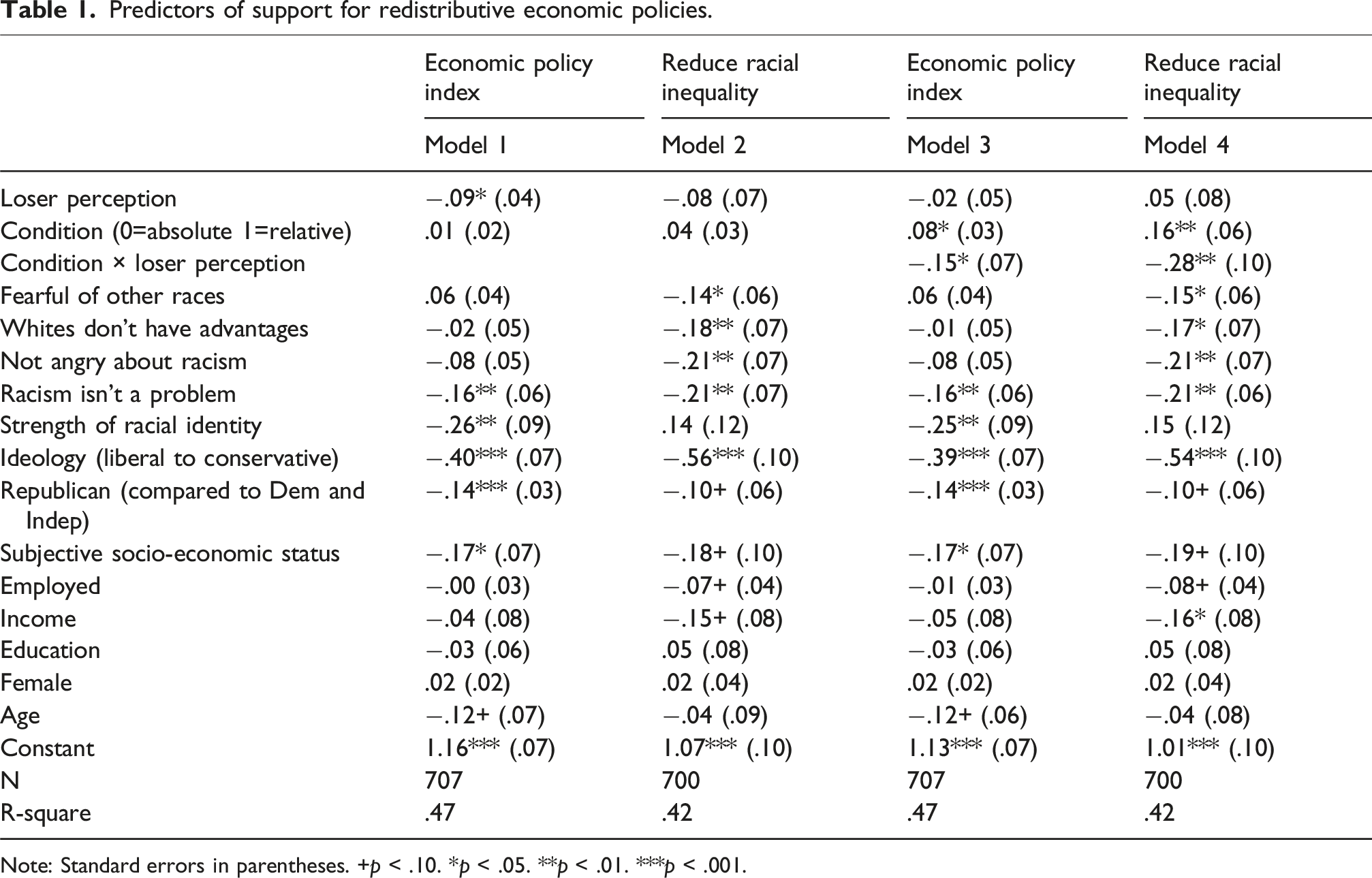
Predictors of support for redistributive economic policies.
Note: Standard errors in parentheses. +p < .10. *p < .05. **p < .01. ***p < .001.
Columns 3 and 4 of Table 1 test H2, that there will be an interaction between whites’ loser perceptions and condition, such that loser perceptions will have a greater negative impact on redistribution attitudes in the relative condition than the absolute condition. The interaction is statistically significant for both dependent variables. Figures 2 and 3 display the shape of the interactions. Consistent with H2, there is a negative relationship between whites’ loser perceptions and support for redistribution policies among those for whom the comparison to racial minorities was made explicit (the relative condition). In contrast, loser perceptions had no impact on support for redistribution policies among those for whom the comparison to racial minorities was not made explicit (the absolute condition). Not surprisingly, the interaction effect is stronger when the redistribution policy is explicitly racialized.
4
Interaction between condition and loser perception predicting the economic policy index (Model 3 in Table 1). Interaction between condition and loser perception predicting support for government spending to reduce inequality between whites and racial minorities (Model 4 in Table 1).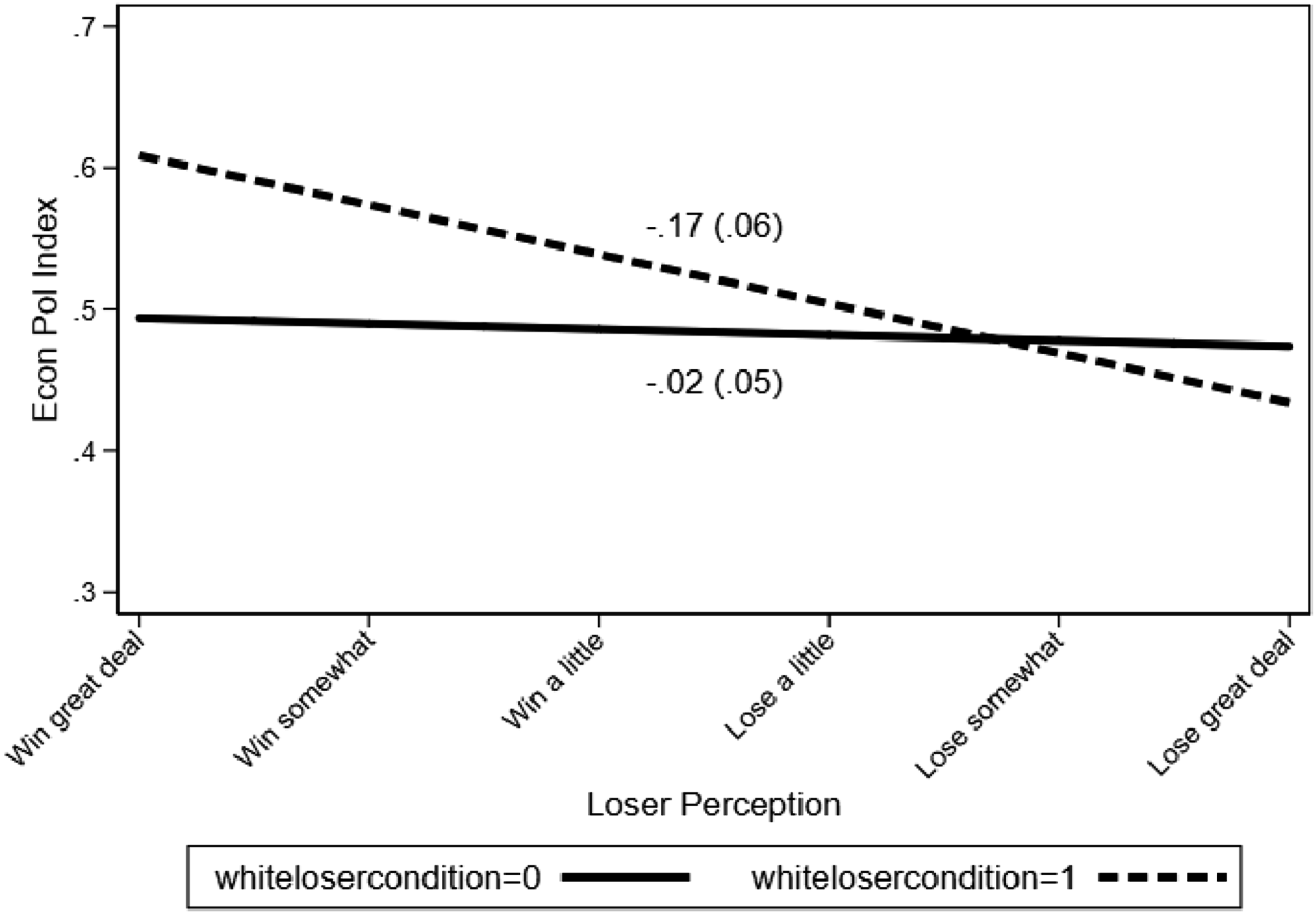

Discussion
The dynamics of political conflict worldwide appear to be shifting. Rather than being structured solely along traditional left–right ideological lines, contemporary conflict increasingly reflects a subjective winner–loser dichotomy. This divide—fueled by globalization’s perceived threat to established social, racial, and political hierarchies—may be supplanting older partisan/ideological frameworks (Koopmans and Zürn, 2019; Teney et al., 2014). Populist figures often appeal to the “forgotten” or “ignored,” invoking a rhetoric centered on loss and mobilizing those who feel marginalized by changing power structures. For instance, Donald Trump’s repeated references to perceived reverse discrimination against whites and his support for policies emphasizing white protectionism illustrate efforts to mobilize “white losers” within the political landscape (Smith and King, 2021). These dynamics underscore the importance of examining how perceptions of racial status threat shape political behavior.
Comparative studies in Europe further highlight that subjective perceptions of winning and losing significantly influence public attitudes toward immigration and European integration (Kriesi et al., 2012; Mau, 2005; Teney et al., 2014). Understanding the impact of loser perceptions—particularly in racial or ethnic terms—is therefore essential to analyzing contemporary political divides.
Our study contributes to this literature by examining the role of loser perceptions in shaping policy preferences in the United States. Specifically, our experiment explores how these perceptions may help explain the coexistence of high economic inequality with low public support for redistribution. We find that white Americans who perceive their racial group as on the losing side of politics are significantly more likely to oppose redistributive policies—but only when the comparison to non-white groups is made explicit. In other words, perceptions of relative group loss (rather than absolute loss) are the key drivers of opposition to redistribution. Notably, we observe no significant relationship between general feelings of group decline and attitudes toward redistribution in the absence of a racial comparison. These findings remain robust even when controlling for political ideology, party identification, and racial attitudes.
Our findings provide further evidence for how racialized attitudes can reduce support for economic redistribution. These findings corroborate the existing scholarship that argues that white status threat increases conservatism and protective policy attitudes among whites, providing evidence from the realm of redistributive policy attitudes. While our experimental study offers support for the status threat hypothesis, it also goes one step further, showing that priming white status threat can be done even with little/subtle messages and does not necessarily require respondents to think about how social, economic, demographic, or political developments may threaten white Americans’ dominant status, as past studies have done. Our paper contributes to extant research by testing the effect of cross-racial comparisons on changes in support for redistribution. It shows that even subtle changes in the political cues (i.e., the use of comparisons between whites and racial minorities rather than absolute frames) can boost anti-egalitarian positions for both “race-targeted” and “race-neutral” redistribution policies.
Our findings are limited to redistribution policy preferences. Given the central place of loser rhetoric in contemporary politics, we expect that perceptions of being on the losing side may also affect policy choices in other domains; we look forward to future research that tests this assumption. We also look forward to future work that explores the specific mechanism(s) by which racialized loser perceptions affect policy attitudes and work that explores the robustness of these findings in other contexts. It could be that less support for redistribution among losers may be due to eroding faith in democratic institutions, including redistribution mechanisms, as Enders and Thornton (2022) suggest. Alternatively, it could be that racialized comparisons reduce support for social welfare policies because it elevates perceived status among non-Hispanic whites and primes racial stereotypes and deservingness concerns as Condon and Wichowsky (2020) posit, or it could be that racialized comparisons reduce support for redistribution by triggering status threat perceptions and protective policy attitudes among whites as threat scholars propose. We look forward to future research that tests these potential mechanisms.
Beyond providing a better understanding of the antecedents of attitudes towards redistribution policies, our findings provide insights into the motivation behind populists’ frequent references to antagonistic “us vs. them” rhetoric to mobilize “losers” around their political agenda. The mere “losing” reference seems insufficient to influence redistribution attitudes. Rather, perceptions of “losing compared to other groups” seem more effective. A deeper understanding of the impact of loser perceptions on current policymaking is crucial as it may guide policymakers in their efforts to combat the populist wave and to attain support from those who perceive themselves as losers.
Several studies in Europe posit that redistribution policy is a significant driving factor for support for populist candidates (Gromadzki et al., 2022; Karakas and Mitra, 2020; König and Wenzelburger, 2022; Pastor and Veronesi, 2021) and suggest that support for greater redistribution policies that “compensate” losers among mainstream party leaders may drive voters away from supporting right-wing populists (Albanese et al., 2022). Our study shows that a promise of a more generous redistributive policy would not attain instantaneous support among those at the top of the racial hierarchy who perceive themselves on the losing side of politics, especially if they perceive themselves as losers compared to racial minorities. This lack of support for redistribution among whites who perceive their racial group to be on the losing side may be the result of their skepticism that they will benefit from redistribution to the same extent as minorities. If so, policymakers may need to work more to convince their white constituents that the policy changes will benefit them significantly if they hope to attain support for their policy proposals for greater redistribution.
Supplemental material
Supplemental material - “White Americans’ ‘loser’ perceptions and redistributive policy preferences”
Supplemental material for “White Americans’ ‘loser’ perceptions and redistributive policy preferences” by Sumeyye Mine Iltekin Gocer and Joanne M. Miller in Research & Politics.
Footnotes

Funding
The authors disclosed receipt of the following financial support for the research, authorship, and/or publication of this article: This project was funded by a University of Minnesota Futures Grant.
Declaration of conflicting interests
The authors declared no potential conflicts of interest with respect to the research, authorship, and/or publication of this article.
Carnegie Corporation of New York Grant
This publication was made possible (in part) by a grant from the Carnegie Corporation of New York. The statements made and views expressed are solely the responsibility of the author.
Supplemental material
Notes
References
Supplementary Material
Please find the following supplemental material available below.
For Open Access articles published under a Creative Commons License, all supplemental material carries the same license as the article it is associated with.
For non-Open Access articles published, all supplemental material carries a non-exclusive license, and permission requests for re-use of supplemental material or any part of supplemental material shall be sent directly to the copyright owner as specified in the copyright notice associated with the article.
