




Abstract
Do problems with government performance impact public support for democracy? Observational studies offer mixed answers. Given the limits of observational data, we present results from a 2022 survey experiment of nearly 2000 residents in Spain. Respondents were prompted to write about one of two common types of poor government performance—corruption or unemployment. In addition, we asked respondents to write about corruption as generated either by elites or by the system of government generally. Our outcome, support for democracy, is measured using questions about commonly eroded democratic practices and about democracy generally (labeled “conceptual democracy”). We find that the writing primes reduce support for conceptual democracy but did not reduce support for specific democratic practices like civil liberties or institutional checks on executives. These findings show that in addition to factors like partisanship and elite rhetoric, government performance plays an important role in shaping public support for democracy in nuanced ways.
Public support for democracy appears to be in decline globally, even in established democratic regimes (Claassen and Magalhães 2023; Foa and Mounk 2016). The absolute number of democracies remains relatively stable, but the “deterioration of qualities associated with democratic governance” (Waldner and Lust 2018) seems evident (Mechkova et al. 2017). While some scholars dispute claims of global democratic backsliding, the perception that democracy is in decline is widespread, and international support for democracy has measurably weakened (Hyde 2020; Little and Meng 2024; Valgardsson and Devine 2022). In response, a growing body of research uses randomized controlled trials to identify factors that depress democratic support (Fossati et al., 2022; Mazepus and Toshkov 2021). Much of this research focuses on ideologically oriented policy choices, partisan cues, and polarization (Carey et al., 2022; Gidengil et al., 2022).
Relatively few studies, however, examine the effects of perceptions of government performance on support for democracy by using high-quality causal-inference designs. This lack of scholarly attention is puzzling given that it is occurring at the same time that government performance issues are highly important for citizens in established democracies. In 2021 (a year before our own survey), a majority of citizens in several Western European countries and the United States said that the political and economic systems need to be completely reformed because they are not working well, a finding that was repeated in 2025 (Pew 2021, 2025). In Spain, 73% of citizens expressed that view, with one the highest percentages among Western democracies (behind only Greece, the United States, and France). Using observational data, scholars have long investigated the connections between perceived government performance and support for democracy, finding strong correlations (Carlin and Singer 2011; Dahlberg et al. 2014; Kriekhaus et al., 2014; Magalhaes 2013; Mattes and Bratton 2007).
In this article, we report on a survey experiment in Spain (n = 1995) that explores how prompts asking respondents to reflect on corruption or unemployment—prominent government performance problems—decrease support for democracy compared to a control group. 1 We find that individuals respond by decreasing support for democracy as a concept, but not for specific elements of democratic process that are often subject to erosion. These results suggest that citizens evaluate democracy in a multi-faceted way. Our findings highlight a possible important asymmetry in how people think about democracy—general evaluations may be vulnerable to performance while core democratic values remain stable. Future research could explore how asymmetric support holds across different democracies with unique performance challenges and sustained democratic threats.
While public support for democracy is currently a widespread concern, efforts to measure that support have not converged on a set of questions that can capture the various dimensions of democracy—though important efforts are taking place along these lines (see Chu et al., 2024; Claassen et al., 2024; Graham and Svolik 2020). In the observational work on government performance and support for democracy noted above, studies often focus on a question about democracy being the best form of government or on very rough, large-scale tradeoffs between democracy and alternatives, such as military rule. Such questions often do not capture the gradual nature of real-world democratic erosion and thus may result in poor measures of support for democracy. A related difficulty is that people may understand very different things by the abstract term “democracy” (Bratton et al. 2005; Dalton et al. 2007; Ferrín and Kriesi 2016). Similar to Claassen et al. (2024), we thus tap into different dimensions of democracy that are commonly subject to real-world erosion. Our questions have the virtue of realism, as they reference restrictions that many democratic governments have attempted to impose even when they violate civil liberties or essential democratic processes.
We tested primes that invite respondents to reflect on government failures to reduce unemployment and corruption. We identified these issues because they are persistent performance problems in Spain. Because populist politicians often highlight corruption problems as a result of a conspiring elite and because populism has been such an important feature of current politics in Spain and elsewhere (Mudde and Kaltwasser 2018; Vampa 2020), we tested three primes about corruption: corruption without further description, corruption as the result of elite choices, and corruption as a systemic problem.
Three of the four primes—unemployment, elite-sponsored corruption, and systemic corruption—reduce support for conceptual (undefined) democracy compared to a control group. The fourth prime, corruption without reference to the source, is in the same direction but not statistically significant. No prime, however, reduces support for specific procedural democratic practices: freedom of assembly, freedom of press, judicial independence, the rule of law, or the free operation of political parties. We did not anticipate this difference between conceptual and procedural democracy, which is derived from our findings rather than theoretically motivated. It suggests, however, an important distinction in the way that citizens may approach the complex idea of democracy.
These results provide causal evidence of perceived poor government performance on decreased support for democracy as a concept. On a more hopeful note, however, they also suggest that, at least in Spain, even when government failures decrease support for conceptual democracy, individuals are not willing to support specific government actions that would compromise civil liberties or institutional checks on executive authority.
The empirical and theoretical context
In many ways Spain is a typical consolidated Western democracy, with a Freedom House score of 90/100, similar to other large nearby countries. However, Spain has also experienced a variety of governance challenges in recent years that lend our primes realism. In contrast to Northwestern and Central European countries, “Southern European economies were caught in a spiral of stagnation, rising unemployment rates (most dramatic among the young) and public debt” for a decade following the “Great Recession” of 2007-9 (Hutter et al., 2018, 10). It is perhaps not a coincidence that Southern European countries like Spain and Italy have had prominent populist parties on both the left and right while many other European countries only have right-wing populist parties. 2 The rise of populism in Spain is correlated with government performance problems relating to globalization and immigration (Vampa 2020). Relatedly, Spain trailed only Greece and tied with Italy in 2021 with respect to the percentage of citizens who are dissatisfied with the way democracy works, at 65% (Pew 2021).
Support for democracy has long attracted academic attention. Yet, research presents conflicting claims about whether government performance influences such support. These debates find their roots in classic distinctions between specific and diffuse support (Dahl 1971; Easton 1975; Linz 1978; Lipset 1959). Can attitudes associated with a particular government affect views about a system of government? While we cannot test or even summarize the extensive arguments along these lines, this article contributes to this debate by utilizing experimental methods to test the causal relationship between perceptions of government performance and system support.
As Magalhaes (2013) notes, studies about the effects of government performance on support for democracy have been surprisingly rare. Moreover, most of the work has failed to identify theoretical predictions about why performance issues may impact support for democracy differently than other possible influences (such as elite cues or partisanship) or which dimensions of democracy are more likely to be impacted by performance issues. Magalhaes found that perceptions of poor performance influenced respondents to stronger support for broad authoritarian solutions (such as a president ruling without a legislature) and to support the idea that democracies do not do well at jobs like running the economy (an outcome closely related to performance problems).
Other studies have similar findings, though a few report contingent or null results. In a study of 26 mostly higher-income countries, Dahlberg et al. (2014) found that concerns with government performance (generally) and corruption both influenced democratic discontent. Kriekhaus et al. (2014) found that higher levels of economic inequality decreased democratic support. Booth and Seligson (2009) and Carlin and Singer (2011) found that personal experience with undesirable outcomes like crime or corruption substantially decreased support for regime institutions. However, Singer’s (2018) later work showed that those who perceive strong (economic) performance not only tend to favor democracy but also oppose institutional checks on executive power because they support the sitting executive. In contrast, another recent study concluded that support for democracy “remains relatively impervious to changes in government effectiveness” (Claassen and Magalhaes 2022, 869). 3 In addition to mixed findings, these observational studies have limitations. They cannot discard the possibility of reverse causality: those who support democracy more strongly may be more likely to perceive higher government performance. Likewise, difficult-to-observe confounders such as personal value systems or political socialization experiences may exist. Recent experimental research has begun to probe these relationships more directly (Becher et al., 2024).
We suggest three reasons why government performance may influence support for democracy and why this relationship warrants closer study. First, in an era of globalization, effective governance is increasingly difficult. Governments face porous borders, increasingly powerful non-state actors, and highly interdependent global markets, all of which place significant pressure on states and can reduce their capacity to perform (Tørsløv et al. 2023). Second, government performance is now more visible than in the past. The rise of social media and rapid information flows make government performance more salient to citizens and collective action more obtainable (Jost et al., 2018; Enikolopov, Stier et al., 2022). Third, the rise of populism has heightened skepticism toward government institutions and intensified mistrust (Algan et al., 2017; Mudde and Kaltwasser, 2018). Taken together, these dynamics draw greater attention to government performance and suggest new questions about how perceptions of poor performance may affect support for democracy. Citizens experiencing performance problems are likely to reasonably ask whether their system of government is appropriate.
Our research focuses on the effects of perceptions of unemployment and corruption on public support for democracy, as these are common and salient government performance problems—and have been important issues in Spain in recent years. 4 While these are obviously not the only possible government performance problems, prior observational research on performance and democratic support (Claassen and Magalhaes 2022) has also focused on corruption and unemployment, providing further justification for selecting these issues. Given the power of elaboration to activate mental concepts (Petty 2011), we asked primed participants to write 150–500 characters on the issue to which they were randomly assigned, describing the problem and recommending a way to combat it. Such elaboration primes are standard in social and political psychology studies (Busby et al., 2019; Simonovits et al., 2022).
Contested and untested claims about the relationship between government performance and support for democracy suggest the importance of an experimental approach. We thus test the following general pre-registered hypothesis:
Primes that prompt respondents to think about government performance problems should reduce support for democracy compared to the control condition. Our research design allows us to explore two additional pre-registered questions, including (1) whether one of these performance issues (unemployment vs corruption) has larger effects on democratic support than the other and (2) whether thinking about the corruption problem as elite- or system-generated has a larger effect on support for democracy.
5
As previous literature has offered little theoretical guidance on which types of performance issues might matter the most, we designed the experiment to explore these questions but do not have hypotheses about relative effect sizes. The possibility exists that unemployment, for example, might have a greater direct impact on support for democracy than perceptions of corruption. If corruption represents a problem with the system, respondents may decrease their support for democracy farther because they cannot use elections to bring in new elites. These issues have not been examined in earlier literature. As we found mostly null results for our main hypothesis, results for these additional hypotheses were also null (see below). With limited space, we have not developed these ideas theoretically.
Research design
We ran a survey experiment (n = 1995) in Spain during July and August 2022. Our sample is an online quota sample that mirrors proportions in the national population by age, region, and gender, meaning it included enough individuals from theoretically relevant demographics and areas of Spain such that we can confidently generalize our results to the population (Druckman and Cindy 2011). 6 Our sample mirrors national census data on a variety of important demographics. The survey firm Netquest recruited participants and administered our survey; full primes and survey question wording in both English and Spanish are reported in pages 23–27 of the appendix.
We randomized assignment to prompts that invited respondents to write 2–3 sentences about government failures to reduce either corruption or unemployment in Spain and to share an idea about combatting the problem. 7 Such elaboration tasks make powerful primes because respondents become more personally invested in the issue by engaging in the cognitive task of processing their thoughts and writing about them (Albertson and Gadarian 2016). These tasks also avoid specifying issues in ways that are less meaningful to respondents (Busby et al., 2019; Simonovits et al., 2022). By allowing open-ended communication about the issue, respondents access their lived experience and meaning. We ask respondents to share an actionable solution to the problem so that they focus on government performance rather than abstract issues like the nature of humanity. Thinking about ways the government could act but does not should induce them to be critical of such performance, which is the essence of the prime. It may of course also lead respondents to have more positive feelings because they may think solutions are possible. Such mixed feelings about complex government-performance issues have more realism than an approach focused single-mindedly on failures but may also reduce effect sizes. 8 The prompts are also designed to separate government issue performance from partisan support for the government (Claassen and Magalhaes 2022; Singer 2018). We did not want respondents to focus on the sitting government or specific current scandal. In addition, it is common to prime individuals to think about topics they are already familiar with, bringing these considerations “top of mind.” Introducing new information may only alter perceptions for some respondents or require hypotheticals that diverge from real-world conditions. For these reasons, we avoid providing new information in our priming exercises. The specific text of the primes can be found in the appendix.
To measure support for democracy, we developed seven statements (see Appendix for precise wording) to directly address dimensions of democracy frequently discussed in Spain, measured using a 5-point scale (Revilla et al., 2014). We expected our outcome questions might represent a single index incorporating most or all of them. However, exploratory factor analysis and other psychometric analyses (Figure A1 and Table A2) suggest that only the two democracy questions could be considered together. The first is a standard question in studies of democracy, asking respondents to what extent they agree that “Democracy may have its problems, but it is better than any other form of government.” The other asks whether it is essential to follow established democratic institutional processes even if it leads to not preferred outcomes. These two questions have an acceptable degree of internal consistency (Cronbach’s alpha = 0.61). 9
We consider the index of these two items a measure of support for “conceptual democracy” as an outcome variable to test our key hypothesis. It is an empirically derived rather than theoretically identified label. Both questions have in common large-scale scope that does not identify particular democratic processes. The remaining questions address concrete democratic practices identified in the V-Dem project: free expression, free association, judicial independence, and equality before the law. 10 These questions capture aspects of democracy that are frequently and cross-nationally subject to democratic backsliding. We adopt the approach of Claasen et al. (2024, 1) to “evaluate the more granular and concrete rights, processes and institutions that collectively constitute liberal democracy.” The questions do not ask about unlikely events such as direct overthrow of elected officials by military rule but rather about nuanced changes to established democratic practices that undermine fundamental democratic principles. Our questions capture the possibility that thinking about the profound problems faced by the country may lead citizens to justify possible departures from democratic norms. The fact that answers to these questions do not comprise a consistent index, either with themselves or with the two conceptual questions, suggests interpersonal variation in the meaning of “democracy.” An individual might not perceive a degradation in democracy by eroding one dimension while another might see that same dimension as essential. This suggests scholars would benefit from additional work to probe the meaning of democracy. We thus explore the effects of our primes on these items separately from the conceptual democracy index described.
Results
We first illustrate the substantive differences between support for different dimensions of democracy by plotting that support in the control group (Figure 1), with all questions coded to indicate increasing support for democratic practices. Conceptual democracy receives the strongest support, closely followed by freedom of assembly and freedom of the press. Some democratic practices, such as rule of law and freedom of political parties, garner less support. Distribution of support for democracy in the control group.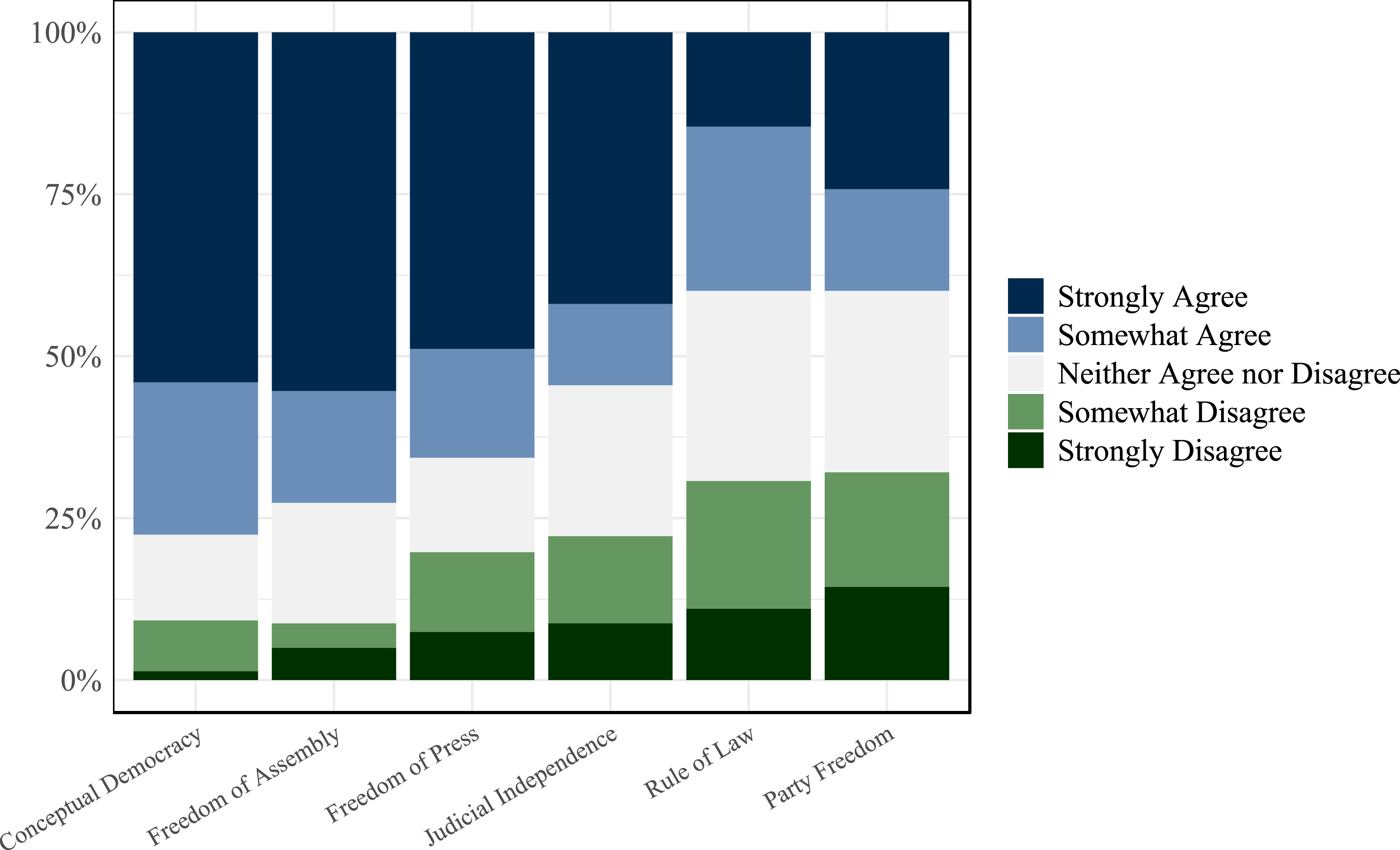
Following procedures outlined in our pre-registration, we estimate intent-to-treat effects on these six dimensions of democracy using ordinary least square regressions, including a small set of pre-registered control variables (results are similar without these controls).
11
Figure 2 presents these results graphically, plotting the marginal effects (with 95% confidence intervals) of each prime relative to the control (the dotted zero line) for each of the democracy support outcome measures.
12
We thus plot six marginal effects for each prime, one for each democracy outcome measure, beginning with an estimate of the prime’s effect on conceptual democracy and then including effects for the five other democratic dimensions questions. Intent-to-treat marginal treatment effects on different dimensions of support for democracy.
As the figure indicates, each of the government performance primes reduced support for conceptual democracy, though the generic corruption prime, which does not associate corruption with particular institutions or actors, falls short of conventional levels of statistical significance. The effect sizes here are similar to those found in other experimental studies causally identifying effects of other factors on support for democracy (Berlinski et al., 2021; Clayton et al., 2021), in the range of 0.2 to 0.25 standard deviations.
Interestingly, we find no consistent pattern in the effects of these primes on the other five specific measures of democratic processes. It is unlikely that question order accounts for the null effects because the strongest results occurred in the sixth question and the next-strongest results in the first question (see items 1 and 6 in Tables A5 and A6). Moreover, the confidence intervals around these estimates do not appear to be larger due to inattentive or non-compliant respondents. As we show in Appendix Figure A.2, when we code open responses for a simple measure of compliance (responses were coded compliant if they were on topic) and estimate complier-average causal effects, the results are indistinguishable from those in Figure 2.
With respect to our exploratory questions, Figure 2 shows there are no significant differences in effects on support for conceptual democracy or concrete democratic practices based on the type of government performance problem (unemployment vs corruption) or the factor responsible for corruption (elites vs the system). As these null results are estimated with similar power, from the same data, and with confidence intervals similar in size to the significant results for conceptual democracy, we suggest that they constitute evidence for a true lack of causal effects. That being said, we recognize that if citizens are presented with political rhetoric positing an explicit tradeoff that, for example, the courts are preventing effective anti-corruption action or employment reform, individuals could reduce support for specific democratic practices. However, given the nature of our experiment with an open-ended writing prompt, in the Spanish context, it appears that average citizens are not making such connections between democratic institutions and constraints on improving performance unprompted. Our finding that support for procedural safeguards remains stable in the face of general performance critiques is an informative result, suggesting resilience in commitment to democratic principles, even if specific targeted rhetoric could induce increased support for backsliding.
We also explore a variety of mechanisms linking government performance to support for democracy and find no particular patterns. Consistent with our pre-registered hypotheses (H4–H7), we look at personal harm from unemployment or corruption, populist orientation, concern over inequality, and satisfaction with democracy as moderators that may influence treatment effect for sub-populations. Overall, we find no patterns of significant results. 13
We also investigate the effects of polarization and incumbency support (partisanship) since existing literature often finds these factors to be important moderators (appendix Table A7 and A8). For ideology, we find that the effects are larger and more consistent for those on the far left, but we find no marginal effects from the primes for those on the extreme right. Far leftists respond to all the primes with significantly less support for conceptual democracy. Those in the center also respond to all of the primes by reporting lower support for democracy. These effects are insignificant for the baseline corruption prime, weakly significant (p < 0.10) for the unemployment and systemic corruption primes, and significant at conventional levels for the elite corruption primes. However, as in the full sample, the conceptual democracy outcome is the only dependent variable on which the primes have any consistent impact. We do not find any pattern of significant effects for the other democracy outcomes. In looking at party vote, we find that the effects are largest for those whose partisan identity aligns with the left incumbent government (a coalition of PSOE and Podemos that was in government at the time of the survey), but we still observe significant effects from our primes for those voters who support other parties. Analyzing the data disaggregated by ideology and partisanship does not substantively change the overall findings on the effects of the primes on support for democracy with the exception of extreme rightists.
This pattern of results indicates that conceptual democracy may be viewed somewhat instrumentally—rather than as a principled commitment—and so can be harmed by performance issues. At the same time, commitment to concrete democratic practices such as respect for civil liberties and institutional checks on executive authority, while weaker at baseline (with much variation), may be more principled, divorced from democracy’s ability to deliver desired outcomes. Spaniards of different political stripes seem resistant to the idea that poor government performance should reduce the specific practices of democracy. While these findings do not precisely reveal what citizens understand by “democracy” as a concept, they do suggest that citizens think differently about the idea of democracy than they do about its specific component parts.
Conclusion
Existing literature is divided on whether government performance influences public support for democracy. In this article, we take an important step toward testing whether government performance matters using a survey experiment with a strong elaboration-task priming technique on a national sample in Spain. Corruption and unemployment are two persistent problems in Spain. We find that asking citizens to reflect, in writing, on these government performance problems decreases support for conceptual democracy but does not influence respondents’ support for specific aspects of democracy. Citizens appear to expect more of democracy as a general system and thus reduce support for it in the face of large problems. However, they are unwilling to yield procedural checks on power or civil liberties when their government is not performing well. This finding suggests that in scholars’ well-founded efforts to disaggregate democracy into its component parts, they should be careful not to lose sight of the fact that citizens also appear to think about democracy holistically.
These findings highlight both the vulnerabilities and resilience of support for democracy in the face of challenging problems. Future research using causal methods should include government performance as a potential determinant of support for democracy and should ask both conceptual questions about democratic systems and institutions generally and also questions about specific institutions and practices commonly associated with democracy. The complexity of democracy may help account for the mixed evidence in previous studies on the effects of government performance. Future research could also investigate whether more explicitly linking government performance and democratic processes would lead to reduced support for specific institutions. It may be the case that in contexts where political elites or the media draw specific connections between policy failure and democratic institutions, public attitudes towards specific democratic institutions or civil liberties would become more susceptible to decline.
Because much of the existing observational literature finding effects for government performance is cross-national, we expect performance issues often influence support for democracy but with varying results depending on country context. As such, we see a move away from multi-country observational studies to country-by-country causal exploration like this study in Spain as a key means to move this research forward. Future research should also address the causal effects of other types of government performance problems and the impact of performance on other attitudes such as satisfaction with democracy.
This study provides an important complement to candidate-choice studies that require citizens to evaluate specific policy-democracy tradeoffs. While that approach is valuable, citizens also think about politics outside of candidate choice contexts. As discussed, a well-established literature suggests that poor government performance may harm support for democracy where that is the prevailing political system. We explore which particular aspects of democracy might be subject to eroded support in the real-world situation where performance is poor but explicit trade-offs are unclear. In these conditions, we find citizens are less interested in reducing democratic protections, though the idea of democracy loses some luster.
From a normative perspective, our findings provide mixed messages. On the one hand, simply focusing respondents on important policy problems decreases support for conceptual democracy. At the same time, Spaniards seem less easy to dissuade from their support for specific democratic principles such as free speech and free assembly. They likewise seem less interested in trading off democratic practices for possible policy improvements than some candidate-choice conjoint experiments suggest. In scholars’ attempts to understand citizen support for democracy, it is important to explore all of the ways in which citizens think about the concept and the different types of contexts in which they experience politics.
Supplemental Material
Supplemental Material - Government performance and support for democracy in Spain
Supplemental Material for Government performance and support for democracy in Spain by Darren Hawkins, Joshua R. Gubler, Celeste Beesley, Tayla Ingles, and Julia Chatterley in Research & Politics
Footnotes
Acknowledgments
We are grateful for colleagues in the BYU political science department and participants in the American Political Science Association Conference in 2023 for their comments on this manuscript.

Ethical considerations
The Institutional Review Board at Brigham Young University found the research to be exempt on 12 July 2022, IRB2022-273.
Consent to participate
Before taking the survey, participants were informed of the nature of the survey and given information about their rights as research participants. The completion of the survey implied their consent to participate, and they were informed of that fact.
Funding
The authors disclosed receipt of the following financial support for the research, authorship, and/or publication of this article: This project was completely funded by the College of Family, Home, and Social Sciences at Brigham Young University, our home institution.
Declaration of conflicting interests
The authors declared no potential conflicts of interest with respect to the research, authorship, and/or publication of this article.
Carnegie Corporation of New York Grant
This publication was made possible (in part) by a grant from the Carnegie Corporation of New York. The statements made and views expressed are solely the responsibility of the author
Supplemental Material
Notes
References
Supplementary Material
Please find the following supplemental material available below.
For Open Access articles published under a Creative Commons License, all supplemental material carries the same license as the article it is associated with.
For non-Open Access articles published, all supplemental material carries a non-exclusive license, and permission requests for re-use of supplemental material or any part of supplemental material shall be sent directly to the copyright owner as specified in the copyright notice associated with the article.
