



Abstract
Ineffective governance is known to weaken support for governments and leaders. However, it is less clear whether these effects spill over to the regime and erode support for the democratic system. This article returns to this classic question, now using time-series, cross-sectional data to test whether the effectiveness of governments in sustaining economic growth, providing quality healthcare, and tackling violent crime affects popular attitudes to democracy. We find that satisfaction with democracy is driven by fluctuations in economic performance and violent crime (but not healthcare quality). Diffuse support for democracy, in contrast, remains relatively impervious to changes in government effectiveness. Violent crime is the only indicator of effectiveness which has an impact on democratic support, and does so indirectly, via its influence on democratic satisfaction. These findings confirm that democratic support—which, unlike democratic satisfaction, is thought to help sustain democracy—is mostly immune to crises of performance.
Keywords
Introduction
Economic recessions, crime waves, and disease epidemics shine an unforgiving light on the effectiveness of governments. Crises such as these demand a coherent and sustained response, cruelly exposing governments who lack the ability or fail to muster the enthusiasm. Indeed, it now seems clear that ineffective governance substantially reduces government support and executive approval (e.g., Aksoy et al., 2020; Hibbs et al., 1982; Lewis-Beck & Stegmaier, 2013; Romero et al., 2016).
Less clear is whether these effects spill over to the regime itself. In autocratic contexts, the effectiveness of governments does appear to enhance support for the regime (e.g., Zhao, 2009; Roskin, 2009; Yang & Zhao, 2015; Zhu, 2011). Evidence is more ambiguous when it comes to attitudes in democracies: although some scholars have linked evaluations of democracy with effective government (e.g., Armingeon & Guthmann, 2014; Clarke et al., 1993; Córdova & Seligson, 2010; Huhe & Tang, 2017; Kotzian, 2011; Mishler & Rose, 2002; Przeworski, 1991), many others find little to no relationship (e.g., Evans & Whitefield, 1995; Mattes & Bratton, 2007; Huang et al., 2008; Yap, 2013). Is it the case that citizens in democracies “have built up loyalty to their political system because it kept the peace and swelled their pocketbooks” (Mounk, 2018, p. 131)? Or does the presence of fair elections, which allow citizens to replace governments (Duch & Stevenson, 2008; Schwindt-Bayer & Tavits, 2017), prevent ineffective governance from corroding public attachment to the democratic system?
The answer to these classic questions is unclear, we argue, because of several limitations in existing research. First, the overwhelming majority of studies of effectiveness and democratic attitudes have employed static, cross-sectional research designs, involving samples of individuals or states measured at one point in time. Such designs struggle to control for pre-existing country-specific cultural, institutional, or historical factors which might jointly determine both government effectiveness and popular attitudes to democracy. Second, existing studies have used two quite different measures of such attitudes: either citizens’ “satisfaction with the way democracy works” or citizens’ principled support for democracy. They rarely examine the impact of effectiveness on both dimensions simultaneously, and even less whether and how satisfaction and support might be interrelated.
This article aims to address both these limitations. Our contribution is to use time-series, cross-sectional (TSCS) measures of government effectiveness, democratic support, and democratic satisfaction from 91 democracies over the period 1988–2018. We consider the impact on support and satisfaction of the effectiveness of governments in fostering economic growth, providing quality healthcare, and tackling violent crime. Our TSCS data allow us to focus on within-country, over-time variation in effectiveness and democratic evaluations, removing the effects of any country-specific historical, cultural, or institutional confounds. Our TSCS data further allow us to model the determinants of support and satisfaction simultaneously using panel structural equation models. In this modeling framework, since both support and satisfaction are treated as endogenous, measures of government effectiveness can exert both direct and indirect effects on each form of democratic evaluation.
We find that government effectiveness has multiple direct effects on satisfaction with democracy: although healthcare quality does not affect it, satisfaction is buoyed by economic growth and undermined by interpersonal violence (as well as by perceived corruption). In contrast, democratic support seems more impervious to variations in government effectiveness, with no direct effects in evidence. We find, however, an indirect effect of violent crime on democratic support. Between the effects of interpersonal violence on (dis)satisfaction and the effects of satisfaction on support, violent crime ultimately has a negative effect on democratic support.
These findings are congruent with existing research emphasizing the instrumental nature of democratic satisfaction and the principled nature of democratic support (e.g., Bratton et al., 2005; Dalton, 2004; Evans & Whitefield, 1995; Linde & Ekman, 2003; Yap, 2013). Our findings also resonate with research showing a link between crime and democratic evaluations (e.g., Carreras, 2013; Fernandez & Kuenzi, 2010; Pérez, 2003; Visconti, 2019)—although now with the added rigor afforded by longitudinal data. However, our findings stand in contrast with arguments that democratic support is rooted in effective governance (e.g., Kotzian, 2011; Fukuyama, 2014; Mounk, 2018; Przeworski, 1991); aside from an indirect effect of violent crime, we find no evidence for this conjecture. 1
The results of this study have implications that are both benign and baleful for democracy. On the benign side, economic growth does not appear to influence democratic support, even taking possible indirect effects into account. As political scientists have long thought, this diffuse form of attachment to democracy offers a reservoir of support that helps systems navigate the shoals of economic crises. This is good news because support plays a more important role than satisfaction in sustaining democracy (Claassen, 2020a). More baleful is the finding that violent crime does seem to erode these democratic attachments (even if indirectly). Indeed, many of the states where violent crime is high—Brazil, South Africa, the Philippines, and Venezuela (IHME, 2017)—are also those where democracy has eroded in recent years.
Democratic Evaluations and Government Effectiveness
The question of whether effective governance affects citizens’ attitudes toward authorities and regimes themselves has been around for decades. As they reflected on the breakdown of democracies in the interwar years, Lipset, Linz, and Dahl all argued that the legitimacy losses experienced by those regimes resulted from failures in “the actual performance of a political system, the extent to which it satisfies the basic functions of government as defined by the expectations of most members of a society” (Lipset, 1959, p. 86) or in the “capacity to implement the policies formulated, with the desired results” (Linz, 1978, p. 22). As Dahl noted in Polyarchy, “the inability of newly established polyarchies in Italy, Germany, and Spain to cope effectively with palpable problems – even to maintain public order – generated doubts about the effectiveness of polyarchy and spurred the shift toward dictatorship” (Dahl, 1971, p. 147). The general notion of a link between (in)effective governance and legitimacy has persisted until today: “if a government fails to facilitate a minimal level of social welfare for its citizens, it will likely face difficulties in establishing authority and building legitimacy in the long run” (Sacks & Levi, 2010, p. 2327; see also Levi & Sacks, 2009).
However, in the existing empirical research, it remains unclear how government effectiveness, understood in this fashion, affects democratic attitudes. The first reason for this lack of clarity is the use of very different measures of democratic attitudes. One type of attitude to democracy is democratic support, the extent to which a public approves of a democratic system and rejects any autocratic alternatives. A large literature examines this concept of democratic support, along with its antecedents and consequences (e.g., Claassen, 2020a; Dalton, 2004; Linz & Stepan, 1996; Magalhães, 2014; Mattes & Bratton, 2007; Norris, 2011; Rose et al., 1998).
The meaning and interpretation of a second concept, democratic satisfaction, is less clear. Despite its ambiguous meaning, questions measuring respondents’ “satisfaction with democracy” are employed in numerous survey projects and appear in numerous research articles. Some authors treat it as akin to democratic support (e.g., Armingeon & Guthmann, 2014). Others use it as a summary measure of political support (e.g., Anderson & Guillory, 1997). But several studies have criticized such interpretations of satisfaction: as Linde and Ekman (2003, p. 400) put it, satisfaction with democracy is not “an adequate indicator of support for the principles or the legitimacy of democracy” (see also Canache et al., 2001). Perhaps the most judicious approach is to treat democratic satisfaction as capturing an instrumental or performance-based appraisal of the regime (e.g., Norris, 2011).
Yet even in research where the measures of democratic support and democratic satisfaction are treated separately, there is no consensus regarding the role played by government effectiveness in sustaining or eroding each of these forms of democratic evaluation. One strand of the literature suggests that democratic support and democratic satisfaction are empirically separate, and that only the latter is vulnerable to performance crises. Specifically, while democratic satisfaction correlates with support for incumbents and evaluations of the economic situation, democratic support shows no such patterns (Montero et al., 1997; Klingemann, 1999; Waldron-Moore, 1999). Satisfaction with democracy is moreover related with several indicators of economic vitality (Clarke et al., 1993; Wagner et al., 2009; Armingeon & Guthmann, 2014; Quaranta & Martini, 2016), but the same does not appear to be true of support for democracy (Evans & Whitefield, 1995; Bratton et al., 2005; Huang et al., 2008; Yap, 2013). The often-derived implication is that these measures capture two fundamentally different types of support: while satisfaction with democracy is “an instrumental, performance driven-attitude,” support for democracy “is largely a principled affair” (Mattes & Bratton, 2007, p. 201).
This distinction between instrumental drivers of satisfaction and principled drivers of support is further seen as confirmation of Easton’s classic distinction between specific and diffuse support. While the former represents represent citizens’ level of satisfaction or dissatisfaction that comes from the ability of the political system to satisfy their demands—“a quid pro quo for the fulfillment of demands” (Easton, 1965, p. 268)—the latter is a “generalized attachment to political objects for their own sake” (Easton, 1975, p. 444). Diffuse support explains why regimes and communities are able to survive despite periods of crisis or poor governance; as Easton put it, “outputs and beneficial performance may rise and fall while this support, in the form of a generalized attachment, continues” (Easton, 1975, p. 444).
However, other empirical studies suggest that even diffuse support for democracy may be shaped by the outputs of governance. Democratic support has been linked with the fostering of positive economic perceptions (de Jonge, 2016; Huhe & Tang, 2017; Mishler & Rose, 2002), 2 the generation of sustained economic growth (Córdova & Seligson, 2010; Kotzian, 2011), and the control of criminal violence (Pérez, 2003; Fernandez & Kuenzi, 2010; Carreras, 2013; Visconti, 2019). 3
This evidence echoes the long-standing arguments about effectiveness and legitimacy which we quoted at the start of this section. In addition, a close reading of Easton suggests that, even for him, specific and diffuse support are less compartmentalized than often thought. He suggested the existence of a “complicated relationship between outputs and diffuse support” (Easton 1975, p. 445), through which a “persistent inability of a government to produce satisfactory outputs for the member of a system may well lead to demands for changing of the regime” (Easton 1957, p. 397). If “little improvement in outputs occur, it will be impossible to prevent the dissatisfaction from shifting toward the regime” (Easton 1965, p. 231). In other words, dissatisfaction with outputs can spill over into a decline in regime support.
In sum, the relationship between government effectiveness and attitudes toward democracy remains unclear. Some studies suggest that such effectiveness is related only to satisfaction with democracy while leaving principled support for democracy undisturbed. Others show that effectiveness may indeed bolster democratic support, either directly or indirectly (i.e., through dissatisfaction).
We believe that the relationship between government effectiveness and democratic attitudes has remained blurred for three interrelated reasons. First, the overwhelming majority of existing studies employ static cross-sectional designs (c.f. Quaranta & Martini, 2016; Wagner et al., 2009), with the consequences that we still know very little about how changes over time in the outputs of governance affect public attitudes to democracy. Second, existing research typically examines democratic support and democratic satisfaction separately (if indeed, both are even examined), which neglects the possibility that they might be interrelated. Third, with few exceptions (Gilley, 2006; Kotzian, 2011), existing studies tend to focus primarily on one particular aspect of government effectiveness.
In this study, we try to address these problems; first, by using measures of democratic attitudes which are longitudinal as well as cross-sectional; second, by examining the interrelationship between democratic support and satisfaction; and third, by employing a conceptualization of government effectiveness that engages with classic discussions in the literature while also allowing the inclusion of a variety of manifestations of effective governance. We expand upon these measures and methods in the next section.
Research Design
Our time-series, cross-sectional research design offers three major advantages over the cross-sectional designs that predominate in existing research on democratic support and satisfaction. First, with across-time variation in all variables, a TSCS design allows us to control for the possible “reverse” effects of previous levels of support on current realizations of the independent variables. For example, low levels of democratic support may allow corrupt leaders to emerge and flourish, even while such leaders may subsequently dampen enthusiasm for democracy (Morris & Klesner, 2010).
Second, TSCS designs allow us to remove any between-country variance in measures of democratic evaluations and government effectiveness, for example, by including country fixed effects. This between-country variance is likely confounded by long-established and static historical, cultural, and institutional factors that are specific to each country. For example, analysts have argued that resilient between-country differences in political culture are a legacy of historically remote political institutions, which in turn condition contemporary institutions and their performance (Acemoglu & Robinson, 2006; Tabbellini, 2008). Instead, our TSCS data allow us to focus on the within-country, over-time variation that is less likely to be contaminated by such confounds.
Finally, dynamic data and designs allow us to estimate both the long- and short-run effects of various factors on democratic support. Although TSCS approaches have been criticized for focusing on the short-run (typically yearly) effects of independent variables on dependent variables (Inglehart et al., 2017), dynamic TSCS models in fact allow analysts to calculate how such short-run effects accumulate over time (see, e.g., De Boef & Keele, 2008; Williams & Whitten, 2012). We incorporate such analyses in the current article.
Dependent Variables
We update the TSCS estimates of democratic support and democratic satisfaction originally developed by Claassen (2020a; 2020b). We extend his estimates of democratic support and satisfaction to include new survey data released since 2017. The analyses presented in this article rely on estimates of both forms of democratic attitudes which range from 1988 to 2018. 4
Our estimates of democratic support and democratic satisfaction rely on existing cross-national survey data which aim to measure either of these concepts. Democratic support is measured using survey questions that ask respondents to: evaluate the appropriateness or desirability of democracy; compare democracy to some undemocratic alternative; or evaluate one of these undemocratic forms of government. Such items are fielded in 14 cross-national survey projects, 5 and are widely used to measure principled support for democracy and rejection of autocracy (e.g., Dalton, 2004; Klingemann, 1999; Mattes & Bratton, 2007; Magalhães, 2014; Norris, 2011). The measure of satisfaction with democracy is based on survey questions that ask respondents how satisfied they are “with the way democracy works” in their countries. This item is included, with some minor variations, in 13 cross-national survey projects. 6
We include support and satisfaction estimates for states which were at least somewhat democratic in the period under consideration. We exclude overtly autocratic states because it is unclear how the effects of government performance will influence evaluations of democracy, an alternative regime to that which citizens of autocracies have experience. In contrast, by focusing on minimally democratic states, we test whether government effectiveness influences citizens’ evaluations of the political regime with which they have experience (see, e.g., Mishler & Rose, 2001). Our joint analysis of support and “satisfaction with democracy” further indicated the need to exclude non-democracies from our sample, given that satisfaction with democracy is a construct and a measure of questionable applicability in non-democratic regimes. 7
We select our sample of 91 somewhat democratic states as follows: (1) include a state starting in the first year in which it was rated as a electoral or liberal democracy using V-Dem’s “Regimes of the World” indicator, and for which we have democratic support and democratic satisfaction estimates; (2) then collect yearly observations for that state until 2018 or until it spent two or more years as a closed autocracy, in which case, stop collecting observations; (3) finally, remove any states with five or fewer consecutive years of coverage. 8
This is a permissive definition of democracy; it includes cases such as Russia and Belarus which spent short periods as electoral democracies in the 1990s before settling into electoral autocracy status. In the online supplementary materials, we confirm that our results are similar if we use a more stringent sample of 80 democracies, dropping the 11 states which spent more years as electoral autocracies than they did as electoral (or liberal) democracies according to the “Regimes of the World” indicator. 9
In Figures 1 and 2, we plot the estimates of democratic support and satisfaction for the 91 states we examine in the article. The trends and patterns vary considerably across space and time. In a few cases (e.g., Indonesia, India, Jamaica, Montenegro, Slovakia, and the United States), democratic support has shown a marked decline. Yet, in others, we see stable (Denmark and Italy) or even rising (Finland and Namibia) levels of support. As Claassen (2020b) concluded after examining similar estimates, democratic support ebbs and flows in different places and at different times. National time-serial estimates of democratic support and satisfaction, I. These plots show the first 48 national time-serial estimates of democratic support (orange/light) and satisfaction (blue/dark). Both are standardized to have a mean of zero and variance of one. National time-serial estimates of democratic support and satisfaction, II. These plots show the final 43 national time-serial estimates of democratic support and satisfaction.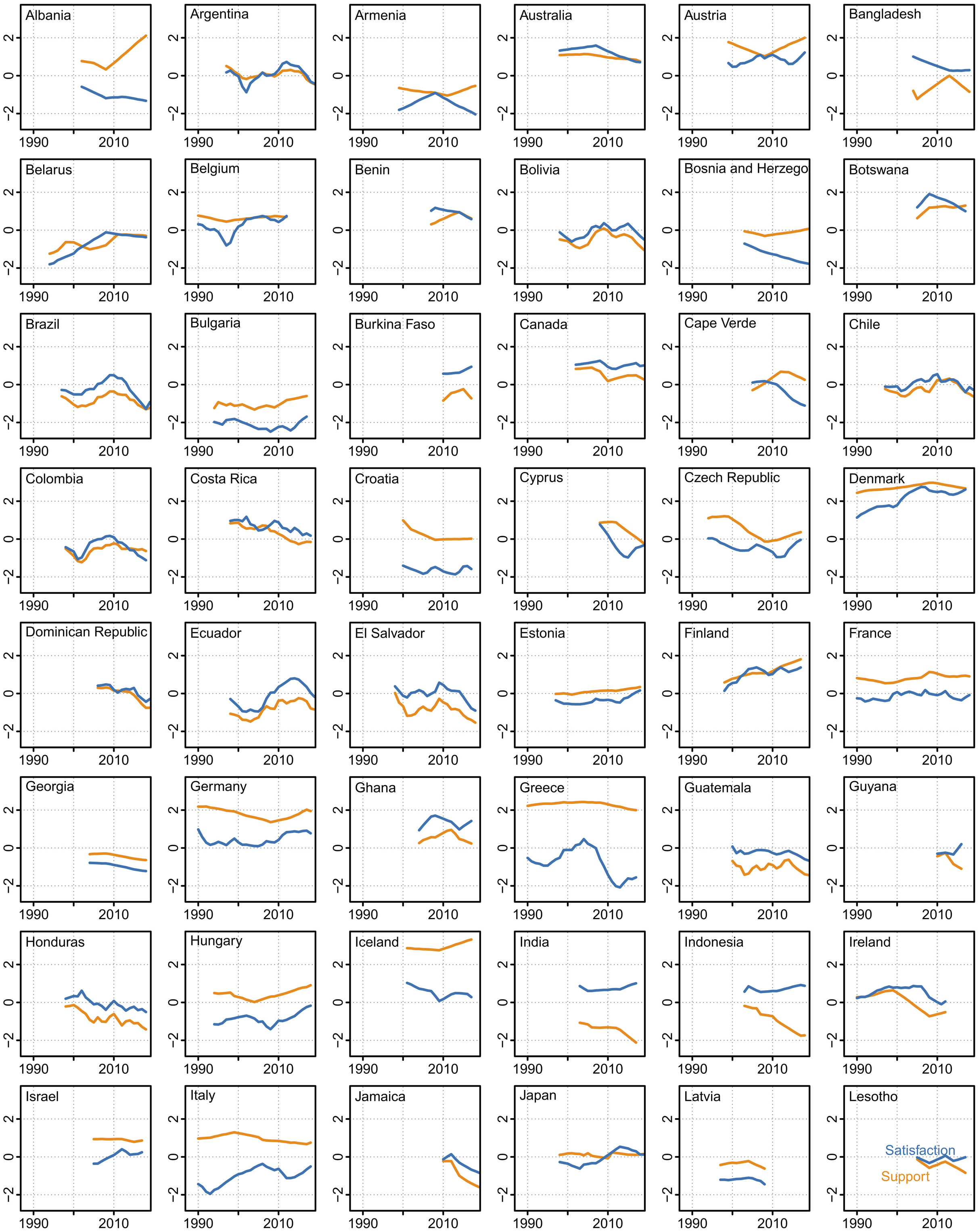
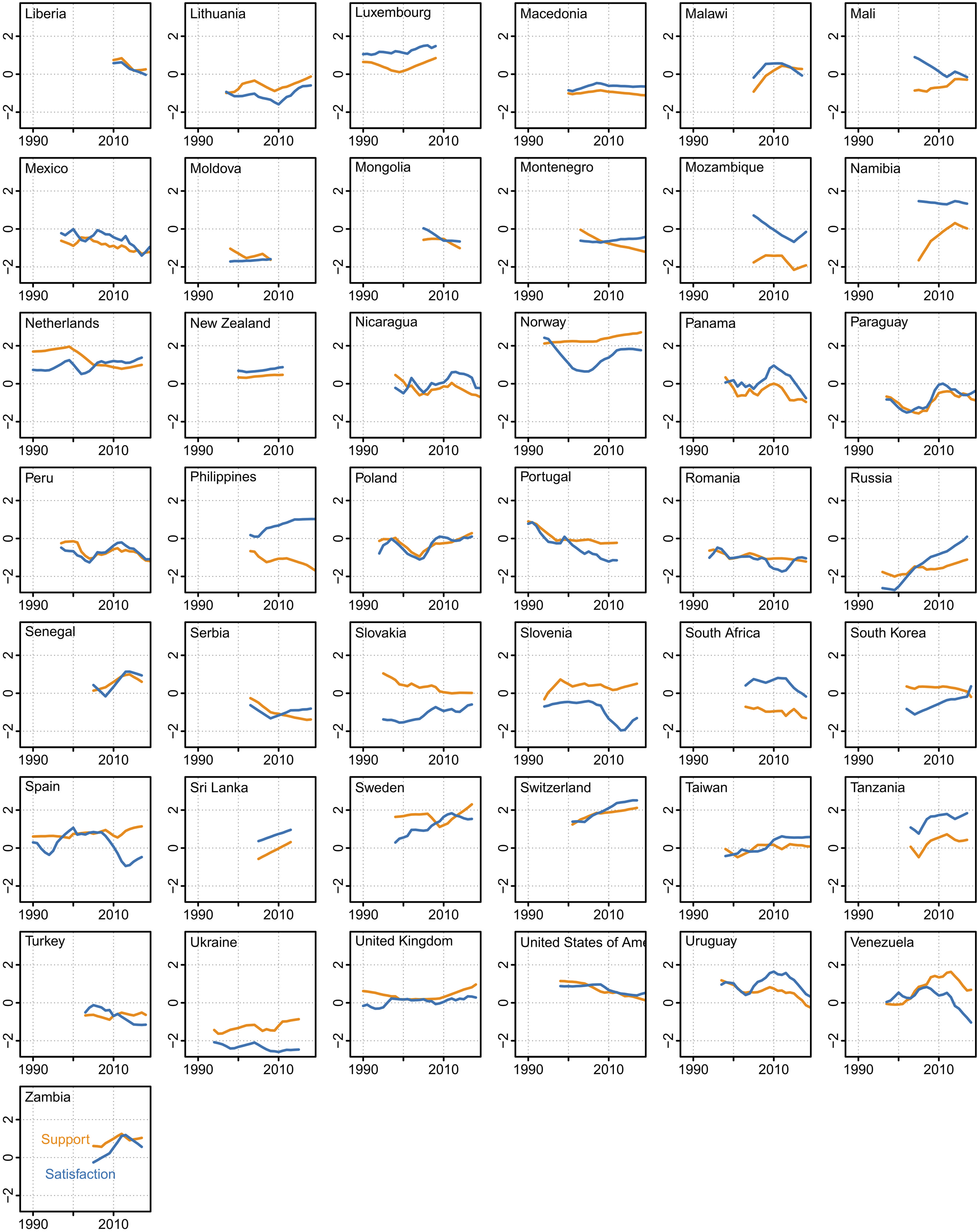
But so too does satisfaction with democracy. Fairly marked increases are evident in some cases (the Philippines, Russia, and Sweden) with pronounced decreases in others (Jamaica, Portugal, and Turkey). Indeed, democratic satisfaction generally appears more malleable than democratic support, which is consistent with the former, but not the latter, being driven by variations in government effectiveness. In particular, sharp declines in satisfaction (but not support) are visible in the aftermath of the 2008–2010 recession (e.g., Brazil, Greece, Spain, and Slovenia), indicating a possible role of economic crisis as a driver of (dis)satisfaction.
In a few countries, democratic support and satisfaction have different, even opposing, trajectories (e.g., Albania, Indonesia, and the Philippines), which reinforces concerns about treating the latter as an indicator of the former (Linde & Ekman, 2003). Yet in many cases we also see democratic support and satisfaction fluctuating in tandem (e.g., Brazil, Bulgaria, Honduras, Peru, and Poland). This strongly suggests that satisfaction shapes support, or vice versa. There appears to be merit in modeling these two sets of opinions jointly—as we do in the current article—by allowing each to influence the other.
Independent Variables
What is “government effectiveness?” In their review of the debates around the concept, Lee and Whitford identify an approach that sees effectiveness as “a measure of the quality of output” or of the extent to which desired outcomes are achieved (Lee & Whitford, 2009, p. 251). This is the approach we take in this study.
We follow this approach for four main reasons. First, it is the conceptualization of effectiveness that seems closest to the sense in which it was employed by authors such as Lipset, Dahl, or Linz, with their emphasis on the ability to satisfy citizens’ expectations, cope with their problems, and obtain “results” as potential drivers of legitimacy. Second, it allows us to focus on objective indicators rather than subjective or perceptual ones. Although there is certainly room for the use of the latter (Lee & Whitford, 2009, p. 254–255), objective indicators allow us to avoid some of the identification problems raised when trying to account for changes in democratic evaluations with changes in other subjective evaluations. Third, this approach also seems most suitable for addressing the question of within-country change that is central to our research design. Many of the general indices available in the literature—such as the World Bank’s “government effectiveness” index (Kaufmann et al., 2010)—incorporate indicators pertaining to the quality of policy formulation and procedural fairness in governance (Boräng et al., 2017). Not only are these outside the scope of “government effectiveness,” as we have defined it, they also tend to be remarkably “sticky” over time (Charron et al., 2015, p. 329), making them unlikely candidates for explaining within-country variations in democratic evaluations over the period of a few decades. Finally, our conceptualization of effectiveness is compatible with the use of multiple indicators of the “quality of output” and different “desired outcomes,” allowing for the possibility that only some of them may be consequential for democratic attitudes.
Following these considerations and making use of available indicators which vary across countries and years, we identify three central aspects of government effectiveness which appear likely to affect regime attitudes: (1) economic performance, (2) quality of healthcare, and (3) control of violent crime. Our measures of these are as follows. We use the annual percent change in GDP per capita as a first measure of economic performance (with the log of GDP per capita used as a control to measure the level of economic development). Data are drawn from the Penn World Tables, and missing values replaced with values from the Maddison and IMF datasets and adjusted using a multilevel linear regression model. Our second measure of economic performance is the inflation rate, with data drawn from the IMF and a sign-log transformation applied to prevent episodes of hyperinflation dominating this measure. 10 In the supplementary materials, we also examine a third economic indicator, the unemployment rate.
To measure the quality of healthcare provision, we use the “Healthcare Access and Quality Index” from the Institute for Health Metrics and Evaluation’s “Global Burden of Disease” (GBD) 2016 study. This index combines age-standardized and risk-standardized death rates for 32 causes “from which death should not occur in the presence of effective care” (Fullman & many others, 2018, p. 2236). It is therefore a measure of overall health system quality, which is likely to be of central concern to citizens in all political systems. In the supplementary materials, we further examine the impact of another measure of health quality, the infant mortality rate.
Our measure of control of violent crime is the log of deaths attributed to interpersonal violence per 100,000 population. The data are obtained from the GBD (2017) study, supplemented with pre-1990s data from their 2016 study. This indicator does not include deaths attributed to conflict and terrorism, suicide, or accident. It corresponds to “Indicator 16.1.1” in the United Nations’ Sustainable Development Goals (SDG), the “number of victims of intentional homicide per 100,000 population,” which indicates its suitability as a measure of violent crime. In the supplementary materials, we also test the impact of political violence.
We also include several control variables. First of these is a measure of corruption perceptions. Many studies have argued that corruption perceptions are correlates not only of satisfaction with democracy (Anderson & Tverdova, 2003; Wagner et al., 2003) but also of support for democracy as a regime (Mishler & Rose, 2001; Seligson, 2002; Huang et al., 2008; Kotzian, 2011; Linde, 2012; Park, 2017). Our TSCS measures of corruption are obtained from the Bayesian Corruption Index (Standaert, 2015), which uses a Bayesian measurement model to combine information from 17 surveys and 110 survey questions about perceived abuse of power for private gain into a single consolidated TSCS index, where higher values represent greater levels of perceived corruption. Second, we include control variables capturing both the electoral and liberal aspects of democracy. Since opportunities to participate and exercise one’s “voice” have long been thought to be important for legitimacy, we control for the effects of democratic electoral procedures and rights, using V-Dem’s “Electoral Democracy Index,” which measures the extent to which a country’s leaders are appointed via clean elections, where all adult citizens enjoy the freedom to vote, associate with other citizens, and express their political views (V-Dem Institute, 2019). We also include V-Dem’s measure of the “Liberal Component” of democracy, which we refer to as “rule of law.” As Claassen (2020b) shows, democratic support reacts thermostatically to changes in rule of law (which include equality before the law as well as legislative and judicial oversight of the executive). In other words, we expect that increases in the rule of law will depress citizens “demand” for democracy, while decreases should boost such demand.
Empirical Strategy
Our modeling framework includes three notable features. First, we include two lags of each dependent variable, that is, support and satisfaction. Second, we focus on within-country variation in all variables by demeaning all included variables. 11 Third, we use structural equation models to allow support and satisfaction to exert reciprocal effects on each other. We explicate these features below.
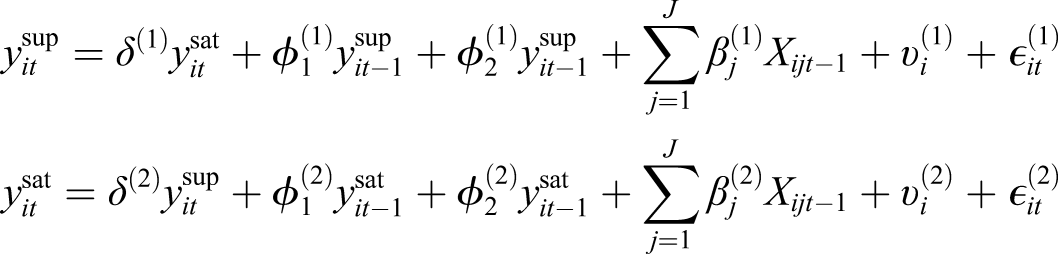
The basic model is a dynamic fixed effects model with two lags of the dependent variable. Two lags are optimal as confirmed by AIC test; they also remove serial correlation in both dependent variables (see the supplementary materials for results). The general model of the opinion series, y
it
, is follows (for i countries, t years, and j covariates)

A more realistic model of democratic support and satisfaction should acknowledge that these democratic attitudes are not independent. We therefore incorporate reciprocal effects of support
Results
Effectiveness and attitudes to democracy.
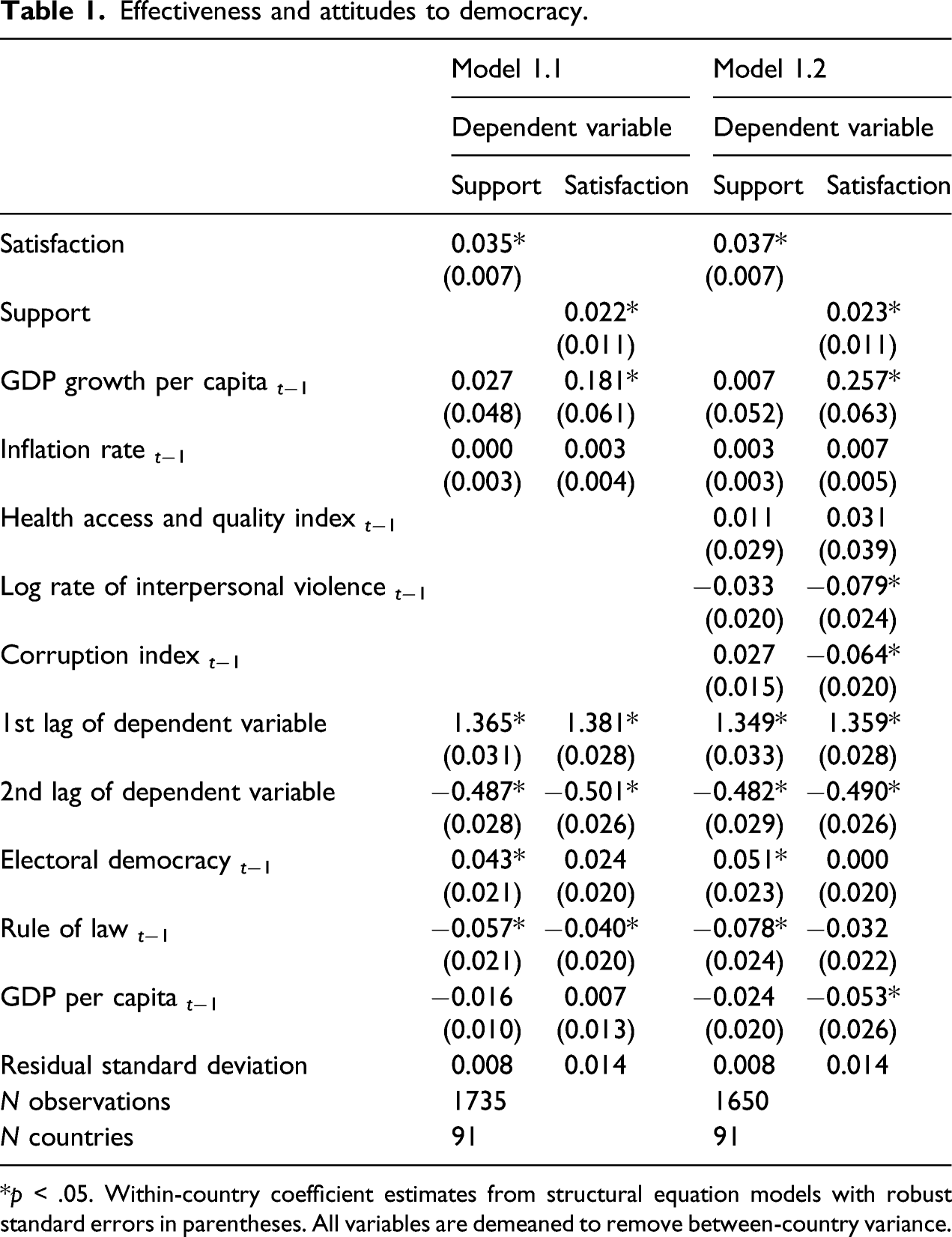
*p < .05. Within-country coefficient estimates from structural equation models with robust standard errors in parentheses. All variables are demeaned to remove between-country variance.
Turning to the indicators of economic performance, we see that within-country growth in GDP exerts a positive and substantial effect on satisfaction with democracy, but a much smaller—and insignificant—effect on democratic support. The inflation rate does not appear to have much impact on either form of democratic attitude. In models included in the supplementary materials, we find no evidence of an independent effect for a third economic indicator, the unemployment rate.
One of the features of our analysis is the inclusion of additional measures of effectiveness. In addition to economic indicators (or evaluations), we also include measures of healthcare quality and violent crime. The first of these, healthcare quality, as measured by the healthcare access and quality index, does not appear to affect either variety of democratic attitude. In the supplementary materials, we show that another measure—the infant mortality rate—similarly has little effect.
In contrast, violent crime (measured by the logged rate of interpersonal violence) does show marked effects on democratic evaluations. We see negative effects on both satisfaction and support, although only the former is significant. These results pertain only to the direct effects of crime on either support or satisfaction. With a negative (and insignificant) direct effect on support, a negative (and significant) direct effect on satisfaction, and a positive (and significant) direct effect of satisfaction on support, there may be also be substantial indirect effects of crime on support, which we consider below. In the supplementary materials we show that political violence neither has an independent effect on democratic evaluations, nor alters the effects of violent crime.
We note also that corruption, although not strictly a measure of government effectiveness, does appear to affect democratic attitudes. We find evidence that corruption has a negative and significant effect on satisfaction with democracy. In contrast, there is no evidence for a negative effect of corruption on support for democracy.
Our SEM framework allows us to parse the reciprocal effects of support on satisfaction and vice versa. 12 Although existing research has shown the correlation between democratic support and satisfaction, here we show that each exerts an independent effect on the other. 13 The larger of these is the effect of satisfaction on support, which ranges from 0.036 to 0.038 in the two models. This indicates that specific regime support helps to build diffuse support, which is the more valuable of the two varieties since it bolsters democratic resilience (Claassen, 2020a). Yet we also find that support for democracy also simultaneously shapes satisfaction with democracy, although the effects we observe (0.022–0.023) are somewhat smaller in magnitude.
Our inclusion of reciprocal effects between the two dependent variables further allows covariates in the model of satisfaction to exert indirect effects on support and vice versa. These may build upon—or mitigate—the direct effects reported in Table 1 and discussed above. In addition, Table 1 shows only the short-run effects of each measure of government effectiveness. With the inclusion of lagged dependent variables, our models allow covariates to exert effects which endure and accumulate over time. To estimate and illustrate the total, long-run effects of each covariate, we turn to turn to dynamic simulations. These allow us to show the effects of a particular change in one independent variable on both dependent variables over the long run, including both direct and indirect effects. These simulated effects are shown in Figure 3.
14
Simulated long-run effects.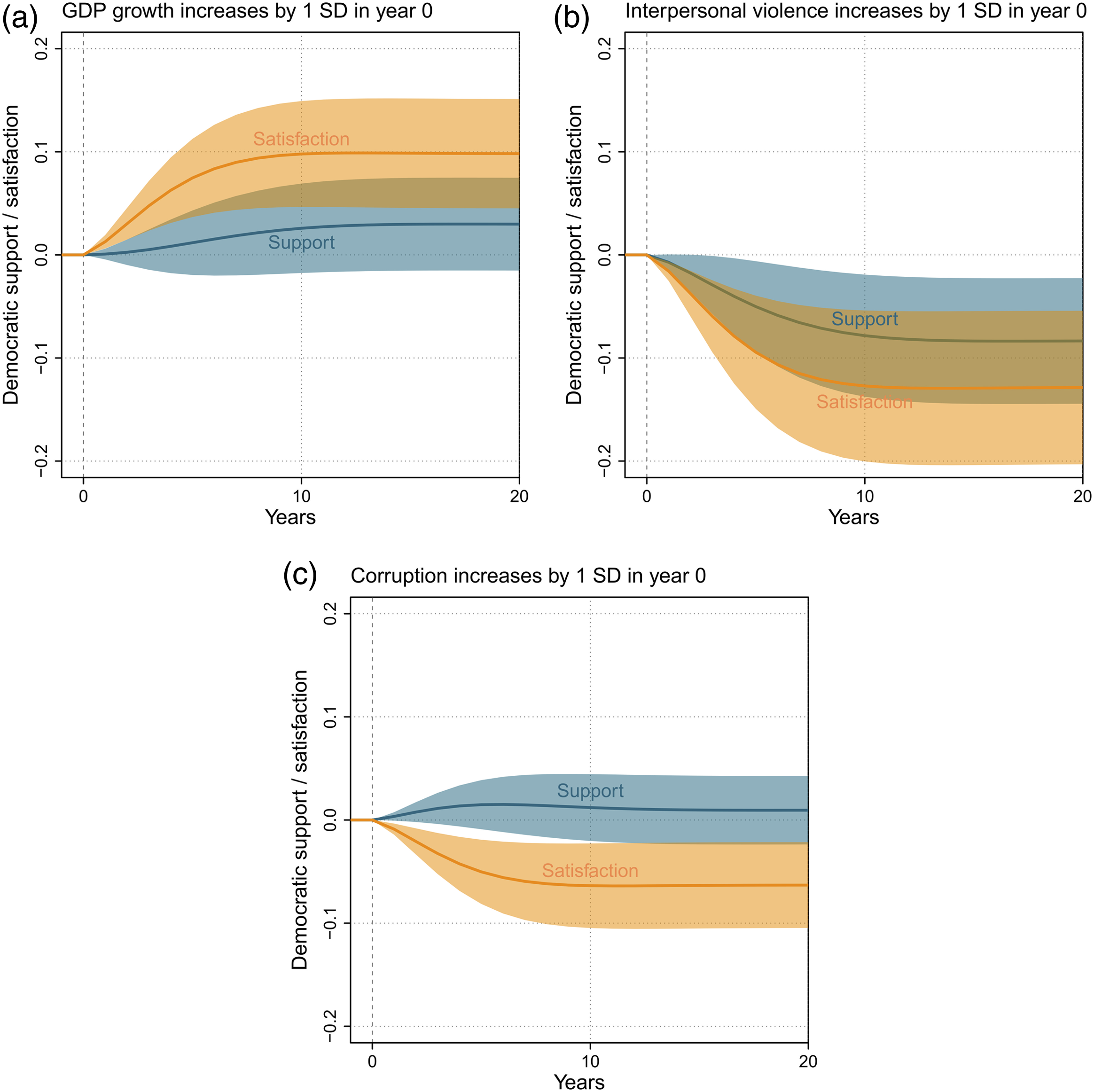
Simulated effects based on coefficients and variance-covariance matrices from Model 1.2. The solid lines indicate the mean simulated effect; the shaded regions indicate the 95% confidence intervals of these simulated effects. GDP growth simulations include the effect of GDP growth on GDP per capita.
Figure 3 show how a substantial but not unreasonably large increase (one standard deviation) in three covariates impacts democratic support and democratic satisfaction in the long run. Besides GDP growth and interpersonal violence, we also include corruption; these being the three covariates which displayed a significant short-run, direct effect in Table 1. The upper left panel shows the effects of an increase in the economic growth rate from 0% (by definition, the country average on the demeaned, within-country scale) to 5% (one standard deviation above the country mean). In addition to the long run effects of growth on both dependent variables, we also factor in how growth leads to change in GDP per capita, another covariate included in our models. The beneficial long-run effects of growth on satisfaction are clearly visible in the figure. Yet these are dampened somewhat by a negative effect of GDP per capita. Nevertheless, 13 years after the growth shock to this hypothetical system, satisfaction reaches its highest point, one-tenth of a standard deviation higher than the ex ante level. The beneficial effects of growth do not extend to democratic support, however. Despite both a positive (but insignificant) direct effect and a positive indirect effect via the contemporaneous impact of satisfaction on support, our simulated economic growth shock never manages to significantly raise democratic support.
The situation is quite different when it comes to control of violent crime. Here, our simulations show the effects of an increase in interpersonal violence from 0 (the average) to 1.2 deaths per 10,000 above this average—a modest, one standard deviation increase. A rise in violence of this magnitude has a marked negative effect on satisfaction in the long run: after a little more than a decade, satisfaction is 0.13 standard deviations lower than in the baseline condition. This 1 SD increase in interpersonal violence also has a significant, negative, long-run effect on support. Although the short-run direct effect reported in Table 1 is not significant, the total effect, which includes the indirect effect via the pathway from satisfaction to support, is both negative and significant. Violent crime therefore erodes both support for, and satisfaction with democracy.
Finally, we see that a 1 standard deviation increase in corruption from the country average of 0 to a level of 0.14 15 has a negative and significant effect on satisfaction in the long run, leading to a total reduction in satisfaction of 0.064 standard deviations after a decade. The short-run direct effect of corruption on support reported in Table 1 is, somewhat surprisingly, positive (albeit insignificant). This weak positive effect is diminished further once the negative indirect effect via the pathway from satisfaction is factored in. Corruption therefore corrodes satisfaction in the long (and short) run, but not support.
In sum, we find that two measures of effective governance, economic growth and violent crime, clearly affect national satisfaction with democracy, even when restricting our attention to the within-country, over-time variance in these variables. We do not find any effects of healthcare access and quality however. In addition, we do not find economic growth to have any discernable effect on principled support for democracy, even allowing for growth to exert both a direct and an indirect effect on support via its effect on democratic satisfaction. The one area of government performance which does seem to impact support (as well as satisfaction) is control of violent crime: increases in the national rate of interpersonal violence clearly have negative effects on evaluations of, and attachment to, democracy.
Conclusion
Many explanations have been proposed for how regimes retain public support and how they lose it. Perhaps the most fundamental of these is that regimes must meet their citizens’ basic needs and expectations, by maintaining order and safety, providing decent healthcare, and improving the populace’s standard of living. In the absence of such effective governance, the theory goes, citizens will ultimately lose faith in the regime itself. As Fukuyama puts it, “[l]egitimacy is won through substantive more than procedural accountability: what counts is the perception of citizens that their government is providing them with the kinds of protections and services they demand” (Fukuyama, 2014, p. 1331). Indeed, studies of resilient autocracies, such as China, have stressed the importance of “performance legitimation,” obtained through the accomplishment of goals such as “economic growth, social stability, strengthening national power, and ‘good governance”’ (Zhu, 2011). And a similar idea has seeped into political commentary, in reference not only to resilient autocracies (Friedman, 2009), but also to the purported “deconsolidation” of democracies; as Mounk (2018, p. 131) argues, “popular attachment to liberal democracy may be rather more shallow and more brittle than its most high-minded supporters tend to think.”
We examine this theory, that is, whether citizens’ support for, and satisfaction with, the democratic system rests at all on the effectiveness of their governments. Moving beyond the cross-sectional tests of existing research by using longitudinal data, we find that economic growth and the control of violent crime do seem to affect people’s satisfaction with the way democracy works in their countries. Furthermore, governments’ inability (or unwillingness) to tackle corruption in the eyes of citizens also seems to undermine democratic satisfaction. These findings will be unsurprising to many because satisfaction with democracy has long been argued to be the more instrumental and “specific” variety of democratic attitude (e.g., Linde & Ekman, 2003; Mattes & Bratton, 2007; Norris, 2011). However, we also find that principled support for democracy does not appear to be undermined in the same way by economic recessions or by perceptions of corruption. Indeed, although we show that each variety of democratic attitudes influences the other, the effects of government effectiveness and corruption never spill over from democratic satisfaction to democratic support.
This finding should be interpreted as positive news for democracies, we believe. There is now evidence that citizens’ principled support for democracy makes a difference for democratic survival (Claassen, 2020a). If such support hinged upon government effectiveness, the recent past and the near future might suggest reasons for concern. Just in the first two decades of the 20th century, the world has experienced two significant recessions and one global health crisis. In addition, the potential for ever increasing prosperity in the industrialized democracies appears to be constrained by demography, low demand, and the limited productivity-enhancing potential of new technologies (Gordon, 2015; Summers, 2014), not to mention the possible long-term negative impacts of climate change (Tol, 2018). Fortunately, our findings suggest that democracies’ reservoir of principled support is much less exposed to performance crises than some have worried.
Democracies do have an advantage over autocracies in the face of such challenges: they allow citizens to replace governments, thereby providing an outlet for citizens’ dissatisfaction (Duch & Stevenson, 2008; Schwindt-Bayer & Tavits, 2017). To be sure, the presence of elections does not imply that democracies are invulnerable to economic malaise. Indeed, economic downturns may hasten autocratization by, for example, threatening the interests of powerful elites (Bernhard et al., 2001; Przeworski et al., 2000). But there is no evidence that the effects of such downturns on democratic survival occur by increasing citizens’ disapproval of, or dissatisfaction with, democracy as a regime.
Democratic support is not entirely impervious to government effectiveness, however. As our results show, the rate of interpersonal violence harms both democratic satisfaction and principled democratic support. This echoes the findings of a significant body of research on crime and democratic support, which employs cross-sectional samples or micro-level panel studies, mainly from Latin America (e.g., Carreras, 2013; Fernandez & Kuenzi, 2010; Pérez, 2003; Visconti, 2019). Why should crime in general, and violent crime in particular, harm citizens’ principled attachments to democracy when economic recession, poor healthcare, and corruption do not? More research on this issue is required. But we submit that the answer may lie in political psychological research on the interplay between authoritarian predispositions and situational threats (Feldman & Stenner, 1997; Feldman, 2003; Stenner, 2005). Uniquely among the varieties of effective government we have considered, interpersonal violence implies that citizens are challenging the normative order of the state—indeed, possibly even challenging the state itself if one adheres to Weberian notions of the state holding a monopoly on the legitimate use of force. As Feldman and Stenner have argued, threats to the normative social order activate latent authoritarian predispositions in citizens. Among other things, this could lead to an increase in support for authoritarian forms of government and a decrease in support for democracy.
Supplemental Material
sj-pdf-1-cps-10.1177_00104140211036042 – Supplemental Material for Effective Government and Evaluations of Democracy
Supplemental Material, sj-pdf-1-cps-10.1177_00104140211036042 for Effective Government and Evaluations of Democracy by Christopher Claassen and Pedro C. Magalhães in Comparative Political Studies
Footnotes
Acknowledgments
We thank Hanspeter Kriesi, Robert Mattes, Bo Rothstein, and Mariano Torcal for their insightful feedback on earlier drafts of this paper.
Declaration of Conflicting Interests
The authors declared no potential conflicts of interest with respect to the research, authorship, and/or publication of this article.
Funding
The authors received no financial support for the research, authorship, and/or publication of this article.

Supplemental Material
Supplemental material for this article is available online.
Notes
Author Biographies
References
Supplementary Material
Please find the following supplemental material available below.
For Open Access articles published under a Creative Commons License, all supplemental material carries the same license as the article it is associated with.
For non-Open Access articles published, all supplemental material carries a non-exclusive license, and permission requests for re-use of supplemental material or any part of supplemental material shall be sent directly to the copyright owner as specified in the copyright notice associated with the article.
