




Abstract
Do ideologically extreme candidates actively pursue small donations? The literature on money in politics debates whether “small” individual campaign donors are more ideologically extreme than large donors. This paper reverses the question, investigating whether extreme candidates request smaller contributions from potential donors. Using data from U.S. congressional candidates’ fundraising platforms in the 2020 elections, I examine how campaigns typically present a set of suggested donation amounts to solicit money from potential donors efficiently. While party, in-state income levels, and the usage of major fundraising platforms mattered, ideological extremism had no bearing on the amounts candidates asked for. Given that solicitation amounts have been long and easily optimized through A/B testing, I interpret this as extreme candidates not finding it profitable to ask for smaller amounts, which is more aligned with the view that small donors are not more ideologically extreme than large donors.
Small donations and donors are dramatically increasing in American politics, fueled by online campaigning (Canes-Wrone and Miller, 2022), efficient and centralized fundraising platforms (Alvarez et al., 2020; Kim and Li, 2025; Yorgason, 2025), elite rhetoric (Gaynor and Gimpel, 2024), and favorable public opinion (Kim and Li, 2025). This trend is driven by ideas that they are democratizing (Rubenstein, 2022) or representative (Macdonald et al., 2024; Magleby et al., 2018); many political candidates emphasize grassroots support and tout their strength in small donations (Alvarez et al., 2020; Gaynor and Gimpel, 2024). Several, such as Bernie Sanders or Donald Trump, have shown that small-donor-based fundraising is a viable strategy, although this success is not universally applicable (Macdonald et al., 2024). Reformers advocate amplifying small donations through means such as public matching funds or tax credits to diversify the donor class and level the playing field (Boatright and Malbin, 2005; Malbin et al., 2012; McCabe and Heerwig, 2019; Panagopoulos, 2011). For example, the For The People Act of 2021 proposed a six-to-one match for under $200 contributions if the candidate refrained from receiving donations over $1,000, and various state-level measures have already implemented such incentives (Malbin et al., 2012).
This has alarmed some, who argue that small donors are more ideologically extreme and might polarize both the electorate and legislators (Bonica, 2011; Klein, 2013; Pildes, 2019). This suspicion may be theoretically justified: while large donors may be “investors” (Francia et al., 2003) with material, access-seeking, or electoral incentives (Bouton et al., 2024), small donors are likely to have little impact on legislative behavior, so are more likely to be political “consumers” (Ansolabehere et al., 2003) with ideological and expressive 1 motivations (Joe et al., 2008; Johnson, 2013). Access-seeking behavior is inevitably tied to assessing the candidate’s viability, and is likely to avoid extreme candidates far from the median voter, in a Downsian sense. Indeed, between access-seeking PACs and individual donors, PACs tend to veer toward more moderate candidates while individuals support more ideologically extreme candidates (Barber, 2016).
Some evidence has favored this argument (Bonica and Shen, 2014; Johnson, 2010), while others have found no differences between small and large donors (Albert and La Raja, 2020; Graf et al., 2006; Magleby et al., 2018; Malbin, 2013) or found small donors are closer to non-donors (Joe et al., 2008). Still others show that extreme legislators and messages attract small donors (Barber, 2016; Culberson et al., 2019; Ferguson et al., 2024a; Keena and Knight-Finley, 2019), regardless of whether they exert polarizing effects on the legislature or are themselves more extreme. Recently, Yorgason (2025) finds that Democrats, when fundraising increases from small donors, shift more ideologically to the left. Overall, the evidence is mixed on whether small donors are more extreme and polarizing.
I weigh in on this debate by reversing the question: do ideologically extreme candidates actively pursue small donations? If small donors are aligned with extreme political ideology and attracted to candidates with such exhibits, it should be optimal for extreme candidates to attempt to woo small donors—in particular, nudging small potential donors by adding non-binding suggestions, or “ask strings” (Athey et al., 2024), for small amounts.
Preset or default amounts have been shown to effectively engage the supply side, whether they are consumers being prompted to tip (Alexander et al., 2021) or potential charity donors (Altmann et al., 2019a; Athey et al., 2024), likely because they reduce cognitive strain (Altmann et al., 2019b; Blumenstock et al., 2018). Unfortunately, there is no research on what happens when a variety of donation profiles are presented to political donors. Research from charity and tipping provides some educated guesses: preset menus result in more donations than open-ended requests (Adena et al., 2014; Moon and VanEpps, 2023). Decreasing suggested amounts can boost participation while reducing the average dollar donated (Altmann et al., 2019a; Haggag and Paci, 2014; Goswami and Urminsky, 2016), making the net effect on total donations ambiguous. Ekström (2021) has shown that increasing the highest suggested donation greatly increased the likelihood to donate an intermediate amount, possibly because a utility maximizing donor would only consider three donation profiles: (1) their ideal amount, (2) the closest default below (1), and (3) the closest default above (1) (Castro and Rodilitz, 2024). Athey et al. (2024) replaced the least-used $75 option in a $25-$50-$75-$100 menu with either $10 (low reference point) or $200 (high reference point), finding that the former increased donor count while the latter increased total donations.
All in all, whether a specific set of suggested amounts is optimal depends on the context and the “market” segmentation of donors. However, it seems plausible to reason that potential donors will have an ideal amount in mind when presented with a set of options (Castro and Rodilitz, 2024), that suggested amounts will matter in political donations, and that given the highly competitive, highly A/B tested nature of donation environments (Karpf, 2016), it is likely that they are tailored to what the campaign perceives as the most optimal set of defaults. Given this, if small donors are more ideologically extreme than large donors due to higher tendencies of expressive/ideological motivations rather than instrumental motivations, we may expect ideologically aligned candidates to strategically include lower suggested amounts. If small and large donors are ideologically similar, we should see no difference in menus by candidate extremism.
Conditional on these theoretical expectations, and using data collected from 2020 U.S. congressional candidates, I find no evidence that extreme candidates request smaller amounts when soliciting donations. Whether the minimum, the average, or the maximum of suggested amounts are used as dependent variables in regressions, ideological extremity is statistically insignificant controlled for variables such as chamber, partisanship, incumbency, and so on. This result can be interpreted as extreme candidates not finding it profitable to ask for smaller amounts, which is more aligned with the argument that small donors are not more likely to be ideologically extreme than large donors, or mobilized by more ideologically extreme candidates. While this does not rule out more nuanced conclusions such as extreme rhetoric mobilizing donors within the candidate of the choice (Kim et al., 2024), the results provide indirect but crucial observation about the nature of small donors and their relationship with political candidates.
Data and methods
I collected data on how candidates request donations from all 2020 U.S. congressional candidates’ official campaign websites. The data is what potential donors would see if they attempted to give via official campaign websites, such as redirect links in websites’ “Donate” tabs.
2
Examples of such pages are presented in Figures 1 and 2, with Figure 2 displaying DW-NOMINATE’s primary dimension scores of the previous cycle. Donation redirect page from the official Donald Trump website, Feb 18, 2025. Examples of donation redirect pages from official campaign websites, 2020 November (a) Elizabeth Warren (D, MA-Sen), DW-NOMINATE -0.751 (relatively extreme) (b) Joe Manchin (D, WV-Sen), DW-NOMINATE -0.060 (relatively moderate) (c) Mike Lee (R, UT-Sen), DW-NOMINATE 0.891 (relatively extreme) (d) Susan Collins (R, MA-Sen), DW-NOMINATE 0.116 (relatively moderate).
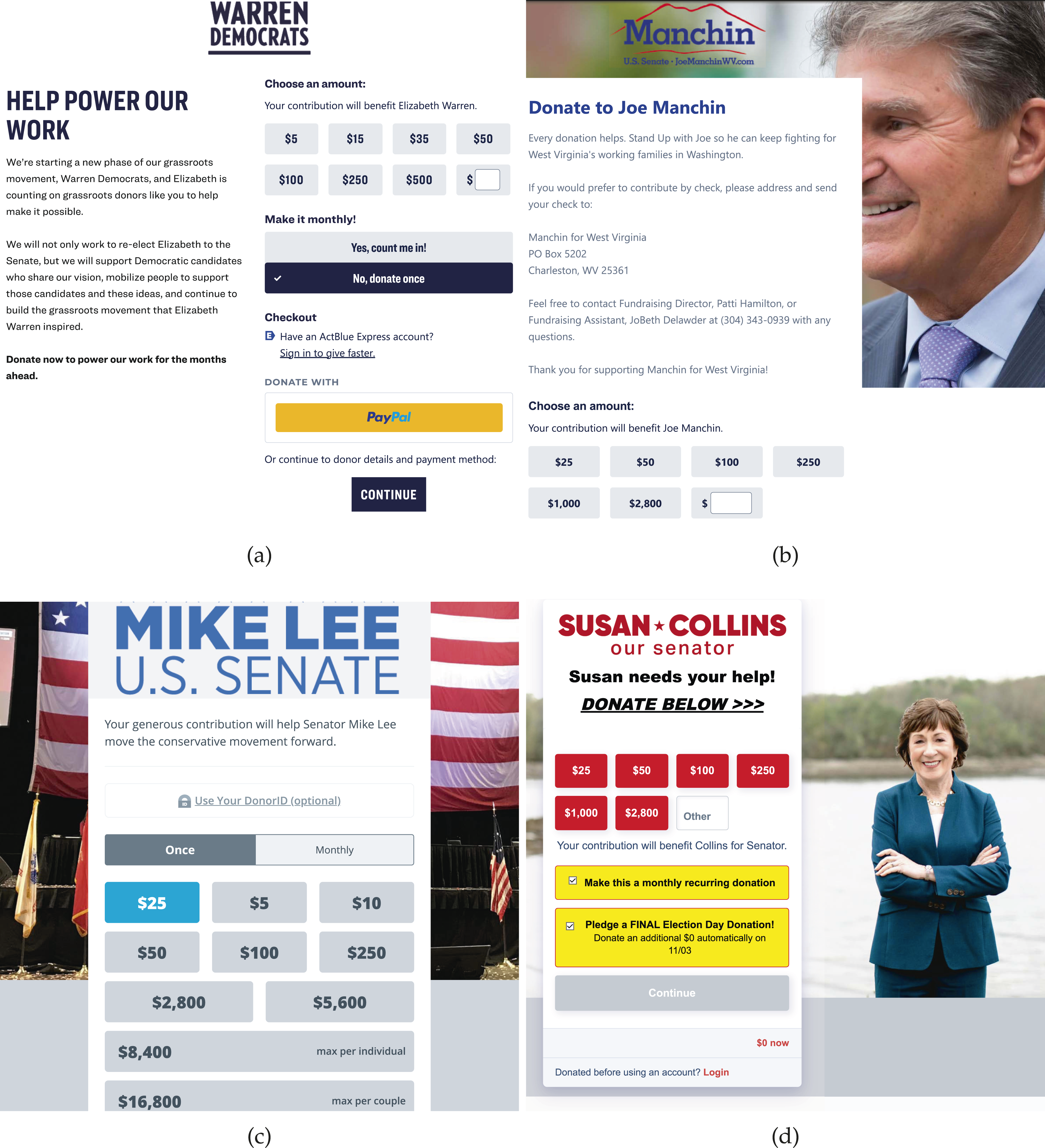
After limiting to general election two-party candidates with a DW-NOMINATE score (Lewis et al., 2023) available, the full sample consists of 416 House and 98 Senate candidates. 3 The data was collected multiple times throughout the cycle, but for most candidates, the amounts asked never changed. Given the staggered nature of candidate entry, for comparability, only the cross-sectional snapshot closest to Election Day was used.
Given a single “profile” or “ask string” of suggested amounts, such as
I run OLS regressions with summary statistics of the suggested amounts as dependent variables against ideological extremity, controlling for the following candidate/electoral characteristics: chamber, party, usage of ActBlue/WinRed, incumbency status, state’s average income, and electoral safety. See Figure 3 for bivariate distributions between ideological extremity and the average of suggested amounts by party. Scatterplot of ideological extremity and mean suggested amount by party.
Ideological extremism and suggested amounts presented to donors
Relationship between candidate/electoral characteristics and suggested amounts, all candidates.

Note: *p < 0.05; **p < 0.01; ***p < 0.001.
As is apparent, ideological extremity has no bearing in explaining the variations in any summary statistics of amounts solicited, whether or not it is interacted with partisanship. The results remain unchanged for subgroup analyses with House candidates, Senate candidates, competitive elections, and non-incumbents only (Supplemental Appendix, Table 2). Again, if small donors tend to fuel ideologically extreme candidates, then it is likely that extreme candidates’ campaigns understand this and actively seek out smaller dollar donations and offer smaller sets of suggested amounts. However, there seems to be no strong evidence in this direction. This is not an artifact of having extreme candidates having missing values in suggested amounts, as no Democrat has such cases, and there are no statistically significant differences in DW-NOMINATE scores between Republican candidates who did or did not provide suggested amounts.
Note that the directions of covariates’ coefficients are largely consistent with intuitive expectations. Incumbents have slightly higher minimum asks, possibly reflecting a more established, loyal fundraising base. Being a Republican candidate led to a significantly large increase in the average and maximum suggested amount, which is unsurprising given that grassroots donations have been emphasized much more by the left. Indeed, the modal Republican candidate asked for a maximum of $2,800, the individual contribution limit, while the modal Democratic candidate only asked for up to $1,000. Usage of major online platforms is associated with smaller amounts asked, which is true for both Republicans using WinRed and Democrats using ActBlue.
A few caveats should be noted. The data is limited mostly to incumbents, with some open-seat candidates and challengers who eventually obtained DW-NOMINATE scores. Bonica (2016) has shown that small donors give much less to winning candidates than large ones, possibly indicating a preference for fringe challengers. 5 However, the results are unchanged when only nonincumbent candidates are used (Figure 2(d)), suggesting that conditional on being competitive, extreme candidates do not seem to be targeting small donors differently than moderate ones. We also lack comprehensive understanding of the strategic environment that campaigns face, such as intertemporal strategies to secure small donors who may eventually become large donors, under- or over-asking to maximize donations instead of sincere asking, and so on. Note, however, that these concerns likely apply to all campaigns; more research is needed to understand such strategic considerations, especially when multiple default asks are possible. Finally, there is no comprehensive data on solicitations pitched through other channels than the official Web site (such as social media), which may better reflect strategic distinctions by ideological extremity.
Conclusion
What amounts political campaigns ask of donors are both interesting campaign behavior and essential demand-side data that fills in the gaps in the campaign finance literature. Using data collected on online fundraiser pages that 2020 U.S. congressional candidates hosted on their campaign websites, I show that ideologically extreme candidates do not necessarily court smaller individual donations. This is counterintuitive if we assume that small donors are disproportionately drawn to extreme candidates, especially given that A/B testing for optimal donation asks is easy to implement and can be tailored to target small donors.
These empirical results thus serve as indirect but meaningful evidence that challenges common assumptions linking small donors to ideological extremism, and have implications for campaign finance reform focused on encouraging small-dollar donations. If small donors are not more ideologically extreme than large donors, reforms amplifying their influence may not necessarily distort the ideological distribution of legislators, while encouraging demographic diversity in surrogate representation (Bonica and Grumbach 2024; Grumbach and Sahn 2020). Policymakers concerned about the polarizing consequences of such reforms should consider that the risks may be overstated, at least based on candidates’ strategic behavior in donation asks. 6
Finally, how do we reconcile this with the fact that lawmakers most reliant on small donors often appear more radical, such as Bernie Sanders (D, VT) or Marjorie Taylor Greene (R, GA-14)? One possibility is, of course, that contrary to the assumption, ask strings or preset menus are not well connected to contribution behaviors from small donors. Ideally, an experimental study spanning several campaign profiles would be able to rule out this possibility. Another possibility is that this trend is driven less by ideological extremism, but more by related forces—such as nationalization (Miller 2022) and political outsider status, including labels like “anti-establishment” or “insurgent” (Boatright and Malbin 2005; Porter and Treul 2024; Uscinski et al., 2021)—that attract small donors independently of symbolic ideology. For instance, John Fetterman (D, PA) and Katie Porter (D, CA-47) both received a high percentage of contributions from small donors (49.33% and 55.61%, respectively, in 2022), have garnered national media attention, yet are relatively ideologically moderate. Media amplification of salient behaviors 7 may significantly influence the mobilization of small donors who pay attention to nationalized issues, irrespective of legislator ideology. I leave this identification for future research.
Supplemental Material
Supplemental material - Fundraising on the fringe: Do ideologically extreme candidates solicit small donations?
Supplemental material for Fundraising on the fringe: Do ideologically extreme candidates solicit small donations? by Seo-young Silvia Kim in Research & Politics
Footnotes
Acknowledgements
I thank Jan Zilinsky, Zhao Li, Yimeng Li, Yuki Atsusaka, Jeff Gill, Josh Kalla, and participants at the APSA 2021 Pre-conference: Frontiers of Money in Politics Research for their comments.
Declaration of conflicting interests
The author(s) declared no potential conflicts of interest with respect to the research, authorship, and/or publication of this article.
Funding
The author(s) received no financial support for the research, authorship, and/or publication of this article.

Supplemental Material
Carnegie Corporation of New York Grant
This publication was made possible (in part) by a grant from the Carnegie Corporation of New York. The statements made and views expressed are solely the responsibility of the author.
Notes
References
Supplementary Material
Please find the following supplemental material available below.
For Open Access articles published under a Creative Commons License, all supplemental material carries the same license as the article it is associated with.
For non-Open Access articles published, all supplemental material carries a non-exclusive license, and permission requests for re-use of supplemental material or any part of supplemental material shall be sent directly to the copyright owner as specified in the copyright notice associated with the article.
