




Abstract
Can a second far-right party succeed in a country where the radical right was, until recently, absent? Spain’s 2024 European Parliament elections provided a striking answer with the emergence of SALF (“Let the Party Be Over”), a far-right anti-politics platform that captured 4.6% of the vote in its electoral debut, outperforming Podemos and the major regional parties. Through a comprehensive analysis of individual-level data from approximately 38,000 respondents across eleven surveys, we provide the first systematic assessment of SALF’s voters and compare them to other Spanish constituencies. First, our findings reveal an intriguing paradox: while SALF voters self-identify as more centrist than supporters of VOX (Spain’s main far-right party), their positions on substantive policies are similarly extreme. In contrast, SALF’s success stems from a distinctive combination of dissatisfaction with democracy and nontraditional media consumption patterns, especially among young male voters. Notably, while VOX’s earlier rise was primarily driven by Spain’s territorial tensions, SALF’s emergence signals a deeper phenomenon: profound disillusionment with Spain’s political system among specific segments of society.
“Even a person who has a gang tattoo: you’re going to fucking jail. If we have to put 40,000 guys in there, we will put them in there [...] And if the U.N. shows up, I’ll laugh in their face”—Luis “Alvise” Pérez, 28th April 2024.
With this remark, Luis “Alvise” Pérez, the leader of the Spanish far-right movement “Se Acabó La Fiesta” (SALF, or “Let the Party be Over” in English), boldly declared his alignment with the authoritarian tactics championed by other international far-right parties. Alvise also promised mass deportations, sending current Spanish Prime Minister Pedro Sánchez to prison and raffling his stipend as a European MP, should he become elected. Quite openly, he declared that he was racing to obtain MP’s judicial benefits as he was prosecuted for several cases because of fake news dissemination. He also claimed not to have an electoral program because his program is his “performance record” and accused all parties, including the far-right VOX, of deeply entrenched corruption. One month after his quoted declaration, 1 he obtained three seats at the EP elections with 4.6% of the national vote share.
What does explain SALF’s success? Spain had been traditionally considered a country free of far-right parties, a pattern that suddenly changed after the Andalusian Regional Elections of 2018 with the emergence of the far-right party VOX (Turnbull-Dugarte, 2019). Now, with VOX consistently attaining over 10% vote intention, another party seemingly competing in the same space of the ideological spectrum becomes similarly successful. This raises the question of what makes SALF different and, more importantly, whether their voters are different too. In this paper, we offer the first empirical assessment of the similarities and differences between SALF voters and those supporting other parties, particularly VOX.
We combined data from 11 independent surveys to build a dataset with approximately 38,000 Spanish respondents, of which 1117 self-report the intention to vote for SALF. 2 We show that SALF voters declare to be more centrist than those supporting other conservative parties. However, their policy preferences are akin to those of VOX in several dimensions. SALF voters are not only far-right in their positions, but they are also more dissatisfied with democracy than other conservative voters. Concerning the particularities of SALF voters compared to PP and VOX supporters, we find that SALF voters are overrepresented among young male individuals who obtain political information from nontraditional sources and are deeply dissatisfied with democracy. Moreover, they associate democracy with weakness and lack of welfare more than VOX voters.
Overall, this paper adds evidence that the establishment of radical right parties does not prevent similar or even more extreme platforms from being successful (Ivaldi, 2023; Otjes, 2021). A mix of democratic dissatisfaction and the widening use of digital information technologies may contribute to the emergence of extreme candidates that endanger liberal democracy, especially among young male voters.
The emergence of SALF at the 2024 EP elections
The June 2024 European Parliament (EP) Elections were characterized in the media as a fight between mainstream parties, which supported European further integration, and far-right parties, portraying a different vision of Europe (Mudde, 2024). Although many mainstream parties have resisted in several European countries, there has been a rise in conservative parties, including far-right ones. In this context, SALF emerged in Spain promising to build the “biggest European jail in the outskirts of Madrid,” ending illegal immigration and desiring that the current Spanish President, Pedro Sánchez, goes to prison. In several dimensions, the rhetoric and forms of SALF exceeded the aggressiveness of previous Spanish far-right parties. The uniqueness of several of these aspects, which some political commentators have connected with Nayib Bukele, 3 makes it difficult to predict how this platform will work in a country like Spain.
SALF’s founder and leader, Luis “Alvise” Pérez Fernández, started his political career as a political analyst of the center-right liberal party Ciudadanos (Cs), which is part of the Renew Europe family in the European Parliament. He ascended within the party and occupied positions of responsibility in the political campaigns of prominent Cs politicians. However, he would resign from the party due to the divergences with the official line of Cs on topics such as gender equality. Eventually, Alvise would become an internet celebrity, thanks to incendiary tweets against minorities that would become viral. He would be involved in several scandals that made him recognize that he ran for the European Elections to be gauged. In a striking difference from VOX, which has traditionally been more supportive of the judicial system and traditional media outlets, SALF has been a savage critic of the Spanish judges and traditional mass media, among other democratic institutions.
Like other new parties (Dinas et al., 2015; Emanuele and Chiaramonte, 2019), SALF secured representation for the first time at the European Parliament Elections. The platform got more than 800,000 votes, which accounts for 4.58% of the votes and three seats in the European Parliament. The party had its best results in some southern coastal provinces, while it obtained fewer votes in areas with stronger regional identities, such as Catalonia, the Basque Country, and Galicia. The emergence of SALF is important for Spanish electoral politics for three reasons. First, this party can move the positions of the main conservative parties to the right, as has happened in other contexts (De Lange, 2012; Down and Han, 2020; Heinze, 2018). Second, the emergence of SALF can affect political coalitions in Spain, where VOX and PP had already governed together at the regional level. It is unclear what the positions of SALF voters concerning having a coalition with PP are, nor what PP voters would think. Paradoxically, the emergence of SALF might further mobilize leftist voters and facilitate coalitions between divergent forces that want to avoid SALF as part of the government. Third, a future government in which SALF is integrated might pursue a far-right agenda, promising to curtail immigration and minority rights, enhancing security and order at the detriment of democratic safeguards.
Just another radical-right party?
Although SALF has some similarities with the Spanish far-right party VOX, there are some striking differences that the Spanish media have portrayed. First, the leader of SALF, Alvise, exercises charismatic leadership, and he is the only well-known figure on the platform. Second, while VOX was a traditional party that emerged as a split of the PP, SALF is not even a political party since it has been created as an association. Although the party leader has links with an existing (although decaying) party, he has emphasized his distrust of traditional politics. Third, SALF has attracted more than 800,000 voters despite lacking an electoral manifesto (as Alvise defends political manifestos to be a lie and that “his record is his manifesto”) and not having held any electoral rallies. This might be due to the party’s online popularity: Alvise is a popular figure on Instagram and Telegram surrounded by scandals and controversies. Although he was temporarily banned from different social platforms, such as Twitter, for spreading fake news, his videos denouncing corruption scandals (many fake ones) have gone viral on several occasions. Despite all these differences, it is unclear whether SALF voters hold preferences similar to those voting for VOX or the reasons behind the success of a second party in a seemingly saturated space in the ideological spectrum.
SALF also shares many features with other far-right parties across the world. While the judicial situation of Alvise Pérez echoes that of Donald Trump (as he has been taken to trial several times because of defamation accusations), his personalism and call for massive security measures are reminiscent of Nayib Bukele (Meléndez-Sánchez and Vergara, 2024). In a relatively secure country by international standards, such as Spain, it is notorious that SALF has been successful with an agenda emphasizing law and order. Moreover, in a striking difference from other populist leaders who became famous through traditional social media outputs (Dollbaum and Dollbaum, 2023), Alvise Pérez has attracted voters through Telegram and other alternative platforms.
Previous research has shown that VOX does not especially embrace a populist discourse (Marcos-Marne et al., 2024) and that the personality of its leader is different from other European far-right parties (López Ortega, 2024). In contrast, more similar to the beginnings of Podemos in which the image of its leader was used in the voting ballots, SALF is a personalistic platform in which its charismatic leader is the main source of party support. However, without analyzing SALF voters, it is unclear whether their supporters share their leader’s policy preferences and democratic disregard, nor what might differentiate their voters from those of VOX.
Research strategy
Data summary by source.

Data
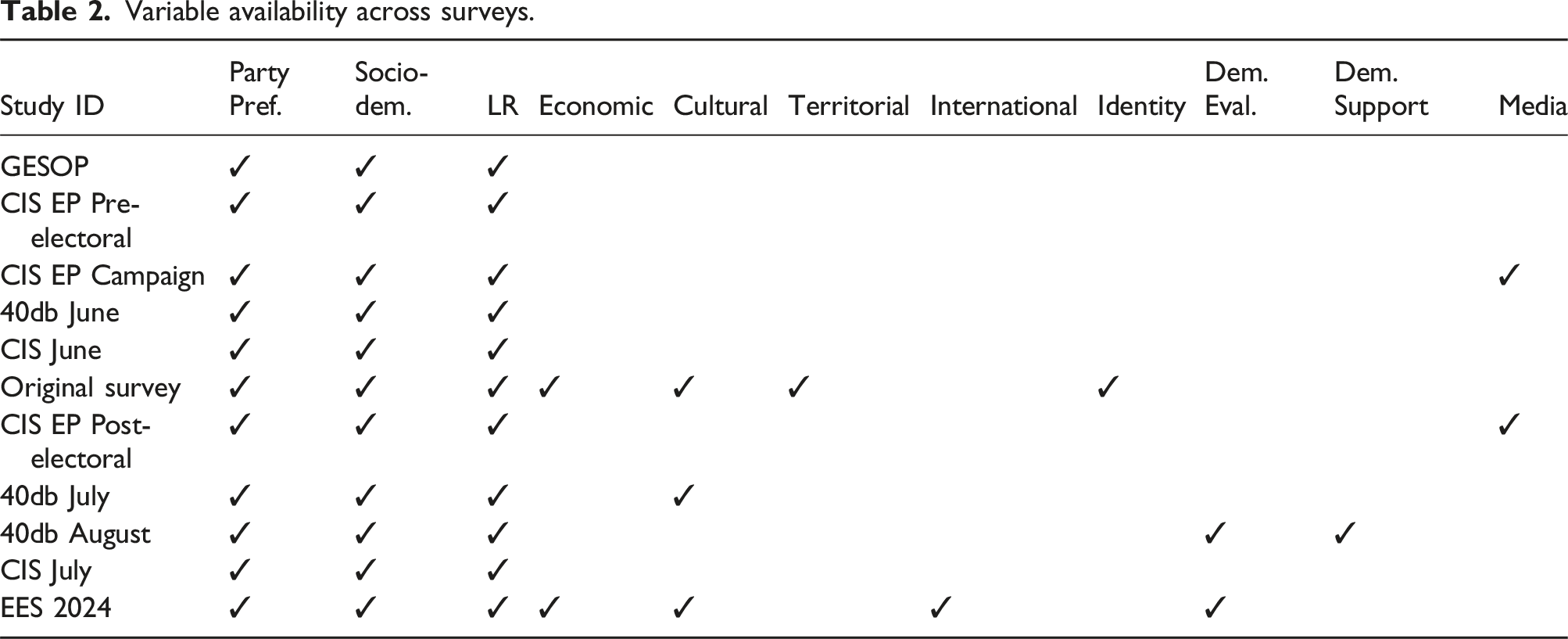
To merge the data for analysis, we started by identifying the variables available in each survey that could be used to discriminate SALF supporters. We identified three options: vote intention, vote recall, and partisan identification (PID). Vote intention is the most common indicator across surveys and it asks what party the respondent would vote for if the national general election would take place tomorrow. Across the selected surveys, this variable always had SALF as one of the options. Vote recall was also present across surveys but did not always include SALF. This is because the surveys fielded before the EP elections asked about the most recent national election, and therefore, SALF was not present as an option. Similarly, the CIS barometers, as they are monthly standardized surveys, do not ask about the EP Elections despite their fieldwork taking place after it. Finally, partisan identification did not always ask about SALF, particularly in the earlier surveys (like GESOP). For this reason, we decided to focus on vote intention as our main variable to identify SALF supporters.
In addition to comparability reasons, the intention to vote has other positive properties. Vote recall is generally more biased since it requires the respondent to recover their past behavior. Therefore, it is more prone to error and more likely to be affected by social desirability bias. As for PID, it might be problematic to assume that voters have developed an emotional attachment with a new party such as SALF. Therefore, vote intention is a better candidate to capture unbiased partisan preferences. Yet, some limitations may be noted. Particularly, vote intention may reflect strategic rather than true partisan preferences. This limitation must be considered when interpreting the results. Still, we believe it is the best available option to analyze SALF supporters.
With these considerations in mind, we built a partisan preference variable using vote intention whenever available. This was always the case except for the 2024 EES. For this survey, we used vote recall and merged it with the vote intention variables from the rest of the surveys to construct a single party-preference variable with eight categories. These categories are the main Spanish political parties (PP, PSOE, VOX, Podemos, Sumar, and SALF), a category for abstainers and those declaring to vote null or blank, and a remaining category for those declaring vote intention for any other party (“Other”). Those responding don’t know, don’t remember, or no answer were categorized as missing values. The resulting variable has 1117 self-declared SALF supporters over a total of 37,817 respondents.
The second step was mapping the available variables across surveys that were both good candidates for harmonization and could provide the most interesting insights about SALF voters. Following these criteria, we focused on five clusters of variables separated by topics: socio-demographic characteristics, ideology, identity, democratic attitudes, and media use and perceptions.
Starting with socio-demographic characteristics, we focus on gender, age, and education, as these are the most common variables across datasets and capture basic respondent attributes that have been identified as good predictors of voting for the radical right. For gender, we created a dichotomous variable where “1” indicates male and “2” indicates female. Whenever a third category—such as “Other”—was present, we coded it as missing, as it was not consistently available across datasets. For education, the surveys used different classification schemes, so we harmonized them into a minimal two-categories variable that indicates whether the respondent has completed tertiary education or not, capturing the nascent educational divide in Western democracies (Zollinger, 2024). Regarding age, all surveys except GESOP included a continuous age variable. To ensure comparability, we used GESOP’s original categorical age groups to create a factor variable across all datasets. We use these categorical variables as controls in our models for comparability but revert to the continuous variable when used as the main explanatory variable. The age categories are “18-29,” “30-44,” “45-59,” and “+60” years old.
For ideology, we use both self-declared ideology on a left-right scale as well as substantive ideology indicators. The left-right scale was present across surveys but sometimes measured from 0 to 10 and others from 1 to 10. In addition, GESOP had a 1 to 5 scale. To harmonize these variables, we first standardized the original variables using min-max normalization so that all of them range from 0 to 1 and then merged them all into a single normalized left-right ideology variable. The other ideology items are scattered across surveys, so we did not harmonize them into single variables. Instead, we used them separately. The specific items tap into cultural and economic preferences. In particular, we used two different indicators of preferences for redistribution, attitudes toward immigration and immigration policies, attitudes toward the LGTBQ+ community, and gender roles. The latest cluster includes opinions about the (traditional) role of women in society, support for same-sex couples marriage, support for a heterosexual pride day, and attitudes toward gender binarism.
We also include a total of six survey items tapping into support for authoritarian responses to the Catalan crisis to measure attitudes toward the Spanish territorial conflict. Finally, we collected a series of items about international world order views, with a focus on the European Union. They include external efficacy at the EU level, views about the EU, support for EU integration, and support for assistance to Ukraine.
We measured SALF respondents’ national and regional identity using the classic Moreno-Linz question on relative identity, as well as asking how proud the respondents feel for being Spaniard and from their region of origin. 5 As for democratic attitudes, we measured two distinct components. First, we use satisfaction with democracy and external efficacy at the national level to tap into democratic evaluations. We used a dichotomous question asking for preferences for democracy vis-a-vis authoritarianism to measure democratic support. Finally, for the latter dimension, we built an index of democratic meanings based on the two features that respondents are more likely to associate with democracy among ten possible options. We assign −1 to any response with a negative feature (e.g., weakness or inefficiency), 1 for a positive feature (e.g., justice or fairness), and 0 for none. We finally aggregate the responses in an index that ranges from −2 (very negative view) to 2 (very positive view).
Regarding media use and perceptions, we collect a series of dichotomous variables asking whether respondents use social media for political information, and TikTok and Telegram more specifically. We also build a variable capturing perceptions of fake news. The original items asked about fake news’ perceived presence in left and right media outlets separately. In both cases, the variables ranged from 1 (none) to 4 (very much). To have a general overview of SALF supporters’ perceived fake news presence, we added the value of both items and divided by two to build an additive index that reports general fake news’ perceptions on a scale from 1 to 4.
Variable availability across surveys.
Estimation
Our goal is to map SALF voters’ attributes vis-a`-vis the main Spanish parties to identify their core similarities and differences—particularly in comparison to VOX. To do so, we run a series of multinomial logistic regression models to predict party preferences based on the different socio-demographic and attitudinal variables highlighted above. Our core model specification is given by the following equation:
We include only these three basic socio-demographic controls because our goal is descriptive rather than predictive. We do not aim to identify the best predictors of SALF support but rather to map the attributes most strongly associated with SALF voting. Therefore, we intentionally keep the set of control variables minimal, so that each coefficient captures the relationship between the independent variable and party support while holding only age, gender, and education constant.
For the same reason, we avoid estimating fully specified models including multiple attitudinal predictors simultaneously (e.g., combining satisfaction with democracy and immigration attitudes), since we lack a clear theoretical framework about the causal structure among them. Including them together could introduce collider bias or overadjustment, in addition to multicollinearity issues, undermining our descriptive goal.
Given our objective, we report log-odds (i.e., the regression coefficients) rather than odds ratios or average marginal effects (AMEs). While AMEs and predicted probabilities are often more intuitive, they summarize non-linear changes in probabilities across the distribution of the independent variable. This means that they are sensitive to the underlying distribution of outcomes (Long and Mustillo 2021), and in our case, this can bias interpretation in favor of larger parties. For instance, an AME might suggest that a one-unit increase in ideological self-placement better predicts support for a center-right party than for the radical right, not necessarily because of a stronger association but simply because the center-right party has a larger vote share, making it the more probable outcome on average.
Odds ratios, on the other hand, can be misleading when comparing across multiple outcome categories—especially in a multinomial setting. Although they are often used to communicate effect sizes in applied work, odds ratios are multiplicative and asymmetric. This asymmetry can distort comparisons: for example, an odds ratio of 2 and an odds ratio of 0.5 are not equidistant from 1, even though they might suggest a similar strength of effect in opposite directions (Long, 2014). Moreover, odds ratios depend on the baseline odds of the outcome, which again introduces sensitivity to party size and prevalence. As such, they are less suited for our goal of mapping directional associations across parties of varying sizes.
In contrast, log-odds represent a linear transformation of the probability ratio and are symmetric around zero, which facilitates meaningful comparisons across parties—regardless of their size or base rates (Norton and Dowd, 2018). A positive log-odds coefficient indicates an increased likelihood of choosing a given party over the reference (abstention/null), while a negative coefficient indicates the opposite. This framing allows us to trace the direction and strength of associations between each explanatory variable and party preference in a consistent and comparable way. While log-odds may be less intuitive at first glance, they are more appropriate for our purpose: identifying and comparing relative associations between voter attributes and support for different parties, rather than estimating absolute effect sizes 6 (Mood, 2010).
Finally, we use a different model specification to estimate the propensity to vote (PTV) for SALF based on respondents’ previous vote choice. Specifically, we run an Ordinary Least Squares (OLS) regression, given by the following equation:
It is important to note that the harmonization and merging of different survey sources—each of which follows distinct sampling procedures (e.g., quota sampling and stratified sampling), interviewing techniques (e.g., online vs in-person), sample sizes, and fieldwork periods—may introduce biases into our estimates, potentially allowing some surveys to disproportionately drive the results. To mitigate this, we run separate regression models for each survey whenever an item is available in more than one of them. We then report both the estimated coefficients from each survey-specific model and from a pooled model with survey-fixed effects. While we expect no substantial differences across specifications, this approach accounts for survey-specific differences while ensuring transparency and allowing readers to assess the robustness of the results across data sources and model specifications.
All our models incorporate appropriate standard errors, and our visualizations display standard 95% confidence intervals. We present the results grouped by the five thematic areas delineated above: socio-demographic characteristics; ideology (subdivided into left-right positioning, economic, cultural, territorial, and international views); identity; democratic attitudes; and media use and perceptions. Given the large number of regression models, we include in the main text only those plots that show the most insightful differences between SALF and other groups of voters, while referring readers to the appendix for the remaining analyses.
(Self-perceived) centrists with far-right positions
As Figure 1 shows, SALF voters perceive themselves to be more ideologically centrist than those supporting VOX.
7
Left-right self-placement of respondents depending on their preferred party. The size of the dot indicates the sample size, and the different symbols account for the different surveys (the filled circle indicates the estimate of the pooled-surveys model with survey fixed-effects).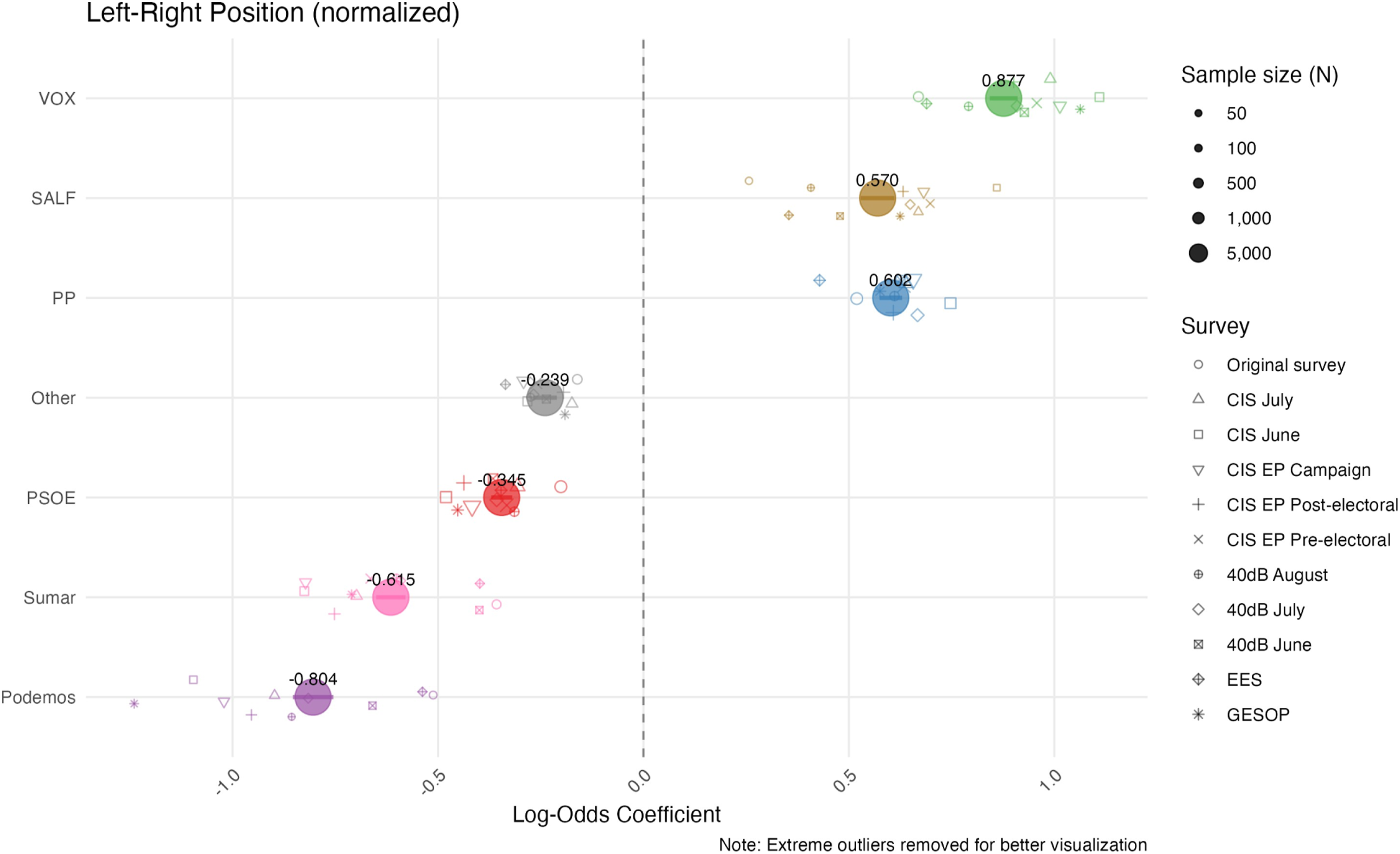
Interestingly, they perceive themselves as ideologically closer to PP than VOX supporters. Although this could be because SALF is a new party, so their voters might hold weakly constrained beliefs and not still be ideologically aligned with their party just because they do not know how to position it (Busch, 2016), it might also be related to the new phenomenon of populist centrism (Zulianello and Larsen, 2024). The latter hypothesis seems particularly consistent if we compare the (right)centrist positioning of their voters with the stories and attitudes of their party leader, who explicitly campaigned against all traditional politicians, both from the left and the right, and even the monarchy, traditionally backed by right-wing politicians. 8 In a country in which the left-right dimension has been traditionally taken as unidimensional (Vidal, 2018), it is particularly surprising to find that SALF voters do not consider themselves as right-wing as their party discourse appears. This could be due to a mix of social desirability bias and the fact that SALF voters have contradictory policy positions on cultural issues, as it is shown later.
The relative centrism of SALF voters does not correlate with moderation in most policy positions. If we look at the policy preferences and attitudes of SALF voters, we find that they are similar, or sometimes even more extreme, than those from VOX. As Figures 2 and 3 show, there are no substantial differences in their political positions on a battery of topics that include general redistribution preferences, preferences for government redistribution, perceptions of immigration, and immigration policies. If anything, SALF voters have more radical positions than VOX voters on economic and social issues (especially on reverting pro-immigration policies). The clear extremism of SALF voters when compared to the rest of the parties (except for VOX) is particularly striking if we account for the fact that each of these items is only present in one of our surveys. That is, we detect statistically significant differences—with SALF voters holding the most extreme positions, only comparable to those of VOX—despite the small number of SALF supporters in our sample, and hence with lower precision and larger confidence intervals. Log-odds of voter preferences on redistribution. As can be seen, SALF and VOX voters have similar positions concerning redistribution. If anything, SALF voters hold more extreme positions. Log-odds of voter attitudes on immigration. As can be seen, SALF and VOX voters have similar positions concerning immigration. If anything, SALF voters have more extreme views.

The far-right extremism of SALF voters is supported by additional findings. As Figure 3 in Appendix C shows, SALF voters are equally conservative on measures related to heterosexual pride and anti-non-binary individuals. Moreover, if we look at the international positions that SALF voters take, we find a similar pattern. If anything, as Figure 6 in Appendix F shows, SALF voters are more negative than VOX in their views toward the European Union and support to help Ukraine. While the attitudes of SALF are consistently extreme on a battery of policy dimensions, Figure 3 in the Appendix shows a substantive difference: SALF voters have less traditional values concerning women’s role in society and same-sex marriage. This suggests that they might be instrumentally inclusive, as these issues can be used by the party to attack immigrants and Islam (Turnbull-Dugarte and Ortega, 2024), which positions them closer to the Western-European radical-right.
Additional analyses in the supplementary materials 9 show how SALF voters position themselves on a series of questions about curtailing democratic institutions in response to a territorial crisis with Catalonia. Overall, SALF voters have slightly more moderate attitudes than VOX supporters, especially in questions about the courts and the media stepping over the government to stop independentism in Catalonia. This suggests that territorial tensions, which have been pointed out as the factor that explained the emergence of VOX (Rama et al., 2021; Turnbull-Dugarte, 2019), are unlikely to be the main driver of SALF’s success among the electorate. This is supported by the fact that, as we show in the appendix, SALF voters’ national identity is not as salient as the national identity of other voters from conservative parties.
Finally, if we look at different propensities to vote for SALF across groups of voters, as in Figure 4, we find that VOX voters are the most likely group to support SALF. Therefore, although they consider themselves to be more centrists than VOX voters and are ideologically closer to PP, SALF is better at attracting VOX supporters than PP voters. Therefore, SALF is clearly competing in the far-right spectrum. Propensity to vote (ranging from 0 to 10) for SALF depending on the party that was voted in the European Parliament election. As expected, those who already voted for SALF are the most likely to support it again. SALF is also attractive among VOX supporters, while the predicted PTV for SALF is much lower among those who voted for PP and almost insignificant for those voting for leftist parties.
So... how are SALF voters different?
We have established that SALF voters are similar to those supporting VOX in substantive policy positions. However, our analyses also report several key differences between them. Figure 5 shows how gender, age, and education are related to the probability of supporting the different parties. The plot shows that SALF voters are particularly young compared to the rest of the voters. It also shows that they are slightly more highly educated than VOX voters but not particularly compared with PP (the center-right) or SUMAR (the radical left) voters. As happens with other far-right parties, SALF and VOX voters are more likely to be male than the rest of the voters, although there are no significant differences between them. In general, SALF voters are concentrated among men compared to the other parties to the same extent as VOX voters, and the main difference stems from age, where SALF shows to concentrate the youngest electorate by far. Log-odds of being a man, having tertiary education, and being older (in years) depending on the supported party. As can be seen, SALF voters are more likely to be younger men with tertiary education when compared to abstainers, the reference category. The different symbols account for the different surveys.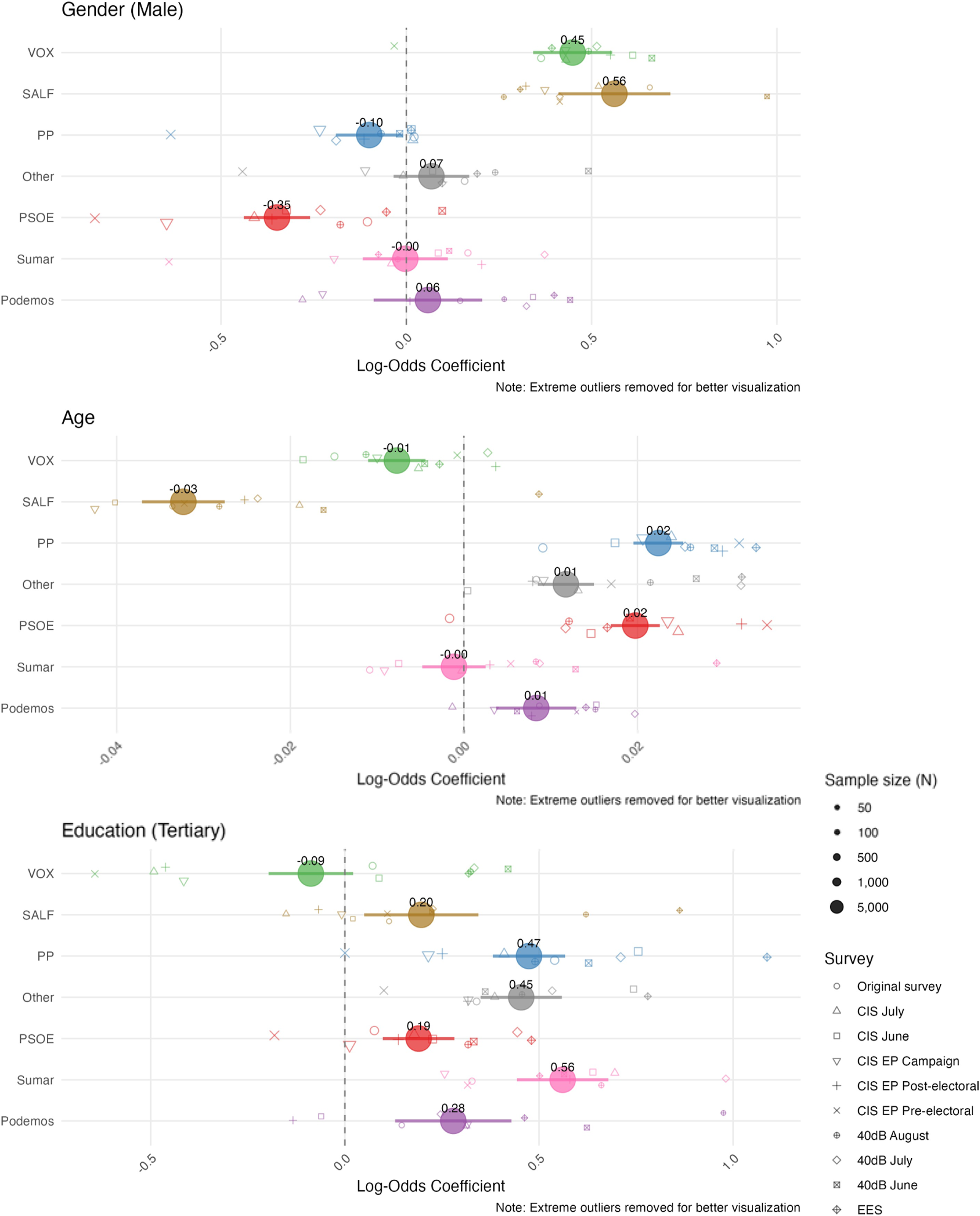
A second difference stems from SALF voters’ use and perceptions of media. In particular, Figure 6 shows two crucial differences between SALF and VOX voters: those who support SALF are more engaged in the use of non traditional social media (particularly Telegram) and perceive more fake news in traditional media. It is important to remember that SALF does not emerge from a TV star (Dollbaum and Dollbaum, 2023) but from the under-the-radar social network Telegram, where his leader Alvise accumulated a large base of followers on his private channels. Our evidence aligns with the idea that this social media channel had a strong impact on voting for SALF. It also confirms a digital divide between SALF and other party supporters, particularly compared with the mainstream parties. This is consistent with the fact that young voters are particularly overrepresented among SALF electorate, but it goes beyond this aspect, as this difference emerges even after holding age constant. Finally, SALF voters do not only use social media for political information more, but they are also those who perceive more fake news in traditional media, at least to the same level as VOX, which could help to explain why they lean more toward non-traditional media channels. Log odds for different variables on media use and perceptions. As can be seen, SALF voters are much more likely than VOX voters to obtain their political information through social media, and Telegram. Compared to mainstream parties, they are more likely to obtain information through TikTok and perceive a higher presence of fake news in traditional media.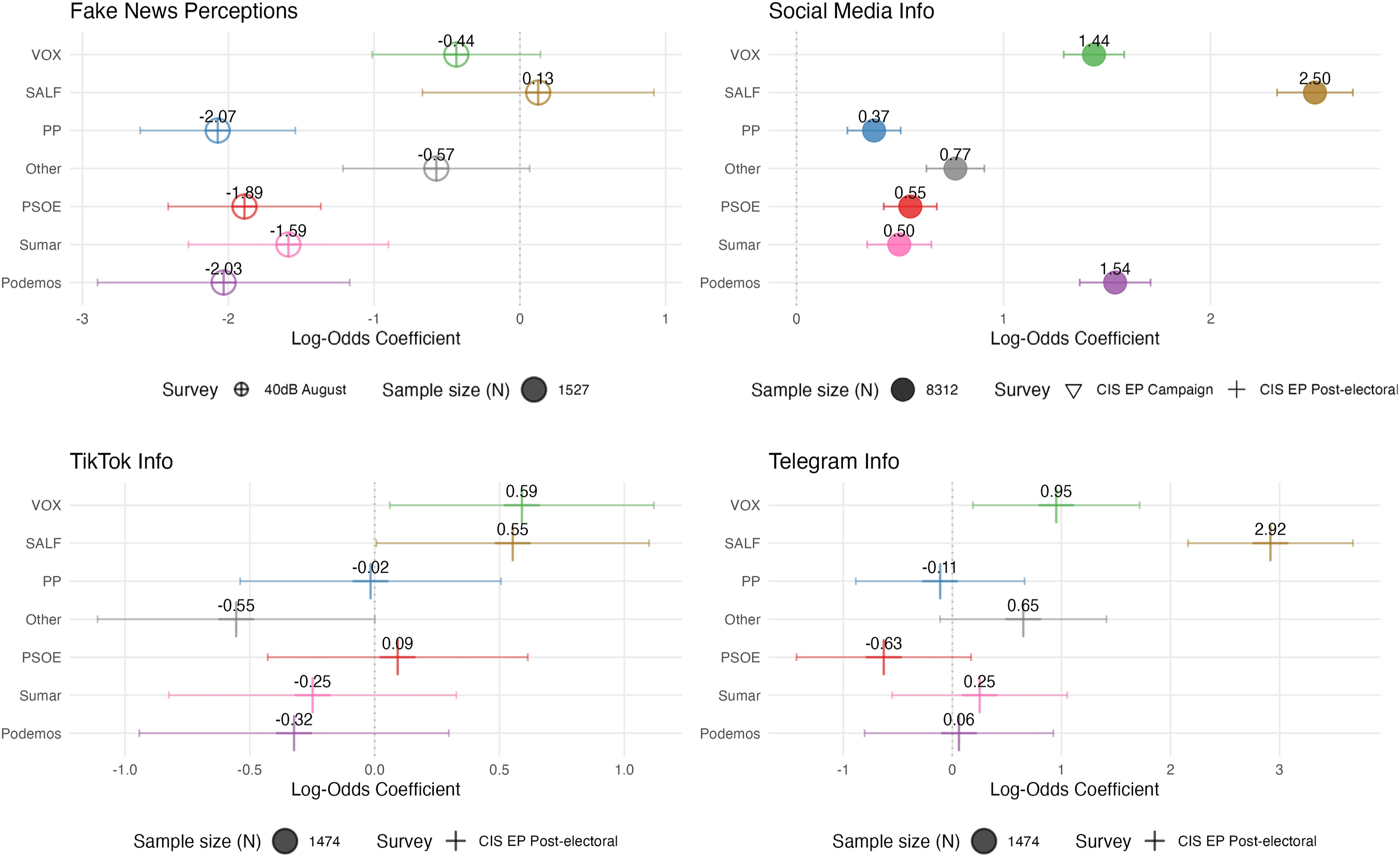
Finally, a third key difference relates to SALF voters’ perceptions and evaluations of democracy. As Figure 7 shows, SALF voters are substantially more dissatisfied with how democracy works in Spain than the rest of the voters, including those supporting VOX. They also have lower external efficacy, as they are the least likely to agree that politicians take into consideration citizens’ opinions. At the same time, however, they show similar levels of support for democracy, which is even slightly lower for VOX voters. Figure 2 in Appendix B suggests that the reasons behind VOX and SALF voters’ discredit towards democracy seem to come from different beliefs, with SALF voters emphasizing weakness, fraud, and less welfare as features of democracy, in contrast to disorder, which is strongly emphasized by VOX. Therefore, while SALF voters score higher on democratic dissatisfaction, they do not hold more authoritarian-oriented attitudes than VOX voters. Overall, our findings also suggest that the reason behind SALF voters’ profound democratic dissatisfaction is the belief that it is a fraudulent and weak system that does not provide enough welfare to its citizens. Log odds for different measures of democratic evaluations and democratic support. While SALF voters are substantially more dissatisfied with democracy and have lower external efficacy, VOX voters show slightly lower levels of democratic support.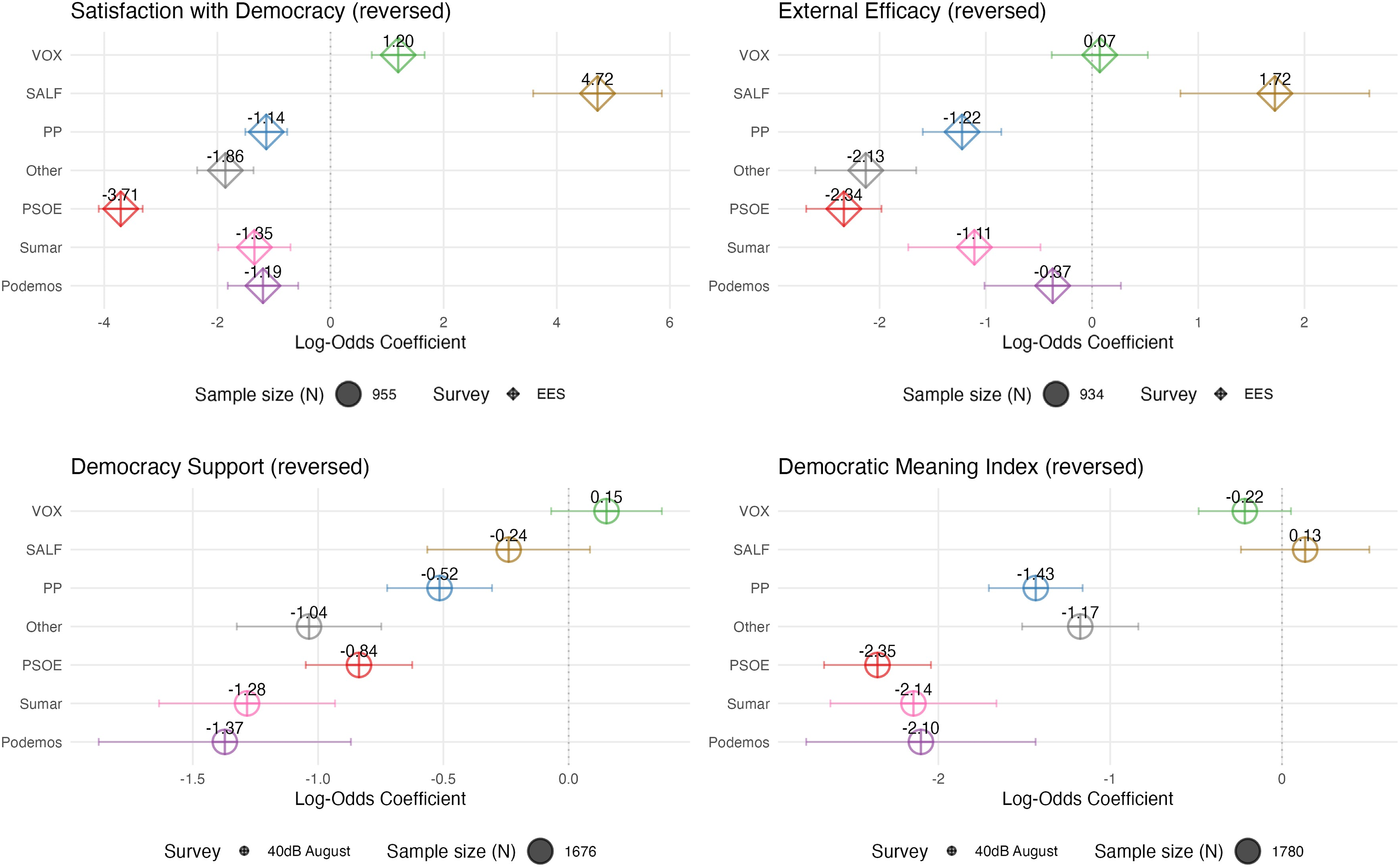
Conclusion
Drawing from data across 11 surveys encompassing approximately 38,000 respondents, we find significant insights into Spain’s evolving far-right political landscape. Our analysis reveals that while SALF voters perceive themselves as more ideologically moderate than VOX supporters —positioning themselves closer to the PP—their stance on socio-economic issues proves equally or even more extreme than VOX voters. Moreover, our examination of voting probabilities across different party supporters demonstrates that SALF most directly competes with VOX and that the two parties share a similar socio-demographic profile of voters.
However, three crucial distinctions set SALF voters apart from other party supporters, including VOX. First, SALF voters are significantly younger than VOX voters. As the previous younger generation was especially affected by the economic crisis (Bessant et al., 2017), which was connected to their vote for the far-left party Podemos (Benedicto and Ramos, 2018), this new younger generation is more inclined to support far-right options, especially SALF among the youngest. As such, SALF connects to the broader trend of young men supporting the far right in western Europe (Abou-Chadi, 2024), becoming the primary manifestation of this phenomenon in recent Spanish elections, according to our analyses.
Second, SALF voters show a marked preference for social media as their primary information source, echoing Alvise’s anti-establishment stance toward traditional media, a characteristic partially shared with the early Podemos, a party that built its strategy on various populist movements. In particular, our evidence demonstrates the connection between using Telegram as a primary information source and voting for SALF.
Finally, SALF voters are those expressing higher dissatisfaction with how democracy works. While both VOX and SALF voters harbor some negative associations with democracy, SALF voters are notably more inclined to link it with weakness and reduced welfare. Overall, this evidence points towards a structural problem concerning young male voters, skeptical of traditional media sources, and deeply dissatisfied with democracy. This is in contrast to the emergence of VOX, linked to territorial concerns about Spanish unity (Turnbull-Dugarte, 2019), which instead are not essential for explaining the success of SALF.
The differences between SALF and VOX supporters mirror distinctions between the parties themselves. While VOX maintains radical position on cultural issues, such as immigration, it has generally pursued an institutional agenda supporting democratic counterbalances—including courts, traditional (even if only right-wing) press, and the monarchy.
Moreover, compared to other radical right parties, VOX’s discourse has not been considered especially populist (Marcos-Marne et al., 2024). In contrast, SALF embodies a charismatic leadership style with comprehensive anti-establishment rhetoric that challenges every democratic institution, from courts and press to the king, as well as all political parties. Increasing democratic satisfaction and trust in the media, especially among young male voters, might be the crucial factor if the menace of SALF wants to be mitigated.
Supplemental Material
Supplemental Material - When the party is over: Explaining the rise of the Spanish far-right SALF
Supplemental Material for When the party is over: Explaining the rise of the Spanish far-right SALF by Javier Padilla Moreno-Torres, Álvaro Canalejo-Molero, and Alberto López Ortega in Research & Politics
Supplemental Material
Supplemental Material - When the party is over: Explaining the rise of the Spanish far-right SALF
Supplemental Material for When the party is over: Explaining the rise of the Spanish far-right SALF by Javier Padilla Moreno-Torres, Álvaro Canalejo-Molero, and Alberto López Ortega in Research & Politics
Footnotes
Author contributions
The authors confirm equal contribution to the paper. All authors reviewed the results and approved the final version of the manuscript.
Declaration of conflicting interests
The authors declared no potential conflicts of interest with respect to the research, authorship, and/or publication of this article.
Funding
The authors disclosed receipt of the following financial support for the research, authorship, and/or publication of this article: This work was generously supported by the University of Lucerne FoKo Grant nr. 69381.

Data Availability Statement
Supplemental Material
Carnegie Corporation of New York Grant
This publication was made possible (in part) by a grant from the Carnegie Corporation of New York. The statements made and views expressed are solely the responsibility of the author.
Notes
References
Supplementary Material
Please find the following supplemental material available below.
For Open Access articles published under a Creative Commons License, all supplemental material carries the same license as the article it is associated with.
For non-Open Access articles published, all supplemental material carries a non-exclusive license, and permission requests for re-use of supplemental material or any part of supplemental material shall be sent directly to the copyright owner as specified in the copyright notice associated with the article.
