




Abstract
The relevance of policymaking stems from its utility in helping social systems manage the output of their constituent members by shaping behavioural and procedural processes. Whilst policymaking might be well-meaning, it does not always lead to satisfactory outcomes. Policy may fail in generating uptake or establishing intent. For this reason, the study of the psychological characteristics of citizens is pertinent in understanding reactions to policy. In the present study, we analysed policy communication and reception in Kuwait in terms of the worldviews they advance. We also studied media responses and worldview distributions amongst the public (n = 1400). Our findings demonstrate both within and between worldview differences in reactions to science policy. We observed an engagement effect between worldviews and their appreciation of science policy. We also observed a within worldviews mobilisation effect, by which differential reactions to science policy are activated once engaged. Our conclusions suggest that policymakers would benefit from a broader management of worldviews and psychological characteristics beyond traditional sociodemographic influences.
Introduction
Policymaking serves to regulate the activities of citizens in a way that helps society chart a direction for its future. A characteristic difficulty in policymaking concerns well intentioned proposals that fail to solicit uptake. Whilst policies can be well-meaning, they do not always necessarily meet citizens’ expectations. A common example is Bowles’ (2016) study on day care centres in Haifa, which saw the introduction of fines for late pickup increase tardiness rather than reduce it on the premise that fines covered late pickup costs, which they did not. The misunderstanding led to a contrarian outcome that actually increased undesirable behaviour. This example demonstrates that policymaking is at times prone to misunderstanding (Sammut and Bauer, 2021). It is therefore essential for policymakers to acquire an adequate understanding of the psychological characteristics of their audience, such that their policy communications can target expectations and aspirations effectively to ensure uptake.
In the present paper, we examine the role of worldviews on policy engagement. Worldviews circumscribe individuals’ sense of purpose and meaning in the world and the life they live. We start by reporting findings from a policy and media analysis in Kuwait. We then proceed to examine the relative distribution of worldviews amongst the general public in Kuwait, towards examining the nuanced effects of worldviews on the nature and style of resonance they achieve amongst the public.
Worldviews
The study of worldviews was originally proposed by Jaspers (1925) to chart human functioning in its totality of being. According to Jaspers, worldviews enable psychological immersion in the social domain, helping users get on with the business of living without having to routinely stop and question its purpose. Decades later, Koltko-Rivera (2004) renewed the appeal. In the present paper, we adopt Sammut, Mifsud & Brockdorff’s (2022) definition of worldviews as ‘generalised outlooks on life and on one’s place in the world that provide a general template for social conduct’. We contend that worldviews serve to interpret social stimuli in characteristic ways that provide a common ground for social relations. We rely on Sammut’s (2019) typology of worldviews and distinguish between Orthodox, Localised, Reward, Pragmatist and Survivor worldviews.
The Orthodox worldview represents a dogmatic outlook on life that relies on rigid adherence to some overarching moral code. The Localised worldview is immanent and focused on fixing laws and institutions so that these can cater to everyone’s needs. The Reward worldview demonstrates agency, positing that life challenges are overcome with effort that opens up new possibilities. The Pragmatist worldview promotes adaptation to circumvent potentially adverse circumstances. Finally, the Survivor worldview represents a cynical outlook that requires stoicism as, in life, good people get exploited whilst the selfish get ahead.
Sammut et al. (2022) investigated the role of worldviews on a legislative proposal for introducing recreational cannabis in Malta. They found that the Orthodox worldview aligned itself against the proposal whilst other worldviews maintained a neutral stance. The authors report that those subscribing to an Orthodox worldview resisted the proposal to legalise recreational cannabis on the grounds that it detracted transcendental aspirations associated with the prevalent Catholic faith. Individuals who subscribed to other worldviews, however, found no such objection as they did not perceive the policy to be in violation of some grand moral precept. The authors conclude that the study of worldviews is crucial in understanding policy uptake or resistance and that insofar as policymakers expect citizens to adopt and follow institutional policies in everyday life, policy proposals need to be formulated in a way that appeals to the worldviews individuals use to navigate their lived environments. Mifsud and Sammut (2023) show that the five worldview types vary along two underlying dimensions of ‘Openness/Conservatism’ and ‘Self-Transcendence/Self-Enhancement’.
In the present study, we adopt Sammut, Mifsud & Brockdorff’s (2022) typology to study Kuwaiti science policy and its appraisal in the media. We studied two distinct policy domains, that is, environmental policy and healthcare policy, due to their explicit concern with scientific developments. In the first study, we looked at both published policies and their reception in the Kuwaiti printed mass media. We then proceeded to measure the prevalence of worldviews in the Kuwaiti public to examine its role in the endorsement of variables associated with science culture. This enabled us to investigate (a) whether policy proposals in the two domains appeal to different worldviews, and (b) whether the reception of worldviews in the media synergises or stirs similar or contrasting worldviews.
Study 1: worldviews in media and policy
Corpus construction
The aim of our first study was (a) to examine how science is communicated to stakeholders and the general public and (b) to identify the various worldviews represented in the different communication genres. Policy documents and news media were identified as the two main forms of science communication of interest. We excluded documents that presented purely facts or findings, without articulating a worldview to justify the facts. Among the most comprehensive and rigorous policy reports identified were those produced by the Kuwait Public Policy Center, which produced proposals for both pillars of health and environment including a research report, a policy paper and a white paper for each of the two pillars. In addition, a policy whitepaper on hydrogen fuel prepared by the Kuwait Foundation for the Advancement of Science and the Kuwait Petroleum Corporation was also included due to its relevance to the environment pillar.
With regards to the published news media, we looked at six newspapers, namely, Al Jareeda, Al Anbaa, Al Rai, Al Qabas, Al Watan and Al Siyasa. These are by far the most established, longest running newspapers in Kuwait that claim the broadest readership and are most likely to contain opinion pieces written by prominent columnists. Keyword searches were performed on each newspaper’s digital news website based on key terms and concepts related to the two pillars of health and environment. Only opinion pieces were selected for inclusion. The search for opinion pieces on the environment pillar yielded good results. That for opinion pieces on the health pillar yielded no relevant data beyond fact-presenting COVID-19 focused pieces. The study received ethical approval from the London School of Economics and Political Science (LSE).
Coding procedure and framework
Coding was carried out by the authors independently, who then met to discuss the process and discuss disagreement on divergent codes. This iterative process enabled the refinement of the coding frame in terms of the development of operational definitions that enabled consensus. The Hydrogen Strategy document was used as a starting point through which the codes were tested and refined. The coding process entailed a search for claims and their justificatory background based on Buhagiar and Sammut’s (2023) argumentation analysis protocol. This posits that arguments are made up of claims justified by warrants and supported by evidence. In the process of argumentation, these various components are strung together to make a case for or against particular claims. Claims, therefore, constitute the logical conclusion of arguments. In this study, we relied on identified claims that were subsequently coded as representative of one of the five worldview types according to the following operational definitions that were applied to the entire corpus: (1) Survivor: The most cynical of the worldviews that frames situations and states of affairs as wholly negative; an impending disaster with no chance of salvation or mitigation [e.g. As we see many of our neighbours in the Arab Gulf states have taken very advanced steps in this field, and I was very pleased and reformulated this article after hearing the news of the government’s interest in quickly implementing proposals for renewable energy projects, beautifying Kuwait City and developing Failaka Island. However, I fear that these projects will remain only ink on paper such as Silk City, island development, free zone, the train and the metro system [...] Or to be delayed for many years, such as Shaddadiya University and the Jaber Stadium. Al Anbaa, 05 August, 2021]. (2) Pragmatist: This worldview frames situations and states of affairs as negative, however given a certain position or stance that is taken there may be some mitigation or getting by [ e.g. Therefore, government agencies must strive to urgently save the environment from the coming pollution risk, which will double due to global warming, and we are confident in the wise leadership of our government in order to protect the environment…The controversy is still ongoing amongst various circles of people surrounding air pollution and water pollution, which is easy to combat according to modern science, but the cost is great, and this is what makes many believe that the issue of environmental pollution can only be solved by the emergence of a new and modern industry called the pollution control industry. Al Anbaa, 14 March, 2022]. (3) Reward: This worldview frames situations or states of affairs as presenting an opportunity or benefit if particular courses of action are pursued [e.g. ‘Blue’ hydrogen – produced from reforming hydrocarbons such as oil, gas and coal resources but with its carbon dioxide emissions captured and stored or consumed in other industrial applications – offers a valuable and potentially rewarding window of opportunity during the transition to emission-free ‘green’ hydrogen produced from electrolysing water using electricity generated from solar or wind energy sources. In many respects, investment in hydrogen may prove to be the most cost-effective response by oil and gas producers to the energy transition. Hydrogen Policy, 2021]. (4) Localised: This worldview focuses on individual and stakeholder obligations to a shared sense of duty towards their own common situation and state of affairs [e.g. Without mechanisms to encourage the participation of civil society and the private sector, Kuwait is losing out on opportunities to bring more resources to the task of improving public health. Civil society and the private sector can be engaged, for example, in developing and implementing NCD action plans. Local businesses will often support school and community health efforts in their areas. Support can come from focused campaigns through the tracking of NCDs among employees to create positive feedback loops. KPCC Health Policy Paper, 2019]. (5) Orthodox: This worldview focuses on a sense of duty towards a higher transcendental order; a greater good [e.g. The most important question is… What is my role as a citizen in alleviating energy-related problems? While the responsible authorities play their role in preparing and forming the appropriate infrastructure for alternative energy, each of us must take care to play our role as well. Al Anbaa, 19 June 2019].
Findings
Worldviews in policy and media.

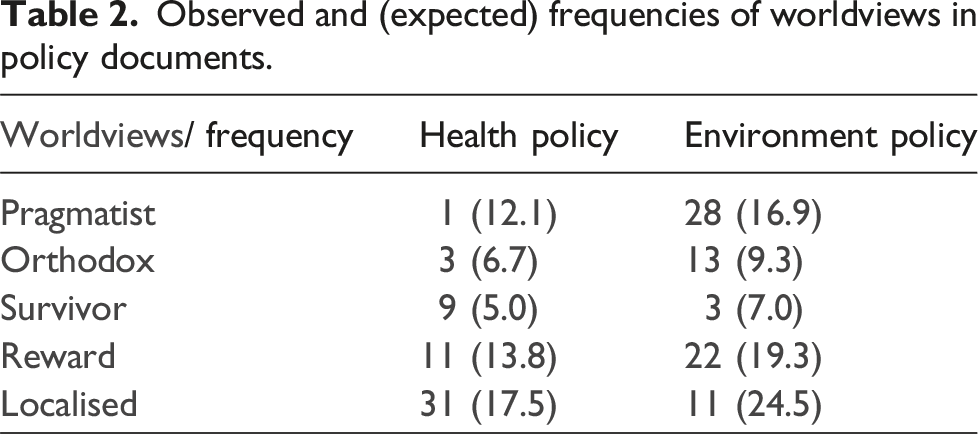
Observed and (expected) frequencies of worldviews in policy documents.
Study 2: worldviews and science culture survey
Participants and procedure
Two parallel attitude surveys of the Kuwaiti population were conducted in 2022. The first involved face-to-face administration of the questionnaire with a randomly generated sample of 400 respondents. A second computer assisted telephone survey with a randomly generated sample of 1000 respondents was also undertaken, for a final combined sample of 1400 respondents (n = 1400). Fieldwork was undertaken between August and October 2022 in either English or Arabic. Ethical clearance was granted by the LSE, and informed consent was obtained from all participants prior to the start of the survey.
Instrument
Demographic details.

Example items from the questionnaire, and the respective measurement type associated with each science culture variable.

Findings
Our findings indicate that the most prevalent worldview in Kuwait is Localised (33.8%), followed by Pragmatist (24.3%), Orthodox (21.7%), Reward (12.8%) and lastly, Survivor (7.3%). We tested whether our culture of science indicators varied by worldview type. None of the mean differences between types was statistically significant. This means that the Kuwaiti public’s inclination to science is not directly a function of the worldviews they assume. We therefore decided to conduct further analyses to examine (a) between and (b) within category differences in worldview types.
The engagement effect
We ran a MANOVA to test for differences between worldviews in Knowledge, Technocracy Tolerance, Reserve and Relational-Categorical thinking, focussing only on respondents who reported some degree of engagement with science (i.e. ‘sometimes’ or ‘regular’). With regards to those who are sometimes engaged, results revealed significant worldview differences. Specifically, the Localised worldview (M = 3.17, SE = 0.09) scored significantly higher on Reserve than the Orthodox worldview (M = 2.60, SE = 0.12, p < .01). The Pragmatist worldview (M = 1.69, SE = 0.16) leaned significantly more towards Categorical thinking than the Survivor worldview (M = 0.80, SE = 0.22, p < .05), which leaned towards Relational thinking. With regards to those who are regularly engaged with science, the Localised worldview (M = 1.06, SE = 0.04) scored significantly higher on Knowledge than the Reward worldview (M = 0.89, SE = 0.05, p < 0.05). Conversely, the Localised worldview scored significantly higher on Technocracy Tolerance and Reserve (M = 3.61, SE = 0.13; M = 3.43, SE = 0.12) than the Reward worldview (M = 2.91, SE = 0.16; M = 2.84, SE = 0.14, p < 0.05). No worldview differences transpired in our Relational-Categorical index. In essence, these results demonstrate that only once individuals are engaged with science to some extent, differences in worldview types underlie discrepancies in Technocracy Tolerance, Reserve and Relational-Categorical thinking.
The mobilisation effect
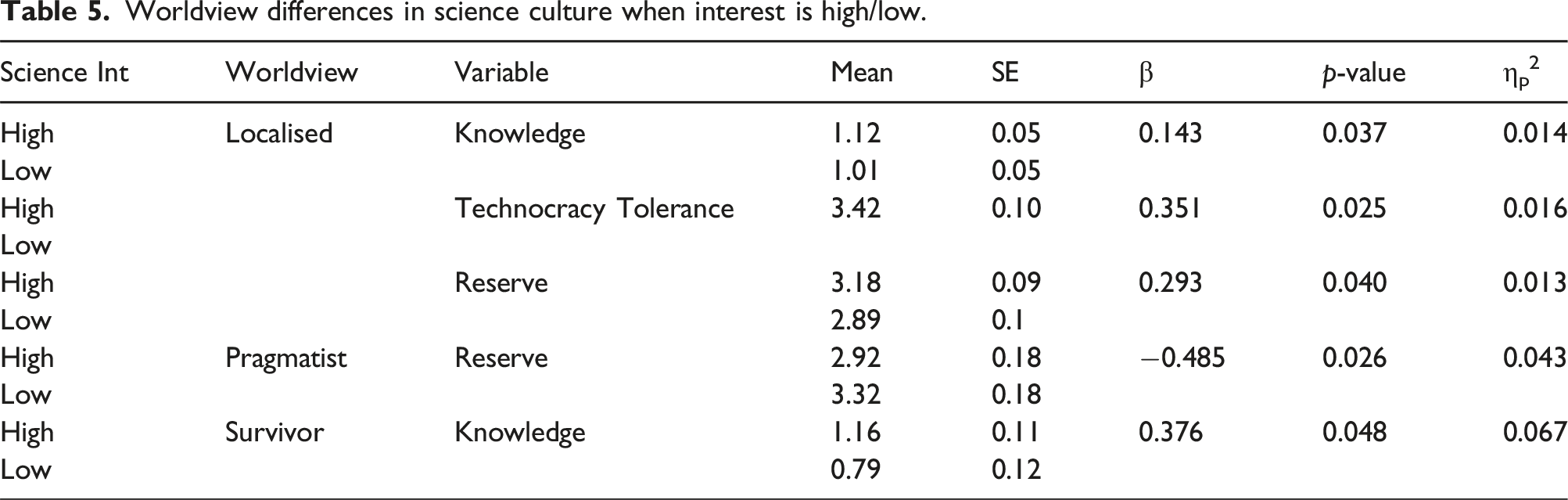
We proceeded to run another MANOVA test to analyse differences within worldviews with regards to Knowledge, Technocracy Tolerance, Reserve and Relational-Categorical thinking, focussing on the same engagement with science cohorts as detailed above (i.e. ‘sometimes’ and ‘regular’ engagement). We also included the variable of interest in science in this part of the analysis.
Worldview differences in science culture when interest is high/low.
Worldview differences in science culture when sometimes engaged is high/low.

Worldview differences in science culture when regularly engaged is high/low.

In summary, these findings indicate that when comparing individuals endorsing the same worldview type, significant differences in Technocracy Tolerance, Reserve and Relational-Categorical thinking emerge between those with high levels of interest and engagement with science on the one hand, and those with low levels on the other.
We concluded our analysis by looking at differences between worldview types and Age, Nationality and Employment (Table 3). None of the differences between worldviews and these sociodemographic variables resulted statistically significant.
Discussion
Our studies show that different policies articulate different worldviews in advancing solutions to common problems, which attract characteristic media responses that are similarly underlined by other supporting or contrasting worldviews. This finding supports Sammut, Mifsud’s and Brockdorff’s (2022) contention that opposition to policy is contingent on the worldviews implicated. Our present findings also show that the influence of worldviews transpires only when citizens are engaged with the policy in question. Worldviews do not distinguish between individual inclinations amongst the non-engaged. Once engaged, however, worldviews determine whether individuals move to support or oppose the policy in question, based on their underlying convictions. This finding is in line with Mifsud and Sammut’s (2023) assertion that worldviews vary in terms of openness/conservation and self-transcendence/self-enhancement aspirations. We termed these two findings the engagement effect and the mobilisation effect, respectively.
In our studies, we found Health policy in Kuwait to be substantially more inclined to articulate a Localised worldview over other types. This worldview is focused on immanent issues and embedded social networks. By contrast, environment policy articulates two worldviews very strongly, that is, a Reward worldview focused on opportunities and achievement, and a Pragmatist worldview focused on adaptation to challenging circumstances. It is worth noting that the policy genre is obviously circumscribed by the function it serves. That is, policies are an effort by policymakers to address identified problems. Matters that are not problematic do not require policy. It is therefore reasonable to expect that policy documents focus on solutions to presenting problems. However, the kind of solutions they articulate and what manner of solution they advance is not given and different policies advance different types of proposals, as our studies have demonstrated.
Since Kuwait’s independence and the nationalisation of oil, the government has provided free universal healthcare to its citizens, including fully covered overseas treatment when necessary. However, the system in its current form is no longer financially sustainable. The healthcare system with its emphasis on treatment rather than prevention through a more holistic healthcare approach has failed to meet challenges resulting from public health behaviours. Changes in lifestyle and attitudes have seen an alarming increase in non-communicable diseases. A combination of poor diet choices, a sedentary lifestyle and an increase in smoking have led to rising rates of diabetes, obesity and some cancers among the population. Along with an increase in overseas treatment expenditure, and an over-reliance on hospital construction and healthcare infrastructure planning, these issues raised questions about the future of Kuwait’s healthcare system in its current form. In addition, the public healthcare system suffers from several other problems such as a lack of a coherent vision and strategy, ineffective organisational structure, weak monitoring and evaluation, poor data management, undertrained administrators, an over-reliance on cheap foreign labour and lack of specialists particularly in preventive health specialisations (school health, public health and health education).
In the same vein, our finding that responses in the media were also lopsided in favour of some worldviews over others is also consequential. We would like to note that media articles discussing health policies were predominantly Localised. This corresponds with the manner in which the policy itself was elaborated. For the environmental policy articles, however, the situation is somewhat different. Media articles dealing with environmental policy were predominantly Pragmatist, but none were Reward. It is worth appreciating the fact that responses in the printed media tend to be of a certain kind, that is, they need to assess and evaluate if they are to appeal to the kind of reader who consumes such media. The similarities and differences we observed, therefore, may pertain to similarities and differences that accrue as a function of the genre in which these opinions circulate. We would also like to note that our corpus did not permit a statistical analysis of prevalence due to the low number of articles and opinion pieces circulating in the Kuwaiti public concerning health and environmental policy. In general, opinion pieces on such topics in Kuwait only emerge when these issues become a matter of controversy or scandal. Otherwise, a slowly deteriorating public health sector and continuously worsening environmental problems have become somewhat of a tolerated status quo for the most part. This, therefore, is a matter for future research to address.
However, we also note a discrepancy between the media domain and the distribution of worldviews in the general public. This means that like policy, media responses may not resonate at all with individuals who do not subscribe to the worldviews expressed in opinion pieces in the media, or policy documents for that matter. Our findings show that both policy and media emphasise some worldviews at the expense of others. We argue that this might have something to do with the resonance both domains achieve (or fail to achieve) with the general public.
Our claim is supported by the finding that we observe differences in culture of science indicators between worldview types once individuals become interested or engaged with science. In our studies, we found that when individuals demonstrate neither interest nor engagement, worldviews do not distinguish between different levels of science culture. When citizens are interested or engaged, they do. Not only, once engaged, the mobilisation effect we observed means that some will move in one direction, whilst other worldviews will move in an opposite direction. This means that worldviews serve to distinguish, as Mifsud and Sammut (2023) have suggested, between those who support policy and those who resist it. These findings bear obvious implications on policy communication, which might need to consider worldview differences to appeal to individuals of a different social-psychological bend. In other words, we propose that policymakers need to assume the burden to spell out how a policy serves the interests of distinct worldviews if it is to avoid knee-jerk resistance on the basis of grand existential outlooks which worldviews effectively encapsulate.
Finally, we would like to highlight the fact that none of the sociodemographic variables we studied resulted in significant differences in policy support or opposition. We conclude, therefore, that worldview differences distinguish between supporters and detractors more reliably than traditional sociodemographic criteria such as age, nationality, gender, employment and so on, which predominate in public policy studies.
Conclusion
We contend that the solutions policymakers put forward necessarily appeal to some more than they do to others. We argue that the worldviews articulated in policy determine, at least in part, the policy’s appraisal by the receiving public. We suggest that a focus on worldviews answers the question regarding limited policy appeal and uptake, in terms of the dual engagement and mobilisation effects. More specifically, we argue that it is worth exploring the treatment of policy by those holding similar worldviews to the ones advanced in the policy and, equally, by those who subscribe to contrasting worldviews. These insights shed light on how policies are received and appraised, who is more inclined to support and who to oppose particular policies, as well as how coalitions are enlisted to follow or resist particular courses of action.
Footnotes
Declaration of conflicting interests
The author(s) declared no potential conflicts of interest with respect to the research, authorship, and/or publication of this article.
Funding
The author(s) disclosed receipt of the following financial support for the research, authorship, and/or publication of this article: This work was supported by the LSE Middle East Centre; MEC-KP-AC-2021-02.
