




Abstract
This study explores how a crisis situation affects voter bias towards women leaders. In an era of global pandemics, frequent climate disasters, economic recessions, and violent conflicts, this question is especially timely. Using an experimental research design, fielded prior the 2019 Israeli elections, we simulate a crisis in one of three policy areas. One typically regarded as masculine (defense), another as feminine (education), and a third with mixed perceptions (finance). We examine whether the framing of a crisis in one of these policy areas changes voters’ gender stereotypes regarding the suitability of women or men for the relevant ministerial positions. We then interact the crisis condition with voters’ gender baseline preference to see how their predispositions towards men and women in politics moderate the effect of a crisis on gender stereotypes. We find that while men are generally regarded as better suited to serve as Ministers of Defense and women to serve as Ministers of Education, a crisis situation increases the perceived suitability of men for both ministerial roles. Thus, a crisis situation strengthens the conventional notion of men as the most competent leaders. These effects are more pronounced among voters whose gender baseline preferences align with existing gender stereotypes.
Introduction
Despite comprehensive theories about gender stereotypes for women leaders, we still lack sufficient knowledge about the circumstances under which women are perceived as leaders, especially in prestigious positions and across diverse policy domains (Taylor-Robinson and Geva, 2023). To address this gap, we created an experiment in which participants evaluated male and female politicians for ministerial positions during a crisis. Studies suggest crises might impede women’s political influence, as voters may revert to stereotypical views favoring men (Falk and Kenski, 2006). However, some crises may provide opportunities for women, as they challenge the perceived advantages associated with men (O'Brien and Piscopo, 2023). Does a crisis in a policy area stereotyped as feminine negate the negative consequences a crisis might have for women political leaders? In addition, how do voters’ predispositions regarding gender and politics affect the way they evaluate political leaders in times of crisis?
We provide answers to these questions using data from a survey experiment embedded in a 2019 national online survey in Israel. The study randomly assigned individuals to crisis conditions in three policy areas: national security, economics, and education. While two of the policy areas are clearly gendered—national security as a traditionally masculine policy area, and education as a traditionally feminine policy area (Taylor-Robinson and Geva, 2023)—evidence regarding economics is less conclusive, as studies show no bias (Dolan, 2010; Dolan and Lynch, 2016; Huddy and Terkildsen, 1993) or even a preference for women in finance during a crisis (Armstrong et al., 2023; Heinzel et al., 2024). Following the treatments, individuals evaluated the suitability of men and women for the respective ministerial roles.
Results reveal that a national security crisis reinforces voters’ gender stereotypes, heightening their belief that men are more suitable for ministerial roles in these domains. However, when a crisis occurs in education—a female-favorable policy area—it does not bolster existing gender stereotypes that might champion women for the job. Instead, it has the opposite effect, diminishing voters' support for women as Ministers of Education. Additionally, we find that gender baseline preferences moderate how a crisis situation affects gender stereotypes about ministerial roles.
Gender stereotypes for leadership roles during crisis situations
According to the “role congruity theory of prejudice” (Eagly and Karau 2002), individuals may heavily weigh gender stereotypes when assessing a candidate’s suitability for a position. Comparative scholarship argues that women politicians consistently face trait-based, issue competency, and belief stereotypes (Alexander and Andersen, 1993; Holman et al., 2011; Huddy and Terkildsen, 1993). Women are viewed as more competent in policy areas such as education, welfare, and healthcare but less competent in masculine domains like the military, crime, and foreign policy (Alexander and Andersen, 1993; Barnes and O’Brien, 2018; Dolan, 2010; Holman et al., 2011). Additionally, research indicates that individuals often have predisposed preferences for male or female leaders and use gender as an information cue to determine their support for politicians (Sanbonmatsu, 2002).
Despite progress in recent decades, the stereotypical gendered dichotomy persists in the political roles men and women attain in parliament and government. Women are often assigned to portfolios like social welfare and education, historically linked to women and the private sphere (Escobar-Lemmon and Taylor-Robinson, 2014). Appointing women to ministries such as infrastructure, economics, and defense, typically associated with men and the public sphere, helps challenge traditional gender role expectations (Krook and O’Brien, 2012). However, such appointments can lead to backlash due to a lack of “role congruity” between women’s gender and the norms associated with such positions (Eagly and Karau, 2002). Women legislators often face penalties for defying gendered expectations (Amanatullah and Tinsley, 2013) and must adapt by exhibiting “masculine” qualities while maintaining “feminine-enough” behavior in line with gender norms (Wojcik and Mullenax 2017).
Previous studies have demonstrated that men are perceived more favorably than women in masculine policy areas, while women are viewed more favorably in stereotypically feminine policy areas (Carli and Eagly, 2007; Taylor-Robinson and Geva, 2023). Following these findings, we propose our first hypothesis, which is rather straightforward. According to H1, men will be regarded as more suitable to serve as Ministers of Defense or Finance, whereas women will be regarded as more suitable to serve as Ministers of Education. Our next hypotheses focus on the way a crisis is expected to influence such perceptions.
Gender stereotypes vary across contexts and individuals, and can change over time. What happens to these perceptions during a crisis? Following Lipscy’s definition (2020) (see also Davidson-Schmich et al., 2023), a crisis is an externally triggered disturbance threatening a nation, requiring immediate political intervention. Such situations often evoke fear, anger, or uncertainty, leading voters to prefer strong, hawkish leaders (Gadarian, 2010). Voters may then question whether women possess the necessary qualities for navigating crises (O'Brien and Piscopo, 2023), especially in masculine domains like national security and terror, where women leaders are seen as less competent (Falk and Kenski, 2006; Holman et al., 2017, 2022; Merolla and Zechmeister, 2009). Thus, scholars anticipate that crises may impede women’s ability to achieve or maintain political influence. Emergency politics reinforce this expectation, as they tend to uphold a masculinized perception of the executive branch, contributing to the exclusion of women politicians and female experts from crisis management teams (Van Daalen et al., 2020). As a result, our next hypothesis (H2a) stipulates that a crisis in any of the three policy issues—security, finance or education—will make voters favor men over women for the respective ministerial role.
Nevertheless, certain crises can also challenge the perceived advantages associated with men and masculinity (O'Brien and Piscopo, 2023) and create favorable conditions for women in politics. The Covid-19 pandemic health crisis serves as a good example. It was regarded as a “feminine crisis,” favoring feminine qualities in a policy domain in which women are usually considered competent leaders. Media coverage has shown a growing appreciation for traditionally feminine attributes in women political leaders, resulting in more favorable coverage than in the past (Johnson and Williams 2020). Relatedly, Davidson-Schmich et al. (2023) argue that men leaders benefit when clear, assertive responses are needed, while women leaders benefit in ambiguous situations requiring empathy. Kroeber and Dingler (2023) also suggest different crises create different expectations for leader attributes.
In addition, crisis environments may present opportunities for women, who may be viewed as outsiders bringing a fresh perspective (Valdini, 2019). For example, Brulé (2023) finds that climate shocks can initiate political transformations that open new space for women in representative politics, while Tripp (2023) shows that crises and conflicts such as wars or revolutions, have had positive impacts on women’s legislative representation. Nevertheless, Reyes-Housholder et al. (2023), who study protest-driven crises, argue it remains challenging to predict the extent to which such crises will promote the rise of female leaders.
Notably, during periods of distrust in existing institutions, voters and parties tend to favor women candidates (Funk et al., 2021). This association is well-documented in the literature on organizations, with its famous “think crisis – think female” catchphrase (Ryan et al., 2016). In executive politics, a similar “glass cliff” phenomenon is observed with the appointment of women as Finance ministers during financial crises (Armstrong et al., 2023; Heinzel et al., 2024).
Based on these findings, we propose a competing hypothesis to H2a. H2b posits that a crisis in education—a policy area that is stereotypically feminine—will make voters favor women over men for the role of Minister of Education.
Finally, we present a moderation hypothesis, incorporating gender baseline preferences into the story. We expect that gender baseline preferences will moderate how a crisis situation affects gender stereotypes for political leadership. Therefore, we examine whether and how voters’ predispositions regarding the suitability and competence of men and women for politics in general influence how they are affected by a crisis situation in a given policy area. H3 thus argues that a crisis will strengthen the existing biases that people already have about leadership roles based on gender.
Experimental design and method
The Israeli case study
In the last 20 years, women’s descriptive representation in Israeli parliament has more than doubled—from 11.6% in the 15th (elected in 1999) to 25% in the 25th Knesset (elected in 2022). Nevertheless, a similar increase has not occurred in the executive where women’s representation remains poor. Moreover, women are usually assigned to head ministries that address “soft” policy issues or those that primarily concern the private sphere (Itzkovitch-Malka and Friedberg, 2018).
While gender inequality is not unique to Israel, certain socio-cultural features exacerbate it by reinforcing gender-based stereotypes. Israeli society exhibits a complex interplay between modernity and tradition, significantly influenced by various cultural and religious groups (Fogiel-Bijaoui and Katz, 2024). The ultra-Orthodox (Haredi) community, adhering strictly to Jewish law and customs, exemplifies this traditionalism, often resisting modern secular influences and barring women from political office (Shapira et al., 2016).
Traditionalism extends beyond the ultra-Orthodox, permeating other segments of Israeli society where cultural and religious traditions shape social norms and public life, especially in familial issues and gender equality (Fogiel-Bijaoui and Katz, 2024). This dynamic marginalizes women politicians more than in other post-industrial societies (Itzkovitch-Malka and Oshri, forthcoming). Israel stands out among advanced democracies regarding attitudes towards women in politics (Taylor-Robinson and Geva, 2023; Yarkoney-Sorek and Geva, 2023), making it a particularly suitable “most-likely” case for this study.
Survey experiment
The online study included 1904 respondents. 1 It was fielded prior to the 2019 Israeli general elections from April 4 to April 10. The study was conducted by the survey company Panel4All using their proprietary opt-in panel. Quotas were set to match the national Jewish population and respondents were balanced across conditions (see Table A1 in the appendix). Respondents were randomly assigned to a control group (750 respondents) or one of the three treatment groups (325 respondents in each group). 2 Each of the three treatments was a crisis situation, which differed according to the policy issue in which the crisis occurred: national security, the economy, or education. Each crisis treatment included a mock news story drawn from actual reports, and focused on the threats posed by the crisis (see the Appendix for full text). Participants in the control group also received a vignette with a short news report concerning the upcoming election. Post treatment, the overwhelming majority of respondents—91%—answered a factual manipulation check correctly. They then answered a question designed to capture the dependent variable, gender stereotypes about ministerial roles.
Measures
Gender stereotypes about ministerial roles
Our dependent variable was based on a survey question asking respondents, “Who do you think is better suited to play the role of Minister of Defense/Finance/Education – a man or a woman?” Response categories ranged from −1-a woman, 0-both the same, and 1-a man. We coded and scaled them for all conditions so that a value of 1 reflects views that are in line with existing gender stereotypes and a value of −1 reflects views that go against them. A value of zero stands for a neutral preference (M sec = 0.39, SD sec = 0.59; M fin = 0.01, SD fin = 0.56; M edu = 0.21; SD edu = 0.56).
Crisis condition
Our main independent variable was coded as a dummy variable taking the value of 1 for respondents in a treatment crisis condition (security/finance/education) and zero for respondents in the control group. A different treatment variable was constructed for each condition.
Gender baseline preference
This independent variable (Sanbonmatsu, 2002) was based on a survey question asking respondents, “If two equally qualified candidates were running for office, one a man and the other a woman, do you think you would be more inclined to vote for the man or the woman?” Response categories ranged from 1-a woman, 2-both the same, and 3-a man. (M = 2.01, SD = 0.60). 3
Female
A dummy variable taking the value of 1 (female) and zero (male) (M = 0.50, SD = 0.50).
We also controlled for demographic variables and attitudinal preferences such as age, education, religiosity, and ideological self-placement that could have an effect on gender stereotypes (see Table A2 for the full descriptive statistics).
Estimation strategy
To test H1 and H2a-b we used two-tailed hypothesis tests. To test H3, which involves an experimental component as well as an interaction term, we estimated the following equation

Where yi denotes gender stereotypes for ministerial positions; β1 captures the coefficient of the crisis condition versus the control group when the gender baseline preference equals zero; β2 captures the difference in the coefficient of the gender baseline preference for the control group; β3 captures the difference in the effect of the gender baseline preference for respondents in the crisis condition versus the control group; Ω is a vector of the above mentioned controls; and ε is an idiosyncratic error term. Given the nature of our dependent variable, in estimating the models we used ordered logit models.
Key findings and discussion
Gender stereotypes about ministerial positions in the control group and a crisis in security, the economy, and education.

Notes. Values are the mean values for the gender stereotype question, ranging from −1 to 1, in each condition. Positive values are in line with the common stereotype in a given policy area, and negative values go against the common stereotype. A value of zero stands for “no difference between men and women.”
When a crisis was introduced, voters’ gender stereotypes shifted. A security crisis significantly increased (p < .00) the belief that men are more suitable as Ministers of Defense, reinforcing gender stereotypes. An economic crisis showed a similar, though less pronounced, trend, differing from the “glass cliff” phenomenon found by Armstrong et al. (2023) and Heinzel et al. (2024). We speculate that the extensive bias women suffer from in the Israeli case is what drives this finding.
A crisis in education significantly (p < 0.00) made respondents view women as less suitable for the Minister of Education role compared to the control group. While a security crisis reinforced stereotypes favoring men, an education crisis did not enhance support for women; instead, it reduced it. As predicted by H2a, in times of crisis, men are seen as better suited to “handle the situation,” regardless of the policy area. Although women are still favored for the Minister of Education, their advantage diminishes significantly during a crisis.
Next, we interacted the respondents’ gender baseline preferences with their treatment/control assignment and plotted the predicted probabilities of our dependent variable given this assignment across the different levels of gender baseline preferences (full results appear in Table A3 in the Appendix).
Figure 1 shows that in all three groups, the predicted probability of favoring a woman for the role of Minister of Defense was extremely low, signaling a floor effect. The treatment effect was largely evident in increasing the probability of favoring men for this role and reducing the likelihood of a “no difference” choice. This effect was the strongest among those who generally preferred men for political roles (left-hand plot) but was also evident among the respondents whose gender baseline preference was “no difference” (middle-plot). However, for those who generally preferred women for political roles, a crisis situation did not increase the perceived suitability of men for the role of Minister of Defense (right-hand plot).
5
Thus, a crisis situation serves to strengthen stereotypical bias favoring men as Defense Ministers, especially among those who are already predisposed to favor men in politics. This effect can be seen as “preaching to the choir”—reinforcing stereotypical views for ministerial positions among those who already hold such a view. The effect of a national security crisis on the respondents’ gender stereotypes about ministerial roles, based on their gender baseline preferences. Notes. Predicted probabilities of gender stereotypes for ministerial roles, based on Model 1 in Table A3 in the Appendix. Control variables set to their observed values. Capped vertical lines represent 95% confidence intervals.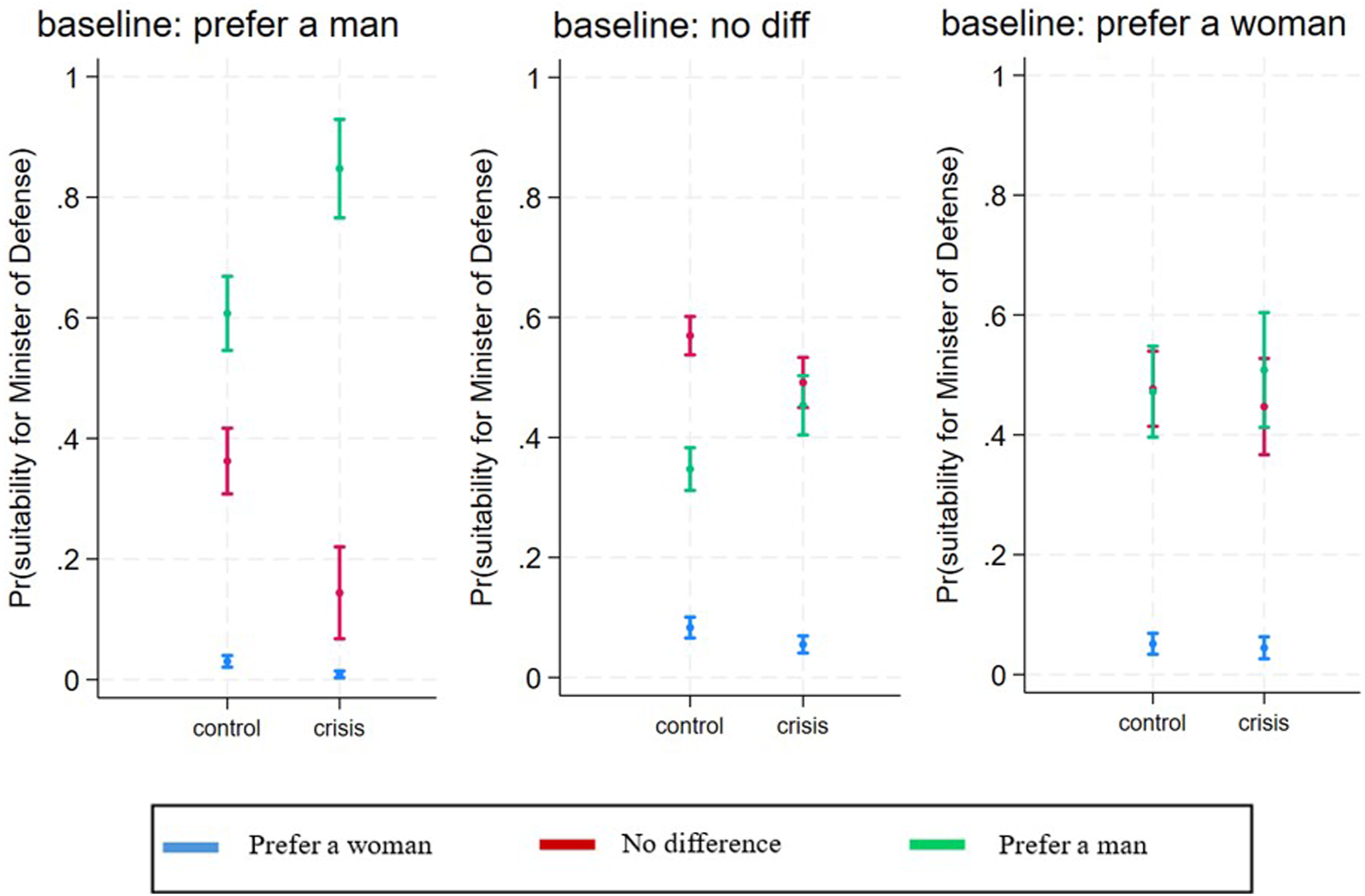
Next, we present a similar analysis for the education crisis (Figure 2). Among all three groups, the predicted probability of favoring a man for the role of Minister of Education was extremely low. The treatment effect was largely evident in reducing the probability of favoring women for this role and increasing the likelihood of a “no difference” choice. Interestingly, for those who preferred men in politics, the treatment had no effect, probably because their likelihood of favoring women for the role of Minister of Education was very low to begin with. The effect was most pronounced among those who generally preferred women for political roles, or those who claimed they had no general gender preferences. This result is truly remarkable. Even in a policy area that is considered favorable to women leaders, and even among those who are generally favorably predisposed towards women’s involvement in politics, a crisis situation casts doubts on women’s credibility to serve as political leaders. The effect of an education crisis on the respondents’ gender stereotypes about ministerial roles based on their gender baseline preferences. Notes. Predicted probabilities of gender stereotypes for ministerial roles, based on Model 5 in Table A3 in the Appendix. Control variables set to their observed values. Capped vertical lines represent 95% confidence intervals.
This analysis confirms H3, although the interactive effect was more intricate than anticipated. For national security, a policy area traditionally considered masculine, a crisis strengthened the stereotypical bias favoring men as Ministers of Defense, especially among those who were already predisposed to favor men in politics. For education, a policy area traditionally considered feminine, a crisis situation did not strengthen stereotypical biases favoring women as competent ministers, but rather did the opposite. This effect was particularly evident among those who generally preferred women as political leaders. Thus, women politicians always draw the short straw—even in policy areas in which they are considered competent and even among voters who are positively predisposed towards women in politics.
The perceived disconnect between women or stereotypically feminine traits, and the demands of political leadership, suggests that voters might doubt women’s ability to handle challenging situations (O'Brien and Piscopo, 2023). While the literature suggests this doubt is particularly strong in masculine policy areas, our study reveals that it is equally true in policy areas considered feminine or more suitable for women. This finding reinforces the idea that crises hinder women’s capacity to achieve or sustain political influence, as it leads voters to prefer men as their leaders.
Conclusion
This study offers insights into some of the underlying dynamics contributing to the under-representation of women in ministerial positions by addressing the socio-political climate within which female politicians navigate. It examines voter perceptions regarding women in positions of leadership, shedding light on the demand-side obstacles women face when aspiring to such roles while illuminating the impact of crisis situations on these dynamics. It shows that the environment of a crisis reinforces the prevailing perception that executive leadership is inherently masculine, creating a setback for women leaders even in policy areas that are stereotypically congruent with their gender.
The findings contribute to scholarship on gender and politics by showing how a crisis affects voters’ mental templates about leaders, strengthening the conventional notion of men as the most competent leaders, regardless of the policy issue at hand. The endurance and reinforcement of such templates provide insights into the persistent underrepresentation of women in politics. In a world fraught with crises of various kinds, the implications of this study for women’s prospects as political leaders appear rather bleak. Ironically, this underscores the importance of appointing women to political leadership roles, as their presence is significant for both substantive and symbolic reasons (Armstrong et al., 2023). Appointing women to high profile ministries—during crisis or routine—can signal and contribute to a growing acceptance of women leaders and belief in their governance abilities.
An important scope condition of this research is that its findings are solely based on the Israeli case study. This context is especially prone to gender bias, making Israel a most-likely case for the negative effect a crisis situation might have on voters’ perceptions of political leaders. Future studies should explore this question further in varying contexts and provide a comparative perspective to the question at hand.
Supplemental Material
Supplemental Material - How do gender stereotypes about leadership positions change in the face of a crisis?
Supplemental Material for How do gender stereotypes about leadership positions change in the face of a crisis? by Reut Itzkovitch-Malka in Research & Politics.
Footnotes
Declaration of conflicting interests
The author(s) declared no potential conflicts of interest with respect to the research, authorship, and/or publication of this article.
Funding
The author(s) disclosed receipt of the following financial support for the research, authorship, and/or publication of this article: Israel Science Foundation (ISF), Grant #554/17 allotted to Reut Itzkovitch-Malka.
Carnegie Corporation of New York Grant
This publication was made possible (in part) by a grant from the Carnegie Corporation of New York. The statements made and views expressed are solely the responsibility of the author.
Ethical statement

Supplemental Material
Notes
References
Supplementary Material
Please find the following supplemental material available below.
For Open Access articles published under a Creative Commons License, all supplemental material carries the same license as the article it is associated with.
For non-Open Access articles published, all supplemental material carries a non-exclusive license, and permission requests for re-use of supplemental material or any part of supplemental material shall be sent directly to the copyright owner as specified in the copyright notice associated with the article.
