




Abstract
Imposing term limits on elected officials is expected to increase turnout due to enhanced competition by one theoretical perspective, while another predicts depressed turnout as a result of clientelist turnout buying. These puzzling contradictory predictions are examined by a quasi-experiment (using a difference-in-differences approach) based on a 2022 reform which introduced term limits for Costa Rican mayors that were applied for the first time in the 2024 municipal election. Over one half of mayors suddenly faced retroactive term limits, while the remaining ones were eligible for reelection. This analysis was pre-registered following the 2022 reform but before the 2024 election, that is, at a time when treatment assignment already occurred but the post-treatment outcomes were not known and the analysis could still not be performed. The analysis could only be completed after the February 2024 election. The results suggest that the adoption of term limits reinvigorated electoral competition but that its participatory gains were only modest, fostering turnout only in the largest cities. The analysis contributes by advancing the—still uncommon—practice of pre-registering observational research after the treatment assignment but prior to the release of the data (and even prior to the processes that produce that data).
Introduction
This quasi-experiment addresses a central puzzle: do term limits increase turnout or depress it? On the one hand, prohibiting incumbents from running has traditionally been viewed as a boon to voter participation because open seats motivate new candidates to enter the contest, reinvigorate electoral competition, and spur voters’ political efficacy. On the other hand, term limits may decrease turnout because re-electable incumbents engage in clientelist turnout buying and voters are drawn to the polls by retrospective shortcuts about the incumbents’ past performance. Such contributions to turnout are removed with term limits.
The research design leverages a quasi-experimental setting in which a 2022 policy reform in Latin America’s longest enduring democracy, Costa Rica, introduced term limits on mayors. Costa Rican mayors faced no term limits until 2022. In March 2022, the Costa Rican National Assembly approved a law that bans reelection of mayors who served for two consecutive terms. This law was applied retroactively already in the February 2024 mayoral election to mayors who were elected in 2020. 59% (48 of the 82) of mayors were consecutively reelected in 2020, so the reform made them ineligible to run for reelection in the 2024 election. However, the remaining 34 mayors were allowed to stand for reelection in 2024. The fact that the adoption of term limits did not apply to all mayors at once provides the basic setting for the pre-registration of the quasi-experimental design using a difference-in-differences technique because the values of the dependent variable in the pre-treatment periods were known for both the treatment and control groups that were created artificially by the 2022 reform. The validity of key methodological assumptions is further substantiated using both qualitative evidence and statistical tests based on municipal-level data from all five election waves between 2002 and 2020: the parallel trends assumption that underpins the difference-in-differences framework is explored and the lack of self-selection of units into treatment is discussed.
The pre-registration report was submitted prior to the scheduled 2024 election after which post-treatment data for the outcomes of interest became available. This research design could not be executed before this election occurred. It was this remaining time between assignment to treatment and control groups in March 2022 by the term limit law and the February 2024 election that allowed sufficient time for the pre-registration. Pre-registering before the outcome is observed attempts to maximize two benefits. On the one hand, relying on real-world policy interventions for treatment assignment, this quasi-experimental setting goes far in maximizing the external validity of research findings. On the other hand, it reaps the associated benefits of registered reports in terms of research transparency and credibility of research findings, avoiding publication bias and differentiating prediction from post-diction (Nosek et al., 2015). It improves on the procedure to pre-register observational research based on historical data where the outcome has been realized (though not yet observed by the researcher) (Monogan, 2015) because the hypothesized effect here cannot be estimated even in principle until the outcome is realized in the future.
An added value of this pre-analysis plan concerns the improvement in research transparency. It overcomes a major barrier for pre-registering observational research whereby researchers must be able to credibly demonstrate that the analysis was registered prior to accessing the data (Burlig, 2018). Most often, observational research is performed on data which is already public. Credible pre-registration of observational analyses is therefore limited only to three settings: where data is generated by the researcher herself, where pre-registration involves the use of restricted data, and prospective analyses registered before the release of the necessary data (Burlig, 2018). This plan uses a variant of the latter setting—not only is the data not released at the time of preregistration (e.g., Neumark, 2001), but also the data is related to a future event generated by a policy reform. By pre-specifying this report prior to the policy shock itself, it can be claimed even more credibly that the relevant data could not have been explored prior to registration.
The report is structured in the following way. First, the two conflicting theoretical predictions regarding the effects of term limits on voter turnout are introduced. Second, the rationale for the quasi-experiment is discussed. Third, the research design is spelled out in detail, substantiating the underpinning methodological assumptions. Fourth, the proposed analyses are introduced and conducted. The concluding section evaluates the main findings
Theoretical expectations
Term limits increase turnout
Term limits are expected to increase turnout because they make elections more competitive. Instrumental theories of turnout suggest that the turnout decision is in part driven by the citizens’ expectation that their vote is pivotal, that is, that by going to the polls their vote is decisive (Downs, 1957; Riker and Ordeshook, 1968). The probability of casting the decisive ballot, and therefore turnout, increases as the closeness of election increases (Fauvelle-Aymar and François, 2006; Simonovits, 2012). Such competitiveness is greatly helped if incumbency advantage is eliminated and open seats with more quality candidates are generated by term limits (Veiga and Veiga, 2018). Open seats without entrenched incumbents create an equal playing field where more candidates stand a chance to win and citizens have a wider vote choice (Kuhlmann and Lewis, 2017). The result is an increase in turnout. But the positive effect of term limits on turnout is also expected to have an expressive component because term limits may inspire greater citizen trust in the system if entrenched incumbents are not allowed to run (De Benedetto and De Paola, 2019; Nalder, 2007; Veiga and Veiga, 2018).
The empirical support for this perspective is robust. Despite early evidence that the adoption of term limits did not spur turnout in the Californian state legislature (Nalder, 2007), the overall experience of US state legislatures strongly suggests a substantial contribution to turnout where term limits apply (Kuhlmann and Lewis, 2017). Consistent with this perspective, a difference-in-differences approach following a municipal reform in Portugal reports an over one percentage point increase in turnout where term limits prevented mayors from running (Veiga and Veiga, 2018). Similarly, a difference-in-discontinuities research design leveraging an Italian term limit reform reported an even larger effect (over 5-point decrease) in turnout in municipalities where incumbent mayors were suddenly allowed to run for a third term (De Benedetto and De Paola, 2019).
Turnout will be higher in municipalities with term-limited mayors.
Term limits depress turnout
Instead of providing a boon to voter participation, a contradictory perspective notes that turnout is actually depressed by them. Two main theoretical arguments support this view. First, as a part of the incumbency advantage incumbents’ name recognition could reduce information costs for voters, so it is less costly to go to the polls. The fact that incumbents run in an election increases the clarity of responsibility, so more voters use this opportunity to hold them accountable for past performance (Dettrey and Schwindt-Bayer, 2009). Second, in settings where clientelist voter linkages are pervasive, introducing term limits is expected to decrease turnout because re-electable incumbents stimulate voter participation by providing patronage and services to citizens (Korzi and Hoddie, 2018). Since non-incumbents do not control these government resources, fewer voters would be mobilized by these clientelist mechanisms if term limits would force the incumbents out of competition.
The evidence for these assertions comes from two cross-national comparative studies of presidential elections. Both report a substantial reductive effect of term limits on turnout. Turnout is sizably higher where incumbents run (by about 6 points) compared to open seat contests, controlling for other variables (Dettrey and Schwindt-Bayer, 2009). The clientelist mechanism through which term limits depress turnout is validated by an interactive finding that the negative effect of term limits is much more pronounced in low-quality democracies but lessens as the quality of democracy increases (Korzi and Hoddie, 2018). Because clientelism is more pervasive in less democratic countries, this gives some support to the notion that the turnout buying political machines run out of steam if incumbents are prevented by term limits from running.
Turnout will be lower in municipalities with term-limited mayors.
Rationale for a quasi-experiment in Costa Rica
Whether term limits actually increase or decrease turnout is an important policy concern. Low and declining turnout rates worldwide signal serious problems for democratic governance (Dassonneville and Hooghe, 2017; Kostelka and Blais, 2021; Lijphart, 1997). Institutional variables are often regarded as the most powerful determinants of voter turnout (Cancela and Geys, 2016; Jackman, 1987), so identifying institutional means to counter such trends has become an important policy concern. However, formulating appropriate research designs to test the effects of institutional variables on turnout poses some important methodological challenges. A potential endogeneity bias may, for example, accompany cross-national analyses of the effects of adopting presidential term limits: presidents self-select whether they will run according to political considerations likely to be correlated with turnout. But even a more direct measurement (whether term limit regulations apply to a president) is prone to self-selection (Korzi and Hoddie, 2018), as presidents frequently evade term limit regulations and some of them repeatedly (Kouba and Pumr, 2023). The proposed quasi-experiment overcomes these methodological challenges and allows for obtaining robust causal estimates of the effect of term limits.
Furthermore, the unusual retroactivity of the Costa Rican term limit reform makes it an ideal testing ground. When term limits for subnational offices are adopted, they usually take effect only after a period that equals the number of years it takes a newly elected politician to reach the limit. Avoiding retroactivity, this is a common feature of state legislators’ term limits in the US states. A total of 16 of the 50 US states used some form term limits by 2022, and all of them (with the partial exception of Maine) adopted such postponed application (e.g., 4 two-term limits were adopted in Arizona in 1992 but applied only since 2000) (US Term Limits, 2023). Methodologically, this rules out leveraging a similar variation in the assignment into two groups as in Costa Rica and exploring the direct effects of term limit adoption.
Consecutive reelection of Costa Rican mayors by election year, the number of consecutive reelections, and by gender.

Research design
The proposed quasi-experiment is based on a difference-in-differences framework. This is possible in the Costa Rican setting because pre-treatment information on the outcome variable (turnout) is available. The difference-in-differences design is based on comparing four different groups of units in time. Only a single one is affected by the treatment while the remaining three are not. The main idea of this empirical strategy is that if the two groups separated in time by the treatment in the later period and the two non-treated groups are subject to the same time trends and the treatment has had no effect in the pre-treatment period, then an estimate of the treatment effect in the two non-treated groups (where it is known to be zero) can be used to remove the effect of confounding factors (Lechner, 2011). The difference in the differences in the outcome variable over time in the two pairs of groups indicates the treatment effect.
The treatment group is composed of municipalities where mayors were reelected in 2020 and were therefore made ineligible for reelection in 2024 by the 2022 reform. The control group consists of all remaining municipalities, that is, those where mayors faced no restrictions on reelection in 2024. Note that the control group also includes municipalities where such mayors were eligible to run in 2024 but chose not to. This follows the requirement that it is the adoption of the institutional rule defining the incumbents’ eligibility (and not his/her decision to run again) that defines the expected causal effect.
Parallel trends assumption
A critical assumption in the difference-in-differences framework is “parallel trends” (or “common trends”): that pre-treatment trends in outcomes are the same between treated and control groups (Ryan et al., 2019). Graphical presentation and a formal test of this assumption based on turnout in the previous five election waves (2002–2020) in all Costa Rican municipalities are presented in Online Appendix (A.1). The results strongly indicate that the pre-treatment trends have been moving in parallel, so the parallel trends assumption is not violated in the Costa Rican context.
Balance tests
Difference-of-means tests are used to assess whether treatment and control groups differ on observables. The null hypothesis proposes that the assignment to treatment is statistically independent of background covariates.
The results of the balance tests for several variables are presented in Online Appendix (A.3). For none of the variables we can reject the null hypothesis of equal means across treatment and control groups.
Analyses
The main model: The effect of term limits on turnout
The main analysis tests whether term limit adoption increases turnout, decreases turnout, or did not affect turnout. The dependent variable (Y) is the turnout rate—the share of voters on the total number of registered voters in each municipality in Costa Rican municipal elections. The data on the dependent variable (turnout rate) is available for five pre-treatment elections (2002, 2006, 2010, 2016, and 2020). The 2024 post-treatment turnout rate was added to this dataset once the results became known after the February 2024 election. As there are 82 municipalities in Costa Rica, the total number of units in the main model is 486 (one new municipality was created before the 2020 elections). Following the recommendation to cluster units at the level at which treatment is independently assigned in difference-in differences designs (Roth et al., 2022), the models report robust standard errors clustered by municipality. The summary statistics for all variables are included in Online Appendix (A.2).
The main model to be estimated after the 2024 election follows this specification:
With only 82 municipalities, a potential concern is statistical power of the test. In order to estimate the effect size necessary to reject the null hypothesis at the 0.05 level, a placebo analysis was performed. Municipalities assigned to treatment by the 2022 reform were assigned to the treatment condition already for the 2020 election (as if the policy already applied for the previous electoral period). Using this placebo assignment in the difference-in-differences framework for 2020 together with the 4 previous election rounds yields a coefficient of −1.07 for placebo-term-limited mayors with a standard error of 0.91 (see the Online Appendix A.4). This standard error is a convenient estimate of what the standard error would be if the analysis was performed using actual treatment assignment in the 2024 election. Multiplying this value by 1.96 suggests the size of the treatment effect estimate necessary to barely reject the null hypothesis at the 0.05 level. This yields an estimated effect size of 1.78 (this is still a conservative estimate considering that the 406 observations in the placebo test will be complemented by 82 more with the 2024 elections). Substantively, the proposed analysis would be unable to reject the null if the effect size of term limits on turnout was similar to that estimated in Portuguese municipalities (1.14) (Veiga and Veiga, 2018). However, it would have sufficient statistical power to reject the null hypothesis with effects size estimates (over 5 percentage points) from all other analyses (De Benedetto and De Paola, 2019; Dettrey and Schwindt-Bayer, 2009; Korzi and Hoddie, 2018).
Term limit adoption and turnout in Costa Rica (OLS model).

***p < .001; **p < .01; *p < .05. Robust standard errors clustered by municipality in parentheses.
Auxiliary analyses
The aim of the following auxiliary analyses is to explore the causal mechanisms specified by theories that link the “competition-driven” turnout-enhancing effects of term limits on turnout or, respectively, the “clientelist-driven” turnout-depressing effects of term limits.
Electoral competition as a causal mechanism
The theory suggests that the principal causal mechanism linking term limits to higher turnout is the increased electoral competition resulting from open seat contests. Furthermore, increased electoral competition indicates a healthy local democracy regardless of whether it also contributes to higher turnout or not. The relationship between term limits and electoral competition can be directly tested in Costa Rica. If competition is indeed fostered by term limit imposition, this would provide further credence to the theory linking term limits to higher voter participation.
The same difference-in-differences models as with the main model (turnout rate) were estimated using the same procedures but with different dependent variables. Dependent variables corresponding to three indicators of electoral competition were used: (1) the number of mayoral candidates running in each municipality, (2) the effective number of candidates in those races following the formula of the Laakso–Taagepera index (Laakso and Taagepera, 1979)—this improves on the raw number of candidates by weighing the contribution of each candidate by their vote share, and (3) the margin of victory subtracting the vote share of the second most voted candidates from the winner.
If competition is indeed what drives the nexus between term limits and turnout, then the difference-in-differences models should reveal a positive effect of term limits on both the raw and effective numbers of candidates and a negative effect on the margin of victory as closer contests indicate a more vibrant competition and victories by landslide margins suggest uncompetitive elections.
Term limit adoption and electoral competition in Costa Rican mayoral elections (OLS).

***p < .001; **p < .01; *p < .05. Robust standard errors clustered by municipality in parentheses.
The conditional effect of political scale
Existing research shows that municipality size is a crucial determinant of turnout, especially in local elections—citizens, including Latin Americans, are much more likely to vote in smaller communities (Kouba and Dosek, 2022). This is evidenced by a strong negative association between municipal size (measured by the logged number of registered voters in a municipality) and turnout in mayoral elections in Costa Rica (Figure 1). Not only has this association been strong but also it has even steadily increased during the observed period. Whereas the Pearson correlation coefficient was −0.71 in the first direct election in 2002, by 2020 the coefficient was already −0.79. Relationship between political scale and turnout in Costa Rican mayoral elections (2002–2020).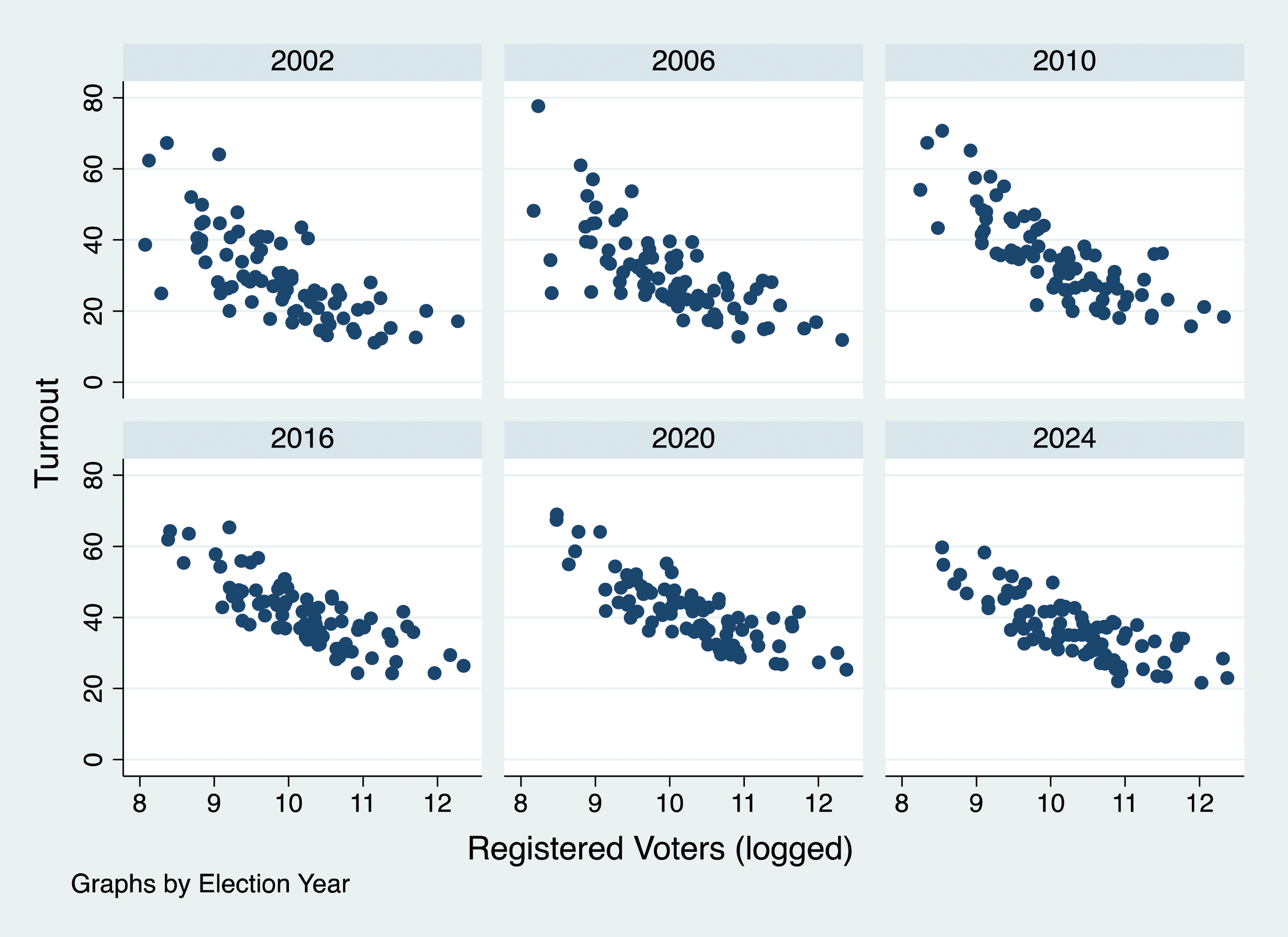
The interpretation of this strong nexus in Costa Rica in an earlier study argues that voter turnout is driven by clientelist electoral mobilization in small municipalities where such clientelist linkages are more likely (Remmer, 2010). In Costa Rica, small communities are characterized by dense “patterns of social interaction that facilitate both (a) the construction of political networks based on personal contacts, face-to-face exchanges of tangible rewards and (b) the monitoring of turnout” (Remmer, 2010: 279-280). The theoretical implication is that clientelist-driven turnout flourishes in smaller political units where there is a greater possibility for clientelist political mobilization. As the political scale of municipalities increases, clientelist turnout buying becomes less pervasive.
These considerations are crucial for understanding the effects of term limits, if these effects are indeed mediated by clientelist mobilization as suggested by the literature (Korzi and Hoddie, 2018). If the clientelist model linking term limits and turnout is valid, then the effect of term limit adoption is likely to be different in small versus large municipalities. Term limiting a mayor in a small community could break the clientelist linkages. Absent such mode of electoral mobilization due to term limits, turnout is expected to decrease according to this logic. But a term limit of a mayor in a large municipality where clientelist linkages are not predicted is not expected to decrease turnout according to this approach. Consequently, finding a null overall effect of term limits in all Costa Rican municipalities might conceal an effect in a part of them—a reduction in turnout in small municipalities.
For that reason, an interaction between municipal size and whether there is a term limit was modeled within the difference-in-differences approach. The same model as the main difference-in-differences model was used but including a variable indicating the size of municipality and its interaction with the treatment variable (see Online Appendix, A5). Figure 2 presents the interaction plot based on this model. The horizontal axis displays the values of municipality size measured by the (logged) number of registered voters across the whole range of observed values in the sample. The results suggest that in small municipalities (which constitute the bulk of Costa Rican municipalities), the adoption of term limits had no participatory consequences. This runs contrary to the proposition that undercutting clientelist electoral mobilization by incumbents through term limits reduces turnout. However, the relationship between term limit adoption and turnout becomes distinguishable from zero with increasing political scale in the largest municipalities. The estimated marginal effect in the largest city, San José, is 4.2 percentage points. Open seat contests imposed by term limits enhanced voter participation only in the largest municipalities. Marginal effect of term limit adoption on turnout levels as the municipal size changes.
Conclusion
The promise of adopting mayoral term limits in Costa Rica was to reconfigure the country’s local political arena by transforming local party systems and forcefully removing the many entrenched incumbents (Aguirre, 2024). Since their introduction, mayoral elections in Costa Rica have suffered from a very low voter turnout which is most pronounced in large urban municipalities (Alfaro-Redondo and Gómez-Campos, 2016). According to prior expectations, the transformed electoral competition due to term limits was assumed to drive additional voters to the polls. However, the results of the difference-in-differences analysis suggest that term limit adoption is not a magic bullet for increased citizen participation in elections. The contribution of term limit adoption to turnout—although positive—is very small (1.1 percentage points) and is not statistically distinguishable from zero. An interactive model suggests that modest participatory gains as a result of term limits were registered only in the largest cities. Together with findings that term limit adoption reinvigorated electoral competition, this provides only very limited support for the theory that term limits foster turnout through more intensive electoral competition. Furthermore, the findings are not consistent with theories that predict declines in turnout as a result of breaking the clientelist mobilization by incumbents. This mechanism was expected to operate in the smallest municipalities.
This is not to suggest that the 2022 term limit reform had no impact on Costa Rican local politics. The results suggest that it has changed patterns of political competition in municipalities in the February 2024 election. The reform made local electoral contests more competitive and decreased the large victory margins. The absence of term limits is more conducive to landslide victories by continuously reelected incumbents, and the adoption of term limits substantially decreases this electoral advantage as it reduces the gap between the winner and the first loser by estimated 16.7 percentage points on average. These findings therefore carry implications for both the reformers of term limit rules as well as for theorizing turnout. From the policy perspective, they provide a cautious tale for those who seek to transform democratic politics by electoral-institutional change. The effect of changing electoral rules on crucial dimensions of democracy, such as citizen participation, is often very limited. From the theoretical perspective, research that posits electoral competition as a key driver of voter participation should consider its lack of effect on turnout in the presence of increases in electoral competitiveness attributable to term limits.
Supplemental Material
Supplemental Material - Understanding the effect of term limits on voter turnout: Evidence from a quasi-experiment in Costa Rica based on a registered report
Supplemental Material for Understanding the effect of term limits on voter turnout: Evidence from a quasi-experiment in Costa Rica based on a registered report by Karel Kouba in Research & Politics.
Footnotes
Declaration of conflicting interests
The author(s) declared no potential conflicts of interest with respect to the research, authorship, and/or publication of this article.
Funding
The author(s) disclosed receipt of the following financial support for the research, authorship, and/or publication of this article: This work was supported by the European Regional Development Fund Project “Beyond Security: Role of Conflict in Resilience-Building” (reg. no.: CZ.02.01.01/00/22_008/0004595).
Carnegie Corporation of New York Grant
This publication was made possible (in part) by a grant from the Carnegie Corporation of New York. The statements made and views expressed are solely the responsibility of the author.

Supplemental Material
Note
References
Supplementary Material
Please find the following supplemental material available below.
For Open Access articles published under a Creative Commons License, all supplemental material carries the same license as the article it is associated with.
For non-Open Access articles published, all supplemental material carries a non-exclusive license, and permission requests for re-use of supplemental material or any part of supplemental material shall be sent directly to the copyright owner as specified in the copyright notice associated with the article.
