



Abstract
Term limits are theoretically expected to boost voter participation which has been confirmed by multiple empirical examinations. This study uses a robust causal assessment within the difference-in-differences framework to evaluate this hypothesis. It leverages an exogenous 2018 term limit reform in Ecuador which prohibited some, but not all, incumbent mayors from running in elections. Contrary to expectations, the results indicate null findings: the adoption of term limits has neither increased turnout, nor depressed the casting of blank and spoiled ballots (alternative indicators of voter engagement under compulsory voting). This is puzzling given that the reform impacted the electoral competition by significantly increasing the number of mayoral candidates in the newly open-seat contests. Two possible solutions to the puzzle of the null findings are presented with implications for understanding the scope conditions for the effect of term limits on voter participation.
Introduction
A growing body of research has proposed that imposing term limits on political incumbents promotes voter turnout by stimulating electoral competition—and explored this relationship empirically (Bowler and Donovan, 2012; De Benedetto and De Paola, 2019; Kouba and Dosek, 2023; Kuhlmann and Lewis, 2017; Nalder, 2007; Sarbaugh-Thompson, 2004; Veiga and Veiga, 2018). However, the empirical assessment of this relationship is made difficult by methodological challenges stemming from the nature of term limit reforms that rarely allow for a variation in the applicability of term limits. This article leverages a robust causal assessment utilizing a quasi-experimental difference-in-differences (DID) framework based on a 2018 exogenous policy reform in Ecuador which forced term limits on a group of 48 of the total 221 mayors (while the remaining mayors were allowed to run for reelection in the 2019 election). Ecuador changed from permitting unlimited reelection of mayors to a rule that only allowed a single consecutive reelection, and this new rule applied retroactively to all the 48 mayors who were reelected in the preceding 2014 election.
This study explores its effects based on a unique dataset of municipal-level electoral results in four election waves (2004, 2009, 2014, and 2019). Despite strong theoretical expectations, and against most existing empirical evidence, the results of the analysis indicate that term limits had no effect on voter turnout and the rate of invalid voting (blank and spoiled ballots). However, these null findings regarding the effect of term limits on voter participation are accompanied by findings of the sizable effect of this electoral reform on the structure of political competition—more and on average weaker candidates entered the electoral competition as a result of term limits.
The case of Ecuador provides a strong test of the effects of term limits, not least because the reform applied retroactively, that is, mayors who held office when term limits were adopted were immediately sanctioned by the reform. This rules out concerns with potential endogeneity. The setting provides a unique opportunity to test the effects of term limits because most term limit reforms worldwide become applicable for all politicians at the same time, thus precluding any variation in the independent variable of interest. Together with research in similar post-reform settings in Portugal (Lopes da Fonseca, 2017; Veiga and Veiga, 2018), Chile (Kouba and Dosek, 2023) and Italy (De Benedetto and De Paola, 2019) which has explored term limit effects on a variety of political and economic outcomes, the Ecuadorean context provides another propitious context for leveraging a similar quasi-experimental design.
The structure of this article is as follows: first, the theoretical expectations regarding the effect of term limits on electoral participation and competition are spelled out in detail. The context of the Ecuadorian term limit reform is introduced in the following section. The section on research design discusses both the DID framework and the data used in the analyses. The next section provides the results of the main models as well as the assessment of the parallel trends assumption which is critical in the DID framework. The conclusion addresses the puzzle of the null findings and proposes theoretical scope conditions that help explain why term limits affected electoral competition without having any participatory consequences.
Term Limits, Voter Participation, and Electoral Competition
Reform advocates as well as researchers have argued that imposing term limits on elected officials would produce a number of political and economic goals, including better representation of women (Pettey, 2018), economic and financial consequences (Lopes da Fonseca, 2017), changes in legislative behavior (Carey et al., 2006), and an overall higher quality of democratic governance (Ginsburg et al., 2010; Kouba and Pumr, 2023). Prominent among these goals has always been the expectation of greater citizen participation in the political process as a consequence of term limits. This was one of the main policy objectives of the reform movement to adopt term limits in US state legislatures which gained momentum in the 1990s. Their advocates sought to revitalize what they perceived as a passive and cynical electorate by ousting entrenched incumbents (see Nalder, 2007: 188).
The academic literature has proposed two main theoretical mechanisms to account for the positive effect of term limits on turnout. The first causal mechanism concerns the effect of an electoral competition which is enhanced by term limits. On one hand, with open seat races without entrenched incumbents, elections become more competitive (Bowler and Donovan, 2012; Nalder, 2007; Veiga and Veiga, 2018). On the other hand, reinvigorated electoral competition has been linked to higher turnout both because more competitive elections increase the probability of casting the decisive vote, thus impacting the rational “calculus of voting” (see Downs, 1957; Riker and Ordeshook, 1968), and because elite actors respond to competitive elections with increased mobilization effort (Cox and Munger, 1989).
Second, term limits directly contribute to higher voter participation by removing some of the negative features associated with incumbency advantage. Such open seat contests (forcibly) remove entrenched incumbents and attract more quality candidates. Higher turnout is expected not only because competition is increased but also because such elections inspire higher confidence of citizens in the political process (Veiga and Veiga, 2018). In this way, term limits reduce voter alienation and mistrust of government, both known causes of depressed turnout (Nalder, 2007: 189). Term limits also expand voter choice because their ability to drive policy and the allocation of resources is enhanced in open seat elections (Kuhlmann and Lewis, 2017).
Where voting is compulsory, the participatory responses to term limits might be channeled through invalid voting, rather than turnout. In countries such as Ecuador where voting is obligatory and the country maintains a strict sanctioning regime for non-voting for citizens between 18 and 65 years of age (Carrión-Yaguana et al., 2023), turnout is already very high and variation in turnout rates might not be as elastic and sensitive to change in external conditions—such as the adoption of term limits—as under voluntary voting. Furthermore, possibly due to the effects of compulsory voting, turnout levels between municipal and national elections have been not only high but also very similar. For example, turnout reached 83.05% in the 2019 local elections but 81.65% in the preceding 2017 presidential election. This is unlike the situation in most countries where the turnout gap between subnational and national elections are substantial, being much higher in the national ones (Gendzwill, 2021).
Therefore, invalid voting (blank and spoiled ballots) should also be used as outcome variables alongside turnout rates, because invalid voting rate captures an important dimension of electoral behavior. In particular, invalid votes are often used by voters in compulsory voting regimes as functional substitutes of abstention. Existing research has found that they signal citizen dissatisfaction with political offer, limited electoral choices, citizens’ withdrawal from politics and outright protest (Cohen, 2018a, 2024; Kroeber et al., 2021; Martinez i Coma and Werner, 2019; Silva and Crisp, 2022). Moreover, the variation in their rates responds to similar causal determinants as voter turnout (Kouba and Lysek, 2019). Casting invalid ballots in Ecuadorian subnational elections follows these patterns and is driven in part by a lack of meaningful competition (Carrión-Yaguana and Carroll, 2021) as well as by protest motivations with some political actors actively mobilizing for ballot invalidation among voters (Dandoy, 2019). The rates of invalid voting are comparatively high in Ecuador, reaching an average of 5.3% blank ballots and 8.1% spoiled ballots in the four municipal election waves between 2004 and 2019. While most research on invalid voting does not distinguish analytically between both types of invalid ballots (thereby assuming that their casual structure is identical), there are also theoretical arguments to evaluate both separately. Experience with Bolivian elections suggests that blank ballots stem from voters’ apathy and ignorance while spoiled ballots signal voter discontent (Driscoll and Nelson, 2014). Because term limits may affect both dimensions differently, the analysis uses both indicators separately alongside a variable for the overall invalid voting rates.
In sum, the same causal mechanisms that link term limits to turnout are theoretically expected to operate in the case of (in)valid voting in a compulsory voting context. Term limits should reinvigorate electoral competition and increase voter efficacy which is expected to decrease the blank and spoiled voting rates. Furthermore, in Latin America, invalid voting rates were found to be strongly conditioned by the structure of electoral competition, and—in particular—by the number of candidates (Cohen, 2018b). Evidence from both presidential and mayoral elections indicates that a positive change in the number of candidates reduces invalid voting as the entry of additional candidates provides new options for casting valid ballots (Cohen, 2018b). Because term limit reforms are expected to draw more candidates into the electoral contest, they are consequently also expected to decrease the rate of invalid voting.
Central to the link between term limits and turnout and invalid voting is the expected effect of electoral competition, which is transformed as a result of preventing incumbents from running in elections. Without term limits, the electoral game becomes more predictable as actors coordinate around the strategic decision of the incumbents to seek reelection. Electoral competition becomes more concentrated both because the incumbency advantage provides the incumbent with an electoral boost (Cox and Katz, 1996; Masket and Lewis, 2007), but also because the presence of the incumbent dissuades potential challengers from entering the electoral arena (Carson et al., 2007; Hall and Snyder, 2015). Thus fewer candidates on average enter the electoral contest compared with situations in which the incumbency effects are removed by term limits.
The Ecuadorian Term Limit Reform
Ecuadorian mayors are elected in direct elections by a simple majority (Basabe-Serrano and Perez, 2022). The imposition of term limits on Ecuadorian mayors was a result of a 2018 referendum in which 64% of voters approved the motion to ban a consecutive reelection beyond a single reelection. This concerned all elected authorities including the prefects of 24 Ecuadorian provinces and the mayors of its 221 municipalities. The referendum was an initiative by the then president Lenín Moreno who sought to unravel the political legacy of his predecessor Rafael Correa (Burbano de Lara and de la Torre, 2020). It reversed a 2015 law passed by the National Assembly dominated by Correa, which allowed for indefinite reelection of elected officials, including, crucially, the president himself. The reform affected about one quarter of the 221 Ecuadorian mayors—48 in total. These were reelected in 2014 and therefore became ineligible to run for reelection in the upcoming 2019 election, while mayors in the remaining 173 municipalities were allowed to run. Among the suddenly term-limited mayors were some of the heavyweights of Ecuador’s politics, such as Jaime Nebot, the mayor of the country’s second largest city Guayaquil.
The term limit reform, while openly aimed at the presidential office (it implied that Correa who had already served two terms might never run again for president in the future), affected all the other elected offices as a—partly unintended—consequence. This conforms to a pattern in Latin America where countries reformed their term limit regulations for local politicians more as a result of their national political considerations, rather than for reasons related to local politics (Došek, 2019). These national-level logics respond to causes that are unrelated to local-level party competition—they include the relative partisan power of presidents and long-term institutional legacies (Negretto, 2022), the features of parties and party systems (Kouba, 2016), power asymmetries indicated by the popular support of the presidents (Corrales, 2016; Welp, 2023) as well as their psychological profile with those with a dominant personality being more likely to challenge term limits (Araya, 2023). These reforms have as a general tendency removed or softened limitations on the presidential reelection bans in recent decades. Local government term limits have followed on the coattails of such permissive presidential reforms in Venezuela and Nicaragua, while more restrictive reforms accompanied similarly restrictive presidential term limit reforms in Ecuador or Colombia.
Furthermore, the adoption of mayoral term limits seemed to address an artificial problem at the local level. Term limits are more easily justified in settings with a large number of indefinitely reelected incumbents. Ecuador, however, featured a comparatively low reelection rate of its mayors prior to the term limit reform, with only 22.1% of mayors being reelected in the last non-term limited election of 2014, down from 32.1% in 2009 (Mejia Acosta and Meneses, 2019: 230). Moreover, Ecuadorian mayors are unlikely to reap the benefits of an incumbency advantage—which term limits are intended to eliminate. In Ecuador, the strategic use of government funds—a crucial tool of the incumbency advantage—did not yield the expected electoral payoffs for incumbent mayors and may have turned to their disadvantage instead (Mejia Acosta and Meneses, 2019). One explanation for this is that the executive intervened to block the impact of municipal spending on the reelection fortunes of mayors by a recentralization effort of president Correa who was not willing or able to ensure the incumbency advantage of even his co-partisan mayors (Mejia Acosta and Meneses, 2019: 236). The signs of an incumbency disadvantage conform to a more general pattern in other Latin American countries where mayors face an “incumbency curse” (Klašnja and Titiunik, 2017; Lucardi and Rosas, 2016).
Research Design and Data
The DID method is used here to assess the effect of term limits on voter turnout, invalid voting and the structure of electoral competition. DID is a counterfactual quasi-experimental method based on estimating the causal effect of a treatment by comparing changes in outcomes between a treatment group and a control group before and after the treatment is implemented (An and Wang, 2023). DID compares the difference in the outcome variable before and after the intervention between the treatment and control groups, and then calculates the difference in these differences. This method is often used in policy evaluations, where it is difficult to conduct randomized controlled trials. The DID framework controls for unobserved variables that may influence the outcome, making it a robust tool of causal inference (Angrist and Pischke, 2009). It controls for unobserved variables by using the control group as a counterfactual for what would have happened to the treatment group in the absence of the treatment. The principal assumption underlying DID is that, in the absence of the treatment, the treatment and control groups would have followed parallel trends over time (Fowler, 2013). If this assumption holds, any differences in outcomes between the two groups after the treatment is implemented can be attributed to the treatment.
The Ecuadorian setting provides strong leverage in the causal assessment of the effects of term limits because the term limit reform was retroactive and exogenous. Its retroactivity meant that it applied to mayors who held office at the time of the adoption of the reform; and the number of their terms, including their unfinished one, counted toward the limit. This supplies a crucial analytical leverage over term limit reforms that apply to elected officials only after the set number of terms elapse in the future. This is, for example, the case of all the 21 US states that adopted term limits in the 1990s but which never targeted state legislators in office at the time of the reform adoption. Rather, its application is postponed until after one or more terms (see Kuhlmann and Lewis, 2017: 380). Empirical assessment of term limits’ effects in similar settings is made difficult by two problems.
First, it leaves zero variation on the main independent variable because all officials become term-limited at the same time in each unit (state). Research has tried to overcome this problem by comparing the outcome variables using before-after research designs, comparing the outcome variables in each unit (state) prior to and following the term limit reform (Bowler and Donovan, 2012; Nalder, 2007; Sarbaugh-Thompson, 2004), or has leveraged cross-sectional variation with non-term-limited states serving as control units (Kuhlmann and Lewis, 2017). But these designs are suboptimal because they are unable to rule out potential endogeneity bias.
Second, because term limits in Ecuador applied immediately to incumbents serving as mayors at the time of the adoption of the reform, this provides an improvement over the Portuguese setting where term limits applied only to mayors elected in a subsequent election (Veiga and Veiga, 2018). In Ecuador, therefore, one can rule out anticipatory effects of political actors (especially incumbents) that could influence the decision to stand for reelection already in the intervening election, and therefore introduce endogeneity concerns. The simultaneously exogenous and retroactive term limit reform in Ecuador overcomes these methodological challenges and allows for the estimation of the effect of term limit reform at the level of original units (municipalities).
The following equation is estimated using the DID framework

where DV is one of the five dependent variables (turnout, blank ballot voting, spoiled ballot voting, invalid voting, electoral competition) in a municipality i in election year t. TLMit (term-limited mayor) is an indicator variable that equals 1 in municipalities where mayors faced term limits, and 0 if mayors faced no reelection ban.
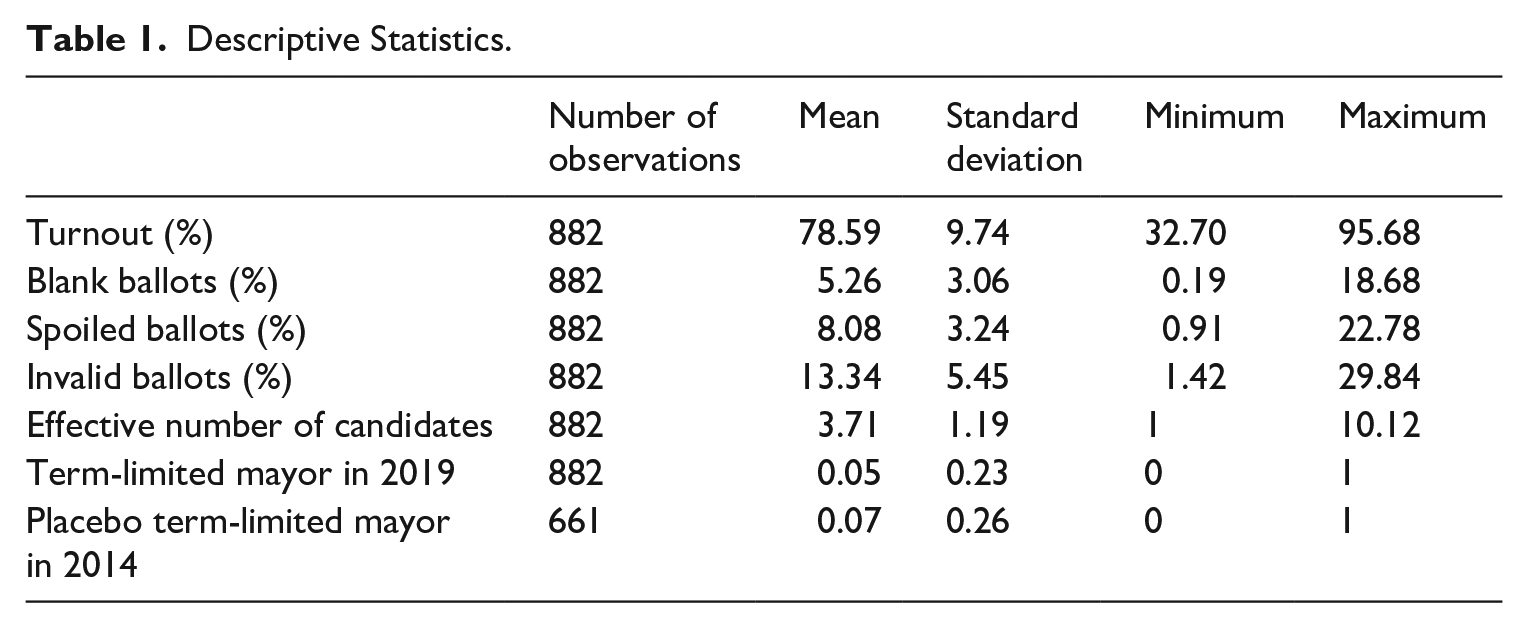
The research design uses data from four election waves of municipal elections (2004, 2009, 2014, and 2019) at the level of each of the 221 municipalities (cantones). The following variables were calculated from data provided by the National Electoral Council (CNE, 2022). Their descriptive statistics are reported in Table 1. Turnout was calculated as the share (in %) of the number of votes cast on the total number of registered voters in each municipality. The incidence of casting blank ballots (in %) was calculated by dividing the number of blank ballots cast by the total number of votes cast. In a parallel manner, the share of spoiled ballots was calculated by dividing the number of spoiled ballots cast by the total number of votes cast. The invalid voting variable is merely a sum of blank and spoiled ballots. Electoral competition is measured by the effective number of candidates (ENC). Rather than providing a raw count of candidates, this is a standard measure which weighs the contribution of each additional candidate by their vote share. It applies the Laakso and Taagepera formula (ENC = 1/Σpi2) where p is the proportion of votes received by the ith candidate (Laakso and Taagepera, 1979). ENC was calculated for all 221 municipalities in all four elections. Finally, the dataset includes dummy variables indicating in which municipalities term limits applied in 2019 (and the same municipalities in 2014 for the placebo test assessing the parallel trends assumption).
Descriptive Statistics.
Results
Contrary to strong theoretical expectations, the models presented in Table 2 suggest that the adoption of term limits had no participatory consequences in Ecuador. The coefficients for term limits in models of turnout and the incidence of blank and spoiled ballots do not reach conventional levels of statistical significance. The coefficient for turnout suggesting a 0.25 percentage point increase under term limits is substantively miniscule. However, the results from the last model strongly indicate that term limit adoption led to a substantial change in electoral competition, adding additional candidates to the electoral races affected by term limits. The estimated effect is sizable as term limits added on average half of an effective candidate (0.55) in a setting where on average 3.7 effective candidates competed in a municipality between 2004 and 2019. Term limits substantially increased the fragmentation of the electoral competition in an already very fragmented Ecuadorian context, but these changes of the competitive context did not translate into higher voter participation and engagement (in terms of turnout and valid voting).
Term Limits, Electoral Participation, and Competition (Difference-in-Differences).
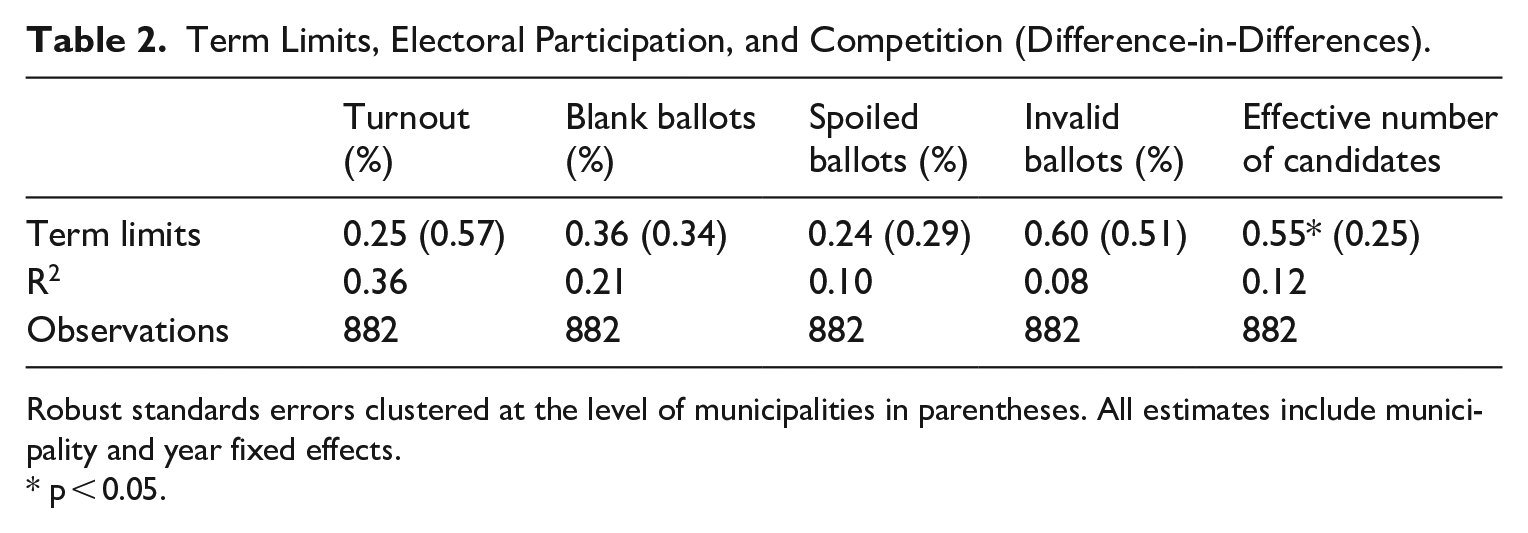
Robust standards errors clustered at the level of municipalities in parentheses. All estimates include municipality and year fixed effects.
p < 0.05.
The DID framework implies a critical parallel (or “common”) trends assumption. It assumes that the outcome variable of interest for both the treatment and control groups would have evolved similarly in the absence of the treatment (Lechner, 2010). In other words, the trends in the outcome variable over time would have been parallel for both groups. The parallel trends assumption is crucial because it allows for the isolation of the causal effect of the treatment from other factors that might influence the outcome over time. Although the validity of the assumption is not directly observable (because it relates to a counterfactual), support for the assumption could be increased by using data for more pre-treatment periods to check whether both treatment and control groups exhibited a similar trend in the past as well (Fredriksson and Oliveira, 2019: 523). Because such trends cannot be checked with only a single pre-treatment period, designs that include more time periods provide more robust results.
In Ecuador, comparable data are available for two additional time periods in which municipal elections were held (2004 and 2009), making it possible to gauge whether the trends in the outcome variables moved in parallel before the policy reform introduced the treatment after the 2014 election. Two ways of assessing the validity of the parallel trends assumption are used here. First, Figures 1–5 plot the outcome variables over time for both the treatment and control groups before the treatment is implemented. If the trend lines for the two groups are roughly parallel, this suggests that the assumption may hold.
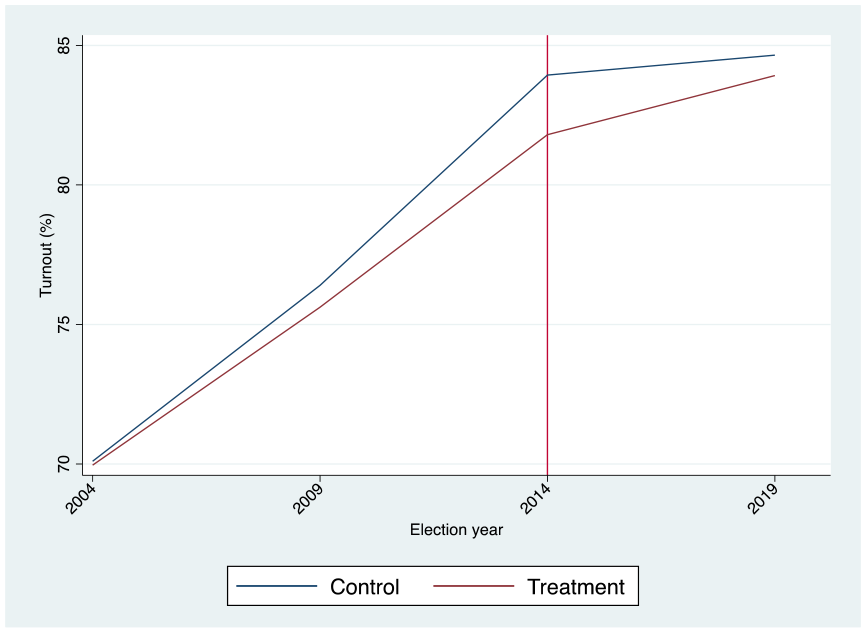
Turnout by Treatment and Control Groups, 2004–2019.
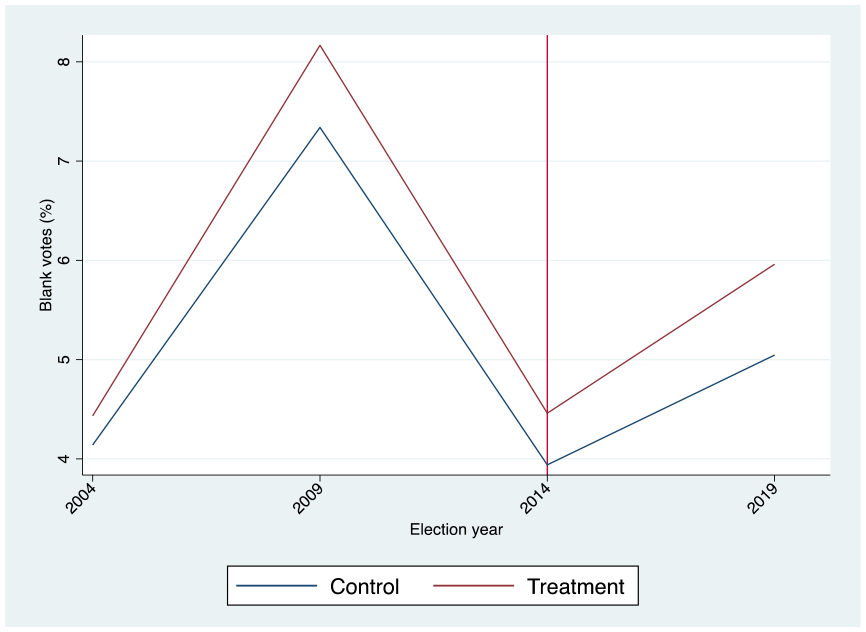
Blank Ballots by Treatment and Control Groups, 2004–2019.
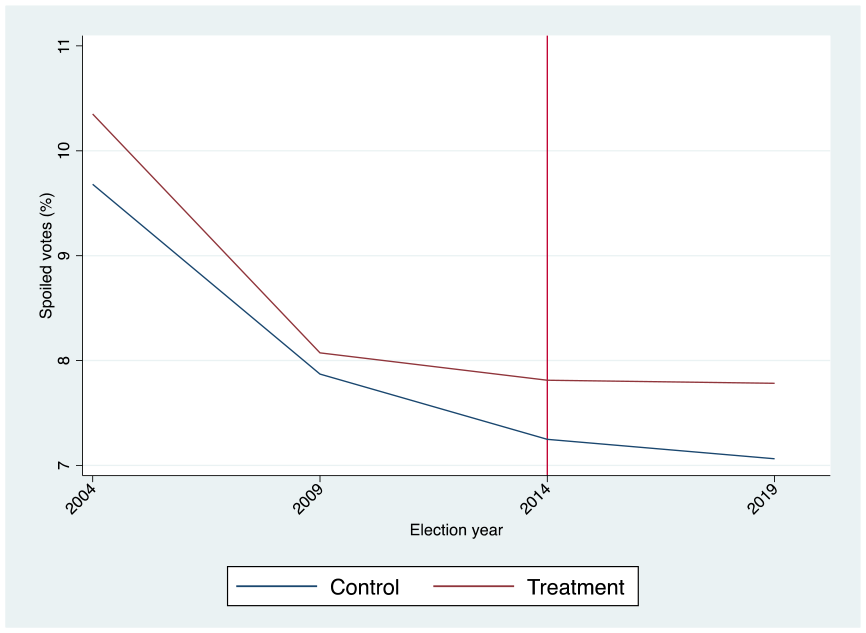
Spoiled Ballots by Treatment and Control Groups, 2004–2019.
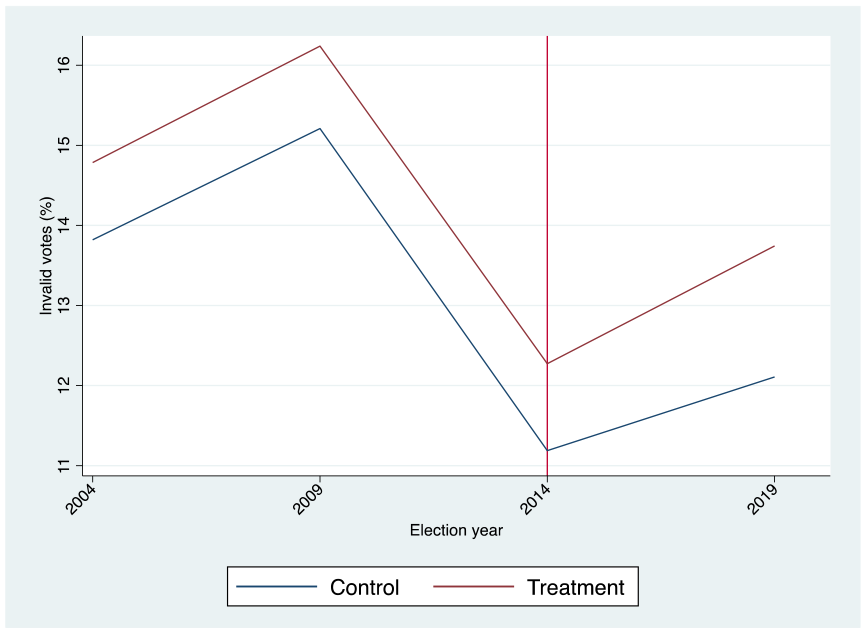
Invalid Ballots by Treatment and Control Groups, 2004–2019.
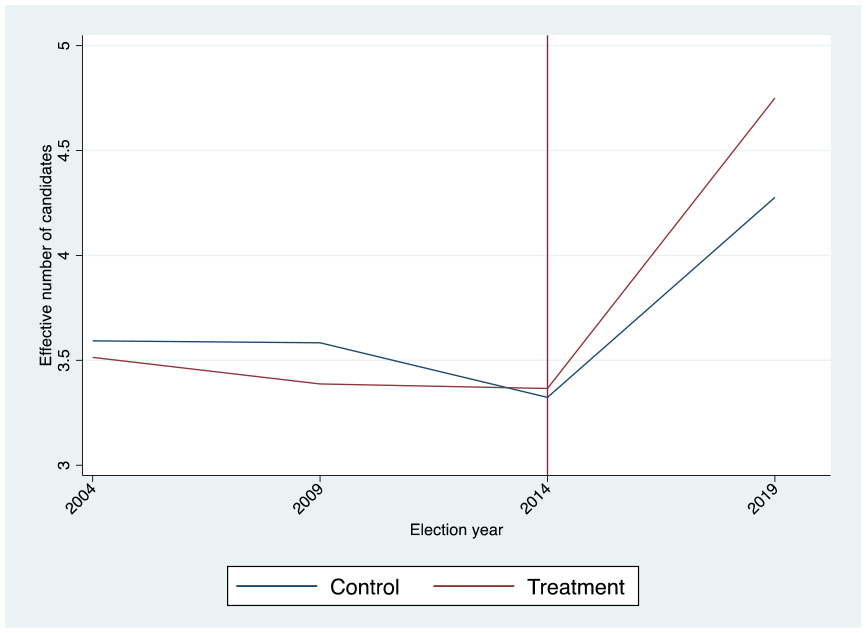
Effective Number of Candidates by Treatment and Control Groups, 2004–2019.
Second, a more formal approach is to conduct a placebo test using pre-treatment data. There should be no significant treatment effect if the parallel trend assumption holds (Fredriksson and Oliveira, 2019). The last pre-treatment election—in 2014—was used as if the treatment had already occurred. Table 3 displays the results for all the outcome variables if artificially “treated” already in 2014. None of the coefficients reach statistical significance, thus giving credence to the parallel trends assumption.
Placebo Test: Hypothetical Adoption of Term Limits in 2014, Electoral Participation and Competition (Difference-in-Differences).
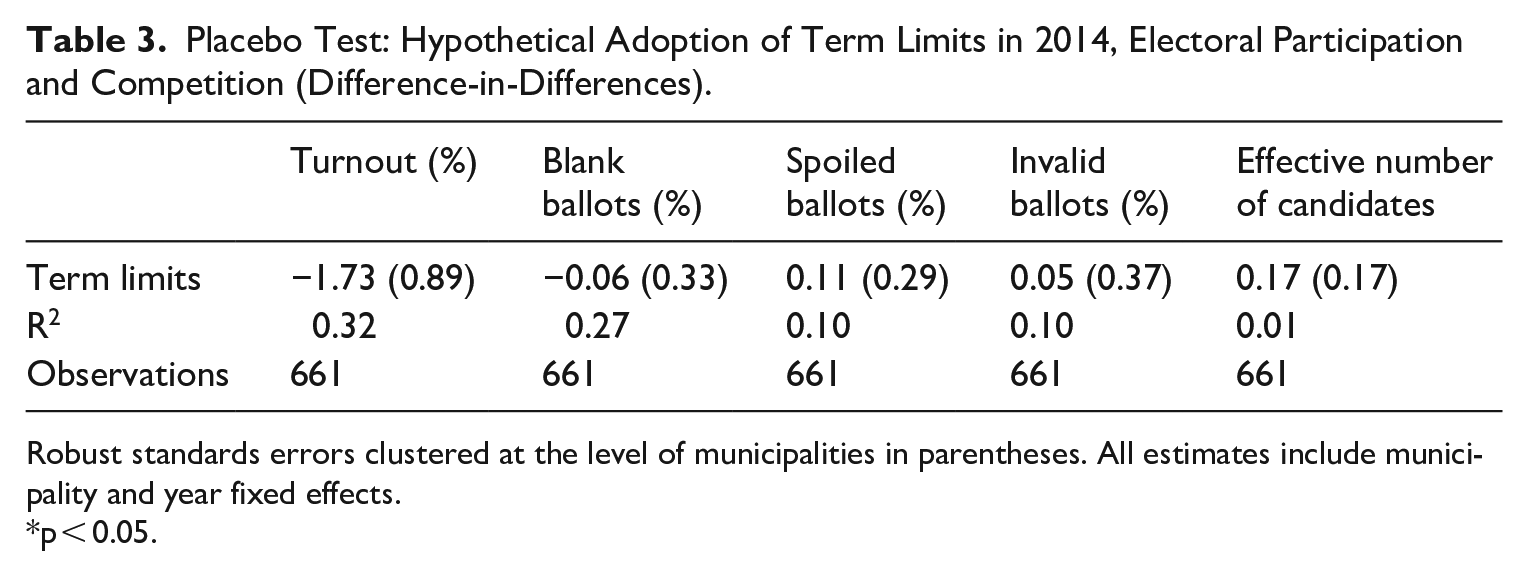
Robust standards errors clustered at the level of municipalities in parentheses. All estimates include municipality and year fixed effects.
p < 0.05.
Discussion
Most existing research reports sizable positive effects of term limit adoption on voter turnout (De Benedetto and De Paola, 2019; Kouba and Dosek, 2023; Kuhlmann and Lewis, 2017; Veiga and Veiga, 2018). Why, contrary to those findings and despite strong theoretical expectations, did term limits not increase voter turnout in Ecuador despite affecting its electoral competition? The following two tentative explanations are suggested as scope conditions that restrict the applicability of the nexus between term limits and citizen participation.
First, the origins of the mayoral term-limit rule in Ecuador were unrelated to local politics and have not addressed any salient problem of municipal government. Paradoxically, Ecuadorian mayoral elections were even characterized by low reelection rates and little or no incumbency advantage even before the reform (Mejia Acosta and Meneses, 2019). The original intention behind the adoption of term limits in 2018 was to limit the number of terms a president could serve (Došek, 2019). The mayoral term limit rules were therefore a result of national-level political considerations about the reelection of presidents, lacking any basis in the local context. This could have prevented the rule from exercising a more profound effect on local politics. In particular, the adoption of mayoral term limits in Ecuador may not have addressed the underlying reasons why citizens are disengaged from the political process, such as lack of trust in government institutions or a sense of political alienation. Even if term limits succeed in replacing incumbents, they may not necessarily improve citizens’ perceptions of the political system and their willingness to participate in elections. This is the fate of many electoral reforms in Latin America whose frequency has resulted in institutional instability marked by short-term political considerations regarding their effects that rarely materialize in practice (Freidenberg, 2022). Ecuador is an extreme case in this respect. A comparative study of Latin American electoral reforms found that it is a country with the highest number of electoral reforms in the region, having adopted at least one electoral reform for 17 years out of the 43 since its transition to democracy—almost a double of the second most reformist country, Peru (Freidenberg et al., 2022). This instability is a sign of institutional weakness because unstable electoral institutional reforms lack significance and do not change how actors behave. It has been suggested that institutional borrowing—adopting foreign institutional designs in other settings—is in part responsible for this institutional weakness (Brinks et al., 2019). Such imported rules are more likely to disregard the local context and confront competing social norms which can reduce incentives for compliance and enforcement (Brinks et al., 2019: 49). Although the adoption of Ecuadorian mayoral term limits was not a rule imported from abroad, similar logic can be deduced based on its “presidential” origin that had little to do with the subnational context of mayoral elections.
Second, that term limits changed the structure of electoral competition without affecting turnout and invalid voting rates is puzzling. One possible solution to this puzzle concerns the contradictory effects of a fragmented candidate field. Invalid voting rates in Latin America are shaped by the number of candidates in both mayoral and presidential elections: while a fragmented candidate menu drives up invalid voting, the actual increase in the number of candidates between elections decreases invalid voting (Cohen, 2018b). It is likely the case that the effect of term limits in Ecuador is locked in these dual mutually contradictory currents whose combined effect cancels each other out. Similarly, muted effects of term limits on voter turnout in the California state legislature were attributed to contradictory effects of the changed electoral competition because “open-seat races after term limits may present a slate of even less-recognized candidates than incumbent-contested elections” (Nalder, 2007: 202). While term limits created more open seat contests, thus driving up voter efficacy, they also spurred the entry of less well-known competitors, thereby reducing turnout. These contradictory effects of term limits on turnout and invalid voting are consistent with the Ecuadorian data.
Footnotes
Declaration of conflicting interests
The author(s) declared no potential conflicts of interest with respect to the research, authorship, and/or publication of this article.
Funding
The author(s) disclosed receipt of the following financial support for the research, authorship, and/or publication of this article: This work was supported by the European Regional Development Fund project “Beyond Security: Role of Conflict in Resilience-Building” (reg. no.: CZ.02.01.01/00/22_008/0004595).
