




Abstract
In 2012, Barcelona City Council introduced a new city agency that would provide housing and resources for migrants and refugees living within their city—irregular migrants. This esteemed sanctuary city policy further integrated irregular migrants into city life; however, how did natives respond to this effort? Through a difference in differences methodological approach and public opinion survey data from 2008 to 2017, I provide evidence of more positive native attitudes towards irregular migrants and immigration policy. I speculate that the increase in positive perceptions occur due to contact theory. While a single-case study, these findings provide hope for how city governments feeling the burden of the ongoing refugee crisis can adequately provide support for their irregular migrant populations without fear of backlash from their citizens.
Introduction
Sanctuary cities are at the forefront in providing migrant populations with critical health and human services in our globalizing world. The term “sanctuary cities” originated from the United States system of governance where state and local-level governments are not legally required to abide by federal, national-level immigration policies and authorities. However, the concept expands beyond the United States as cities across the globe have become unique urban environments to protect irregular migrants (Darling and Bauder, 2019; Mancina, 2016; O’Brien et al., 2019). Sanctuary cities are municipalities where the local government strictly prohibits inquiry into one’s migration status and cooperation with the national-level migration authorities (Kaufmann et al., 2022). A city becomes a sanctuary city after the implementation of at least one policy that provides this protection for migrants—either with a secure status or access to city services.
In this paper, I will use the phrase irregular migrants 1 to refer to “migrant(s) in a situation of administrative irregularity”—often referred to as “undocumented” or “illegalized” migrants (Moeffette, 2018: 13). With the increasing number of sanctuary cities, ongoing refugee crisis, and imminent increase of climate refugees in advanced democracies, academics and policy-makers must understand the political implications of these irregular migrant populations. To what extent does a political response to the pressing needs of these individuals change perceptions of natives in a country towards irregular migrants?
Through a progressive, sanctuary city policy in Barcelona, I analyze natives’ response to irregular migrants. In 2012, Barcelona announced the implementation of the Office of the Irregular Settlement Plan (OPAI) to provide irregular migrants predominately living on the streets with permanent housing, legal advice, and jobs (Kaufmann et al., 2022). Barcelona implements this expansive sanctuary city policy to provide care for their increasing number of irregular migrants (Trias Crea, 2012; Evelyn, 2021). One would expect the inner workings of a city to improve after implementation of policies in support of migrant groups struggling to find housing, health care, jobs, etc. However, one would also expect resistance from natives on the incorporation and inclusion of irregular migrants into their society on cultural or economic grounds, resulting in decreased tolerance of sanctuary policy efforts.
In this paper, I utilize 2008–2017 survey data from the Spanish Government and a difference in differences methodological approach to provide evidence that in Barcelona, after enforcement of a sanctuary city policy that further integrates irregular migrants into city life, there are more positive native attitudes towards irregular migrants themselves. Additionally, in direct response to the announcement of the policy, native tolerance of migration policy more broadly improves.
Theoretical approach
Generally speaking, urban centers are the hubs of liberal ideals and forward-thinking in our contemporary world. Public opinion research suggests that attitudes towards irregular migrants should be more positive in cities due to numerous left-leaning voters, more opportunities for jobs, and greater health and human services (Homola and Tavits, 2018; Kaufmann et al., 2022). In particular, Homola and Tavits (2018) argue that individuals who support left-leaning parties tend to have more positive attitudes towards non-natives because of their liberal worldview (1794). And since individuals on the political left often support migrant integration (Badea et al., 2017; Knappert et al., 2021; Van Prooijen et al., 2018), we would expect these cities to welcome integration efforts. Western European cities during the 2015–2016 refugee crisis, with the support of leftist voters, often went up against national government policies aimed to restrict irregular migrants and asylum seekers. These urban spaces likely support and assist their irregular migrant populations because their citizens have more positive attitudes towards these individuals.
Yet, the implementation of the OPAI sanctuary city policy coincides with the aftermath of the 2008 economic recession. During this time period, Spain faced high levels of unemployment and financial distress across the country (Arango, 2013). According to the US Bureau of Labor Statistics, the unemployment rate steadily increased from 2009, peaking at 26.5% in April of 2013. 2 One body of literature emphasizes that because native individuals have attitudes primarily based in their material, economic self-interest, they are likely to oppose immigration to protect their future financial security (Mayda, 2006; Scheve and Slaughter, 2001). In addition, the refugee crisis put an extra burden on countries in Western Europe as irregular migrants arrived at unprecedented rates (Mazza, 2022). The refugee crisis likely increased negative opinions towards migrants as natives perceive an influx of migrants as a welfare burden to their country or threat to their national identity—one’s “sociotropic” perspective (Dancygier and Donnelly, 2013; Hainmueller and Hopkins, 2014; Tzeng and Tsai, 2020). As Hangartner et al. (2019) find in the Greek islands, natives become more exclusionary towards migrants and supportive of restrictive migrant policies after direct effects of the refugee crisis. In general, despite Spain’s overall tolerant public opinion and policy on immigration, one could expect negative immigration attitudes post-2008 due to the economic recession and refugee crisis. And more specifically, we may also expect detrimental effects of both events on immigration attitudes in cities throughout Spain with high unemployment rates and numerous irregular migrants seeking basic services in urban centers.
How does the OPAI policy of 2012 in Barcelona affect migration attitudes? On the one hand, one may argue the OPAI implementation strained economically scarce resources in the city, resulting in native attitudes towards migrants to decrease. As Dancygier (2010) argues, when urban resources are limited, the potential for conflict between natives and migrants increases. On the other hand, one may argue that the OPAI implementation provided the opportunity for irregular migrants to integrate into every-day life in the city, increasing native attitudes. The OPAI implementation may have mitigated these possible threats to a smooth-running city by creating a new city agency to provide specific services catered towards irregular migrant needs. Thus, the OPAI policy creates the potential for natives and irregular migrants to interact in more positive, mundane settings. For instance, Knappert et al. (2021) find an association between personal contact and less negative refugee stereotypes among native populations. These competing hypotheses are as follows: H1a: The implementation of a sanctuary city policy to benefit irregular migrants will result in more negative native attitudes towards irregular migrants. H1b: The implementation of a sanctuary city policy to benefit irregular migrants will result in more positive native attitudes towards irregular migrants.
Case selection and background
The European context is essential to assess this research question. Kaufmann et al. (2022) highlight the influx and rejection of over a million refugees into Europe in the last decade. While numerous refugees have been rejected, well below 50% of these individuals have returned to their country of origin (Spencer and Delvino, 2019). The United Nations Office of the High Commissioner for Human Rights reports that there are about 30–40 million irregular migrants across the globe, and 2.9–3.8 million live in Europe (Kaufmann et al., 2022). With copious irregular migrants in Europe, it is essential to assess how these populations interact in their urban environment with native individuals for appropriate political action and response.
To analyze how sanctuary city policies influence attitudes of native populations towards irregular migrant groups, I look at the impacts of the progressive OPAI housing policy in Barcelona, Spain. This specific policy is used as a model across Europe for how to properly manage irregular migrant populations (Integrating Cities, 2014). In 2012, Barcelona City Council announced its plans for implementing the OPAI; however, the agency’s efforts took effect a couple years later. Since policy visibility declines over time (Mettler, 2011), I analyze before and after the announcement of the policy in 2012 to analyze how native attitudes change with regards to immigration policy.
In 2014, the City Council initiated an Action Plan and encouraged irregular migrants to register themselves in the local census (padrón) to obtain access to local services such as public facilities, libraries, and emergency health services (Delvino, 2017; Evelyn, 2021). The municipal government took concrete action to register irregular migrants without the need for a permanent address to facilitate access to the OPAI resources. Since implementation, the “Good Ideas Archive,” compiled by the Cities of Migration global initiative to learn how to better integrate migrants in cities, states that the OPAI efforts have decreased Barcelona’s total number of irregular migrants living in irregular settlements by about 40% (2021). This policy response directly moved 600 irregular migrants from the largest settlement, Calle Puigcerdà (Más de Medio, 2018). Therefore, in assessing natives’ attitudes towards migrants themselves, I look prior to the 2014 registration of irregular migrants and their perceptions afterwards. 3
Research design
In approaching how to measure natives’ attitudes towards irregular migrants before and after the implementation of the OPAI sanctuary city policy, I use a difference in differences, quasi-experimental methodological approach. Difference in differences causal design allows for the attitudes towards irregular migrants to be assessed for two distinct groups. First, for individuals that do not live in the broader Barcelona autonomous region, Cataluña. Second, for individuals that do live in the broader Barcelona autonomous region of Cataluña such that they can legally interact with the city and benefit from the OPAI policy. 4 The Centro de Investigaciones Sociológicas (CIS), 5 run by the Spanish government, conducted survey interviews for individuals’ attitudes towards immigration between 2008 and 2017 across the country. 6 The CIS dataset is a nationally representative, weighted sample of the Spanish population (ages 18 and older). The random sampling took place proportional to the 255 municipalities and 46 provinces throughout the country and questionnaires were administered face-to-face utilizing a computer-assisted personal interview at the survey respondent’s home. Each annual dataset includes about 2,500 respondents.
The difference in differences approach within this paper relies on some key assumptions (Roth et al., 2023). First, the methodological approach does not control for the potential ways that the OPAI policy affects people living outside of Barcelona. However, since there was limited news coverage and salience of the policy, this assumption is limited. Second, the results rely on similar (parallel) trends for both Barcelona and not Barcelona respondents (observed) before the policy implementation to assume that without treatment the (unobserved) outcomes would not have varied to this degree. The pre-trend plots reasonably assume parallel trends; however, I conduct additional robustness checks and placebo tests which strongly suggest that these results are dependent on the Barcelona case.
The CIS dataset includes survey responses to two relevant public opinion questions for testing the hypotheses (see Appendix 1). The first asks their opinion on the regularization of “illegal migrants” in Spain. The second asks the degree of tolerance of the laws that regulate the entry of “foreigners” into Spain. I run two difference in differences linear regression models to assess how individuals view the regularization of irregular migrants and tolerance of migration laws. Regularization is the first dependent variable that captures the attitudes of natives towards irregular migrant populations and is categorized into four ordinal groups. The second dependent variable is the tolerance of migration laws and it is categorized into five ordinal groups. The key independent variable captures the difference between individuals that live in Barcelona and those that do not live in Barcelona after policy implementation and announcement, respectively.
Importantly, both survey question answers have been transformed from ordinal to numeric, assuming equal distance between each answer choice. For both questions as the answer choice increases, the survey response is more favorable to regularization of irregular migrants and is more tolerant towards migration policy. These two survey questions provide insight into 1) native attitudes towards irregular migrant regularization and 2) native tolerance towards migration policy.


Summary Statistics.

Results
In conducting the difference-in-difference estimator, I find evidence for Attitudes towards regularization of irregular migrants over time.
Linear Model Results.

Note. *p
In terms of magnitude, the interaction term for Barcelona, post-2014 tells us that on average, Barcelona respondents were about 0.104 more favorable towards regularization of irregular migrants than if the policy had not been implemented and further enforced, ceteris paribus (see Figure 2, left). The statistically significant interaction term suggests that had the policy not been implemented, the attitude of Barcelona respondents may not have positively increased as much. These results suggest that after the OPAI policy implementation, Barcelona respondents’ attitudes towards regularization of irregular migrants positively improved. Marginal effects of respondents living in Barcelona in the post-treatment period. Not Barcelona = 0 and Barcelona = 1. Left figure shows the marginal effect of the OPAI policy post-2014 on attitudes towards regularization of migrants. Right figure shows the marginal effect of the OPAI policy post-2012 on tolerance of migration policy.
In analyzing how attitudes towards sanctuary city policies change before and after implementation, the trends for Barcelona and non-Barcelona respondents are virtually the same prior to the announcement of the policy in 2012 (see Figure 3). Similar to the results found above, with a 2012 cut off point, I find statistically significant evidence that the sanctuary city policy results in a 0.101 increase towards migration policy more broadly (see Figure 2, right). The statistically significant interaction term suggests that had the policy not been implemented, the tolerance of Barcelona respondents towards migration policy may not have positively increased as much. There is statistically significant evidence that after the announcement, there is an increase in tolerance towards irregular migration policies. Tolerance for liberal irregular migration policies over time.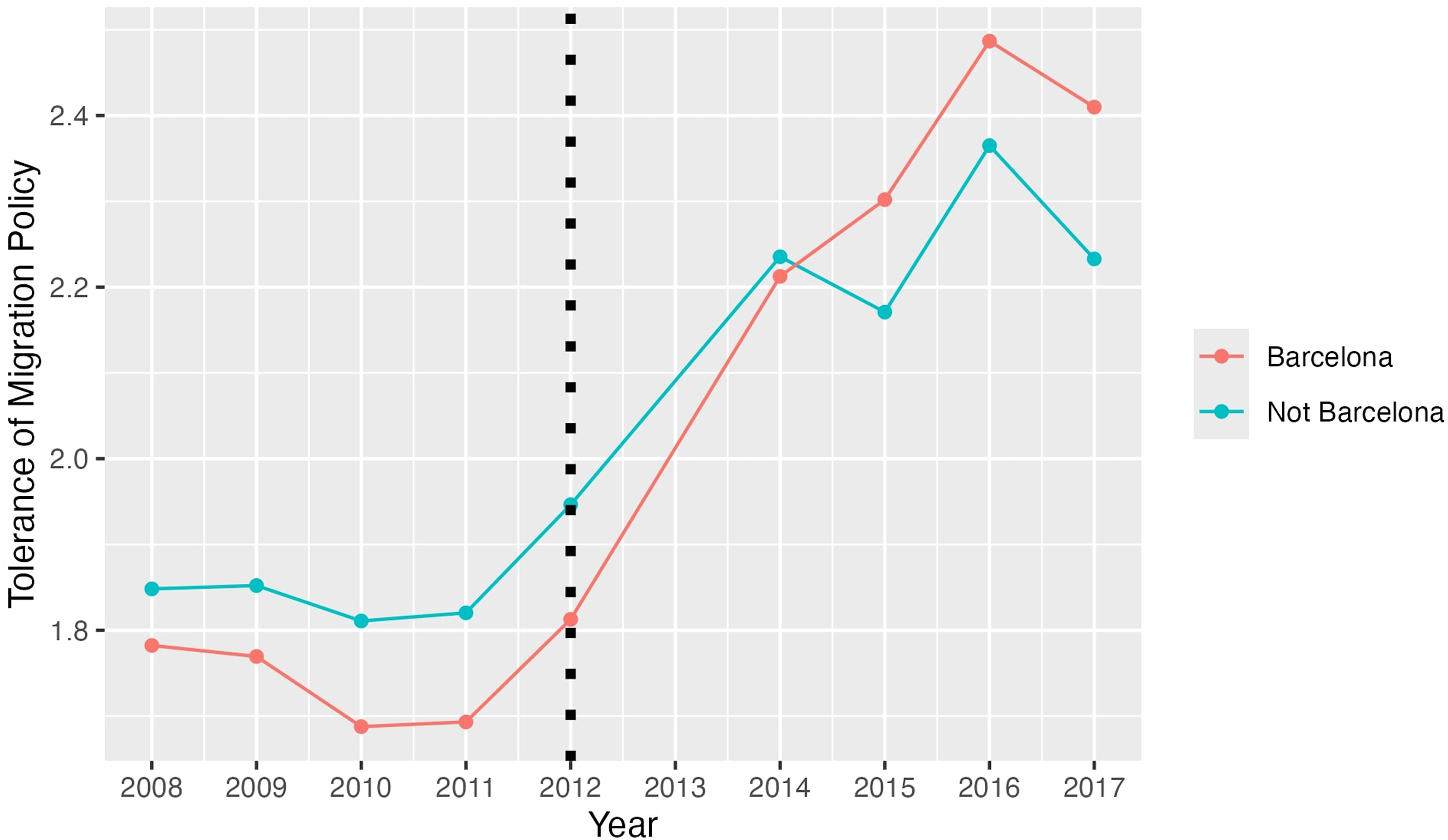
Overall, the OPAI policy implementation effected both attitudes towards regularization of migrants and policies surrounding irregular migrant inclusion. There are more positive attitudes of Barcelona residents towards migrants themselves and tolerance towards the laws on the inclusion of irregular migrants. These findings show that without the implementation of the OPAI policy, Barcelona perceptions of irregular migrants and migration policy may not have become more positive.
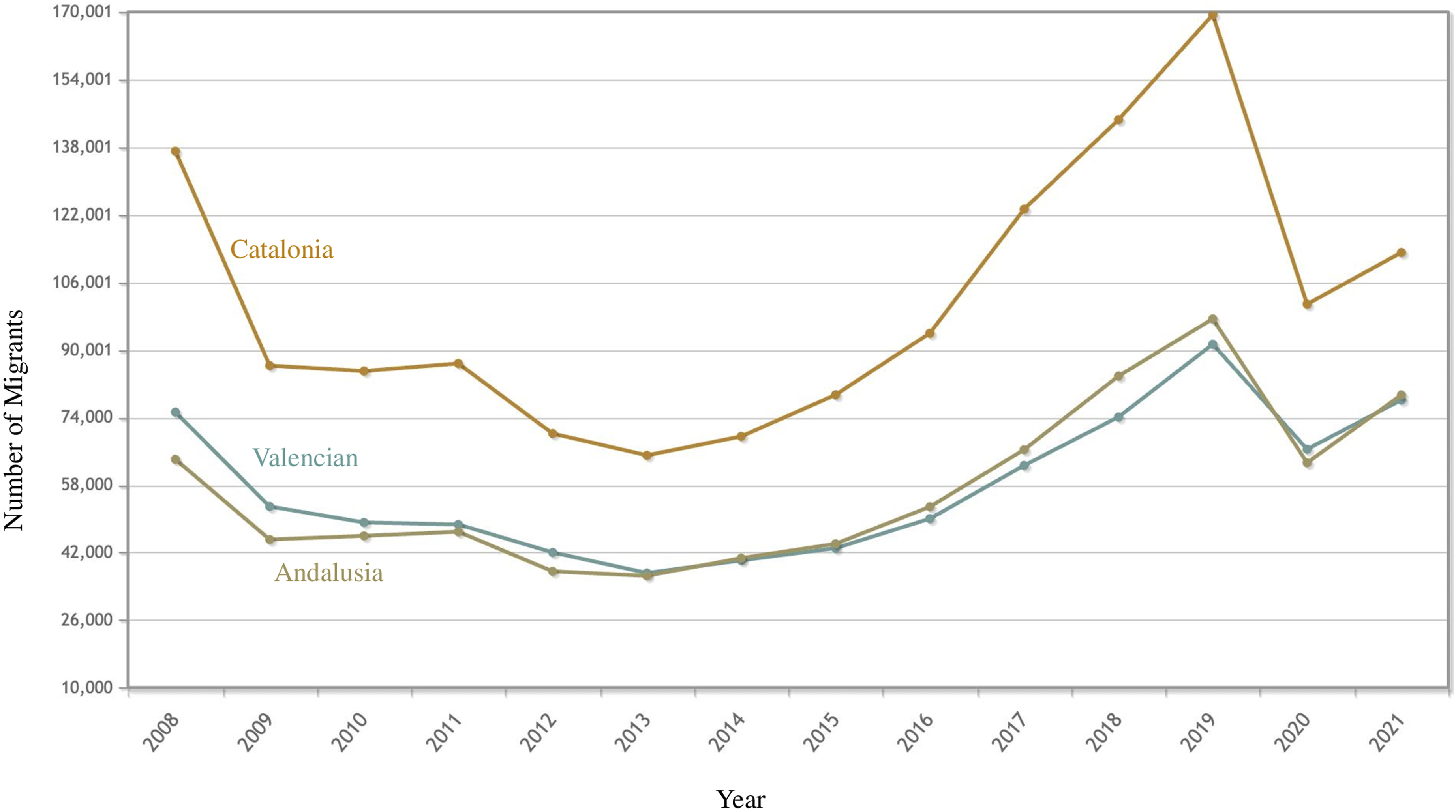
While pre-trend plots appear reasonable for meeting the parallel trends assumption, I conduct additional robustness checks. I conduct placebo tests using the same data set, removing Barcelona respondents to focus on survey respondents from Seville and Valencia. In general, even during the global recession and refugee crisis, Spain is perceived by others to be a welcoming country to migrants (Finotelli and Rinken, 2023). Seville and Valencia both have heavy migration in comparison to other parts of the country, but have the same general trend in migrant inflows over time (see Figure 4). Migration patterns by autonomous community.
8
Seville and Valencia Placebo Tests.

Note. *p
Discussion and conclusion
Sanctuary cities provide for individuals in their current city of residence who otherwise have no legal rights. The OPAI policy in Barcelona revolutionized how a city can aid a population without democratic power or access to health and human services. We cannot expect to generalize their achievements elsewhere. Understanding the potential implications of integrating irregular migrants requires careful analysis of the specific context. The outcomes of a single policy, in a specific country, outline the potential of sanctuary city policies in further integrating individuals within their societies.
In this paper, I analyze native reactions to irregular migrants after intense registration efforts that provided access to Barcelona’s city services. Why might positive opinions towards migrants improve after policy implementation? Previous literature highlights intergroup contact as the key aspect that decreases the perception of threat towards migrants (Bohman, 2015). Allport’s (1954) classical contact theory notes that intergroup contact between members of different groups results in more positive perceptions towards the other group. Through coming into contact with an out-group, threat perceptions decrease by members of an in-group. Therefore, if the OPAI policy facilitated positive interactions between natives and irregular migrants, the in-group’s (natives’) opinions may have become more favorable towards the out-group (irregular migrants). I speculate that during this integration process, natives come into contact with irregular migrants in different, more mundane capacities that positively shape their perceptions of these individuals (Pettigrew and Tropp, 2006). However, competing work in the U.S. context shows that contact with undocumented migrants does not improve American attitudes towards immigration. Rather, the proximity to the U.S.-Mexico border and local migrant population size increase negative attitudes towards migrants (Gravelle, 2016). This paper is limited in that it is assumed respondents outside of Barcelona were not affected at all by the policy implementation. The lack of salience of the policy throughout the country helps mitigate this assumption to some degree, but not fully.
Irregular migrants have limited democratic and human rights within their city of residence. As their population continues to rapidly increase across the globe, it is essential to utilize instances where elected officials seek to integrate these individuals as a framework for other contexts. Policy-makers can be cautiously optimistic of the overall benefits that integration policies for irregular migrants bring to their city residents. However, future research must analyze potential differences between native groups, since the left and right do not necessarily react to threats in the same way (Hibbing et al., 2014).
Recent work in the American context has shown that local offices for immigration services result in more favorable public attitudes towards the city itself (Jiménez and Nuñez, 2023). Therefore, future studies must continue to look at the city level across contexts to understand the potential for positive integration amidst the ongoing global immigration crises.
Supplemental Material
Supplemental Material - Sanctuary city success? How attitudes towards irregular migrants and urban policy differ in Barcelona
Supplemental Material for Sanctuary city success? How attitudes towards irregular migrants and urban policy differ in Barcelona by Grace C. Morris in Research & Politics
Footnotes
Acknowledgments
I would like to thank my advisor, Zeynep Somer-Topcu for her constant encouragement and helpful feedback, the two anonymous reviewers for their suggested revisions, and the following people for reading multiple iterations and providing support in a multitude of ways: Kathie Tovo, Connor Jerzak, Andrés Cruz, Oguzhan Alkan, Kendall Curtis, Matt Martin, Kenny Miao, Alex Norris, Sam Selsky, and Daisy Ward.
Declaration of conflicting interests
The author declared no potential conflicts of interest with respect to the research, authorship, and/or publication of this article.
Funding
The author received no financial support for the research, authorship, and/or publication of this article.

Supplemental Material
Supplemental material for this article is available online.
Notes
References
Supplementary Material
Please find the following supplemental material available below.
For Open Access articles published under a Creative Commons License, all supplemental material carries the same license as the article it is associated with.
For non-Open Access articles published, all supplemental material carries a non-exclusive license, and permission requests for re-use of supplemental material or any part of supplemental material shall be sent directly to the copyright owner as specified in the copyright notice associated with the article.
