




Abstract
Contested borders raise the question of how to provide security without provoking a stronger neighbor. Using novel survey data from Georgia, we investigate how proximity to disputed borderlines and variation in the nature of borderlines shape security perceptions and foreign policy preferences. People near the ambiguous border to South Ossetia are substantially more likely to worry about border insecurity than those near the fortified borderline to Abkhazia. Yet those near South Ossetia are least likely to demand a stronger stance against Russian-supported creeping borderization and are not consistently more in favor of a stronger alliance with NATO. This exploratory study points to important within-country variation and that those most affect by instability do not necessarily favor more hawkish foreign policies.
Introduction
Borders influence political and economic interactions between countries and directly impact the lives of those living in their vicinity. These consequences are particularly daunting around contested borderlines, as border conflicts around the globe regularly remind us of. Given how important borders are for citizens’ lives, we know surprisingly little about attitudes towards border security (Gravelle, 2022). We investigate how contested borders affect perceptions of security and foreign policy preferences by asking three questions. First, how does proximity to contested borderlines affect people’s sense of security? Second, how does proximity shape foreign policy preferences? Finally, does the effect of proximity on attitudes depend on boundary lines’ characteristics?
We address these questions with novel survey data from Georgia because this country poses a particularly interesting case for these questions. First, Georgia has two contested boundary lines that differ in their degree of fortification, although being formally equivalent. 1 Second, foreign policy issues are highly salient, especially the question of how to deal with a militarily superior potential aggressor (Kupatadze and Zeitzoff, 2021). We compare perceptions of security and foreign policy attitudes of those who live in close vicinity to boundary lines with those who live further away. We compare the impact of a fortified, clearly visible, and stable boundary line with the effect of a more tenuous one. Past research has equated physical proximity to borders with greater visibility and argued that proximity and visibility make individuals experience borders in a more concrete manner (Cortina, 2020; Gravelle, 2022; Mutz and Simmons, 2022; Trope and Liberman, 2010). We separate proximity to borderline from their visibility or degree of fortification. We investigate whether physical distance to and physical appearance of borders impact attitudes differently.
Our study highlights that border security is “largely in the eyes of the beholder, enhancing a sense of psychological rather than material security” (Simmons and Kenwick, 2022: 16). It advances our understanding of the effect of borders on perceptions and preferences by uncovering complex within-country variation in how contested boundary lines shape attitudes. We show that this variation is driven not just by proximity but also by border characteristics. By de-coupling proximity from visibility and fortification, we highlight that the effect of proximity to borders on attitudes depends on the nature of the borderline. Our study also cautions about how perceived insecurity translates into foreign policy preferences. Personal security risks do not automatically push individuals towards favoring a hawkish foreign policy. With much stronger neighbors, this relationship is more complicated.
How borders shape perceptions
Borders are designed to restrict and control the movement of goods and people and to display sovereignty over territory (Hassner and Wittenberg, 2015). They project political authority to the outside world and towards their own citizens (Simmons and Kenwick, 2022). Borders shape expectations, perceptions, and de facto implementation of sovereignty and of peace processes (Krasner, 2001; Lake, 2003; Morgan-Jones et al., 2020). They establish a sense of belonging and unity for those encircled by a common boundary line. Leaders even build border walls to strengthen support, similar to the “rally around the flag” effect (Linebarger and Braithwaite, 2022).
But the impact of borders on attitudes depends on how borders are experienced. First, political phenomena, including formal and informal borders, are experienced differently by those in geographic proximity compared to those to whom the phenomenon is a more abstract concept due to greater physical distance (Cortina, 2020; Gravelle, 2018; Trope and Liberman, 2010). For example, support for the U.S.–Mexico border wall varies not only by characteristics of the individual but also by proximity to the border (Cortina, 2020; Gravelle, 2018, 2022).
Second, borders vary greatly in their physical manifestations and projection of sovereignty within and outside their territory. While some consist of concrete walls with highly regulated transit points, others lack any manifestations of where exactly the border is (Simmons and Kenwick, 2022). Weakly fortified or ambiguous borders often have a destructive impact on their environment (Barak, 2010). Ambiguous borders can lead to political or military insecurity and conflict (Cederman et al., 2022). Border insecurity shapes the stability of social networks and social trust, and therefore the potential for conflict, for centuries to come (Abramson et al., 2022). Borders fortified by concrete walls are associated with greater border security (Mutz and Simmons, 2022). But border ambiguity can enable politicians to lay claim to areas beyond these boundaries, even if they have lost effective control (Barak, 2010). But how do geographic proximity to more or less ambiguous borders affect perceived security and foreign policy preferences?
Georgia’s Administrative Boundary Lines and their effect on perceptions and attitudes
Georgia’s two breakaway regions, Abkhazia and South Ossetia (referred to as Tskhinvali region in Georgia), are prime examples of different contested borderlines. 2 Neither is recognized as international border by Georgia or the majority of the international community. But Georgia does not have effective control over the “occupation lines” or over the two de facto states. Beyond these similarities, the two administrative boundary lines (ABLs) differ in their physical form, their ambiguity, and how they regulate transit.
Abkhazia is cut off from the rest of Georgia by a clear and effective physical border. Topography facilitates its visibility, stability, and predictability. For large sections, the borderline roughly follows the Enguri river and is not passable; the majority of passable sections are clearly demarcated by fences and walls (Rzeszutko, 2022). The ABL between Georgia and South Ossetia is substantially longer and cuts across predominantly passable areas. Only a small proportion is clearly demarcated with barbed wire fences, installed by Russian and South Ossetian border guards (Rzeszutko, 2022). Many areas lack any sign of the borderline. This invisible borderline, often cutting across farmland and villages, leaves residents at a risk of being detained by Russian and South Ossetian border guards for supposedly crossing into South Ossetian territory. This ambiguity and weak fortification allow for “creeping occupation,” referring to Russian border forces shifting the borderline by erecting barbed wires or moving them further into Georgian territory (IDFI, 2015; Khatchvani, 2019; Mindiashvili and Tavakarashvili, 2019).
Georgians living in the borderland to Abkhazia can see where effective control of the Georgian government ends. Its visibility and permanency provide stability and dependability despite not being officially recognized. For those near the South Ossetian ABL, invisible and shifting borders threaten their livelihood and physical security as they risk detention by border guards (Amnesty International, 2018; Brun, 2019).
How does proximity to these different boundaries shape attitudes among the Georgian population? Official statistics suggest that people on the Georgian-controlled side of both ABLs are regularly detained by Russian border guards. 3 Despite the personal risks in physical proximity to both ABLs, proximity to a visible, established, fixed boundary line suggests dependability. The borderline is not an unknown quantity and is more likely seen as a “normal” feature. We do not expect that proximity to the Abkhaz ABL is associated with greater perceived personal insecurity. 4
We expect that people who live close to the South Ossetian ABL have a very different perception of how this boundary affects their safety. The lack of permanent and in parts visible structures is a reminder of the unresolved questions of territorial control. This unstable situation, exemplified by the ambiguous boundary line, can reinforce the perception that peace and security might only be temporary. We expect that greater proximity to the South Ossetian ABL is associated with greater perceived personal insecurity.
The possibly more pressing question is how living in the vicinity of disputed boundary lines shapes expectations on how to counter expansionist policies by a substantially stronger neighbor. People might support escalating a crisis when provoked by a militarily superior opponent (Clary et al., 2021). In Georgia, prior to its 2008 war with Russia, “the entire political spectrum of Georgian voters […] desired that their government pursue aggressive wartime bargaining behaviors vis-a`-vis Russia” (Driscoll and Maliniak, 2016, 270). But this “war initiation bump” for brinkmanship was driven by those outside the conflict zones.
While greater proximity to an ambiguous boundary might lead to greater perceived individual insecurity, this proximity, and perceived insecurity, might not translate into more hawkish foreign policy preferences. Driscoll and Maliniak (2016)’s findings highlight that those near conflict zones do not support aggressive bargaining. Getmansky et al. (2019) find that those who would be most affected by militarized border disputes are less supportive of hawkish policies. While we expect people in greater proximity to an ambiguous boundary to feel more insecurity, we do not expect these same individuals to prefer a stronger stance against creeping borderization—even at the cost of continued border ambiguity or physical encroachment on their territory—because those individuals would have to carry the brunt of a potential military confrontation.
Data and descriptive patterns
We use data from an original face-to-face survey of 2,033 respondents in Georgia in 2018. The sample is representative of the Georgian adult population, excluding populations of South Ossetia and Abkhazia. We oversampled in the border regions near the Abkhaz and South Ossetian ABLs to be able to draw inferences from these two populations. 5
Georgians view border insecurity as a highly salient problem. Figure A.1.2 in the Appendix shows that when asked about what severely threatened their personal security, border insecurity is by far the most commonly identified issue after poverty. How does proximity to boundaries affect perceptions? Figure 1 shows the percentages of respondents who live in the South Ossetia border region, the Abkhazia border region, and of those outside both border regions, who view the border as a severe personal security risk. We identify border region as increasingly larger areas, ranging from within 0.1° to 0.4° of the Administrative Boundary Lines.
6
The levels of statistical significance refer to the difference in means tests between those in the respective border region compared to those outside both border regions. Respondents near the South Ossetian ABL are more likely to mention border insecurity as a severe personal security risk, while those near the ABL to Abkhazia are less likely to do so. Border insecurity as severe personal security risk.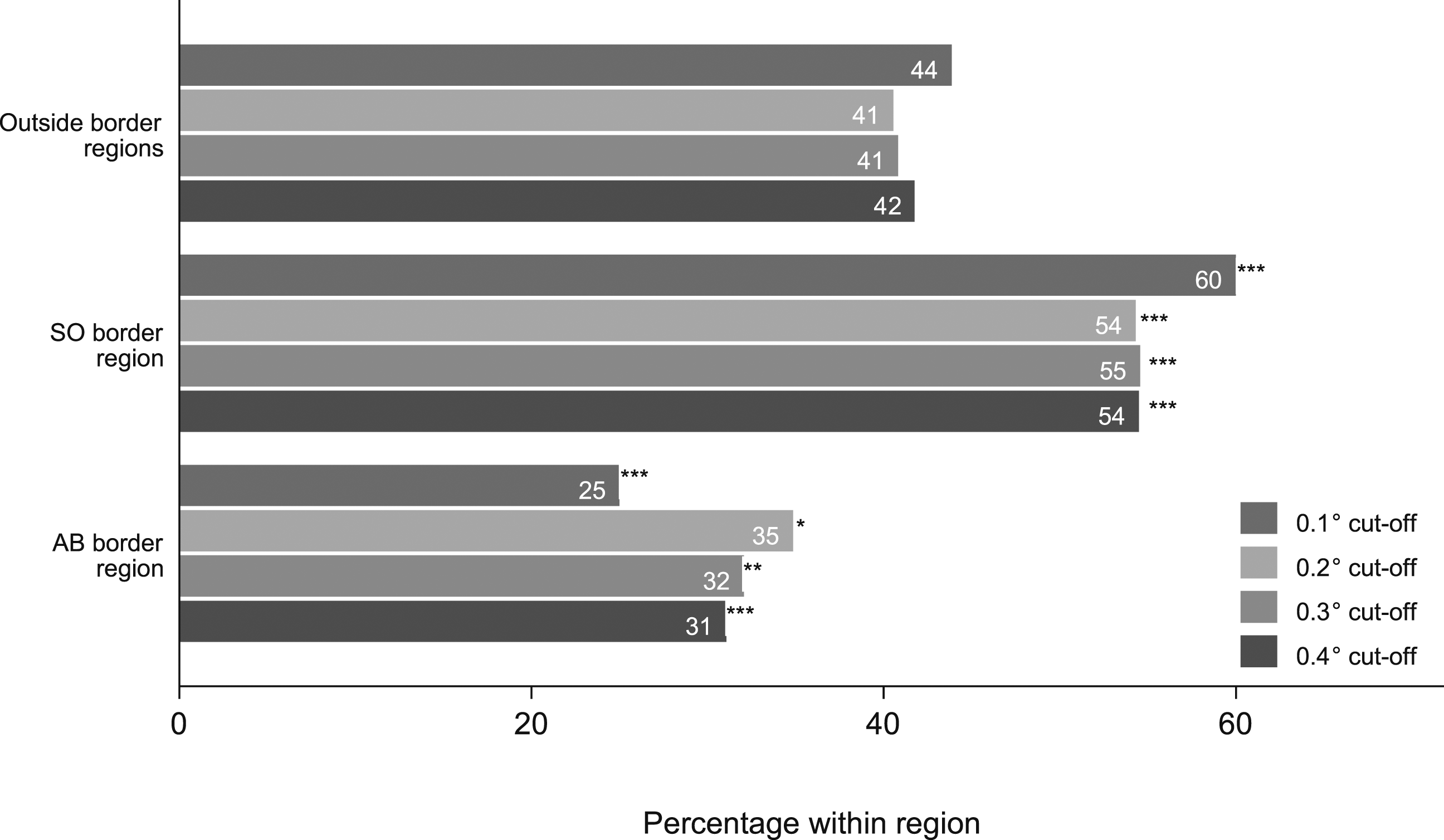
Given the insecurity due to “creeping borderization,” we asked whether the Georgian army should use force to prevent moving the ABL to South Ossetia further into Georgia. Figure 2 suggests that although the majority of respondents near the South Ossetian borderline perceive border instability as a severe personal security risk, an even larger share does not support using force to prevent moving the boundary line. Viewing the border as a personal security risk does not translate into supporting the use of force to prevent further encroachment on their territory, although this creeping borderization threatens their livelihoods and survival (Amnesty International, 2018; Brun, 2019). Should Georgia use force to prevent SO border change?
Do those who are directly affected by Russian supported creeping borderization wish for closer military collaboration with NATO as potential deterrent against further aggression? The ABLs might act as a reminder of past conflicts with Russia.
7
Figure 3 shows the percentage of people in the three areas who chose NATO/EU or Russia as their preferred closest military partner, using two different cutoff lines for border areas. Respondents were given the option of choosing between China, NATO, Russia, EU, USA, Other, and “none of these,” as well as “don’t know” and “refuse to answer.” For readability of the figure, we only show the choice for Russia and for NATO/EU.
8
About 40% of respondents outside the borderlands chose NATO or EU and 25% Russia. Those in close proximity to the South Ossetian boundary line are more likely to choose NATO as partner than other respondents, but this difference disappears for respondents within 0.3° of the ABL. Across all groups, support is substantially stronger for NATO and EU as military partner rather than Russia. Preferred military partner.
Multivariate analyses
We investigate perceived risk to personal security, attitudes towards using force to counter creeping borderization, and preferred military partner in multivariate analyses. We first run the analyses on the complete sample and identify respondents within 11 km and 33 km of the ABLs with binary variables. Next, we constrain the sample to both border regions to compare responses between the two. The last two models only include respondents from within 0.3° of either ABL to check whether individual characteristics shape responses in these areas differently. We control for individual characteristics that might affect attitudes towards the ABL and policy preferences. 9 The binary variable Tbilisi identifies respondents in the capital. Heard about border violence indicates whether respondents have (very) often heard about people being detained, beaten, abducted, or killed in the border region. 10 Harmed in war identifies respondents who answer that they or someone they personally know had been physically harmed during the wars in the early 1990s or in 2008. We capture respondents’ subjective assessment of their own economic condition, ranging from “1—very bad” to “5—very good.” We control for high level of education (university degree), whether the respondent was female, and three categories of age, using the youngest age bracket as the reference point. 11 We use logit (Table A.1.3) and multinomial logit models (Tables A.1.4 and A.1.5) with standard errors clustered on the primary sampling unit.
Models 1 and 2 in Table A.1.3 in the Appendix confirm that people near the South Ossetian ABL are more likely than others to view border insecurity as a severe personal security threat. Figure 4 visualizes perception of border security, comparing respondents within and outside the 11 km borderline (Model 1).
12
Respondents near the ambiguous South Ossetian borderline are most likely to see the border as severe risk and those near the fortified Abkhaz border are least likely to share this concern—even less than those outside both border areas. This is surprising since people are oftentimes abducted near the Abkhaz ABL (see Figure A.1.1). When excluding respondents outside both border regions, respondents near the South Ossetian ABL are more likely to see the border as a severe security risk than those near the Abkhaz ABL. The clearly delineated borderline is associated with reduced perceived risk to personal security. Having regularly heard about violence at the border is consistently associated with greater concerns about border insecurity across all models, including when only looking at the border region near the Abkhaz ABL. Likelihood of perceiving border as threat. Note: Simulations are based on Model 1 in Table A.1.3. The figure shows the point estimates and 95% confidence intervals of the predicted probabilities of identifying border insecurity as a severe risk to personal among several alternative options. Control variables are held at their modal value.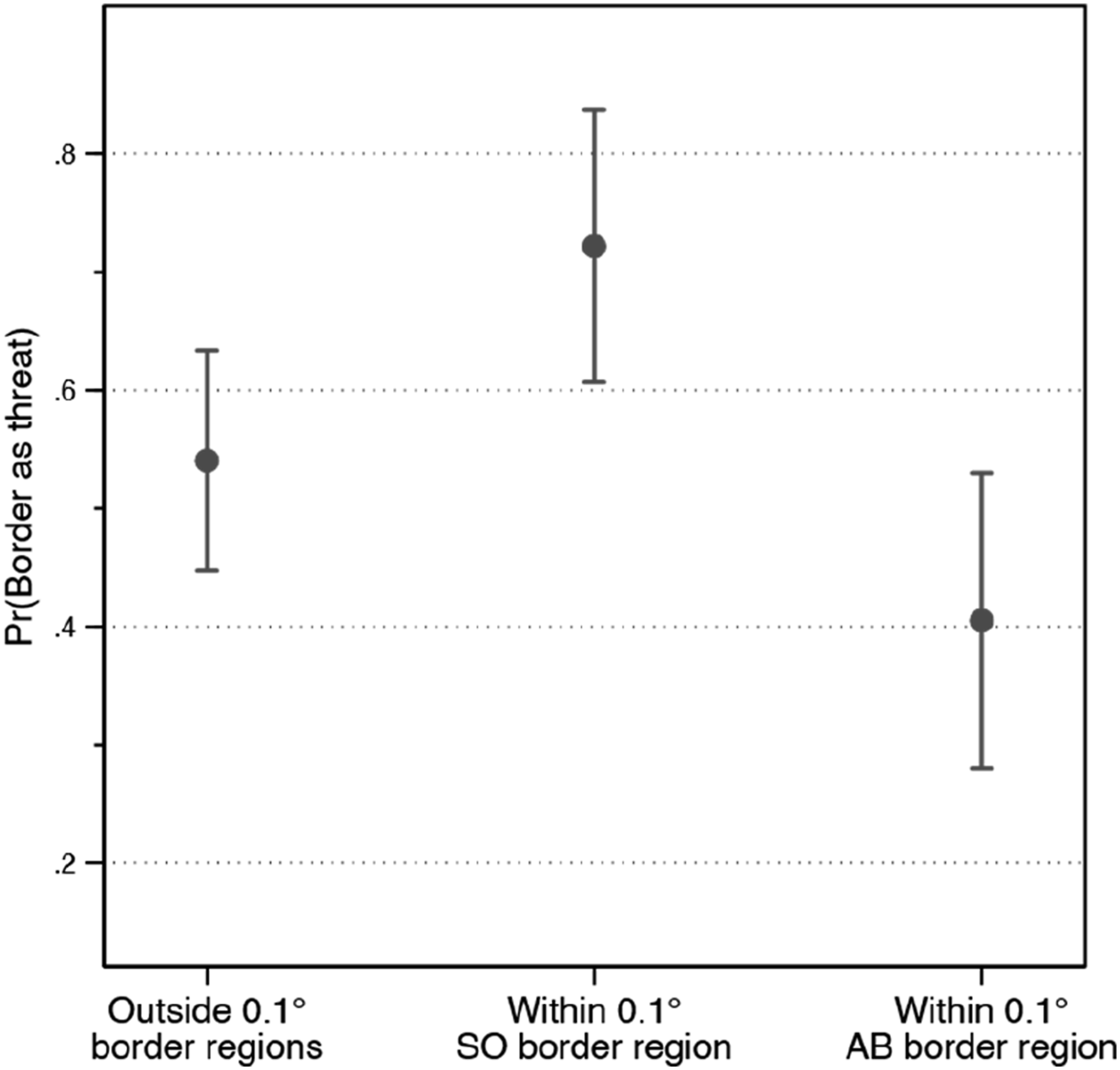
In the face of creeping borderization, we asked whether respondents agreed with the statement that the Georgian Army should use force to prevent the South Ossetian ABL being moved further into Georgian-controlled areas. We use multinomial models to assess the impact of borderlands on the three outcome options, using the category Neither agree nor disagree as baseline. Table A.1.4 in the Appendix shows the results, using the same four samples and control variables as in Table A.1.3, plus the binary variable for whether border insecurity is seen as a severe threat to personal security.
Respondents near the South Ossetian ABL are more likely to disagree with using force to counter creeping borderization. Those near the Abkhaz border “sit on the fence,” they are least likely to voice a preference. It is not surprising that those near the South Ossetian border are more likely to express an opinion than those near the Abkhaz ABL (see Model 8), because the latter are less effected by the instability of the South Ossetian ABL. But this does not explain why they are less likely to voice a clear opinion than those outside the border regions. Interestingly, viewing border insecurity as personal threat does not strongly or systematically affect attitudes towards militarily defending it. Even though people are concerned about border insecurity, they judge taking a military stance as too risky and unrealistic in the face of a far superior opponent. 13
Figure 5 simulates the predicted probabilities of Model 6 in Table A.1.4. Those living closest to the contested boundary are most strongly against defending it with force, despite suffering the most under the creeping borderization and being most concerned about border insecurity. Those most affected by insecurity are not necessarily most supportive of a hawkish foreign policy against a far superior neighbor. Support for use of force at South Ossetian ABL.
Finally, we analyze whether border proximity affects preferences for military partners. Being close to the boundary line and being able to see Russian forces across the fence, as is the case along parts of the South Ossetian ABL, might lead to a stronger demand for collaborating with NATO to protect against potential future incursions. We recode the answers to our question about preferred military partner into three categories, NATO/EU, Russia, and don’t know. These categories represent the most common answers, as shown in Table A.1.2 in the Appendix. 14 Table A.1.3 shows the results of the multinomial analyses, with Russia as reference category, using the same independent variables as in Table A.1.4.
If we focus only on the two border regions (Model 13), those near the South Ossetian ABL are less likely than those near the Abkhaz ABL to choose NATO/EU or say they don’t know, although they are most affected by creeping borderization. People in this region might be motivated by pragmatism or greater support for Russia. Media reports covering the period just before and during our survey report increasingly anti-Western messages in Georgia, directed primarily against the United States, NATO, and the EU as partners (Media Development Foundation Georgia, 2018, 2019). Several interviewees suggested that Russia-friendly messages were particularly prominent near the South Ossetian ABL, which might have contributed to this finding.
Since attitudes towards Russia or NATO are likely shaped by overall attitudes towards the EU, we add two variables that capture whether respondents see European political values as incompatible with Georgian ones or whether they think Georgia would benefit from European political values. Across all models in Table A.1.5 pro-European attitudes are strongly correlated with preferring partnering with NATO or EU, while anti-European political values are strongly and consistently linked with favoring Russia. Figure 6 shows the predicted probabilities of these preferences when setting pro-European values to 1 (left panel), which is also the modal value, and anti-European values to 1 (right panel). The driving force behind attitudes towards preferred military partner seems to be attitudes towards European values.
15
Perceived border threat does not influence these preferences. The oldest age cohort is consistently less likely to choose NATO/EU over Russia as favored military partner.
16
Preferred partner for Georgian armed forces by values.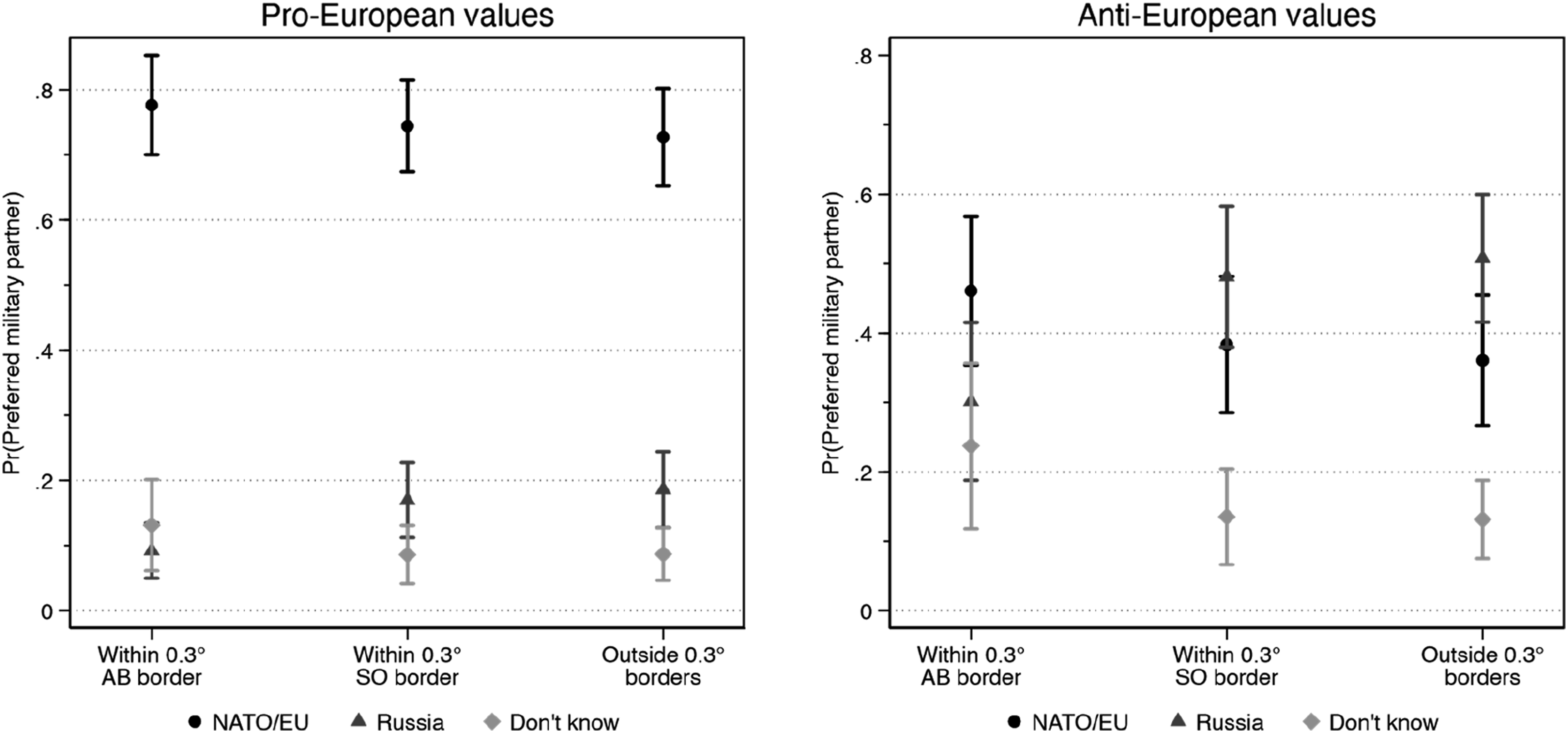
Conclusion
We investigated how two borderlines that are not recognized as legitimate boundaries but differ in their formalization affect perceptions and preferences of those living in their shadows. We separated the impact of proximity to borders from their physical stability and visibility on perceptions. Our findings reflect the impact boundaries have on security perceptions. Living in close proximity to clearly demarcated and physically enforced borders reduced perceived threats in volatile contexts, while proximity to weaker fortification was associated with greater perceived insecurity. Insights from this study also suggest that threat perceptions do not automatically translate into demanding a stronger military response or protection. Faced with a significantly superior opponent, people in ambiguous borderlands are wary of provoking a reaction that could massively deteriorate their security situation. 17 Living in contested borderlands might come with a particular sensitivity towards the complexity of the situation.
Our study has several implications for countries with unstable borders towards militarily superior neighbors. First, while proximity to borders influences preferences, this impact is moderated by physical characteristics of the border. In contentious contexts, strong borders and walls might indeed improve perceived border security for those living in their shadows. More temporary structures, particularly when the exact location of the boundary lines is ambiguous, heighten perceived personal insecurity. Second, greater perceived border insecurity does not automatically translate into demanding a stronger fortification or border defense. Our results point to the complexity of the problem created by a much stronger neighbor that pursues expansionist goals. Perceived threats do not automatically translate into preferences for hawkish policies. Third, foreign policy preferences, such as preferred allies, are not necessarily driven by proximity to contested boundaries. Instead, they might be shaped by more general patterns of norms and preferences that vary between generations. Finally, our study highlights the complexity and difficulty of how to provide security and stability in contested regions while avoiding provoking a much stronger aggressor.
Supplemental Material
Supplemental Material - Borders and bullies: How borders shape perceptions of security and foreign policy preferences
Supplemental Material for Borders and bullies: How borders shape perceptions of security and foreign policy preferences by Sabine C. Carey and Jürgen Brandsch in Research & Politics.
Footnotes
Acknowledgements
The authors gratefully acknowledge the comments and input from the IE School of Global & Public Affairs and from panel participants at the Conflict and Research Society Conference 2022.
Declaration of conflicting interests
The author(s) declared no potential conflicts of interest with respect to the research, authorship, and/or publication of this article.
Funding
The author(s) disclosed receipt of the following financial support for the research, authorship, and/or publication of this article: This work was supported by the European Research Council under the European Union’s Seventh Framework Programme (FP7/2007-2013/ERC Grant Agreement no. 336019). Publication of this article was funded by the University of Mannheim.

Supplemental Material
Supplemental material for this article is available online.
Notes
References
Supplementary Material
Please find the following supplemental material available below.
For Open Access articles published under a Creative Commons License, all supplemental material carries the same license as the article it is associated with.
For non-Open Access articles published, all supplemental material carries a non-exclusive license, and permission requests for re-use of supplemental material or any part of supplemental material shall be sent directly to the copyright owner as specified in the copyright notice associated with the article.
