



Abstract
Can media have a lasting impact on attitudes in postwar countries? A lingering impact of media could substantially shape peace and security in postwar societies. Our quasi-experimental research design and original survey data utilize variation in the reception of an anti-government radio station in Nepal's Terai region, which was shut down after violent clashes. Our results show that individuals with access to anti-government broadcasts were less optimistic about peace, police and civic activism three years after the closure of the station. The study has implications for understanding the longer-term role of media for post-conflict attitudes and state-building.
Introduction
Post-conflict peace is often fragile. About 40% of civil wars recur within the first decade (Collier et al., 2008), while the median peace duration is seven years (Gates et al., 2016). Extensive research examines how to reduce the risk of civil war relapse, for example through power-sharing institutions, security sector reforms, rights protections of ethnic groups and international peacekeeping missions (e.g. Caplan and Hoeffler, 2017; Gurses and Rost, 2013; Hartzell and Hoddie, 2020; Hultman et al., 2016; Walter, 2004). Yet even without the re-escalation of war, countries show tremendous differences in their quality of peace, with many of them suffering from significant postwar political violence (Höglund and Kovacs, 2010).
To better understand the quality of post-conflict peace beyond the mere absence of battle deaths, we investigate the role that media can play in shaping attitudes toward central elements of a functioning democratic system. Radio can change attitudes toward and behaviors of democratic engagement (Paluck and Green, 2009). Persistent messaging can create anxiety among the population, even without specific threats (Rigterink and Schomerus, 2017). Carefully orchestrated propaganda can motivate individuals to commit acts of violence through indirect persuasion and contagion effects (Petrova and Yanagizawa-Drott, 2016; Yanagizawa-Drott, 2014).
Yet what happens when anxiety-inducing messaging stops? Can media continue to shape attitudes and threat perceptions after the transmission ceases? How long-lasting is the effect of media on people's beliefs? Although the theoretical mechanisms that link media to beliefs and preferences do not have a clear or explicit temporal dimension, relevant work in conflict-related contexts has predominantly concentrated on contemporaneous effects (e.g. Adena et al., 2015; Bernini, 2023; Rigterink and Schomerus, 2017; Yanagizawa-Drott, 2014), as has the literature on media and persuasion more generally (DellaVigna and Gentzkow, 2010).
Whether media's influence can linger beyond the time of transmission remains an open question. In a non-conflict setting, Durante et al. (2019) find a long-lasting influence of introducing Berlusconi's entertainment TV in Italy on voting patterns 25 years later. We ask and empirically investigate whether radio exposure is associated with political attitudes years after the transmission has ended. If media broadcasts continue to shape perceptions even after transmission has ended, the impact of propaganda and media could be far greater than previously assumed.
We investigate whether exposure to a radio station that was closely associated with an anti-government stance and that was burnt down, continues to shape perceptions of security and stability in a postwar context. We capture the effect of this radio station on lived experiences of peace and security in fragile postwar conditions for two reasons. First, countries often struggle to establish meaningful peace after war (Gates et al., 2016), so understanding people's perceptions of security and stability is particularly pressing. They provide important insights into whether “postwar conditions [are] able to handle the strains in a society and thus [do] not see a relapse into the same conflict or the start of another conflict” (Wallensteen, 2015: 6). Second, societies that have emerged from war often struggle with a lingering distrust of state and non-state actors that might disturb the fragile balance. Understanding how media affect perceived insecurity under these adverse circumstances becomes even more important, particularly if these effects might outlast the broadcasts.
Our study contributes to a better understanding of lived experiences of security, peace and human rights in postwar societies beyond the absence of war (Autesserre, 2017; Carey et al., 2022; Firchow and Mac Ginty, 2017; Haass et al., 2022). We focus on contexts where people have experienced significant threats to their security and livelihoods. This article provides novel insights into media's longer-term impact on perceived “quality peace” (Wallensteen, 2015) in fragile postwar societies.
Wallensteen (2015: 3) argues that quality peace comprises “dignity, security, and predictability”. Dignity requires equal rights for opponents and necessitates “the possibility of large parts of the population being engaged in control of their own destiny” (Wallensteen, 2015: 16). We capture this participatory element of dignity with attitudes toward peaceful political activism. Dignity requires a society to cope with divergent demands being politicized and that people tolerate peaceful displays of acceptable and non-threatening forms of political participation, without worrying that they might endanger peace. The second element of quality peace, security, we capture as trust in the police forces. As street-level bureaucrats (Brehm and Gates, 1999; Lipsky, 1969) and the public face of the government (Blair et al., 2019), perceptions of the police play a crucial role for lived security. This is particularly the case in volatile postwar contexts. Police forces are often directly implicated in war-time violence and struggle to (re-)establish trust in their ability to provide security for all (Blair and Morse, 2021; Dow, 2022; Eck et al., 2021). The last element in our multidimensional concept of meaningful and stable peace is perceived future stability and peace in the country; it equates to Wallensteen's (2015) third element of quality peace, predictability. We suggest that in postwar contexts, anti-government media can influence these aspects on those within its broadcasting range for years after transmission has ended.
We investigate whether a radio station in the Western Terai region of Nepal that was closely aligned with anti-government views and protest continues to affect attitudes three years after it was taken off the air. The popular radio station Fulbari FM Radio was owned by a well-known minority-group leader who publicly opposed the government's promulgation of the constitution. He was also involved in organizing major anti-government protests on 24 August 2015, which turned violent and led to the death of eight police officers and a toddler (Human Rights Watch, 2015). The radio station was burnt down, marking the end of Fulbari FM Radio (Bibhas, 2019). The violence further escalated, resulting in extensive damage of Tharu properties and 66 people killed (Human Rights Watch, 2015, 2019). Drawing on original data from a 2018 survey (N = 2025), we take advantage of variation in the reception of the radio station sent from two transmitters at different locations to analyze the impact on people's attitudes toward the police, non-violent activism and future peace. We find that people living within the broadcasting area of the anti-government radio station were indeed more skeptical about central elements of a functioning democratic system three years after Fulbari FM Radio was shut down.
Our study highlights the interdependencies between free media and diffuse trust in democratic institutions in the context of fragile peace and security. It provides new insights on how diverse media can provide challenges for the development of meaningful peace in the context of a “fractious semi-democracy” like Nepal (Pinckney, 2020). It speaks to the growing literature on postwar peace beyond the absence of full-blown civil war recurrence (Carey et al., 2022; Haass et al., 2022; Mac Ginty, 2014; Wallensteen, 2015). By analyzing the longer-term effects of radio in a fragile political environment, our study extends the focus of the contemporaneous impact of media on political attitudes and violence and provides new insights in the context of fragile postwar societies (Armand et al., 2020; Paluck and Green, 2009; Peisakhin and Rozenas, 2018; Warren, 2015; Yanagizawa-Drott, 2014). Finally, our findings help us understand micro-dynamics of post-conflict stability by providing new insights into potential tensions between media freedom, societal peace and public trust in the state's security forces.
Post-conflict peace and media as mobilizing force
A successful transition from civil war to meaningful peace requires more than the cessation of gunfire (Galtung, 1969). For a society to move from a postwar condition to meaningful peace, it needs to accommodate divisions and grievances without these strains triggering renewed violence (Wallensteen, 2015). Consolidating a peaceful environment and a functioning political system based on liberal values and stability is challenging. It necessitates that political and social interactions are no longer characterized by unpredictability. The ability to escape this fragility and potential for escalation is a coveted but often scarce commodity. In postwar societies, where groups have often highly polarized views of and experiences with political institutions, media might moderate or fuel anxiety and distrust, potentially complicating the road to meaningful reconciliation.
Media can influence people's perceptions of actors and dynamics during ongoing conflicts. Rigterink and Schomerus (2017) show that radio messages asking rebel fighters to defect lead to anxiety among regular civilians since listeners associate these appeals with a high rebel presence despite there being no signs that insurgents operate in the area. As a result, people shift their reliance from state forces to local militias, whom they credit with superior ability to protect them against rebels. Hence, media can substantially alter perceptions of safety and trust in the state's security organizations.
Biased messaging can go beyond reinforcing preferences by persuading individuals to take action. Armand et al. (2020) show that radio broadcasts successfully convinced insurgents to defect from their rebel group. The link between media and mobilization, rather than demobilization, is rarely a direct one though (Petrova and Yanagizawa-Drott, 2016). Yanagizawa-Drott (2014) suggests that propaganda messages during the Rwandan genocide mobilized individuals and induced violence primarily via indirect spillover effects.
The sticky impact of biased media in a postwar context
Most research on media and political attitudes in postwar contexts concentrates on immediate or contemporaneous effects (e.g. Paluck and Green, 2009; Rigterink and Schomerus, 2017; Straus, 2007; Yanagizawa-Drott, 2014). However, what happens when media channels that are closely linked with political and social cleavages are taken off air? Do they continue to shape attitudes and perceptions of instability and conflict beyond their transmission? If shutting down a radio channel fails to fully terminate the media's impact on perceptions, affected communities need to be sensitive to these dynamics to counterbalance them, particularly in post-conflict contexts. We argue that in volatile post-conflict environments, a radio program with a clear agenda opposing key government policies and procedures can continue to shape attitudes for several years beyond the actual broadcasts. If media messages have a lingering impact on sentiments, attitudes, and behavior, then their aggregate impact over time is likely to be greater than suggested by current research. Understanding a potentially sticky effect is particularly important in volatile postwar contexts, where persistent prejudices and mistrust in state institutions can undermine democracy- and peace-building efforts.
Elements of peace and security in postwar countries
In a post-conflict country, continued grievances, particularly by those who identify themselves as the losing side, can undermine processes toward meaningful peace and security. To understand the potentially longer-term impact of media on post-conflict stability, we investigate whether anti-government radio broadcasts can affect attitudes three years after the radio channel was shut down. To understand the quality and stability of peace in postwar countries with fragile internal security, we capture the multidimensionality of “quality peace” (Wallensteen, 2015) with different facets of attitudes that have important consequences for the quality of peace in post-conflict countries: trust in the police, attitudes toward peaceful activism, and perceived prospect of peace.
Trust in police
A key challenge in post-conflict societies is to (re-)establish trust in state institutions (De Juan and Pierskalla, 2016). Research on police forces in Western democracies tells us that trust in the police makes people feel safe (Tyler, 2011). Public trust in the police is essential for the credibility of the state as a whole (Karim, 2020). Attitudes toward the police, therefore, form an important component of security, which in turn is required for quality peace (Wallensteen, 2015). Creating capable, legitimate and trusted police forces is a central component of establishing sustainable peace (Ansorg et al., 2016; Deglow and Sundberg, 2021; Downie, 2013; Lake, 2022).
Establishing trust in the police is particularly challenging in postwar societies. Police often perpetrated wartime violence (Dow, 2022). For people who previously suffered from state-sponsored repression it is more difficult to trust the police after the conflict ends (Blair and Morse, 2021). Fear of repression reduces trust in the police and hampers constructive cooperation with the security apparatus (Curtice, 2021). In volatile, postwar contexts, even regular interactions with policing often generate “fear and uncertainty for civilians” (Lake, 2022: 859). For people to willingly relinquish the monopoly on the use of force to the state, they must believe that the police can and will provide security (Karim, 2019).
Since media play an important role in shaping attitudes, we investigate how the reception of anti-government media affects trust in the police because of the vital role the police play in establishing and maintaining peace and security, particularly in postwar contexts. We ask whether the reception of a popular radio station that was known for its anti-government stance and whose owner was associated with violent protests can shape perceptions of the police several years after the sender's closure. The connection between media and assessment of risks is often driven by the availability of information and not subject to cognitive deliberation (Rigterink and Schomerus, 2017; Tversky and Kahneman, 1973). Media exposure can increase anxiety, resulting in lower trust in police forces. Repeated negative messaging about the government and its policies probably leads to greater salience of grievances and discontent, which we expect to be associated with a lingering sense of mistrust in the police that does not cease with the transmission of the messages. We expect people living within the radio's transmission area to be less trusting of the police three years after transmission ended, compared with those outside the broadcasting zone.
Attitudes toward peaceful activism
In a functioning democracy, individuals need to have realistic opportunities to engage in politics and campaign for their preferences. An important question is how much oppositional political activity the political elite will tolerate before it feels threatened and responds by restricting political spaces or with physical repression (Poe, 2004). Postwar societies often face a difficult path to a safe environment for political activism because leaders are usually wary of any display of discontent or opposition. Also civil society groups might overreact to the display of political engagement and violently respond to any form of political activism. In postwar contexts, political institutions are often not seen as effective, legitimate, and unbiased, which makes people particularly wary of their ability to cope with and accommodate political activism. Yet the ability to exercise and tolerate peaceful and legitimate political activism is a fundamental building block of a democratic system. Wallensteen (2015) argues that the ability of all groups to be able to participate in politics is a fundamental element of quality peace in postwar societies. Participatory politics is seen as a key element of dignity, and dignity is necessary to reduce the likelihood of recurring war and to achieve quality peace. If society cannot accommodate the strains that come with mobilizing for different political opinions, it cannot be labeled as having achieved peace, but is stuck in the postwar period (Wallensteen, 2015: 6).
Media coverage, particularly if it focuses on grievances about government policies, raises awareness and salience of discontent (Strömberg, 2015). The more people are directly or indirectly exposed to information that suggests growing discontent and mobilization, the more likely it is that they will worry about stability and exhibit higher levels of anxiety (Rigterink and Schomerus, 2017). With little alternative information available, frequent radio reporting is associated with a higher perceived likelihood of an event taking place (Fielding and Shortland, 2009). We argue that exposure to anti-government radio is linked to higher levels of anxiety not just contemporaneously. We expect that the reception of a radio station known for its critique of government policies and that is associated with political violence can have a lasting impact on people's attitudes. People within the reception area of such a radio station are likely to be more concerned about the impact of peaceful political activism on the overall level of stability than those outside the radio station's reach, even after transmission has ended.
Perceptions of future peace
As the final dimension, we test the longer-term impact of biased radio on perceptions of future peace. Wallensteen (2015) emphasizes the importance of predictability for quality peace. Whether individuals think the country is heading toward a peaceful or unstable future provides a glimpse into how they assess the stability of peace and how they subjectively experience it (Carey et al., 2022). It reflects the perceived stability of peace and optimism about the future. In volatile postwar environments, a negative outlook could lead to grievances, greater disengagement, and withdrawal from democratic processes.
We expect media's ability to contribute to agenda setting, priming, and heightened salience (Strömberg, 2015) to shape perceptions about future stability and peace. A radio channel that repeatedly criticizes government policies might portray a volatile situation. The greater salience of discontent and grievances that results from receiving such radio messages does not need to be restricted to contemporaneous effects (e.g. Rigterink and Schomerus, 2017). This messaging can reinforce negative attitudes and a sense of insecurity and uncertainty about future peace, which we expect to persist beyond the life of the radio channel. We argue that radio reception is associated with more negative perceptions of future stability in a postwar country, at least for the group represented by the program.
The Nepalese context
We empirically test our argument about the sustained impact of anti-government radio on attitudes in postwar Nepal. In 1996 a civil war broke out in the western region of Nepal when the Communist Party of Nepal (Maoist) rebelled against the monarchy. A decade-long armed conflict ensued and ended with the Comprehensive Peace Accord in 2006. The Tharu community, which had been disproportionately affected by the civil war, continued to suffer from discrimination by state authorities, including the police (International Crisis Group, 2016). Grievances of minority communities in the southern plains of Nepal remained, predominantly among the Madhesi in the eastern and the Tharu in the western part of the Terai region (Pinckney, 2020).
Their discontent culminated during the final weeks of drafting the new constitution in August 2015. The boundaries of the federal provinces posed a central controversy in this drawn-out process (Strasheim, 2019). The Tharu community had campaigned for special autonomy for the districts of Kailali and Kanchanpur to help address their political and economic marginalization. While proposed changes by other groups, such as the Akhanda Undivided Far-West movement, were quickly accommodated, members of the Tharu community, who had previously been promised their own Tharuwat State, were excluded from consultation processes and their demands remained unaddressed.
Tharu organized a protest in Tikapur, the district capital of Kailali, on 24 August 2015. Despite government curfews in an attempt to prevent Tharu rallies, they wanted to voice their discontent with the new boundaries and with their lack of involvement in the fast-tracked decision-making process (Bibhas, 2019; Human Rights Watch, 2015; International Crisis Group, 2016). The event turned violent and cost the lives of eight police officers and of an 18-month-old child of an officer (Human Rights Watch, 2015). Over the following weeks, violence escalated further, resulting in over 60 casualties. This triggered the deployment of the army for the first time since the end of the civil war (Human Rights Watch, 2019; International Crisis Group, 2016). The police filed cases against 58 Tharu but none against Akhanda supporters. In 2017, 25 Tharu remained in court without trial, and 11 were sentenced to life imprisonment in 2019 (Fujikura, 2020; The Kathmandu Post, 2019).
Resham Chaudhary and Fulbari FM Radio
The local administration quickly identified Resham Chaudhary as the mastermind behind the Tikapur violence, although evidence suggests that he was not in Tikapur at the time of the protests (Manandhar, 2017). In March 2019, he was sentenced to life imprisonment, together with 10 others (The Kathmandu Post, 2019). The verdict was highly controversial (Lal, 2019). Resham Chaudhary is increasingly seen as a victim rather than an instigator, including in a leaked government report about the incident, which was never made public despite local and international pressure to do so (Human Rights Watch, 2019; Manandhar, 2017).
Chaudhary is a well-known Tharu journalist and a popular musician, actor and film producer (Fujikura, 2020). In 2015 he headed the Rastriya Janata Party, representing Madhesi and Tharu communities and opposing the promulgation of the constitution (Manandhar, 2017). From 1993 he worked for several national radio stations in Nepal before setting up his own Fulbari FM Radio, with one station in Kailali and one in neighboring Bardiya district (Manandhar, 2017). It was a popular radio station owing to its diverse program, ranging from entertainment to news. 1
After the killings of the police officers on 25 August 2015, Tharus were attacked and their properties looted and burnt, including Fulbari FM Radio station, apparently by police officers, among others (Bibhas, 2019). 2 Chaudhary went into hiding and Fulbari FM Radio ceased to exist. While hiding in India and charged with homicide in connection with the August violence, Chaudhary won by a landslide a seat in the 2017 parliamentary election (Manandhar, 2017). In February 2018, he turned himself in and was convicted in 2019. In January 2022, his wife registered his new Nagarik Unmukti Party, which became the largest party in Kailali just five months later (The Kathmandu Post, 2022).
Chaudhary and his Fulbari FM Radio station are closely intertwined with the struggle against the promulgation of Nepal's new constitution. Both divide opinions about the legitimacy of this struggle and about their involvement in the August 2015 violence. While members from the hill communities and the Akhanda movement, as well as representatives of the state, view him as the mastermind behind the police killings and agitator of the Tharu community, for others, he represents the injustices minorities continue to suffer at the hands of the Nepali state and its police force, which include long-standing harassment and sexual violence perpetrated by the security forces (International Crisis Group, 2016).
Expected impact of radio on attitudes in Western Terai
Despite the peace agreement in 2006, life in the Western Terai in Nepal has been anything but peaceful. Violent clashes between different groups and with the state's security forces continue. The events at the end of August and September 2015 marked a particularly violent period. Owing to the extent of the clashes and the killings of police officers and a toddler, and the subsequent electoral success of a famous fugitive, Resham Chaudhary, the incident attracted nationwide attention. It arguably shaped general perceptions of peace and security forces during subsequent years.
We want to find out whether one radio station that was directly and openly connected to a very prominent and high-profile leader of the Tharu community and closely associated with an anti-government stance and contesting the promulgation of the new constitution had a lasting impact on attitudes three years after it was burnt down. Our primary interest is in comparing the attitudes of those within and outside the broadcasting range of Fulbari FM Radio three years after it shut down. Given the popularity of the radio channel and the nationwide attention its famous owner attracted, we expect that Fulbari FM Radio affected attitudes among all groups within its broadcasting area. The August 2015 violence, the subsequent electoral success of Chaudhary, and his sentence to life in prison have garnered national media attention for years, so we can assume that respondents across our whole sample were aware of these events. This makes the empirical setup a hard case, as its nationwide prominence might have mitigated the long-term effects of past radio exposure.
We focus on the three sets of attitudes described above, providing insights into central aspects of subjectively experienced quality peace and security in postwar societies. First, we analyze the impact of Fulbari FM Radio reception on attitudes toward the police. We expect those living in areas with access to Fulbari FM Radio to have more negative attitudes toward the police than those outside its broadcasting area several years after the radio's closure. Within the radio's broadcasting range, the police could be attached with a negative affect tag, while the source of information might fade into the background until it is forgotten (Rigterink and Schomerus, 2017)—and while the impact on attitudes remains. The dominant and controversial role the police played in the violent incident that led to the closure of the radio station might have compounded the lingering distrust of the police. We argue that this lingering distrust is likely to be greater among those within the radio's broadcasting range than among those who were exposed to the reports about the violent event and its aftermath but who had not been exposed to Fulbari FM Radio.
Second, we want to know whether the radio station affects people's views of peaceful political activism three years after the violent event and the closure of Fulbari FM Radio. The radio station had advocated and campaigned for the political influence of minority groups, whose protests in 2015 turned violent and permanently terminated the sender. We expect respondents with access to Fulbari FM Radio in their area to be more concerned about peaceful political activism as forms of political participation than those in areas without.
Third, we analyze the impact of previous anti-government radio exposure on perceived prospects for peace and, therefore, perceived predictability. Given the focus of Fulbari FM Radio on discrimination by the state and grievances of politically underrepresented groups, we expect exposure to biased radio broadcasts to be associated with heightened concerns about future peace for years after the radio's closure.
Research design
To test the long-term impact of an anti-government radio station on attitudes toward the police, political activism, and peace in a postwar country, we carried out an original survey of 2025 respondents in Western Terai during April to July 2018. Our local partner Sharecast Initiative Nepal, who implemented the face-to-face survey, had extensive experience in social science surveys and worked with their enumerators for several years in this part of Nepal. Prior to fielding the survey, we spent one week with our partner and all enumerators to finalize the questionnaire. Discussing each question's substance and wording with local experts helped us to ensure that our survey questions did not pose any risks to the enumerators or respondents and were phrased in a respectful and easily understandable manner. This close collaboration also allowed us to address any questions that arose from translating the survey from English to Tharu and Nepali language. 3
Survey sampling and interviews
Figure 1 provides two maps of the surveyed area in Nepal's Western Terai and Hill regions. The small map shows the geographic location of the districts within Nepal. The large map zooms into these 10 districts (administrative division level two), indicating the randomly sampled wards (administrative division level four) and the respective number of respondents included in the survey. To maximize sample representativeness of the adult population of Nepal's Western Terai and Hill regions, we used a multi-stage geographically stratified random sampling procedure based on district, municipality, and ward-level demographic information obtained from the 2011 National Population and Housing Census of Nepal.
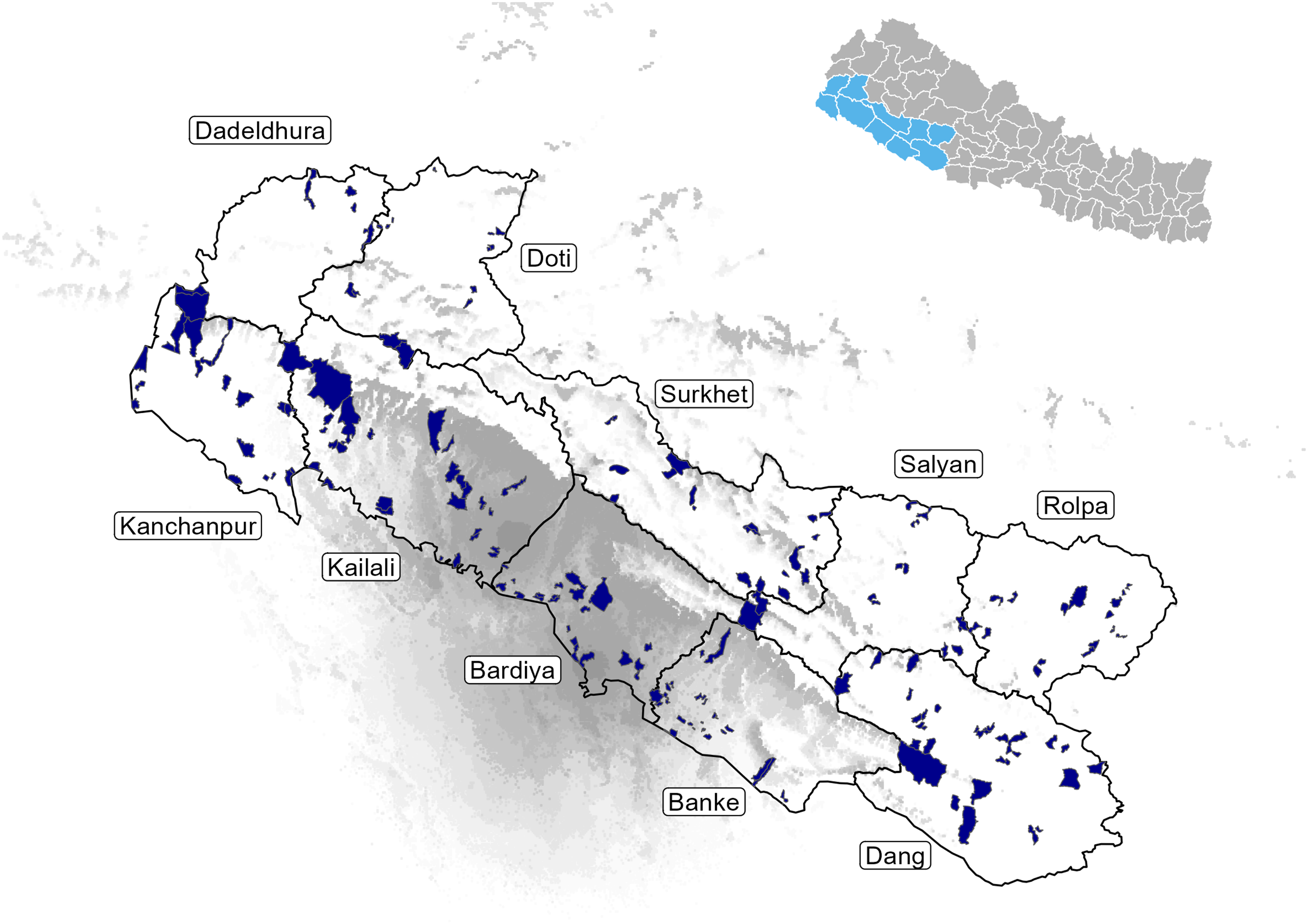
Sampled wards and Fulbari FM Radio signal strength level. Note: The large map visualizes the 10 southwestern districts of Nepal under study, with sampled wards highlighted. Shades of gray represent the signal strength of Fulbari FM Radio, as calculated by the Longley-Rice Irregular Terrain Model for the transmitters located in Gulariya (Bardiya) and Tikapur (Kailali), with darker shades corresponding to higher signal strength levels. The inset map situates the 10 districts within Nepal.
Our sample region poses several survey methodological challenges, including dispersed settlement patterns in partially rough terrain, different mother tongues, and variably hierarchical family structures. To minimize potential problems with hard-to-reach populations as well as non-response biases, together with experts from Sharecast Initiative Nepal we developed standardized guidelines for local enumerators in the field and provided them with intensive training. Upon arrival at a selected ward, the enumerators randomly selected individual households (random walk) and adult household members (selection based on last birthday) to prevent any over-representation of societal groups who are more likely to be at home during the day (e.g. owing to age, employment or gender). To avoid biased responses correlated with the respondents’ ethnic group or reservations regarding Nepalese authorities, all enumerators read out a standardized text at the beginning of each interview. The text explained that the survey was funded by the European Union, independent of the Nepalese government, and that the voluntary participation was subject to complete anonymity and confidentiality. Each respondent could choose to conduct the interview in Nepali or Tharu language.
Dependent variables
To test our hypotheses about the effects of radio reception on three aspects of peace, we rely on six binary indicators from our survey. We operationalize trust in the police with three indicators: Police contact: own negative consequences measures whether people believe that they would face negative consequences if they contacted the police for help after having been robbed. Police: safety provider indicates whether respondents rank the police among the top three most effective providers of safety out of 13 choices. 4 Police incites violence measures whether respondents see the police as instigating violence.
Two dependent variables measure respondents’ attitudes toward peaceful activism: Threat stability: distribute leaflets and Threat stability: peaceful protest indicate whether respondents perceive leaflet distribution and peaceful protests as a threat to political stability in Nepal. 5 Finally, we operationalize individuals’ view of future peace with the variable Heading toward peaceful times. It indicates whether respondents believe Nepal to be heading toward peaceful times (coded one if yes, and zero otherwise). 6 Table A.1.1 in Online Appendix A lists the question wording for our dependent variables and their binary coding.
Explanatory variables and identification
To identify the effect of radio broadcasts on attitudes, we combine our survey data with data on radio reception. We leverage variation in the coverage of Fulbari FM Radio, which is a function of radio transmitter features and topography. Radio Fulbari FM Radio aired its program from two transmitters. 7 In line with previous work (Armand et al., 2020; Adena et al., 2015; Della Vigna et al., 2014; Yanagizawa-Drott, 2014), we obtain the estimated signal strength from a Longley-Rice Irregular Terrain Model for radio propagation to construct a measure for radio reception from both transmitters. 8 Based on the estimated signal, we code a binary variable Signal received, indicating whether a respondent falls into the radio reception area or not. We construct different versions of this variable based on a range of cut-off values (70–90 dBm) to ensure that our findings are not sensitive to slight variations in the chosen cut-off value. 9
A precondition for our treatment to work is that respondents in our sample listen to the radio. At the time of our survey in 2018, Nepal had a vibrant radio landscape with over 700 FM radio stations and was the only country in South Asia that allowed private radio stations to broadcast news (Acharya, 2018: 7). For our sample of respondents, radio was by far the most common source of information, as shown in Figure 2. A survey from 2016 suggested that over half of Nepal's population listened to radio every day (Acharya, 2018: 7). It seems reasonable to assume that also prior to our survey, respondents were repeatedly exposed to discussions on the radio, including the highly popular and diverse program of Fulbari FM Radio. 10
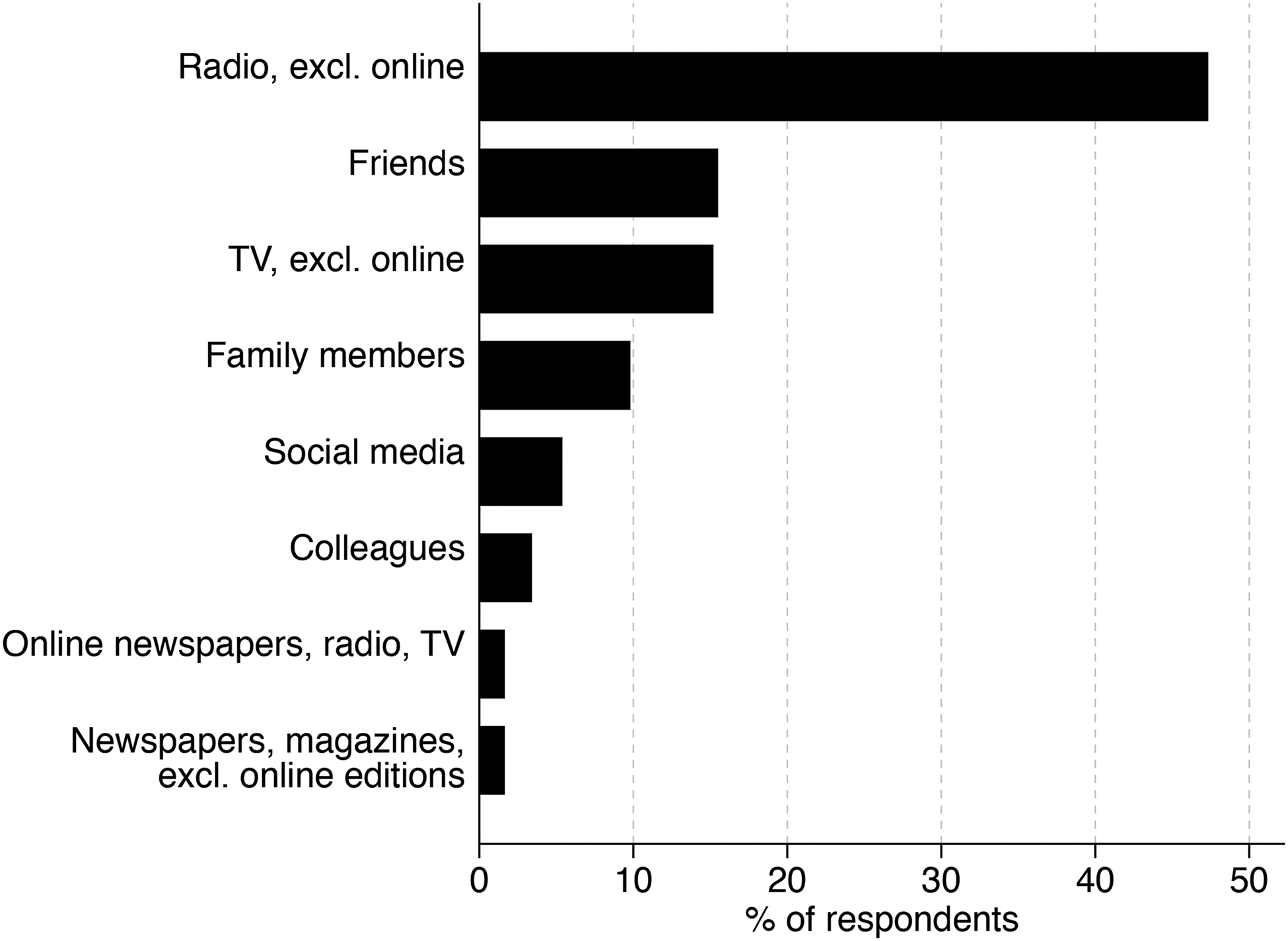
Main source of information.
As one of the first private radio stations in the region, which was owned by a popular and well-known actor, musician, and journalist, Fulbari FM Radio had a diverse program that included not just anti-government positions but also popular entertainment. Based on this profile, it probably had a broad audience and was not exclusively followed by one particular ethnic group. Yet respondents do not necessarily need to consume the messages themselves. Media's impact does not depend on direct consumption of the messages, because broadcasts also influence those who do not tune in themselves. Studies analyzing the contemporaneous impact of media on attitudes highlight that broadcasts affect polarization primarily indirectly by diffusion via social interactions (Bernini, 2023; Rigterink and Schomerus, 2017; Yanagizawa-Drott, 2014). They highlight that although people might purposefully avoid media they expect to represent views contrary to their own (Arceneaux et al., 2013), their attitudes and behaviors can still be affected by them (Della Vigna et al., 2014). Such indirect persuasion does not depend on direct media exposure (Bernini, 2023; Petrova and Yanagizawa-Drott, 2016). Building on these insights, we assume that Fulbari FM Radio, even after ceasing transmission, can shape the attitudes of those living within their previous signal reach, irrespective of whether they themselves listened to the channel.
Control variables
We control for a range of variables that might confound our results. To account for individual experiences of violence and potential direct exposure to the August 2015 violence that led to the closure of the radio station, we include the distance of the respondent's location from this violence in Tikapur (Distance to violent event) and a binary indicator for whether a respondent experienced physical violence during the war directly or indirectly (Physical harm).
We control for several sociodemographic respondent characteristics: self-identification as a member of the Tharu minority, Age in years, gender (Female), Education (10-point scale), a person's Interest in politics (binary indicator), their self-reported Own economic conditions (five-point scale, from very bad to very good) and their perceived economic well-being compared with the majority of people in Nepal (Relative well being worse, binary indicator coded to one if “worse”).
Finally, we measure individuals’ information consumption: General radio access indicates whether people have radio access in their household. The binary variables Main source information:
Estimation strategy
Since our dependent variables are binary indicators, we model the probability that a respondent agreed with the respective item question. We assume a binomial data generating process and use logit regressions in all models with the following specification:

Results
To get a first impression of the impact of Fulbari FM Radio on attitudes three years after its closure, Table 1 summarizes our results. The first column shows the respective statement of interest. The second column gives the percentage share of respondents who agreed with the respective statement among all interviewees living in areas that could receive Fulbari FM Radio. The third column shows the same percentages for respondents living outside the reception area. The final column indicates whether the difference in means is statistically significant.
Summary of main results.
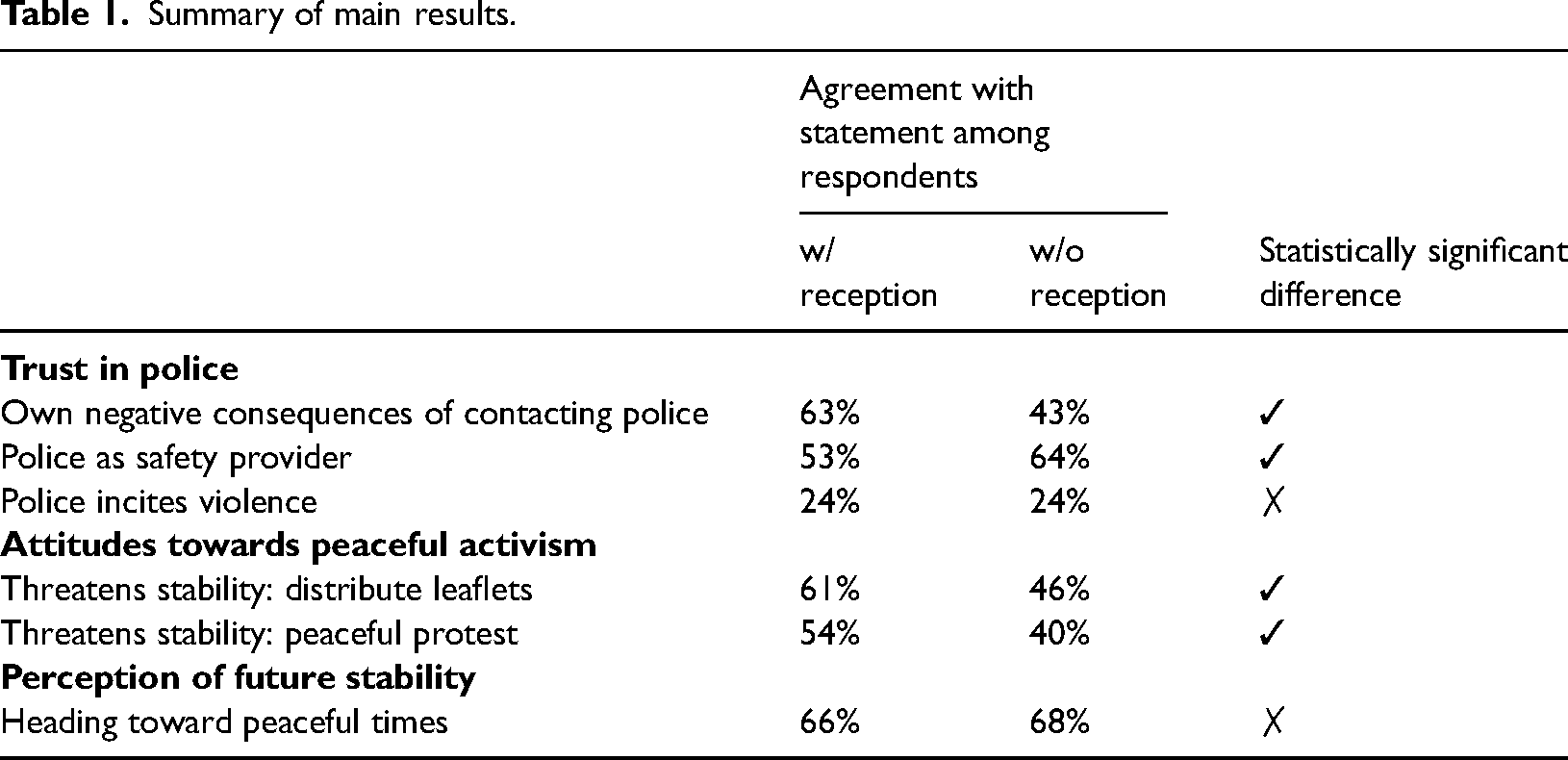
Fulbari FM Radio seems to have made a lasting impression on those within its broadcasting range. For most survey items, signal reception is linked to noticeable differences. A larger share of respondents within the broadcasting zone reports that they would be worried about negative consequences for themselves if they reported a robbery to the police and they are less likely to identify the police as an actor that contributes to their personal safety. A larger share of respondents with radio reception 3 years earlier is wary of political activism. We do not find a difference between our treatment and control groups in how they assess whether the police would incite violence or how they see the future trajectory of the country.
Trust in the police
In our multivariate analyses, we first test the impact of the radio signal on attitudes toward the police three years after its closure. Table 2 shows the statistical results from logistic regression models for three survey items. First, we ask whether respondents believed that reporting a robbery to the police would have negative consequences for those who had been attacked and reported the incident. Second, we ask whether respondents viewed the police as one of the main guarantors for their personal safety. The third question reflects the respondents’ assessment of the police as inciting violence.
Impact of radio reception on trust in the police.
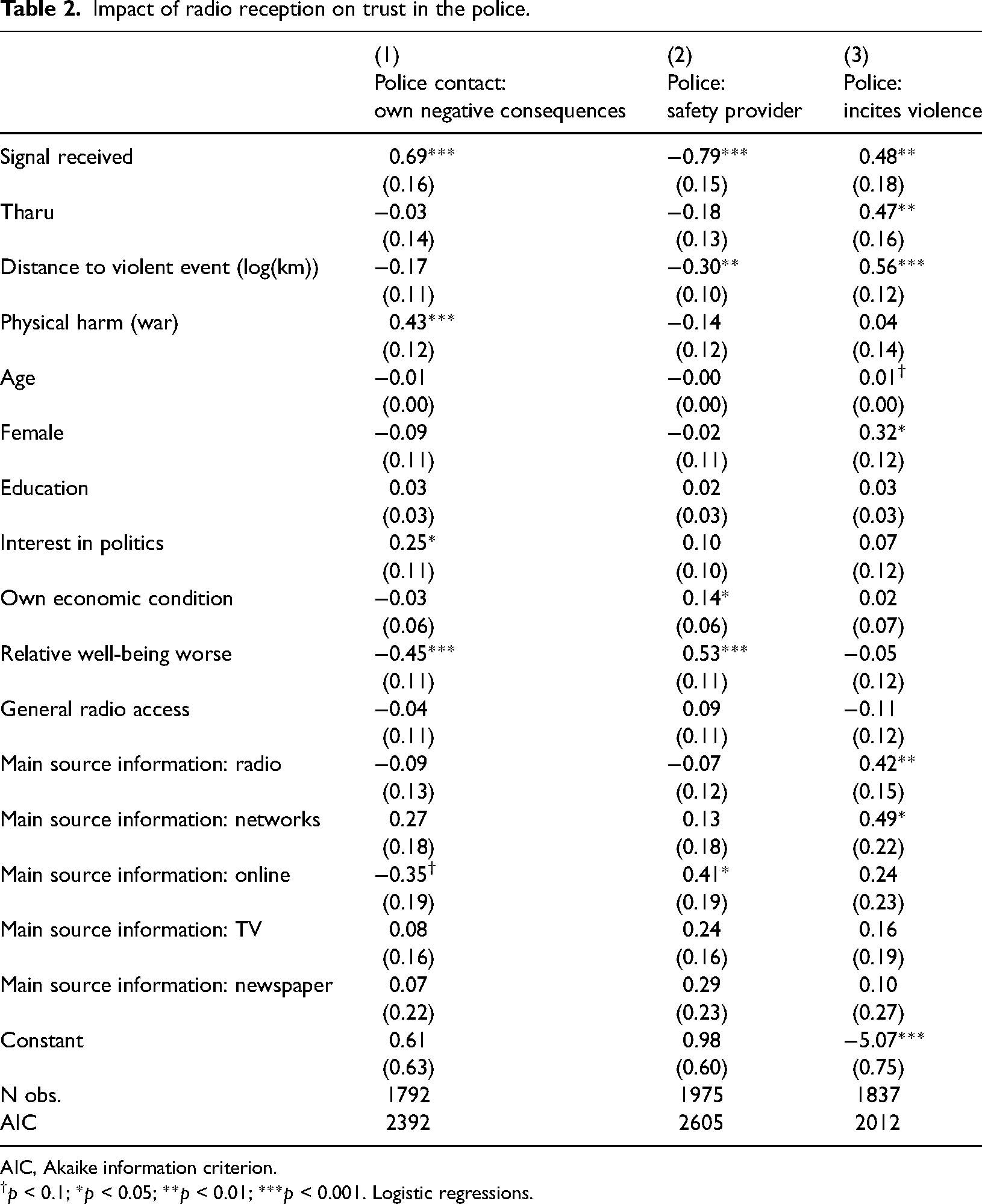
AIC, Akaike information criterion.
†p < 0.1; *p < 0.05; **p < 0.01; ***p < 0.001. Logistic regressions.
Across all models, those within the signal area display consistently more negative attitudes toward the police than those outside its range three years after transmission. 11 Those with reception 3 years earlier are more likely to fear negative consequences for reporting to the police that they had been a victim of crime, they are less likely to see the police as keeping them safe, and more likely to see the police as inciting violence. Anti-government radio seems to have made a lasting negative impression of key state agents. 12 Figure 3 plots the changes in the predicted probabilities and the 95% confidence intervals of our findings. Living within the broadcasting range of an anti-government radio station significantly reduced trust in the state's security forces three years after the closure of the station.
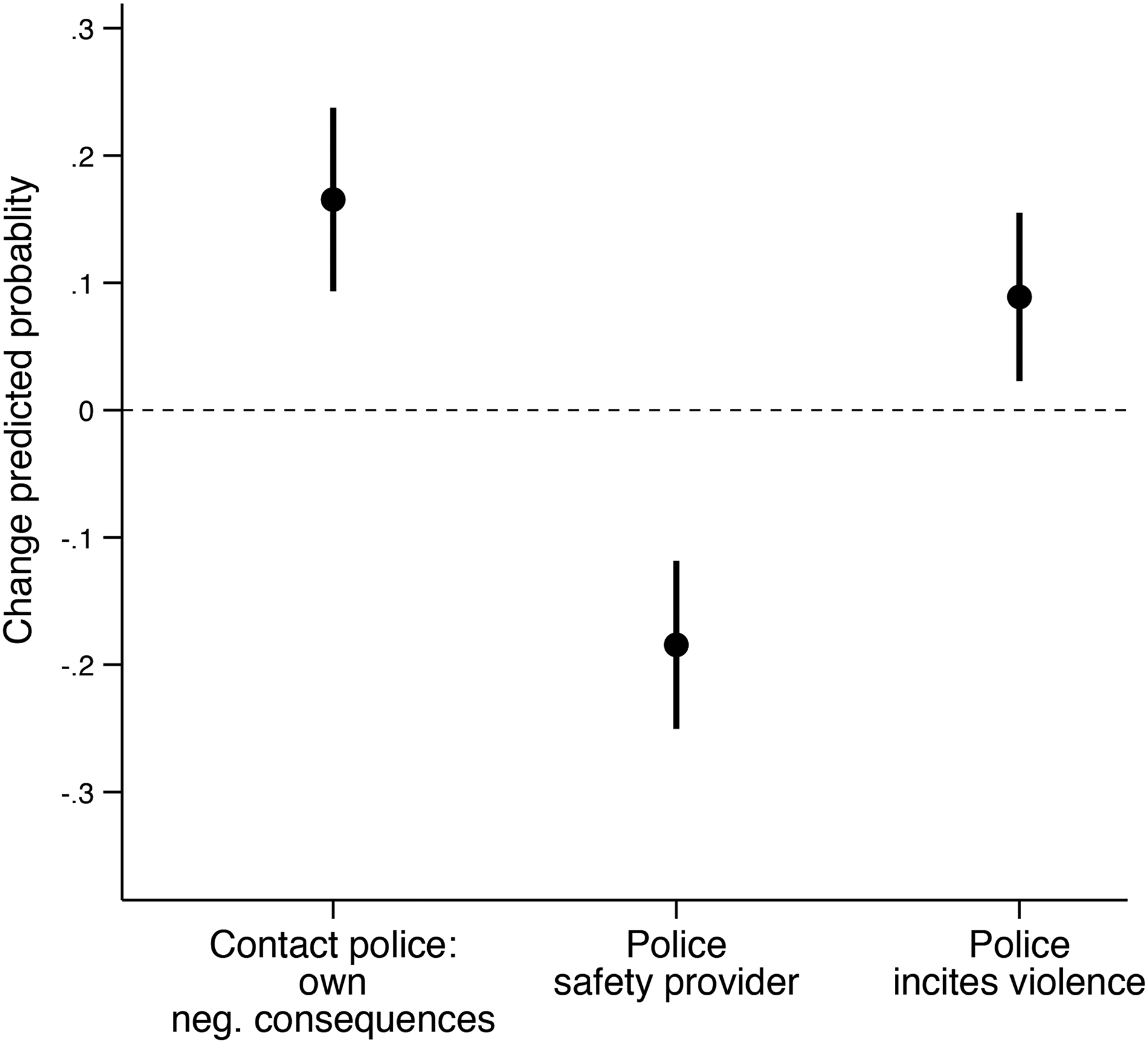
Effect of radio reception on trust in the police. Note: Plot shows the effect of radio reception on changes in the predicted probability that individuals agree to different items measuring trust in the police. Vertical lines indicate 95% confidence intervals. Calculations are based on models 1–3 in Table 2.
Perception of peaceful activism and future peace
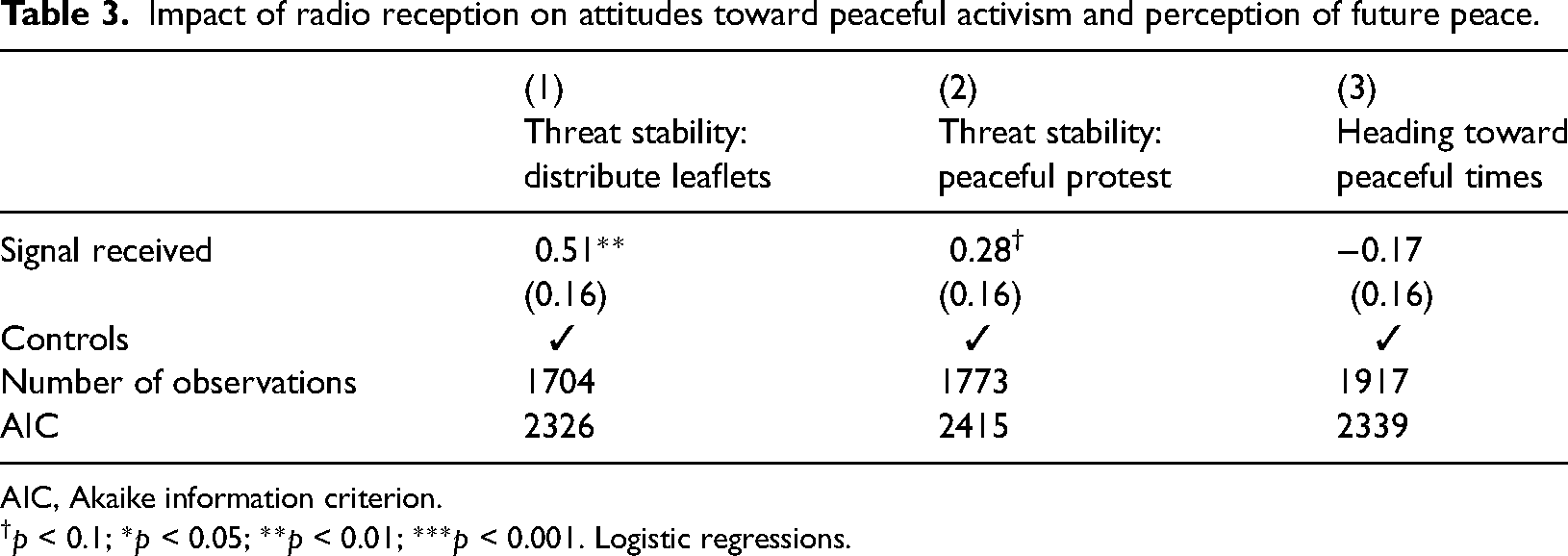
Table 3 shows the results of our main explanatory variable for estimating attitudes toward peaceful activism and future peace. 13 Those within Fulbari FM Radio's range three years earlier are more likely to view distributing leaflets as threatening stability. The pattern is less clear for peaceful protests. Figure 4 simulates the changes in predicted probabilities of having radio reception on attitudes toward peaceful activism and participation. Survey respondents in areas with previous access to Fulbari FM Radio are substantively more likely than respondents outside of the broadcasting area to see actions of non-violent political activism as detrimental to the country's stability. This difference is particularly pronounced for merely distributing leaflets, which people living within the broadcasting range consider especially problematic.
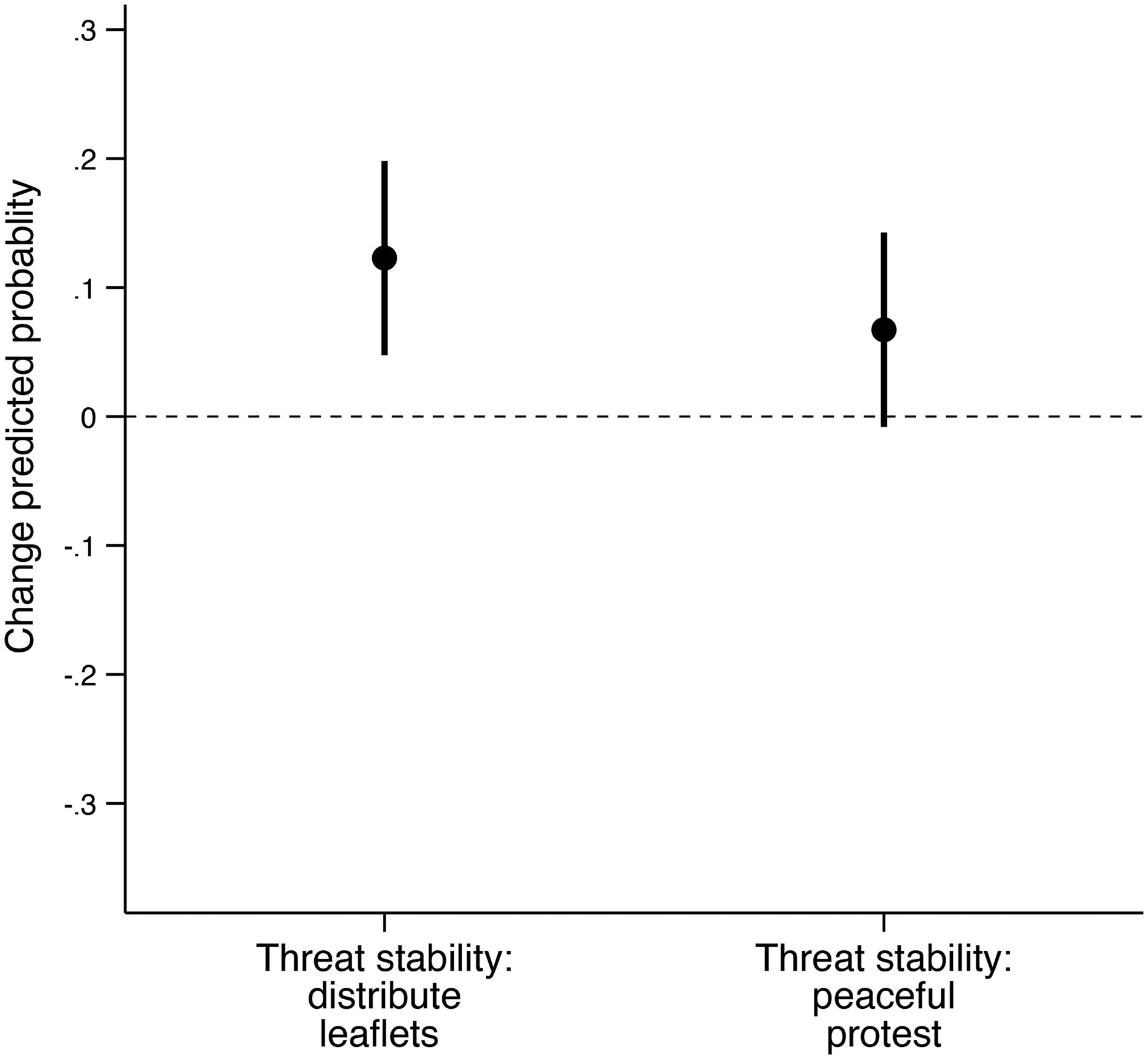
Effect of radio reception on attitudes toward peaceful activism. Note: Plot shows average marginal effect of radio reception on the likelihood that individuals agree to different items measuring attitudes toward peaceful activism. Dots represent first difference estimates; vertical lines indicate 95% confidence intervals. Calculations are based on Models 1 and 2 in Table 3. The cut-off value used to determine signal reception is 80 dBm.
Impact of radio reception on attitudes toward peaceful activism and perception of future peace.
AIC, Akaike information criterion.
†p < 0.1; *p < 0.05; **p < 0.01; ***p < 0.001. Logistic regressions.
The effect of the radio station on seeing peaceful protests as a threat to stability hints at a positive relationship, but is barely crossing conventional levels of statistical significance. Exposure to anti-government radio seems to have reduced people's confidence in the state's ability to accommodate participation in democratic opinion formation. This might make it difficult to consolidate democratic norms and tolerate participatory behaviors.
Finally, we test the impact of anti-government radio on people's outlook on future peace. The results are shown in Model 3 in Table 3. The coefficient for Signal received is negative but statistically insignificant. We do not find empirical support for our expected link between exposure to Fulbari FM Radio and heightened concerns about the country's prospects for peace. Respondents living in the former broadcasting area of Fulbari FM Radio were neither more nor less likely to believe that the country is heading toward peaceful times.
Robustness checks
We subject our findings to several robustness checks, using alternative specifications and plausibility tests. First, we rerun our analyses with only our key variable of interest Signal received (Tables A.3.1–A.3.6). Second, we repeat our main analyses for alternative versions of the treatment variable based on different cut-off values between 70 and 90 dBm (Figures A.5.1.1–A.5.1.5), testing whether our results are sensitive to the signal strength threshold of 80 dBm. Third, since the locations of radio stations are unlikely to be completely random, we conduct a placebo analysis to check whether our main results might be due to the continued broadcasting of another radio station from the same area (Table A.5.2.1). 14 This test allows us to determine whether the effects we observed are indeed attributable to people's access to Fulbari FM Radio programming. The placebo analyses using another nearby station's signal instead of Fulbari FM Radio's support that the main findings are indeed attributable to Fulbari FM Radio's broadcasts. Fourth, we conduct a series of additional placebo tests using randomly assigned signal strength levels to check whether our main findings can indeed be attributed to Fulbari FM Radio access (Figure A.5.3.1). Fifth, we use coarsened exact matching to reduce remaining imbalances between treatment and control groups (Section A.6).
Sixth, to account for potential differences between people from hill and plain regions, we add a measure for the altitude of the respondent's residency. The results from both tests remain substantively the same as shown in Tables A.3.1 and A.3.2. Seventh, we replicate our analyses using linear probability models (Tables A.3.3 and A.3.4). Eighth, we use fixed effects on the province level (Tables A.3.5 and A.3.6). Finally, we analyze sub-samples of individuals who did not relocate (Tables A.3.7 and A.3.8) and of those who did (Tables A.3.9 and A.3.10).
The results from all these additional tests lend extensive support to our main findings. Having received a highly popular entertainment and news broadcaster that was clearly associated with an anti-government stance is associated with lower trust in the police and greater concern about political activism three years after the radio station was closed. The differences between those within and outside the broadcasting range remain substantively meaningful. This is particularly noteworthy given the continued nationwide publicity of the violent clashes that took place in Tikapur in 2015, which terminated the radio station. The story remained in nationwide news because of the extent of the violence, the high-profile case of Resham Chaudhary as an elected fugitive, charged with a life sentence, and his continued electoral popularity. Since all respondents were probably exposed to these developments that occurred between the radio closure and our survey, our case poses a particularly challenging setting for finding a difference between those within and outside the broadcasting range of Fulbari FM Radio three years earlier.
A heterogeneous impact of radio reception on attitudes?
Fulbari FM Radio promoted the interests of the Tharu community and was owned by a highly prominent member and politician of this ethnic group. Members of the Tharu community were reportedly subject to excessive police violence during the August 2015 violence, including arbitrary arrest and torture, and Tharu property was destroyed by Akhanda protesters, while police forces watched from the sidelines (Amnesty International, 2016; Bibhas, 2019; Human Rights Watch, 2015, 2019). These violent events highlight the deep divisions between Tharu and non-Tharu communities and between the Tharu minority group and the police.
Research on the effect of media highlights that radio messages might have a heterogeneous impact owing to prior beliefs and attitudes (e.g. Della Vigna et al., 2014; Peisakhin and Rozenas, 2018; Taber and Lodge, 2006). Taber and Lodge's (2006) model of “motivated skepticism” suggests that individuals undertake greater efforts to discount information that is incompatible with their priors but seek out information in line with their preconceptions (confirmation bias). They find such information more convincing and trustworthy (prior attitude effect). These trends have been replicated in the context of political violence (Adena et al., 2015; Della Vigna et al., 2014; Yanagizawa-Drott, 2014). 15
Therefore, we explore the alternative argument that anti-government radio might have a different longer-term impact on those within its broadcasting range depending on whether they identify as members of the Tharu community. 16 To test for potential heterogeneous effects of radio reception, we interact the variable Signal received with the variable Tharu, which is coded one if a respondent self-reports to be a member of the ethnic group of Tharu and zero otherwise. 17 If radio messages about minority grievances and the channel's association with political violence lead to a pessimistic outlook also among non-minority group members, it supports the argument about the availability of information and agenda setting, where greater exposure leads to greater awareness, which triggers anxiety or discontent, even in people who do not directly experience these grievances (Strömberg, 2015; Tversky and Kahneman, 1973).
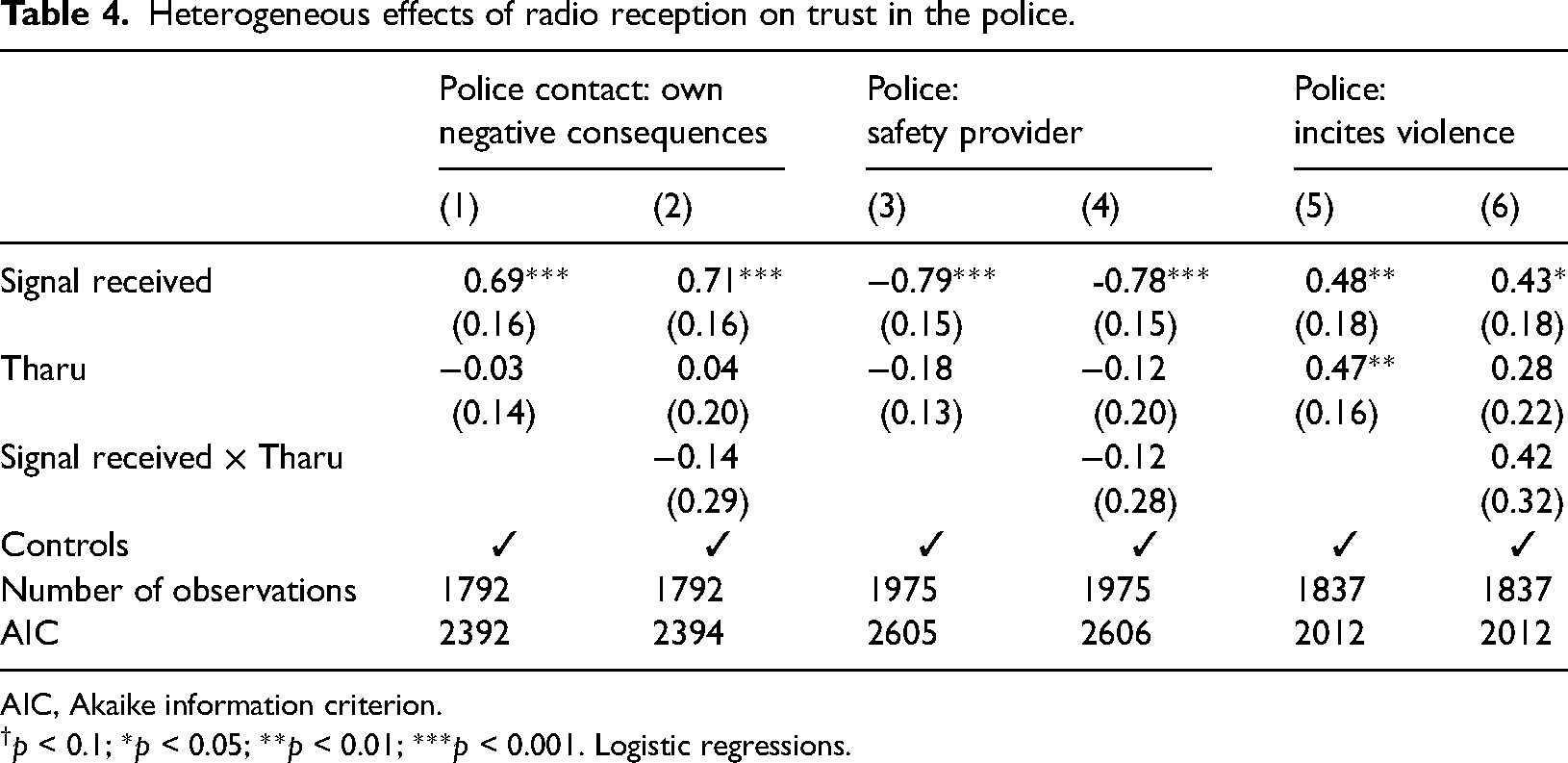
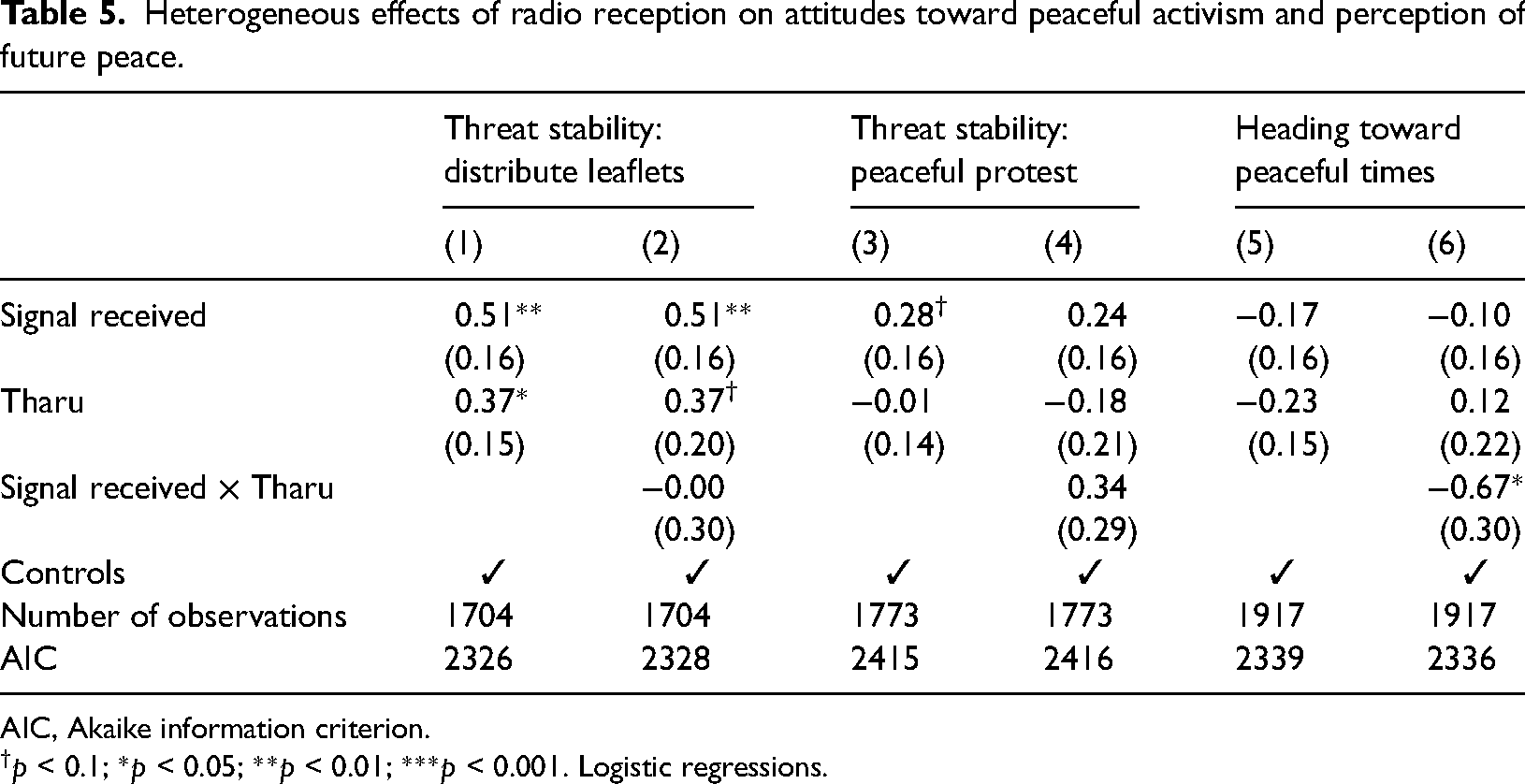
Table 4 includes the interaction results for our measures of trust in the police (see Table A.4.1 for controls). The effect of anti-government radio does not differ between Tharu and recipients belonging to other groups. Table 5 includes interaction results for attitudes toward peaceful activism and the perception of future stability (see Table A.4.2 for controls). Again, the effect of anti-government radio on political activism did not differ between Tharu and non-Tharu. Tharu respondents seem more concerned about the destabilizing impact of distributing leaflets than non-Tharu. However, among those within the radio's signaling range, Tharu did not respond differently than respondents from other groups, as the interaction term fails to reach statistical significance.
Heterogeneous effects of radio reception on trust in the police.
AIC, Akaike information criterion.
†p < 0.1; *p < 0.05; **p < 0.01; ***p < 0.001. Logistic regressions.
Heterogeneous effects of radio reception on attitudes toward peaceful activism and perception of future peace.
AIC, Akaike information criterion.
†p < 0.1; *p < 0.05; **p < 0.01; ***p < 0.001. Logistic regressions.
Table 5 shows the interaction effect for our measure of perception of future stability. While we found no overall effect of anti-government radio on respondents’ perception that Nepal is heading toward peaceful times, the interaction model suggests a more nuanced conclusion: Anti-government radio seems to have a lasting impact on the outlook on future peace in Nepal—but only for the Tharu group. For these respondents, anti-government radio reduced expectations that Nepal is heading toward a peaceful future, compared to members of other groups. Figure 5 plots this interaction effect over a range of different cut-off values for signal strength, noting the statistically significant difference between the effect for Tharu and others in the top right-hand corner.
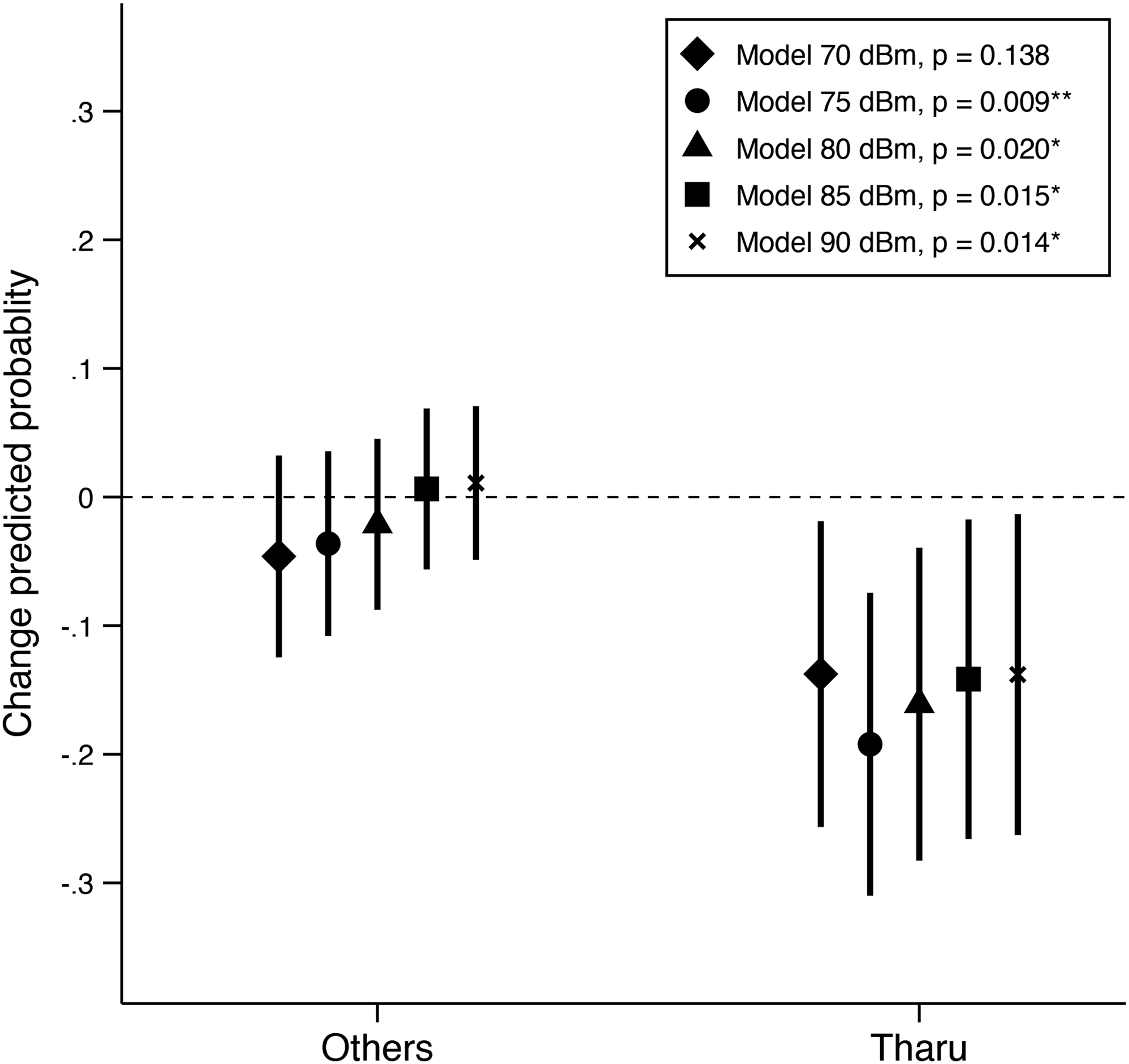
Effect of radio reception on belief that Nepal heads toward peace. Note: Plot shows average marginal effect of radio reception on the likelihood that a respondent perceives the country as heading toward peaceful times for range of different cut-off values for the signal strength. Dots, squares, diamonds and crosses represent first difference estimates; vertical lines indicate 95% confidence intervals; p-values indicate the statistical significance of the difference in effects. Calculations are based on models 70–90 dBm. Model 80 dBm can be found in Table 5. Table A.4.3 in the Appendix shows the models for the remaining cut-off values.
Our additional analyses suggest that Fulbari FM Radio had a persistent impact on those within its transmission range—primarily without a differential effect on members of the Tharu minority group. Its anti-government stance, including its opposition to the government proposed constitution at the time, appears to have had a lasting negative impact on how people from different backgrounds view the police and whether they perceive political activism as precarious behavior. Assessments of future peace might be more sensitive to being shaped by confirmation bias than current evaluations.
Conclusion
Our study has shown that an anti-government radio station affected attitudes toward the police, toward peaceful activism, and perceived future peace three years after its closure. This effect is independent of the distance to highly publicized violent events that were linked to the radio's message and its closure. The reduced trust in the police of those who were previously within the anti-government's radio broadcasting range raises important questions about lingering effects of media on attitudes toward state institutions and their perceived legitimacy. Since the radio station was associated with anti-government protests and minority grievances, we expected that those within its range would become more suspicious of peaceful activism and its impact on political stability. Our results supported our expectations, although only distribution of leaflets and not peaceful protests were seen as destabilizing by those within the radio's former broadcasting range.
Notably, our results show that exposure to anti-government radio did not generate a rally-round-the-flag effect around protesters or shift attitudes in favor of political activism. Instead, exposure to anti-government radio, which was linked to political unrest, heightened sensitivity toward the escalatory potential of both police operations and political activism in the longer term.
This heightened concern about police or political activism was shared by all people who lived within the transmission area three years earlier. Our results showed that Fulbari FM Radio had a homogeneous impact on attitudes toward police and political activism and that its longer-term effect was not restricted to those who might have been aligned with the radio's anti-government views. Our results lend further support to “a general theme from empirical and theoretical work on persuasion […] that persuasion is really hard” (Little, 2018: 50). Instead of polarizing communities that have different attitudes toward the government and that belong to different ethnic groups, anti-government radio in the western part of the Terai region in Nepal left a lasting wariness of political activity on either side of the spectrum—on the side of the government represented by the police and on the side of the opposition represented by those engaged in political activism—by raising concern about its escalatory and destabilizing potential in an already volatile postwar context.
Fulbari FM Radio had a clearly different impact on the Tharu minority and non-Tharu with respect to whether people thought that the country would head toward peaceful times or political instability. Previous radio reception made respondents more wary about where the country was heading—but this only applied to members of the disadvantaged Tharu group. The radio station seems to have resonated with preexisting concerns of this community and exacerbated the negative outlook for the future even after the end of transmission. Future work might want to explore under which conditions and contexts prior experience and preferences moderate the link between media and attitudes.
We have shown that in a volatile post-conflict environment, media can have a lasting impact on attitudes toward basic building blocks of a functioning democratic system. Beyond a contemporaneous impact, which has been the main focus in the literature, anti-government radio can have a lasting influence. Our study highlights that beyond the ability to further polarize and mobilize (Bernini, 2023; Yanagizawa-Drott, 2014), radio can have an enduring influence beyond its actual transmission and shape attitudes for years to come. Yet censorship is not the solution. In a volatile post-conflict context that provides little space for opposition groups to voice dissent and to effectively participate in the political process, the population and political authorities need to get accustomed to oppositional voices as an essential element of the democratic process. Political leaders should make offers to engage in conversations and build trust in institutionalized mechanisms for peaceful democratic conflict resolution and ensuring sustainable progress.
Our study was motivated by understanding the role of media in affecting or aggravating insecurity in postwar societies. We provided new insights into media's longer term impact on quality peace as a multidimensional concept, comprising security, participation as an element of dignity and predictability (Wallensteen, 2015). Future studies might investigate whether our findings transcend fragile postwar contexts. Highly polarized societies without a recent armed conflict may be similarly susceptible to inflammatory media's impact on the basic elements of a democratic system, such as trust in security institutions and citizen participation—long after the messaging stops.
Supplemental Material
sj-pdf-1-cmp-10.1177_07388942241267816 - Supplemental material for Media impact on perceptions in postwar societies: Insights from Nepal
Supplemental material, sj-pdf-1-cmp-10.1177_07388942241267816 for Media impact on perceptions in postwar societies: Insights from Nepal by Sabine C Carey, Christian Gläßel and Katrin Paula in Conflict Management and Peace Science
Footnotes
Acknowledgements
The authors are particularly grateful to Smriti Kafle for her invaluable input and to Madhu Acharya, Bhumiraj Chapagain, and their team from Sharecast Initiative Nepal for their professional support. They thank Subindra Bugati, David Davis, Gabrielle Levy, Kelly Morrison, Jessie Trudeau, and the Hamburg Empirical Political Science seminar series for helpful feedback.
Funding
The authors disclosed receipt of the following financial support for the research, authorship, and/or publication of this article: This work was supported by the FP7 Ideas: European Research Council, (grant number ERC-StG 336019).

Supplemental material
Supplemental materials for this article are available online.
Notes
References
Supplementary Material
Please find the following supplemental material available below.
For Open Access articles published under a Creative Commons License, all supplemental material carries the same license as the article it is associated with.
For non-Open Access articles published, all supplemental material carries a non-exclusive license, and permission requests for re-use of supplemental material or any part of supplemental material shall be sent directly to the copyright owner as specified in the copyright notice associated with the article.
