



Abstract
This paper explores the attitudes of expatriate workers towards the future of migration to the Arab Gulf states. We conduct an online survey and framing experiment administered to more than 2900 expatriate workers in Kuwait and Qatar. We find that Arab migrants are less supportive of future migration than other migrants and also exhibit high levels of ethnic-group bias in favor of fellow Arabs. Evidence from the framing experiment suggests that Arab migrants disfavor Indian workers, even though workers from South Asia are less likely to pose competition for jobs. Our findings provide empirical evidence for ethnic boundary policing within the migrant community and speak to the conditions that encourage anti-migrant sentiment and in-group favoritism among Arab expatriate workers in the Gulf region.
Introduction
There are estimated to be almost 30 million migrants working in the Arab Gulf states in what is one of the largest transnational migration flows in the world (e.g., Gardner et al., 2013; Hvidt 2019). These workers occupy a variety of fields from low-skilled construction and service sector workers to highly skilled professionals, including doctors, engineers, accountants, and educators. Beyond the occupational distinctions among migrant workers, there are also differences in ethnic identity that shape the political, economic, and social landscape of Arab Gulf societies. Despite the ubiquity of foreign workers in Arab Gulf societies, we know relatively little about their attitudes toward future migration or the biases that these individuals may hold toward their fellow migrants. Such knowledge is important because—although migration policy is set by national governments—migrants are often in a position to recommend the hiring of other foreign workers while simultaneously contributing to a generalized environment toward migration. Indeed, migrants in the Gulf are thought to favor the hiring of co-nationals in worker recruitment processes over which they can exert significant control. 1
A substantial literature has sought to document and explain anti-migrant sentiment among Gulf citizens (e.g., Diop et al., 2012, 2015; York 2022), but to our knowledge no study has examined attitudes toward migration among expatriate workers in the Arab Gulf context. Using data from an original, online survey and framing experiment, we report on the attitudes of more than 2900 foreigners working in Kuwait and Qatar, oil-rich Arab Gulf states that are deeply dependent on migrant labor. The vast majority of the foreign workers (almost 93%) in our sample are from other Arab countries.
Respondents were asked if they would like to see the number of foreign workers in their host country (i.e., Kuwait or Qatar) increase, decrease, or stay about the same. On the whole, migrants would like to see the total number of expatriate workers stay about the same. There exists variation, however, across different demographic and economic groups with regard to their attitudes. In general, Arab migrants are less supportive of future migration than other expatriate workers and migrant workers in Kuwait hope to see less future migration than those in Qatar. We further find that migrants with a more favorable “passport index” (i.e., one that offers visa-free access to more countries) and those with higher levels of education are more supportive of future migration, while older and female migrants who are generally less supportive of future migration. These findings map on to recent research that suggests migrants with better outside options develop different attitudes toward the migration experience than those with less bargaining power (Ewers et al., 2021).
Respondents also participated in a framing experiment in which they were asked to consider how highly they would prioritize foreign workers with different occupational and identity attributes. Our results suggest that Arab migrants are strongly influenced by the identity characteristics of their fellow migrants. In particular, Arab migrants are generally opposed to prioritization of migration by Indian expatriate workers—regardless of the worker’s professional class. Our ability to precisely identify patterns for other groups of foreign workers is limited by our smaller sample size of non-Arab migrants.
By drawing attention to identity-based biases among Arab migrants to the Gulf states, these findings complement recent work on forms of boundary policing and gate-keeping among expatriate workers in that region (Ewers et al., 2021; Lori 2021, 2022). Although Arab migrants are not more likely than South Asians to be accepted by nationals as fellow citizens (Shockley and Gengler 2023), migrants experience their time as expatriates differentially depending on their background, including their linguistic and cultural proximity to Gulf citizenries (Ewers et al., 2021). Arab migrants—seeking to anchor their relationship to the host population—appear to be increasing the social distance between themselves and non-Arab migrant populations, despite the existence of common economic and social challenges faced by all foreign workers in the Arab Gulf region. These findings relate to the ways that acceptance of migrant communities reflect complex, multi-group dynamics (e.g., Fouka et al., 2021) and a wider literature concerning the conditions supporting anti-migrant sentiment and prejudice toward migrants (e.g., Hainmueller and Hangartner 2013; Hainmueller and Hopkins 2014; Dancygier and Laitin 2014; Alrababa’h et al., 2021).
Identity and labor market dynamics
Kuwait and Qatar share a number of important similarities, and scholars have long examined these cases comparatively within the field of Middle Eastern studies (e.g., Crystal, 1990). One important source of commonality is that both countries have highly stratified labor markets, with heavy reliance on expatriate labor at virtually all skill levels within the domestic economy. Foreigners account for a large percentage of the total population across the Arab Gulf region, making up an estimated 70% of the population in Kuwait and 88% in Qatar (Gulf Labour Markets and Migration 2020).
Existing research on migrants to Arab Gulf labor markets has largely focused on one of two subjects. A first stream of research has sought to describe the working conditions of migrants in a variety of fields, from construction to domestic labor (e.g., Blaydes, 2023; Gardner et al., 2013; Sarmadi, 2013; Seshan, 2012). A second stream within the literature has examined attitudes toward foreign workers on the part of nationals (i.e., citizens) within Arab Gulf societies. Some of the most important work on attitudes toward foreigners in the Arab Gulf states has focused on Qatar. Like all Gulf states, Qatar is a hierarchical and segregated society where citizenship, class, and ethnicity interact to create a complex system of privilege and exclusion (Schielke 2020, 37). Diop et al. (2012) show that Qataris are relatively indifferent between high and low-skilled migrants, but showed a preference towards high-skilled workers. 2 Other studies have suggested that Qataris are not indifferent to the choice between white and blue collar workers. For example, York (2022) conducts mediation analysis which suggests a diverse set of concerns leading to dislike for particular types of migrants, especially on the part of Qataris who may see migrants as job market competitors.
Although a rich and growing literature considers the conditions of migrant workers and attitudes of Gulf nationals toward those workers, we know relatively little about the preferences of foreign workers themselves regarding questions of migration. To what extent do migrants identify and support the economic aspirations of their fellow migrants? And how is support for migration conditioned on the class status or ethnic identity of other foreign workers? Social identity theory would suggest that individuals identify with groups which differ from each other in terms of their status (e.g., Tajfel and Turner 1979; Shayo 2009, 2020). In the Gulf context, Arab migrants share their ethnic identity with high-status Arab Gulf citizens, while they share their migrant status with expatriate workers from around the world. This paper seeks to characterize the preferences of expatriate workers toward migrants of different ethnic identities versus those with whom they share a common economic and citizenship designation.
Empirical strategy
To understand more about the preferences of Gulf migrants, we recruited over 2100 expatriate workers in Qatar and an additional 800 in Kuwait to participate in an online survey. 3 The survey was administered in November and December 2020 with recruitment completed in January 2021. This period of time was one of considerable uncertainty regarding the future of migration and economic growth in the Gulf region as a result of the COVID-19 pandemic.
Participants were recruited through English and Arabic-language advertisements posted to three widely used social media platforms: Facebook, Instagram, and Twitter. The vast majority of individuals who agreed to participate in our survey were Arabs who originated from outside of the Arab Gulf region. 93% of the respondents in this sample are from Arab countries. The remaining 7% of the sample were nationals from Asia (including East, South, and West Asia) and Western countries with smaller numbers from sub-Saharan Africa. This does not reflect the distribution of foreign workers in Kuwait and Qatar, but likely an artifact of two factors related to our online recruitment methods. First, we only recruited respondents in Arabic and English, rather than with a larger number of world languages. Second, our recruitment strategy depended on social media penetration where Arab countries typically have higher levels of social media usage compared to other developing countries.
Descriptive Statistics.

aThe education level scale spans 1 to 9, with 1 indicating no formal schooling, and 9 representing a doctorate degree. Intermediate values denote stages from primary (2), preparatory (3), secondary (4), post-secondary vocational (5), associate’s degree (6), bachelor’s degree (7), to master’s degree (8).
bIndex ranges from 1 (most powerful) to 104 (least powerful). In the regression analysis, we reverse this scale for ease of interpretation.
cRanges from “1” (decrease a lot) to “5” (increase a lot).
All survey respondents were asked the following question: “After the Coronavirus pandemic, would you like to see the number of foreign workers in Qatar (Kuwait) increase, decrease, or stay about the same?” Respondents answered using the scale: “increase a lot,” “increase somewhat,” “stay about the same,” “decrease somewhat,” or “decrease a lot.” This question is used to gauge the respondent’s generalized disposition toward future migration in their host country.
Respondents also participated in a framing experiment in which they were asked, “If Qatar (Kuwait) were thinking about changing the number of foreign workers in Qatar (Kuwait), what level of priority would you give to [Arab/Indian] [doctors/construction workers]?” The final two elements of the profile were randomly assigned; the task was repeated twice and programming prevented duplicate profiles. Respondents assigned each randomly generated profile “very high priority,” “somewhat high priority,” “somewhat low priority,” or “very low priority” as a candidate for future migration. Our use of a framing experiment is consistent with scholarship which suggests that attitudes toward migration are likely to be conditional, based at least in part on migrant attributes such as national origin and skill level (Hainmueller and Hangartner 2013). 5
Each element of the migrant profile speaks to a politically salient cleavage in the Arab Gulf context. For example, the division between Arabs and non-Arabs is a long-standing social cleavage with historical roots in both Kuwait and Qatar. Although Persians, Turks, and Indians (among other groups) have lived alongside Arabs in the cosmopolitan cities of the Gulf region, political leadership and social status has been dominated by the Arabs citizens of the region. As a result, Arab migrants to the Gulf region may prefer to identify as Arabs “first” rather than based on their migration status.
The second dimension of the framing experiment seeks to tap into differential preferences for high versus low-skilled labor. We have chosen to use doctors as our example of high-skilled labor with the goal of eliciting variation in the support for different types of migrants. Because the survey was fielded in the context of COVID-19 pandemic, one might expect high levels of support for expatriate workers with expertise in medicine.
The experiment also considers support for increasing the number of Arab versus Indian construction workers in each country. Although the percentage of Arab construction workers has declined over time relative to workers from South Asia, programs continue to train construction workers in countries like Egypt in preparation for participation in the Gulf construction sector. 6 In addition, Sudanese nationals are reported to participate in the Gulf construction sector and about a third of economically active Syrians in Qatar in 2015 worked in manual occupations. 7 India continues to be one of the largest sending countries to the construction sectors of Kuwait and Qatar. 8
We view our empirical approach as enjoying some unique advantages. First, the data that we have collected helps us to understand more about an under-studied migrant population—expatriate workers in the Arab Gulf context. The relatively large sample size in our study—especially for the Arab respondents in our sample—assists in the confidence we have in our findings. Second, our use of an online survey reduces the likelihood of social desirability bias when asking respondents about the future of migration. In addition, the timing of the survey permits us to explore attitudes to migration at a critical juncture—in the midst of the COVID-19 pandemic. Third, our use of a framing experiment allows us to disaggregate the effects of skill and ethnic identity on attitudes toward migration priorities. We have tailored the experimental conditions to speak to salient cleavages in the Arab Gulf context.
Results
Support for Increasing the Number of Foreign Workers.
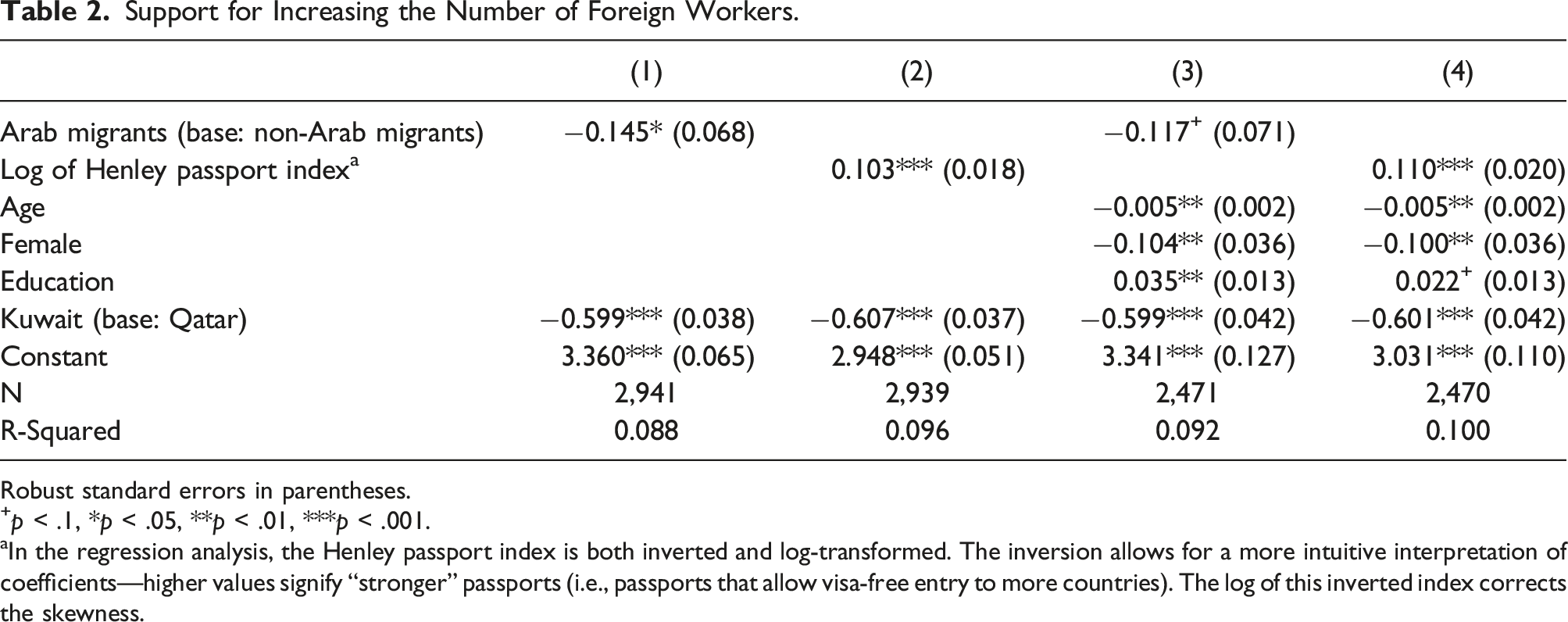
Robust standard errors in parentheses.
+p < .1, *p < .05, **p < .01, ***p < .001.
aIn the regression analysis, the Henley passport index is both inverted and log-transformed. The inversion allows for a more intuitive interpretation of coefficients—higher values signify “stronger” passports (i.e., passports that allow visa-free entry to more countries). The log of this inverted index corrects the skewness.
In Column 2, we use the migrant’s national origin to determine the relative “strength” of their passport (i.e., the ability to engage in visa-free travel to more destinations as measured by the Henley passport index) as an explanatory variable to the baseline regression in Column 1. This strategy allows us to build on research that suggests that migrants enjoy both economic bargaining power associated with their passport and their ability to leverage local cultural and social capital to reduce distance between themselves and the host population (Ewers et al., 2021). We find that migrants from countries with more favorable passports possessed more positive generalized attitudes toward migration. Inclusion of demographic covariates suggest that support for migration is strongest among younger, male, and better educated migrants. 9 As suggested in Ewers et al. (2021), these may be the migrants that enjoy the best economic outside option in a globalized labor market.
Next, we analyze the results of the framing experiment which allows us to identify migrant prioritization of future migrants, conditional on different skill and identity profiles. Given the random assignment of treatment conditions in the experiment, we estimate our second outcome variable—high priority assigned to a migrant profile—solely as a function of the two profile attributes of ethnic identity and occupation, our proxy for skill level. The results of the framing experiment are visualized in Figure 1. Migrant worker prioritization among Arab and non-Arab migrants.
We find that Arab expatriates exhibit a strong co-ethnic bias, preferring low-skill Arab immigrants to high-skill Indian migrants. More exactly, whereas Arab expatriates are an estimated 60% likely to assign the highest priority to Arab doctors, and 33% likely to prioritize Arab construction workers, this likelihood drops to a mere 7% for Indian doctors and 10% for Indian construction workers. These differences are substantively large and precisely measured. Non-Arab expatriates also show a bias for Arab over Indian doctors, but they do not differentially prioritize low-skill workers based on national origin, and the magnitude of bias (35% likelihood vs 16%) is relatively modest. These effects are also less precisely estimated given our smaller sample size of non-Arab migrants.
Figure 2 relates the attitudes toward the future of migration with the probability that a respondent support a high prioritization for different migrant profiles in the framing experiment. For Arab migrants who would like to see future migration decrease “a lot” still exhibited relatively high prioritization for Arab doctors and (to a lesser extent) Arab construction workers. Interestingly, as general disposition toward migration becomes more favorable, support for Indian workers—regardless of skill level—does not meaningfully increase.
10
Support for migration and migrant worker prioritization among Arab migrants.
What explains these results? A standard explanation might suggest that Arab migrants are particularly concerned about labor market competition and, as a result, seek to stem other migrants that might displace them in the future. The fact that Arab migrants are particularly biased against Indian workers—rather than fellow Arabs who are more likely to pose labor market competition for them—works against this interpretation. In addition, if fear of labor market competition were a major concern, we might expect that high and low-skilled Arab migrants would have different preferences over which workers to prioritize for future migration. Disaggregation of the experimental results by education, however, does not reveal differential levels of bias against non-coethnics. Arab expatriates possessing a higher educational level are equally likely to (de)prioritize Indian doctors when compared to Arab residents of objectively lower educational status. 11
A second possible explanation is that Arab expatriate workers are influenced by forms of ethnic boundary policing and anti-immigrant sentiment common within local Kuwaiti or Qatari society and politics. For example, negative rhetoric toward migrants tended to be more common in Kuwait relative to Qatar during this time period as Qatar prepared to host the 2022 World Cup and was highly reliant on foreign workers in the run-up to that event. If local elite rhetoric opposed to Arab migration led migrants to “circle the wagons” in support of fellow co-ethnics, we might expect to observe more co-ethnic bias in Kuwait than Qatar. If we analyze the framing experiment results for Kuwait and Qatar separately, however, we observe bias patterns that are highly similar. 12 As a result, causal mechanisms consistent with country-level differences in bias patterns are not supported by the data.
A remaining explanation consistent with our empirical evidence suggests the existence of straightforward co-ethnic bias on the part of Arab expatriate workers toward fellow Arabs. Even though Arab expatriates would likely find other Arab expatriates their closest substitutes, there is stronger support for their future migration compared to migration of Indian nationals. Our results suggest that within migrant populations, cultural considerations can trump economic ones when developing economic policy preferences (Margalit 2012; Hainmueller and Hopkins 2014; Dancygier and Laitin 2014).
Our results also relate to existing work on how one disadvantaged minority group may seek to become better integrated in local society as a second, more culturally or ethnically distant group arrives. 13 In the Arab Gulf context, workers from fellow Arab countries have long enjoyed an important role in local economies while South Asian migrants have become more numerous in recent decades. Scholars engaged in ethnographic fieldwork in the Gulf find that in such contexts, migrant groups sometimes act as antagonistic ethnic “blocs” (Schielke 2020, 23). Longva (1997, 231) reports that because Arab expatriate communities in Kuwait are culturally “closer” to locals than other migrants, they tend to replicate the exclusionary attitudes and behaviors of Kuwaiti nationals. Indeed, Arab migrants to the Gulf may prefer to emphasize their Arab—rather than their class-based—identity as a way of minimizing the social distance between themselves and the high-status citizens of Kuwait and Qatar.
Most generally, our results point to the importance of nonmaterial factors as determinants of social identification, including the importance of national identity (e.g., Kalin and Sambanis 2018, 248; Shockley and Gengler 2020; Alrababa’h et al., 2021). Although Arab migrants expect to enjoy future benefits from relatively open migration policies, the desire to erect social distinctions based on Arab identification shared with high-status locals suggests an interest in maintaining social hierarchies based on descent criteria (Ewers et al., 2021; Lori 2021, 2022). 14
Discussion
Skilled and unskilled migrant labor underpins the economies of Middle Eastern oil producers. A substantial literature has documented anti-immigrant attitudes among Arab Gulf citizens, many of whom view a globalized labor force as a threat to cultural identity, personal economic prosperity, and—since the COVID-19 pandemic—even public health. This paper considers a different case—the preferences toward foreign labor by Gulf expatriates themselves. Our findings allow us to make connections between migration, class, and identity in the context of a deeply segmented labor market.
We find that Arab migrants exhibit less support for future migration than non-Arabs and that migrants in Kuwait are less supportive than those in Qatar. Individuals that come from countries with a more favorable “passport index” as well as younger, male, and educated migrants are all more favorably inclined toward future migration. Results from a framing experiment designed to disentangle the relevance of skill from ethnic identity when determining priorities for future migration show that Arab expatriates exhibit high levels of co-ethnic bias in favor of fellow Arabs, regardless of a prospective migrant’s skill level.
What is at stake with these findings? Bias against fellow migrants poses a puzzle because anti-immigrant sentiment may damage the future status, and associated economic payoffs, of existing migrants. Anti-migrant sentiment also has the potential to damage the region’s historically open migration policies which have had the net effect of benefiting migrants from a wide variety of countries. Indeed, the Arab Gulf states account for some of the highest levels of annual remittances globally (McAuliffe and Khadria 2020), and Weyl (2018) has suggested that migration to the Arab Gulf countries has massively reduced forms of global economic inequality. As a result, the future of migration to the Arab Gulf states has wide-ranging political, social, and economic implications (Clemens 2011).
Footnotes
Declaration of conflicting interests
The author(s) declared no potential conflicts of interest with respect to the research, authorship, and/or publication of this article.
Funding
The author(s) disclosed receipt of the following financial support for the research, authorship, and/or publication of this article: This study is supported by Social and Economic Survey Research Institute, Qatar University
