




Abstract
Although judicial elections are considered a method of keeping state courts—otherwise insulated from public pressure—accountable, the private financing of judicial campaigns has been met with significant criticism. In particular, the perception that campaign contributions can buy favorable case outcomes for contributors to judicial candidates may pose problems for judicial legitimacy. While some scholars and advocacy groups have advanced proposals which seek to eliminate private financing from judicial elections, research has yet to demonstrate a link between the public’s evaluations of a court’s legitimacy and the campaign financing system the state employs. In this paper, we present the results of a survey experiment that examines the public’s evaluations of judicial legitimacy under different campaign financing schemes. We find evidence supportive of our core hypothesis: respondents viewed courts with publicly financed elections as more legitimate than those with privately financed elections. This study helps to reinforce the viability of public financing by empirically demonstrating that the public views a state supreme court elected using the public financing model as more legitimate and less susceptible to donor pressure than one selected using privately financed models.
Scholarship does not consistently find that private funding of campaigns in judicial contests shapes judges’ behavior (Bonneau and Cann 2009; Cann, 2002, 2007; Cann et al. 2012; McCall 2003; Ware 1999). In spite of this, evidence offered by researchers and advocates alike suggests that the public views courts as more corruptible and less legitimate when judges privately finance their campaigns (Cann and Yates 2008; Gibson 2008; 2009; “Report” 2002). While studies have examined public financing’s effects on legislative elections, relatively little work has been conducted on judicial elections. Of these works, none have focused on judicial legitimacy. We contend that this is a relationship worthy of further investigation given that a considerable percentage of the general public holds the view that campaign contributions have an impact on judges and their actions. We thus test the proposition that a state’s method of financing judicial elections influences the public’s evaluation of their state’s high court and its decisions.
We present the results of a survey experiment where we examine the public’s evaluations of judicial legitimacy under different campaign financing schemes. We find evidence supportive of our core hypothesis: respondents view courts with publicly financed elections as more legitimate than those with privately financed elections. While our study does not directly focus on the relationship between campaign contributions and judicial outputs, it suggests that evaluations of court legitimacy could be improved by removing the potential and perceived impropriety that judicial campaign fundraising can cause.
Campaign contributions and the judiciary
Regardless of an inconsistently demonstrated impact on judicial decision-making, evidence suggests that the public believes there is at least potential for improper influence of donations on judges. Surveys reliably show that large majorities of the public believe campaign contributions affect judges (McClure 2017; National Center for State Courts, 1999). Geyh’s (2003) work on judicial elections posits an “axiom of 80,” concluding that about 80% of people want to elect judges but about 80% of people believe that campaign contributions can improperly affect votes. This finding lines up with survey data quite nicely, with 78% of people agreeing either strongly or somewhat with the statement that campaign contributions affect elected judges (National Center for State Courts, 1999; see also Justice at Stake/Brennan Center National Poll, 2013).
A logical extension of this line of research is to ask whether those perceptions of donor favoritism damage the public’s support for the courts more generally. Given the widespread perception of quid pro quo, partisan judicial elections do appear to endanger public support for state courts (Cann and Yates 2008). Campaign contributions seem to be a primary mechanism behind that trend (e.g., Gibson 2008; 2009). Other factors such as attack advertisements and policy position-taking show little effect, further supporting the important role campaign contributions play in endangering judicial legitimacy (Gibson 2009).
Reducing reliance on campaign contributions through public financing may be beneficial for state courts, as campaign contributions can impact public perceptions of courts. Evidence suggests that public financing may result in lower levels of donor favoritism and more moderate voting patterns in state supreme courts (Hazelton et al., 2016). However, it is unclear how the public’s view on judicial legitimacy differs between states that use public financing and those that rely on private financing. 1
Public financing and institutional legitimacy
Several points emerge from extant scholarship that motivate further study of campaign financing’s effects on judicial legitimacy. The cost of judicial campaigns is rising, necessitating ever more fundraising from serious candidates and thus corresponding increases in donations from parties with interests before the courts in question (Abbe and Herrnson 2003; Hansen 1991; Shepherd 2013). The public is not happy with this phenomenon. Not only do people believe that campaign contributions create potential for impropriety and a justice system that is proverbially “for sale,” but they also report lowered trust in the courts and a diminished likelihood to accept those courts’ decisions as legitimate (Cann and Yates 2008; Gibson 2008; 2009). Public financing, if sufficiently funded and effectively administered, can significantly reduce the need for private donations.
Only a handful of states, however, have passed public financing reforms, and only two—New Mexico and West Virginia—still offer public financing to state supreme court candidates (“Public” 2019). While these two states differ on some of the finer details of their individual public financing schemes, each involves an optional program wherein candidates collect small private donations to prove a certain level of support in order to earn government funding for their campaigns up to a predetermined funding limit.
There is already evidence that existing public financing schemes do matter in reducing private donations; in West Virginia, total private funds raised in state supreme court elections was cut by nearly half between 2012 and 2016, during which the state’s public financing program was permanently instituted (Smith 2018).11 Taken together, these points suggest that limiting private donations to judicial candidates through the implementation of public financing could offer a boost to public perceptions of the legitimacy of judicial elections and, subsequently, to the courts those judges fill.
Of the 22 states that use judicial elections to select their high court judges, 9 use a partisan method and 13 use a non-partisan method—and the two states currently offering public financing represent both partisan (NM) and non-partisan (WV) models. Thus, we argue that it is worth incorporating the style of elections into the present study as research conflicts on whether partisan elections significantly reduce legitimacy compared to non-partisan elections (Cann and Yates 2008; Woodson 2017). Given the previously discussed limitations of literature on public financing, the associations between partisanship and legitimacy within the context of a public financing scheme has not been studied. It is thus worth examining this relationship, and, in the absence of a conclusive answer from the literature, it is reasonable to hypothesize that non-partisan elections might be considered more legitimate by the public than partisan elections due to higher perceived neutrality.
Legitimacy should be considered important to courts, and not just as a symbolic concept. Courts rely on their legitimacy to carry out their core responsibilities, as they lack hard powers like control over money or force to enforce their decisions (e.g., Tyler and Mitchell 1993). 2 Indeed, the public is more likely to accept decisions from courts it perceives as legitimate, even when those decisions are unpopular, due to institutional loyalty (Gibson et al., 2003, 2005; Cann and Yates 2008).
Scholars have primarily focused on explaining how campaign contributions affect judicial decision-making and have not paid enough attention to the public’s response, which we acknowledge may be based on irrational or incorrect perceptions. Public financing may not just free judges from undue influence, but also address the public’s desire for a publicly accountable judiciary that is not subject to donor pressure. This analysis thus seeks to provide evidence examining the effectiveness of public financing as a reform proposal.
Study design
Demographic characteristics of survey respondents.

The respondents were randomly assigned to one of four scenarios describing the financing regime a judicial candidate in their state took advantage of in a recent election. Two groups received a vignette where the judge was elected via a privately financed campaign. The other two groups were told that the judge’s campaign was financed in part by public funds. 5 The system described was modeled on proposed ideal public funding schemes, including the voluntary (opt-in) nature and the level of funding offered (here, a matching system whereby small private donations are matched by public funds). 6 While respondents were told if the election was a partisan or non-partisan one, they were not informed of the party of the judge in the former condition in an attempt to control for the effects of partisanship on evaluations of judicial legitimacy (Cann et al. 2012).
Our vignette-based approach is similar to other studies that test how certain campaign factors affect judicial legitimacy (see Gibson 2008; 2009). Like these studies, our experimental design allows us to isolate and assess the effect of our election conditions of interest on respondents’ evaluations of the legitimacy of the court. While our entirely hypothetical scenarios do present some external validity challenges, we view our approach as appropriate given that few jurisdictions have adopted public financing schemes for their judicial elections. In other words, we are unable to use the same approach as those who can leverage the lived experiences of respondents (e.g., Woodson 2017).
State high courts were used in the vignettes for several reasons, among them the existence of actual public financing schemes for state high court elections and the heightened importance of legitimacy for courts of last resort that are handing down major decisions. State supreme courts also enjoy relatively high salience for voters, at least as compared to lower-level state and municipal courts. Expensive state supreme court campaigns have had the effect of raising this salience for voters, with more money creating more voter awareness and increasing participation (Hall and Bonneau 2008). Our hypothetical courts are also removed from any concerns about recency bias that might be associated with asking people about their home state’s court. While diffuse support should be divorced from immediate approval of decisions anyway, it is still valuable to limit exposure to factors that could affect specific support by limiting the information offered in the vignettes. If, for example, a court had recently made high-profile and controversial decisions, it is plausible that opinions about that court could change. However, because we provide no context clues that would lead a respondent to associate the hypothetical court with their state’s own supreme court, we believe that we avoid this problem.
Measurement
Measuring judicial legitimacy is challenging, with an extensive literature dedicated to the task (e.g., Cann and Yates 2008; Gibson et al. 2003; Gibson and Nelson 2015; Krewson 2019; Strother and Glennon 2021). Surveys are the primary means of measuring legitimacy, but studying public financing schemes in judicial elections presents practical issues due to limited real-world examples. Some studies have leveraged natural experiments by employing the discontinuity produced by the implementation of public financing schemes (e.g., Hazelton et al. 2016). This approach, while successfully applied in the study of judicial decision-making, is ill-matched to legitimacy research given that surveys would have to be in the field both before and after the shift, hence the experimental vignette design.
Question text and response summary statistics.
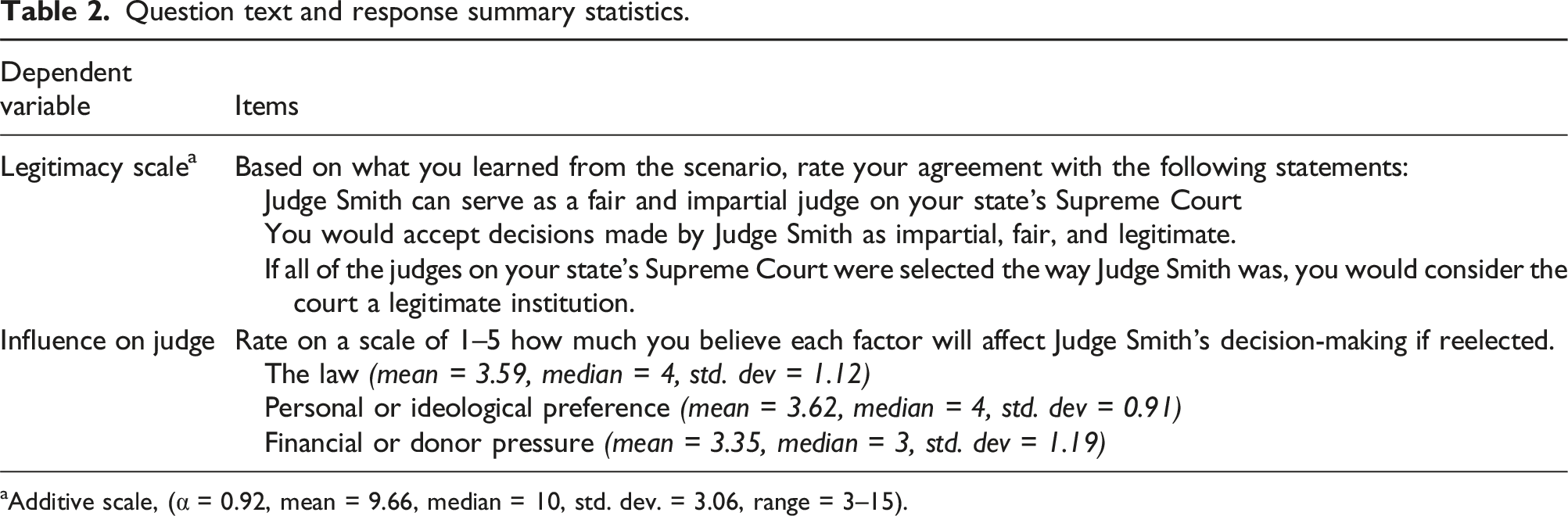
aAdditive scale, (α = 0.92, mean = 9.66, median = 10, std. dev. = 3.06, range = 3–15).
Analysis
Effects of campaign financing type and election style on judicial legitimacy score. 8
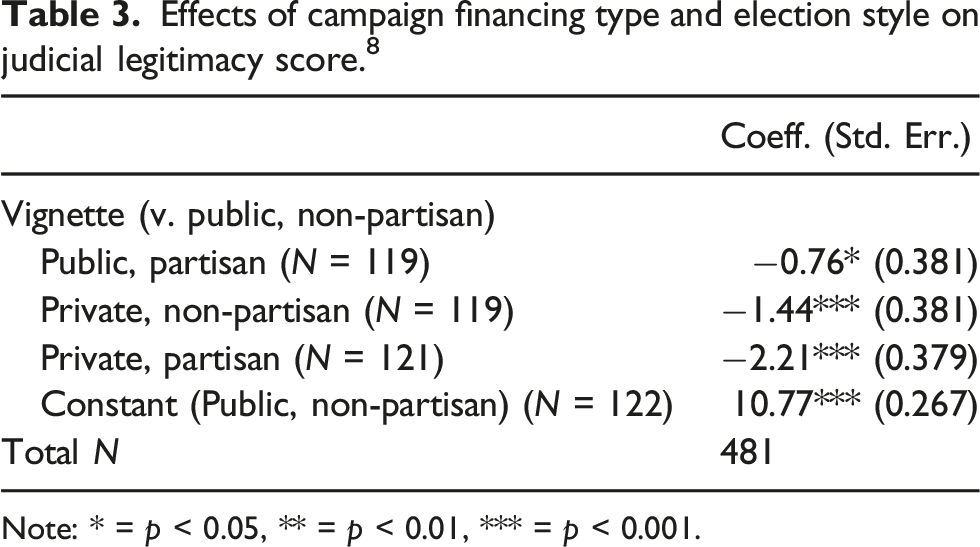
Note: * = p < 0.05, ** = p < 0.01, *** = p < 0.001.
Respondent beliefs of influences of different factors on a judge’s decision-making by financing type and election style.

Note: x = p < 0.10, * = p < 0.05, ** = p < 0.01, *** = p < 0.001.

Respondent’s belief of influences of different factors on a judge’s decision-making by financing type and election style, coefficient plot of three models*.
Together, these results demonstrate that respondents were most likely to perceive a difference in the influence of donors across the publicly and privately financed vignettes. A benefit of the randomization method employed here is that we can control the information and conditions of the election described; thus, we are afforded a degree of certainty in concluding that the measured shift in perception of donor pressure is directly related to whether the described election is publicly or privately financed. Coupled with the observed effects on legitimacy, decreased perceptions of donor pressure appear to be a possible causal mechanism for a bump in legitimacy for publicly financed courts, though our model stops short of directly measuring this relationship. 9 This is consistent with prior studies finding strong effects of campaign contributions on judicial legitimacy, and it adds to the viability of public financing as taming the loss.
The results suggest that partisan elections may amplify the negative impact of campaign contributions. Non-partisan elections are viewed as more legitimate despite respondents’ views on the importance of preferences and ideology, which are usually associated with partisan elections. Respondents who received a partisan vignette rated personal preferences as slightly more important that those who received a non-partisan vignette, indicating that partisan elections alone may increase the perception of donor pressure.
Discussion
This study demonstrates that the public may view a state supreme court elected through publicly financed campaigns as more legitimate and less susceptible to donor influence as compared to privately funded elections. Judicial power depends on legitimacy, and there is merit to identifying institutional reforms that serve to bolster it. The study suggests that public financing could also improve support for other institutions, like state legislatures, which face similar donor-related criticisms. Previous studies show little difference between campaign contributions’ negative effects on legitimacy across judicial and legislative elections, implying that improvements in legitimacy might be realized across the board under public financing schemes (Gibson 2008; 2009).
That said, this study cannot help us determine whether public financing actually addresses the underlying issue its proponents claim it solves: donor influence on decision-making. While it remains useful to explore reforms that improve public perceptions of the judiciary, it is important to understand the underlying flaws of judicial elections that damage those perceptions in the first place, including whether private financing might be one of those flaws. Researchers should continue to study the role of campaign finance in judicial decision-making for elected courts; a clearer understanding of that link is essential to addressing any defects which may be present in current systems.
Future research could build on our work in additional ways. One approach would be to test our findings with concrete, controversial scenarios—this would provide a tougher test of the legitimacy gains we observe in our study. Researchers may also explore real examples of publicly financed judicial elections in states and localities to gain further insight into public perceptions of financing schemes currently employed. Additionally, we acknowledge that our sample is younger and more Democratic than the general public. It is worth considering whether this group is particularly concerned about private financing. Future studies could examine this issue using a larger, more diverse sample or by targeting specific subgroups.
This experiment also did not expose respondents to the potential downsides of public financing. 10 These factors may challenge respondents’ views on the viability of the reform. Also absent was mention of independent campaign expenditures, which public financing alone cannot prevent. What this experiment does allow, however, is an isolation of the potential effects public financing might have, with all else actually held equal.
Judicial elections will likely never escape accusations of impropriety, and there will always be purists who argue they should not play a role in selecting judges. Still, given that they are almost certainly here to stay, it is worth understanding the ways in which their different features affect public legitimacy of the courts and, further, how that legitimacy could be augmented by reform efforts. It should be of vital importance to supporters of reform and status quo alike to discover the effects of specific proposals.
Supplemental Material
Supplemental Material - Public campaign financing’s effects on judicial legitimacy: Evidence from a survey experiment
Supplemental Material for Public campaign financing’s effects on judicial legitimacy: Evidence from a survey experiment by Tiger Bjornlund and Alyx Mark in Research & Politics
Supplemental Material
Supplemental Material - Public campaign financing’s effects on judicial legitimacy: Evidence from a survey experiment
Supplemental Material for Public campaign financing’s effects on judicial legitimacy: Evidence from a survey experiment by Tiger Bjornlund and Alyx Mark in Research & Politics
Footnotes
Acknowledgments
The authors would like to thank Logan Dancey, Lindsay Dolan, Jake Haselswerdt, the anonymous reviewers, and the Research and Politics editorial team for their helpful comments and suggestions, as well as the Wesleyan Department of Government for providing funding.
Declaration of conflicting interests
The author(s) declared no potential conflicts of interest with respect to the research, authorship, and/or publication of this article.
Funding
The author(s) disclosed receipt of the following financial support for the research, authorship, and/or publication of this article: This work was supported by the Wesleyan Department of Government.
Correction (June 2025):

Supplemental material
Notes
References
Supplementary Material
Please find the following supplemental material available below.
For Open Access articles published under a Creative Commons License, all supplemental material carries the same license as the article it is associated with.
For non-Open Access articles published, all supplemental material carries a non-exclusive license, and permission requests for re-use of supplemental material or any part of supplemental material shall be sent directly to the copyright owner as specified in the copyright notice associated with the article.
