




Abstract
Politicians’ perceptions of how citizens decide which party to vote for matter for how they behave in between elections. Yet, except for three older studies, a systematic assessment of how political actors today conceive of citizens’ voting motives is non-existent. This study’s goal is to fill the empirical lacuna by asking a large number of Belgian Members of Parliament what they believe determines citizens’ party choice. It shows that few politicians believe that citizens do their democratic duty and vote for a party because of its policy profile. In politicians’ conception, voters hardly take into account the party’s policy promises for the future nor the party’s past behavior when casting their vote. Instead, most MPs believe that citizens are seduced to vote for a party because of individual candidates on the party list, and because of the party’s campaign communications. These findings matter for substantive representation.
Electoral support is key for parties—not the least because it is a prerequisite for the pursuit of any other objective they may have (Strøm, 1990). In their quest for electoral survival or even success, parties try to convince citizens to cast a vote for them on election day. To secure such voter support, parties, and more precisely their politicians, naturally rely on their conception of how voters decide which party to vote for (Esaiasson and Holmberg, 1996 or see Mayhew, 1974 who makes the same argument for an individual politician’s decision-making calculus). As such, politicians’ understanding of citizens’ voting considerations—what is it that makes citizens vote for one party or the other?—impacts their behavior. It influences how they present themselves to voters during the legislature, how they campaign in the run-up to elections, and particularly important; how they deal with public opinion (Kingdon, 1968). After all, how constrained parties are by (future) voter preferences at least in part hinges on their theory of voting behavior, and more precisely on the extent to which citizens are expected to vote for a party because of its policy profile. As such, it is commonly argued, the role of elections is not just the actual possibility of citizens delegating power, the sheer anticipation of elections may as well induce responsive political action (Miller and Stokes, 1963; Mansbridge, 2003).
Imagine that representatives are convinced that citizens vote for their party because of its (future) policy positions and past policy decisions. In their attempt to please voters, then, they should be incentivized to learn and respond to these voters’ preferences and, similarly, should feel more reluctant to divert from these preferences (Miller and Stokes, 1963). Simply put; if one believes that policy positions (either future or past) matter on Election Day, one should be more concerned about voters’ policy preferences to begin with (Mayhew, 1974). If, on the other hand, politicians assume that their party’s policy profile hardly affects citizens’ party choice, they have fewer electoral incentives to learn about and pander to citizens’ desires. After all, they may reason, voters will not reward responsive action, nor hold them accountable for unresponsive action (Strøm, 1990). So, the point is that politicians’ conception of voting considerations matters for (substantive) representation.
It is not surprising, then, that over the years scholars have sought to understand politicians’ beliefs about voters; of the policies, these voters desire (e.g., Belchior, 2014; Walgrave et al., 2022) of the issues they want to see tackled (e.g., Converse and Pierce, 1986), of the parties they will vote for or of the likelihood that they will turn out at the ballot (Skovron, 2018). Yet, except for some older work of Kingdon (1968) and Miller and Stokes (1963) who asked US legislators about their perceptions of voting considerations, and Esaiasson and Holmberg (1996) who studied MPs' conception of party voting motives after the Swedish election of 1985, there are no recent studies that examine what politicians believe determines citizens’ party choice.
Addressing this lacuna in our understanding of how politicians view voters, we ask 292 Members of Parliament in Belgium to rank five voting considerations in order of (perceived) importance. Two voting motives are based on policy content (prospective and retrospective policy voting), and the other three heuristics are not explicitly related to the party’s policy profile (campaign communications, individual personalities, and partisan loyalties). Our findings show that politicians are Democratic Realists, to put in Achen and Bartels’ (2017) words. Politicians tend to believe that campaign communications and individual candidates on the list matter most, while they consider it rather unlikely that voters would choose a party because of its policy profile.
The black box of politicians’ conception of citizens’ party choice motives
A small literature—in total, we are aware of only three studies—has tackled politicians' perceptions of voting considerations. Most notably, In Representation from above, Esaiasson and Holmberg (1996) prompt Swedish Members of Parliament to reflect on why citizens chose a certain party in the 1985 elections. In particular, they asked politicians to what extent the election campaign, the party leader’s image, party loyalty, ideology, class membership, the economy, foreign policy, and religious questions impacted the election result. They conclude that Swedish politicians demonstrate disdain for citizens’ voting motivations as they believe that voters are easily swayed by media campaigns and popular party leaders. Overall, Esaiasson and Holmberg’s (1996) findings suggest that Swedish politicians are rather pessimistic about citizens’ ability to perform their democratic duties. In addition, two older studies tackle elite perceptions of voting considerations by asking US legislators about the determinants of their personal election results. First, and in contrast to Esaiasson and Holmberg’s (1996) findings, Miller and Stokes (1963) show that most Members of Congress think their personal policy records had been important in gaining votes. Kingdon (1968) as well questioned election candidates in the US right after the elections about the extent to which they thought the party, the issues of the election, and their voting records had influenced their election results, and confirmed that many politicians believed their policy records mattered.
Not all politicians seem to share the same conception of voting considerations though. Interestingly, Kingdon (1968) explores this variation, trying to explain why politicians conceive differently of citizens’ voting motives. He compares the beliefs of the winners and losers of the election, and shows that those who are (re-)elected are more convinced that candidate and issue characteristics had been decisive, a finding that he labels the “congratulation-rationalization effect.” In essence, he argues, winners overestimate the degree to which citizens voted on the “right” bases (i.e. their policy efforts), while candidates that had lost in the elections tend to downgrade the importance of their own efforts, and argue instead that voters engage in “blind voting for party labels” (but see Kim and Racheter, 1973). Kingdon’s findings suggest that being successful in the elections leads to a favorable change in politicians’ beliefs about voters’ competence to cast a policy-induced vote choice. In this research note, we examine whether this explanation holds in the context of party choice considerations.
Another key question is; what should we expect politicians today to believe about the drivers of citizens’ party choice? After all, ever since these three valuable scholarly contributions have been made, citizens’ actual voting behavior has changed in a few respects. Vote choice today is more unstable (see Dassonneville, 2022). Increased volatility implies that more voters currently decide last minute which party to vote for and/or changes parties from one election to another, and, therefore, parties have to put more effort into persuading these voters (e.g., Johann et al., 2018). Also, politics has become increasingly mediatized—political actors are all the more dependent on and shaped by mass (and social) media—which has led to, for instance, an increase in the importance of party leaders in citizens’ party choice (Enli and Skogerbø, 2013; Wauters et al., 2018). Therefore, on the one hand, one would expect politicians to reason that campaigns and individual personalities are pivotal for the electoral success of their party. On the other hand, though, one could just as well argue that citizens today have all the more means to get informed about a party’s issue stance and policy behavior— for example, voting advice applications are omnipresent (e.g., Garzia, 2010) and parliamentary behavior has become more transparent due to the mediatization of politics (e.g., Esser and Strömbäck, 2014). Moreover, increased volatility may result from voters switching parties based on their policy preferences instead of holding on to a particular party out of habit. Overall, there is some empirical work suggesting that policies do matter for citizens’ voting decisions (see, for instance, Naurin et al., 2019 who find that government parties are held accountable for breaking pledges, or Dalton, 2019 who show that citizens do vote in line with their policy preferences). While others, such as Achen and Bartels (2017) are more skeptical about citizens’ ability and willingness to cast a policy-induced vote. All in all, we have no clear expectations about whether or not politicians today think voters choose a party for its policy profile.
Data and method
This study was conducted in Belgium, a small West-European country with strong parties and a proportional electoral system. The Belgian political system is very different from the plurality system in the USA, where two of the earlier studies on politicians’ perceptions of voting motives have been conducted, and is similar to the Swedish system where Esaiasson and Holmberg (1996) studied MPs’ beliefs about party choice motives. In particular, Belgium has a flexible ballot list system in which voters have two options on election day; they either vote for a party, a “list vote,” or they additionally cast a vote for (a) particular candidate(s) of that party, a “preferential vote.” In essence, citizens cast a party vote (which determines the seats they get), but they can also express their appreciation for candidates on the list (Deschouwer, 2009; André et al., 2014).
To examine how voting considerations are perceived, we draw on a survey with Belgian MPs, collected within a larger project 1 surveying and interviewing politicians between March and June 2018. 2 Specifically, 324 politicians were willing to participate, which makes for a response rate of 77%. The group of participants is representative of the full population of Belgian politicians in terms of gender, age, and seniority (see Appendix I). The participants filled in a 30-minute survey on a laptop in the presence of a researcher to make sure they, not their employees, answered our questions.
This study’s objective is to map politicians’ perceptions of citizens’ voting motives, and more specifically to examine whether politicians think that citizens, either prospectively or retrospectively, cast a policy-induced vote choice. Representative democracy hinges on the delegation of policy preferences and accountability for policy decisions in elections (Strøm, 2000). The retrospective party performance rule implies that citizens evaluate conditions in society, and reward or punish parties for policy actions that they think contributed to this state of affairs. The prospective party position rule lies at the other side of the temporal dimension with voters knowing where parties stand on different policy issues, what the consequences of these policy issues would be and then identifying and voting for the party that offers the most pleasing package of policy positions (Arnold, 1992). Apart from punishing or rewarding parties for their policy promises or their past actions, voters can rely on various other heuristics to cast a vote (see Lefevere, 2011; Achen and Bartels, 2017). Three important heuristics are included in our question; habit votes—voters consistently, and presumably without much consideration, voting for the same party— voters picking a party for (one or more) individuals on the party list, and voters being swayed because of campaign communications. One may argue that campaign communications also include the pledges parties make for the future (and, therefore, that such communications are also a policy-related voting motive). Still, politicians are asked to rank campaign communications, habit votes, and individual votes with two explicit policy-related voting considerations, one of which is about promises for future policies, making it highly unlikely that these three heuristics are seen by politicians as policy-related voting motives.
We study each of these five voting considerations as how they are perceived by politicians by asking; “People often have very different reasons for why they vote for a particular party. Below is a list of such possible reasons. Please imagine how the average Flemish citizen makes his/her vote choice and rank the reasons below from 1 (the main reason) to 5 (the least important reason) by dragging each of the items into your preferred order.” The answer choices were: “For one or more individual candidates of the party,” “Because of the party program, the promises the party makes for the future,” “Because of the performances of the party in the past legislature,” “Out of habit: they always vote for the same party,” “Because of the party’s communication during the campaign.” 292 out of 324 politicians that agreed to participate in the survey completed the ranking question.
Next, we examine whether Kingdon’s claim about successful politicians rationalizing their election results in the context of party votes. There are different ways to operationalize political success, namely, by looking at seniority (how long are politicians active in parliament), whether they hold or have held a high-level position (i.e., being (ex)speaker, (ex)minister, (ex)party group leader or (ex) party leader), at whether they are in government or not and finally, and finally at their subjective electoral safety (survey question: “How likely do you think it is that you will be re-elected?” (1) Very unlikely; (5) Very likely).
Results
What considerations govern citizens’ vote choice, according to politicians? Figure 1 presents each of the five voting motives with the average importance ascribed to it by politicians. Note that the variable was recoded so that the most important reason gets the highest score (5), and the least important reason receives the lowest score (1). Overall, politicians seem convinced that party choice is driven by the popularity of individual personalities: no less than 43% of the respondents indicate that the number one reason citizens vote for a party is that they like one or more candidates of that party, even in a strong party system such as Belgium. We cannot say with certainty which individuals they are thinking of when they say that individuals matter but earlier work on the personalization of politics in Belgium suggests that this likely is a party leader effect (Wauters et al., 2018). Ranked second, then, is the party’s communications in the campaign. That individual personalities and campaigns matter a great deal for a party’s electoral success, at least in the minds of politicians, confirms findings from Esaiasson and Holmberg (1996: 199) who posit that politicians “believe citizens are rather easy prey to media campaigns and charming party leaders.” Politicians’ perceptions of citizens’ voting considerations (rank 1–5) (N = 292).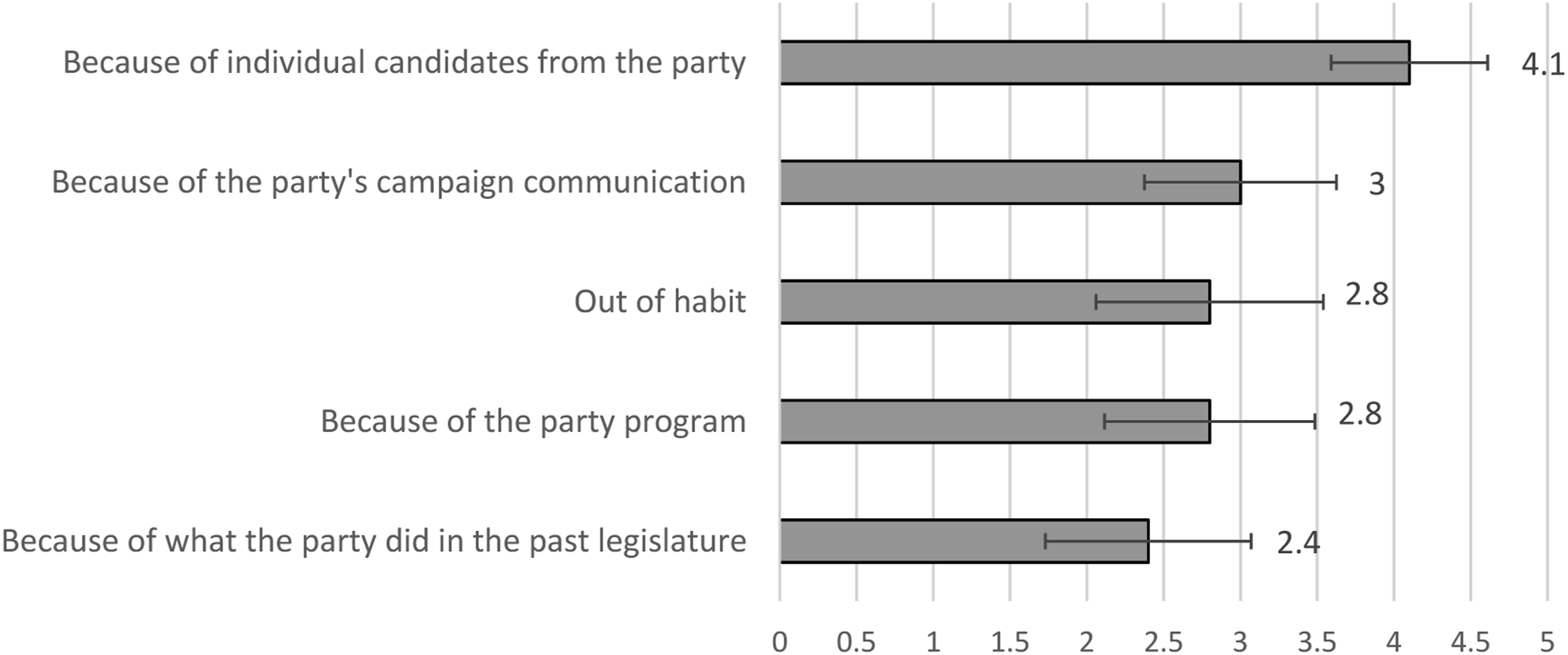
Politicians are somewhat less convinced that citizens vote for a party out of habit. And, importantly, politicians believe that the policy promises a party makes for the future don’t matter that much for citizens’ party choice. Moreover, few politicians expect voters to retrospectively punish or reward a party on election day for its decision-making. Overall, looking at both retrospective and prospective voting motives together, a mere 20% of the Belgian politicians we surveyed say citizens primarily vote for a party because of policy concerns.
A Friedman test shows that there is a statistically significant difference between the mean ranks of the five voting motives (Friedman = 185.411; p-value = 0.000). Wilcoxon signed-rank tests for each of the pairwise combinations confirm statistical difference for all combinations except for the difference between the perceived importance of habit votes and the party program, and between habit votes and the importance of campaign communications.
In sum, politicians’ conception of voting motives seems to align quite well with Achen and Bartel’s (2017) findings. Contrary to what they refer to as the Folk Theory of Democracy, the authors show that citizens only rarely cast a vote based on their policy preferences. In that sense, a majority of politicians seem to be democratic realists; they believe that policy concerns are not the main driver of citizens’ party choices. From a substantive representation perspective, these findings are rather sobering. After all, political actors who feel little or no control by voters, that is: those who do not expect to be held accountable by voters, have fewer electoral incentives to learn and respond to citizens’ wishes (Mayhew, 1974).
Next, we examine whether more successful politicians believe more than their colleagues that citizens vote for a party because of its (past and future) policy profile. In particular, a politician’s average rating of the retrospective and prospective voting considerations is what we look at here. The higher this score, the more politicians believe citizens vote for a party because of its policy profile. The average importance politicians attribute to policy-induced voting motives ranges from 1.5 to 4.5, so there is quite some variation to explore (Mean = 2.6; SD = 0.92). The full regression results are shown in Appendix II.
First, it shows that seniority does not impact politicians’ conception of citizens’ party choice considerations; it is not the case that being in parliament for a while, politicians update their views of voters. Nor do we see that high-level elites more strongly believe that citizens vote for a party because of its policy profile. Note that we surveyed mostly ex-toppers (not current ministers or party leaders) who may not feel very successful being a regular MP after having held the position of minister or party leader in the past, so it may still be that those who occupy leading positions conceive differently of voting motives. Also, we find that politicians do not update their beliefs about voters in the anticipation of personal electoral success (confirming findings from Kim and Racheter, 1973 but going against Kingdon’s 1968 hypothesis). It is not the case that politicians who anticipate being re-elected in the next election are more convinced that citizens make a policy-induced party choice than their colleagues who anticipate losing their seats. Interestingly, when government and opposition MPs are compared in Figure 2, we do find some evidence for Kingdon’s congratulation-rationalization hypothesis: winners of the election (they are in government, after all) more strongly believe a party’s policy profile matters for citizens’ party choice than opposition MPs. It is not the case that government MPs attribute a lot of importance to policy-induced voting considerations (predicted value of 2.74), but they do feel significantly more monitored by voters than MPs in the opposition (predicted value of 2.38). Interestingly, this difference between government and opposition MPs may also reflect the fact that the policy behavior of government parties is generally more visible and thus potentially of greater importance to voters. Note that it is not an effect of the ideology of the parties that were in government. Including a measure of politicians’ ideological position (based on their party affiliation) in the same regression does not change the positive and significant effect of government status (nor is the ideological position a predictor of perceived party choice motives). Finally, we examine whether there are systematic differences between successful and less successful MPs in how they rank habit votes, communications, and individuals as a driver of citizens’ party choice. But there are none (see Appendix III). Predicted value of perceived importance of policy-related voting motives for government and opposition MPs.
Conclusion
On what grounds do citizens vote for a party, according to politicians? Putting this question to a large sample of Belgian representatives, this study shows that most politicians are rather pessimistic about the extent to which citizens vote for a party because of its policy profile. Most politicians do not believe that voters cast a retrospective or prospective vote choice. Instead, politicians ascribe a lot of importance to the parties’ campaign communications, and especially to the role of individual candidates.
That a large majority of politicians is convinced that citizens do not judge a party’s past performance on Election Day nor vote for a party with whom they share their policy preferences, matters for democratic representation. After all, politicians assume that voters care about the party’s policy profile is a key mechanism driving voter responsiveness (Mansbridge, 2003; Mayhew, 1974). The fact that politicians believe that a party’s policy behavior and future policy promises do not determine citizens’ party choice, implies that one incentive for these parties to learn about and respond to voters' preferences, to keep their election promises, and to announce politically feasible policies, is rather absent (Przeworski et al., 1999).
One may argue that it does not matter all that much what politicians believe about voters, as long as these voters effectively hold parties to account on election day and make an ideologically congruent party choice. Yet, there are two main reasons why it is unlikely that citizens’ vote choice as such ensures policy congruence. For one, people don’t always vote “correctly,” that is vote for the party that shares their preferences (most) (see Lau et al., 2014; Achen and Bartels, 2017). Also, even when they do vote correctly (see, for instance, Feltovich and Giovannoni, 2015), this does not necessarily guarantee voter responsiveness in between elections. After all, voters give one party a broad mandate in the election, instead of dictating a specific course of action for every single issue that may pop up during the legislature and no institution impels parties to adhere to their pre-election promises. And voter, as well as party preferences, may simply change in between elections. Therefore, the perceptions politicians have of their voters and the resulting behavioral considerations are an important field of study.
Next, this research note examines the relationship between (electoral) success and politicians’ conception of voting considerations and finds that government members are somewhat more optimistic about citizens making a policy-induced vote choice—while politicians’ seniority, position, and re-election prospects did not appear to affect their conception of citizens’ party choice considerations. Although the empirical evidence is mixed, we can carefully say that there appears to be a tendency for “successful” MPs to bring their conception of citizens’ voting behavior somewhat more in line with normative theories about democratic accountability and delegation—or to put it differently: to reason that voters rewarded their party for its policy profile (Kingdon, 1968). Though this research note tackled explanations for voting motive beliefs on the individual level (in this single-case study we simply did not have enough parties), we would in particular encourage future work to leverage party variation more. Maybe politicians from successful parties (those who’s won seats in the election, or those who are doing well in the polls) hold a different conception of voting motivations than their colleagues who are in the “losing” camp.
Future work would benefit from scope expansion in two other ways. For one, a more fine-grained study of politicians’ perceptions would be helpful. Letting politicians reflect freely, in an open interview, on the motivations behind citizens’ party choice (see Lefevere, 2011 for a similar approach with citizens), would provide rich insights into, for instance, the reasons why politicians consider some voting considerations important or unimportant (e.g., “Why do politicians say candidates matter? Is it trust, personality or their handling of policies that convinces voters? And how do they conceptualize campaign communications?). Second, another interesting research avenue would be to explore whether politicians conceive of their voters differently than of the broader public (see Van Schendelen, 1981).
Though the scope of this research is limited, the rich and novel data do give us a better grasp of politicians’ beliefs about voters, which constitutes an important link in the mechanism of (anticipatory) representation (Mansbridge, 2003).
Footnotes
Acknowledgements
The author wants to thank Peter Esaiasson, Stefaan Walgrave and all members of M2P (research group Media, Movements & Politics at the University of Antwerp) for their helpful feedback on the research note.
Declaration of Conflicting Interests
The author declared no potential conflicts of interest with respect to the research, authorship, and/or publication of this article.
Funding
The author disclosed receipt of the following financial support for the research, authorship, and/or publication of this article: This work was supported by the National Science Foundation (FWO) [grant number 11G8819N].

Notes
Appendix
Composition of the politician sample.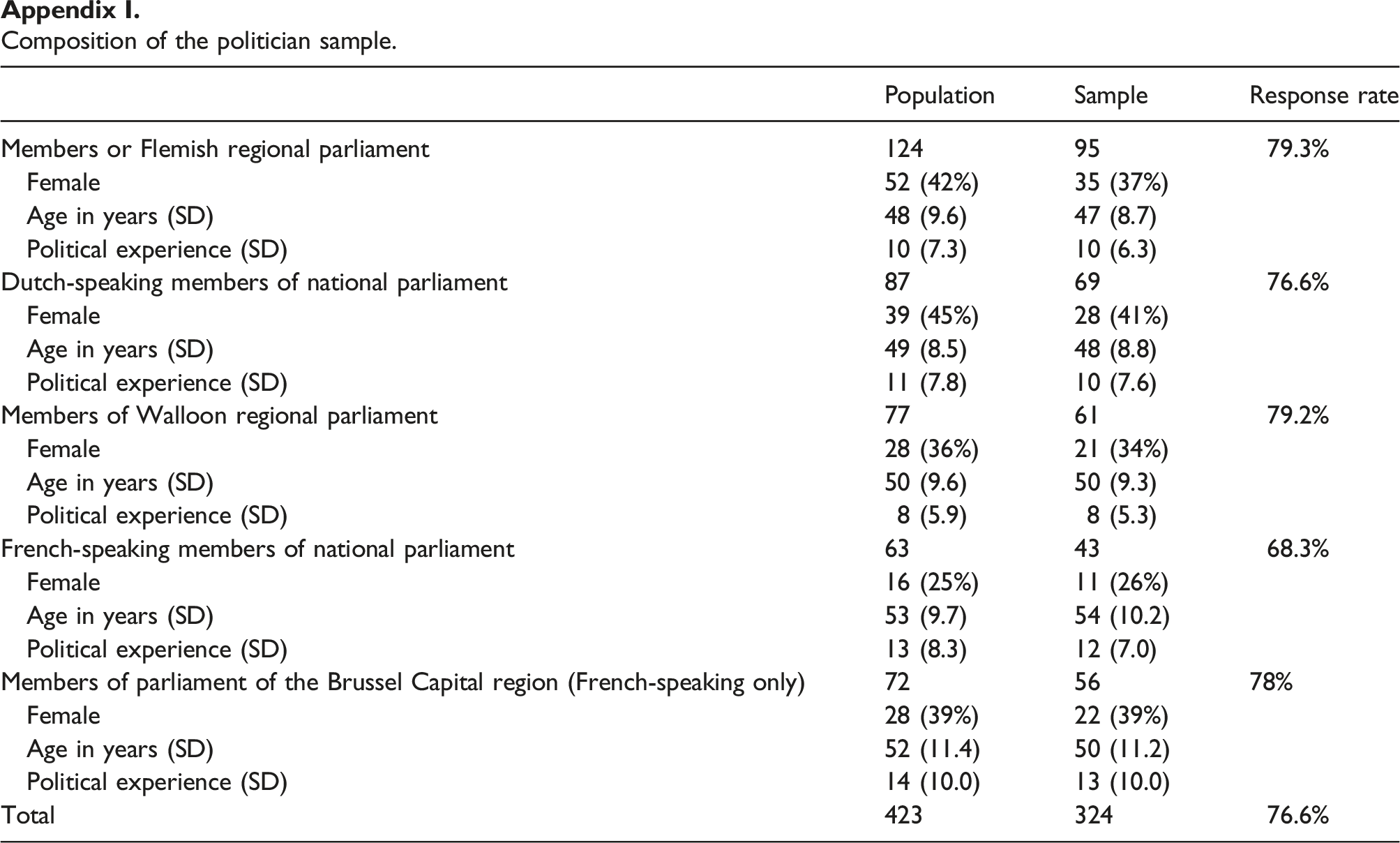
Population
Sample
Response rate
Members or Flemish regional parliament
124
95
79.3%
Female
52 (42%)
35 (37%)
Age in years (SD)
48 (9.6)
47 (8.7)
Political experience (SD)
10 (7.3)
10 (6.3)
Dutch-speaking members of national parliament
87
69
76.6%
Female
39 (45%)
28 (41%)
Age in years (SD)
49 (8.5)
48 (8.8)
Political experience (SD)
11 (7.8)
10 (7.6)
Members of Walloon regional parliament
77
61
79.2%
Female
28 (36%)
21 (34%)
Age in years (SD)
50 (9.6)
50 (9.3)
Political experience (SD)
8 (5.9)
8 (5.3)
French-speaking members of national parliament
63
43
68.3%
Female
16 (25%)
11 (26%)
Age in years (SD)
53 (9.7)
54 (10.2)
Political experience (SD)
13 (8.3)
12 (7.0)
Members of parliament of the Brussel Capital region (French-speaking only)
72
56
78%
Female
28 (39%)
22 (39%)
Age in years (SD)
52 (11.4)
50 (11.2)
Political experience (SD)
14 (10.0)
13 (10.0)
Total
423
324
76.6%
Linear regression predicting perceived importance of policy-induced voting considerations. Note. 90% confidence intervals.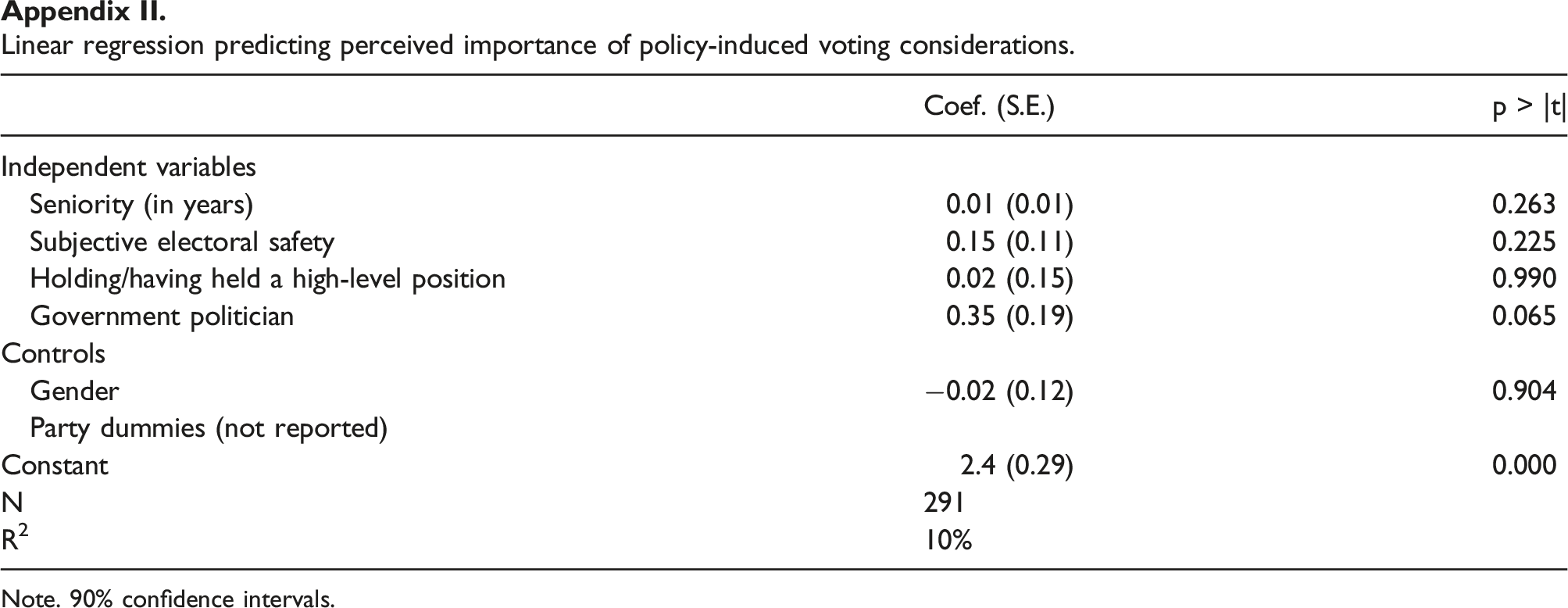
Coef. (S.E.)
p > |t|
Independent variables
Seniority (in years)
0.01 (0.01)
0.263
Subjective electoral safety
0.15 (0.11)
0.225
Holding/having held a high-level position
0.02 (0.15)
0.990
Government politician
0.35 (0.19)
0.065
Controls
Gender
−0.02 (0.12)
0.904
Party dummies (not reported)
Constant
2.4 (0.29)
0.000
N
291
R2
10%
Linear regression predicting perceived importance of individual candidates, habit votes, and campaign communications for citizens’ party choice decision. Note. 90% confidence intervals.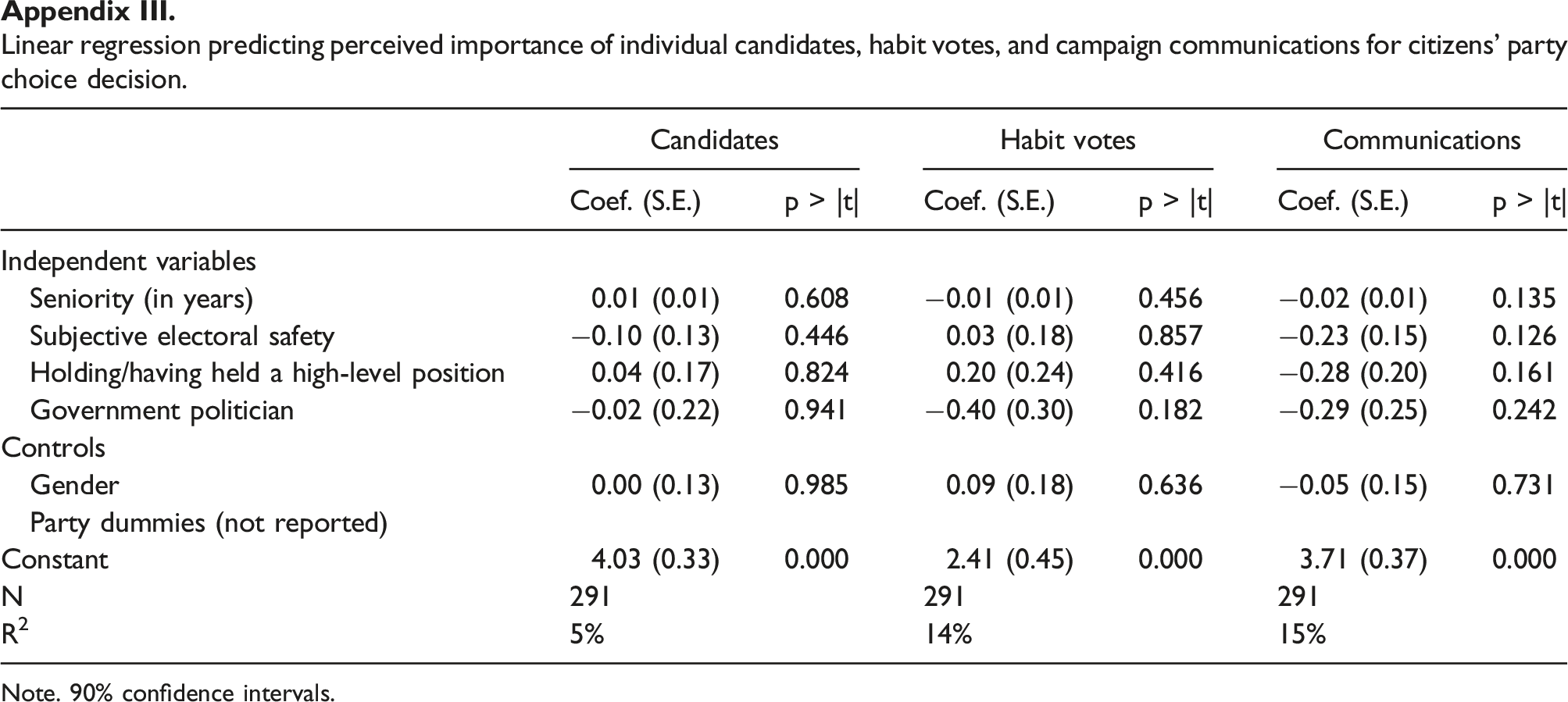
Candidates
Habit votes
Communications
Coef. (S.E.)
p > |t|
Coef. (S.E.)
p > |t|
Coef. (S.E.)
p > |t|
Independent variables
Seniority (in years)
0.01 (0.01)
0.608
−0.01 (0.01)
0.456
−0.02 (0.01)
0.135
Subjective electoral safety
−0.10 (0.13)
0.446
0.03 (0.18)
0.857
−0.23 (0.15)
0.126
Holding/having held a high-level position
0.04 (0.17)
0.824
0.20 (0.24)
0.416
−0.28 (0.20)
0.161
Government politician
−0.02 (0.22)
0.941
−0.40 (0.30)
0.182
−0.29 (0.25)
0.242
Controls
Gender
0.00 (0.13)
0.985
0.09 (0.18)
0.636
−0.05 (0.15)
0.731
Party dummies (not reported)
Constant
4.03 (0.33)
0.000
2.41 (0.45)
0.000
3.71 (0.37)
0.000
N
291
291
291
R2
5%
14%
15%