



Abstract
In this short manuscript, I explore the predictive validity of a common component of racial resentment—(dis)agreement with the idea that minority racial groups need special favors to get ahead. Specifically, this analysis takes advantage of different “special favors” questions included in the Cooperative Congressional Election Studies (CCES) 2012-2014 Panel Study to assess whether affirmative action preferences are uniquely racialized. I find that (1) respondents react differently to the special favors instrument on the basis of the racial group in question, (2) these assessments vary among liberals and conservatives, and (3) they predict racialized outcomes stereotypically associated with a given racial group. These findings dovetail with recent work that illustrates an ideological sorting of such measures, while offering modest evidence that a prominent instrument used in symbolic racism scales is, in fact, race-coded to specific target groups.
Surveying white Americans’ beliefs about race is more complicated than often credited. In particular, one significant debate within this literature involves questions about whether survey instruments that invoke race tap into “genuine” beliefs about racial groups or some other, perhaps unrelated, political criteria. While some argue survey questions used in batteries like racial resentment reflect sincere, racial group-specific prejudice (e.g., Kinder and Sanders 1996; Kinder and Mendelberg 2000), others claim that they reflect more innocuous attitudes involving group-based preferences (Wilson 2006), ideology (Feldman and Huddy 2005), matters of policy (Carmines et al. 2011), fairness judgments (Carney and Enos 2017), or, most recently, less caustic evaluations involving favoring or disfavoring groups (Agadjanian et al., 2023).
In this short manuscript, I explore the predictive validity of a common component of racial resentment—(dis)agreement with the idea that minority racial groups need special favors to get ahead. Specifically, this analysis takes advantage of different “special favors” questions included in the Cooperative Congressional Election Studies (CCES) 2012-2014 Panel Study to assess whether affirmative action preferences are racialized. I find that (1) respondents react differently to the special favors instrument on the basis of the racial group in question, (2) these assessments vary among liberals and conservatives, and (3) they predict racialized outcomes stereotypically associated with a given racial group. These findings dovetail with recent work that illustrates an ideological sorting of such measures, while offering modest evidence that a prominent instrument used in symbolic racism scales is, in fact, race-coded to specific target groups.
Debate about the structure and meaning of whites’ racial attitudes
In the post-Civil Rights era, social norms regarding the expression of negative racial sentiments shifted the way that Americans expressed negative views about minorities (Schuman et al., 1997). As “old fashioned racism,” explicit stereotyping, and overt prejudice became harder to detect in the survey context, social scientists developed different measurement tools suited to measure a new form of racism rooted in cultural grievances rather than biological differences (Sears and Henry 2003). This “modern racism” involved three ingredients: 1) anti-Black affect, 2) a perceived failure of African Americans to work hard enough to remedy inequalities, and 3) denial that institutional discrimination is prevalent (Kinder and Sanders 1996).
Survey instruments designed to embody these ideas, however, have drawn frequent criticism focused on the nature and meanings of such items and how researchers should interpret analysis of them. Carmines et al. (2011), for example, reject the idea that the symbolic racism items actually involve prejudice, as such (see also Sniderman et al., 1996). In their view, these attitudes instead reflect views about limited government rather than explicit, pernicious affect toward minorities. Alternatively, Carney and Enos’ (2017) experimental work finds conceptual parallels between the racial resentment battery and system justification and just world theories. Given that American conservatism emphasizes resistance to change and justification of inequality (e.g., Jost et al., 2003; Lerner, 1980), it is conceivable that the instruments used to capture this measure of racial affect also map straightforwardly—and innocently—onto traditional ideological beliefs. Still others argument that the moniker “resentment” is misplaced because these instruments do not, in fact, measure resentment as such (Davis and Wilson 2021), but may, in contrast, tap into more banal evaluative considerations involving “favoring” or “disfavoring” certain groups (Agadjanian et al., 2023).
Indeed, a cursory review of the items that comprise the racial resentment scale reveals that these survey instruments could tap into a wide variety of ideas, ranging from beliefs about inequality and historical injustice, to judgments involving the relationship between work ethic and success, to beliefs about progress, and to preferences regarding the scope of government intervention—all independent of racism, per se. From an application standpoint, then, scholars are left to infer that these survey questions are valid measures of racial attitudes by either linking them to other measures of racial affect (e.g., feeling thermometers; construct validity) or tying them to racialized social and political evaluations (predictive validity). While demonstrating construct validity is relatively straightforward, attempts to establish predictive validity are tricky because measures of racial attitudes often ask respondents to endorse a liberal (conservative) view of the role of government (Rabinowitz et al., 2009). The result is ambiguity over whether such instruments are useful measures of racial affect, especially when survey questions invoke explicit ideological tradeoffs.
“Special favors” and racial groups
These tensions culminate in the case of affirmative action preferences. On balance, polling suggests that Americans are broadly supportive of the ideals of equality (Pew 2019). And, yet, while public support for affirmative action policies targeted at minorities has steadily increased over the past two decades—rising from roughly 47% in favor of such programs in 2001 to 61% in 2018 (Norman 2019)—a nontrivial proportion of Americans are unwilling to support policies that might more fully ameliorate group differences in economic outcomes.
Among the original symbolic racism instructions, these attitudes are the most interpretively convoluted, asking respondents to convey whether Black Americans deserve “special favors” when other groups “worked their way up.” Wilson (2006: 111) emphasizes this point, writing that “racial preference programs reflect an amalgam of two objects: the black target group and the preference policy itself.” Accordingly, it is difficult to ascribe negative affect (prejudice) to individuals who are unwilling to support affirmative action without (1) explicitly gathering information about how they think about racial groups, or (2) assessing whether such attitudes are grounded in opposition to public aid more generally. On these points, Sniderman and colleagues’ (Sniderman et al., 1996) work proves illustrative. They convincingly demonstrate that exchanging racial groups in a poverty-reduction question (e.g., “Blacks” with “New immigrants from Europe”) can shift respondents’ openness to public aid with an ironic twist: the public is more supportive of providing aid to African Americans than a pluralistic group of white immigrants, but less supportive when testing aid to Blacks against a more general category of “disadvantaged” people (51). There are differences among ideologues and perceptions of work ethic matter, but it is difficult to infer that attitudes involving “special favors” are necessarily tinged with racism inasmuch as they are with politics (Snidermanet al., 1996; Davis and Wilson 2021).
On a practical level, without a counterfactual racial group against which to benchmark respondents’ views toward African Americans, it is difficult to assess whether the survey question can be reasonably tied to attitudes toward a specific group or are, instead, an approximation of more general liberal-conservative preferences involving the role of government. 1 Fortuitously, however, the Cooperative Congressional Election Study’s 2010-2014 Panel Study offers an intriguing opportunity to test these questions. They asked respondents to report whether they agreed or disagreed with the following statement: Irish, Italian, Jewish, and many other minorities overcame prejudice and worked their way up; [Blacks/Hispanics] should do the same without any special favors. The presence of different forms of affirmative action preferences involving both African American and Hispanic target groups in the CCES provides a unique opportunity to re-assess the question of whether these attitudes incorporate “ideological” views or race-specific affect—a useful task because scholars interested in longitudinal analysis of racial attitudes have few, long-running measures of such beliefs. My analytical expectations are as follows.
First, I expect to observe that beliefs about “special favors” regarding African Americans will be more generous than those involving Hispanics. The reason for this is simple: although the public is exposed to negative descriptions of Latinos and Hispanics in the media (Reny and Manzano, 2016), popular depictions of poverty and inequality in the United States are traditionally racialized via frames that involve African Americans (Clawson and Trice, 2000; Ramasubramanian and Martinez, 2017).
Second, I expect the Black- and Hispanic-favors items to predict only those outcomes that are stereotypically racialized to the corresponding group. The logic of this expectation is straightforward. The favors instrument involving “Blacks,” for example, should predict gun control policies (which are racialized in a specific way for African Americans; Filindra and Kaplan 2016) and affect for then-President Obama (who is Black), while the favors instrument invoking “Hispanics” as the reference category should not. In contrast, beliefs about immigration policies should be sensitive to attitudes about affirmative action involving Hispanics, but not African Americans, given the stereotypical correspondence between the Hispanic target group and racialization of immigration policy.
Finally, in light of work that illustrates that liberals and conservatives parse these ideas in very different ways (e.g., Sniderman et al., 1996; Feldman and Huddy 2005; Englehart 2019; Agadjanian 2023), it is possible that liberals and conservatives not only exhibit different beliefs about special favors, but connect them to relevant political preferences in different ways.
Data and measures
The following analyses use Cooperative Congressional Election Studies (CCES) 2012-2014 Panel Study data. Given that members of different racial groups vary in their approach to these questions (see Davis and Wilson, 2021 for a review), all analysis is restricted to white-identifying respondents.
Special favors
At both the 2012 and 2014 waves, respondents were asked whether they agreed or disagreed with the following statement: “Irish, Italian, Jewish, and many other minorities overcame prejudice and worked their way up; [Blacks/Hipanics] should do the same without any special favors.” Individuals answered this question twice, with only the racial group varying across items. Responses ranged from “strongly disagree” (1) to “strongly agree” (5), with higher values conveying a more “negative” response. They are highly correlated (r = 0.85), but some differences manifest among ideologues, which we return to in the next section.
Liberal-conservative ideology
Liberal-conservative self-placement was collected at both waves. Individuals were asked where they placed themselves on a scale ranging from “very liberal” (1) to “very conservative” (7). 2
Policy preferences
Finally, the CCES asked a number of detailed questions regarding policy preferences across several domains. These items can be roughly broken into racialized policies that stereotypically involve Blacks and Hispanics and non-racialized policies. Two policies conventionally connected with African Americans involve (1) affirmative action and (2) gun control. Two immigration policies might presumably involve how respondents think about Hispanics: (3) birthright citizenship; (4) penalties for businesses that knowingly hired illegal immigrants. Two additional policies have less meaningful connections to race: (5) abortion, and (6) raising taxes to balance the federal budget. Each of these variables was coded so that higher values convey conservative responses; as such, we would expect to find “positive” coefficient estimates for the favors items stereotypically connected with a given group. Full information about question wording and response options is available in the Supplemental Appendix.
Results
We begin by investigating whether white respondents report different attitudes on the two favors instruments. Recalling that lower values correspond to endorsing the statement that a group needs “special favors,” the average response regarding Blacks is more favorable (
However, because past research is clear that these beliefs are conditional upon ideology, we present the distribution of responses to these two items from the 2012 wave in Figure 1. Both conservatives and liberals exhibit more charitable responses to the favors instrument involving Black rather than Hispanic Americans. However, there are two significant aspects of these responses that warrant discussion. First, conservatives are extremely likely to agree that both racial groups should not receive special favors. In fact, the average score for Blacks ( Distribution of responses to the “favors” survey instrument. Estimates convey weighted distribution of responses. Data drawn from the 2012 wave of 2010–2014 CCES Panel Study.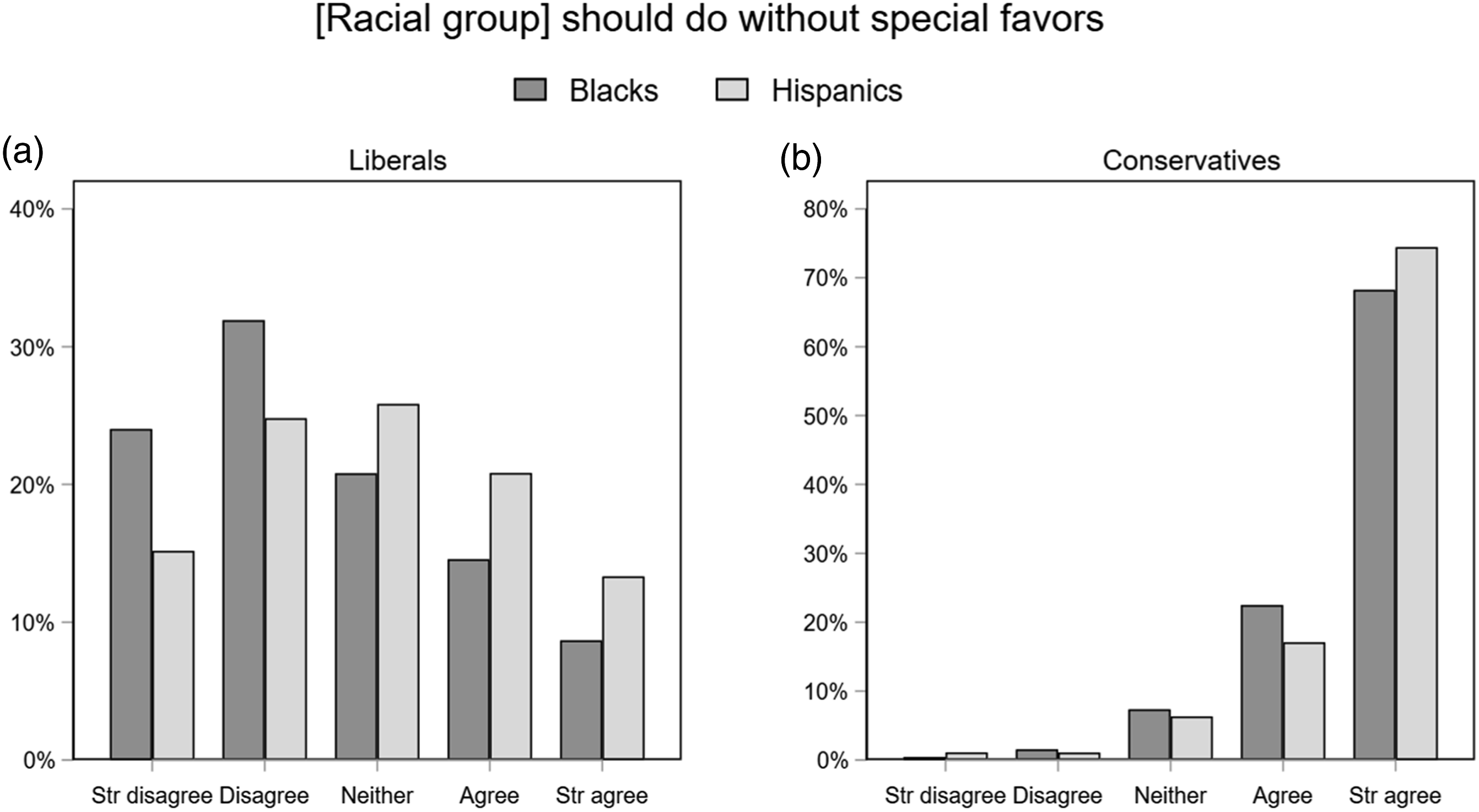
We turn next to assessing how these items are related to other political preferences. To restate the logic of this test of predictive validity, we would expect that the favors items should only predict outcomes that are both racialized and stereotypically associated with a respective racial group. We introduce one caveat, however, to these expectations: although this logic tacitly assume that these instruments should behave uniformly among respondents, the descriptive results reveal significant differences between how liberals and conservatives think about these questions. In turn, these differences might shape the relationship between the favors items and other political assessments. To account for this possibility, we also subset the following models for liberals and conservatives to assess whether asymmetries are apparent.
In Figure 2, we plot the coefficient estimates associated with regressing various policy attitudes in 2014 on the 2012 favors items. These models each include a lagged dependent variable, which simply allows us to account for how much of 2014 policy attitude is attributable to the favors instruments relative to the preexisting policy belief at 2012. Put another way, by controlling for prior beliefs with respect to the dependent variable, we isolate how the favors instrument is related to later policy beliefs. In each model, the dependent variable has been scaled so that higher values convey more ideologically conservative preferences. Point estimates convey the difference between supporting the idea that a given racial group needs special aid and opposing such special favors. Higher values, then, are conventionally associated with more “racially” “conservative” responses. The relationship between beliefs about special favors and public policy. Point estimates are derived from panel models that incorporate lagged DV, along with respective 2012 value of favors for both racial groups and sociodemographic control variables. Liberal and conservative estimates are generated by subsetting models to those individuals who identified with those labels; solid bands indicate 95% confidence intervals. Full modeling output is available in the Appendix. Data drawn from the 2012 and 2014 waves of CCES Panel Study.
Beginning with the pooled models of all respondents (i.e., dark cross point estimates), the first two panels suggest that the Black-favors instruments are unrelated to immigration policies, which matches our expectation that the racial group mismatch between the favors and policy attitudes should be associated with null effects. In contrast, attitudes toward Hispanics predict both the rejection of birthright citizenships (Panel 1) and support for fining businesses that hire undocumented workers (Panel 2). We pivot next to policies that are conventionally racialized involving African Americans in the second row. Next, in Panel 3, the results associated with explicitly asking about affirmative action policies illustrate that both favors instruments are related to such preferences, although the relationship between attitudes towards African Americans and affirmative action is about twice as large in magnitude as the relationship between Hispanic-favors and affirmative action preferences. With respect to gun control (Panel 4), the evidence is clear: attitudes toward Blacks but not Hispanics are associated with a preference for fewer restrictions on gun ownership. Finally, moving to the third row of polices that involve non-racialized policies, we find little evidence that either instrument is related to abortion (Panel 5) or tax preferences (Panel 6).
We pivot, next, to the split-sample models involving how liberal and conservative respondents connect their racial to policy attitudes. For the most part, these differences are muted; only in the case of gun control do we observe that conservatives’ attitudes toward Black-favors generate large and pronounced effects that are different than liberals. Bearing in mind the distributional differences associated with the favors instruments across groups, the marginal effect of moving from minimum to maximum values on the favors items appears to be largely equivalent across groups. That finding is notable given questions about the extent to which such survey questions have undergone general partisan-ideological sorting.
Finally, we conclude by modeling approval of then-President Barack Obama. Figure 3 presents a series of point estimates associated with regressing 2014 Obama approval on 2012 favors attitudes. The pattern of results matches those found in Figure 2. In the case of an evaluative target who is an African American, only beliefs about whether Blacks deserve special favors is associated with downstream Obama approval. Attitudes about Hispanics are unrelated to such assessments. In this case, however, the relationship is much larger in magnitude among self-identified liberal relative to conservative respondents, which matches recent scholarship that shows how political identities can shape the expression of these views (Engelhart, 2019; Chudy 2021; Agadjanian et al., 2023).
3
Obama approval and racial group favors. Point estimates are derived from panel models that incorporate lagged IV and DV at 2012 wave and sociodemographic characteristics. Estimates bracketed by 95% confidence intervals. Source: 2012 wave of 2010–2014 CCES Panel Study.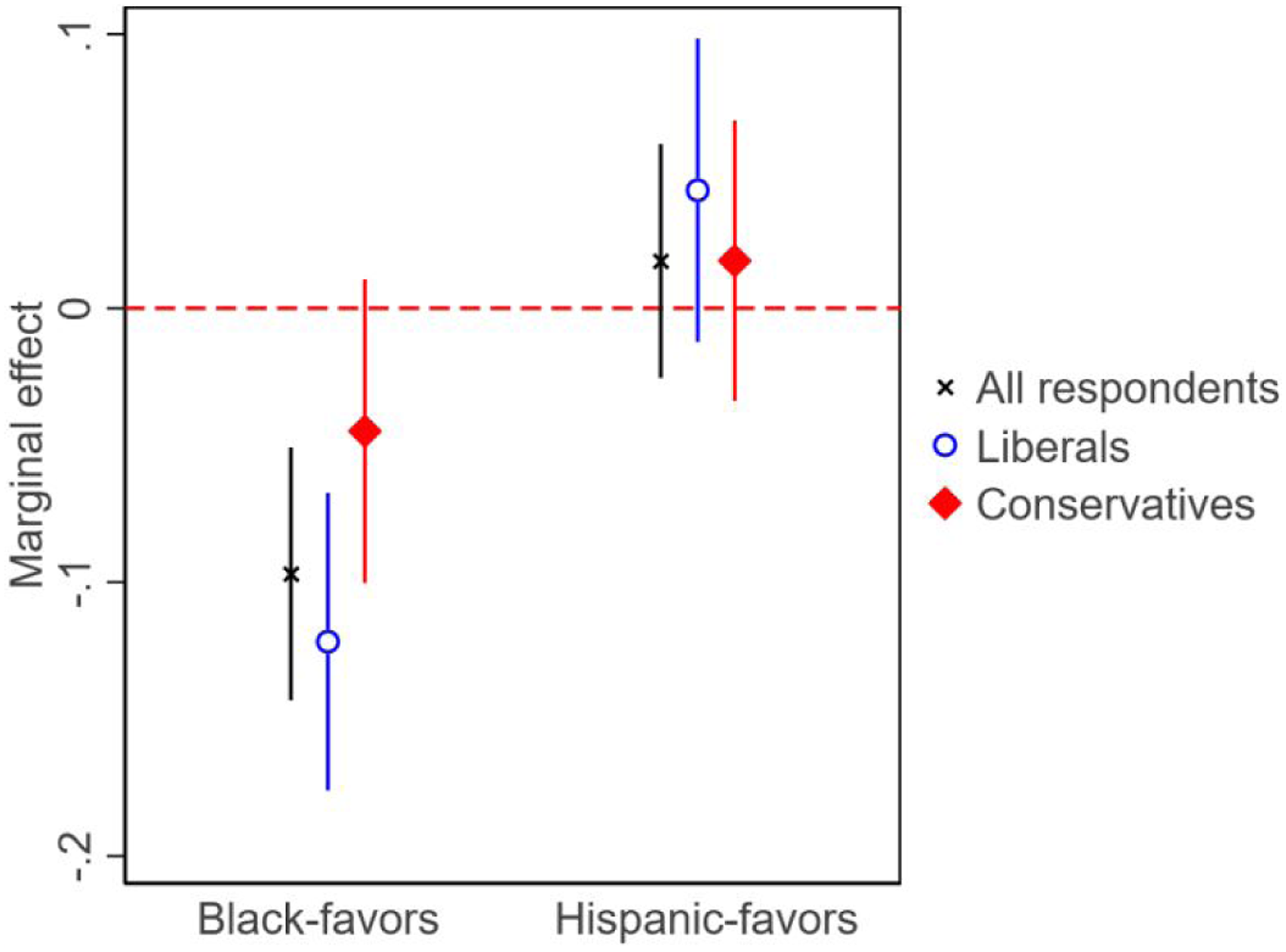
Conclusion
As social standards surrounding the acceptable expression of racial attitudes have shifted markedly over time, the measurement strategies used to capture racial opinions evolved, as well. This study situates itself among recent work that explores how white Americans think about matters of race within this framework. In this case, the relative status of racial groups and their ability to overcome social or economic challenges—embodied in the “favors” element of racial resentment—could conceivably tap into latent prejudice (e.g., Sears and Henry 2003), group-based preferences (Wilson 2006), or ideological beliefs about individualism (Carney and Enos 2017). Although we are cautious about over-fitting our explanation of these relationships as prejudice, wholly disentangling these attitudes from racial affect seems implausible. Both Kam and Burge (2018) and Simmons and Bobo (2018), for example, present evidence that this measure involves sincere racial affect (see also Enders, 2021).
These findings suggest that prominent differences exist regarding how Americans think about the special favors that ought to be given to Black relative to Hispanic citizens. On balance, respondents are more sympathetic toward African Americans, with the caveat that these attitudes are conditional upon liberal-conservative identity. Further, when respondents were asked to evaluate racialized political targets, the “favors” items are often linked to the corresponding racial group connected to the evaluative object. 4
At minimum, the favors instruments appear to pick up some amount of ethnocentric, racial affect; a stronger interpretation of the results, in turn, suggests that these variables are coded to their respective racial groups. Although low values on the instrument may not be discriminatory, per se, the fact that they correlate reliably with racialized policy and do not predict non-racialized policy implies that these are not “merely” proxies for ideological preferences. This evidence is valuable, then, because this instrument has a long history of inclusion on surveys as an unobtrusive measure of racial attitudes (with the caveat that Davis and Wilson's [2021] work implies changes to question wording are necessary if one wants to couch responses to these questions as (“with the caveat that resentment”). While the motivations associated with these attitudes may be a matter of debate—perhaps they constitute sympathies with minorities (Chudy 2021) or the tendency to favor or disfavor the group in question (Agadjanian et al., 2023)—they nevertheless exhibit reasonable amounts of predictive validity.
Supplemental Material
Supplemental Material - The (racial) implications of “special favors”
Supplemental Material for The (racial) implications of “special favors” by Nicholas T Davis in Research & Politics.
Footnotes
Declaration of conflicting interests
The author(s) declared no potential conflicts of interest with respect to the research, authorship, and/or publication of this article.
Funding
The author(s) received no financial support for the research, authorship, and/or publication of this article.
Correction (June 2025):

Supplemental Material
Notes
References
Supplementary Material
Please find the following supplemental material available below.
For Open Access articles published under a Creative Commons License, all supplemental material carries the same license as the article it is associated with.
For non-Open Access articles published, all supplemental material carries a non-exclusive license, and permission requests for re-use of supplemental material or any part of supplemental material shall be sent directly to the copyright owner as specified in the copyright notice associated with the article.
