




Abstract
We present the MMAD Repressive Actors Dataset (MMAD-RA). The MMAD-RA is a new data source that provides systematic information on the repressive actors present at protest events in autocracies, including their type, tactics, and level of violence. The data is temporally and geographically fine-grained, allowing for analysis between and within more than 60 countries from 2003 to 2012. The MMAD-RA enables analysis of the variation in repressive actors deployed to protests and their behavior, as well as how these actors impact protest dynamics and outcomes across political and socio-economic contexts. We believe the data will be a valuable resource for pushing forward research on how repressive actors engage with mass protests.
Introduction
Popular uprisings such as the People Power Revolution in the Philippines, the Orange Revolution in Ukraine, and the Arab Spring illustrate that political protests can bring about political change and democratization. An essential aspect of protest success is the reaction of the repressive state apparatus. As a response, a research agenda on how repressive actors engage with protesters have emerged, generating a rich set of compelling theoretical arguments and hypotheses (Bellin, 2012; Greitens, 2016; Nepstad, 2013; Pion-Berlin et al., 2014). A cornerstone of this research is to go beyond the assumption of a unitary coercive state, distinguishing between coercive actors within the state and exploring how actor types, constellations, and fragmentation shape violence against protesters and the risk of security force defection and coups.
To date, quantitative tests of the relationship between repressive actors and protest outcomes are hampered by a lack of comprehensive and fine-grained data that match with theory. While several excellent datasets on the existence and characteristics of repressive armed actors are available, 1 these primarily allow for analysis only at the aggregated level (typically country-year) when paired with protest data. Analysis at such an aggregated level is often insufficient to test theoretical arguments, for example, the effect of a regime’s repressive actors on short-term protest dynamics and outcomes such as security apparatus defection, regime accommodation, and escalation to large-scale political violence. Existing data also do not allow for descriptive analysis of what types of repressive actors are present at protests or how engagement and tactics vary with political and socio-economic contexts.
In this article, we present new, comprehensive data on the repressive actors present at individual protest events that can address the data lacuna. The MMAD Repressive Actors Dataset (MMAD-RA) contains temporally and geographically fine-grained data on the actors present at protest events in over 60 autocratic countries from 2003 to 2012, including actor type categorization, details on repressive action, and the number of injuries and fatalities. The data builds on the Mass Mobilization in Autocracies Database (MMAD, Weidmann and Rød, 2019, Chapter 4) and includes information on the repressive actors for every anti-regime protest event report in the MMAD. Our discussion of patterns in the data reveals a compelling case for empirically disaggregating the actors of protest repression. We observe that most authoritarian regimes rely on an array of different actor types when facing protests and that the behavior of these actors diverges. We believe the MMAD-RA will be a valuable resource for pushing forward research on how repressive actors engage with protests.
Scope of the MMAD-RA
The MMAD-RA includes information on the actors of repression for every anti-regime protest event report in the MMAD Version 1.0 (Weidmann and Rød, 2019, Chapter 4). 2 We define repressive actors as organizations or groups commanding physical force as extensions of the government. The universe of cases for the MMAD-RA is protest events in the MMAD where repressive actors are coded as present at the event. 3 The MMAD contains fine-grained event report data on protests in autocracies, including ordinal information on protest repression. Following Geddes et al. (2014), the MMAD regards regimes as autocratic if the government obtained power in other ways than through reasonably fair competitive elections or if, while in power, the government altered the rules to ensure future elections are not competitive. An anti-regime protest is operationalized as a public gathering of at least 25 people opposing the central, regional, or local government.
Repression is “the act of subduing someone by institutional or physical force” (Jacqueline, 2016, page 1). Repression can be categorized as civil liberties infringements such as censorship and restrictions on the freedom of speech, movement, or organization, or physical integrity violations such as torture, imprisonment without a fair trial, and mass killing. The MMAD-RA is concerned with the actors engaged in physical integrity violations at protest events.
As displayed in Figure 1, for every MMAD data entry where a repressive actor is present, the MMAD-RA contains information on the actor and, if available, the type of repression and the number of injured and killed persons.
4
As shown in Figure 2, the data distinguish between police, militarized police, the military, and militias. We include separate categories when reporting about actor types is ambiguous and for other actors that do not fit the main actor types. With this broad set of actors, we aim to capture repression by the “regular” state security apparatus and armed groups operating outside or in parallel with them. The actor distinctions are built on conceptual and empirical research on civil–military relations and state repression (De Bruin, 2021; Feaver, 1999). Overview of variables included in the MMAD Repressive Actors Dataset. Overview of repressive actor types in the MMAD Repressive Actors Dataset.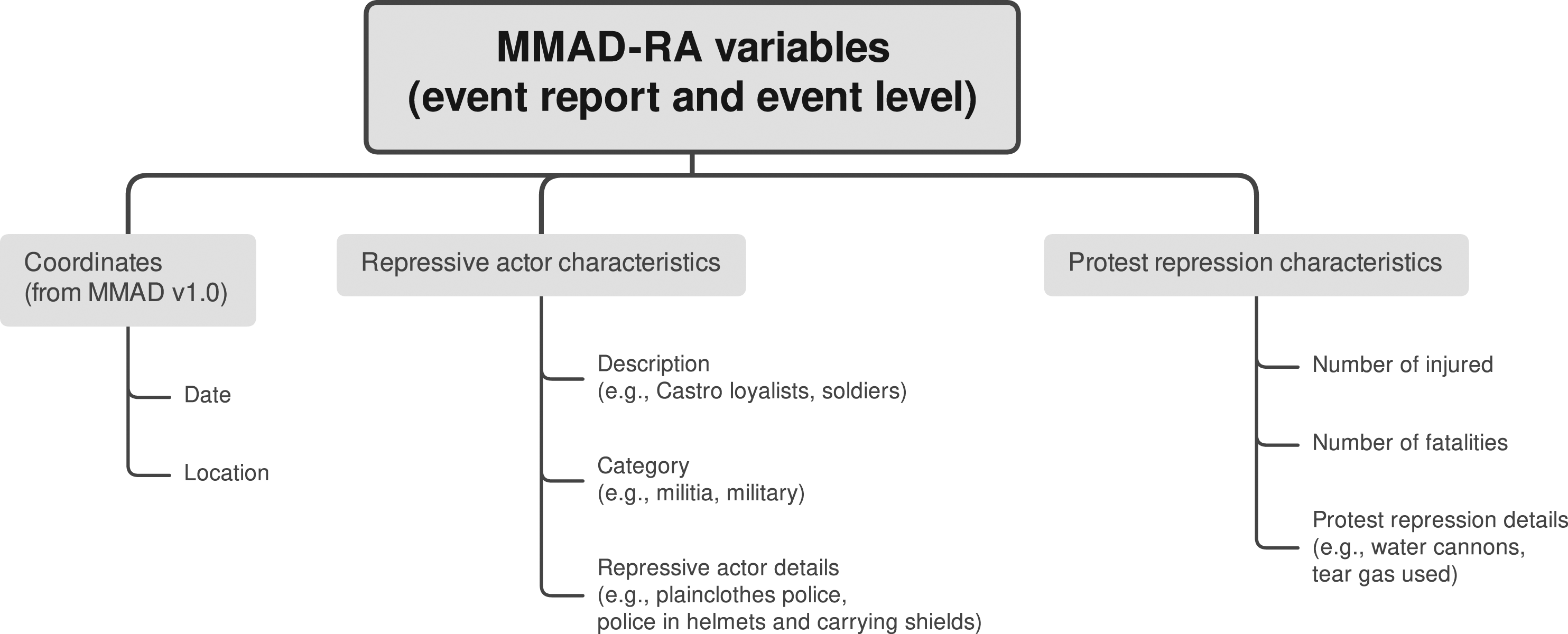

The military actor type consists of army, navy, and air force actors. We code actor names such as “soldiers” and “army” as part of the military category. The police actor type encompasses actors belonging to the regular civilian police force. Following existing research, we distinguish civilian police from militarized police (De Bruin, 2022), which encompasses special police units such as riot squads, tactical units, and gendarmerie. Militarized police can operate under civilian or military control and are characterized by the use of military-grade equipment and a more hierarchical and centralized organization than the regular civilian police. We code as police when sources refer to “policemen” or “police units,” unless other information indicates the use of military equipment and tactics or that special police units are deployed, in which case we code as military police. The militia actor type contains non-state armed groups linked to the government that operate parallel to the police, militarized police, and military. We assign the militia category to repressive actors with labels such as “loyalists,” “militants,” or “militia” in news reports. Where sources provide a name for the repressive actor, we consult additional sources for categorization. Myanmar reports mentioning the involvement of the Swan Arr Shin group, for instance, are assigned to the militia category following the PGMD (Carey et al., 2013).
In many cases, we cannot assign the repressive actor to one of the four main types based on the information in news reports. We label these “ambiguous security force.” Here, news articles use generic labels such as “security forces,” “security personnel,” or “paramilitary forces” without providing more information on the repressive actor. 5 These ambiguous labels are probably often used when it is unclear who the actor is, making it likely that the label captures actors such as militia and specialized forces rather than, for example, regular police. The patterns we uncover in the following sections lend support to this assumption. While the ambiguity can make studying how types of actors use violence against protesters more complex, there is a host of information on tactics and levels of violence for analysis in this actor category.
The other category includes actors that do not fit into the categories discussed above and rarely are mentioned, such as mercenaries and border guards. Actors are coded as missing if the report does not provide a description or name of the repressive actor.
Patterns in the data
Descriptive patterns in the data shed light on which repressive actors are deployed to protests in autocracies and how they interact with protesters. Figure 3 shows the number of protest events at which each repressive actor was present.
6
Police forces are present at most protests (4370, ≈72%). Militarized police were deployed to 876 events, military to 474, militias to 158, and other repressive actors to 40 events. The second most frequent category captures ambiguous security forces, making up 1193 repressive events (≈20%). Only 245 events (≈4%) lack information on the repressive actor. Number of MMAD-RA events for which each actor is present.
The level of violence differs by actors. Figure 4, which plots the median number of injuries (gray) and fatalities (black) with error bars corresponding to the first and third quartiles, highlights a comparatively lower level of violence used by police forces. The median number of injuries and fatalities is higher when the military, militarized police, militias, or ambiguous security forces are deployed. The difference in violence between the ambiguous security force category and police forces indicates that the former most often refers to actors other than the police. Two processes can give rise to these violence-level patterns. The police—given their recruitment, training, and equipment—may be less likely to resort to violence than other repressive actors. At the same time, police forces are likely deployed at other types of protests than, for example, the military, which is more likely present when a popular uprising poses a severe threat to regime survival. Median number of injuries and fatalities per event and repressive actor type. The error bars correspond to the first and third quartiles. The actors are ordered based on the median number of fatalities.
Figure 5 unpacks the repressive actor variation per country. Countries are ordered based on the mean engagement level of repressive actors during protests, with the countries on top of the list seeing, on average, more violent repression than those at the bottom of the list. In contrast to the reliance on police forces by the lion’s share of autocracies, the limited role of the police stands out in several countries characterized by more violent repression (e.g., Libya and the Central African Republic). We also see that the share attributed to ambiguous security forces is high in countries with more violent repression. Figure 5 also makes a compelling case for empirically disaggregating actors of repression: The overwhelming majority of authoritarian regimes deploys an array of different actors when facing anti-regime mobilization, and no country is coded as deploying only one type of repressive actor. The data can be used to gain knowledge on the temporal and spatial dynamics of repressive actor deployment and theoretically categorize regimes based on the repressive actors they deploy to protests. Variation in repressive actor type present at protest events by country. Percentages are calculated through the distribution of the repressive actors employed at protest events per country. If different repressive actors are employed at the same event, the repressive actors are accounted for separately. The number of protest employments of repressive actor x is divided by the total number of (distinct) actor protest employments per country. Countries are sorted in descending order based on the mean level of engagement, excluding countries with less than five protest events.
The MMAD-RA contains rich detail on the actions of repressive actors during protests. A glimpse of these is displayed in the waffle chart in Figure 6. The waffle charts visualize the distribution of event details per repressive actor using 100 squares, each representing 1% of the observations.
7
Several patterns are evident. The most common actions differ starkly between repressive actors. Arrests are much more common when the police or military police are present, whereas the military, militias, and security forces are more frequently mentioned when shots are fired. These patterns are in line with existing scholarship emphasizing the brutality of militias and the role of the military when regimes are threatened by popular overthrow (Bellin, 2012) and the number of injured and killed for each repressive actor that we presented in Figure 4. We note that the waffle chart patterns for militias and the ambiguous security forces category are similar and that ambiguous security forces fire shots at protesters much more often than police and militarized police, indicating that the latter label likely is often used for non-police actors, including militias. The use of batons and tear gas is relatively constant for different actors (excluding the missing category). We also see that stone-throwing (by protesters or repressive actors) is equally likely for all actors. However, more destruction of property is reported at protests where the military is deployed. Waffle charts showing event details by repressive actor types. The figure shows the distribution of event details per repressive actor. Multiple event details can be used to describe one event. Each square represents 1% of the event details mentioned per repressive actor.
A closer look at repressive actors during the Arab Spring
Scholars have engaged extensively with the role of the coercive apparatus during the Arab Spring in 2011. Regime transitions in Tunisia and Egypt have been linked to factors such as military economic incentives, disagreement between top-level generals and mid-tier officers, and competition between the police and the army (Bellin, 2012; Grewal, 2019; Nassif, 2015). Violent repression was much more widespread in Libya and Syria. Kadhafi’s fragmented coercive apparatus consisting of largely uncoordinated security forces and militias and al-Assad’s use of ethnic stacking to ensure loyalty are contributing factors to the escalation to large-scale political violence in these countries (Makara, 2013). Case and small-N comparative studies on the role of the coercive apparatus during the Arab Spring have significantly furthered our understanding of the success and repression of protest movements.
The MMAD-RA quantifies the deployment and behavior of repressive actors during protests in autocracies. Figure 7 displays the repressive actors active in six countries in the MENA region during the Arab Spring. The map is much in line with qualitative accounts of the role of various repressive actors in different regimes during the uprisings. The police are the most frequent repressive actor deployed at protests in Morocco, Algeria, Tunisia, and Egypt. In Tunisia and Egypt, the military mainly stayed on the sidelines, arguably facilitating the ousters of Mubarak and Ben Ali. Most frequent repressive actor per location in Morocco, Algeria, Tunisia, Libya, Egypt, and Syria from 2010 to 2012. The size of the circles corresponds to the number of events. The map was created using CShapes (Schvitz et al., 2022).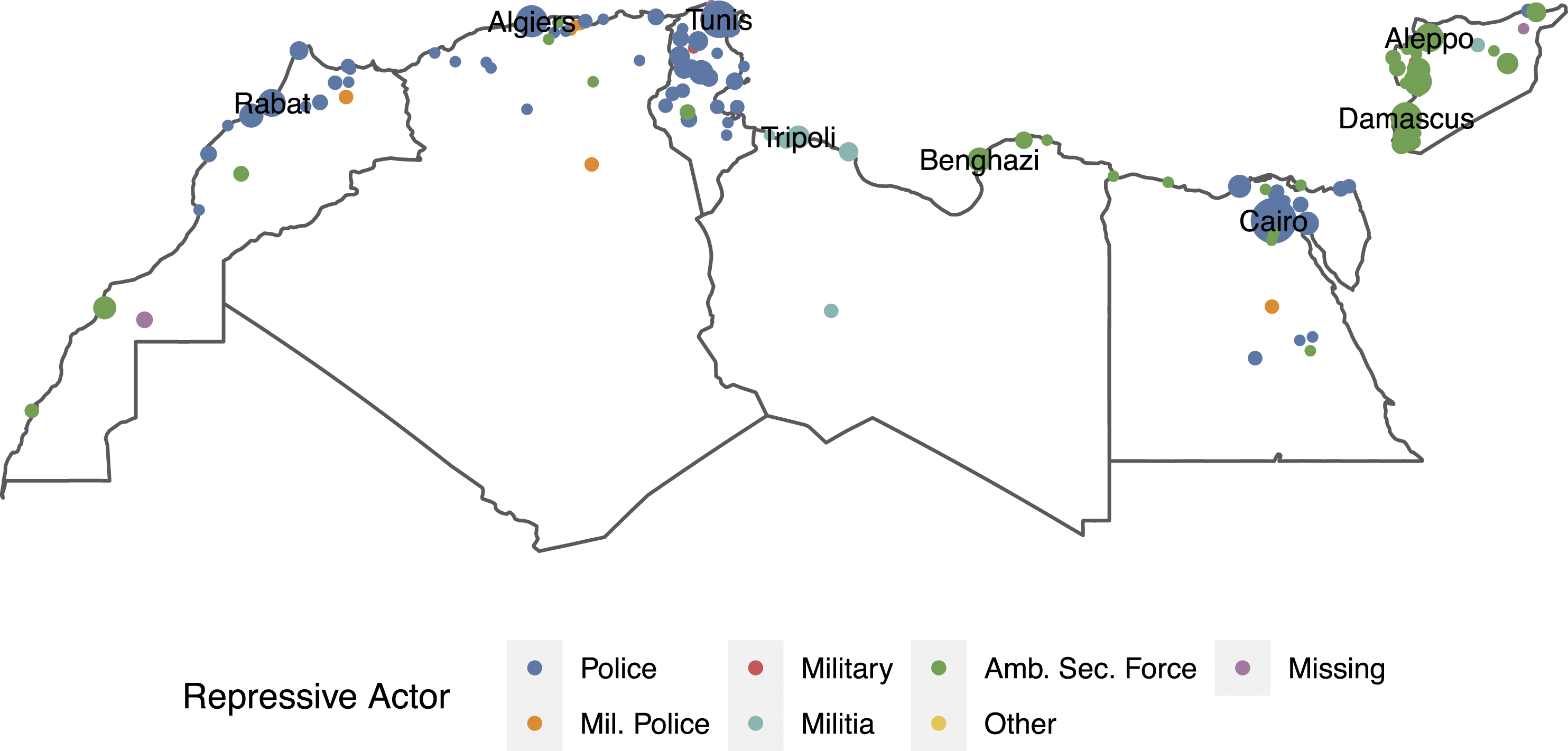
Syria and Libya stand out in Figure 7, with most areas dominated by the ambiguous security forces category. Based on knowledge of the repression of the Arab Spring in these countries, special forces and militias with personal or ethnic ties to Assad and Kadhafi likely make up the majority of these cases (Brooks, 2017). The numbers on lethal violence during protest events further underline how Syria and Libya stand out. Compared to the other MENA countries in Figure 7, protests in Syria and Libya have a higher average number of fatalities (14 vs 5). 8 Event details also predominantly feature descriptions of repressive actors firing at protesters in Syria (69% of events with information on event details) and Libya (57%). In the four other countries, the data shows that potentially lethal repression was uncommon in Morocco and Algeria (0–6%) but frequent in Egypt and Tunisia (approximately 30%). In these countries, non-lethal repressive actions such as arrests and tear gas were more common than in Syria and Libya.
Our discussion of the patterns in Figure 7 strongly suggests that the variation in actors that regimes rely on to repress protests can inform us about the potential for regime change and a violent escalation amid mass protests. Future work using the MMAD-RA can provide insights into the dynamics that produce this outcome variation.
Data quality and limitations
MMAD-RA’s data material stems from the MMAD and provides a systematic representation of information on repressive actors involved in protest events in these sources. However, there are limitations on reporting of protest repression in autocracies that users of the data need to be aware of (Davenport and Ball, 2002). First, descriptions of repressive actors in the news reports are often unclear and difficult to assign to actor definitions. As discussed, for 20% of the protest events, repressive actors are coded as ambiguous due to insufficient details in the sources. Second, small protests with low levels of violence are likely underreported, potentially skewing the actor distribution. Here, the reliance on media sources introduces bias to the report selection since violent reports are more likely to be captured by news outlets (Croicu and Eck, 2022).
How does this affect the MMAD-RA data? The data shows that military, militia, and the ambiguous security forces actor type are more likely to be featured in reports with data on the number of injured/killed than in event reports without data on these violence indicators, compared to police and militarized police. If this holds for potentially non-reported protest events, the MMAD-RA may underreport police and overreport military, militia, and the ambiguous security forces actor type. We also expect to see more bias during periods of upheaval (e.g., Arab Spring) when information is harder to verify and in harshly authoritarian regimes where information is scarce. Users of the data are advised to consider how their predictor or outcome of interest correlates with potential bias and which direction the bias goes when deciding on research design and interpreting results.
Despite these limitations, the MMAD-RA enables analysis of reporting on repressive actors since it contains information at the event report level. Users can analyze how reporting of the same event varies or how reporting varies over time. Alternatively, the MMAD-RA can be paired with other data to explore reporting patterns (Weidmann, 2016).
Discussion
There has been a significant increase in protests and large nonviolent resistance movements in recent decades (Chenoweth, 2020). To help scholars analyze and understand these movements’ dynamics, we have built on a growing body of research on states’ coercive apparatus and created the MMAD Repressive Actors Dataset (MMAD-RA). The MMAD-RA provides systematic information on the repressive actors present at protests in autocracies, including their type, tactics, and use of violence. The data is highly granular and captures variability between and within countries over time.
The MMAD-RA will be a valuable resource for students of protest, civil war, and democratization. For instance, the data allows researchers to investigate spatial patterns of repressive actor deployment and use of violence, how actors are related to repressive tactics and violence, and to classify regimes according to the coercive apparatus engaged in protest repression. Ultimately, the data can shed light on which repressive actors defend autocratic leaders in the face of mass protests and which actors decide to support or defect. The information provided in the MMAD-RA can also be used to link protest dynamics to political developments in the aftermath of protests and to help predict where unarmed rebellion can take a violent turn (Rød et al., 2022).
Supplemental Material
Supplemental Material - Introducing the MMAD Repressive Actors Dataset
Supplemental Material for Introducing the MMAD Repressive Actors Dataset by Espen Geelmuyden Rød, Jan Rustemeyer and Sabine Otto in Research & Politics
Supplemental Material
Supplemental Material - Introducing the MMAD Repressive Actors Dataset
Supplemental Material for Introducing the MMAD Repressive Actors Dataset by Espen Geelmuyden Rød, Jan Rustemeyer and Sabine Otto in Research & Politics
Footnotes
Acknowledgements
We would like to thank Andra Negus for research assistance. Thanks to Christoph Dworschak, Anton Kronborg, Jonas Vestby, and participants at workshops at PRIO and Uppsala University for excellent comments.
Declaration of conflicting interests
The author(s) declared no potential conflicts of interest with respect to the research, authorship, and/or publication of this article.
Funding
The author(s) disclosed receipt of the following financial support for the research, authorship, and/or publication of this article: This work was supported by the Research funded by the Swedish Research Council grant nr. 2018-01222.
Correction (June 2025):

Supplemental Material
Supplemental material for this article is available online.
The files can be found at https://dataverse.harvard.edu/dataset.xhtml?persistentId=doi:10.7910/DVN/D652NF&version=DRAFT
Notes
References
Supplementary Material
Please find the following supplemental material available below.
For Open Access articles published under a Creative Commons License, all supplemental material carries the same license as the article it is associated with.
For non-Open Access articles published, all supplemental material carries a non-exclusive license, and permission requests for re-use of supplemental material or any part of supplemental material shall be sent directly to the copyright owner as specified in the copyright notice associated with the article.
