



Abstract
Why do people support extrajudicial violence? In two survey experiments with respondents in Brazil, we examine which characteristics of lynching scenarios garner greater support for lynching and whether providing different types of information about lynching reduces support for it. We find that people often do support community members to take vengeance. In particular, our analysis finds that people strongly support the use of extrajudicial violence by families of victims against men who sexually assault and murder women and children. We also find that criminal punishment and the threat of vendettas reduce support, but appeals to the human rights of victims have zero effect on support for lynchings. Unlike the U.S. experience with lynchings, race was not observed to play an important role in how respondents answered the survey.
Introduction
The regulation of violence is a crucial role of the state. When states control violence effectively, markets, politics, and civil society can flourish (Besley and Persson, 2011; North et al., 2009). However, many states in the Global South still struggle to maintain a monopoly on the use of force. Scholars have written extensively about how rebel organizations challenge government institutions, yet we know little about what motivates local extrajudicial violence and vigilantism in the developing world (Bateson, 2021). 1 This omission is significant not only because vigilantism can deepen group enmities and lead to vicious cycles of violence, but also because it undermines the rule of law and the legitimacy of the state, which are essential for long-term economic development and democratic stability (Jung and Cohen, 2020; Tankebe, 2009).
One of the most serious forms of extrajudicial violence is lynching. Lynching can be defined as “incidents of physical violence committed by large numbers of private citizens against one or more individuals accused of having committed a ‘criminal’ offense, whether or not this violence resulted in the death of the victim(s)” (Godoy, 2004: 645). Although lynchings occur in more than one hundred countries in all regions of the world (Jung and Cohen, 2020; Smith, 2019), Latin America has been particularly affected by a sharp increase in vigilante violence. Lynching episodes have been reported in Guatemala, Mexico, Peru, Venezuela, and many other countries in the region (Barbara, 2015; Cruz and Kloppe-Santamaría, 2019; Godoy, 2004). From 2011 to 2015, Brazil registered about 2500 lynching episodes, and 173 people were killed by angry mobs in 2015 alone—nearly one execution every 2 days (Barbara, 2015; Oliveira, 2016). According to Martins (2015), who has studied lynchings in Brazil for more than 30 years, these numbers are not only the highest in the country’s history but also among the highest in the world. The people who participate in lynchings are typically young men, but they also sometimes include teenage girls, elderly women, and even members of the local police (Moura, 2017).
These alarming figures suggest that, despite being dismissed by policymakers as irrational and senseless, vigilantism enjoys considerable approval in Latin America (Berg and Wendt, 2011; Goldstein, 2005). This raises a number of puzzles: under which conditions do citizens perceive lynchings as a legitimate response to crime? Are some groups seen as more “deserving” of lynchings than others? And how can we reduce pro-vigilantism attitudes in young, unequal democracies?
In this study, we run two survey experiments and use primary qualitative data to understand attitudes toward lynchings in Brazil. Our paper begins with a conjoint experiment that evaluates in which circumstances citizens perceive lynchings as a justifiable punishment for crime. We also included open-ended questions for respondents to elaborate on their decision process. Lastly, we employ an information provision experiment to test the efficacy of three strategies to reduce individual support for lynchings.
Our empirical approach offers several distinct advantages. First, the data we collected come from the same level of analysis as the phenomenon itself: local residents. Second, online surveys are less susceptible to social desirability bias, and survey experiments help to elicit sensitive information—an especially important benefit in researching this topic (Horiuchi et al., 2022). Third, the experimental nature of the approach allows us to precisely estimate effect sizes and compare different theoretical explanations simultaneously. Finally, we can also control for confounding, which is a potential concern in previous research on vigilantism.
Our results show that people’s attitudes toward lynching are shaped strongly by the characteristics of the incident that give rise to it. In particular, respondents express support for lynchings perpetrated by the family of a victim of a sexual offense or murder. Subgroup analyses show that our findings are consistent across different segments of the population. In line with Godoy (2006) and Martins (2015), we find no experimental or qualitative evidence that lynching support is primarily driven by the race of the criminal. Our results also indicate that popular support for lynchings can be substantially reduced by reminding individuals of the penalties for lynching and of the risk of sparking vendettas, but not by emphasizing human rights protections. This suggests that campaigns focusing on the risks to vigilantes’ personal security can be effective correctives to pro-lynching attitudes and may strengthen support for the rule of law.
When is lynching perceived as more justified?
We invited respondents from all regions of Brazil to participate in our experiment. Qualtrics recruited 2406 adult Brazilian citizens between 30 October and 22 December 2020 to take part in our survey experiment. 2 We included 10 questions on demographics and other information that might influence the results. The covariates are the respondent’s age, gender, ethnicity, level of education, monthly family income, political orientation (left to right), support for the death penalty, whether they had been victimized in the last year, their trust in the police, and their trust in the judicial system. We used these measures to disentangle heterogeneous effects in the main responses. Descriptive statistics are available in Section B of the Supplementary Material.
Attributes and levels.

In addition to our knowledge of the Brazilian case, we also chose our attributes based partly on existing work on crime, vigilantism, and extrajudicial violence. From the prison violence literature, we know that the relative age differences and the genders of perpetrators and victims affect how it is perceived (Fleisher and Krienert, 2009). We likewise know that certain offenses are seen as especially reprehensible (Skarbek, 2014), so we included such offenses, like molestation, alongside less serious offenses. We include race because, in the United States, violent lynchings have often been wielded for racist reasons (Dray, 2003). Likewise, we include residency because extrajudicial violence is often used against people “who don’t belong” or are “outsiders” in some respect. Finally, in honor cultures that value retaliatory violence, people believe that victims and the family of victims have a special right (and often an obligation) to enact retribution (Weiner, 2013).
Respondents were asked to indicate in which scenario in each pair they thought that extrajudicial punishment was more justified. We also included a text box below each experiment for subjects to explain why they selected a particular case and whether they believed lynching was justified in neither case. Respondents read the following prompt before they started the experiment:
3
• Lynchings are often used as social punishment in Brazil. Lynchings are cases in which three or more people physically attack or execute a suspected criminal in public. We are interested in knowing more about how Brazilians see these episodes. In the next five questions, please read the description of two possible lynching victims in Brazil and indicate in which case you believe the punishment is more justified. Even if you are not entirely sure, please select one of the cases.
We report marginal means in our main analysis instead of average marginal component effects (AMCEs). Leeper et al. (2020) show that AMCEs can be misleading in subgroup comparisons as model results are sensitive to the choice of reference categories in interactions. In contrast, marginal means allow for a clear description of quantities of interest, in our case preferences about lynching, while also allowing for easy comparisons between groups of respondents. In a forced-choice experiment such as this one, a marginal-means estimate of 0.5 indicates that respondents are indifferent to this attribute vis-à-vis other attributes. When the coefficient is lower than 0.5, respondents dislike profiles with this attribute. Conversely, when the point estimate is higher than 0.5, respondents prefer profiles containing a given attribute.
Figure 1 shows the main results for the conjoint experiment. The graph illustrates the preference associated with each attribute of the hypothetical lynching episode. Dots with horizontal bars represent point estimates and 95% confidence intervals from linear regressions with robust standard errors clustered at the respondent level.
4
Relative preferences for lynching-episode attributes (marginal means).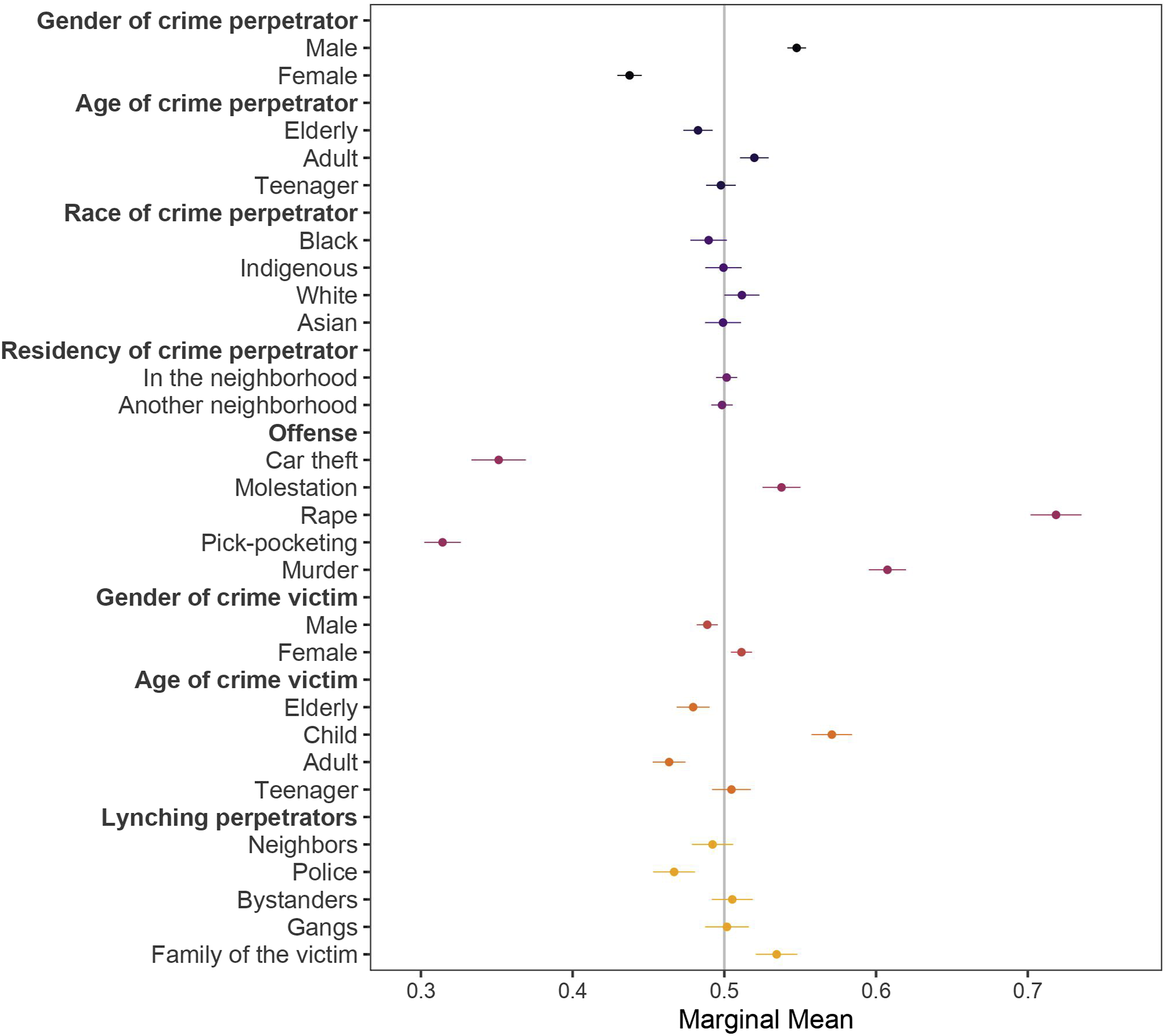
Respondents selected male offenders as preferred lynching victims more often than female offenders. We found identical results in our subgroup analyses, in which we disaggregated our sample according to respondents’ gender, income, race, support for the death penalty, and views on the police and judiciary. In all cases, men and teenage boys were more likely to be selected as more justified victims of lynching. Compared with the attributes we discuss below, the gender of the crime perpetrator had one of the largest effects in our experiment. With regard to the age of the crime perpetrator, respondents tolerated the lynching of adults more than attacks against teenagers or the elderly. More precisely, subjects were indifferent toward teenagers but reacted positively to lynching of adults and negatively to lynching of elderly people.
When we analyzed the effect of the race of the crime perpetrator, in contrast with the American experience, respondents favored the lynching of white perpetrators the most. Of all the racial identities that we included in the experiment, Black people were the least likely to be chosen as a more justified lynching victim, although the 95% confidence intervals overlap with the remaining categories. The effect is also robust for most subgroups, including white respondents. Asian respondents, however, rated fellow Asians as their least preferred choice. Taken together, the results provide experimental evidence that support for lynchings in Brazil does not resemble the typical racial patterns scholars have observed in the United States (Dray, 2003; Obert and Mattiacci, 2018; Seguin and Rigby, 2019). These findings are consistent with recent research on vigilantism in Haiti (Jung and Cohen, 2020) and with journalistic observations. They further suggest that the US experience with lynchings might be distinct from vigilantism in other places and times (Oliveira, 2016).
The residency of the perpetrator is not a significant driver of support for lynching. Subjects were indifferent as to whether the crime perpetrator lives in the area or in another neighborhood. In this sense, it is possible that subjects see lynchings not as a means to protect the area in which they live, which people commonly suppose vigilante groups do, but rather as retribution in specific cases.
The next attribute is type of offense. Rape was by far the most significant attribute in our model, followed by murder and molestation. It is not surprising that murder and rape were the most important offenses to respondents. Overall, we found that respondents do not believe that property crimes, such as car theft and pickpocketing, provide justification for lynching. When we analyzed the data by groups, we also saw that poorer respondents, whose household income is less than R$3000 (US$650) per month, are more likely to support the lynching of individuals who commit a property crime.
For age, we observed that respondents were particularly concerned about children as crime victims, as this attribute is strongly correlated with support for lynchings. Respondents also thought lynchings are more justified when the victim is a teenager, an elderly person, or an adult.
When we analyzed the gender of the crime victim, we found that respondents support lynchings more strongly when the victim is a woman or teenage girl and less strongly when the lynching victim is a man or teenage boy. The difference here is smaller than when we considered the gender of the crime perpetrator, but as in the previous estimation the 95% confidence intervals of each attribute did not overlap.
Lastly, and related to this, we examined who respondents believed are more legitimate perpetrators of lynchings. Respondents considered the family to be the most justified in carrying out a lynching. Again, the intervals here did not overlap with those of any other category. Bystanders, gangs, and neighbors do not increase or decrease respondents attitudes about lynching. If the police carry out a lynching, that reduced the perceived justification. In sum, respondents did not believe that lynchings should be carried out by the state but did believe they should be used as a tool for individual or family retribution. These results are consistent with norms of an honor culture in which offenses are seen to tarnish the victim’s status and the only way to remove the stigma is through self-help efforts in the form of retaliatory violence (Nisbett and Cohen, 1996).
Respondents were given the opportunity to explain the reason why they answered as they did. We analyzed a random sample of nearly 17% of the answers. Three major themes emerge. First, respondents felt that crimes that were especially heinous deserved a response. For example, one respondent explained their choice of a particular case as more justified by noting, “Eye for an eye, it’s absolutely fair.” A second theme is the injustice of victimizing vulnerable populations. One respondent explains, “The victim is an elderly person, it’s okay to lynch the criminal.” Another respondent says, “If the victim is a child, lynchings are not enough, they deserve more.” Finally, a third theme is that families have a special right to vengeance. One respondent explained their choice by saying, “The family was appalled and did justice with their own hands!” These open-ended answers are not only consistent with the quantitative results about what people believe, but they also provide additional evidence about why they hold their beliefs. 5
How to reduce support for lynchings
Even if people view lynchings as a legitimate activity that does not mean that this norm cannot be changed. In our second experiment, we measured the effect of information provision on attitudes about lynching. More specifically, we tested whether reminding respondents about the legal and social consequences of vigilante justice reduces subjects’ support for it. 6 The experiment included three treatment conditions and a control group. In all of them, we presented respondents with a short statement affirming that some Brazilians support vigilantism under certain conditions. We asked the control group to rate their agreement with the statement. Respondents were asked to use 0 to 49 if they disagreed, 50 if they neither agreed nor disagreed, and 50 to 100 if they agreed with the statement.
Each of the three treatment groups received a different message about the legal or social consequences of lynching in Brazil. In the first treatment, we informed subjects about how the Brazilian constitution and penal code punish civilian violence. The second treatment group was notified about the human rights guarantees enshrined in Brazil’s legal framework. The last treatment noted that lynchings can spark vendettas and initiate a cycle of violence in the community. Subjects in the control group received no information about the consequences of lynchings. The text shown to the control and treatment groups can be read below.
7
• Control group: In Brazil, some people believe that lynching may be justified under certain conditions. To what degree do you agree or disagree that lynching can be justified? Please use the slider below to indicate your preference. For disagreement, use 0–49; for agreement, use 51–100. Please use 50 if you neither agree nor disagree. • Treatment 1 (Legal punishment for lynching perpetrators): In Brazil, some people believe that lynching may be justified under certain conditions. However, the Brazilian constitution and penal code strictly forbid lynching and those involved can be accused of torture or murder. To what degree do you agree or disagree that lynching can be justified? Please use the slider below to indicate your preference. For disagreement, use 0 to 49; for agreement, use 51 to 100. Please use 50 if you neither agree nor disagree. • Treatment 2 (Human rights): In Brazil, some people believe that lynching may be justified under certain conditions. However, the Brazilian constitution states that all individuals have the right of not being tortured, including criminals. To what degree do you agree or disagree that lynching can be justified? Please use the slider below to indicate your preference. For disagreement, use 0–49; for agreement, use 51–100. Please use 50 if you neither agree nor disagree. • Treatment 3 (Vendettas): In Brazil, some people believe that lynching may be justified under certain conditions. However, lynchings can trigger a new cycle of violence as the family or friends of the victim may retaliate against the community. To what degree do you agree or disagree that lynching can be justified? Please use the slider below to indicate your preference. For disagreement, use 0–49; for agreement, use 51–100. Please use 50 if you neither agree nor disagree.
We are interested in the difference between the average score given by each of the treatment groups and the average score given by the control group. We estimate average treatment effects using OLS with dummy indicators for the treatment groups.
Average treatment effects for Experiment 2.

*p
Robust standard errors in parentheses.
Our last treatment, which raises the possibility of sparking vendettas, has a large, negative effect on support for lynchings. Mentioning that lynchings trigger cycles of violence has a negative effect of about 8% when compared with the control group. While we expected that the coefficient for this treatment condition would be larger than that for the treatment on legal punishments, the means of both groups are not statistically different from each other. As with the other experiments, the results remain stable when we conduct subgroup analyses.
Conclusion
Regulating violence is one of the most fundamental responsibilities of the state, and in many places in the world today, states are failing to do so. Brazil provides a telling example of how extrajudicial violence can escalate and pose a serious threat to the stability of government institutions.
Our results show that the characteristics of a lynching significantly affect people’s support for it, especially when the crimes are heinous or committed against vulnerable populations. In contrast with studies about mob violence in the American South, we find no evidence that lynchings are strictly racially motivated in Brazil. While we were able to reduce support for lynchings by reminding respondents that lynchings are a criminal act and that lynchings risk igniting vendettas, appeals to human rights had no effect in our experiment.
These findings have implications that extend well beyond Brazil. In particular, our experiments indicate that lynchings have a crucial gendered aspect, which has also been documented in other contexts. Using data from 18 Latin American countries, Nivette (2016) also finds that respondents are most likely to support lynchings when the criminal raped a child, and studies about lynchings in the American South point out that several episodes resulted from accusations of sexual assault (Jacquet, 2013; Smångs, 2020). We believe that a culture of honor may explain these results. Individuals in honor societies view crime as an attack on their personal reputation and, in turn, are more likely to take revenge to defend their status and that of people perceived as deserving protection, such as women and children (Nisbett and Cohen, 1996). A culture of honor may also explain why Brazilians see lynchings carried out by the family of the victim as more justified, as well as refraining from using extralegal violence if it can trigger vendettas. We expect similar results in societies which share those cultural norms. Lastly, the fact that race does not appear to be a major motivation behind lynchings also reflects the experience of places like Haiti or Southern Africa, where popular violence was mainly driven by other social factors (Berg and Wendt, 2011; Jung and Cohen, 2020). Even in the American South, Whites and Blacks also lynched people of their own race (Beck and Tolnay, 1997). In this respect, our paper also highlights that lynchings in the Global South may be more strongly connected with the idea of “popular justice” than with racial animus (Kloppe-Santamaría, 2019; Martins, 2015).
Our work also suggests new avenues for further research. While previous studies indicate that there is a relationship between pro-lynching attitudes and actual engagement in vigilante violence (Weisburd, 1988), future research should try to identify which factors motivate citizens to participate in lynching episodes (Nivette, 2016). Moreover, it is still unclear whether other forms of vigilantism, such as security patrols, property damages, or coercive interrogations, have similar levels of popular support (Bateson, 2021). Finally, lynchings have often been described as a response to low state capacity (Trevizo, 2022), yet in some cases state agents actively incite or engage in vigilante violence themselves (Arias and Goldstein, 2010). Future studies may investigate in which circumstances state authorities favor informal local control instead of public law enforcement. Unravelling these issues is crucial if scholars wish to better understand how and why states and civil society decide to use violence.
Supplemental Material
Supplemental Material—Vigilantism and institutions: Understanding attitudes toward Lynching in Brazil
Supplemental Material for Vigilantism and institutions: Understanding attitudes toward Lynching in Brazil by Danilo Freire and David Skarbek in Research and Politics.
Footnotes
Acknowledgments
We thank Rosario Aguilar, Nicholas Barnes, Hannah Baron, Dara Kay Cohen, Nick Cowen, Daniel J. D’Amico, Miriam Golden, Richard Locke, Umberto Mignozzetti, Eduardo Moncada, Irfan Nooruddin, Jonathan Obert, Brian J. Phillips, Alexandra Scacco, Livia Schubiger, Natán Skigin, Nicholas Rush Smith, Richard Snyder, and Georg Vanberg for their valuable comments. We received helpful feedback in seminars at EGAP; the Extra-legal Governance Institute at the University of Oxford; the Comparative Workshop at Brown University; the Kroc-Kellogg Peace, Conflict, Crime and Violence Workshop at Notre Dame; and the Severyns Ravenholt Seminar in Comparative Politics at the University of Washington. This study received IRB approval from Brown University in October 2020 (Protocol, 2009002803). Replication materials are available at  . We thank the Centre for the Study of Governance & Society at King’s College London and the Templeton Foundation, and the Institute for Humane Studies (grant no. IHS016984) for their financial support.
Declaration of conflicting interests
The author(s) declared no potential conflicts of interest with respect to the research, authorship, and/or publication of this article.
Funding
The author(s) disclosed receipt of the following financial support for the research, authorship, and/or publication of this article: This work was supported by the King’s College London.
Supplemental Material
Supplemental material for this article is available online.
Notes
References
Supplementary Material
Please find the following supplemental material available below.
For Open Access articles published under a Creative Commons License, all supplemental material carries the same license as the article it is associated with.
For non-Open Access articles published, all supplemental material carries a non-exclusive license, and permission requests for re-use of supplemental material or any part of supplemental material shall be sent directly to the copyright owner as specified in the copyright notice associated with the article.
