




Abstract
The Panama Papers disclosures in April 2016 revealed information about tax avoidance and fraud among political elites and the wealthy on a global scale. But did the disclosures affect relevant political attitudes and behavior, including perceptions of corruption, redistributive preferences, and voting intentions? We leverage nationally representative surveys that were in the field at the time in two heavily impacted countries, France and Spain, and treat the disclosures as a natural experiment, comparing respondents questioned just before and just after the disclosures. Our design highlights the difficulty, at times, of interpreting natural experiments, given the potentially compounded treatments that arise as events unfold over time, and the common inability to properly determine views prior to the treatment. That said, the analysis indicates that the disclosures had limited effects on the domains most likely affected by such a scandal, consistent with them being interpreted based on existing beliefs and identities. Our results thus contradict prior findings which suggest that the Panama Papers had substantial effects on redistributive attitudes, and shed further light on voters’ learning and updating around uncertain, yet emotionally laden, political facts.
Introduction
Evaluating the impact of novel information on political attitudes and behavior has lately taken on greater urgency (e.g., Flynn et al., 2017). We focus on two related areas where this question is particularly acute: corruption and economic inequality. Recent research in these domains suggest an unclear picture regarding the role of information, despite a generally uninformed citizenry (Chang et al., 2010; Gimpelson and Treisman, 2018). Scholars have shown that informing voters about corruption can reduce the support for relevant officials (Weitz-Shapiro and Winters, 2017), or it can have null or even positive effects on incumbent support (De Vries and Solaz, 2017). Similarly for economic inequality, some studies find that informing voters about the true levels of inequality in society does increase support for income redistribution (Kuziemko et al., 2015), while others find null or inconsistent results (Trump and White, 2018).
This paper contributes to these debates by taking advantage of the unexpected disclosures of the Panama Papers on 3 April 2016. This large trove of leaked documents provided an exogenous information shock, which revealed many instances of government officials and wealthy individuals engaging in fraud and tax evasion through offshore shell accounts. To estimate the effect of the disclosures, we use an “Unexpected Event During Surveys” research design (see Muñoz et al., 2020), comparing the survey responses provided before and after this unexpected event, across two nationally representative surveys in France and Spain, two countries heavily implicated by the disclosures.
We are not the first to study the effects of the Panama Papers on political behavior. Ouali (2020) finds that European citizens became more supportive of redistribution, as well as slightly more likely to support pro-redistribution parties. Although the paper is novel in its contribution, it is hampered by making causal inferences based on data measured well before or after the disclosures. As we outline below, our research design, motivated as a natural experiment around a narrower time frame, allows us to more accurately capture the potential effects of the leak on political behavior.
In the end, we mostly find null results, although there is evidence that the disclosures shifted citizens’ perceptions of corruption, as well as their willingness to redistribute income, in both partisan and altruistic ways. Importantly, we find little reliable evidence that the Panama Papers revelation shifted intended voting behavior, even where the incumbent government was seemingly directly implicated in the scandal. The results are consistent with the hypothesis that the information shock was not strong enough to change partisan loyalties, but may instead generally have been interpreted based on existing beliefs and identities (Solaz et al., 2019).
That being said, an unexpected event during a survey is not a silver bullet for causal inference. Although we carefully evaluate several relevant threats to internal validity and find each of the underlying assumptions of our analysis plausible, the analysis nonetheless highlights the uncertainty involved in applying this increasingly common research design to noisy real world observational data. As such, we emphasize that our results should be interpreted in light of the limitations in internal validity posed by this research design.
The Panama Papers scandal
On 3 April 2016, the International Consortium of Investigative Journalists (ICIJ), composed of journalists from various countries, released the first set of documents from the so called “Panama Papers” (see ICIJ, 2020). These were documents from the Panamanian law firm Mossack Fonseca, leaked by an anonymous whistleblower. The documents detail personal financial information about wealthy individuals and public officials, relating to offshore entities and shell corporations. In total, 140 politicians from 50 countries were implicated in the scandal, including the leaders of Argentina, Ukraine, and Iceland.
Spain and France were two of the most affected countries by these leaks (Dalby and Wilson-Chapman, 2019). Among the prominent individuals implicated in Spain were the Minister of Industry (who later resigned) and the former vice-president, both belonging to the ruling conservative party, the Partido Popular (PP), a political party previously implicated in a series of corruption scandals. In France, on the other hand, the political figures implicated were more evenly distributed across the political spectrum. Several key members of the far-right party, the Front National (FN), were mentioned in the leaks (including its founder and previous leader), as was a previous minister in the socialist government at the time, and Senators and Delegates in the French Parliament from various parties.
The disclosures of the Panama Papers received widespread news attention at the time, and were thus highly salient among the public.
1
Figure 1 provides the Google search trends in both Spain and France before and after the leak, as benchmarked to searches for “Trump” and “Euro 2016,” both of which were trending topics at the time.
2
The search count shows a clear peak in searches for “Panama Papers” around the 3rd of April, which suggests that the leaks significantly caught people’s attention in these two countries.
3
Google trends keyword searches around 3 April 2016.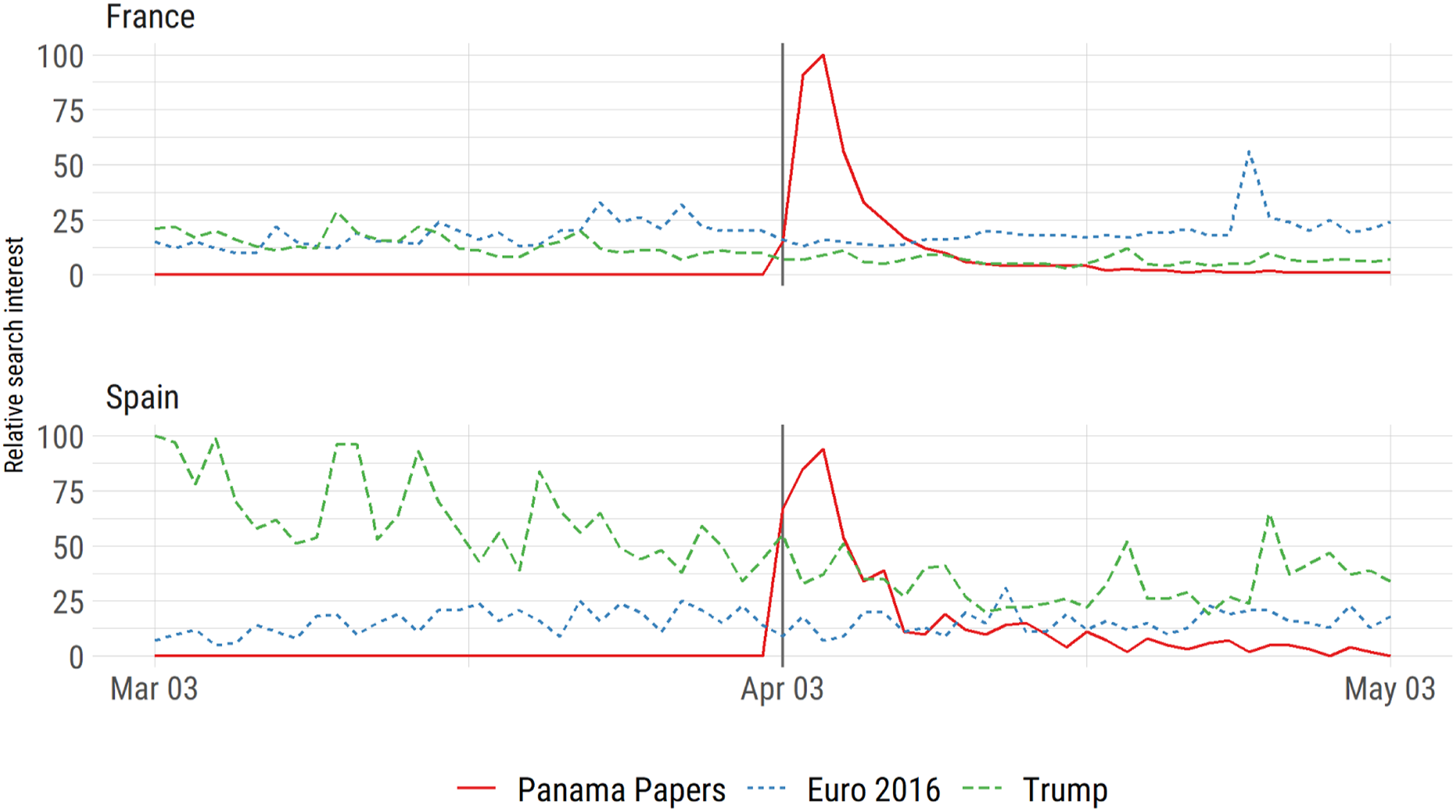
We expect such a leak to provide two crucial pieces of information. First, it should provide a general signal of “corruption” among political elites, at least in the minds of voters, and in particular the specific parties prominently mentioned in the documents. 4 Previous research on corruption generally argues that support for incumbent parties decreases whenever there is greater and better quality information exposing corruption in the government, unless responsibility is unclear or there are no superior alternative parties to support (De Vries and Solaz, 2017). We also know that voters are more likely to disregard negative information against their own party, but embrace negative information undermining opposing parties, such that corruption scandals have the potential to increase polarization between government supporters and opponents (Solaz et al., 2019). Consequently, the effect of corruption information is expected to not only depend on its strength and the existence of alternatives but also on the motivated responses to the information.
In Spain, this is expected to more specifically increase beliefs in the prevalence of corruption within the incumbent ruling party, except among supporters of the party, who should reject such accusations. In France, meanwhile, this could either increase the general belief that all politicians and public officials are corrupt, if voters are not reacting in a motivated fashion, or, if voters instead update in a motivated way, it could produce asymmetric perceptions of corruption in the government, as supporters of each party are provided with “ammunition” to selectively use when rejecting opposing parties.
Second, such a leak also provides a rough reminder of the extent of inequality in society, as well as a potential indicator of the lack of economic fairness due to imbalanced tax compliance. Information that lowers perceptions of relative ranking or dampens expectations of economic mobility should enhance voters’ support for redistributive public policies, in particular for poorer individuals who stand to gain the most (Mérola and Helgason, 2016). Research has also demonstrated the importance of beliefs regarding fairness and deservingness when it comes to attitudes around inequality (Almås et al., 2010). In that sense, learning about the unequal opportunities that exist across social groups, or tax avoidance among the wealthy (who thus might seem less deserving), should increase support for redistributive policies as well, potentially even among the rich.
Holding offshore shell accounts is generally viewed as the privilege of the elite few, generally done in order to avoid paying taxes, thus serving as a signal or prime of the large gap that exist among the middle and working classes, on one side, and the rich on the other, both in terms of their income and tax compliance. Such information is therefore generally expected to increase the support for redistributive policies, effects which should be stronger among lower income voters.
Data and research design
To test the expectations above, we take advantage of two nationally representative surveys in France and Spain that were in the field in the days before and after the Panama Papers scandal was exposed. We employ an “Unexpected Event During Surveys” research design, which compares responses of individuals to the same survey just before and just after an unexpected and exogenous event (Muñoz et al., 2020). This research design gives us leverage to evaluate the effect of said event on individual preferences and voting intentions.
The “Role of Government” module of the International Social Survey Programme (ISSP) was in the field in France from February 9 until September 30, although 75% of responses were collected before May (ISSP, 2018). The survey yielded 1501 responses, based on a simple random sample. As respondents completed the survey by mail, the date of survey completion is the date the mailed in survey was received by the survey organization. As such, we do not know the exact date when respondents completed and mailed the questionnaire, and as a result, we code as missing responses received on April 4–6 (meaning 1–3 days after the disclosures), since the treatment status of these responses is uncertain (the results are not sensitive to sightly changing these dates).
The April barometer survey of the Centro de Investigaciones Sociológicas (CIS) was in the field in Spain from April 1 to April 10. The face-to-face survey yielded 2490 responses, with sampling stratified by region and town size, and individuals stratified by age and sex. Due to its face-to-face nature, there are considerable imbalances in the temporal distribution of interviews across regions, which require special methodological care, as we outline in the next section. 5
The ISSP survey contains numerous questions which are relevant for our purposes. To capture redistributive attitudes, we use three questions: whether it is the government’s responsibility to reduce income differences between the rich and the poor, and whether taxes for those with high incomes and those with low incomes are too high. To capture changes in beliefs about corruption and government accountability we use two questions: how many politicians and how many public officials, respectively, are perceived to be involved in corruption. 6
The CIS survey primarily consists of questions on voting intentions. To capture the effect of the corruption shock on voting intentions, we use a question on how likely respondents are to vote for one of the four major parties in Spain on a scale from 0 to 10. 7
Assumptions and threats to internal validity
As with any natural experiment, drawing inferences about causation based on the “UEDS” research design rests on several assumptions, some of which can be directly assessed, while others depend on circumstantial evidence (Muñoz et al., 2020).
First, it could be the case that some or all respondents in the treatment group did not receive the treatment, which for our study would entail respondents not noticing the outbreak of the Panama Papers scandal. We consider such non-compliance unlikely to be problematic in our case: The scandal was extensively documented by the mainstream media, while the Google Trends analysis suggests that the scandal gathered major attention among the public as soon as it broke out in both France and Spain. That being said, we do not have individual level data on exposure to the scandal and our results should be interpreted in light of that limitation.
Second, the excludability assumption may be violated, as the outbreak of the scandal did not occur in a vacuum but rather unfolded in the context of Spanish and French politics. To guard against the potential for a monotonic time trend in attitudes, we limit the time window of our samples as much as is feasible considering the sample size. Due to differences in fieldwork between the two countries, these feasible windows differ substantially: In the Spanish case we can limit our analysis to the two days before and after the outbreak of the scandal, while in the French case we limit ourselves to a one month window before and after 3 April 2016. 8 As is often the case with natural experiment, we are thus unable to cleanly isolate the exposure of the Panama Papers from the political reactions and societal discussions that followed (at least in France), although these later events also helped keep the issues of corruption and inequality salient in the weeks after the disclosures themselves. 9
Third, the ignorability assumption may be violated, primarily because the reachability of respondents may differ in a consequential manner, leading some types of individuals to respond earlier than others, regardless of the treatment. Furthermore, the scandal may have caused some respondents to participate due to their reactions to the disclosures. To assess this assumption, we do a balance test on relevant covariates and find some imbalance (see section 2.2 of the Online Appendix). In the case of the Spanish survey, which was based on face-to-face interviews, we primarily find differences in the regional composition of the treatment and control groups. In the case of the French survey, we find differences between age and education groups, which is in line with previous research on bias due to reachability (Muñoz et al., 2020). In the analysis reported below, we account for these differences using entropy balanced matching (Hainmueller, 2012). Along with different treatment windows, the appendix details the results without entropy balancing.
Empirical analysis
We rescale all outcome variables to have a mean of zero and standard deviation of one, and code them such that higher values represent more agreement with a given statement. Following theoretical expectations, we report overall effects, as well as effects by key subgroups: “rich” versus “non-rich,” and incumbent government supporters versus non-incumbent supporters. 10 Full model results and question wordings are available in the appendix.
Figure 2 shows the treatment effects on redistributive preferences in France. As we can see, there are no reliable overall effects, regardless of the outcome. However, there is a noticeable subgroup difference, with richer respondents increasing their support for reducing taxes after the Panama Papers disclosures, although only on lower income citizens. Interestingly, this increased support for reducing the tax burden among the poor is significantly stronger (by about 0.75 standard deviations) for respondents from the top of the income distribution than the rest. Since there are no significant shifts regarding the tax burden on high income citizens, this could imply that there is a specific increase in sympathy from the rich toward the poor, which manifests itself as a willingness to lower the fiscal burden on the poor, as opposed to increase it on the rich. These results are consistent with recent evidence among developed democracies, which finds that the rich become more altruistic as income inequality rises (Dimick et al., 2017), although they are harder to explain from a standard political economy perspective. The Panama Papers’ effect on redistributive preferences in France. Note: OLS estimates with entropy balancing weights and one month treatment bandwidth. Positive values indicate more agreement with statement. Confidence intervals shown at 90 and 95% level with thick and thin lines, respectively.
Meanwhile, Figure 3 displays the results of the information shock on corruption beliefs in France. There are several important effects. First, there is a clear, and very strong, partisan effect, whereby supporters of the incumbent government become considerably less likely to admit that there is corruption among public officials and politicians. This effect is not only strong (0.5–0.75 standard deviations) and significant on its own, but it is also significantly different from the effect among all other respondents. This is consistent with recent research on the seemingly motivated bias in corruption perceptions between supporters and opponents of the incumbent government (Solaz et al., 2019), as well as broader work on partisan cheerleading around political facts (Bullock and Lenz, 2019).
11
Although opponents of the government view the government as somewhat more corrupt after the disclosures, this effect is not significant. The Panama Papers’ effect on corruption beliefs in France. Note: OLS estimates with entropy balancing weights and one month treatment bandwidth. Positive values indicate more agreement with statement. Confidence intervals shown at 90 and 95% level with thick and thin lines, respectively.
In Figure 4, we turn our attention to the results of the information shock on voting intentions in Spain. There are no strong or highly precise effects. Importantly, unlike the previous results, we see no consistent evidence of a partisan effect based on prior votes.
12
Thus, despite having the clearest case of an incumbent government particularly tainted by the Panama Papers revelation, it would seem that this information shock did not significantly alter voting intentions across supporters or opponents of the government in Spain. This is consistent with recent findings regarding the difficulty of shifting voting behavior, even when presenting voters with clear information about the performance of incumbent officials (Dunning et al., 2019). It is also possible, however, that the leaks were somewhat overshadowed by the run-up to the elections at the time, in particular as it relates to members of the ruling party implicated. The Panama Papers’ effect on voting intentions in Spain. Note: OLS estimates with entropy balancing weights and two day treatment bandwidth. Positive values indicate more agreement with statement. Confidence intervals shown at 90 and 95% level with thick and thin lines, respectively.
Conclusion
It is unclear how much political attitudes truly change when exposed to novel political information. The more revelatory the information, the more we might expect attitudes, and potentially behavior, to change. Since voters generally are unaware of the level of corruption (Chang et al., 2010) or economic inequality (Gimpelson and Treisman, 2018) in society, we would expect that glimpses into the true state of affairs on these issues should be particularly important. The empirical literature, however, is decidedly mixed in this regard.
In order to shed light on this question, we take advantage of the unexpected disclosures of the Panama Papers, a natural experiment presenting unique evidence on the sometimes illegal offshore accounts of the rich and politically powerful, which garnered a great deal of media attention. But did it affect political attitudes and behaviors? We find that it did not, at least not in a uniform and consistent way. Critically, it did not seem to lower support for the incumbent, even when government ministers were directly implicated. It did, however, seemingly polarize perceptions about corruption in the government among supporters and opponents, while also producing a greater willingness among the rich to redistribute income by lowering the fiscal burden on the poor.
Although our research design does entail some important assumptions, we believe these are adequately satisfied in our case. That said, the design does not allow us to properly specify the mechanism in question, since we cannot cleanly identify the “treatment”—in particular, whether the information received was truly novel or what exact information produced the effects. For example, while we believe that the null effects on voting behavior in Spain reflect the difficulty of significantly shifting voting intentions two months before an election, it is also possible that the disclosures presented little new information given the recent corruption scandals which tainted the incumbent government, or that the leaks simply did not receive sufficient media attention in the context of an election campaign. Future work should further investigate the differing effects of novel versus reaffirming information, as well as the conflicting pathways of immediate information shocks and any subsequent government responses on the ground.
Although this highlights the potential cost of lower internal validity from natural experiments, there are also benefits to such a design. Most importantly, it helps us overcome the well-known problems of ecological validity potentially plaguing survey experiments (Barabas and Jerit, 2010). As such, our findings of partisan differences in corruption perceptions become even more noteworthy, given recent evidence from survey experiments indicating that voters engage in minimal motivated learning when consuming factual information (Guess and Coppock, 2020). We believe systematically comparing differences in modes and designs across issue areas is therefore an important next step in the broader literature on the role of information in public opinion and political behavior.
Supplemental Material
Supplemental Material - The impact of real world information shocks on political attitudes: Evidence from the Panama Papers disclosures
Supplemental Material for The impact of real world information shocks on political attitudes: Evidence from the Panama Papers disclosures by Agnar Freyr Helgason and Vittorio Merola in Research & Politics
Footnotes
Declaration of conflicting interests
The author(s) declared no potential conflicts of interest with respect to the research, authorship, and/or publication of this article.
Funding
The author(s) disclosed receipt of the following financial support for the research, authorship, and/or publication of this article: Agnar Freyr Helgason’s contribution was supported by the Icelandic Research Fund (Grant No. 173968-052).
Correction (June 2025):

Supplemental Material
Supplemental material for this article is available online.
The files can be found at https://dataverse.harvard.edu/dataset.xhtml?persistentId=doi:10.7910/DVN/QP1OTG&version=DRAFT
Notes
References
Supplementary Material
Please find the following supplemental material available below.
For Open Access articles published under a Creative Commons License, all supplemental material carries the same license as the article it is associated with.
For non-Open Access articles published, all supplemental material carries a non-exclusive license, and permission requests for re-use of supplemental material or any part of supplemental material shall be sent directly to the copyright owner as specified in the copyright notice associated with the article.
