




Abstract
We analyze whether exposure to state violence affects substance use at the individual level. In doing so, we bring together the political science and public health literatures on the effects of violence, analyzing an outcome that is neglected in political science and a type of violence that remains understudied in public health. We leverage a unique panel study, the Population Council’s Survey of Young People in Egypt (SYPE), to test whether rates of substance use are higher among those who were exposed to violence during the country’s 2011 revolution, a moment of intense state violence against civilians. Results demonstrate that direct exposure to state violence increases substance use; respondents exposed to violence are significantly more likely to use drugs, alcohol, and tobacco than those who were not. Our findings are robust to specifications that control for respondents’ reported exposure to state violence prior to the revolution and substance use among family and friends, factors identified in medical research as key predictors. Our study sheds light on a fundamental predicament of authoritarian governance and the downstream effects of state violence.
Introduction
States regularly use violence to defend not only against external enemies but also internal challengers. The state will be violent towards its own citizens as it seeks to maintain order, control the population, and demobilize organized opposition (Hassan et al., 2022). Political science research on the effects of conflict finds a number of consequences from exposure to state violence that align with understandings of group threat drawn from behavioral psychology (Brewer and Brown, 1998), including both defensive in-group favoring behaviors (Berrebi and Klor, 2008; Canetti-Nisim et al., 2009; Elster, 2019; Feldman and Stenner, 1997; Getmansky and Zeitzoff, 2014; Hadzic et al., 2020; Hetherington and Weiler, 2009; Hoffman and Nugent, 2017) and positive pro-sociality (Bellows and Miguel, 2009; Balcells, 2012; Nugent, 2020; Punamaki et al., 1997; Voors et al., 2012). At the same time, medical studies consistently demonstrate the pernicious individual-level effects of exposure to violence of all kinds, with an overwhelming focus on exposure to interpersonal violence in the home or family (Kendler et al., 2003a, 2003b; Kendler et al., 2007; Ogden et al., 2022; Sullivan et al., 2004). In this article, we seek to bring these two disparate literatures into conversation and analyze whether exposure to state violence affects substance use at the individual level. Our innovation is that we focus on an outcome neglected in political science analyses and a type of violence that remains understudied in the public health literature.
To test whether exposure to state violence affects substance use, we leverage a unique panel study of young Egyptians to test whether witnessing state violence increased subsequent drug, alcohol, and tobacco use. The Population Council’s Survey of Young People in Egypt (SYPE) interviewed 10,916 young adults in 2009 and again from 2013 to 2014. Both waves of the survey asked several questions about the respondent’s personal substance use habits. In 2011, between the two waves, Egypt experienced a revolution as part of the Arab Spring uprisings. Revolution is an instance of contentious politics during which state violence is particularly prevalent as the state seeks to reassert its authority. During the revolution, the Egyptian state responded to protest mobilization and opposition in all forms with brute force. As a result, a large number of Egyptians were exposed to state violence, many for the first time. Egypt thus serves as an important test case, where exposure to violence is likely to be widespread enough following the revolution to detect its effect in individual survey data. In addition, the 2014 instrument included a battery capturing the respondent’s experience of the 2011 revolution, which asked whether they witnessed violence during it.
We find that exposure to state violence during the 2011 revolution significantly increased substance use; respondents exposed to violence are 1 to 2 percentage points more likely to subsequently report using drugs, alcohol, and tobacco than those not exposed to violence. Substantively, the size of this effect is akin to that of major life events identified in medical studies as contributing to a significant increase in substance use such as losing employment, experiencing depression, or becoming less religious. Our results are robust to specifications that control for respondents’ reported exposure to state violence prior to the revolution and relevant substance use among friends and family, an important predictor of substance use in the medical literature. The article proceeds as follows. First, we synthesize the political science literature on the effects of state violence and the public health literature on exposure to violence and substance use. Next, we outline our empirical strategy and discuss the results of our analyses. We then conclude with the implications of our findings, the limitations of our study, and thoughts for future research.
The effects of exposure to state violence
Political science studies demonstrate that exposure to violence may have both positive and negative effects on politically relevant outcomes, with an understanding of threat drawn from social psychology (Brewer and Brown, 1998). Violence often engenders defensive behaviors. For example, exposure to violence decreases pro-social behavior towards out-group members, increases support for conservative preferences that may harm, punish or exclude the out-group, and results in a larger number of votes for politicians who advocate these policies (Berrebi and Klor, 2008; Canetti-Nisim et al., 2009; Elster, 2019; Feldman and Stenner, 1997; Getmansky and Zeitzoff, 2014; Hadzic et al., 2020; Hetherington and Weiler, 2009; Hoffman and Nugent, 2017). However, the nature of violence matters for whether it has a positive or negative effect on politics. When violence is targeted, affecting some groups and not others, it creates more divisive outcomes. When violence is widespread and shared across groups, it can be transformative and increase pro-social political behavior and preferences (Balcells, 2012; Bellows and Miguel, 2009; Punamaki et al., 1997; Nugent, 2020; Voors et al., 2012). The types of violence explored in these studies include civil or international war, state violence, and terrorism. A similar mechanism underpins the effects; the life-threatening nature of violence alters the salience of politically-relevant identities, with consequences for political behavior and preferences (Balcells, 2012; Nugent, 2020). More direct (i.e. personal) exposure to violence tends to have a stronger effect on a variety of political, social, and economic outcomes (Zimmerman and Posick, 2016).
But beyond both the positive and pernicious political effects of exposure to state violence, there are also individual experiences and consequences of violence. Medical studies demonstrate that exposure to violence correlates with an increase in substance use (Andreas, 2019; Löfving-Gupta et al., 2018; Sullivan et al., 2004). Genetics explain a significant amount of the variation in rates of substance use (Gillespie et al., 2007); genetic traits may account for up to two-thirds of drug, alcohol, and tobacco use disorders (Kendler et al., 2003b). But while these characteristics are immutable, they are activated by a number of contextual variables that change throughout a person’s life and vary across different individuals with similar genetic inheritances, perhaps demonstrated most convincingly in twin studies (Kendler et al., 2003a; Kendler et al., 2007). Exposure to violence is a particularly influential contextual trigger. Violence may take the form of domestic and parental violence (Ogden et al., 2022; Sullivan et al., 2004), community violence (Löfving-Gupta et al., 2018), or a public tragedy like a mass shooting (North et al., 1997). The effects of exposure to violence are particularly acute when violence is experienced during the developmentally formative childhood and adolescent years (Menard et al., 2015; Mueller and Tronick, 2019).
A common mechanism underpins the ways in which exposure to different types of violence increases individuals’ reliance on substances. Those who experience violence directly may develop physical ailments and self-medicate with substances to ease these symptoms (Van Brown et al., 2020). In addition, witnesses to violence are prone to developing stress- and trauma-related cognitive and psychological issues as a result and similarly self-medicate to cope (Fricchione et al., 2016; Liberzon and Ressler, 2016; Mukhara et al., 2018). The extent to which exposure to violence is direct and personal, in addition to the longevity of the exposure, matters for how detrimental it is (Wilson et al., 2013).
The medical literature provides us with an important basis for theorizing whether exposure to state violence will affect substance use. While exposure to state violence may have seemingly positive or helpful group-level effects, such as in-group solidarity, it is also likely disastrous for individual mental health and substance use rates. Similar to other types of violence, state violence creates stress and trauma for those who are exposed to it, and in turn, they self-medicate with substances to alleviate these symptoms. In addition, both the medical and political science literature agree that the nature of that exposure — whether it is experienced directly — is important for whether violence affects an individual. In line with existing research, we thus expect that individuals in the SYPE sample who were directly exposed to state violence during the 2011 Egyptian revolution to be more likely to report subsequent substance use than comparable individuals who were not exposed to state violence during the revolution.
Empirical strategy
To test whether exposure to state violence increases reported substance use, we leverage a unique panel study of young Egyptians, the Population Council’s Survey of Young People in Egypt (SYPE). SYPE first surveyed a nationally representative sample of nearly 15,000 Egyptians between the ages of 10 and 29 in 2009. In 2013 and 2014, SYPE re-interviewed 10,916 respondents. 1 We highlight two important aspects of the SYPE that are helpful for our analyses. First, instruments for both waves included extensive and comparable questions about individual substance use and use by family and friends. This allows us to compare increases in substance use while controlling for a variety of individual, social, and community factors that might also increase an individual’s propensity to use drugs, alcohol, and tobacco.
Second, the two waves of the survey straddled the country’s 2011 revolution, part of the wave of uprisings in the Middle East and North Africa known as the Arab Spring. A revolution is when “a state or political regime is overthrown and thereby transformed by a popular movement in an irregular, extra-constitutional, and/or violent fashion” and necessitates “the mobilization of large numbers of people against the existing state” (Goodwin, 2001: 11). 2 While states regularly employ actual or threatened violence to maintain control over populations (Hassan et al., 2022), revolution is an instance of contentious politics that prominently features defensive and often escalating state violence against mobilized civilians (Calvert, 1967; Davenport, 2007, 2015; Lichbach, 1987). In Egypt, 18 days of sustained mass mobilization forced President Hosni Mubarak to step down after nearly 30 years in office. While his removal was swift, it was not without violence. In 2011, nearly 900 protesters were killed in the country’s capital alone, according to a leaked government report (Kingsley and Doss, 2013).
Egypt is an important contemporary case of revolution, and one in which exposure to violence is likely widespread enough that its effects should be detectable in individual survey data. In addition, the nature of exposure to state violence during revolution may vary and may be either direct or indirect. Individuals may be personally and directly exposed to state violence targeting themselves or others around them. The nature of exposure to state violence is also important for the significance, size, and direction of its effects. Individuals may indirectly experience violence by seeing it or hearing about it on social media or on television (LeBas and Young, 2020). Variation in exposure permits us to further understand the relationship between violence and substance use in line with medical studies. The 2014 SYPE instrument included a battery capturing the respondent’s experience of the 2011 revolution, which asked whether they witnessed violence during that time. This allows us to examine whether similar individuals with differing exposure to violence during the revolution report different rates of subsequent substance use. Our main analyses examining the effect of exposure to state violence on substance use exploit the panel structure of the data, which permits us to account for unobservable bias that confounds causal inferences in cross-sectional analyses. We use a linear model that includes individual and time fixed effects.
Our independent variable of interest is exposure to state violence during the 2011 revolution. SYPE asks respondents to “think about the period since the start of the January 25th revolution” and then respond whether they saw a person being injured or killed. This serves as a measurement of direct exposure to violence. 18.5% of our sample responded affirmatively. In addition, respondents could report whether they witnessed violence on television or social media, namely Facebook. These questions serve as measurements of indirect exposure to violence, and 98% and 30% of respondents responded affirmatively to each question, respectively. Since questions about exposure to violence during the revolution are, obviously, only asked in the second wave of the survey, we create a 2009 baseline measure for exposure to violence using the question, “have you ever witnessed police violence?” While the questions differ slightly in phrasing and likely refers to direct exposure, we believe it gives us a baseline if imperfect measurement of pre-2011 exposure. We note that only a small portion of our respondents — 2.5% — answered the 2009 question in the affirmative.
Our dependent variables capture drug, alcohol, and tobacco use. Drug use is measured by responses to the question, “have you experimented with any drugs before?” 1.4% of respondents in the first wave reported experimenting with illegal drugs in wave 1 of the survey, while 1.8% responded affirmatively in wave 2. The vast majority of those who use drugs report using tramadol or cannabis products in a follow-up question. Alcohol use is measured by responses to the question, “have you ever tried alcohol (beer, wine) before?” 1.1% of respondents responded affirmatively in 2009, and 2.2% responded affirmatively in 2014. Finally, tobacco use is measured by responses to the question, “Which statement do you think best describes your smoking behavior?” Those who reported that they currently smoke cigarettes or other tobacco products were coded as 1, and 0 otherwise. 11.8% of respondents reported smoking in 2009, while 12.2% reported this in 2014.
We include several controls in our analyses motivated by medical literature on correlates of substance use, discussed in detail in Appendix A.1. This includes sex, employment status, education, socioeconomic status, age, family and friend substance use, depression, generalized trust, and social connectedness. 3 Summary statistics for all variables are included in Appendix A.2. 4
Results
Exposure to violence and substance use.

Note: ∗p < 0.1; ∗∗p < 0.05; ∗∗∗p < 0.01. OLS models with standard errors clustered by respondent and two-way fixed effects (individual and time). Columns 2, 4, and 6 include controls for time-varying measures of family and friend usage, employment, education, SES, depression, religiosity, generalized trust, and number of friends.

Marginal effect of witnessing violence on substance use.
The size of the effect of witnessing violence on substance use is similar to that of becoming unemployed, experiencing depression, or becoming less religious, major life events identified in medical studies as contributing to a significant increase in substance use. We note that, consistent with medical studies, whether a respondent’s family or friends use substances has the largest effect on whether an indi-vidual uses that substance, though whether this is due to exposure, genetic inheritance, or social pressure remains undetermined. However, above and beyond the effects of other important predictors, exposure to violence during the revolution remains a highly significant and substantively important variable.
Different types of exposure to violence and substance use.
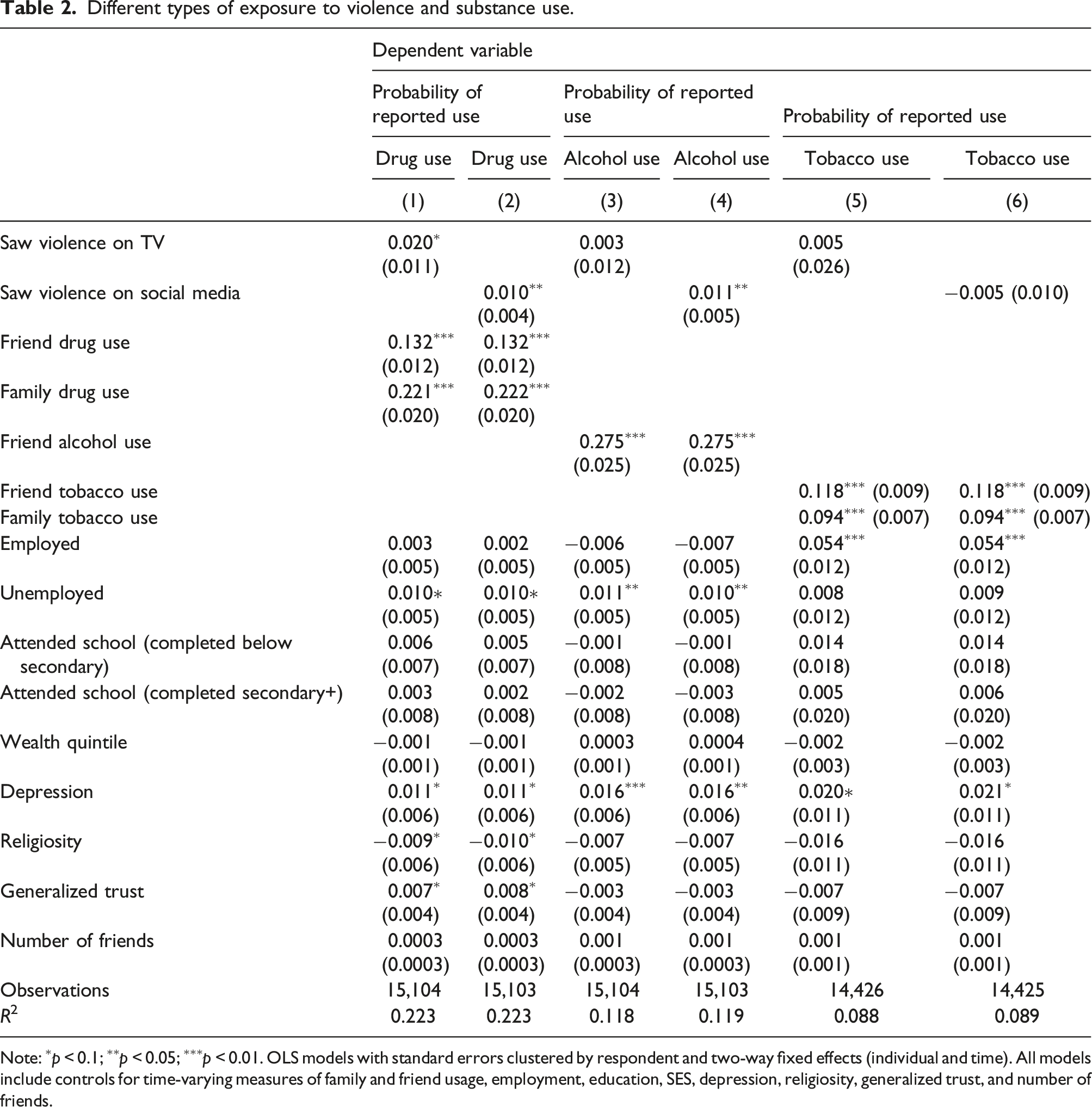
Note: ∗p < 0.1; ∗∗p < 0.05; ∗∗∗p < 0.01. OLS models with standard errors clustered by respondent and two-way fixed effects (individual and time). All models include controls for time-varying measures of family and friend usage, employment, education, SES, depression, religiosity, generalized trust, and number of friends.
Implications, limitations, and future research
We demonstrate that exposure to state violence during the 2011 revolutionary uprising in Egypt resulted in higher reported drug, alcohol, and tobacco use among a panel study of 10,916 young adults. The effect size — a 1–2 percentage point increase, depending on model specifications and type of substance — is similar to a number of variables identified as particularly important for shifting individual substance use, such as losing employment, experiencing depression, or becoming less religious. While inherited and contextual variables are important and continue to explain much of the variation, exposure to state violence can significantly alter substance use.
Our results point to a fundamental predicament of authoritarian governance: while violence may be necessary for states’ survival, it also has unintended consequences that may create governance challenges. 6 Increased substance use resulting from exposure to state violence has two important implications for politics in repressive contexts. First, our findings demonstrate that state violence is bad for public health; exposure has a significant negative effect on important public health outcomes. And yet state violence persists. Non-democratic regimes around the world use significant repression to quell mobilized populations (Bellin, 2012), and in democracies such as the United States scholars have identified a myriad of ways that police brutality leads to negative health outcomes (Alang et al., 2017). State violence may contribute to burgeoning substance use crises as increasingly exposed populations seek to cope with the trauma of brutal regime responses.
Relatedly, the growth of substance use may potentially change public opinion and create demand for new government policies. Existing research finds that exposure to drug use shapes policy preferences (De Benedictis-Kessner and Hankinson, 2019). To examine this further, we conducted a survey of Egyptians focused on exposure to recreational drug use and attitudes towards penalization of drug use and government funding of drug treatment facilities. 7 The results, shown in Table A.4 and discussed in detail in Appendix A.4, demonstrate that individuals who report exposure to drug use are more supportive of drug depenalization policies and of increased funding for drug treatment. If more people are exposed to violence and use illicit substances as a result, the exposure to substance use will become more widespread in the population, in turn increasing demand for new government interventions. Both of these downstream effects highlight the potential for state violence to destabilize repressive regimes through the exacerbation of public health crises and through shaping the preferences and policy demands of citizens.
Our findings speak to the unintended consequences of political violence, and we hope our work will inspire others to expand the breadth of the outcomes analyzed. We conclude this piece by highlighting some of the limitations of our study with an eye toward future research. While the SYPE provides an invaluable panel data resource, the instrument did not include adequate questions to adjudicate the mechanism through which exposure to state violence increases substance use. In addition, because the sample was representative, it included small numbers of substance users. We surmise that the mechanism is likely some form of self-medication to deal with the trauma of being exposed to state violence, but there are other emotional, cognitive, and identity mechanisms that future studies should also explore. A creative targeted sampling of substance users would also increase the number of observations so that researchers may explore these questions with sub-group analysis. Finally, we encourage researchers to conduct studies in different contexts, especially where psychotherapy is widely available at a reasonable cost. Individuals are more likely to self-medicate when they are unable to access or afford psychotherapy and other medical treatments (Fagan et al., 2015), and the Egyptian context does not readily supply therapeutic treatment for substance use and abuse disorders. We also encourage other scholars to theorize and analyze the public health effects and implications of different types of state violence, by not only exploiting moments of acute mobilization, such as revolutions, but also comparing them with instances of persistent exposure such as heavy policing.
Supplemental Material
Supplemental Material - Exposure to state violence and substance use
Supplemental Material for Exposure to state violence and substance use by Alexandra D Blackman, Sarah Kammourh and Elizabeth R Nugent in Research & Politics
Footnotes
Author’s note
The authors are indebted to Nicholas Lotito for assistance in the revision of this article and thank Daniel Tavana and participants of Yale University’s Political Violence and its Legacies seminar for comments on earlier drafts. This publication was supported by the Princeton University Library Open Access Fund Replication files are available at 
Declaration of conflicting interests
The author(s) declared no potential conflicts of interest with respect to the research, authorship, and/or publication of this article.
Funding
The author(s) received no financial support for the research, authorship, and/or publication of this article.
Supplemental Material
Supplemental material for this article is available online.
Notes
References
Supplementary Material
Please find the following supplemental material available below.
For Open Access articles published under a Creative Commons License, all supplemental material carries the same license as the article it is associated with.
For non-Open Access articles published, all supplemental material carries a non-exclusive license, and permission requests for re-use of supplemental material or any part of supplemental material shall be sent directly to the copyright owner as specified in the copyright notice associated with the article.
