



Abstract
Drawing on social identity theory, we predicted that affirming Black and Latino individuals as American would undermine solidarity between people of color (PoC), who are broadly stereotyped by society as un-American. We tested this prediction in two pre-registered experiments with Black and Latino adults (N = 1,880), where participants read about another minoritized group’s contribution to U.S. culture (i.e., Latino people: reggaetón and hip hop; Black people: jazz and hip hop). Reading about Latinos’ musical contributions to U.S. culture insignificantly reduced Black solidarity with PoC, although an increase in Black solidarity with PoC unexpectedly boosted support for pro-Latino policies. In turn, reading about Black contributions to U.S. culture surprisingly increased Latino solidarity with PoC, which then substantially heightened pro-Black policy support. This unanticipated mediation effect is statistically robust and substantively meaningful. We explain how these contradictory results help advance research on the conditions that catalyze solidarity between PoC.
Across more than three decades of research, scholars have established that conflict, rather than cooperation, is the modal outcome in political relations between African Americans, Asian Americans, Latinos, and other people of color (PoC) (Bobo and Hutchings, 1996; Benjamin, 2017; McClain and Karnig, 1990; McClain, 1993; McClain et al., 2006; Pérez and Kuo, 2021; Wilkinson, 2015). But what causes solidarity between PoC to break down? Although research highlights various historical, sociological, and material factors associated with interminority conflict (Bobo and Hutchings, 1996; Kim, 2003; McClain and Karnig, 1990), scholars have dedicated less attention to the psychological mechanisms responsible for political conflict between PoC. Some of this omission can be traced to a relative dearth of frameworks that explain interminority relations in every sense of this word. Although political scientists have developed explanations for why Latinos may conflict with African Americans (McClain et al., 2006), why African Americans conflict with Latinos (Carter, 2019), and why both of these groups might conflict with other people of color (Wilkinson, 2015), we have fewer theoretical frameworks that can explain relations between minoritized groups that use the same psychological principles (Pérez and Kuo, 2021). 1
We draw on psychological work that attends more closely to the specific social stations occupied by PoC (Craig et al., 2020; Zou and Cheryan, 2017). This research stipulates that while people of color are all relatively disadvantaged with respect to Whites, the sources of these disadvantages varies for these distinct groups according to how foreign and inferior they are alleged to be. As Figure 1 indicates, Whites are positioned as the most superior and American racial group in the U.S. racial hierarchy, which reflects their dominant status vis-à-vis PoC (Sidanius and Pratto, 2000). However, while Asian and Latino people are each stereotyped as foreign and un-American, Asian individuals are considered a more superior minority than Latino and Black individuals, as highlighted by the model minority myth—the characterization of Asian individuals as less impertinent than Black and Latino people (Tuan, 1998). Moreover, although Black people are considered less American than White individuals, the former are stereotyped as being more American than Latinos and Asians (Carter, 2019). Two axes of subordination. Adapted from Zou and Cheryan’s (2017) Radical Position Model (RPM).
Several experiments establish that a shared sense of discrimination as foreign or inferior boosts solidarity between PoC, which then heightens their support for policies that implicate minoritized groups beyond one’s own (Eidgahy and Pérez, 2022; Pérez et al., 2022). For example, insofar as Asian and Latino individuals sense they are similarly discriminated as foreigners, they express more pro-Latino and pro-Asian policy preferences, respectively. Meta-analytic evidence further shows this pattern generalizes across racially minoritized groups and both dimensions of the U.S. racial hierarchy (i.e., inferiority and foreigness) (Pérez et al., 2022).
These studies generally catalyze solidarity between people of color by transforming a negative attribute (i.e., shared discrimination) into a net political positive (i.e., solidarity). However, this narrow focus on stigmatizing attributes held in common by PoC overlooks the many strengths and sources of pride that minoritized groups sometimes possess, such as resilience in the face of adversity, a steadfast commitment to one’s ancestors and community, and major cultural and economic contributions to U.S. society (Anoll, 2022; Slaughter, 2021). Indeed, research by Brannon et al. (2020) and Cortland et al. (2017) suggests that a focus on shared positive attributes might be amenable to producing interminority solidarity.
However, classic research from social identity theory (SIT) anticipates that a focus on a similarly stationed outgroup might actually provoke individuals to engage in efforts to preserve their ingroup’s positive distinctiveness—that is, those attributes that make one’s ingroup unique (Brewer, 1991). This psychological drive to defend an ingroup’s distinctiveness is a well-established trigger of intergroup conflict in many settings (Brewer, 1991; Danbold and Huo, 2015; Pérez and Kuo, 2021), which implies a reduction in interminority solidarity. For example, studies show that highlighting racial discrimination against Latinos and Asians leads them to become more pro-Latino and pro-Asian, respectively—not more pro-minority (Pérez, 2021).
We create synergy between the varied stations of PoC in America’s racial order and some of the positive experiences that define them as minoritized groups. Specifically, we operationalize Black and Latino musical influences on U.S. culture as one positive attribute displayed by these communities of color as bona fide Americans (e.g., jazz and regaettón) (Zou and Cheryan, 2017; see also Carter, 2019; Silber Mohammed, 2017). Our focus on Black and Latino people as Americans contributes to ongoing efforts highlighting the importance of this category to PoC (e.g., Carter and Pérez, 2016; Pérez and Kuo, 2021) and how it conditions their sense of belonging in society and politics (Huo and Binning, 2008; Ocampo, 2018). We evaluate whether affirming this positive aspect shared by PoC undermines solidarity between them, consistent with classic work in social identity theory (Tajfel, 1981). Below, we clarify our theoretical reasoning and yield two hypotheses. We then leverage two survey experiments with Black (N = 950) and Latino (N = 930) adults to test our pre-registered predictions.
The evidence ultimately contradicts our predictions. In our African American sample, our treatment negligibly impacted Black solidarity with PoC, but an increase in solidarity unexpectedly boosted Black support for pro-Latino policy. In turn, our treatment unexpectedly heightened Latino solidarity with PoC, which then reliably increased support for pro-Black policies. Although surprising, the mediation pattern among Latinos is statistically robust and substantively interpretable. We explain how these contradictory results can help further innovate research on the connections between positive shared experiences and interminority U.S. politics.
Theory and hypotheses
Our argument about the salience of being American and interminority solidarity draws on research from social identity theory (SIT) and its offshoots (Tajfel, 1981). This literature explains that the categorization of individuals into ingroups and outgroups generally unravels into the expression of ingroup favoritism (Tajfel, 1981). One motivation behind this effect is distinctiveness (Brewer, 1991), which drives people to uphold those attributes, values, and experiences that makes their ingroup unique, thus endowing an ingroup with cachet (Danbold and Huo, 2015). In light of ingroup favoritism, individuals coalesce behind their category, thereby increasing the affective, cognitive, physical, and material space between them and an outgroup(s).
For interminority politics, this implies that unity between similarly situated groups (e.g., African Americans and Latinos) is incredibly difficult to achieve, even if they share some positive attributes—a prediction sustained by more than 30 years of scholarship on interminority conflict (Benjamin, 2017; McClain and Karnig, 1990; Wilkinson, 2015). Indeed, per the distinctiveness motive previously discussed, similarly stationed outgroups are often more inclined to display ingroup favoritism rather than intergroup unity (Pérez, 2021). These insights yield two hypotheses.
First (H1), we expect that highlighting a positive attribute that is shared with another minoritized group (e.g., contributions to U.S. culture) will decrease Black and Latino solidarity with people of color. We reason that by affirming PoC’s sense of being American, ingroup members will distance themselves from outgroups that are socially construed as un-American (Tajfel, 1981). That is, affirming one’s sense of being American should lead PoC to see themselves as members of the nation, thereby producing a more defensive stance toward racial outgroups who are deemed un-American or outside the nation (Zou and Cheryan, 2017).
In turn (H2), we hypothesize that a weakened sense of solidarity with PoC will subsequently reduce support for policies that implicate un-American outgroups. Accordingly, in light of weakened solidarity with PoC, Black individuals will become less supportive of pro-Latino initiatives, including more flexible policies toward undocumented Latino immigrants, such as reductions in border patrol surveillance along the U.S.–Mexico border. Similarly, Latinos should become less supportive of pro-Black efforts, such as endorsement of #BlackLivesMatter.
Research design: Two parallel experiments with Black and Latino adults
We pre-registered our hypotheses and tested them with a pair of experiments with Black and Latino individuals (SI.1 reports our pre-registration). In partnership with Dynata, an online survey platform, we recruited two parallel samples of Black (N = 950) and Latino (N = 930) adults to participate in brief 8-min surveys. Although some Latinos identify racially as Black (Gonzalez-Barrera, 2022), we were not confident about yielding a large sample of Afro-Latino adults to analyze separately, so we did not explore this option further.
After providing consent, participants in both samples answered a few demographic questions (e.g., age, gender, education, and nativity) (SI.2 reports question wording and SI.3 reports balance checks). 2 Participants were then randomly allocated to one of two conditions. The control group exposed participants to an article depicting the extinction of giant tortoises (cf. Hopkins et al., 2020). Participants in our American condition read an article affirming another minoritized outgroup’s musical contributions to U.S. culture (i.e., Black people: hip hop and jazz; Latinos: hip hop and regaettón). We consider these musical contributions to be a positive attribute held in common by Black and Latino people as Americans, which is indicated by each group’s linkage to hip hop music’s origins within these groups (Lorenz, 2013). 3
Each experiment presented our manipulations as news briefs focused on another minoritized outgroup. This means Black participants read articles focused on Latino people and their musical contributions to U.S. culture, while Latino participants read an article focused on Black people and their musical contributions to American culture (see SI.2). Consider the treatment assigned to Black participants. This manipulation was presented as a news brief attributed to the Associated Press (AP) and highlighted Latinos via its title: “With a Centuries-Long Presence in the U.S.,
Following our manipulation check, participants completed two (2) statements designed to capture our mediator, solidarity with people of color, with one item being reverse-worded to mitigate acquiescence bias. This statement read “The problems of Blacks, Latinos, Asians, and other minorities are too different for them to be allies or partners.” Both items were answered on a scale from 1 - strongly disagree to 5 - strongly agree. We code and scale them so that higher values reflect a stronger sense of solidarity with PoC. 4
After appraising our mediator, we administered policy items that strongly implicate Latino and Black people, respectively. SI.5 presents a confirmatory factor-analysis validating these policy proposals. Using the same 5-point scale, all participants expressed their agreement with “Increasing the number of border patrol agents at the U.S.–Mexico border,” “Renewing temporary relief from deportation for undocumented Latino immigrants brought to the U.S. as children,” and “Granting a pathway to citizenship for undocumented Latino immigrants.” We coded replies so that higher values reflect more opposition to restrictive policies toward Latinos.
Additionally, Black and Latino participants answered two items centered on African Americans. Using the same response scale as before, participants indicated the degree to which they agreed with “Limiting the protest activities of #BlackLivesMatter and other movements like it” and “Introducing harsher penalties for hate crimes committed against Black individuals.” Again, all items are coded so that higher values indicate greater support for the pro-Black position.
Our analyses employ a causal inference approach, where all paths in the mediation process are simultaneously estimated, instead of a simpler set of sequential regressions (Hayes, 2021). This will help us later appraise the robustness of our observed mediation patterns. In our analyses, all variables are re-scaled to a 0–1 range, allowing us to interpret our OLS coefficients as percentage-point shifts. All reported p-values are two-tailed.
Results
The mediated effects of affirming another minoritized outgroup as American on pro-outgroup policy support.
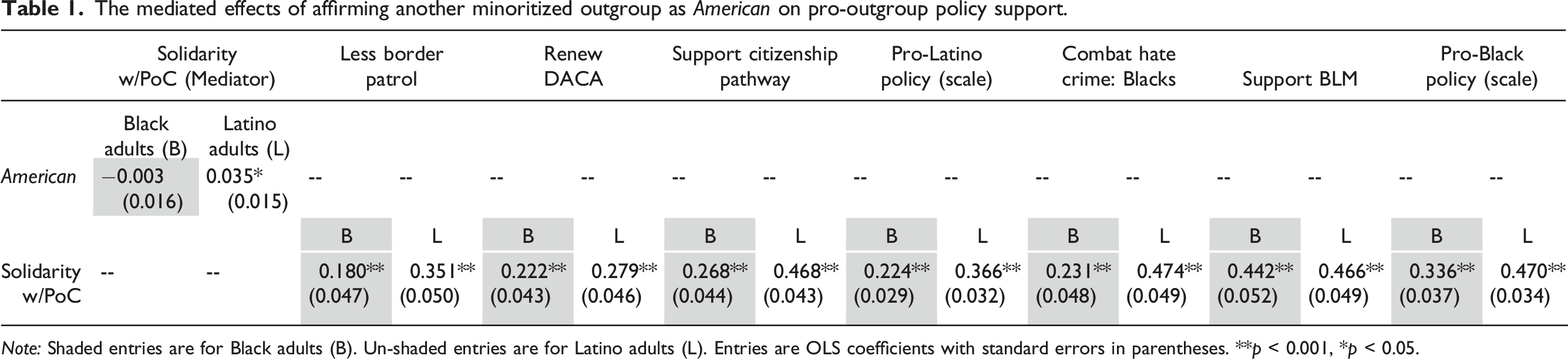
Note: Shaded entries are for Black adults (B). Un-shaded entries are for Latino adults (L). Entries are OLS coefficients with standard errors in parentheses. **p < 0.001, *p < 0.05.
Despite this null effect, an additional unit increase in solidarity with PoC is robustly associated with increased support for policies that implicate Latinos. This also contradicts our second hypothesis (H2), which stipulated a negative downstream association. Specifically, a unit increase in solidarity with PoC boosts Black adults’ opposition to border patrol increases along the U.S.–Mexico Border (0.180, s.e. = 0.047, p < 0.001), support for DACA (0.222, s.e. = 0.043, p < 0.001), and support for a pathway to citizenship (0.268, s.e. = 0.044, p < 0.001). Combining these variables into an additive index reveals that the association between heightened solidarity and Black support for pro-Latino policies is still positive and reliable (0.224, s.e. = 0.029, p < 0.001). Figure 2(a) depicts this relationship among Black adults. The indirect effect of affirming Black and Latino people’s sense of being American. (a) Black adults. (b) Latino adults.
What about Latinos—how do they respond when exposed to Black individuals’ contributions to American culture? Table 1 also shows evidence that again cuts against both hypotheses—except here, the entire mediation pattern is substantively and statistically meaningful. The un-shaded entries in Table 1 correspond to Latinos. These entries show, contra (H1), that our American treatment causes Latinos to express reliably more (not less) solidarity with people of color (0.035, s.e. = 0.015, p < 0.021). In turn, an additional unit increase in solidarity with PoC is associated with stronger (not weaker) Latino support for efforts to combat hate crimes against Black individuals (0.474, s.e. = 0.049, p < 0.001) and the Black Lives Matter Movement (0.466, s.e. = 0.049, p < 0.001). These patterns contradict (H2). When we combine this item pair into an additive index, we find that greater solidarity with PoC is associated with greater Latino endorsement of pro-Black policies (0.470, s.e. = 0.034, p < 0.001). Figure 2(b) depicts this unanticipated relationship among Latinos.
We investigate further how robust this unexpected mediation pattern among Latinos is. We do this by first calibrating the observed effects as d values, which are standardized mean differences. By convention, d values around 0.20, 0.50, and 0.80 or higher are considered small, medium, and strong, respectively. In our Latino sample, we find that exposure to treatment reliably increases solidarity with PoC (d = 0.159), which then significantly boosts Latino support for pro-Black policies (d = 0.890). This pattern suggests that a small treatment effect was able to catalyze solidarity with people of color among Latinos, which then substantially increases their support for pro-Black policies. SI.6 reports additional evidence that our treatment operates comparably among specific subgroups within these populations (e.g., Mexicans and Puerto Ricans).
Given that solidarity with people of color was measured (not manipulated) in our studies, we next examine how robust this observed mediation pattern in our Latino sample is to possible confounding. We estimate a rho (ρ), which tells us how strong a correlation between our outcome and an omitted variable must be for this mediated pathway to vanish to zero (Hayes, 2021). Our analysis finds this pathway is remarkably robust, with an estimated rho (ρ) = 0.431.
Finally, we conduct a mini meta-analysis of our Latino and Black experiments to gauge whether a measurable mediation pattern emerges across both African American and Latino adults (Goh et al., 2016). Across both studies, we find that highlighting an outgroup’s contributions to U.S. culture weakly increases solidarity between PoC (d = 0.074, s.e. = 0.049, p < 0.135), which then significantly increases downstream support for pro-out group policies (r = 0.355, s.e. = 025 → d = 0.760, p < 0.001).
This mediated reaction is marginally significant at best (Aorian test: 1.498, p < 0.134). We explain below what the entirety of our results imply about interminority politics.
Implications
We originally hypothesized that affirming another minoritized group’s contributions to American culture would significantly reduce Black and Latino individuals’ expressions of solidarity with PoC (H1), which would undermine their support for policies implicating other minoritized groups (H2). Our evidence contradicts both hypotheses. Although our findings were unexpected, additional analyses underscored the statistical viability of some of the results we uncovered among Latinos, suggesting revisions to our theoretic reasoning about the American dimension in our racial hierarchy. What might those revisions be?
We based our hypotheses on the well-established notion that individuals are driven to preserve their ingroup’s distinctiveness. Thus, we anticipated that in light of our treatments, Black and Latino adults would express less solidarity with PoC because their sense of being American would lead them to distance themselves from an outgroup that is marginalized as un-American to various degrees (Zou and Cheryan, 2017). Instead, we observed that African Americans were unaffected by our treatment, suggesting that perhaps they consider Latinos to be well nestled within a shared American category (Silber Mohammed, 2017). That is, Black adults might perceive Latinos as bona fide Americans—not as un-American. This interpretation aligns with the downstream association we observed between increases in Black solidarity with PoC and greater support for pro-Latino policies.
For Latinos, the observed results were statistically sharper, but also unexpected. We found that our treatment reliably increased (not decreased) their expressions of solidarity with people of color, suggesting more clearly that Latino adults view their Black peers as bona fide Americans—and that they see “their” contributions as affirming “our” collective sense of being members of the U.S. nation. This interpretation aligns with the substantial downstream association we observed between Latinos’ heightened solidarity with people of color and their support for pro-Black policy. But to pin down this inference with additional confidence, future research might consider a treatment that highlights the contributions of one’s ingroup to America and observe whether such affirmation is sufficient to also generate a more generous stance toward other racially minoritized groups.
So why do we still find an inconsistently reliable treatment effect in this pair of studies? Recall our meta-analysis, which unearthed a marginal increase in solidarity across both groups. With clearer hindsight at our backs, a closer look at the positioning of Black and Latino people as Americans in the racial order (see Figure 1) reminds us that while each of these groups is stereotyped as un-American, Latinos are further marginalized on this dimension than Black individuals. This suggests that perhaps Latinos’ sense of their tenuous position as American influenced their interpretation of our treatment. When reading an affirming account about Black contributions to U.S. culture, perhaps Latinos automatically saw themselves in that rendering as another minoritized group that also contributes to the nation (Pérez, 2021). This prospect ultimately requires further experimentation. Yet our results direct us and other scholars to be even more sensitive to the nuanced positions of people of color in a shared group like American, including the possibility that PoC view this national category in more inclusive terms than White individuals (Zou and Cheryan, 2017) (see SI.7 for additional discussion of this interpretation).
Supplemental Material
Supplemental Material - Does affirming Black and Latino people as American weaken racial solidarity? A surprising “no” from two pre-registered experiments
Supplemental Material for Does affirming Black and Latino people as American weaken racial solidarity? A surprising “no” from two pre-registered experiments by Efrén O Pérez, Alisson Ramos and Bianca V Vicuña in Research & Politics
Footnotes
Declaration of conflicting interests
The author(s) declared no potential conflicts of interest with respect to the research, authorship, and/or publication of this article.
Funding
The author(s) received no financial support for the research, authorship, and/or publication of this article.

Supplemental Material
Supplemental material for this article is available online.
Notes
References
Supplementary Material
Please find the following supplemental material available below.
For Open Access articles published under a Creative Commons License, all supplemental material carries the same license as the article it is associated with.
For non-Open Access articles published, all supplemental material carries a non-exclusive license, and permission requests for re-use of supplemental material or any part of supplemental material shall be sent directly to the copyright owner as specified in the copyright notice associated with the article.
