




Abstract
A growing number of studies discuss the impact of non-political factors on the political success of incumbents. Theoretically, this literature addresses core ideas about electoral accountability and voter rationality. Scholars have explored factors such as shark attacks, weather, natural disasters, and sports results. So far, the evidence has been inconclusive and almost exclusively from majoritarian contexts, where government accountability is easy for voters to assign. We contribute with an analysis of whether nationally important sports success, such as Olympic gold medals, affect support for coalition governments in a multiparty context. We use monthly polling from Finland for a 28-year period from Jan 1994 to Dec 2021, which we combine with data on sports success. Our analysis shows that nationally important sports success has no impact on government popularity. The finding holds while controlling for traditional drivers of government popularity and across different operationalizations of government support and sports success. With this finding, the study joins several previous analyses, which have been supportive of voter rationality.
Introduction
With 22 min remaining, England, the defending champions, had a 2-0 lead against Germany in the 1970 quarter final in the football world cup. That is when Franz Beckenbauer struck, followed by Uwe Seeler. In extra time, Gerd Müller sealed the win for Germany.
Four days later, the Conservatives won the UK general election, a result so surprising that it has prompted much scholarly speculation ever since. According to conventional explanation, the shock was caused by polling errors (Abrams 1970). However, many commentators attributed the surprising downfall of Harold Wilson’s Labour government to the dramatic quarter final loss.
A growing literature discusses the impact of non-political factors on political support, such as the effect of rainfall (Fujiwara et al., 2016), shark attacks (Achen and Bartels, 2016), wildfires (Ramos and Sanz, 2020) and other natural disasters (Chang and Berdiev, 2015; Gasper and Reeves, 2011), candidates’ names (Muraoka, 2021), and sports results (Busby et al., 2017). The issue is contested. Some studies report statistically significant impacts, while others do not (Fowler and Montagnes, 2015; Healy et al., 2010; cf. Achen and Bartels, 2016; Busby et al., 2017; Busby and Druckman, 2018; Fowler and Hall, 2018).
The matter is more than a curiosity. Theoretically, this literature speaks to core ideas about electoral accountability and voter rationality; what goes into the calculus when people decide how to act politically? Do they only evaluate the political track records of incumbents or do they (also) engage in blind retrospection and project their experiences of non-political events? If democratic publics do not evaluate politicians based on policy merits, the logic of representative democracy could be disrupted.
Stakes are high, but the evidence is inconclusive and sensitive to modeling choices (Fowler and Montagnes, 2022; Graham et al., 2021). To offer more evidence, we use monthly polling data from Finland to investigate the impact of nationally significant sports victories on government support. Each poll is based on a nationally representative sample of the Finnish voting age population, forming a consistent time series across a 28-year-period from January 1994 to December 2021. We focus on sports events because they are more genuinely non-political compared to natural disasters or the weather, which links to perhaps the most politicized question of our time, climate change. Although sports success could be seen as the result of political decisions to (de)invest in sports, it is more far-removed from the political realm than disaster relief or weather-related matters.
As the evidence is conflicting, Busby and Druckman conclude (2018: 9), “The obvious question is under what conditions do irrelevant event effects occur?” We take up this challenge. Most studies have focused on local-level analyses, but by looking at national-level implications during a long observation period, we analyze a broader pattern. Importantly, Finland offers a multiparty context, where broad coalition governments make punishing and rewarding the power-holders more difficult for the electorate.
The (ir)rationality of political behavior
Electoral accountability depends greatly on voters’ ability to actually implement it. However, a sizable empirical literature, traceable at least to Converse’ (1964), suggests that citizens’ lack of awareness of even the most basic political realities makes rational electoral behavior unlikely. But opposing views have come in two different shapes. First, as, for example, Popkin (1991) has argued, low-sophistication may be enough, because people use party identification and other cues to reach the same decisions they would have anyway. Second, others have demonstrated rational linkages between voter behavior and policy, even between elections (e.g., Soroka and Wlezien, 2010).
The literature concerning the impact of events exogenous to politics again challenges the rationality assumption (Ashworth et al., 2018). Achen and Bartels (2016) famously suggested that shark attacks in the summer of 1916 in New Jersey caused a significant electoral loss for the incumbent president Woodrow Wilson in the affected areas. In an extensive analysis of the impact of natural disasters on electoral behavior, Chang and Berdiev (2015), covered 156 countries during 1975–2010. They found that natural catastrophes increase the probability of a government getting replaced. This general pattern holds across different operationalizations of disasters and controlling for key economic and political variables. Gasper and Reeves (2011) show that voters punish incumbents for inadequate reactions to disasters and reward them for appropriate assistance. Although sometimes electoral responses can be considered unreasonable, voter behavior seems to be based on rational assessments of how authorities handle the aftermath of a disaster (Healy and Malhotra, 2010). Although natural disasters themselves are unpolitical events, the impact they have on people’s lives becomes political and this affects opinions in understandable ways. Moreover, Fowler and Hall (2018) show that Achen and Bartels’ findings are driven by modeling choices, and are, at best, inconclusive.
Again, Heersink et al. (2017) provide counterevidence by showing that Herbert Hoover suffered significant electoral losses in areas affected by major flooding in the US south in 1927, despite unprecedented relief aid and presidential attention, supporting the notions of blind retrospection and voter irrationality. Ramos and Sanz (2020) demonstrate that wildfires increased incumbent support in local elections in Spain by up to eight percentage points—a surge that is hardly due to blind retrospection, but perhaps results from a rally-around-the leader-effect. However, evidence regarding the impact of natural disasters on voting behavior remains inconsistent and the implications for discussions on (ir)rationality are equally unclear.
Further tests of voter (ir)rationality show that in some electoral contexts the ordering of the candidates on the ballot (Ho and Imai, 2008) and its physical appearance and design have some bearing on voting behavior (e.g., Calvo et al., 2009; Moehler and Conroy-Krutz, 2016). In three experiments, Huber et al. (2012) show that evaluations of incumbent performance can be manipulated by simple rhetoric. In direct support of the voter irrationality thesis, participants’ voting intentions were affected by a game of lottery, entirely unrelated to the political choice at hand, but which seemingly affected the participants’ own wellbeing.
Faced with inconclusive empirical evidence, Ashworth et al. (2018) have challenged the idea that voters’ reactions to exogenous events are irrational. They argue that also events outside politicians’ control affect voters’ possibilities to learn about how politicians handle natural disasters. Natural disasters typically reveal the true state of the infrastructure and emergency preparedness of public authorities, functioning as powerful cues for evaluating incumbent performance (Ashworth et al., 2018). Moreover, Fowler and Montagnes (2022) provide compelling evidence suggesting that previous research may have identified chance false positives, rather than genuine effects.
Sports is, however, arguably a domain more genuinely detached from democratic politics. Public sports facilities, sports associations, and even athletes can be supported by government funding, but it seems far-fetched to see sports success as the result of party politics. Based on this reasoning, a sub-section of the literature has examined voter irrationality in relation to sports success.
Linking sports success and government support
While the impact of the 1970 world cup loss to Germany on the British general election is mainly anecdotal, a few studies have attempted to trace the political consequences of sports results. The suggested mechanism is the emotional experience of winning and losing and its effect on in-group sentiment. Winning in sports could increase a positive feeling towards a perceived in-group, which could spill over to other domains, such as political attitudes (Kerry et al., 2020). Sporting events affect the general mood of people, which is then projected on other objects, such as politicians (Busby et al., 2017; Busby and Druckman, 2018). Sports teams are one such in-group and national success in sports positively affects the sense of national pride (Elling et al., 2014). Elite sports have traditionally been one of the most important ways for societies to construct and to boost national pride and social cohesion (Van Hilvoorde et al., 2010: 88–89 for overview).
We investigate the possibility that nationally important sports success, such as winning an Olympic gold medal, creates a collective emotional experience coupled with an increased sense of social cohesion. This general mood could manifest itself politically through increased support for the government, much like a “rally-around-the-flag” effect. Finland is a likely case to demonstrate such an effect. Historically, elite sports success has played a significant role in creating national identity and pride in Finland. International sports success was the key building block in the development of national identity in the early 1900s and it was even used as a unifying force after a traumatizing civil war in 1918 (Laine, 2006: 68–69). Public attitudes towards elite sports success remain very positive. In a comparative study from 2016 with nationally representative survey samples (n for Finland = 1690), 73% of Finnish respondents said national sports success brings them joy and happiness. Furthermore, Finland was on par with other highest ranking countries in feeling national pride when an athlete performs successfully (Mäkinen, 2017). The necessary attitudinal landscape exists in Finland for the emotional mechanism to realistically have an impact.
Furthermore, major international sports victories are a rare event for Finns. To illustrate the point: the US celebrated 247 Olympic gold medals in the summer games during the observation period, while Finland celebrated only four (www.olympic.org). The most popular spectator sport in the country, ice hockey, serves as another example. During the 28-year observation period, Finland only managed to win the annual world championships three times. The first-ever victory in 1995 enjoys mythical status in modern folklore, through songs, documentaries, and even a movie that depicts the winning team.
Consequently, Finland is arguably a case where one can plausibly expect to find a positive effect of sports success on government popularity. Most importantly, Finland presents a scenario where such a linkage, if it exists, could be genuine and not spurious (cf. Müller and Kneafsey, 2021). In this sense, Finland can be seen as a likely case. However, given the difficulty of assigning government responsibility in broad coalition governments with flexible ideological boundaries across parties, the political context makes Finland also a hard case for identifying such an effect. As the next section demonstrates, our data allows us to tackle the difficult Finnish context through extensive, monthly polling data, which includes many different government compositions. It allows us to use various measures of government popularity and connect them with various measures of sports success to cover many possible manifestations of a linkage between the key variables, while controlling for other factors.
Data, variables, and method
Our data consists of 336 monthly telephone polls on vote intentions from January 1994 to December 2021. The monthly popularity polls are collected by Taloustutkimus which is an independent market research company. The polls are commissioned by the Finnish public broadcast company YLE. Sample sizes have ranged between 1900 and 3900 with a margin of error around 2 percentage points (95 % confidence level).
Dependent variable: government support
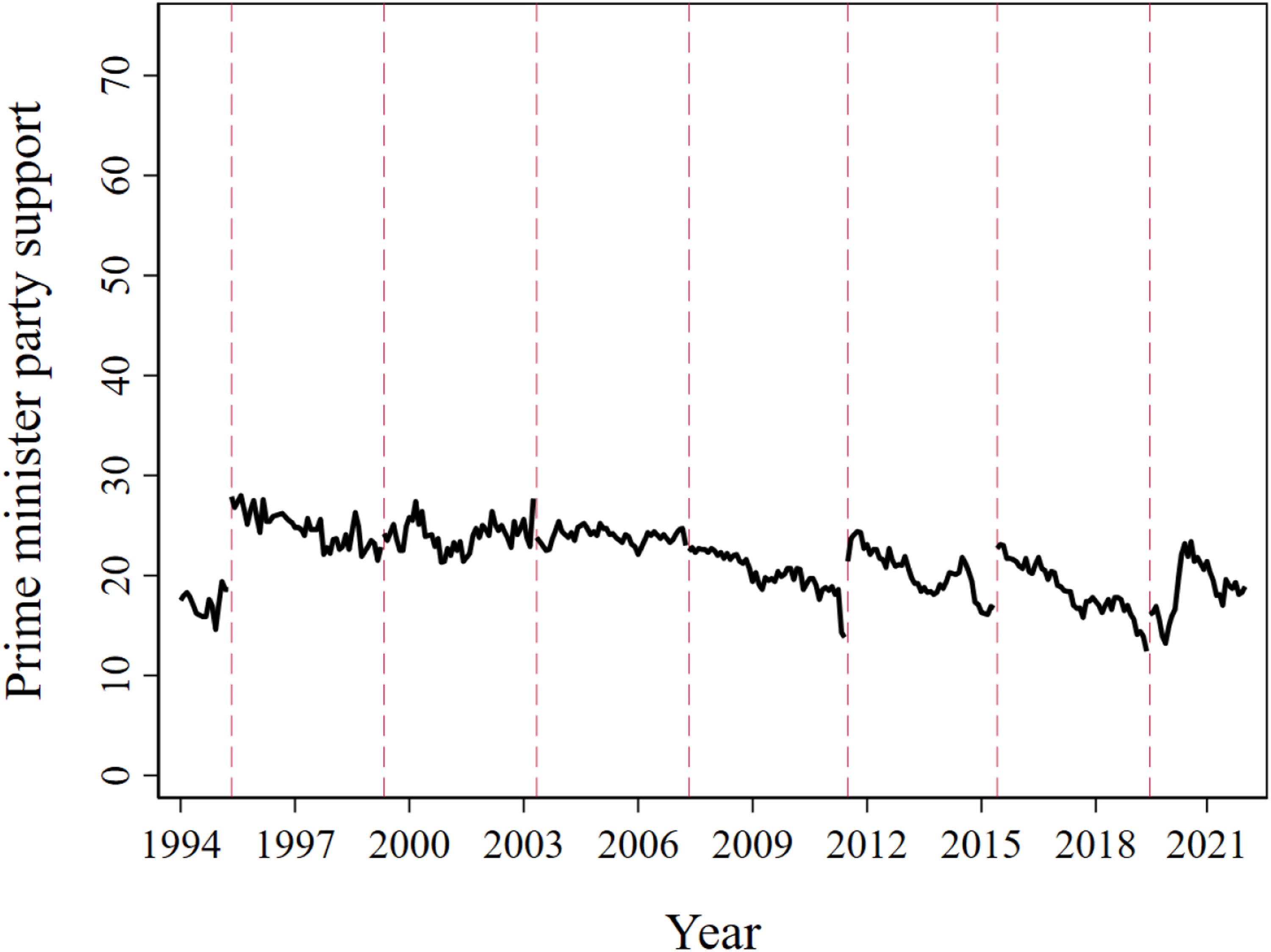
Identifying “the government” is straightforward in majoritarian systems, but pinpointing government responsibility is more difficult in multiparty settings with coalition governments. The same goes for measuring government support. For robustness, we use two operationalizations. The obvious option is the combined support for all government parties. The first dependent variable, government support, varies between 35.0 and 71.9%. In the observation period, the number of parties in government ranges between three and six. Another apparent alternative is to only consider the party of the prime minister, which usually holds most parliamentary seats and is the most powerful party in the coalition (Fisher and Hobolt, 2010). The second dependent variable, prime minister party support, varies between 12.4 and 28.0%.
Sports success
Given relatively modest sporting success, we include dummy variables indicating when Finnish athletes or sport teams won at least one gold medal in the following international championships: Summer Olympic Games, Winter Olympic Games, World Championships in Athletics, FIS Nordic World Ski Championships, Ice Hockey World Championships, Formula 1, and World Rally Championships. We identify 30 months when Finland won one or more gold medals. Each poll commences one or 2 weeks into each month and ends a few days into next month. We coded as follows. If a multi-sport event went on for a couple of weeks, a month is coded 1 if a gold medal was won and the majority of the event went on that month; otherwise the next month is coded 1. If an individual athlete or team won a gold earlier than the 25th of that month, the month is coded 1; otherwise the next month is coded 1. We also include 1 month and 2 months lagged values to check if the effect of sports success remains, alternatively becomes detectable later.
Control variables
To check whether government support rests on rational evaluations, we control for the tendency of voters to blame, or reward, the government for economic performance. The responsibility hypothesis is often framed in terms of economic outcomes: ‘the voters hold the government responsible for the development in the economy’ (Nannestad and Paldam, 1994). Government popularity should increase with good economic performance and decrease with poor. Together with gross domestic product growth and inflation, unemployment has been the most frequently used macro variable in models of economic voting (Duch and Stevenson, 2008: 17–27). We use unemployment because we have access to monthly data in contrast to quarterly GDP growth data. Moreover, judging how unemployment develops is more concrete than, say, how inflation has developed. Also, the public tends to react more quickly to changes in unemployment (Conover et al., 1986). Since there is a seasonal pattern in the unemployment rate, we use a 12-month moving average to smooth out the data.
The variable months in office accounts for the expectation of the cost of ruling hypothesis, which refers to “a slow general depreciation in the popularity of the average government” (Nannestad and Paldam, 1994: 217). To account for the possibility that government parties enjoy higher popularity in the beginning of the term, the variable “honeymoon effect” takes the value of six in the first month of each term, declines to one by the sixth month and takes the value of zero thereafter (Veiga and Veiga, 2004: 139).
Pandemic is a dummy variable to account for a special event or period (Nannestad and Paldam, 1994) or the rally-around-the-flag effect in a time of crisis (Mueller, 1970). In Finland, as in many other countries, public support for the government quickly rose in March 2020 when the global COVID-19 pandemic struck and support remained at a high level for over a year.
Finally, we include a control variable for the number of parties in government to account for different government coalitions consisting of the varying number of coalition partners.
Modeling strategy
We estimate fixed-effects regression models for panel data because we are only interested in the impact of variables that vary over time. Our data consist of repeated observations nested in clusters: monthly observations are nested in government coalitions or in prime minister party terms. First, each government coalition and prime minister party is assigned a unique identification number. If a party drops out of government, the subsequent coalition is treated as a new cluster, because the number of parties in government goes hand in hand with total support for the coalition. Second, since the prime minister party has not changed mid-term, each prime minister party has a unique identification number across the whole period between two elections. We use cluster-robust standard errors to account for cross-sectional heteroscedasticity and within-panel serial correlation.
Analysis
We first present the raw longitudinal data, scatterplots of the two dependent variables versus the time variable. The graphs display the development of public support for the government coalitions (Figure 1) and for the prime minister parties (Figure 2). Support for both the government parties and the prime minister party fluctuates from 1 month to another. The question is if any of the spikes can be explained by sports success. Combined government parties’ support over time. Prime minister parties’ support over time.
The first set of estimates of the fixed-effects regression estimations include dummy variables to indicate when any athlete or team won a gold medal. The second set of estimates have separate dummy variables for major international multi-sport events and individual sport events.
Predicting combined government support and prime minister party support: Fixed-effects regression with cluster-robust standard errors.

**p < 0.01; **p < 0.05.
Estimating the effects of multiple sports success dummy variables: Fixed-effects regression with cluster-robust standard errors.

**p < 0.01; **p < 0.05.
In Table 1, the control variables perform as expected, giving us confidence in the models. When unemployment increases, government support decreases. The effect is relatively small as government support decreases on average 0.75 percentage points for each one percentage point increase in unemployment. Unemployment is not statistically significant when we use support for the prime minister party as the dependent variable. The negative and significant coefficient for time in office supports the expectation that government parties’ and prime minister parties’ popularity deteriorates over time, as suggested by the cost of ruling hypothesis. We estimate the mean slope to be −0.12 per month for the government and −0.09 per month for the prime minister party. There is no evidence of a honeymoon effect. All else equal, support for both the government coalition parties and the prime minister party increased in the wake of the COVID-19 pandemic. Finally, the number of parties only captures cross-sectional differences: government coalitions consisting of a greater number of partners have greater combined support.
Discussion
A variety of sports success measures and two different measures of government support produced no evidence of a (positive) impact of sports success on government popularity. Our data spans across almost 30 years and 331 measurements of government support, covering many different types of coalitions but we only find the expected, statistically significant associations for the control variables: government support declines when unemployment increases, and there is a noticeable rally-around-the-flag effect during the pandemic. This gives us confidence to claim that our data captures real-life effects on government support, but that sports success is not among them. We join Müller and Kneafsey (2021), who report null findings in a similar “best case” scenario from Ireland, which also has coalition governments where assigning government responsibility can be difficult for voters.
So where does this leave us regarding voter (ir)rationality? In a direct interpretation, the findings suggest that the Finnish electorate behaves rationally. It reacts (negatively) to unemployment, but not to events that are exogenous to politics. While the findings support the idea of a rational electorate, we speculate that the reason is not per se that voters in multiparty countries are more rational, but that their expression of government support differs from voters in two-party systems. The latter is a confrontational political context, where blaming or rewarding the government is straightforward. This setting invites even irrational feedback to officeholders. In multiparty systems, voters lack the same opportunity to react. Consequently, the findings may reflect a rationality that is induced by the system, rather than a rationality that is a property of voters.
Although our findings question the positive impact of irrelevant events on democratic politics (also Fowler and Montagnes, 2015, 2022; Fowler and Hall, 2018; Müller and Kneafsey, 2021), we conclude by repeating the call for more context-specific evidence sounded by Busby and Druckman (2018). While some scholars question whether looking for political effects of non-political events is a meaningful exercise, there is still room for more contextual variety in the analyses before the idea should be dismissed.
Footnotes
Declaration of conflicting interests
The author(s) declared no potential conflicts of interest with respect to the research, authorship, and/or publication of this article.
Funding
The author(s) disclosed receipt of the following financial support for the research, authorship, and/or publication of this article: This work was supported by the Stiftelsen för Åbo Akademi (Future of Democracy, Centre of Excellence).
