




Abstract
Why do citizens prefer high-skilled immigrants to low-skilled immigrants? To understand the causal mechanism behind this tendency among citizens, we conducted a vignette survey experiment that enables us to clarify the role of multiple mediators. We specifically focused on three key factors that have been proposed in existing research as those that could lead citizens to welcome high-skilled immigrants: expectations of economic contribution, welfare contribution, and small crime potential. We found that the skill premium was fully eliminated when natives were informed that immigrants would be engaged in low-skill jobs in the host country, which underscores the essential role that post-migration work plays in the acceptance of immigrants by natives. Our findings provide suggestive evidence that natives welcome high-skilled immigrants simply because they expect economic benefits from high-skilled immigrants, not because they expect them to contribute to welfare or be less likely to commit crimes.
For decades, it has been claimed that citizens do not prefer immigrants who possess similar skill levels to theirs because skill level evokes economic competition between citizens and immigrants over scarce jobs (i.e., natives are concerned about labor market competition). However, a simple experiment conducted by Hainmueller and Hiscox (2010) provided a strong counterargument to this economic competition theory, showing that citizens consistently preferred high-skilled immigrants to low-skilled immigrants, regardless of their own level of skills, income, and nationalism. Numerous studies have confirmed this tendency across North America, Europe, and Asia (e.g., Helbling and Kriesi, 2014; Iyengar et al., 2013; Kage et al., 2018; Naumann et al., 2018; Newman and Malhotra, 2019). The preference of citizens for high-skilled immigrants seems to be a universal trend.
Despite consistent findings, the reasons for the preference for high-skilled immigrants have not been uncovered. Why do citizens prefer high-skilled immigrants to low-skilled immigrants? Hainmueller and Hiscox (2010) explained citizens’ preferences by sociotropic considerations or perceptions that immigrants may bring positive benefits to the local economy as a whole. However, their explanation remains theoretical and has not been empirically tested. Moreover, even with research using experiments, the mechanisms behind this has not been fully investigated (see Online Supplemental Appendix A). To explore the reasons why citizens prefer high-skilled immigrants to low-skilled immigrants, we designed a survey experiment to investigate under what conditions the skill premium decreases. Conducting this experiment in Japan, where citizens prefer high-skilled immigrants to low-skilled immigrants, similar to the U.S. and European contexts (e.g., Kage et al., 2018), we tested three potential mechanisms by which high-skilled immigrants contribute to the destination society: economy, welfare, and safety. Our results show that citizens do not prefer high-skilled immigrants to low-skilled immigrants if high-skilled immigrants are not expected to enrich the economic situation of their country, while expectations of welfare contributions by high-skilled immigrants and their low likelihood of committing a crime are irrelevant in shaping citizens’ attitudes.
Three mechanisms
Existing research has proposed three key factors as possible mechanisms that could lead citizens to welcome high-skilled immigrants: expectations of economic contribution, welfare contribution, and small crime potential. First, immigrants’ skill level can be a strong signal of their productivity, which may eventually contribute to the country’s overall economic situation. Because high-skilled immigrants are perceived to contribute to the economy of the destination society by increasing gross product (Peri, 2016) and innovation (Bernstein et al., 2018), citizens are expected to welcome them. Second, immigrants tend to be attracted to destinations that provide high welfare benefits (e.g., Borjas, 1999). Citizens tend to exhibit a negative attitude toward immigrants who disproportionately exploit welfare services (e.g., Fox, 2004). Because high-skilled immigrants are less likely to increase the welfare burden of the destination country (e.g., Bonin et al., 2000), citizens may form a positive attitude toward such immigrants based on this perspective. Third, public safety concerns are one of the most important factors that shape citizens’ attitudes toward immigrants (e.g., Burscher et al., 2015). Because groups with lower socioeconomic status tend to engage in crimes such as burglary (e.g., Pratt and Cullen, 2005), low-skilled immigrants are likely to be associated with a high probability of committing crimes. Indeed, Flores and Schachter (2018) found that citizens associated unemployed and low-status immigrants with illegality in their experimental study. Therefore, citizens may welcome high-skilled immigrants owing to their small crime potential in society.
While multiple studies have shown that citizens prefer high-skilled immigrants to low-skilled immigrants (see Online Supplemental Appendix A for the list of studies), few studies have carefully investigated the reasons for this tendency. A few exceptions are those that have examined welfare mechanisms. Gerber et al. (2017) asked Americans directly about the perceived influence of low-skilled and high-skilled immigrants on society. Their findings indicated that low-skilled citizens tended to be more aware of the welfare burden placed on them by low-skilled immigrants. Similarly, Helbling and Kriesi (2014) showed that high-income citizens living in low-tax regions (who cared more about taxes than low-income workers) preferred high-skilled immigrants and concluded that welfare was a mediator. Naumann et al. (2018) also supported this view. However, their findings were based on observational data and have the potential for unobserved heterogeneity. Moreover, in these studies, the income level of citizens was not always linked to concerns about the welfare burden posed by immigrants. This motivated us to evaluate, through experimentation, the mechanisms by which citizens welcome high-skilled immigrants.
Experiment design
We conducted an online survey, including a vignette experiment designed to elucidate the mechanisms of the skill premium, in March 2020. To conduct the survey, we recruited around 3,000 Japanese participants aged 18–79 years from an opt-in panel, using quota sampling for gender, age group, and prefecture of residence. Detailed information on our survey, including question wording, is provided in Online Supplemental Appendix B.
In our survey experiment, after responses to demographic questions, the respondents were exposed to a vignette that described a fictitious 32-year-old Chinese man who wanted to work in Japan and was seeking future permanent residency status. We asked Japanese respondents whether they would grant a three- to five-year working visa to this person if they were an immigration officer. Their responses were recorded as a dichotomous measure, which was the outcome variable of this study.
We manipulated both the main treatment (the immigrant’s skill level) and possible mediators (the immigrant’s economic contribution, welfare contribution, and criminal potential) simultaneously in the vignette. For some of the respondents, we informed them of only the immigrant’s skill level, manipulated by his educational attainment (technical high school or master’s degree in computer science) and former job type (plumber or software engineer). Following Acharya et al. (2018), we called this condition the natural-mediator arm (NMA). For the rest of the respondents, we provided information related to one of the possible mediators about the immigrant as well as his skills, which we call manipulated-mediator arms (MMAs). Thus, we randomly assigned respondents to one of eight groups: two patterns of NMA and six patterns of MMA. 1
Vignette wording translated into English.

Note: Phrases in brackets varied depending on the main treatment conditions (high or low skill).
The essence of this experimental design is to try to block a causal path through one of the possible mediators in the MMAs, while relying on the respondents’ guesses for mediators in the NMA. This enables us to examine the extent to which each of the possible mediators is relevant to citizens’ values about immigrants’ skill by comparing the treatment effect of immigrants’ skill levels on approval rates with the NMA and the corresponding MMA. For example, if respondents have a greater preference for high-skilled immigrants because they expect them to contribute to the country’s economy, they should not welcome immigrants when they know they will engage in low-skilled jobs with limited contributions to the economy (i.e., store clerk), even if the immigrant is, in fact, a high-skilled person. Conversely, if the effect of skill level remains positive in the economic MMA, we can conclude that the economic contribution factor is irrelevant to the skill premium.
Formally, for each possible mediator, we pooled respondents in the NMA and corresponding MMA and estimated the following linear probability model
Relationship between the parameters of the linear probability model and the ATE, ACDE, and EE.

Note: This table derives from Table 1 of Acharya et al. (2018), but we replaced the original potential-outcome notations in the cells with our regression parameters for our explanation purposes.
Results
Figure 1 illustrates the results of our analyses.
3
In the NMA, the approval rate for a low-skilled immigrant was 63.2%, and the corresponding value for a high-skilled immigrant was 73.7%, indicating that respondents generally welcomed the immigrant whose profile was displayed in our survey. These results also indicate that, in line with the findings of previous studies, respondents were more likely to give a visa to a high-skilled immigrant than a low-skilled immigrant by 10.4 percentage points. This difference corresponded to the ATE of the immigrant’s high skill on the respondents’ approval of his working visa, which is shown in the first row of the left panel of Figure 1. Estimation results of the average treatment effect (ATE) of an immigrant’s high skill on respondents’ approval of his visa, the average controlled direct effect (ACDE) of high skill fixing each mediator, and the eliminated effect (EE) for each mediator. Dots are point estimates, and segments represent 95% confidence intervals based on HC2 robust standard errors.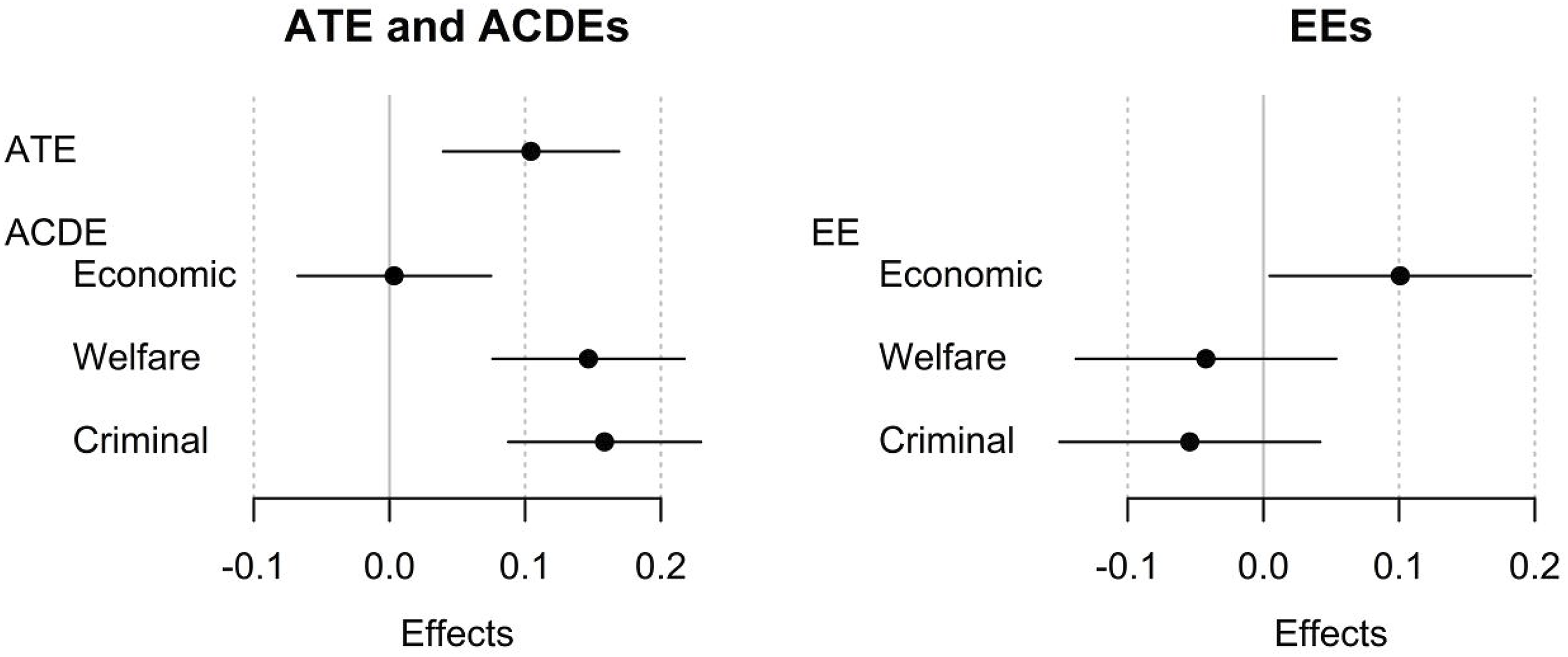
We observed striking results for economic MMA. The ACDE was estimated to be almost zero. In contrast, the estimated EE was 10.1 percentage points, which was nearly equal to the estimated ATE and statistically significant at the 5% level. These results indicate that the effect of having high skill was perfectly eliminated by informing respondents of an immigrant’s plan to not seek a high-skilled job. Such a complete elimination of the skill premium by the economic contribution led us to expect that the other possible mediators would not work, and the results corroborate our expectations. As for the welfare MMA and the criminal MMA, the ACDEs were estimated to be positive, while the estimated EEs were not statistically distinguishable from zero. In other words, neither the information about an immigrant’s willingness to use welfare resources nor the information about an immigrant’s crime potential changed the effect of having high skill. 4
Discussion
The estimated EEs indicate that the information that high-skilled immigrants will not leverage their skills after entering Japan cancels the skill premium, while the information about welfare burden and the likelihood of committing a crime does not. In other words, the immigrant’s post-migration occupation is a critical condition for the immigrant skill effect to work.
What do these results tell us about the causal mechanisms of the skill premium? Following the argument of Acharya et al. (2018), the quantity of interest here is the average natural indirect effect (ANIE). In our case, this quantity indicates the difference in approval probability when respondents would guess a mediator based on the high-skill information and when they would guess so based on the low-skill information, holding the actual immigrant’s skill level constant at a high level. If the ANIE is positive, we can conclude that the mediator mediates the immigrant’s skill and visa approval. The ANIE equals the EE minus the average reference interaction (ARI). In our experiment, the ARI was the difference between the effect of an immigrant’s skill level when the mediator was the job that the respondent would infer if the immigrant were low-skilled and the effect of an immigrant’s skill level when the job information about the mediator was clearly provided. 5
To identify the EE for the economic MMA with the ANIE, we must assume that the ARI is close to zero. This is a limitation of this experimental design and, unfortunately it would be difficult to justify the zero-ARI assumption. For example, the information provided in the economic MNA may lead respondents to doubt the immigrant’s actual skill level or motivation to work, which would violate the assumption. 6 Nonetheless, our findings—the effect of immigrants’ skill level on natives’ support for immigrants was conditioned by their work plans at the destination—strongly suggest that the skill premium is attributable to the considerations of economic factors by natives. 7
Conclusion
Numerous studies have shown that citizens consistently prefer high-skilled immigrants to low-skilled immigrants. However, it remains unclear why citizens prefer to accept high-skilled immigrants despite concerns that they would compete in the labor market. Citizens’ concerns associated with ethnocentrism cannot solve this puzzle. To understand the causal mechanisms behind this tendency, we conducted a survey experiment with a design to elucidate natives’ expectations from high-skill immigrants that underlie the skill premium. Among the three key factors that have been proposed in existing research as a possible source of the premium attached to highly skilled immigrants, our findings revealed that neither the expected alleviation of the welfare burden nor the low crime potential mediated citizens’ attitudes toward immigrants. We found that citizens are less likely to prefer high-skilled immigrants if they were informed that they do not plan to work in high-skilled jobs. This suggests that the potential contribution of the immigrant to the economy is the only driving force behind citizens’ preference for high-skilled immigrants. While this study may not have been able to rigorously identify the exact causal mechanisms, as a first step, we believe it has greatly advanced our understanding of how the skill premium works for immigrants.
Our results contradict previous studies that have found welfare concerns to be the primary mechanisms of preference for high-skilled immigrants (e.g., Gerber et al., 2017; Helbling and Kriesi, 2014; Naumann, et al., 2018). As we pointed out, these studies relied on proxy variables (e.g., income levels of citizens as a concern for the welfare burden) to assess the mechanism. In contrast, our study evaluated the mechanism by manipulating the impact of welfare concerns directly through an experiment. Our results clearly suggest that natives generally respond positively when they learn that immigrants contribute economically to the host society. However, these results do not rule out the possibility of effects from environmental moderators such as welfare spending or immigrant proportion in the native’s place of residence. Existing research has conducted analyses using such environmental factors, showing, for example, that where taxes are low, exclusionism rises among those who are more concerned about welfare. Future experimental studies could incorporate the heterogeneity of such environmental factors.
Our findings can point the way to improving natives’ attitudes toward immigrants. Since natives prefer immigrants who contribute economically to society (e.g., Igarashi and Ono, 2021), communicating the significance of immigrants’ economic contributions to host society is important to improve their attitude toward immigrants. For example, immigrants from China to Japan have about the same percentage of white-collar professional and senior managerial jobs as Japanese (Korekawa, 2015). Giving this information to Japanese people may improve their attitudes toward Chinese immigrants. Furthermore, if high-skilled immigrants are preferred because they are engaged in high-skilled jobs, it is possible that if low-skilled immigrants are able to engage in high-skilled jobs, natives may not perceive them negatively. Future research will need to further test this possibility through experimentation.
Supplemental Material
sj-pdf-1-rap-10.1177_20531680221091439 – Supplemental Material for Why do citizens prefer high-skilled immigrants to low-skilled immigrants? Identifying causal mechanisms of immigration preferences with a survey experiment
Supplemental Material, sj-pdf-1-rap-10.1177_20531680221091439 for Why do citizens prefer high-skilled immigrants to low-skilled immigrants? Identifying causal mechanisms of immigration preferences with a survey experiment by Akira Igarashi, Hirofumi Miwa and Yoshikuni Ono in Research & Politics
Footnotes
Acknowledgment
We are grateful for helpful comments and suggestions by Charles Crabtree at Dartmouth College, Koji Kagotani at Osaka University of Economics, and seminar participants at the Research Institute of Economy, Trade and Industry (RIETI) and the Japanese Society for Quantitative Political Science. This study was conducted as part of the project “Advanced Technology and Democracy: Does new technology help or hurt democracy?” at RIETI. The survey experiment described in this manuscript has received IRB approval from Tohoku University.
Declaration of conflicting interests
The authors declared no potential conflicts of interest with respect to the research, authorship, and/or publication of this article.
Funding
The authors disclosed receipt of the following financial support for the research, authorship, and/or publication of this article: This work was financially supported by the RIETI and the Japan Society for the Promotion of Science (Grants-in-Aid for Scientific Research: 18H00813, 19H01449, 19H00584, and 20H00059).
Verification materials

Supplemental Material
Supplemental material for this article is available online.
Notes
References
Supplementary Material
Please find the following supplemental material available below.
For Open Access articles published under a Creative Commons License, all supplemental material carries the same license as the article it is associated with.
For non-Open Access articles published, all supplemental material carries a non-exclusive license, and permission requests for re-use of supplemental material or any part of supplemental material shall be sent directly to the copyright owner as specified in the copyright notice associated with the article.
