




Abstract
Existing studies demonstrate that threat perceptions matter for immigration attitudes. However, while these perceptions are potentially sensitive to information about immigrants’ impacts, questions remain about whether inserting such information into public debates changes attitudes and policy preferences—especially on polarizing issues like immigration. Moreover, few studies have considered messages featuring the type of nonphotorealistic visual elements that increasingly appear in media. Using a survey experiment fielded in the United Kingdom, we examined whether evidence about European Union immigrants’ modestly positive economic impacts on the United Kingdom—presented either as text, with visualizations, or as an animated film—changed immigration attitudes and policy preferences. Although visual elements did not have an effect over and above text, all the informational treatments moved attitudes and preferences in positive directions, even among Leave voters. Our study brings together research on immigration public opinion and visual media and has implications for policymaking and journalism practice.
Immigration continues to animate contemporary political and policy debates across receiving societies (McLaren 2015). Within this context, understanding public attitudes on immigration remains crucial: not only are there arguments that governments’ responses should be based, in part, on readings of citizens’ preferences (Ruhs 2022), but there is also evidence that what people think about immigrants and asylum-seekers matters for subsequent behaviors including their willingness to provide assistance to these groups and support their longer term residency (e.g., Thravalou et al. 2021).
Immigration public opinion studies regularly observe that attitudes and preferences vary depending on migrants’ characteristics (Bansak et al. 2016; Hainmueller and Hopkins 2015). These include features such as ethnicity (Ford 2011), religious identity (Fernández-Reino et al. 2022), skill level (Naumann et al. 2018), and—in a world that continues to be affected by COVID-19 (Xiang et al. 2022)—essentialness to national economies and frontline services (Fernández-Reino et al. 2020; Gerver 2022). Generally, what motivates these variations is the extent to which host societies perceive these groups to pose threats to material welfare or symbolic identities (Dinesen and Hjorth 2020; Dražanová 2022). Although the salience and strength of these perceptions are likely influenced by predisposing factors set earlier in life, such as personality traits (Gallego and Pardos-Prado 2014), they are also potentially sensitive to available information about each threat. Indeed, longer-standing theories of attitude formation suggest that people base their opinions on prior conceptions and understandings comprising knowledge gained from a range of sources including media (Blinder and Jeannet 2018; Lippmann 1922; Zaller 1992). 1
Whether directly or indirectly invoking those theories, an established line of scholarship has empirically tested to what extent information shapes political behavior. It suggests that the extent to which voters possess relevant information matters for their attitudes and, to a lesser degree, policy preferences (Althaus 2003; Bartels 1996; De Vries et al. 2018; Gaines et al. 2007). But given growing affective polarization and partisan motivated reasoning, recent empirical work has revisited these findings to further develop scope conditions under which and for whom this happens—especially when the information runs against respondents’ prior beliefs (Leeper and Mullinix 2018).
Understanding these conditions particularly matters now: mis- and disinformation potentially contribute to greater polarization, cynicism, and inauthenticity (McKay and Tenove 2021) while presenting challenges for legislators trying to read and respond to public opinion (Ahlstrom-Vij 2022). Recent studies involving multiple issues (Guess and Coppock 2020; Wood and Porter 2019), countries beyond the United States and Europe (Porter and Wood 2021), and a meta-analysis of 30 experimental studies (Walter et al. 2020) suggest that corrections reduce false beliefs. Several factors moderate this conclusion: elite cues indicating consensus or polarization (Druckman et al. 2013); whether individuals require a definitive answer to a problem (Kruglanski and Webster 1996); and partisanship in more right-leaning directions (Walter et al. 2020).
However, beyond generating more accurate beliefs, it is less clear whether and for whom information moves attitudes and preferences in particular directions. Here, the issue of immigration provides a potentially difficult and as such especially worthwhile test owing to its saliency and polarizing effects in receiving countries, which raises the likelihood of people interpreting political messages along partisan lines (Iyengar et al. 2019). This is certainly the case in the United Kingdom—the focus of this paper—where the debate about how to best manage immigration was a key issue in the 2016 European Union referendum (Hobolt 2016). Since the referendum, divisions among Leave and Remain voters have colored views on seemingly nonpolitical issues, potentially contributing to further affective polarization and new political identities (Hobolt et al. 2021).
Therefore, in this paper, we extend existing experimental work on messages’ effectiveness to political settings and cleavages beyond those found in the United States, which has tended to dominate scholarly attention—especially on immigration attitudes (Dražanová and Gonnot 2022). We also draw attention to messaging modes featuring multimodal elements that combine textual and visual components. Multimodality is a key feature of contemporary media outputs, especially on digital platforms (Engebretsen 2020). It also increasingly characterizes how citizens encounter and learn about political issues (Powell et al. 2015) and minority groups (Dan 2019). Yet with few recent exceptions involving photography and video (e.g., Boussalis et al. 2021; Hameleers et al. 2020), there is little experimental evidence addressing the consequences of factual information for attitudes and preferences when it appears in multimodal formats that incorporate common yet nonphotorealistic visual elements such as graphs or animated figures. This presents problems for building better theories about when and what types of messages matter for political behaviors, and for informing communication-based interventions in policy or media.
We address this lack of evidence by using a survey experiment fielded in March 2019 among UK-based adults (N = 3,889). Our experiment featured treatments containing multimodal messages that expressed factually correct information about the (generally modestly positive) impacts of EU migrants on the UK economy. Specifically, we compared information conveyed in traditional text–based forms or accompanied by either a series of data visualizations (e.g., charts and graphs) or an infographic-based animated video. By testing these kinds of visual outputs, we depart from most prior work that has tended to focus on the effects of messages containing realistic elements such as video recordings or photography on political attitudes.
Overall, all the messaging modes moved aggregate attitudes and preferences in line with the positive message: treated respondents—both in the aggregate and Leave voters specifically—expressed more positive views toward EU immigration compared to the control group. Although adding data visualizations or animations did not have effects over and above text, we interpret this as evidence that multimodality does not detract from text-based interventions. Rather, our results leave scope for visual modes to exert influence in ways we did not test in this study. Indeed, our findings accord with the broad direction of prior work, which tends to show that certain kinds of information are more impactful than others: in our experimental design, we relied on facts directly addressing immigrants’ impacts rather than on generic information about, for example, the proportions of foreign-born people in a society. As we outline in the conclusion, these results contribute to a theoretical understanding of the extent to which partisans are receptive to counter-attitudinal information, and what this may mean for future democratic functioning. Moreover, they present implications for practical messaging interventions on political issues.
In what follows, we start by outlining our theoretical expectations about how information about immigration and the visual form in which it is communicated affects attitudes and preferences. Then, we present the design and details of our original survey experiment, as well as explain key choices surrounding our data handling and analysis. Next, we share the results of our experiment and connect them to our theoretical expectations. Finally, we conclude with a discussion about what our study implies for scholarship on immigration public opinion and communications practice.
Visual Information and Its Effects on Attitudes
The main aim of our investigation is to contribute to debates about the effects of information regarding polarizing political issues like immigration, while also addressing the relevant literature's lack of evidence regarding how—if at all—the type of nonphotorealistic visual elements that have become commonplace in contemporary media outputs either enhance or dampen these effects. We motivate this in three stages: first, by addressing the relationship between information and immigration public opinion generally; second, by focusing on the effects of visual (and specifically nonphotorealistic) communication modes; and third, by setting expectations about how polarization between groups with different views on immigration might produce different effects.
Information and Immigration Public Opinion
There has been a long-standing interest in explaining public attitudes toward immigration and immigrants, notably by distinguishing among the types of threat being invoked (see Dinesen and Hjorth 2020). Although cross-national evidence suggests that immigration public opinion is relatively stable in the longer term despite external shocks such as sudden inflows (Claassen and McLaren 2022; Kustov et al. 2021; Stockemer et al. 2020), there remains some scope for shifts in respondents’ knowledge or information environments to change their understandings and attitudes in the shorter term (Dennison and Dražanová 2018). Without downplaying these shifts’ potential to be highly variable and temporary, they nevertheless can be consequential for outcomes related to immigration (Bos et al. 2016) as well as other topics—especially during elections and referenda (Foos and Bischof 2022; Wojcieszak et al. 2017).
If what people know about immigration is related to their attitudes and preferences, what kinds of information matter? Several recent studies into immigration public opinion show how facts about the sizes and compositions of immigrant stocks and flows impact perceptions and attitudes (Blinder and Schaffner 2020; Grigorieff et al. 2020). Yet, it is less clear whether such facts also change opinions toward preferred immigration policies specifically. For example, two US studies show that immigration preferences do not change in the face of correct information about the size of minority populations (Hopkins et al. 2018; Lawrence and Sides 2014). In an extension to that work, Jørgensen and Osmundsen (2022) considered whether this noneffect might derive from citizens differentiating among immigrant groups by national origins, or being sensitive toward information besides population size. Focusing on Danish attitudes toward non-Western immigrants, they found that citizens did not change their policy preferences after seeing correct information about this group's welfare dependency, rate of committing crimes, or size as a proportion of the total population.
Building on studies like these, our experiment examines what types of information might matter not only for perceptions and attitudes but also for policy preferences. We developed a series of messages that presented data on the economic impacts that immigrants from the European Union have on the United Kingdom (more details appear in the “Methods and Data” section). Our focus on economic aspects was motivated by surveys suggesting that people in the United Kingdom at the time wanted immigration numbers reduced (Duffy et al. 2017) and that the main worry driving that desires concerned immigrants’ economic impacts (Duffy and Frere-Smith 2014). Available data on such impacts support four claims: (1) EU immigrants have had a minimal impact on wages for UK native workers, even increasing them in some sectors; (2) EU immigrants, particularly from Eastern Europe, are disproportionately employed in low-paying jobs that UK citizens are unwilling to do; (3) EU immigrants are unlikely to have contributed to higher unemployment among UK native workers; and (4) European immigrants tend to have a modestly net positive impact from a fiscal point of view, paying in more in terms of taxes and other contributions than they take out (Migration Advisory Committee 2018; Migration Observatory 2019).
As such, the informational content of our message treatments departs from prior work by highlighting the impacts of immigrants originating from within the European Union who are more likely to be perceived as closer in culture and background (Dennison and Geddes 2018), and by testing information that explicitly addresses concerns about these migrants’ negative economic impacts. We expect these messages—regardless of their textual or visual forms—will change perceptions, attitudes, and preferences:
On average, respondents who see messages reporting on the positive impacts of EU migrants on the UK economy will express significantly more positive perceptions, attitudes, and policy preferences on EU immigration compared to respondents in a control group who see no message.
Different Kinds of Visual Messaging: Does Multimodality Matter?
Next, we turn attention to the potential effects of visual communication modes on immigration attitudes. On the one hand, visual elements such as photography that display realistic (i.e., true to life) representations tend to command viewers’ attention in news contexts (Dahmen 2012). Moreover, audiences perceive multimodal messages such as prototypical tweets containing photographic elements as being slightly more credible than similar text-only messages (Hameleers et al. 2020), possibly because they believe these kinds of images to be especially trustworthy and objective sources of evidence (Messaris and Abraham 2001). What is more, several experimental studies have demonstrated how realistic visuals specifically impact how people perceive political issues and actors. For example, photographs showing higher levels of conflict that were embedded within news articles and attributed to hypothetical student protests elicited more negative evaluations (Arpan et al. 2006). Subsequent studies have examined the combined effects of photographs and text in more naturalistic news settings, suggesting that images shift behavioral intentions—particularly among the politically interested (Geise et al. 2021)—but are not necessarily more effective than text alone at changing attitudes (Powell et al. 2015). Meanwhile, in settings relying on video recordings such as televised debates, audiences evaluate candidates partly on their nonverbal displays captured on-screen (Nina and Santana-Pereira 2021), and often through gendered expectations of politicians’ behavior (Boussalis et al. 2021).
On the other hand, it is not clear that researchers should assume non-photorealistic visual approaches to be less familiar, attention-commanding, and credible—and therefore less impactful—on account of their abstracted or stylized characteristics. These kinds of outputs increasingly accompany textual information in popular media: for example, the prevalence of graphs and figurative animations has grown alongside the popularity of data journalism which usually combines quantitative information with elements of storytelling (Young et al. 2018). Similar to familiar forms of photojournalism, eye-tracking studies and surveys show that audiences pay attention to these kinds of images in realistic online news settings (Haan et al. 2018). Meanwhile, recent studies demonstrate how these messaging modes potentially impact attitudes and understandings of immigration (Allen 2018) as well as other issues including human rights (Rall et al. 2016), abortion (Hill 2017), and climate change (Engebretsen 2020). Yet few studies have quantitatively tested for this impact using politically relevant issues and sample sizes that allow for distinguishing among audiences varying in characteristics that likely matter for attitudinal change. 2 Therefore, we examine whether these kinds of visuals have effects over and beyond textual modes:
On average, respondents who see textual messages reporting on the positive impacts of EU migrants on the UK economy and accompanied by nonphotorealistic visuals will express significantly more positive perceptions, attitudes, and policy preferences on EU immigration compared to respondents who see the same information in its textual form only.
Heterogeneous Effects of Informational Interventions About Immigration
If concerns about partisan motivated reasoning are warranted, finding aggregate effects in H1 and H2 might mask important forms of heterogeneity across different groups. Although we do not focus on belief accuracy in this study, these concerns are best understood against a growing body of work considering whether factual information promotes accurate beliefs (Walter et al. 2020), or if partisan motivated reasoning might dampen or even reverse the effects of corrections on polarizing issues (“backfire”) among respondents holding views that go against the direction of the messages (Nyhan and Reifler 2010).
Subsequent empirical tests suggest that, even in situations that should be favorable to backfire effects, people tend to update their beliefs in line with the messages (Wood and Porter 2019). Even so, there remain questions about whether this holds across different kinds of messages, including those containing visual components that are increasingly supported by digital platforms. Again, there has been a long-standing interest in examining how photographs enhance the persuasive effects of text in journalistic settings (e.g., Powell et al. 2015). But messengers in journalism and policy increasingly communicate through nonphotorealistic visuals, particularly data visualization—or the “visual representation and presentation of data to facilitate understanding” (Kirk 2019, 15)—as well as infographics lacking data yet using visual elements such as shape and color. Indeed, audiences are more likely to encounter information in these visual modalities than in tables (Engebretsen and Kennedy 2020). Although recent surveys of online visualizations and infographics have argued that these specific modes potentially impact political behaviors beyond belief accuracy (Amit-Danhi and Shifman 2018; Allen 2021), less is known about whether and for whom this may be the case.
Therefore, we consider whether factual information about political issues conveyed in multimodal ways is less effective among people for whom the messages are counter-attitudinal. This question is particularly relevant to the UK context. During the UK's 2016 EU referendum, immigration was one of the most important issues that shaped voters’ preferences, with Leave voters more likely to favor restrictions and lower immigration levels (Hobolt 2016). Since then, the labels of “Leave” and “Remain” have remained highly salient for the ways that UK voters perceive not only political topics such as government competency but also each other in nonpolitical settings (Hobolt et al. 2021).
These patterns suggest that, in our case, information about the modestly positive economic impacts of EU immigration is likely to be viewed through polarized lenses, creating favorable conditions for backfire among Leave voters. Of course, while immigration was a central concern for this group, other related issues such as investment in public services also mattered for these voters (Rolfe et al. 2018). Moreover, as explained in the “Methods and Data” section, our experimental design did not measure respondents’ attitudes prior to each treatment. Instead, we used a between-subjects design comparing the outcomes in treatment condition to a control group that did not see any message. 3 Therefore, we propose the following hypothesis:
Respondents identifying as Leave voters who see messages emphasizing the positive impacts of EU migrants on the UK economy will express significantly more negative perceptions, attitudes, and policy preferences on EU immigration compared to Leave voters in a control group who see no message.
Data and Methods
Experimental Design and Treatments
We randomly assigned respondents to one of four conditions. 4 In the Control condition, respondents completed a questionnaire asking standard demographic questions as well as questions about their overall immigration attitudes, perceptions of how EU immigrants impact the UK economy, and preferences on a range of immigration policies. We provide details on these questions in the “Dependent Variables” section below.
In the Text condition, prior to the attitudinal questions, we asked respondents to read a factual statement about the impacts of EU immigrants on the UK economy, which appears in Figure 1. This statement drew upon available statistics and economic evidence addressing key concerns in the UK debate about these immigrants’ effects on the economy: their impacts on wages, the extent to which they displace British workers in the labor market, and whether they put additional pressure on public services such as healthcare and schools. 5
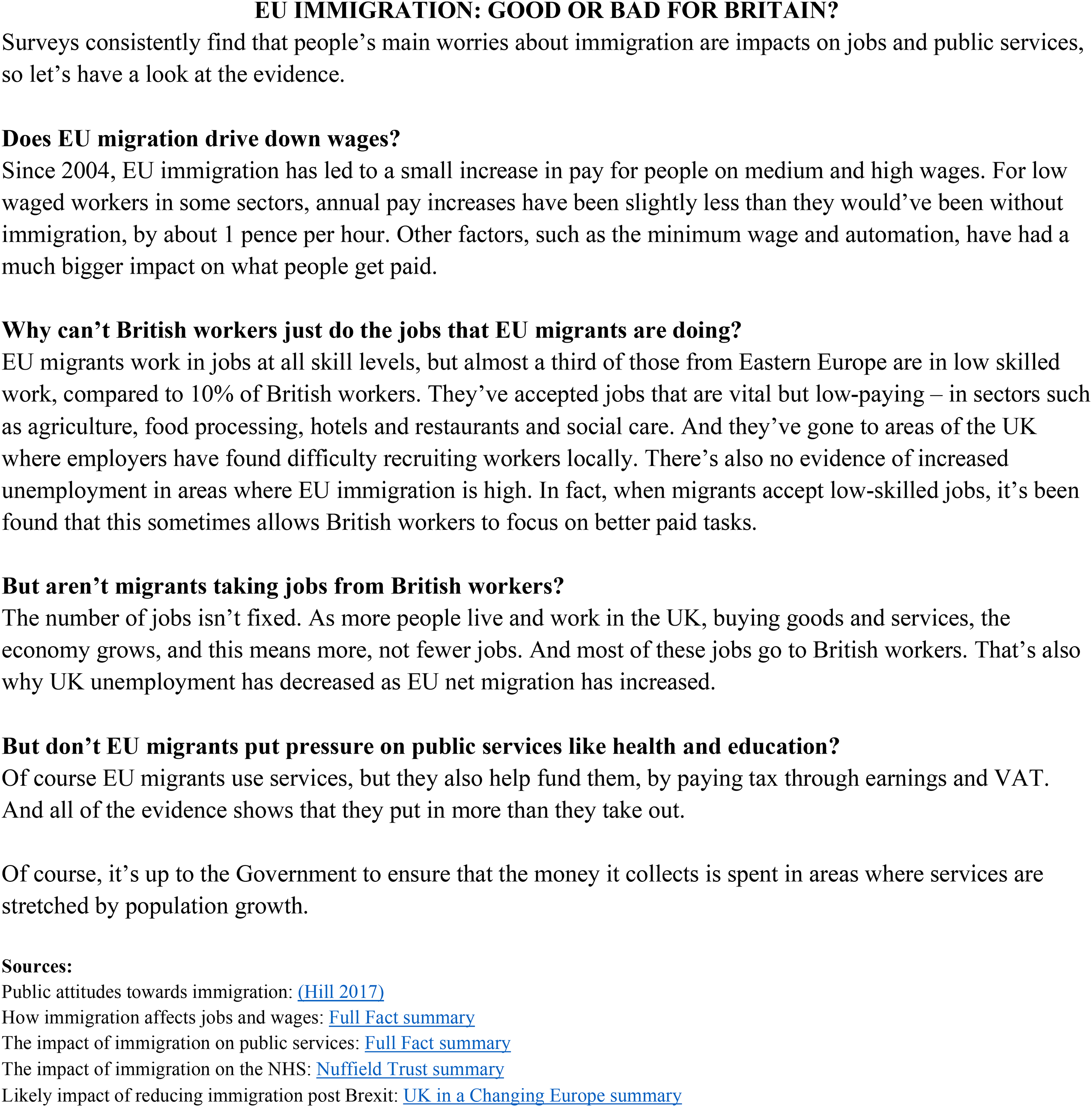
Message used in the Text condition.
The Visualization condition in Figure 2 was the same as the Text condition except for the addition of three static charts accompanying each relevant claim. These charts were created in R (R Core Team 2018). To enhance the treatments’ external validity, we incorporated design choices mirroring those found in fact-check briefings (e.g., Full Fact 2017) and corresponding with the patterns found in systematic surveys of publicly available migration data visualizations (Dennett 2015; Allen 2021). These features included line and bar chart types, blue coloration, titles, and citations of sources. 6
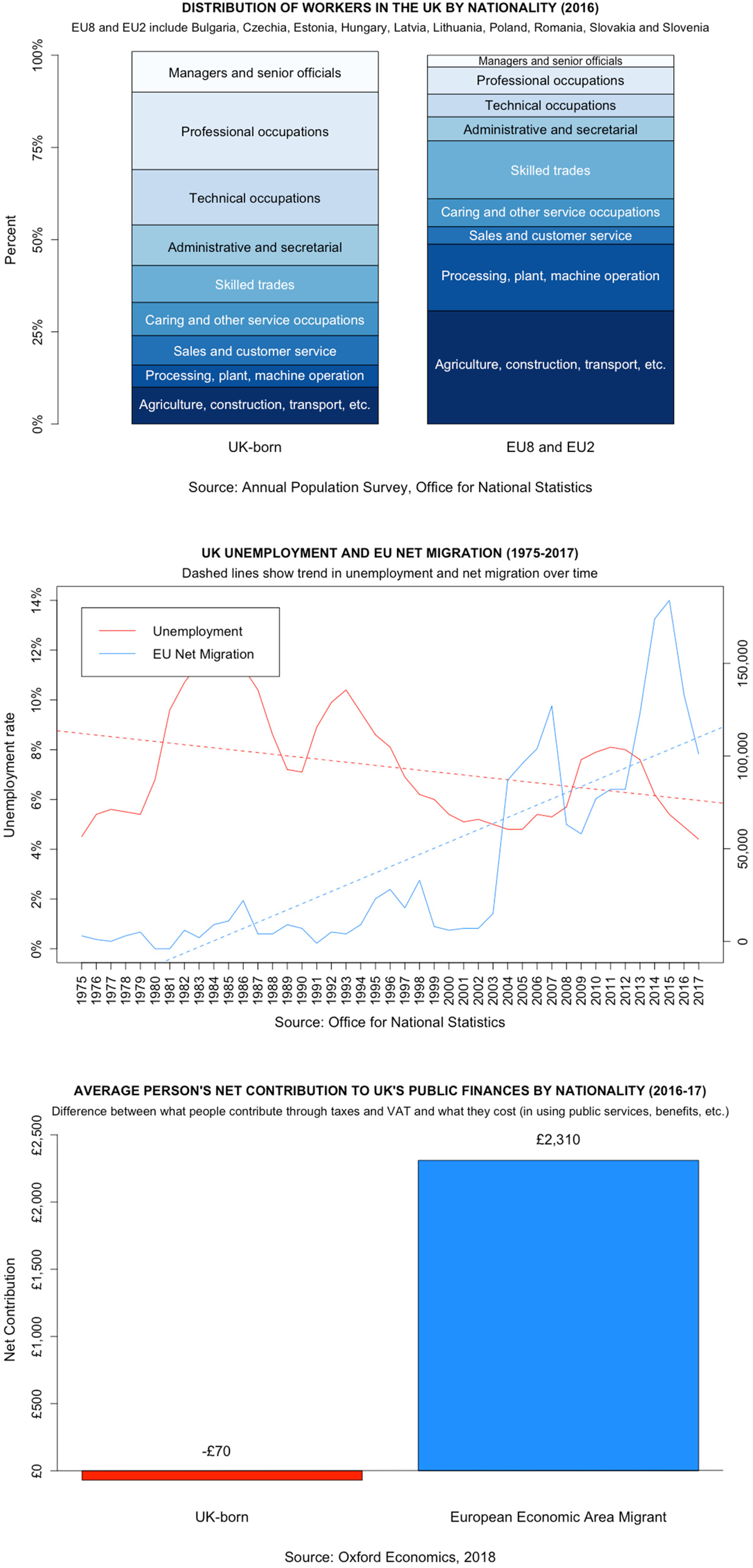
Charts used in the Visualization condition.
Finally, we presented participants in the Video condition with an animated infographic video in which a narrator read the same content in the Text condition accompanied by large subtitles. Screenshots from the animation appear in Figure 3. The full video is available at https://youtu.be/HpLvw8au1AI. This treatment did not include any charts: rather, it used cartoon-like characters, simplified shapes, and movement.

Screenshots from animation used in the Video condition.
Page timing data show that respondents in the Visualization condition spent an average of 56 seconds longer with their treatment compared to those in the Text condition, while those in the Video condition spent an average of 112 seconds longer with their treatment compared to the Text group. This suggests that respondents likely engaged with the visual treatments, although we could not directly observe respondents’ behavior given the remote set-up of the experiment.
Sampling and Missing Data Procedures
We recruited 3,889 UK adult citizens using Prolific (https://www.prolific.co) in March 2019, having received ethical approval for this study from the relevant university committee in December 2018, and obtained informed consent from respondents before the survey began. Prolific is an online participant recruitment platform that offers several advantages over other established options such as Amazon Mechanical Turk, notably a more diverse pool of respondents (Peer et al. 2017) and greater control over pre-screening participants (Palan and Schitter 2018). Evaluation studies also indicate that Prolific returns high levels of data quality compared to common online alternatives in terms of respondents’ attention, comprehension, and honesty (Peer et al. 2022).
Across all items, 2.6 percent of responses were missing due to respondents not answering the relevant question (see Table S3). This resulted in 26 percent of observations in the sample being incomplete with respect to at least one variable of interest, including some outcome variables. Since deleting these observations in a list-wise fashion would introduce bias and inefficiency to the experimental data (Enders 2010; Horiuchi et al. 2007), we used multiple imputations to impute missing responses via aregImpute in R's Hmisc package (Harrell and Dupont 2020). 7 Meanwhile, our sampling strategy aimed to recruit similar proportions of Leave and Remain voters by gender, as reported by Ipsos MORI (2016). The achieved sample (Table S2) closely followed those figures, suggesting a degree of representativeness along these lines. Finally, although randomization makes testing and adjusting for individual-level differences among conditions unnecessary (Mutz 2011), we provide descriptive statistics about the respondents assigned to each experimental condition in the supplementary information (Table S1).
Dependent Variables
We report treatment effects for three outcomes. The first dependent variable is overall attitudes to immigration levels, as measured by yes/no responses to the question “Do you think too many immigrants have been let into this country, or not?” This wording comes from the British Election Study (BES), a long-running and high-quality panel in the United Kingdom (Fieldhouse et al. 2020).
The second dependent variable is perceptions of EU immigrants’ economic impacts on the United Kingdom, as measured by levels of agreement with three items: “EU migrants take jobs from British workers,” “EU migrants drive down wages of British workers,” and “EU migrants help create jobs in the UK” (where 1 = Strongly agree and 5 = Strongly disagree, with the final item reverse coded for analysis). These items come from Rolfe et al. (2018), having originally been used to expand upon the standard BES item “do you think immigration is good or bad for Britain's economy?” We constructed a scale from these items through Item Response Theory, using the mirt package (Chalmers 2012) in R. 8 IRT models are used to measure latent traits assumed to fall on a continuous scale, ranging from −∞ to +∞, with a mean of 0 and standard deviation of 1. This means that, while an individual value ascribed to a respondent has no intrinsic meaning, it can nevertheless be interpreted relative to an estimated population mean. Modeled responses on the present scale ranged from −2.29 (maximally negative perceptions) to 1.78 (maximally positive perceptions) on the scale.
An IRT model needs to satisfy three assumptions: good model fit, unidimensionality (i.e., the scale measures a single trait), and local independence (i.e., the individual items are uncorrelated after considering the underlying trait measured by the model). Empirical plots suggested a good fit, and a scree plot suggested unidimensionality. We evaluated local independence using Yen's (1993) Q3 test, which produced a maximum value of −0.686 in this case. Although Yen suggests that values outside of −0.2 and 0.2 provide evidence of local dependence, this rule of thumb is more appropriate for scales comprising 35 items or more, as shorter scales will tend to generate larger (and negative) Q3 values, even in the absence of local dependence (Ayala 2009, 133, 137).
The third dependent variable is policy preferences toward EU immigration, as measured by three items: “On a scale from 0 to 10, to what extent do you agree with the statement that the Government should use Brexit as an opportunity to cut down EU immigration?” (reverse coded for analysis), “How would you prefer immigration levels to Britain changed?” (0 = Decreased a lot and 10 = Increased a lot), and “Do you personally feel that it is more important for the United Kingdom to have access to the European Union's single market or to gain full control of immigration?” (0 = Access to the single market is more important and 10 = Controlling immigration is more important; reverse coded for analysis). The first item comes from Rolfe et al. (2018), and the remaining two correspond to the variables immigself and euPriorityBalance in BES waves 7–17. Here, too, we constructed a scale using IRT modeling. The trace lines for this fitted model—showing the points on the resulting scale at which respondents would be expected to choose each response item—suggested collapsing the first two items (about Brexit and immigration levels) into three response options, and the third into a seven response option. Refitting the model against that recoding saw the item load substantially better onto the factor. Modeled responses ranged from −1.68 (maximally restrictive policy preferences) to 1.86 (maximally liberal policy preferences) on the scale. Empirical plots suggested a good model fit, a scree plot indicated unidimensionality, and the largest Q3 value was −0.676.
For further clarity, we also report the mean untransformed values for each of the items comprising the economic perceptions and policy preferences dependent variables in the supplementary information (Figure S1). Note that calculating these means treats the component items as being continuous, despite them (strictly speaking) being ordinal, for example, 1 = “Strongly agree” to 5 = “Strongly disagree” for the economic perceptions items. This motivates the choice to analyze effects for statistical inference purposes based on IRT scales (which, as noted above, are continuous) calculated from these items, rather than on the items themselves. Still, untransformed means are helpful in providing an additional yet informal illustration of effect sizes, which is why we include them.
In addition, we sense-checked our dependent variables by looking at their distributions in the control condition, expecting them to resemble the spread of attitudes and preferences in the general population. Specifically, we expected that a greater proportion of Leave voters compared to Remain voters would answer “yes” to the question of whether too many immigrants have been let into the country, and that Remain voters would score higher than Leave voters on our economic perceptions and policy preferences scales. Figure 4 shows that the data match these expectations.
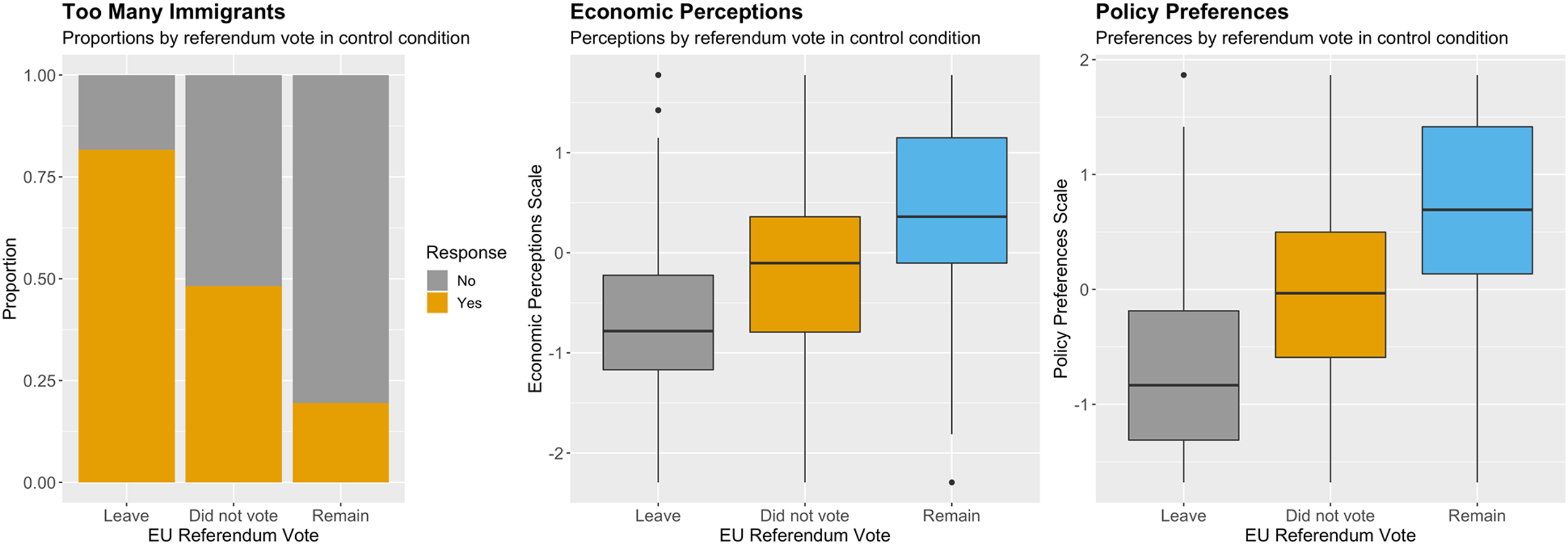
Distributions for outcome variables by EU referendum vote in control condition.
Finally, we acknowledge that common choices about including or excluding covariates, handling missing or outlier data, and modeling choices may have implications for the eventual results, including with respect to their level of statistical significance (e.g., Ofosu and Posner 2021; Owen and Li 2021). Although we did not preregister an analysis plan at the time of data collection because norms surrounding this practice were still developing, we have made all of the fully anonymized data and associated scripts available on a public GitHub repository. 9 This provides a public record of our analysis and enables others to stress-test the findings, in line with Open Science conventions (Lewis 2020).
Results
Does Economic Information Change Immigration Attitudes and Preferences?
First, we consider whether the additional information—conveyed in either textual or nonphotorealistic visual modes—had any aggregate effects (H1). To do so, we fitted three models with robust standard errors: a logistic model (using glm in R) expressing our first dependent variable of attitudes toward immigration levels as a function of each experimental condition, while controlling for demographic covariates; and two linear models (using lm in R), modeling respondents’ location on the economic perceptions and policy preferences scales as a function of each experimental condition, again controlling for covariates. 10 (As can be seen from Table S6, running the analysis without covariates does not change the substantive results). Figure 5 plots the estimated treatment effects compared to the control.
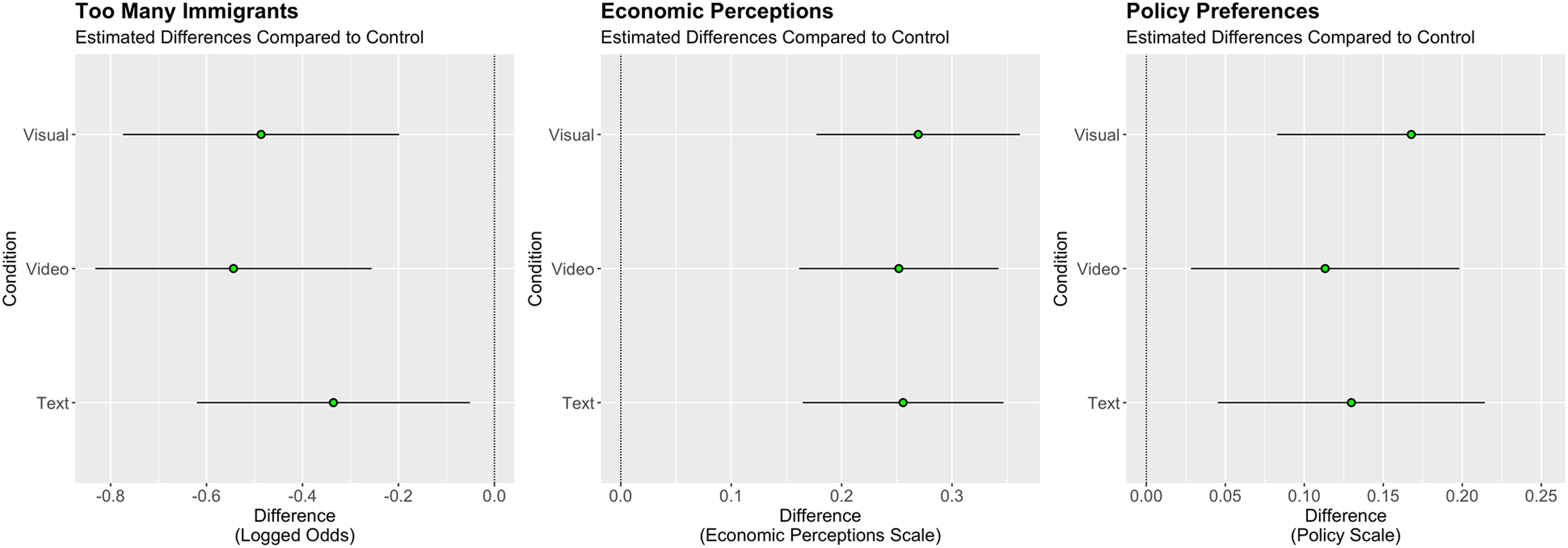
Treatment effects for message modes compared to the control.
Each treatment had a significant effect on each of the outcomes, compared to the control, which lends strong support for H1. As shown in the top two lines of each panel in Figure 5, both visual treatments—which combined the text-based information and visual outputs in a multimodal fashion—had substantial effects on respondents’ immigration attitudes, economic perceptions of EU immigrants, and policy preferences in line with the messages’ valence. Meanwhile, the text-only message also had similar effects.
Do Nonphotorealistic Visuals Matter?
To identify any effects of visuals over and above text, Figure 6 plots the estimated differences between treatments, using the Holm method to adjust p-values to account for multiple comparisons among treatments. 11 As shown in the bottom two lines of each panel, neither of the visual modes displayed effects that were significantly different from those produced in the Text condition, contrary to H2. Yet it is also clear that these visual modes did not meaningfully attenuate the overall treatment effects of the text-based information, either, which leaves open the possibility for nonphotorealistic messaging modes to change attitudes in ways we have not tested here—a point to which we return in the discussion.
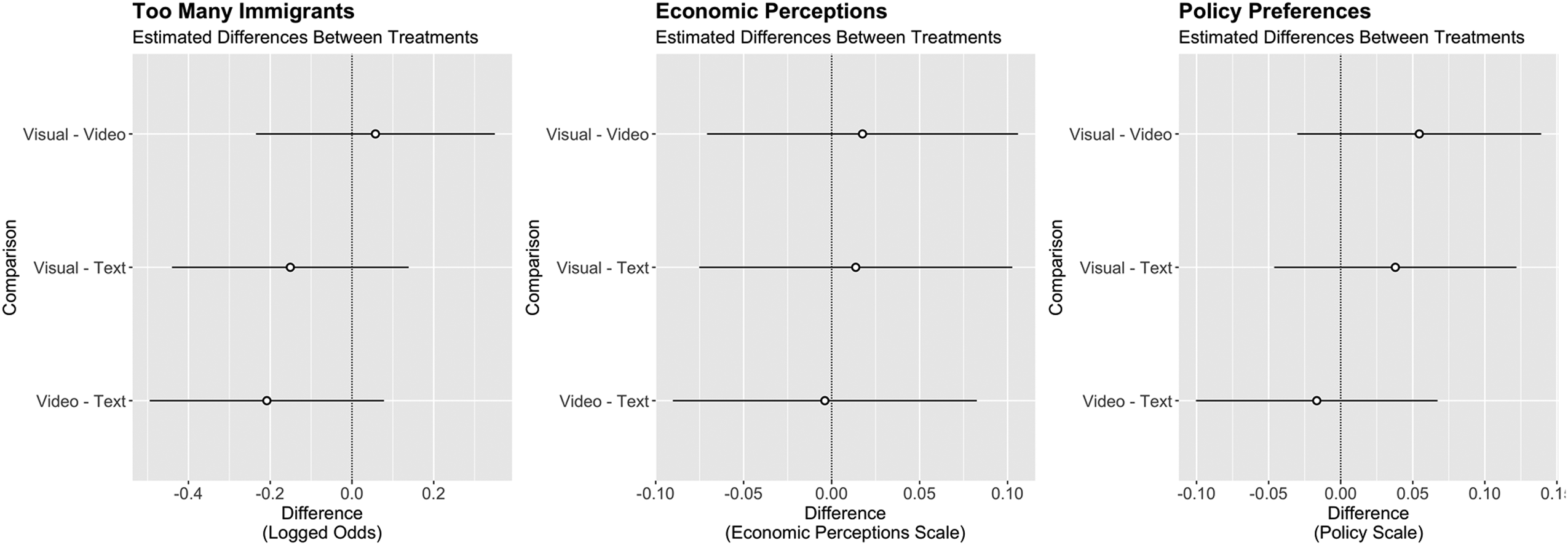
Treatment effect differences among message modes, estimated using multiple comparisons (p-values corrected using Holm method).
Is There Heterogeneity by EU Referendum Voting?
Might the aggregate effects identified in the previous sections mask heterogeneous effects, specifically among Leave voters (H3)? We fitted three new models, identical to the ones used in the previous section, but including an interaction term between treatment group and referendum vote. 12 Table 1 breaks down the modeled treatment effects by treatment condition and referendum vote.
Treatment Effects Interacted with Referendum Vote.
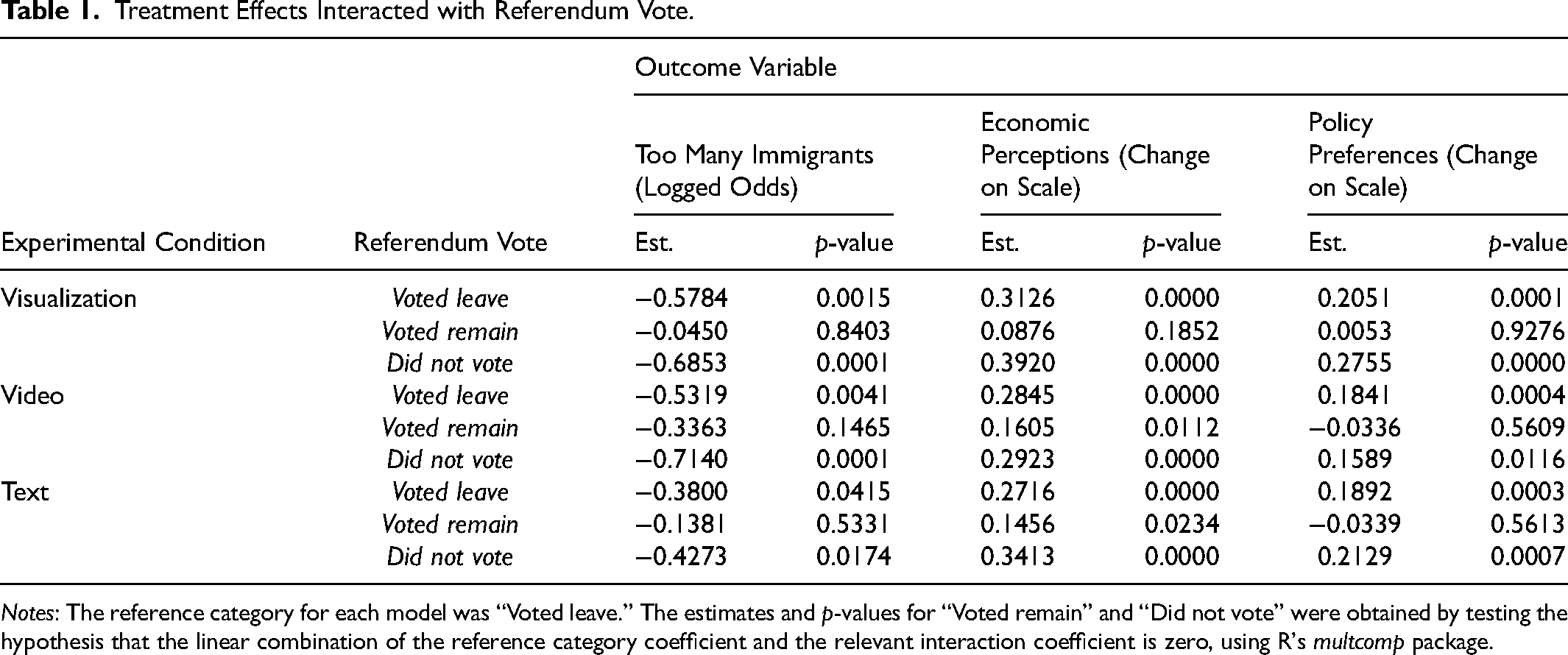
Notes: The reference category for each model was “Voted leave.” The estimates and p-values for “Voted remain” and “Did not vote” were obtained by testing the hypothesis that the linear combination of the reference category coefficient and the relevant interaction coefficient is zero, using R's multcomp package.
Our results do not provide evidence of heterogeneity. Across the three treatments, Leave voters were less likely to agree with the claim that too many immigrants have been let into the country, and registered more positive responses on the economic perceptions and policy preferences scales, compared to those in the control group. If anything, it was Remain voters who were less susceptible to the treatments. A likely explanation involves ceiling effects: this group initially held more positive views toward immigration and would have had less room for treatment effects—an explanation that receives some support from Figure 4. We do not see any reason to make much of the negative effect in the video and text conditions for this group given the effect's size and the large p-values.
We further explore the possibility of treatment heterogeneity by using the same interacted models to plot predicted probabilities for the typical Leave, Remain, and nonvoting respondents in each treatment condition on our “too many immigrants” outcome variable, as well as the predicted locations of the same respondent types on the economic perceptions and policy preferences scales. 13 We show these probabilities in Figure 7.
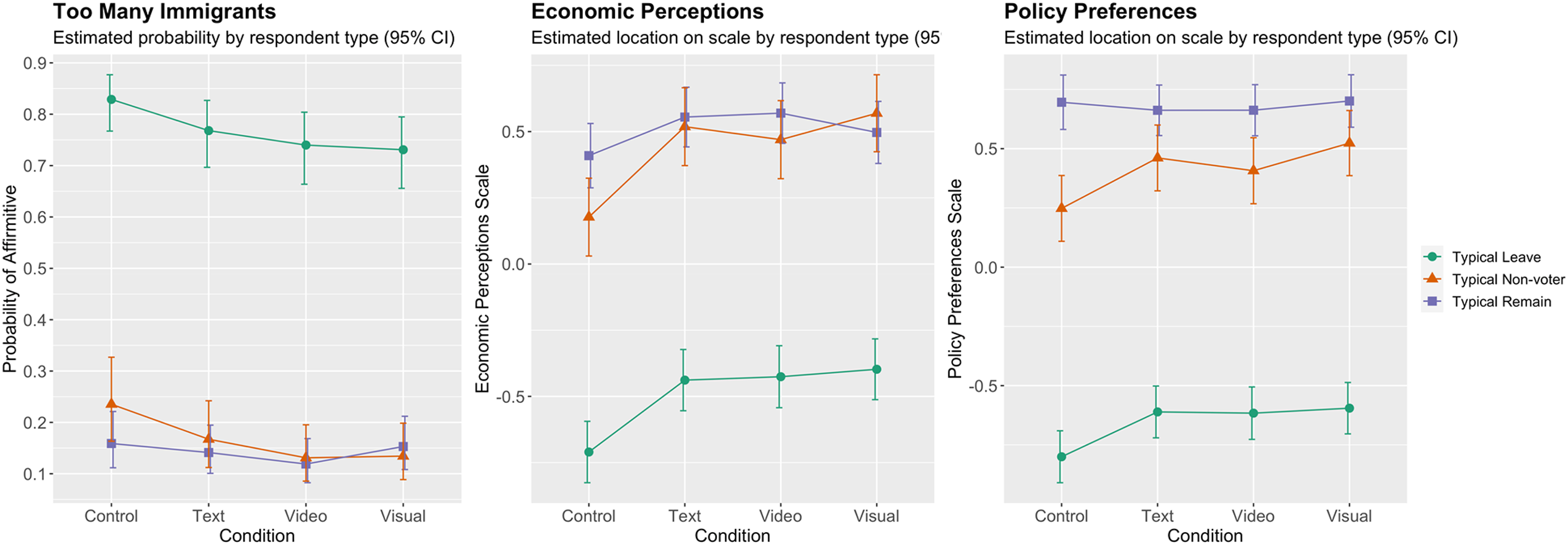
Predicted probabilities (left) and scale location (middle and right) for typical Leave, Remain, and Non-voting respondents by outcome variable.
Focusing on typical Leave voters, the relative location of the point estimates in each treatment condition compared to the control yet again fails to indicate heterogeneity. The gap between the control and treatment groups on economic perceptions is particularly noteworthy. Recall that this outcome variable reflected items that explicitly corresponded with the two main concerns about EU immigration addressed by the messages (i.e., EU workers displacing British workers, and EU workers driving down wages). Indeed, returning to the individual items underlying the economic perceptions scale reveals average treatment effects on the order of 0.3 points on a five-point scale (1 = “Strongly agree” to 5 = “Strongly disagree”, with one item reverse coded, as per the “Dependent Variables” section), or about 7 percent of the entire range (Figure S1). Consequently, this result potentially indicates how factual information can change attitudes, at least on economic questions, when it is relevant to an attitudinal outcome. This stands in contrast to general information such as the proportion of immigrants in the population, which prior studies have tended to test. These results also support the interpretation that a ceiling effect likely explained the smaller results for Remain voters on account of their preexisting attitudes and preferences. Therefore, we do not find support for H3: despite seeing positively valenced messages about the impacts of EU immigrants, Leave voters did not reject these messages, and instead changed their views in line with the information whether appearing in forms containing charts or an animated video.
Discussion
The availability and use of information is critical for empirically understanding how and why people vote in the ways they do (Delli Carpini and Keeter 1996) as well as for normative discussions about what citizens ought to base their preferences on (Ahlstrom-Vij 2022; Druckman 2014). Prior scholarship has debated how and for whom information matters for political behaviors: while fact-checking appears to generate more correct beliefs (Porter and Wood 2021), its ability to move attitudes and preferences in particular directions—and especially on immigration—is not well established. In parallel, and responding to the growing centrality of visuals to political communication, other scholars have explored the conditional effects of photographs on different outcomes (Powell et al. 2015).
Yet despite the proliferation of messaging featuring visual elements that are not photorealistic, these two areas have not been fully connected, as demonstrated by the relative absence of studies on the subject. In response, we addressed how and for whom factual information on immigration makes a difference when it is conveyed in multimodal forms containing nonphotorealistic elements that have firmly established themselves in journalism and digital communication. On the basis of our survey experimental evidence, we arrive at three conclusions regarding message efficacy with respect to multimodality, types of information, and audiences predisposed to hold counter-attitudinal views.
First, positively valenced information conveyed in ways that combine visuals and text can move attitudes, perceptions, and policy preferences in an intended direction. However, at least in our case, the visual elements themselves do not appear to have effects over and above the accompanying text. These findings connect the literature on fact-checking (which is mainly concerned with belief accuracy) with studies of visual messaging which have hypothesized but not yet causally demonstrated that digital objects such as data visualizations and infographics impact what viewers think about important political issues including immigration (Allen 2021). On the one hand, the null results with respect to the visual elements’ efficacy cast some doubt on conventional wisdom that visuals are somehow always more impactful in their own rights. 14 On the other hand, since we found significant effects in the same direction across all the treatments containing visual elements, we interpret this as evidence that visuals of the kinds we test here at the very least do not attenuate the efficacy of messaging efforts.
Moreover, although our study design did not aim to test the mechanisms through which charts specifically exert their influence, we offer one possibility based on how people evaluate visual information using heuristics or cognitive shortcuts (Kahneman 2011). The treatment effects may have been driven by a perception of credibility, as the sociological literature on visualization “conventions” (Kennedy et al. 2016) suggests. Conventions are the socially shared meanings expressed by visualizations through their design features, such as color choices and shapes. Visual communication scholars have cataloged these features to show how these choices prioritize some values—such as scientific objectivity—over others (Aiello 2020). Meanwhile, experimental work demonstrates how people evaluate the trustworthiness of quantitative evidence using heuristics that prioritize larger sample sizes and verifiability of sources (Lindsey and Ah Yun 2003). Either way, visualizations of quantitative data can give an impression of credibility. Since citizens are more likely to accept the framings of messengers they believe to be credible (Druckman 2001), it is possible that visualizations generate trust in viewers and motivate accuracy-related goals that override partisan ones. The extent to which this holds in other media contexts, its strength compared to realistic visual modes, and who might be more susceptible to using this heuristic, warrants further exploration as low-cost visualization tools continue to grow in popularity and expand the reach of these communication modes.
Second, we contribute further evidence about what kinds of information may be more likely to change immigration policy opinions in particular: when the minority group in question is closer to the host society (as in our case of EU immigration to the United Kingdom), and when the information speaks directly to concerns about those immigrants’ impacts. Prior work (e.g., Hopkins et al. 2018; Jørgensen and Osmundsen 2022; Lawrence and Sides 2014) has tended to find null or weak effects with respect to policy preference changes resulting from information about immigrants’ overall share of the population, or about minority groups which are culturally more distant. By contrast, our results suggest that policy opinions are more malleable given relevant information. To be clear, since we focused on immigrants’ material impacts in this study, future work is needed to test whether relevancy also matters for addressing other symbolic threats that are important for immigration attitudes (Dinesen and Hjorth 2020).
Third, we do not find that factual information about immigration—whether in text-only or multimodal forms containing visuals—elicits more negative responses among respondents who likely hold counter-attitudinal views. Rather, our interventions moved attitudes, perceptions, and policy preferences in directions matching the valence of the message, even among Leave-voting respondents. These results extend the scope of prior experimental work that has failed to find backfire effects in the US context (Guess and Coppock 2018) to cover a different political context and messaging mode. To be sure, our design only featured treatments presenting facts about the impacts of EU immigration on the UK economy. We cannot strictly rule out that the effects we find here might be asymmetric, in that presenting information about the negative impacts of EU immigration might generate backfire among Remain voters.
In terms of limitations, our study did not measure the longevity of these effects, which would be useful for informing and evaluating interventions such as campaigns. More generally, this raises the question of whether the timing of our study might partially explain the results. Political psychology studies suggest respondents’ attitudes are more changeable on lower-salience issues that do not stimulate polarization (Iyengar et al. 2019). Immigration was not one of the most important issues in Britain when we fielded the experiment: in March 2019, only 15 percent of British respondents named immigration as one of the most important issues for the country, its lowest level since 2002, while 71 percent named Brexit/EU (Ipsos MORI 2019). However, the high salience of Brexit—combined with knowledge about how immigration motivated Leave voters, that two of the policy items explicitly mentioned Brexit, and the range of attitudes within our control group (Figure 4)—casts doubt on the idea that our effects are merely an artifact of low salience.
Furthermore, we acknowledge that our messages lacked partisan cues or explicit political endorsements. However, this was by design since our main interest was in exploring the effects of different messaging forms in fact-checking contexts, where the information presented is typically ascribed to independent, nonpartisan sources. Prior experimental studies, including ones involving contentious issues like immigration, suggest that such cues can remind partisans of their pre-existing views and potentially enhance framing effects on party-defining issues (Aarøe 2012; Bechtel et al. 2015). Although this opens avenues for examining whether and how parties can use visuals to persuade voters (e.g., Amit-Danhi 2022), those were not the avenues pursued in this study. Instead, our results lend support to the idea that nonpartisan messengers can also impact public debates (Schudson 2010) in ways that lead people to follow the valence of the evidence communicated.
Turning our view beyond migration studies, our study contributes new evidence about the possibilities of information for impacting public understanding of consequential issues. Facts, at least on the economic impacts of EU immigration, do still matter. So, too, do the visual modes through which they are increasingly communicated in combination with text. Therefore, despite well-founded concerns about current politics being characterized by strongly held partisan beliefs, we think it is important to acknowledge how, in light of results like ours, factual information still can play an important role in shaping what people think.
Supplemental Material
sj-docx-1-mrx-10.1177_01979183221142779 - Supplemental material for Communicating Economic Evidence About Immigration Changes Attitudes and Policy Preferences
Supplemental material, sj-docx-1-mrx-10.1177_01979183221142779 for Communicating Economic Evidence About Immigration Changes Attitudes and Policy Preferences by William L. Allen, Kristoffer Ahlstrom-Vij, Heather Rolfe and Johnny Runge in International Migration Review
Footnotes
Acknowledgments
Previous versions of this paper were presented at the virtual 2020 European Political Science Association conference (June 18-19) and the virtual 2021 International Communication Association conference (May 27-31), as well as seminar series hosted by the Centre on Migration, Policy, and Society (COMPAS) at the University of Oxford and the Centre for Science, Knowledge, and Policy (SKAPE) at the University of Edinburgh. We would like to thank the discussants and participants at these events for their valuable feedback, as well as the anonymous reviewers for further helpful comments.
Declaration of Conflicting Interests
The author(s) declared no potential conflicts of interest with respect to the research, authorship, and/or publication of this article.
Funding
The author(s) disclosed receipt of the following financial support for the research, authorship, and/or publication of this article: This work was supported by the UK Economic and Social Research Council (grant number ES/J500112/1) and the British Academy (grant number PF21\210066). Funding specifically for the survey experiment was provided by Birkbeck, University of London and The Toyota Foundation-Japan (grant number D16-R-0211).

Supplemental Material
Supplemental material for this article is available online.
Notes
References
Supplementary Material
Please find the following supplemental material available below.
For Open Access articles published under a Creative Commons License, all supplemental material carries the same license as the article it is associated with.
For non-Open Access articles published, all supplemental material carries a non-exclusive license, and permission requests for re-use of supplemental material or any part of supplemental material shall be sent directly to the copyright owner as specified in the copyright notice associated with the article.
