




Abstract
A prominent debate in the civil war literature asks whether commodity price shocks incentivize fighting, but existing analyses find inconsistent results. This paper shows these results arise, in part, because research conflates the decision to form a militant campaign with the start of civil conflict. Using original data on 973 militant groups, I sequentially disaggregate between civil conflict onset and the earlier stage of militant mobilization. I use fixed effect regression methods to test for indirect and interaction effects that could obscure the shock-civil conflict relationship. First, I estimate the effect of export commodity price shocks on mobilization onset. Second, I re-examine the shock-civil conflict relationship conditioning on the number of militant groups mobilizing at the time of the shock. The results show economic shocks indirectly increase the risk of civil conflict by driving militant formation. Disaggregating these stages of militant activity advances research about two-stage conflict processes as well as the indirect causes of violence.
Introduction
Each year, militant conflict costs an average of 3,500 lives, $97 USD billion in lost economic activity, and irreparable harm (UNDP, 2020: 1–2). Developing effective policies to prevent this violence depend on addressing a first-order question: why do people fight?
A prominent strand of civil war research examines whether people fight due to changing economic conditions, commonly measured via commodity price shocks. However, researchers disagree both over how and even whether price changes affect the risk of conflict. One problem is that price changes produce theoretically discordant predictions: price drops can increase the risk of conflict by lowering the opportunity costs to form a militant campaign (Hirshleifer, 1989; Grossman, 1995) or decrease the risk of conflict by reducing the attractiveness of state capture (Garfinkel and Skaperdas, 2007; Besley and Persson, 2008). 1 Other points of contention arise due to varying research designs, variable selection, and shock heterogeneity which produce conflicting empirical results. 2 Overall, there is little consensus on when price shocks increase a country’s risk for conflict.
This article re-examines the shock-conflict debate through a replication analysis of Bazzi and Blattman (2014). Its purpose is to highlight an important, but commonly overlooked, mobilization stage preceding the eruption of civil conflict. Shocks can have differential effects on conflict processes, but existing studies miss these by only focusing on one outcome in this chain of events. 3 Understanding the causes of civil conflict requires accounting for selection effects determining what causes militant campaigns to form in the first place (Bartusevicius and Gleditsch, 2019; Germann and Sambanis, 2021; Lewis, 2020). Analytically decoupling the start of mobilization from the start of conflict can improve theories about two-stage conflict processes and the direct—or indirect—causes of violence.
I suggest inconsistent results in the shock-conflict literature arise, in part, because analyses focus on civil conflict onset and not the earlier stage of militant mobilization. While existing shock-conflict analyses typically treat these two events as simultaneous, the average time between when a militant campaign forms and when it intensifies into civil conflict is 3.86 years. By sequentially disaggregating between two stages of militant activity, this article aims to better determine under what conditions changing economic conditions incentivize people to fight.
Treating militant formation and civil conflict as synonymous can mask the effect of changing economic conditions on civil conflict in one of two ways. First, conflating these stages can introduce Type I error into analyses, producing a false empirical relationship between economic shocks and conflict. Because mobilization generally precedes civil conflict onset by several years, there is a risk scholars miss lagged or indirect effects of shocks on conflict. Alternatively, scholars may miss interaction effects because they do not condition on whether mobilization is already underway (Buhaug et al., 2021). If shocks principally increase the risk of conflict by enabling pre-existing campaigns to escalate, then they may seemingly have no effect in countries where mobilization is not ongoing. Pooling observations with different degrees of pre-conflict militant activity could obscure a shock-conflict relationship, resulting in mixed findings.
Using original data on the formation dates of 973 militant group between 1970 and 2007, I test for these indirect and interaction effects. I follow the research design in Bazzi and Blattman (2014) to see how introducing information about pre-conflict mobilization changes their null findings. I first estimate how export commodity price changes affect the risk of militant mobilization onset. The results show that negative price shocks substantially increase the relative risk a new militant campaign forms. Second, I re-examine the shock-civil conflict relationship by conditioning on the number of militant campaigns active at the time of the shock. Consistent with recent research, I find no evidence price shocks increase the risk of civil conflict even when controlling for the presence of pre-existing campaigns. These results are robust across varying commodity price specifications, shock types, and modeling specifications.
This analysis shows economic shocks can have one effect on the emergence of militant campaigns and another on civil conflict; understanding the latter depends on accounting for the former. In short, the results imply the main effect of changing economic conditions on civil conflict risk runs principally through militant mobilization.
Differential effects of shocks
Existing studies may find inconsistent evidence of a shock-conflict relationship because they do not capture the conditions under which changing economic conditions are most likely to increase the risk of civil conflict. Conventional wisdom treats mobilization and civil conflict as synonymous, but it is unclear whether shocks drive mobilization, conflict, or both stages of this conflict process. Disentangling how shocks can affect each stage is important to more precisely explain why people fight.
First, shocks may indirectly shape civil conflict dynamics by increasing the initial risk of militant formation (Figure 1(a)). Drawing on existing opportunity cost theories, this logic expects reduced income flows motivate people to form and join new militant campaigns (Hirshleifer, 1989; Grossman, 1995). When negative economic shocks reduce country export revenues, it can have a downstream effect that also reduces individual disposable incomes within that country. Because individuals sacrifice smaller income losses in exchange for taking up arms, it becomes easier to induce would-be militants to fight. However, mobilization often precedes civil conflict by several years and so is often missed in analyses. Further, mobilization may not translate into civil conflict. In equilibrium, opportunity cost models predict the observable outcome of mobilization is not overt violence, but a “hot peace” or standoff between militants and the state (Skaperdas, 2006; Blattman and Miguel, 2010). Whether a militant campaign escalates into civil conflict depends on bargaining dynamics that unfold after mobilization begins. In many cases, bargaining between a state and militant group mitigates the risk of further violence. For example, when oil prices dropped in 1998, five militant groups in Nigeria’s Niger Delta region formed to threaten rebellion unless changes to the government’s oil revenue-sharing policies materialized. Amidst the specter of violence, mobilization spurred the state to negotiate, not fight. Bargaining ultimately reduced the risk of civil conflict through the creation of the Niger Delta Development Commission (Mabro, 1998). This predicts shocks should impact the formation of militant campaigns. HYPOTHESIS 1 (INDIRECT EFFECT): Shocks should increase the risk of mobilization. Two pathways governing the shock-conflict relationship.

Alternatively, an interaction effect may exist that inadvertently masks a shock-conflict relationship (Figure 1(b)). Shocks can increase the risk of conflict by exacerbating information asymmetries about the size of the state prize (Fearon, 2004; Walter, 2009). These problems can heighten the risk of bargaining failure and civil conflict. However, a precondition for bargaining failure to occur is the presence of at least one militant challenger to negotiate with (Buhaug et al., 2021). If there are no militant groups operating at the time of the shock, there is little risk of bargaining breakdown. When a model pools countries with low and high levels of pre-conflict militant activity, then it may inadvertently overlook the effect of shocks. If interaction effects are present, then conditioning on the number of pre-existing militant campaigns should help recover a shock-conflict relationship. HYPOTHESIS 2 (INTERACTION EFFECT): Pre-conflict mobilization should moderate the effect of shocks on civil conflict onset.
Overall, this suggests existing analyses may find mixed results because they do not precisely identify at what stage of conflict shocks have the greatest effect. I test for potential indirect and interaction effects using an original dataset on the timing of militant campaigns.
Data
To test these hypotheses, I re-examine a prominent study by Bazzi and Blattman (2014), which finds no discernible shock-conflict relationship. I theoretically intervene in the debate by assessing whether their null findings arise due to indirect effects, interaction effects, or both.
I use an original dataset of militant groups which operated around the world between 1970 and 2012. This data builds on growing research by Braithwaite and Cunningham (2020) to examine the organizational foundations and earlier stages of armed conflict. This dataset is broader than conventional rebel group datasets by including rebel groups, terrorist groups, anti-government militias, and violent political parties. 4 Spatial and temporal coverage for the key explanatory variable—commodity price changes—from Bazzi and Blattman (2014) reduces the focus to 973 militant campaigns operating across 116 countries between 1970 and 2007. 5 For each entry, I collect longitudinal data on three points in a militant group’s campaign: when it forms, when it initiates violence, and when—if ever—it escalates to civil conflict.
Mobilization and civil conflict data
The unit of analysis is the country-year. The two dependent variables are two different stages in the emergence and evolution of militant campaigns: mobilization and civil conflict onset. To test for indirect effects, I code when militant groups form. Mobilization is a binary indicator measuring “1” every year that a new militant campaign forms in country i in year t and zero otherwise. I code mobilization such that a campaign only forms once. This mitigates a measurement concern that a group could emerge repeatedly in the dataset by disappearing and then reappearing a few years later. Evidence of formation includes initial political meetings, manifesto signings, or proclamations. For example, the Nigerian Ijaw Youth Council formed in 1998 when it issued the Kaiama Declaration outlining its reasons for taking up arms. Mobilization sometimes, but not necessarily, occurs the same year an armed group initiates violence. I aggregate this group information at the country-level.
To test for interaction effects, I include a count of the number of militant campaigns operating at the time of a shock. Different number of groups can create different entry barriers to formation (Fjelde and Nilsson, 2018). I include a logged, one-year lagged count of militant campaigns (Ln(NumMilitants)). The number of campaigns range from 0 to 70 with a mean of 1.89. Approximately 45% of country-years have at least one militant campaign. Full summary statistics are in Appendix B.
Prevalence of militant conflict by region, 1970–2007.

Price shocks data
The main explanatory variable is commodity price changes using data from Bazzi and Blattman (2014). Their dataset records information on 65 different commodity export prices from 1957 to 2007. Commodity price changes are a popular tool to measure changing economic incentives to fight because they provide a relatively exogenous source of variation to local incomes within a country (Bruckner and Ciccone, 2010).
The dataset records price changes for different classes of good and then creates a composite measure based on the country’s relative export dependence of that commodity. The independent variable (PriceChange) is the change in log export commodity price indexes between year t and year t−1. The price index is a “geometric average of all commodity export prices weighted by lagged export shares” (Bazzi and Blattman, 2014). 6 A price index increases corresponds to larger local incomes in the exporting country.
Results and discussion
Price shocks may have indirect or interaction effects on the risk of civil conflict not captured in existing analyses. I test for these effects by estimating the relationship between price changes and the onset of two different campaign stages using a linear probability model (equations 1 and 2).

Shocks and militant mobilization
Effect of commodity price changes on new militant mobilization.

∗∗∗p < 0.01; ∗∗p < 0.05; ∗p < 0.1 SE clustered by country.
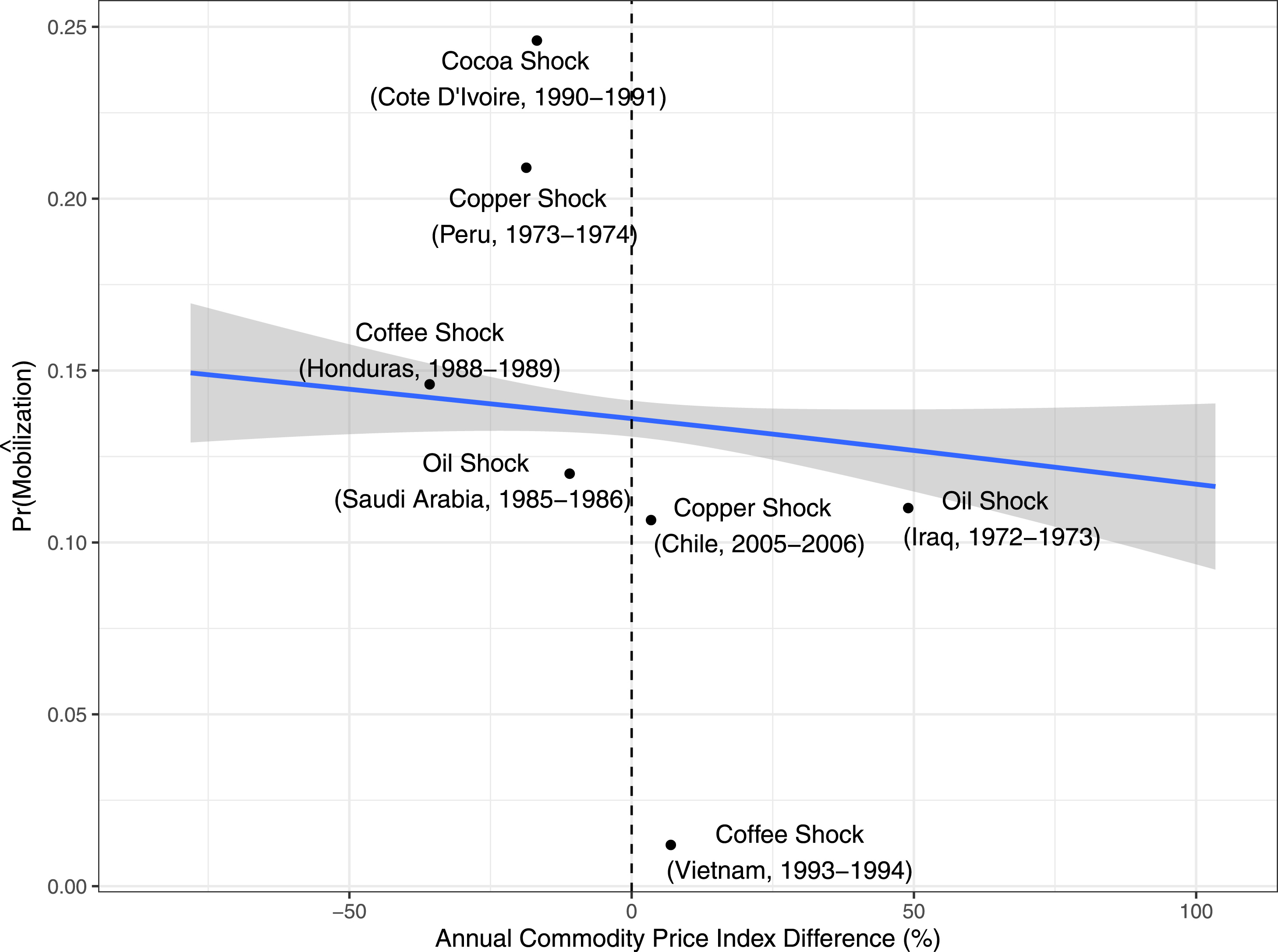
Predicted Probability of Mobilization.
I run a series of robustness checks using alternate modeling specifications and price change transformations to assess whether the size, scale, or type of shock matters (Appendix C).
Across a battery of different tests, the results do not change. I also explore for heterogeneous effects on mobilization including whether shocks have a stronger effect in different types of states (weak or non-democratic) or in spurring certain campaign types to form (separatist or center-seeking) (Appendix D). The results provide suggestive evidence that negative price shocks correlate with the emergence of new militant campaigns. Because mobilization onset typically precedes civil conflict by several years, analyses can miss this relationship. This suggest shocks may indirectly affect civil conflict by catalyzing militant formation.
Re-examining shocks and civil conflict
Effect of commodity price changes on civil conflict onset.

∗∗∗p < 0.01; ∗∗p < 0.05; ∗p < 0.1 SE clustered by country.
Model 3 includes an interaction term measuring the relationship between a price change and number of militant campaigns. The interaction means the coefficient on pricechange measures the effect of a shock when there are no pre-existing militant campaigns at the time of the shock. The effect is insignificant. This supports research by Bazzi and Blattman (2014), Berman and Couttenier (2015) and Blair et al. (2021) that price changes have no consistent effect on the risk of civil conflict even when controlling for pre-existing campaigns. Models 4–6 re-run the same model specification using the higher 1000-battle death threshold for civil war onset.
Figure 3 plots the marginal effect for the 25-battle death threshold and 1000-battle death threshold. The marginal effect is close to zero, suggesting shock-conflict dynamics do not significantly differ across low-activity and high-activity mobilization environments. In the Appendix, I examine if interaction effects may arise due to alternative shock measures, disaggregated shock types, or modeling specifications, but still find no shock-conflict relationship (Appendix C). Overall, these results suggest existing shock-conflict inconsistencies arise because they miss the earlier emergence of militant campaigns rather than mask interaction effects. Marginal effect of pre-existing campaigns on the shocks-civil conflict relationship.
Conclusion
Existing research often theorizes about how shocks affect the decision to form and join militant groups, but test for a phenomenon that occurs years after these campaigns begin. Disentangling these two stages reveals price shocks increase the risk of mobilization onset, but have no proximate effect on civil conflict onset. It shows shocks can have differential effects on conflict processes; examining these different stages as independent outcomes can improve theoretical understanding about why people fight.
The results have three implications for existing theory and future research. First, cross-national regressions remain useful for civil conflict analyses. Just as micro-level analyses deepen understanding about where violence occurs within countries, time series analyses of different conflict stages can expand understanding about when violence begins. Second, the results imply the need to re-examine whether alternative incentives to fight—such as political instability (Peic and Reiter, 2011), foreign aid (Savun and Tirone, 2012), or neighboring conflict (Buhaug and Gleditsch, 2008)—explain mobilization, conflict, or both. Finally, if poor economic conditions are not a direct cause of civil conflict, then we must identify what the precipitating factors are. Further thinking about why some militant campaigns escalate into civil wars, but not others, can improve conflict prevention efforts.
Supplemental Material
Supplemental Material - Economic shocks and militant formation
Supplemental Material for Economic shocks and militant formation by Iris Malone in Research & Politics
Footnotes
Acknowledgments
The author thanks Jordan Bernhardt, Bridget Coggins, James Fearon, Marc Grinberg, Lindsay Hundley, Kenneth Schultz, Michael Tomz, and workshop participants at the World Bank Conference on Annual Development Economics, Center for International Security and Cooperation (CISAC), and 2017 Annual American Political Science Association Conference for their helpful comments.
Declaration of conflicting interests
The author(s) declared no potential conflicts of interest with respect to the research, authorship, and/or publication of this article.
Funding
The author(s) received no financial support for the research, authorship, and/or publication of this article.
Correction (June 2025):

Supplemental Material
Notes
References
Supplementary Material
Please find the following supplemental material available below.
For Open Access articles published under a Creative Commons License, all supplemental material carries the same license as the article it is associated with.
For non-Open Access articles published, all supplemental material carries a non-exclusive license, and permission requests for re-use of supplemental material or any part of supplemental material shall be sent directly to the copyright owner as specified in the copyright notice associated with the article.
