




Abstract
Why do some aid projects in conflict environments improve the welfare of local communities and reduce insurgent violence, whereas other projects place them in greater danger? This study investigates this question by testing the effects of aid projects on the intensity of civil war using subnational data on violence and service provision in Myanmar (2012–2020). We find that small-scale, cash-based aid projects significantly reduce battlefield violence at the township level, and the effects of such projects are larger than those of other projects aimed at reducing violence (e.g., peacebuilding). These results provide support for recent counterinsurgency theories, which argue that smaller projects can reduce violence by motivating civilians to share information about rebels with the government (or pro-government) forces. This analysis offers a unique insight into the way cash-based services, though small and relatively inexpensive, can foster stability in conflict zones and save more lives.
Introduction
Civil war is one of the principal causes of a humanitarian crisis. People are killed or wounded by firearms and are internally displaced or live as refugees, their livelihoods are exposed to the lack of adequate health services, clean water, and housing, and their socioeconomic conditions are disrupted. Foreign governments and international organizations have responded to the dire humanitarian needs within conflict zones, providing aid to those affected by the crisis. For example, since 2004, the United States has delivered over $2.8 billion to the Iraqi and Afghan people through the Commander’s Emergency Response Program (CERP), which is designed to give U.S. commanders funds for urgent humanitarian relief and small-scale reconstruction projects within their areas of operation (Martins, 2005; SIGAR, 2021: 34). An increase in CERP spending that improved the welfare of civilians was also found to reduce insurgent violence against the government. After analyzing the effect of CERP spending in the Iraq War during 2007–2008, Berman et al. (2011: 801) found that a $10 increase in per capital CERP spending was associated with a decrease of 15.9 violent incidents per 100,000 residents.
In contrast, some of the other aid projects, which typically funded larger reconstruction projects than CERP, failed to achieve stabilization during an insurgency (Berman et al., 2018: 223–224). The Local Governance and Community Development Program (LGCD), for instance, had spent $109 million on community rehabilitation projects in Afghanistan from 2006 to 2011 to help the Afghan government “extend its reach into unstable areas and engage at-risk populations (USAID 2011: 1).” Unfortunately, the final review of the U.S. Agency for International Development (USAID) concluded that the project did not foster stability; rather, eight Afghan provinces that received the most LGCD spending experienced increased Taliban attacks between 2006 and 2010 (SIGAR, 2012: 11).
These contrasting examples raise an important question: why do some aid projects in conflict environments improve the welfare of local communities and reduce insurgent violence, while other projects place them in greater danger? This study attempts to answer this question by testing the effects of aid projects—both development-focused and humanitarian—on the intensity of civil war using subnational data on violence and service provision in Myanmar (2012–2020). We find that small-scale, cash-based aid projects significantly reduce battlefield violence at the township level, and the effects of such projects are larger than those of other projects specifically aimed at violence reduction (e.g., peacebuilding). These results provide support for recent counterinsurgency theories, which argue that smaller projects are more likely to reduce violence by motivating civilians to share information about rebels with the government (or pro-government) forces (Berman et al., 2011, 2018; Crost et al., 2016). Our analysis is policy-relevant as it provides a unique insight into the way cash-based aid, although small and relatively inexpensive, can foster stability in conflict zones and ultimately save more lives.
Cash-based aid, information sharing, and civil war violence
Information is a key resource in a civil war (Kalyvas, 2006: 174). While incumbents and insurgents are battling for territorial control, they also engage in competition to win the “hearts and minds” of civilians who possess critical information on rebel forces’ location, identities, and tactics (Nygård and Weintraub, 2015: 562). Civilians can choose to provide such information to incumbents, often through denunciation or tips, in exchange for personal security and other benefits provided to them by government or foreign powers (Kalyvas, 2006: 176–181). Civilians in conflict zones may also provide tips to the rival organization that is powerful enough to promise selective material benefits and security. A piece in the Israeli daily Ha’aretz illustrates how the provision of small-scale incentives led some Palestinians to collaborate with Israeli authorities (Gideon, 2000: Bl): The burden of gathering information now falls mainly on collaborators. It is perhaps the dirtiest game of the occupation, and far from fading away, it continues as strong as ever. [T]he Shin Bet tries every possible method of acquiring more agents and its people cynically exploit economic and personal hardships. A license to visit Israel? An exit permit for medical treatment? Family reunification? First tell us a little about what’s happening in the village mosques.
The provision of rewards, therefore, becomes a means by which counterinsurgents can incentivize the local population to greater information sharing.
In line with the above reasoning, some previous studies have investigated how aid projects affect collaboration and insurgent violence. Berman et al. (2018), for example, argue that small, informed, and conditional aid projects can motivate civilians to share information with the government and/or foreign troops. This information sharing allows counterinsurgents to locate and destroy insurgents more easily, and therefore, the aid can have a violence-reducing effect at a local level. They find empirical support for this prediction in a panel data analysis of insurgent attacks during the first 5 years of the Iraq War (2003–2008) (Berman et al., 2011, 2013). Based on an experimental study of conditional cash transfer (CCT) programs in the Philippines, Crost et al. (2016) also found that a CCT program led to a substantial decrease in violent incidents by weakening insurgent influence in “treatment” villages.
In this study, we conduct a township-level analysis, assessing whether cash-based aid has a violence-reducing effect or not using disaggregated data on aid projects from the Myanmar Information Management Unit (MIMU). The MIMU, established in 2007 with support from United Nations Development Programme, assembles the best available data on humanitarian and development-focused projects across Myanmar in all the regions and at the lowest administrative unit (MIMU, 2021). While the MIMU data have been used in a variety of development-related projects in recent years, to our knowledge, no previous work on civil war violence has utilized these data sources. Given the paucity of subnational data on war-time aid program, the MIMU gives us a unique opportunity to explore the “external validity” of the claimed effects of cash-based aid.
Hypothesis
Following the “hearts and minds” model, we argue that civilian collaboration depends on the provision of material benefits. Incumbents thus provide aid to civilians; however, to be effective, aid must take the form of private goods—cash payments, microfinancing, jobs, and so on. On the other hand, public goods services that benefit all members of the community (e.g., drainage, irrigation, and road construction) cannot incentivize civilians to share information. The logic is straightforward: if an individual receives the benefits regardless of her/his own actions, then the service creates no incentives for her/him to provide tips to counterinsurgents (Berman et al., 2018: 122). Therefore, we argue that cash-based services in the form of private goods will be the most effective in boosting information sharing, weakening the rebels’ foothold in the community, and thus bringing stability to conflict-ridden areas.
Cash provision, however, may also provoke insurgent reprisals against the recipient communities. If insurgents are concerned that cash-based aid would undermine their position, they could resist in violent ways to sabotage projects and/or prevent civilian defection (Sexton, 2016). We consider this unlikely because rebels generally lack the means and ability to target such a small-scale project, which is “far less visible to insurgents” than, for example, the construction of socioeconomic infrastructure (Sexton, 2016: 733). This is especially true in recent years as growing numbers of cash services are delivered via mobile devices. Based on this argument, we propose the following hypothesis:
Research design
In 2018, the MIMU and Humanitarian Assistance and Resilience Program Facility (HARP-F) published a report, Vulnerability in Myanmar, which provided township-level data on the number of aid projects across 17 sectors between 2012 and 2016 (HARP-F and MIMU, 2018). In addition, the MIMU’s 3W (Who does What, Where) database records information on the number of agencies participating in humanitarian and/or development projects targeting internally displaced persons (IDPs) or other vulnerable communities at the township level during 2014–2020 (MIMU, 2021). We conduct our analysis using both datasets: the number of aid projects (2012-2016) and the number of active agencies in IDP-focused projects (2014–2020).
The dependent variable (Battle Deaths) is the number of battle-related deaths within a given township and year. 1 This variable comes from the Armed Conflict Location and Event Data Project (ACLED), which tracks events of violence in Myanmar (and other parts of the world) with the event type, actors, geographic location, and date (Raleigh et al., 2010). Since our theory is concerned with conflict zones where government forces and rebels are engaged in battles over territorial control, we restrict our sample to states having at least 25 battle-related deaths in a calendar year. This left 101 townships in Kachin, Shan (North), Shan (South), and Rakhine states for the period 2012–2016, and 79 townships in Kachin, Shan (North), and Rakhine states for the period 2014–2020.
The first set of explanatory variables for 2012–2016 is the number of aid projects in all sectors and in the seven most common sectors within a given township and year: Total Aid, Livelihoods, Food, Education, Health, Disaster Reduction, Protection, and Peacebuilding. The livelihoods sector contains activities such as microfinance, cash for work, cash grants, and income generation support and is, therefore, our main variable of theoretical interest. The second set of variables for 2014–2020 comprises the number of active agencies in IDP-related projects in the following sectors: Livelihoods, Food, Education, Health, Protection, and Peacebuilding. As such, the second part of the empirical analysis focuses on services for IDPs and their host communities. Most of the IDP camps and host communities in Myanmar are located near or within areas of armed conflict and are vulnerable to poverty, physical abuse, and violent attacks. 2 Hence, we believe that IDP-related projects are more relevant to testing the effects of aid in conflict settings than other development-focused projects for non-IDP populations. In sum, for both periods of analysis, we use the Livelihoods variables to test the hypothesis. All explanatory variables are standardized with a mean of 0 and a standard deviation of one to facilitate comparability between regression coefficients. 3 They are also lagged by one year to reduce endogeneity bias, ensuring that there were provisions of aid preceding the occurrence of violence.
Nevertheless, we acknowledge that lagging explanatory variables is not sufficient to eliminate endogeneity concerns (Bellemare et al., 2011). Thus, we conducted additional analyses to evaluate the influence of endogeneity on our results. First, we tested whether the prior incidence of battle deaths affects the provision of aid during the subsequent year. For instance, if aid projects were delayed or halted due to instability resulting from civil war, we should see a decrease in the provision of services. Moreover, if humanitarian aid workers did indeed deliver services to the neediest in conflict zones, we might expect increased service provision. Neither was the case. We found no significant evidence that past battle deaths influence the number of aid projects or agencies. Second, we used a two-stage least squares approach for the period 2014–2020. We used nighttime light emissions as an instrument for Livelihoods since it is significantly correlated with the number of agencies in IDP-focused projects in the livelihoods sector but is not directly linked to battle-related deaths. Consistent with our hypothesis, the instrument for Livelihoods remained negative and significant. Section 2 of the Online Appendix presents the methodological details and results of the endogeneity tests.
Figure 1 displays locations of battle deaths (marked as red dots) and cash-based projects in the livelihoods sector (represented as different shades of the color brown) at the township level. Some spatial correlation is observed between the two variables: aid agencies tend to provide more cash-based services to townships where battle deaths were reported. This suggests that service providers at least do not avoid violent places. Given these circumstances, it is unlikely that an increase in battle deaths decreased the provision of aid. Locations of battle deaths and cash-based aid programs in conflict zones. (a) Number of projects in livelihoods sector (2012–2016). (b) Number of IDP-related agencies in livelihoods sector (2014–2020). Notes: Gray-colored states are excluded from the analysis because armed conflicts in those states did not reach the threshold of 25 battle-related deaths within a calendar year. Red dots denote locations of battle deaths. The number of projects or organizations in the livelihoods sector is represented as different shades of the color brown; the darker the color, the greater the number of projects or agencies within a township.
We also use four township-level controls that may influence civil war violence through other channels. The Strategic Development variable counts the number of strategic events that do not involve physical violence. Typical examples include recruitment drives, looting, defusing landmines/IEDs, and troop deployment to new areas. Although these events do not manifest as outright violence, they may influence the state of disorder and/or trigger future conflicts (ACLED, 2018). Next, the Civilian Fatality variable is the number of civilians killed unilaterally by organized armed groups (e.g. state forces, rebels, militias). This “one-sided violence” is distinguished from combat since civilians are unarmed and, in general, unable to defend themselves from armed attacks. However, a recent study by Cederman et al. (2020) found that such targeting of civilians can contribute to the escalation of a civil war by driving civilians to join or support a specific armed group. Both of these variables are taken from the ACLED database (Raleigh et al., 2010). In addition, violent events in one location may increase the risk of neighboring locations to also experience violence (Schutte and Weidmann, 2011). In order to capture such “spillover” effects, we include the average number of battle deaths in contiguous neighboring townships (Neighbor). Last, we use annual averages of Nightlight emissions at the township level as a proxy for local economic activity. 4 For the same reason we lag explanatory variables by 1 year, these controls enter the model lagged by 1 year.
We use a Poisson model with fixed effects to account for the discrete nature of the battle deaths variable.
5
To further control for spatiotemporal factors, we include both township and year fixed effects. Township fixed effects account for all time-invariant (or sluggish), unobserved characteristics that are likely to influence the average level of battle deaths within a township, such as ethnoreligious grievances and geographic characteristics (e.g., mountainous terrain and natural resource endowments). Year fixed effects deal with country-wide temporal trends that may influence the dependent variable (e.g., drought, financial crisis, and presidential election). Hence, the number of battle deaths

Results
Poisson regression of battle deaths in Kachin, Shan (North and South), and Rakhine States, 2012–2016.

Robust standard errors clustered on township in parentheses.
*p < 0.05; ** p < 0.01; *** p < 0.001 (two-tailed tests).
In model 4, we further include the Protection and Peacebuilding variables to the Poisson regression. 6 The purpose of aid in the protection and peacebuilding sectors is to reduce violence. The former is concerned, for example, with protection from gender-based violence and child protection in emergencies. Meanwhile, the latter focuses on mediation, conflict prevention, and trust-building activities for community members (e.g., engaging youth and women in the peace process and training civilian ceasefire monitors). As expected, higher levels of Peacebuilding have a negative influence on battle deaths, although this effect is small and only marginally significant (p = 0.056). Meanwhile, the coefficient for Protection is not distinguishable from zero. These results show that the impact of Livelihoods remains powerful even after controlling for peace-focused projects. Last, the control variables show mixed results: the coefficients for Civilian Fatality and Strategic Development are positive and significant in models 1–2 and 4, respectively, but do not have significant effects in other models. Neighbor and Nightlight fail to exhibit any significant effects.
Poisson regression of battle deaths in Kachin, Shan (North), and Rakhine States, 2014–2020.
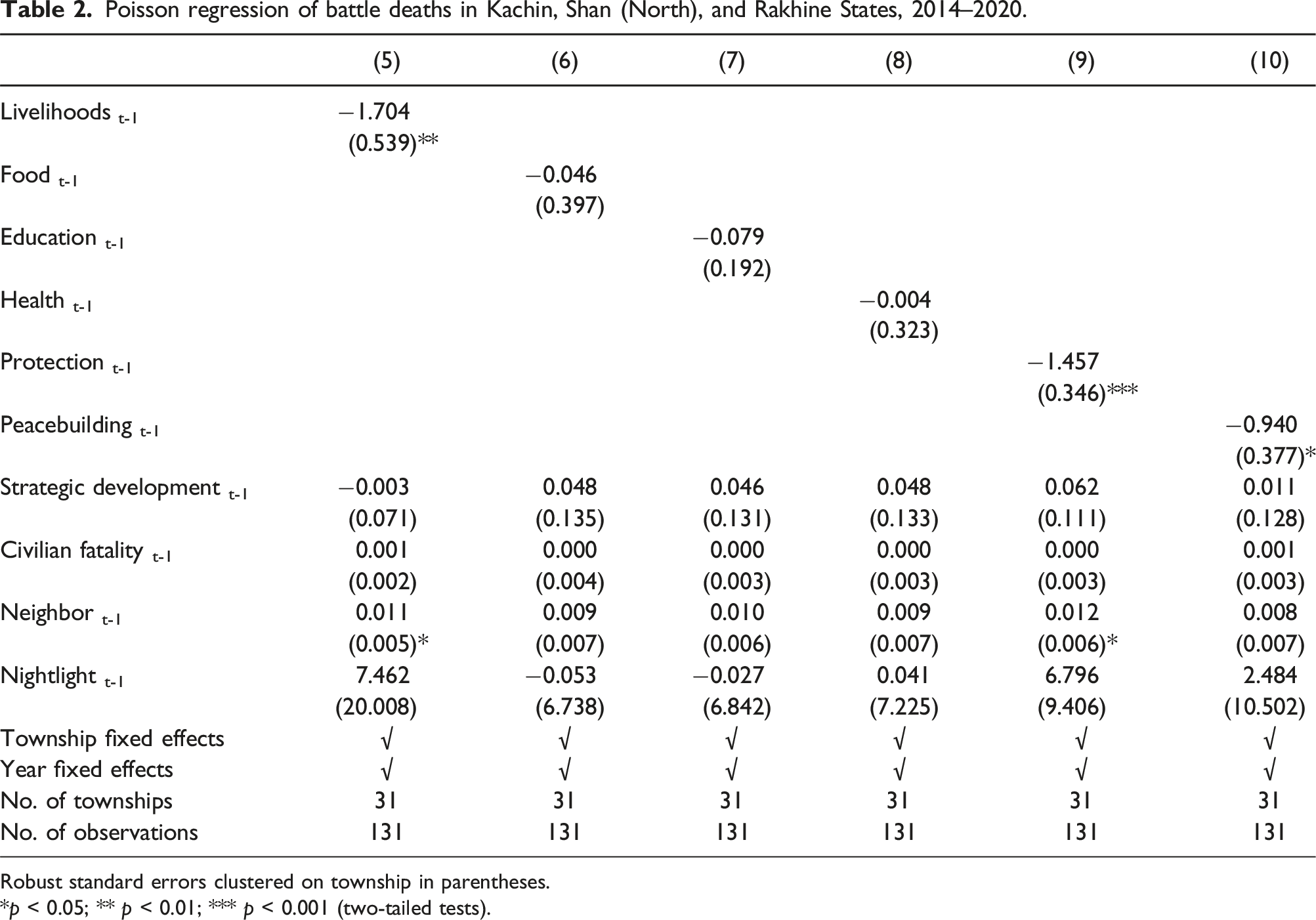
Robust standard errors clustered on township in parentheses.
*p < 0.05; ** p < 0.01; *** p < 0.001 (two-tailed tests).

Predicted effect of cash-based aid on the number of battle deaths, with 95% confidence intervals. Other variables are held at their means. (a) Number of projects (2012–2016). (b) Number of agencies (2014–2020).
Conclusion
This study presents a systematic examination of the effect of cash-based services on civil war using subnational data from Myanmar. Recent studies have argued that small-scale, cash-based aid can reduce the level of violence in a civil war by enhancing voluntary information flow from civilians to counterinsurgents and thus undermining the civilian base of support for the insurgents. Indeed, this is what we find in Myanmar: (1) increased cash-based programs in the livelihoods sector decrease the number of battle-related deaths at the township level and (2) the effects of such programs are larger than those of any other project type, including peacebuilding. These results are highly relevant to aid policy in areas affected by insurgency. In such places, local governments and the international aid community may want to expand cash-based programs to win the “hearts and minds” of vulnerable people and create a stable environment necessary for development.
Last, it is important to acknowledge that these results come with an important caveat. Even if we establish a robust relationship between cash-based aid and battle-related deaths in the civil war in Myanmar, our research design cannot reveal the hypothesized mechanism of civilian collaboration. 8 Future research based on in-depth case studies and/or survey experiments on aid recipients will allow us to draw more concrete conclusions about the strategic benefits of cash-based aid: namely, how and to what extent this project can shape collaboration. The progress of this research agenda hinges upon the ability of scholars to design and carry out such detailed analyses at the micro level.
Supplemental Material
sj-pdf-1-rap-10.1177_20531680221076246 – Supplemental material for Cash-based aid and civil war violence: New evidence from Myanmar (2012–2020)
Supplemental material, sj-pdf-1-rap-10.1177_20531680221076246 for Cash-based aid and civil war violence: New evidence from Myanmar (2012–2020) by Hyun Jin Choi and Jiyoun Park in Research & Politics
Footnotes
Declaration of conflicting interests
The author(s) declared no potential conflicts of interest with respect to the research, authorship, and/or publication of this article.
Funding
The author(s) disclosed receipt of the following financial support for the research, authorship, and/or publication of this article: This work was supported by the Ministry of Education of the Republic of Korea and the National Research Foundation of Korea (NRF-2019S1A5A2A03050714).
Correction (April 2025):

Supplemental material
Notes
References
Supplementary Material
Please find the following supplemental material available below.
For Open Access articles published under a Creative Commons License, all supplemental material carries the same license as the article it is associated with.
For non-Open Access articles published, all supplemental material carries a non-exclusive license, and permission requests for re-use of supplemental material or any part of supplemental material shall be sent directly to the copyright owner as specified in the copyright notice associated with the article.
