




Abstract
In 2014, the Uppsala Conflict Data Program (UCDP) recorded 40 armed conflicts with a minimum of 25 battle-related deaths, up by six from 2013. This is the highest number of conflicts reported since 1999, and 11 of these conflicts were defined as wars, that is, conflicts generating 1,000 or more battle-related deaths in one calendar year. Further, an escalation of several conflicts, coupled with the extreme violence in Syria, resulted in the highest number of battle-related deaths in the post-1989 period. Yet, compared to the large-scale interstate wars of the 20th century, the number of fatalities caused by armed conflicts in 2014 was relatively low. Additionally, seven conflicts identified in 2013 were no longer active in 2014. However, four new conflicts erupted in 2014, all of them in Ukraine, and three previously registered conflicts were restarted by new actors. Furthermore, six conflicts reoccurred with previously registered actors. A positive development, however, is the increase to ten of the number of peace agreements concluded and signed in 2014, which represents a further four compared with 2013. And although this increase is part of a positive trend since 2011, it is worth noting that several peace processes remained fragile by the end of the year.
Conflicts in 2014 in the longer perspective
Since the end of the Cold War, the number of armed conflicts in the world has decreased substantially, a trend that has been picked up by researchers arguing that wars are in decline (cf. Pinker, 2011; Goldstein, 2011; Pinker & Mack, 2014). For the past ten years, however, the Uppsala Conflict Data Program (UCDP) has recorded an uneven, yet clearly visible, upward trend, 1 particularly the growing number of internationalized armed conflicts, that is, conflicts in which one or more states contributed troops to one or both warring sides. Nevertheless, this ten-year period is also where we find the year with the lowest number of active conflicts in the post-Cold War period. All this illustrates the fluctuations associated with the trend in armed conflict.
Another way of looking at the trend in armed conflict is by way of the fatalities in these conflicts. In recent years, the conflict in Syria and the escalating violence in countries like Iraq, Afghanistan, Nigeria, and Ukraine, have resulted in the highest yearly death toll in the post-Cold War period. Yet, the scale associated with the number of fatalities caused by armed conflicts in 2014 was still lower than that of the large-scale wars of the 20th century. Also, one notable positive development since 2011 is the increase in the number of peace agreements being signed.
In 2014, 40 armed conflicts were active in 27 locations worldwide, representing an increase of 18% when compared to the 34 conflicts 2 reported in 2013. This is also the highest number of conflicts reported since 1999. And although the figure remains at a relatively low level compared to that during the immediate post-Cold War period, the trend visible during the early 2000s, showing a decreasing number of armed conflicts, seems to have now been reversed. Indeed, numbers are currently up to the same level as in the second half of the 1990s. The peak year of 1991 saw 51 active conflicts, while the lowest number of active conflicts in the post-Cold War period was recorded in 2010, when 31 conflicts were active.
Of the reported 40 active conflicts, 11 reached the intensity level of war – conflicts with at least 1,000 battle-related deaths in one calendar year – five more than in 2013. 3 The number of conflict dyads 4 also increased in 2014, going from 48 to 53. 5 Eight separate conflicts had two active dyads, the conflict in Sudan had three active dyads, and in Pakistan as many as four rebel groups were fighting the government simultaneously. 6 The average number of active dyads, a measure of fragmentation in an armed conflict, however, decreased in 2014, from 1.41 to 1.33, when compared to 2013.
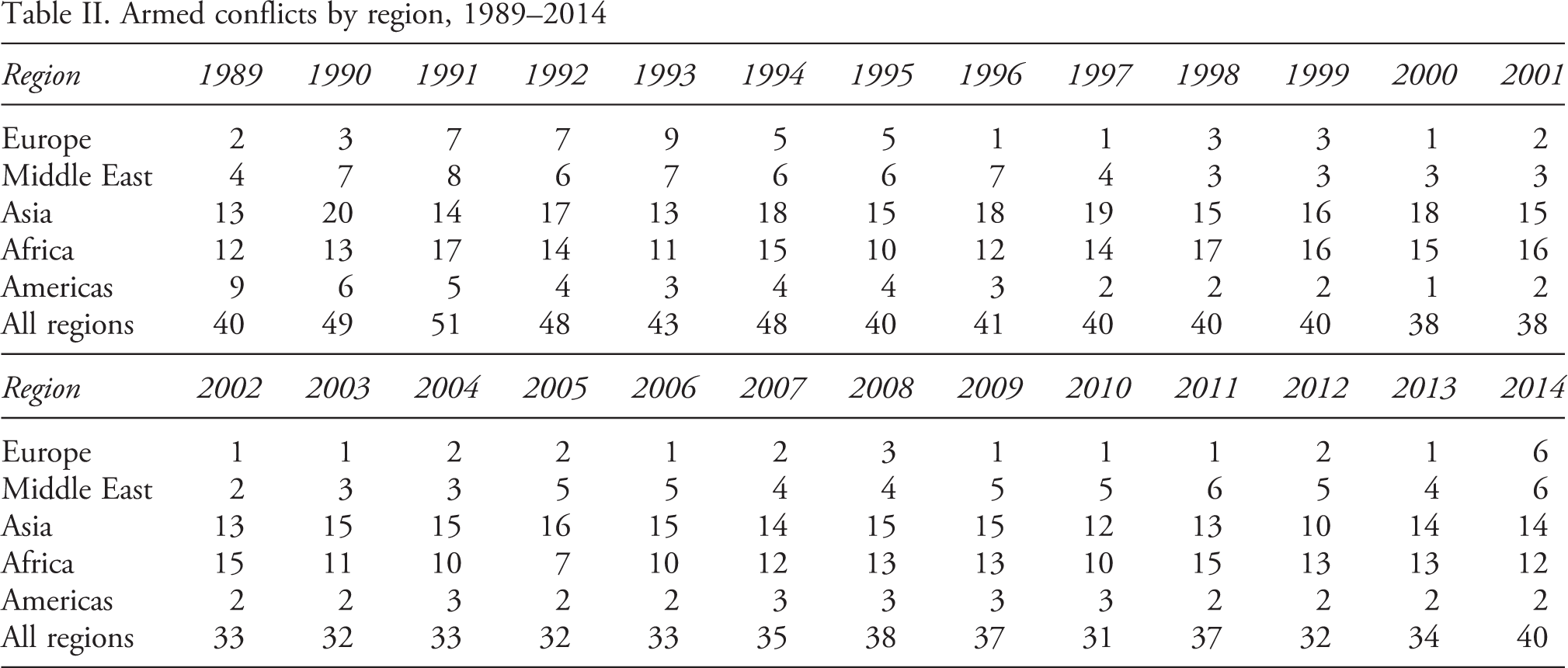
Since 1946, there have been 567 dyads in 259 conflicts active in 159 locations. The average number of dyads in this period is 2.19. The annual incidence of conflicts and conflict dyads since 1989 are recorded in Tables I and II. Figure 1 shows the trend in the number of active armed conflicts since 1946.
What stands out in the 21st century is the lack of large-scale interstate conflict. Only one was active in 2014, the conflict between India and Pakistan, which led to fewer than 50 fatalities. The remaining 39 conflicts were fought within states, but 13 of them – or 33% – were internationalized in the sense that one or more states contributed troops to one or both sides. These conflicts were Afghanistan, Azerbaijan (Nagorno-Karabakh), Iraq, Mali, Nigeria, Somalia, South Sudan, Uganda, Ukraine (Donetsk), Ukraine (Lugansk), Ukraine (Novorossiya), USA (the conflict with Al-Qaeda), and Yemen. This is an increase when compared to the previous year when 27% of the recorded conflicts were internationalized. The involvement of external actors in internal conflicts is not a new phenomenon. However, it is noteworthy that the 2014 proportion is the highest recorded in the entire post-World War II period, signifying the continuation of a trend that has been observed in recent years (Themnér & Wallensteen, 2013). The United States and Russia were two of the main external warring parties in 2014, involved in four and three conflicts, respectively. Jordan, the United Kingdom, Belgium, and France were also involved in three conflicts each. While the United States has been one of the most frequent external warring parties since 2001, Russia entered this group based on recent developments in Ukraine.
Armed conflicts, battle-related deaths,a and conflict locations, 1989–2014
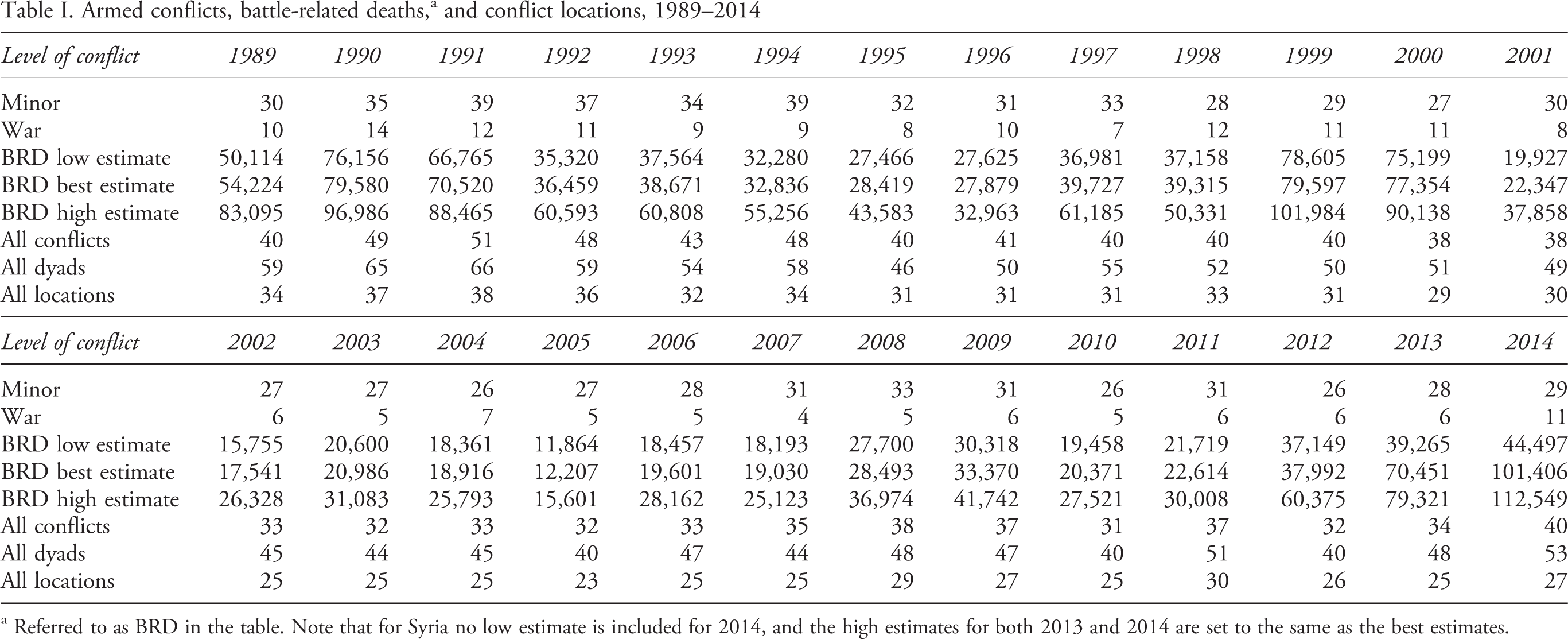
a Referred to as BRD in the table. Note that for Syria no low estimate is included for 2014, and the high estimates for both 2013 and 2014 are set to the same as the best estimates.
Armed conflicts by region, 1989–2014
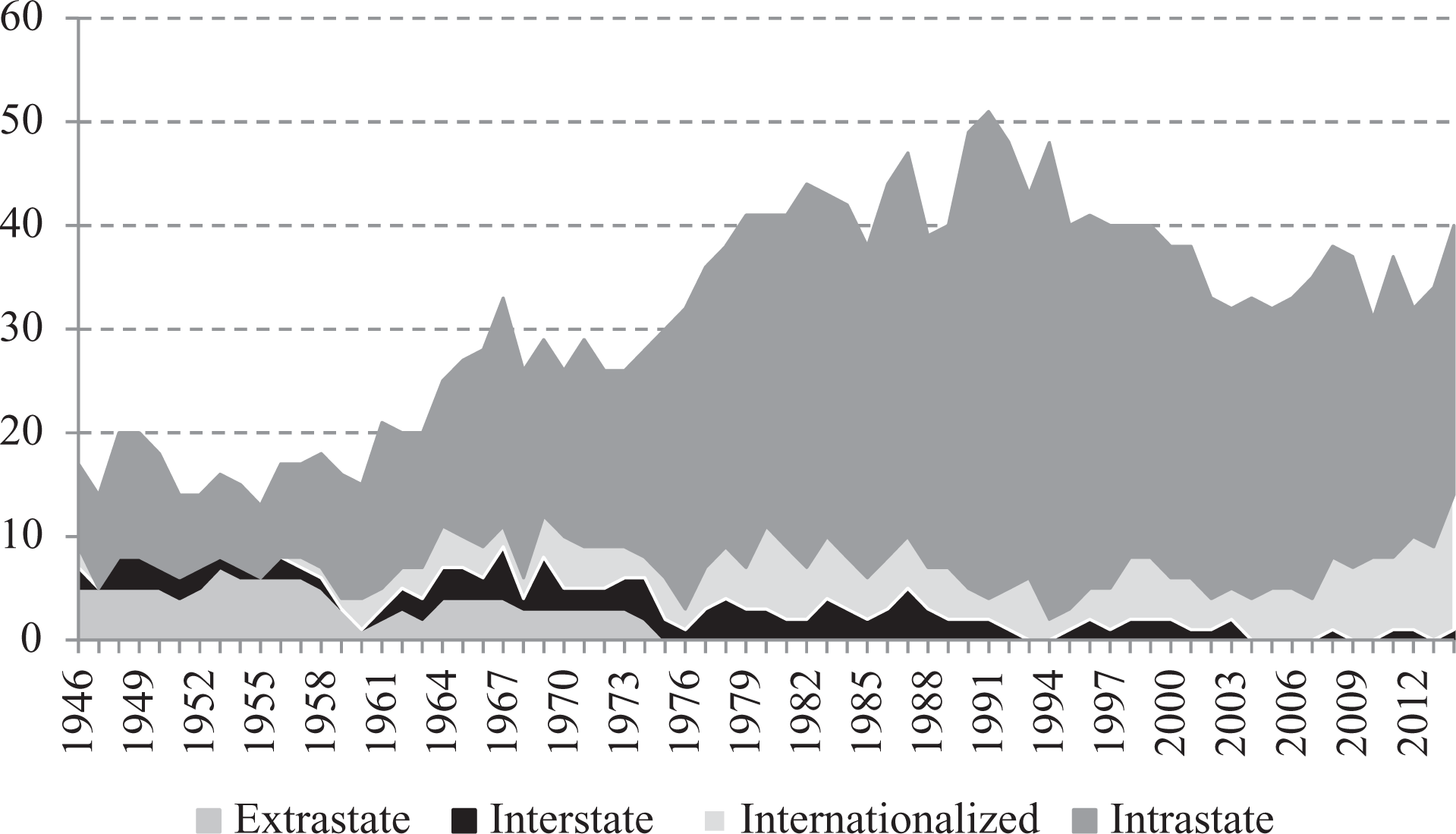
Number of armed conflicts by type, 1946–2014
Battle-related deaths in 2014
As previously noted, there were 11 conflicts reaching the level of war in 2014, an increase of five compared to 2013. This is the largest relative increase witnessed since the early 1960s although the total number of wars is still lower than during most of the 1980s and 1990s, with a peak in 1988 when 16 wars were recorded by the UCDP. The large number of wars witnessed in 2014 also translated into an increase in the number of battle-related deaths, 7 with 101,400 fatalities as a best estimate, which makes it the most violent year in the entire post-Cold War period. Compared to the second half of the 20th century, with extremely fatal interstate wars in Korea, Vietnam, Iran–Iraq, and Ethiopia–Eritrea, the number of fatalities caused by armed conflicts is still lower (Lacina & Gleditsch, 2005). Although the bulk of the fatalities in 2014 occurred in the conflict in Syria, battle-related deaths increased substantially in other conflicts. In fact, even when excluding Syria, more than 47,000 deaths were recorded in 2014. This is the highest number of fatalities since the year 2000 when the war between Ethiopia and Eritrea alone caused 50,000 deaths. Of the ten conflicts with the most fatalities in 2013, eight became more violent in 2014. Figure 2 shows the trend in the number of battle-related deaths between 1989 and 2014. In 2014, Syria was by far the most violent conflict, followed by Iraq, Afghanistan, Nigeria, Pakistan, Ukraine (Donetsk), South Sudan, Israel (Palestine), Yemen, Ukraine (Novorossiya), and Somalia.
The conflict in Syria went on at exceptionally high levels of intensity throughout 2014. The year started with failed attempts at finding a political solution through the Geneva II talks, and the strategy of imposing sieges and starving areas under the control of Syrian insurgents continued during the year, as did the campaign of air bombardments of Aleppo. Furthermore, while the government allowed its stores of chemical weapons to be removed or destroyed, there were strong indications that chlorine gas was used in the northern parts of the country. An important feature of the rebel landscape in 2014 was the severe inter-rebel fighting Battle-related deaths by type of estimate, 1989–2014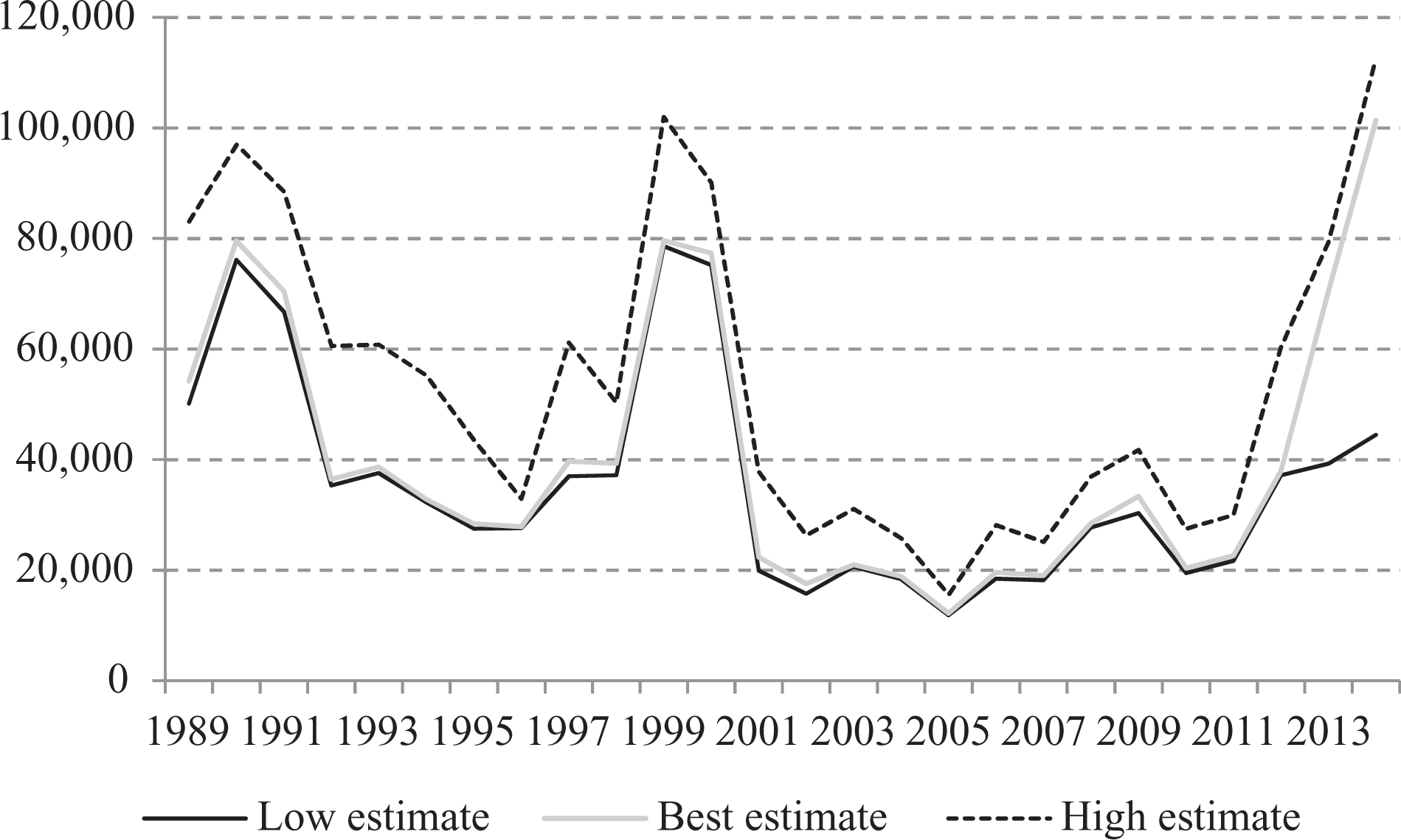
Themnér & Wallensteen (2014) refrained from reporting fatality estimates for the conflict in Syria, due to problems stemming from a combination of ‘issue crowding’ and ‘issue fatigue’. However, in 2014 the UN published a report on fatality estimates, and the SOHR (Syrian Observatory for Human Rights) provided more detailed breakdowns of their summary figures. While it still has not been possible to carry out the usual event coding procedure, the UCDP has consulted different summary figures resulting in conservative estimates for the battle-related deaths, which can be compared to other fatality estimates provided by the UCDP. For 2013 and 2014, the UCDP has added SOHR’s total number of rebel fatalities and total number of fatalities on the government side (SOHR, 2015), and then excluded all rebel fatalities that were coded as part of non-state violence by the UCDP. No civilian casualties have been included in the best estimate, to make sure that no one-sided violence was coded as part of the armed conflict. However, this produces a conservative estimate since many civilians in fact died in fighting between the government forces and the Syrian insurgents.
The developments in Syria were closely connected to the conflict in Iraq, where fighting between the government and IS escalated dramatically in 2014. At least 12,000 people were killed as IS carried out large-scale attacks and seized vast areas, including Iraq’s second largest city, Mosul. As IS gained ground and reports of killings, abductions and torture increased, the USA and a number of other countries commenced air strikes against the group in both Iraq and Syria. By the end of the year Australia, Belgium, Canada, Denmark, France, the Netherlands, and the UK were carrying out attacks together with the USA against IS targets in Iraq, while Jordan, Bahrain, Saudi Arabia, and the United Arab Emirates joined the USA in attacks against IS bases in Syria.
In Afghanistan, the conflict against the Taliban continued to escalate causing over 12,000 deaths, and the violence reached its highest level in the post-1989 period. Further, the Afghan security forces counted an increasing number of fatalities as they took on the full responsibility for security in Afghanistan. Civilian casualties also increased and for the first time, ground battles between the Taliban and the Afghan government became the main cause of civilian deaths, whereas in previous years this had been due to improvised explosive devices (IEDs). The withdrawal of international forces continued and the ISAF (International Security Assistance Force) mission was officially terminated in December 2014. But security agreements with the USA and NATO allowed for 12,000 soldiers to remain in Afghanistan in 2015, as part of the new mission ‘Operation Resolute Support’. Yet, it appears that the absence of foreign troops made the insurgents able to assemble bigger formations and more frequently engage in ground battles against the Afghan security forces.
Another conflict that escalated dramatically in 2014 was in Nigeria, where the security situation in the northern and northeastern parts of the country continued to deteriorate. Jama’atu Ahlis Sunna Lidda’awati wal-Jihad (commonly called Boko Haram) made rapid territorial gains in August and September, and declared the establishment of an Islamic caliphate in areas under its control in November. Aside from its fight against the Nigerian military, the group continued its large-scale attacks against civilians. In April, it carried out the infamous attack against Chibok, which resulted in the abduction of almost 300 schoolgirls. The girls remained in captivity as the year drew to a close.
In Pakistan, a case of rebel fragmentation could be observed, where the government fought four different Islamist groups in 2014: TTP (Tehrik-i-Taleban Pakistan: Taliban Movement of Pakistan), Lashkar-e Islam, IMU (Islamic Movement of Uzbekistan), and Jamaat-ul-Ahrar. During the first half of the year, peace talks were held with the biggest group, TTP, which led to a reduction in hostilities. However, the decision to negotiate created rifts in the organization, and after a ceasefire agreement was proclaimed in March, Jamaat-ul-Ahrar, a splinter group from TTP, carried out a suicide attack in Islamabad. The peace talks with TTP collapsed in June as TTP and IMU, a group which has challenged the governments in both Uzbekistan and Tajikistan, and fights alongside the Taliban in Afghanistan, carried out an attack against Karachi International Airport. The government responded by launching operations targeting militants from TTP, IMU, and Lashkar-e Islam in North Waziristan and Khyber Agency. Despite serious infighting, and a massive offensive by the government, the TTP still succeeded in carrying out a terrorist attack against a school in Peshawar in December. At least 148 people, most of them children, died in the attack, which severely lowered the prospects for future negotiations. By the end of the year the situation in Pakistan was unusually complex.
In Ukraine, the UCDP recorded four different conflicts in 2014, two of which reached the intensity of war – Ukraine (Donetsk) and Ukraine (Novorossiya) – causing approximately 2,000 and 1,500 fatalities respectively. The Ukrainian situation is further elaborated on in the next section.
The conflict over government in South Sudan continued to be active in 2014, and fighting between the government and SPLM/A In Opposition (Sudanese People’s Liberation Movement/Army In Opposition), loyal to former Vice President Riek Machar, reached the level of war. Much of the fighting was concentrated in three key oil cities, Bor, Malakal, and Bentiu, which changed hands multiple times during the year. Both sides retaliated by targeting civilians, often based on ethnic considerations, yet attempts to negotiate continued in Addis Ababa under the auspices of IGAD (Intergovernmental Authority on Development) throughout the year, and several ceasefires were declared, only to be breached by the parties.
The Israel–Palestine conflict reached the highest level of intensity since the early 1980s as a result of ‘Operation Protective Edge’ launched in July 2014. Attempts at negotiations broke down in April and after the kidnapping and murder of three Israeli youths in June, violence escalated to levels not seen in more than 30 years. Individuals connected to Hamas were suspected of the murders, but the group officially denied involvement. Israel launched aerial bombings with the expressed goal of stopping Hamas missile fire, but also conducted a ground incursion, trying to destroy the tunnel system that Hamas used to attack Israeli targets. In late August, after two months of almost daily attacks, a ceasefire was agreed to through Egyptian efforts.
In 2014 the armed conflict between the Government of Yemen and AQAP (Al-Qaeda in the Arabian Peninsula) escalated and once again reached the level of war. The USA continued to carry out drone strikes against the group. Moreover, in March 2014, Ansarallah (commonly referred to as the Huthis) called for the government’s resignation, and the fighting between the government of Yemen and Ansarallah was subsequently included in UCDP data for the first time. 8 In mid-August, Ansarallah intensified its calls for the government to step down and organized demonstrations in the capital Sanaa. The peaceful protests transformed into armed clashes and on 21 September Ansarallah took control of most of the capital. A peace agreement, which included provisions for the formation of a new government and a ceasefire, was signed shortly afterwards. Despite the fulfilment of Ansarallah’s demands, the group kept its troops in Sanaa.
Fighting against al-Shabaab in Somalia has resulted in large numbers of fatalities over several years. In 2013, the intensity level was just below 1,000 battle-related deaths. In 2014, however, the fighting once again reached the level of war. The Somali National Army, together with AMISOM (African Union Mission in Somalia) troops, drove al-Shabaab from several strongholds, forcing it to relocate further south. The group increasingly relied on guerilla tactics and focused more on targeting government officials and soft, civilian targets than on conducting large offensives and controlling territory.
New conflicts: The case of Ukraine
Four new armed conflicts erupted in 2014, all of them in Ukraine. One was fought over the control of government while the remaining three concerned the status of territories in the eastern parts of the country: Ukraine (Donetsk), Ukraine (Lugansk), and Ukraine (Novorossiya).
In November 2013, Ukraine was set to sign an association agreement with the EU. However, just a few days before the signing ceremony President Viktor Yanukovych decided to abandon the process and instead deepen the country’s ties with Russia. This triggered mass protests in the capital, Kiev. While starting out as a demonstration, the opposition, named Maidan after the Independence Square in Kiev, soon became more coherent, created a military force and demanded the resignation of the government. By the end of January 2014, Maidan had occupied a large number of administrative buildings, including the City Hall. The government resigned on 28 January, but the opposition continued to call for the president to step down. In late February, Yanukovych was dismissed by the Parliament and fled to Russia.
The pro-EU governmental change in Kiev, and Russia’s annexation of Crimea in March, led to the rise of a pro-Russian movement in the eastern parts of the country which later escalated into a series of territorial conflicts. One of the organizations formed was DPR (Donetsk People’s Republic). It demanded sovereignty over the Donetsk region and proclaimed its independence in April 2014. A military confrontation ensued, resulting in well over 1,000 battle-related deaths, and also led to events such as the downing of the civilian airliner MH17 while it was flying over the region on 17 July. Large-scale military operations by both sides, including heavy shelling and tank offensives, were observed, along with accusations of Russian support for the separatists.
Parallel to these developments, another separatist group had been emerging in Lugansk. LPR (Lugansk People’s Republic) was formed in April, in the same manner as DPR, and soon demanded independence for the territory of Lugansk. DPR and LPR became strong allies and supporters of each other. On 11 May, the LPR had secured sufficient territory to be able to run a referendum on the region’s independence from Ukraine which the group declared one day later. Heavy fighting followed in and around Lugansk city, forcing most residents to flee as much of the town was damaged.
Ukraine, DPR, and LPR reached a ceasefire on 5 September, under the auspices of OSCE; however, the agreement soon proved insufficient. In order to further their military offensive and have a stronger voice in the negotiations, DPR and LPR created a new, unified group called United Forces of Novorossiya on 16 September. The group had a new stated incompatibility, a region larger than Donetsk and Lugansk combined, referred to as Novorossiya. A ceasefire signed on 19 September with the Ukrainian government did not prevent fighting from continuing at high intensity.
The conflicts in Ukraine have pitted the USA and the EU against Russia and created a deadlock in diplomatic relations, as illustrated by the sanctions imposed on Russian individuals and organizations after the annexation of Crimea, along with further similar measures throughout the year. And while Russia bolstered its military presence along the border with Ukraine, Ukraine itself, in December, decided to drop its non-aligned status and announced that it is applying for NATO membership.
Restarted conflicts
Three previously registered armed conflicts were resumed with new actors: Egypt, Lebanon, and Libya. In Egypt, the armed conflict over government restarted in 2014, after having been inactive since the 1990s. In the wake of the Arab Spring uprising in 2011, which included widespread violence against protesters by official security forces, the security situation in the Sinai Peninsula deteriorated significantly. It worsened in 2013, following the military’s ouster of President Mohammed Morsi. Several of the attacks in Sinai in 2013 were assigned to Ansar Bayt al-Maqdis, but this violence was not included in UCDP data due to lack of a stated incompatibility. In early 2014, the group announced its opposition to the government and clashes took place throughout the year. The group changed its name to Wilayat Sinai (Sinai Province) in November after having pledged allegiance to IS, referring to itself as a province in the caliphate proclaimed by IS.
Inactive since 1990, the conflict over government in Lebanon resumed in 2014 as a consequence of IS’s advancements in the region. In August, IS, together with Jabhat al-Nusra, clashed with Lebanese troops in and around the border town of Arsal, following the arrest of a rebel commander. The Lebanese army managed to retake control over the town by mid-August, but IS continued to have a presence in the area.
Since the ousting of President Muammar Gaddafi in 2011, Libya has been characterized by widespread violence between different militias. In 2014, the conflict over government became active once again, with over 25 deaths incurred by fighting between the government and two separate rebel groups. Following the elections in June 2014, two governments claimed power, one in the capital, Tripoli, and one in Tobruk. 9 This led to a clash between the Zintan Brigades, supporting the parallel government in Tobruk, and the Tripoli government in and around the capital during the second half of 2014. There were also clashes between the Tripoli government and the Libya National Army, formed by retired general Khalifa Haftar. In October, the Libya National Army formally aligned itself with the Tobruk government.
Six conflicts were restarted by previously registered actors: Azerbaijan (Nagorno-Karabakh), India (Garoland), India–Pakistan, Israel (Palestine, see above), Mali (Azawad), and Myanmar (Kokang).
In Azerbaijan, skirmishes along the Line of Contact resulted in the conflict being active in 2014. Although the violence was nowhere near as intense as in the early 1990s, the death toll was higher than in any year since the ceasefire was signed in 1994. The presidents of Armenia and Azerbaijan met under the aegis of Russian President Vladimir Putin in August, in the presence of US Secretary of State John Kerry in September, and finally under the auspices of the OSCE Minsk Group in October. The meetings, which failed to reduce the tensions, involved no representatives from the Nagorno-Karabakh authorities.
In India, the conflict over Garoland, first active in 2012, again passed the threshold for inclusion. Violence simmered just below UCDP’s inclusion level in 2013, and in 2014 a small increase in violence resulted in the conflict being recorded as active.
Also in India, the interstate conflict with Pakistan was active for the first time since the ceasefire agreement was signed in 2003. Relations soured in August 2014 as India’s foreign secretary cancelled a meeting with her Pakistani counterpart following reports of a meeting between Pakistani diplomats and Kashmiri insurgents. Cross-border shelling escalated in October and by the end of the year at least 38 people had been killed in battle.
The conflict over Azawad in northern Mali fell below the level of inclusion in 2013 due to ongoing peace negotiations between the government and the Tuareg separatist group MNLA (Mouvement national de libération de l’Azawad; National Movement for the Liberation of Azawad). In the beginning of 2014, MNLA repeatedly accused the government of not complying with the agreement signed in 2013 and following a visit by the Malian president to the rebel-held town of Kidal, fighting escalated. A ceasefire was proclaimed in late May but the peace process was hampered by souring relations between different Tuareg groups. Two different rebel alliances were formed, one opting for autonomy and the other for independence, and in July clashes erupted between the two. By the end of the year, negotiations had restarted in Algiers and plans were made for further talks during 2015.
The conflict between the government of Myanmar and the rebel group MNDAA (Myanmar Nationalities Democratic Alliance Army), fighting over the territory of Kokang, was last active in 2009 when MNDAA was largely crushed and lost much of its territory. In December 2014, the MNDAA leader announced that the group was trying to regain some of these territories and fighting erupted in the northern parts of Shan State, narrowly making the conflict active that year.
Conflicts no longer active
Seven conflicts recorded for 2013 were no longer identified as active in 2014: Central African Republic, Ethiopia (Oromiya), Malaysia (Sabah), Myanmar (Karen), Myanmar (Shan), Mozambique, and Turkey (Kurdistan).
In Central African Republic, large-scale fighting continued in 2014, with widespread atrocities committed by different rebel groups and mobs mobilized along ethnic and religious lines. However, after the resignation of the President, and Séléka leader, Michel Djotodia in January 2014, violence became sectarian or stood between the anti-Balaka forces loyal to the previous President François Bouzizé and the ex-Séléka forces of ousted President Michel Djotodia. Consequently, no conflict involving the government of CAR was active in 2014. In spite of a large international presence in the form of AU (African Union), UN, and EU troops, and a ceasefire agreement signed in July, violence among armed groups continued to create a massive humanitarian crisis.
Fighting between the Ethiopian Government and the separatist rebel group OLF (Oromo Liberation Front) continued, albeit on a low scale, during the year. Information regarding this conflict is scarce and reports failed to confirm 25 battle-related deaths during 2014.
The conflict in Malaysia over the territory of Sabah emerged in 2013 when the Sulu Sultanate claimed its historical rights over the area. When the Sultan died in October 2013, the Sultanate announced that it would continue to claim Sabah, but through peaceful means only. Even though Malaysian security forces alleged that the Sultanate planned a second intrusion, no fighting was recorded in this conflict in 2014.
In Myanmar, a broad peace process has been ongoing since 2011, involving a large number of armed groups. Although some of the groups continued to clash with the government during 2014, the conflicts over Karen and Shan did not cross the 25-fatality threshold for inclusion. In both conflicts, bilateral ceasefire agreements with the rebel groups existed, but fighting continued on a small scale.
Tensions remained high in Mozambique, although the fighting did not result in 25 battle-related deaths during the year. A peace agreement signed in August gave Renamo a greater say in the election committee. However, Renamo rejected the results of the October elections and threatened to establish a secessionist republic in the parts of Mozambique where the party had won a majority.
Talks initiated in 2012 between the government of Turkey and the Kurdish group PKK (Partiya Karkeren Kurdistan; Kurdistan Workers’ Party) have resulted in a de-escalation of violence. Despite some small-scale clashes the ceasefire announced in March 2013 officially continued. The close connections to the developments in Syria remained a destabilizing factor, and hundreds of PKK fighters reportedly joined the Syrian Kurdish group PYD (Partiya Yektîya Demokrat; Democratic Union Party) in its fight against IS for the town of Kobane in July 2014. As Turkey refrained from intervening in Kobane, massive demonstrations unfolded across the country, resulting in violent clashes between police and protesters. PKK threatened to end the no-conflict period and accused Turkey of delaying the peace process by not bringing an end to the siege. In October, Turkey shifted its position and allowed Kurdish Peshmerga forces from Iraq to pass through the country in order to reinforce the Kurdish forces in Kobane. By the end of the year, formal negotiations including the government and PKK were again being discussed.
Peace agreements
A positive development, in contrast to the large increase in the number of conflicts, is an increase in the number of peace agreements signed during 2014. During the year, ten peace agreements were concluded, four more than in 2013. Of these, four were concluded in South Sudan, three in the Philippines, one in Sudan, one in Yemen, and one in Mozambique.
In South Sudan, a number of attempts at halting the violence were made, resulting in several ceasefires and peace agreements. On 30 January 2014, the South Sudanese government and the SSDM/A-Cobra faction (South Sudan Democratic Movement/Army-Cobra faction) signed the ‘Agreement on a Cessation of Hostilities’ during negotiations in Addis Ababa under the auspices of IGAD. The parties agreed to cease all hostilities and to continue to find ways to end the conflict peacefully. On 9 May 2014, two peace agreements were concluded during separate negotiations in Addis Ababa. The first one was signed with the Cobra faction and provided for the establishment of a semi-autonomous administration called Greater Pibor Administrative Area in the conflict-ridden Jonglei state. The second one, ‘Agreement to Resolve the Crisis in South Sudan’, was signed by the government of South Sudan and the rebel group SPLM/A In Opposition. Besides the immediate cessation of hostilities, the agreement stated that a transitional government of national unity was the best option for peace in the country. SPLM/A In Opposition signed another agreement in Arusha on 20 October 2014. In the ‘Framework for Intra-SPLM Dialogue’ the warring parties agreed to reunify the SPLM/A and work towards democracy and freedom.
In the Philippines, the government and the rebel group MILF (Moro Islamic Liberation Front) hammered out the fourth and final annex to the Framework Agreement on the Bangsamoro signed late 2012, regulating the decommissioning process. The parties also agreed on a document regulating the borders of the Bangsamoro waters. In March 2014 the Comprehensive Agreement on the Bangsamoro (CAB) was signed, providing for the establishment of an autonomous Bangsamoro political entity in Mindanao. The CAB consolidated and affirmed the agreements signed by the parties, and mediated by Malaysia, during 2012 and 2013.
In Sudan, a peace process agreement was signed during 2014. Indeed, in September, during negotiations in Addis Ababa facilitated by the AU, the parties signed an ‘Agreement on the National Dialogue and Constitutional Process’ in which the government of Sudan and the rebel group SRF (Sudanese Revolutionary Army) agreed that a comprehensive political settlement was the ideal option for resolving problems in Sudan, and that dialogue and a constitutional process was to start after the rules of such dialogue had been agreed upon.
In 2013, the conflict in Mozambique between the Frelimo-run government and Renamo resumed after 20 mostly peaceful years. Fighting continued on a low scale in 2014 before a peace agreement was signed by Renamo leader Afonso Dhlakama and President Armand Guebuza, in August. The parties agreed to the integration of the Renamo fighters into the military, in addition to changes in the electoral commission before the October elections.
In Yemen, the UN facilitated talks between President Abd Rabbuh Mansur Hadi and Ansarallah in September 2014. The negotiations resulted in the ‘Peace and National Partnership Agreement’, stipulating the dissolution of the government and giving Ansarallah broad powers in the new government.
The increase in the number of peace agreements is part of a positive trend since 2011 when only one peace agreement was signed. However, many of the peace processes initiated in 2014 remained fragile by the end of the year. The Yemeni rebel group Ansarallah continued to fight despite its demands being met in the agreement. In Mozambique, tensions remained high and the Renamo leader threatened to establish a secessionist republic. In Sudan, the agreement with SRF failed to halt the violence, and in South Sudan tensions within the former SPLM/A continued in spite of several agreements concluded during the year. On a positive note, the SSDM/A-Cobra faction refrained from attacking the government of South Sudan after its leader was appointed administrator of the newly established Greater Pibor Administrative Area. In the Philippines, the peace process with MILF has substantially reduced the violence which has been ongoing since the early 1990s.
Footnotes
Replication data
The complete datasets (UCDP/PRIO Armed Conflict Dataset, UCDP Dyadic Dataset, and UCDP Battle-Related Deaths Dataset) updated to 2014 are found at http://www.pcr.uu.se/research/ucdp/datasets/. Older versions of these datasets can also be found at this address (all datasets) and http://www.prio.org/Data/Armed-Conflict/UCDP-PRIO/ (the UCDP/PRIO Armed Conflict Dataset). The tables and figures in this article were created directly from the Excel sheets at the UCDP web page. Detailed descriptions of the individual conflicts are found in the UCDP Conflict Encyclopedia at http://www.ucdp.uu.se/database. Replication data for this article can be found both at http://www.pcr.uu.se/research/ucdp/datasets/replication_datasets/ and  .
.
Acknowledgements
Numerous colleagues in Uppsala have contributed to the data collection, notably Marie Allansson, Mihai Croicu, Emma Elfversson, Garoun Engström, Maria Greek, Helena Grusell, Stina Högbladh, Gabrielle Lövquist, Ralph Sundberg, Samuel Taub, and Lotta Themnér. A special thanks for comments on the first draft by Maria Greek and Margareta Sollenberg.
Notes
Appendix 1. Armed conflicts active in 2014
This list includes all conflicts that exceeded the minimum threshold of 25 battle-related deaths in 2014 and fulfilled the other criteria for inclusion. 1 The column Year(s) shows the latest range of years in which the conflict has been active without interruption. The start year is found in parenthesis in the Incompatibility column, which indicates when the armed conflict reached 25 battle-related deaths for the first time. If a conflict has been inactive for more than ten years or if there has been a complete change in the opposition side, the start year refers to the onset of the latest phase of the conflict. For more complete information on the conflict- and dyad history, see (a) the UCDP/PRIO Armed Conflict Dataset and the UCDP Dyadic Dataset at http://www.pcr.uu.se/research/ucdp/datasets/ and (b) the Uppsala Conflict Data Program’s online conflict encyclopedia at http://www.ucdp.uu.se/database. The column ‘Intensity in 2014’ displays the aggregated conflict intensity in terms of the number of battle-related deaths. Thus, if more than one dyad is active in the conflict, the intensity column records their aggregated intensity. Three fatality estimates are given in the table: low, best, and high. 2
Appendix 2. Unclear cases in 2014
Cases that have been completely rejected on the grounds that they definitely do not meet the criteria of armed conflict are not included in the list below. For the conflicts listed here, the available information suggests the possibility of the cases meeting the criteria of armed conflicts, but there is insufficient information concerning at least one of the three components of the definition: (a) the number of deaths, (b) the identity or level of organization of a party or (c) the type of incompatibility. The list of unclear cases for the entire 1946–2014 period is currently under review, but will be published at http://www.pcr.uu.se/research/ucdp/datasets/. The unclear aspect may concern an entire conflict or a dyad in a conflict that is included in Appendix 1.