



Abstract
Diplomacy is a chief instrument of foreign policy. Through high-level diplomatic visits, governments can facilitate cooperation and signal the quality of their relations with other states. Because host countries cannot receive an indefinite number of visits, they must make strategic decisions, prioritizing some countries over others. This reveals information about their foreign policy priorities as well as diplomatic hierarchies and practices in the system as a whole. But what determines high-level diplomatic visits? Existing scholarship disagrees. In this research note, we assess the determinants of high-level diplomatic visits to the U.S. Theoretically, we draw on previous studies and formulate structural, domestic, and practice-oriented accounts of high-level visits as tools of foreign policy. Empirically, we gather original data on diplomatic visits to the U.S. by foreign leaders from 1946 to 2012. Our main results are two-fold. First, high-level diplomatic visits to the U.S. are primarily determined by structural factors such as economic relations. Second, we find clear differences in invited country profiles during and after the Cold War, demonstrating that high-level visits are used strategically to promote shifting foreign policy priorities.
Introduction
Diplomacy is one the oldest instruments of foreign policy. States use diplomacy to facilitate cooperation, prosperity, and peace (Goldsmith and Horiuchi, 2009). Yet, scholars disagree on the precise nature and purpose of diplomacy (Pouliot, 2016; Wong, 2015; Yarhi-Milo, 2014). One way to improve our understanding of why and how diplomacy is conducted is to study high-level diplomatic visits (see, for example, Kastner and Saunders, 2012; Lebovic and Saunders, 2016; Malis and Smith, 2020; Nitsch, 2007). Meetings between heads of state provide signals to the world about the relationship between the host and the visiting country and have been shown to play a role in shaping deterrence (McManus, 2018), regime survival (Malis and Smith, 2020), and trade patterns (Nitsch, 2007). Since host countries cannot receive an indefinite number of visitors—meetings are rare, time-consuming, and costly—they must make strategic decisions, prioritizing some countries and leaders over others. The way in which states allocate this scarce resource across countries reveals information about their priorities, but also about diplomatic hierarchies and practices in the system as a whole (Kastner and Saunders, 2012).
What determines high-level diplomatic visits? Three dominant approaches have emerged in the literature. The structural approach stresses the distribution of state capacities, arguing that diplomacy is used to maintain and promote security and trade relations. The domestic (or agency-based) approach points to the role and preferences of political leaders and their parties. The practice-based approach emphasizes continuity and sticky norms in explaining high-level diplomacy. These approaches have proven able to explain a significant amount of variation in outgoing high-level diplomatic visits, specifically travel by U.S. presidents to foreign countries (Lebovic and Saunders, 2016; Ostrander and Rider, 2019). We know considerably less about the role of incoming visits, that is, the visits of foreign leaders to a host country. Since both types of meetings are central to diplomatic relations, it is important to establish whether they are shaped by the same factors or if they play different roles in a country’s diplomatic strategy.
The purpose of this research note is to empirically assess the explanatory power of structural, domestic, and practice-oriented variables in shaping diplomacy, with a novel focus on incoming high-level visits to the U.S. We focus on the U.S. for three reasons. First, the U.S. has been the central nave around which Western diplomacy has turned since World War II, making it a natural starting point for systematic studies of diplomatic visits (Lebovic and Saunders, 2016; McManus, 2018; Ostrander and Rider, 2019; Malis and Smith, 2020). Second, given the primacy of the U.S. in the international community during this time, we can assume that state visits to the U.S. constitute a scarce resource, subject to a process of economizing and strategic selection by both prospective visitors and the host. Third, the U.S. played a central role in the Cold War, allowing us to test whether the determinants of high-level meetings are time-invariant or affected by the political shifts associated with the end of the Cold War.
Drawing on information from the U.S. State Department’s Office of the Historian (2017), we have collected a new dataset on diplomatic visits to the U.S. by foreign leaders from 1946 to 2012. Based on quantitative analysis of these data, we make two key findings. First, high-level diplomatic visits to the U.S. are recurrent and they are primarily determined by economic relations. Second, we observe a marked difference in the profile of visitors during and after the Cold War. During the Cold War, high-level meetings privilege states with which the U.S. had weak trade links and no defense cooperation. After the end of the Cold War, in contrast, the U.S. increasingly invited states with which it had strong trade links and expansive security cooperation. We view this divergence as indicating the strategic employment of diplomacy: During the Cold War, the U.S. hosted countries with which it had less trade and security links in order to prevent the domination of the USSR, but since the early 1990s, it has used diplomacy first and foremost to nourish its trade links and security interests.
Explaining diplomatic visits
Drawing on existing literatures on diplomacy and IR, we focus on structural, domestic, and practice-based explanations for diplomacy. We draw, in particular, on the theoretical propositions developed in Lebovic and Saunders (2016), but where they focus on outgoing U.S. visits, we tailor our theory to explain incoming visits, that is, occasions where foreign leaders are officially invited and hosted by the U.S. Government on U.S. soil. Historical evidence suggests that both outgoing and incoming meetings are central to a country’s diplomatic strategy, but there is also reason to expect some differences between them. For example, outgoing diplomatic visits require full-time engagement from the U.S. President, incur greater expense, and send foreign policy signals of a particular type. Incoming high-level visits allow the U.S. greater control, are likely to draw on different administrative resources, and may play a different role in foreign policy agenda-setting, for example, by signaling acceptance and friendship rather than U.S. presence abroad.
In explaining diplomatic relations, the structural perspective emphasizes that states organize their diplomacy to advance their strategic interests (Morgenthau and Thompson, 1985: 155). According to this approach, we would expect the U.S. to invest diplomatic resources into high-level bilateral diplomatic events with countries that rely on or contribute to American military and/or economic power. Diplomacy scholars within the structural tradition have pointed to a range of strategic interests that states seek to promote via high-level meetings. Some contend that security and ideology are important factors in diplomatic relations, though pointing to the primacy of economic interests (Nitsch, 2007). Others argue that political ideology and power are the most important determinants of diplomatic exchanges (Neumayer, 2008). Yet, for others, diplomacy is ultimately about security interests (Morgenthau and Thompson, 1985: 155). Lebovic and Saunders (2016) argue and find support for the idea that economic and security interests have the strongest influence on U.S. diplomatic visits abroad, while ideological considerations are less important.
In contrast to the structural approach—which subordinates the role of agency and domestic factors as determinants of international diplomacy—researchers rooted in agent-based and sociological theories emphasize the role of individual diplomats, foreign leaders and their experience, and domestic-level dynamics such as the role of diasporas and political preferences in Congress (Fuhrmann, 2020; Saunders, 2011; Wong, 2015). These scholars do not entirely reject the strategic interests emphasized by structural theorists, but focus more on the characteristics and preferences of individuals and groups in explaining various diplomatic processes and outcomes. Drawing on this approach, the main expectation is that diplomatic visits to the U.S. are shaped by domestic-level politics and that visits more generally are explained by Presidents’—or their administrations’—preferences, constraints, and policy priorities (Yarhi-Milo, 2014; Ostrander and Rider, 2019). Indeed, Republican or Democratic administrations may have different priorities as to which states they welcome and why—independent of previous visits of former administrations. In reflection of shifting domestic priorities and constraints, we might observe a higher number of visits to the US during first-term presidencies, as incoming Presidents seek to establish their foreign policy credentials, which might be less of a priority for outgoing, second-term (“lame duck”) presidents. Domestic characteristics of visiting governments, such as the level of democracy and respect for human rights (Lebovic and Saunders, 2016: 111), may also matter in deciding whom to invite.
Unlike structural and agent-based theories, the literature on diplomatic practice stresses the sociological sources of diplomatic processes and exchanges (Wiseman, 2011). Researchers working within this tradition view diplomacy not as the result of measured and calculated decisions, but as the result of habits and practices that constantly reproduce and define diplomatic relationships. The constructivist perspective highlights the role of shared values and norms as important factors to strengthen the ties between countries and to facilitate the development of diplomatic practices (Hopf, 2010). Although diplomatic practices are subject to change when the distribution of capacities shifts in world politics, diplomacy is largely repetitive and stable over time. Or as Vincent Pouliot puts it: “diplomacy is uneventful and mundane” (Pouliot, 2016: 9). For instance, hosting the United Kingdom (UK) is a tradition that has been exercised by many U.S. administrations and the deviation from this long-standing tradition may invite uncertainty into the diplomatic relationship between the U.S. and United Kingdom. This approach generates the expectation that high-level diplomatic visits are consistent with regard to which states visit the U.S., and thus that visits are less dependent on shifts in structural and domestic factors.
Data
Our dependent variable is incoming diplomatic visits to the U.S. We coded a new dataset based on information provided by the U.S. State Department’s Office of the Historian.
1
The data covers a longer period, but we restrict our analysis to the period 1946-2012 since we lack data for several of our explanatory variables beyond that period. The data from U.S. State Department indicates the name of the country, the name of the foreign leader and his or her rank, the date and number of days that the visitor spent in the U.S., and brief information about the nature of the visit. The U.S. Department ranks the visits accordingly: state visits, official visits, official working visits, working visits, and private visits (see Supplementary Table A1, Online Appendix). Figure 1 shows the yearly incoming visits to the U.S. across different U.S. administrations. We note that incoming visits increase more or less linearly after 1945, indicating growing intensity of high-level diplomacy, but that there is considerable variance around the mean trend. Figure 1 also plots outgoing visits, which exhibit a similarly increasing trend line but at a lower level. Both types of visits culminate after the end of the Cold War. This descriptive analysis demonstrates that the historical trend of increasing outgoing visits (Lebovic and Saunders, 2016; Ostrander and Rider, 2019) is matched by a trend of increasing incoming visits. It also shows that in most years, the count of incoming visits exceeds that of outgoing visits, underlining our argument that this type of meeting is an important instrument in U.S. diplomatic strategy. Incoming and outgoing diplomatic visits across different U.S. administrations.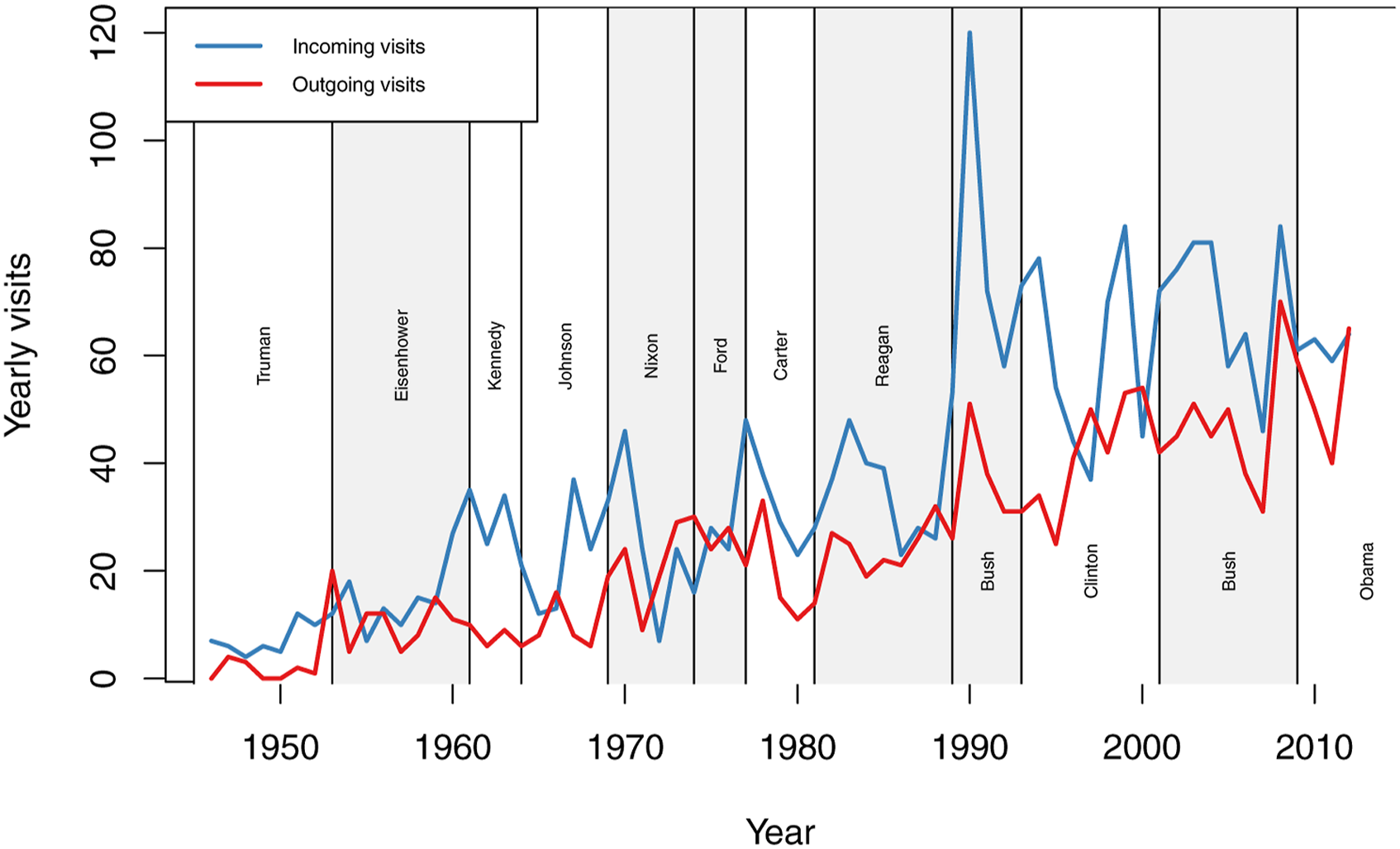
We follow Lebovic and Saunders (2016) in focusing on bilateral visits. Bilateral visits include all visits where the visitor met with the President and other government representatives. This category excludes multilateral visits (for example, attendance at the UN) and all private visits without a diplomatic purpose (such as vacations or medical treatments). In our analysis, we solely show the results for bilateral visits but include the results for multilateral visits in the Online Appendix.
We count a total of 710 incoming bilateral visits over the period 1946-2012. Supplementary Figure A1 in the Online Appendix exhibits the aggregated distribution of visits across the countries in the sample (see Supplementary Figure A2 for the geographical distribution of the visits). We note that the distribution has considerable skew, indicating that the scarce good of high-level U.S. visits is allocated with discretion. In Figure 2, we illustrate the 10 most frequent visitors to the U.S. As expected, this group contains several of the countries most closely aligned with the U.S. The United Kingdom, with 55 visits, is the most frequent visitor, and several of the countries in this group are military allies and close commercial partners of the U.S., including Israel, Japan, and Italy. Perhaps more surprisingly, Jordan and Ireland are among the top 10, but both are countries with long-standing diplomatic relationships with the U.S. Most frequent visitors.
Explanatory variables
On the explanatory side, we include several variables pertaining to the structural, domestic, and practice-based approaches to diplomacy. To represent structural factors, we include U.S. Trade (trade with host country/total U.S. trade), U.S. Military Aid, U.S. defense pact, and U.S. alignment (UN vote similarity with the U.S.) These four variables capture security, economic, and political influences.
To represent domestic factors, our main indicator records whether the administration is Republican (= 1) or Democratic (= 0), which allows us to assess whether there is a systematic difference in diplomatic engagement across the two main political parties. Moreover, we include the variable Second term to assess whether U.S. leaders receive more or less visits during their second term in office. We also add the visiting country’s Level of Democracy (V-dem’s Civil liberties index) and respect for human rights (V-dem’s Physical violence index) to the domestic factors that may influence hosting decisions of the U.S.
To assess the importance of practice in diplomacy, we include Prior Visits (lagged dependent variable). If practice matters, we would expect to see an independent effect of prior visits, as the U.S. and its counterparts employ visits to maintain diplomatic relationships. In addition, we include year-fixed effects to account for the positive trend in the number of visits (see Figure 1) and region-fixed effects to account for regional differences. For information on the variables and their sources, see Supplementary Table A2.
Findings
Figure 3 presents the main results from logistic regression with year- and regional-fixed effects. In Supplementary Table A3, we report full estimates and models with and without fixed-effects. The determinants of diplomatic visits to the U.S. Logit estimates with 95% confidence intervals.
Our estimates provide support for the structural and practice-based account, while lending mixed support to the domestic account. The variables US trade and US military aid are statistically significant at p < 0.01 across all models, indicating that economic and security links increase the likelihood of an incoming diplomatic visit. Supplementary Figure A3 shows that a one-unit increase in US trade and US military aid increases the probability of diplomatic visits to the US by 26 and 18 percentage points respectively (average marginal effects). The practice-based explanations also find support, as prior visits are significant and positive. Variables capturing domestic influences receive less consistent support. We find that the visiting countries’ level of democracy matters for diplomatic visits to the US but there is no systematic difference between Republican and Democracy administrations. The coefficient for the second-term variable indicate that US leaders are less likely to receive visitors during their second term (significant at p < 0.1). This finding suggests that US leaders are more likely to invite foreign visitors when they assume office, while prioritizing outgoing visits during their second term (Lebovic and Saunders, 2016; see also Figure 1).
While it receives weaker support, overall, our findings do not falsify the domestic influence approach. Rather, they suggest that such influences are subordinate to structural explanations or, alternatively, that domestic factors might be partly rooted in strategic interests.
Existing research on diplomacy provides reason to assume that the determinants of high-level visits might change as the power distributions in world politics shift. The end of Cold War provides an opportunity to test whether this shift altered the way the U.S. used diplomatic visits to pursue its interests. Did the U.S. let the same foreign policy interests shape its diplomatic practices consistently throughout the study period 1946-2012, or do we observe over-time shifts? To answer this question, we interact our main independent variables with a Cold War dummy variable (1 = Cold War and 0 = otherwise). To save space, we present the average marginal results of all interaction effects in Figure 4 (see Supplementary Table A4 for full estimates). Interaction effects—average marginal effects.
We make several significant findings. First, while the U.S. hosted countries with which it had weak trade links during the Cold War period, it increasingly hosted its trade partners during the postCold War period. 2 Second, during the Cold War period, the U.S. hosted more countries with which it had no defense pacts, while it did the opposite after the end of the Cold War. We explain these results by suggesting that the U.S. used high-level diplomatic visits—as part of its broader diplomatic efforts—to prevent the expansion of the USSR during the Cold War by strategically inviting and cultivating relationships with countries to which it had no or weaker security and trade links. After the end of the Cold War, however, diplomatic visits to the U.S. were predominantly influenced by economic interests. In essence, this suggests that U.S. foreign policy, as this is reflected in diplomatic visits, has become more attuned to structural interests in recent decades.
The Democratic Republic of the Congo (DRC), formerly known as Zaire, serves as an illustrative case of the dynamics of the Cold War and the post-Cold War diplomatic visits to the U.S. One of the first confrontations between the U.S. and the Soviet Union occurred in the former Belgian Congo in 1960 (O’Balance, 2000). On 24 June 1960, Belgian Congo elected its new Prime Minister, Patrice Lumumba, who declared the country’s independence shortly thereafter. The Eisenhower administration hoped for a pro-Western, stable Congo that could stand up against communism. However, not long after the declaration of independence, the Eisenhower administration became concerned over internal conflicts in the new Republic of the Congo, which could present opportunities for Soviet Union intervention. The reports from the CIA chief in Congo, indicating the arrival of Soviet-backed military experts, gave additional reason for the U.S. to act. The Eisenhower administration invited Lumumba to Washington in order to exert influence on the prime minister and to counter Soviet interests. But Lumumba’s sympathies lay firmly with the Soviet Union rather than with the U.S. (O’Balance, 2000). Accordingly, the U.S. diplomatic efforts became directed at removing Lumumba and replacing him with someone more pro-Western. In the fall of 1960, Colonel Joseph Mobutu came to power through a coup d’état. Mobutu represented ideas more aligned with U.S. objectives. During the following 30 years, the U.S. hosted Mobutu no less than nine times. After the end of the Cold War, it hosted the country on four occasions, despite generally increasing the number of meetings by foreign leaders.
As an additional extension of our initial findings, we interact structural factors with prior visits in order to assess the role of strategic ties among recurrent visitors. The analysis provides some evidence that strategic factors are less salient for recurrent visitors (see Supplementary Figure A5).
We also perform additional robustness tests. In line with previous research, we control for the political ideology (left or right) of the visiting government. These factors are not statistically significant, and our results remain unchanged (Supplementary Table A5, model 1). Moreover, we re-estimate our models adding also multilateral visits to our dependent variable. The inclusion of multilateral visits does not change the substantive results of our main models (Supplementary Table A5, models 2 & 3). Finally, we also control for foreign leaders’ years in office as a proxy for their experience and status. Our model suggests that years in office have no significant impact on visits to the U.S. (Supplementary Table A5, model 5).
Conclusions
In this article, we have assessed the explanatory power of three dominant accounts of diplomacy using data on incoming high-level visits to the U.S. between 1945 and 2012. The empirical analysis provides support for structural explanations, suggesting that this type of diplomacy is governed by trade and security links. The findings also indicate that economic concerns were subordinate in determining incoming high-level meetings during the Cold War period, but dominant thereafter. We interpret this reflecting the harnessing of diplomacy behind the U.S. grand strategy of Soviet containment. The analyses also lend support to the practice-based account, suggesting that diplomacy is shaped by patterns of repetition and stability and that routinized diplomatic visits may play a role in knitting countries together beyond the imperatives of strategy and economics.
As the first study focusing specifically on the incoming high-level visits to the U.S., this study contributes to the growing literature on U.S. diplomatic visits and the more general literature on the role of diplomacy in international relations. The findings corroborate existing claims (Lebovic and Saunders, 2016) that U.S. diplomatic visits are shaped by economic and security interests, with two important extensions. First, the analyses demonstrate that both in- and outgoing diplomatic visits is shaped by the same considerations, despite significant variation in host state control between the two types of meetings. This suggests that the two types of meetings are likely used similarly in the maintenance of strategic relationships, while they may still imply different foreign policy signals. This is consistent with the finding that U.S. domestic politics, which has been shown to explain variation in outgoing visits (Ostrander and Rider, 2019), appear to matter less for incoming visits. Second, the analyses indicate that the type of foreign policy interests that are pursued via incoming high-level diplomatic visits has changed over time, with the U.S. privileging one type of countries during the Cold War and a different type in the postCold War era.
In a wider light, the findings indicate that diplomacy is used for multiple purposes, both strategic and non-strategic, and that several theoretical angles are necessary to fully account for these interactions. A priority for research is to investigate and establish scope conditions, seeking to identify more specific contexts under which different theoretical mechanisms provide the best explanation. Future research should therefore deepen the qualitative approaches foreshadowed in our analysis to generate stronger evidence on causal mechanisms that can complement and help elucidate quantitative results. Researchers could also focus on different types of diplomatic visits to explore the potential sequential deepening of social relationships.
Finally, while our results point to systematic patterns, likely to reflect intentional, strategic choices made by the U.S. over long periods of time, and researchers should seek to collect and investigate data on diplomatic visits beyond the U.S. Our understanding of the role of diplomacy would benefit from tests spanning a broader population of states, ideally covering in- and outgoing visits by a large portion of the world’s governments over significant periods of time.
Supplemental Material
Supplemental Material - Visiting the hegemon: Explaining diplomatic visits to the United States
Supplemental Material for Visiting the hegemon: Explaining diplomatic visits to the United States by Faradj Koliev, and Magnus Lundgren in Research & Politics.
Footnotes
Declaration of conflicting interests
The author(s) declared no potential conflicts of interest with respect to the research, authorship, and/or publication of this article.
Funding
The author(s) received no financial support for the research, authorship, and/or publication of this article.
Correction (March 2025):

Supplemental material
Supplemental material for this article is available online.
The replication files can be found at https://dataverse.harvard.edu/dataset.xhtml?persistentId=doi%3A10.7910%2FDVN%2FQDSQW6&version=DRAFT#.
Notes
References
Supplementary Material
Please find the following supplemental material available below.
For Open Access articles published under a Creative Commons License, all supplemental material carries the same license as the article it is associated with.
For non-Open Access articles published, all supplemental material carries a non-exclusive license, and permission requests for re-use of supplemental material or any part of supplemental material shall be sent directly to the copyright owner as specified in the copyright notice associated with the article.
