



Abstract
Memories of old conflicts often shape domestic politics long after these conflicts end. Contemporary debates about past civil wars and/or repressive regimes in different parts of the world suggest that these are sensitive topics that might increase political polarization, particularly when transitional justice policies are implemented and political parties mobilize discontentment with such policies. One such policy recently debated in Spain is removing public symbols linked to a past civil war and subsequent authoritarian regime (i.e., Francoism). However, the empirical evidence on its impact is still limited. This article attempts to fill this gap by examining the political consequences of street renaming. Using a difference-in-differences approach, we show that the removal of Francoist street names has contributed to an increase of electoral support for a new far-right party, Vox, mainly at the expense of a traditional right-wing conservative party, PP. Our results suggest that revisiting the past can cause a backlash among those ideologically aligned with the perpetrator, and that some political parties can capitalize on this.
Introduction
Memories of contested historical events shape domestic politics across the world. One way in which historical memory is formed and reproduced is through symbols such as statues or street names, and their establishment (or removal) constitutes a policy that is often related to Transitional Justice (TJ) processes in societies emerging from authoritarian or conflicted pasts. These forms of so-called “symbolic TJ policies” are considered important to facilitate national reconciliation.
Yet, symbolic policies are not free of controversy. In Ukraine, removing Soviet statues during the “Leninopad” caused a backlash among sympathizers of the old Soviet regime (Rozenas and Vlasenko, 2021). In the South of the United States, there have been several instances of right-wing or white supremacist protests when statues of Confederates have been torn down, and there is a heated policy and scholarly debate about whether these statues should remain in public spaces or not (Grossman, 2016).
In this study, we explore whether symbolic TJ policies cause a backlash. If yes, what are the political consequences of such backlash? Social movements or political parties can capitalize on grievances about the removal of symbols of a past regime to build further support. We probe into a potential backlash effect of the removal of public symbols linked to the Francoist regime in Spain, where memories of this dictatorship are divisive and potentially polarizing (Balcells, 2012). Our design exploits some of the changes brought about in Spain by the 2007 Law of Historical Memory (LHM), which introduced a mandate to remove Francoist symbols from public spaces, including street names. We examine whether street renaming generated an increase in electoral support for Vox, a relatively new far-right party that is gaining ground in Spain.
Traditional conservative parties in Spain have generally opposed TJ policies and have been adamant about sticking to the “pact of forgetting” that characterized the transition to democracy in the late 1970s (e.g. Fuente, 1980). Yet, the Spanish far-right is more resolute in exonerating the Francoist regime and defending its memory. In response to recent TJ policies promoted by a left-wing government, Vox has fiercely tried to capitalize on discontentment among Spaniards who do not support such policies. 1 This party has been vocally opposed to the removal of Francoist symbols from public spaces or to the transfer of Francisco Franco’s remains from the Valley of the Fallen’s mausoleum to a private grave (Taladrid, 2019). Vox has characterized the LHM as an instrument of leftist propaganda, has claimed that Spain’s national unity is the path to overcome historical divisions, and has unabashedly whitewashed Francisco Franco’s figure. However, we do not know whether this strategy has electorally benefited Vox or not, and identifying causality is thorny because of confounding events. For example, during the 2017 secessionist crisis in Catalonia, Vox was actively involved in the judicial prosecution of separatist leaders, posing as the true guarantor of Spanish territorial unity. The latter probably had an impact on its territorial performance in the 2019 elections.
We implement a difference-in-differences (DiD) design where we analyze the impact of Francoist street renaming on the growth in Vox’s electoral support between 2016 and 2019. We find that support for Vox increased around 6% more in municipalities where there was a Francoist street renaming between June 2016 and April 2019 than in places without such replacements. Support for the Partido Popular (PP) decreased 8% more in those same municipalities, while support for the socialist party (PSOE) did not vary. This finding suggests a potential effect of these removals to increased asymmetric polarization, where only one sector of society (in this case, the right) radicalizes.
The effects of symbolic TJ policies
After regime transitions or violent episodes, countries face the need to come to terms with the past (Elster, 2004). To this end, countries often rely on different TJ policies, such as trials, truth commissions, reparations, amnesties, or symbolic measures like museums or memorials (Balasco, 2013; De Brito et al., 2001; Elster, 2004). All these various measures aim to serve justice, redress grievances, and reduce the probability of conflict recurrence (Loyle and Appel, 2017). However, the short-term and long-term and consequences of TJ policies are still not clear.
Many scholars praise TJ policies, arguing that they increase the prospect for democracy (Elster, 2004; Sikkink and Walling, 2007) and reduce the risk of future conflict by increasing accountability for past victimization (Kim and Sikkink, 2010; Meernik et al., 2010) and redressing grievances (Akhavan, 1998; Loyle and Appel, 2017). Other authors posit that the positive view on TJ policies is overly optimistic and that there is scant evidence supporting a beneficial effect (Mendeloff, 2004; Thoms et al., 2010). Some even claim that TJ policies can harm reconciliation and conflict because they can renew social tensions in divided societies (Snyder and Vinjamuri, 2004). In an attempt to shed light on this debate, Capoccia and Pop-Eleches (2020) study the impact of TJ trials on democratic attitudes in West Germany and find heterogeneous effects depending on the type of punishment and the group identity of the defendants. Balcells et al. (2021), for their part, study the impact of TJ museums with a field experiment in Santiago, Chile. They find that a single TJ museum visit can have reconciliatory and pro-democratic effects, and document no evidence of a backlash among those ideologically close to the Pinochet regime.
We aim to contribute to this literature by exploring the effects of a particular subset of TJ policies: removing symbols of a past regime from public spaces. We focus on Francoist street renaming in Spain. Just like the removal of statues and symbols, the building of museums or the establishment of historical markers (Ward, 2021), street renaming is a symbolic TJ policy (Aguilar et al., 2011). Symbolic TJ intertwines with the politics of memory, which involve “the shaping of collective memory by political actors and institutions” (Zubrzycki and Woźny, 2020, 176). While there has been significant research on other aspects of TJ policies such as trials, reparations, or lustration (Loyle and Appel, 2017; Nalepa, 2010; Voytas, 2021), the study of symbolic TJ is relatively underdeveloped.
In Spain, the 2007 LHM, promoted by a left-wing (PSOE) government, constituted an attempt to redress long-held grievances by the victims of the Nationalist side in the civil war (1936–1939) and the Francoist regime (1939–1977). It included provisions for the removal of Francoist symbols from public spaces, such as street names and monuments. Indeed, while many local governments had removed Francoist street names right after the transition to democracy, hundreds of municipalities kept them because the historical memory issue was not salient or because local politicians deliberately avoided it. The 2007 Law prompted municipal governments to be proactive and offered local associations a legal platform to pressure their local councils to remove Francoist symbols. Anecdotally, we know that these policies generated some backlash among Spanish right-wing citizens (e.g. Ezquiaga, 2021). Yet, we do not know if this backlash was systematic or the extent to which it benefited the far-right, which tried to exploit it electorally. We test this hypothesis with local-level data.
Empirics
We implement a DiD design analyzing the effect of Francoist street name removals on the growth in local electoral support for Vox between two different general elections in June 2016 and April 2019. We focus on this period because Vox first participated in national elections in December 2015, and 2016–2019 is the only long enough electoral period in which it is possible to measure changes in its electoral share. Moreover, during this period, Vox experienced a surge in electoral support and turned into a critical electoral player in Spanish politics (Turnbull-Dugarte et al., 2020).
We focus on all Spanish municipalities that still had at least one Francoist street name in June 2016. Our models aim to identify whether Vox electorally grew more in municipalities that renamed Francoist streets than in those that did not.
Francoist street name removal
To build our main independent variable, we use data from the Spanish National Statistical Institute (INE, 2020) identifying all street names in Spain at different points in time. The INE offers data on all existing streets on June 30th and December 31st every year since 2010 (it also provides one-time data for June 2001). Using the official ID number for each street, we can track name changes over time.
To identify streets named after Francoist symbols or figures, we use the list published by the Madrid City Council in 2017, following a report by a specially designated commission. 2 We expand it by including prominent Francoist names (e.g., “José Antonio,” “Calvo Sotelo,” “Generalísimo,” “General Franco”) that the city of Madrid had already removed before 2017. 3 Our main variable is a binary indicator of Francoist street name removal between 30 June 2016 and 31 December 2018. 4
Figure 1 shows the number of Francoist street name removals during every 6-month period since 2011. We can see that there is a spike after 2016, precisely during the period we examine. There are several reasons for this peak. First, after the 2007 LHM, there were legal battles or lobbying campaigns to remove Francoist names, which dragged for some time and started to resolve after 2016. In mid-2016, Olmedo, Valladolid, became the first municipality to be sentenced for not complying with the 2007 LHM (El Norte de Castilla, 2016). Second, after 2015, there was increased institutional activity in favor of street renaming, partly as a result of the PP losing grip of several municipal and regional governments in the 2015 elections (e.g. El Comercio, 2016; Vázquez, 2016). We show more information on street name changes over time in the Supplementary Appendix (Section A4). Number of Francoist street name removals over time (2011–2020).
Variables
Our primary dependent variable is the percentage of electoral support for Vox. We obtained the data from the Spanish Ministry of Interior 5 and calculated the share of valid votes for Vox in each municipality in the 2016 and 2019 general elections. 6
In addition, we also examine the electoral share of two mainstream parties, the Popular Party (Partido Popular, PP), at the right, and the socialist party (Partido Socialista Obrero Español, PSOE), at the left, to capture local shifts in political preferences.
We include a series of control variables at the local level. In particular, we include turnout in the June 2016 election, (logged) population from the 2011 census, the (logged) number of Francoist street names in June 2016, the unemployment rate in January 2016, and a binary indicator of whether a leftist mayor won the May 2015 municipal election. In addition, we also include fixed effects at the region level (Autonomous Communities). We show summary statistics of all variables in the Supplementary Appendix (Section A2).
Models
We run OLS regressions on the electoral support for Vox, PP, and PSOE in the June 2016 and April 2019 elections as dependent variables, using an indicator of Francoist street name removal between June 2016 and December 2018 as our main independent variable. We define the DiD model as

Sample classification.

Note: Row percentages. Changes in 2016–2018 refer to the period between 30/06/2 016 and 31/12/2 018.
Focusing on municipalities that still had Francoist street names in 2016 implies that the DiD sample is more rightist than the average in Spain. 8 In the Appendix, we compare municipalities in the sample to those out of the sample (section A5).
Results
Mean electoral share in sample.

Francoist street name removal and change in electoral support for parties.

Note: +p < .1; *p < .05; **p < .01; ***p < .001. Only municipalities that had at least one street with a Francoist name in t0 were included in the sample.
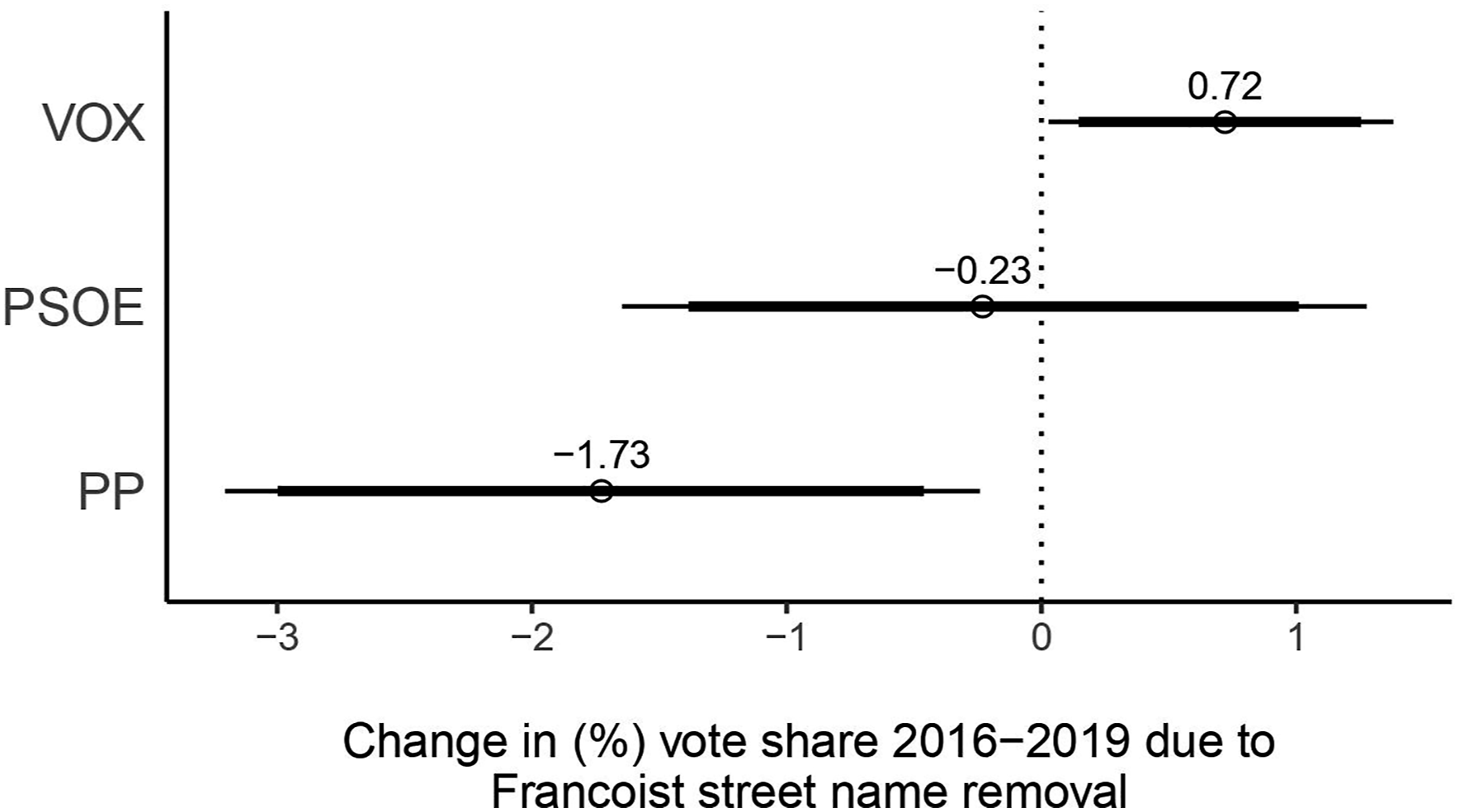
DiD estimates of Francoist street renaming on vote change, obtained from simulations (mean and 90%/95% CIs).
The evidence is supportive of the backlash hypothesis. First, Vox increased its support 0.7 points more in municipalities that renamed Francoist street names than in those that did not. Considering that the nation-wide electoral share of Vox in April 2019 was 10.3%, this effect is non-negligible: the change in electoral support was around 6% higher in these municipalities. Second, removing Francoist street names is related to a decrease in electoral support for PP, of almost 1.5 points. Interestingly, it does not significantly affect electoral support for PSOE, indicating that the change in political preferences takes place among rightist individuals. This last result is coherent with the idea that increased support for the far-right was linked not only to street renaming but to mobilization strategies of the far-right.
Our findings could be confounded if Francoist street renaming was driven by the same factors also explaining a shift to far-right preferences. One possibility is that these street name changes took place in more conservative areas where Spanish nationalism was stronger. In this case, we should see different trends before 2016 between municipalities that later removed Francoist street names and those that did not. Figure 3 shows normalized electoral trends among control and treated groups for PP and Vox. Although data for Vox only goes six months back in time, there are no distinct trends for the two parties for which we find an effect of Francoist street renaming before June 2016. We show data on pre-treatment trends in the Supplementary Appendix (Section A7), even though a strict test of the parallel trends assumption is not possible given the absence of previous data on Vox, which emerged in 2014. Pre- and post-treatment trends in Vox and PP electoral share.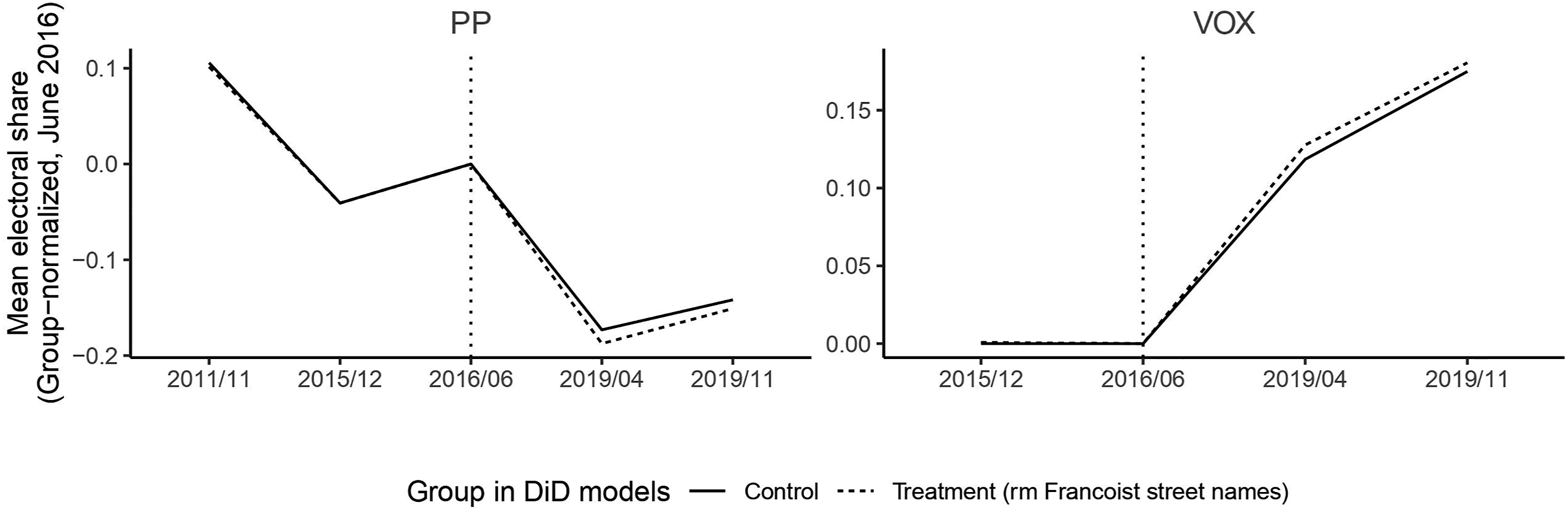
In the Appendix, we include several additional analyses. We present cross-sectional models (Section A6) using the independent variable in continuous form, tracking Francoist street name removals during different periods (including changes between 2001 and 2019), and using both support for Vox in the November 2019 elections as well as the change in support between April and November 2019 as dependent variables. The results are coherent with the DiD analyses. They also show that Francoist street name removals account for Vox’s growth between 2016 and 2019 but not for the changes between April and November 2019, which suggests that any local effect due to a backlash over the politics of memory took place mainly during the period we analyze.
Finally, we test the robustness of the DiD results to different specifications (Section A7), in particular: including the primary independent variable in continuous form (logged number of street name removals), excluding from the sample municipalities where Vox did not have any votes in 2016, and changing the independent variable so it also includes street renamings registered in the first half of 2019. We also show results from first-difference models (Section A8). Results do not significantly change when using alternative specifications and support the main findings.
Conclusion
Using local-level data, we analyze the political effect of Francoist street renaming in Spain and find evidence in favor of a backlash hypothesis. In the short-term, Francoist street name removals have increased support for a far-right party, Vox, which has recently gained steam with a discourse grounded in an authoritarian and an exclusionary version of Spanish nationalism. Vox has grown in these places at the expense of the traditional conservative party, PP, but not of the main left-wing party, PSOE, pointing to a process of asymmetric polarization resulting from this policy.
The results from our analyses echo recent debates about symbolic TJ policies and memories of past conflicts in other countries. Our goal is not to take a normative stand against these policies. Despite potential short-term backlash effects, we believe that they can be highly beneficial in the long run (these measures could well contribute to national reconciliation down the road). Moreover, TJ symbolic policies might have these unintended effects only where some political parties take electoral advantage of this issue. In other words, asymmetric polarization does not have to be an automatic outcome of these policies and actions of other political parties can perhaps palliate it. For example, by countering narratives or compensating the aggrieved in other ways (i.e., relocating these symbols into a museum), interested political and social actors could limit the extent to which this discontentment can be opportunistically exploited by more extreme parties. The extent to which such remedial policies can work is nonetheless out of the scope of this paper.
Finally, while we have focused on the removals of symbols, other TJ policies might not have similar backlash effects. For instance, recent research shows that TJ museums can promote reconciliation (Balcells et al., 2021), and that reparations can increase political engagement among victims (Voytas, 2021). The average impact of TJ will depend on how the effects of the different measures add up (Loyle and Appel, 2017; Olsen et al., 2010). Overall, this article contributes to an open and lively scholarly debate on the effectiveness of TJ policies.
Supplemental Material
sj-pdf-1-rap-10.1177_20531680211058550 – Supplemental Material for Do TJ policies cause backlash? Evidence from street name changes in Spain
Supplemental Material, sj-pdf-1-rap-10.1177_20531680211058550 for Do TJ policies cause backlash? Evidence from street name changes in Spain by Francisco Villamil and Laia Balcells in Research & Politics
Footnotes
Acknowledgments
We are grateful to Elsa Voytas, José Rama, Mai Hassan, participants at ISA 2021 and APSA 2021, and two anonymous reviewers for their helpful comments, as well as to Claire Lee for research assistance. This study is published within the Georgetown University project “Inequality and Governance in Unstable Democracies–The mediating Role of Trust,” implemented by a consortium led by Institute of Development Studies (IDS). The support of the UK Economic and Social Research Council (ESRC grant ES/S009965/1) is gratefully acknowledged.
Declaration of conflicting interests
The author(s) declared no potential conflicts of interest with respect to the research, authorship, and/or publication of this article.
Funding
The author(s) disclosed receipt of the following financial support for the research, authorship, and/or publication of this article: This work was supported by the Economic and Social Research Council grant numbers ES/S009965/1.
Correction (March 2025):

Supplemental material
Supplemental material for this article is available online.
Notes
References
Supplementary Material
Please find the following supplemental material available below.
For Open Access articles published under a Creative Commons License, all supplemental material carries the same license as the article it is associated with.
For non-Open Access articles published, all supplemental material carries a non-exclusive license, and permission requests for re-use of supplemental material or any part of supplemental material shall be sent directly to the copyright owner as specified in the copyright notice associated with the article.
