



Abstract
Two issue frames quickly emerged in policy and media communications about COVID-19 lockdown measures. Initially, a public health frame advocated for strong quarantine policies to slow the spread of the virus. As the economic costs associated with quarantine measures became clear, an economic frame pushed for an end to (or a relaxation of) these measures to alleviate the economic damage associated with lockdowns. We do not know much about how these competing communication frames affected lockdown support, especially in poor- and middle-income countries. To explore this question, we embedded a framing experiment in a nationally representative telephone survey in May 2020 in Peru, one of the world’s hardest-hit countries by the coronavirus pandemic. The vignette experiment reveals that the economic frame produces a decrease in public support for quarantine measures in Peru. In contrast, respondents exposed to a health frame do not increase their approval of the same measures.
Introduction
The COVID-19 global pandemic forced governments around the world to adopt behavioral interventions such as lockdown or quarantine measures to slow the spread of the virus. These restrictive measures severely disrupted social and economic activities but were seen as essential by the scientific community given the absence of an effective treatment.
Two issue frames emerged in policy and media communications about lockdown measures. Initially, a public health frame advocated for strong quarantine policies to slow the spread of the virus. As the economic costs associated with quarantine measures became clear, an economic frame pushed for an end to (or a relaxation of) these measures to alleviate the economic damage associated with lockdowns.
Previous research has shown that the way this trade-off is communicated to the public in OECD countries shapes preferences regarding lockdown measures and social distancing. The main finding in this emerging literature is that people who are exposed to a public health framing are more supportive of restrictive measures and social distancing (Carrieri et al. 2020). Not only that, given the public health emergency, people in the United Kingdom and in the United States strongly prioritized health over wealth in the early days of the pandemic (Hargreaves Heap et al., 2020). Although the economy versus health trade-off can be felt more intensely by people who live in poor- or middle-income countries, we know less about the impact of communication frames on public preferences about containment measures in these contexts.
In this paper, we conduct a framing experiment in Peru, a Latin American country that suffered a very severe COVID-19 outbreak. The Peruvian government was one of the first in Latin America to implement sweeping lockdown measures to prevent the spread of the disease and the healthcare system’s collapse. A state of national emergency was announced mid-March, just a few days after the country’s first coronavirus case was confirmed. It established a nationwide quarantine that included mandatory social isolation, restriction of movement and public gatherings, border closure, and domestic travel suspension. Peru is a great case to study support for lockdown policies because, despite these timely and stringent measures, cases and deaths spiked.
We explore how two commonly used frames in the public debate about lockdown measures (health vs economy) affect support for those measures. Our main argument is that respondents exposed to the economic frame should become less supportive of strict containment policies during a public health crisis because they re-evaluate their self-interest in the context of costly lockdown measures. In line with this expectation, our results show that respondents exposed to an economic frame are more likely to disapprove of the government-mandated quarantine. Conversely, respondents exposed to a health frame were not more likely to endorse containment measures.
Issue framing and public opinion on containment measures
The literature on issue framing theorizes that the ways in which elites portray a social issue generate different public responses. Individuals reach different conclusions about a policy, depending on the emphasis media communications place on certain considerations (e.g., health versus economic concerns). For instance, allowing a hate group rally can be presented as a matter of public safety or free speech. These framing effects have been studied on a variety of subjects, from social welfare policy to environmental policy (Chong and Druckman, 2007). Yet, research about the framing effects on public opinion during the coronavirus pandemic, and during health crises in general, is still limited.
The issue of quarantine measures provides an interesting context for testing the influence of issue framing on public opinion. The policies aimed at preventing the spread of the coronavirus included various measures, ranging from stay-at-home orders to social distancing, and they were subject to great controversy. Early on, experts and policymakers disagreed about the best strategies, the stringency of the measures, and for how long to keep them. In developing countries, especially, the information available to policymakers and the public about the pandemic’s human and economic cost was scarce and imprecise. The public thus observed how the policy debate unfolded before them, as authorities gained a better understanding of the risks the public health emergency entailed, and attempted to inform and persuade public opinion.
In Peru, as in most other Latin American countries, media and policy frames initially emphasized the public health benefits of quarantine measures. Between March and May 2020, there was significant communication about the importance of protecting public health in the context of a global pandemic. For instance, public health experts repeatedly urged the population to practice social distancing and abide by stay-at-home orders to save lives and prevent the healthcare system’s collapse (Huerta, 2020). As the devastating economic effects of lockdown measures became clear, an alternative communication frame gradually emerged emphasizing the economic costs of containment policies. In fact, some economists highlighted the potential economic devastation of maintaining a strict national quarantine for too long (Rospigliosi, 2020). In supplemental appendix A, we provide a detailed discussion on the information environment in Peru in the early months of the COVID-19 pandemic.
Both the economic and the public health frames coexisted in news coverage when this study was conducted (late May 2020), but most Peruvians were more heavily exposed to public health communication in the early months of the pandemic. By early May, Peru had the highest number of deaths in the region, only after far more populous Brazil. The weak and underfunded public healthcare system, which already had operated at near capacity before the pandemic, was quickly overwhelmed by coronavirus cases.
Concern about public health and support for containment measures is therefore likely to be the baseline attitude among Peruvians in May 2020. Indeed, we find that 76% of respondents in the control group in our survey experiment support lockdown measures. As noted, this could be due to health messages received by respondents from external sources prior to our study. This is critical because the high baseline support for containment measures means there is less room to make respondents more supportive of lockdowns in response to our treatment.
Nevertheless, there is evidence from other highly supported policy issues showing that baseline attitudes can actually be changed. For example, even though 72% of Americans believe that climate change is real (Marlon et al., 2020), we know that particular events such as natural disasters can increase concerns about a warming planet (Bergquist and Warshaw, 2019). It is therefore possible that exposure to a public health framing that clearly articulates the health benefits of lockdowns leads to an increase in the already high level of support for containment measures. Our experimental design will allow us to test these two alternative hypotheses.
The public health frame should not influence support for quarantine measures in Peru.
The public health frame should produce an increase in support for quarantine measures in Peru. Our main research goal is to investigate whether an economic frame on COVID-19 lockdowns can lead to a decrease in support for containment policies. Previous research has established that social and cultural issues can be framed in terms of economic consequences, and those economic frames can lead to attitude changes both at the mass and at the elite level (Chong et al., 2001; Chong and Marshall, 1999; Malhotra and Newman, 2017). For instance, both citizens and government officials are more likely to support the removal of Confederate symbols in southern U.S. states when the decision is presented as good for business (Grose and Peterson, 2020). Building on that theoretical scaffolding and those earlier findings, we argue that an economic framing might change respondents’ self-interest from concerns about public health (the likely baseline in May 2020) toward concerns about the economic consequences of the pandemic. In turn, this should lead to changes in people’s attitudes regarding the need for strict containment policies, such as lockdowns. To our knowledge, our study is the first to assess whether economic self-interest frames can shift people’s attitudes on public health policies. The economic frame should resonate strongly among respondents in our survey given the socioeconomic context in Peru. Structural economic conditions in Peru (and in Latin America more generally) are marked by high levels of labor informality and wealth inequality (Gasparini and Tornarolli, 2009). More than 70% of Peruvians work in the informal sector, and their daily subsistence thus depends on insecure and low-paying jobs that do not guarantee social security benefits (CEPLAN, 2016). These informal jobs cannot be done from home, and failing to show up to work can have immediate negative consequences for poor informal workers and their families. As a result, quarantine and social distancing recommendations are almost impossible to carry out by most Peruvians, especially the poor. In May, the economic consequences of the pandemic were already evident, as the National Statistics Institute reported that one in four residents of Lima had lost their job (INEI, 2020). The second hypothesis of the paper follows from this discussion.
The economic frame should produce a decrease in support for quarantine measures in Peru. One limitation of our design is the differential direction of the hypothesized effect of the two treatments. If there is any effect at all, the public health frame should increase support for lockdown measures, while the economic frame should lower support for them. However, it may well be that the economic frame—in lessening respondents’ support—is not precisely parallel to the health frame that was hypothesized to move respondents toward greater support. In fact, we expect that given the high baseline of support for public health measures and the fact that there is less room to grow for the public health treatment, we should observe a smaller treatment effect for the public health frame (if there is any effect at all). While this design choice might be unconventional, we chose this approach to approximate in a realistic way the two main messaging frames the Peruvian population was exposed to at the time our survey was conducted.
Design
We implemented a nationally representative survey by telephone of 1,490 randomly selected respondents aged 18 years and over in Peru, conducted by the Instituto de Estudios Peruanos on 21–28 May 2020. At the time, the rate of infections was still accelerating and the healthcare system was on the verge of collapsing. Amid the rapidly developing situation in Peru, some experts and authorities started to consider a plan for re-opening the economy, which fueled the health versus economy policy debate. The survey included traditional demographic and COVID-related questions. We include more information about the sample design in supplemental appendix B.
We use a framing experiment to evaluate how economic and health frames affect people’s attitudes toward lockdowns. Chong and Druckman (2007: 104) refer to framing effects as “alternative framings of the same basic issue,” stating that these effects occur “when (often small) changes in the presentation of an issue or an event produce (sometimes large) changes of opinion.” This approach emphasizes the internal validity of framing studies. The goal is to clearly isolate the specific aspect of the information environment that changes (or not) people’s preferences. However, in certain circumstances, this approach might undermine external validity because people are not exposed to stylized frames in real life. We therefore decided to underscore external validity by using frames that mimic the public debate in the media during the early phase of the pandemic in Peru (see supplemental appendix A for more information about media coverage). Our design is very similar to the one used by other scholars to evaluate the impact of policy (or issue) frames on trade preferences (Ardanaz et al., 2013).
We embedded a framing experiment in the survey where people were randomized to three different conditions. The first was an economic framing where the enumerator read the following to the respondent: “Most economic experts recommend relaxing quarantine measures to reduce damage to the economy, which would allow more people to go to work.” The second was a health framing where the enumerator read the following to the respondent: “Most public health experts recommend maintaining quarantine measures to reduce virus transmission, which would help ease the burden on the health system.” The third corresponds to the control group, in which respondents were not exposed to any framing.
The two issue frames follow the same structure but deliver different policy content. In both cases, we start with an expert statement about lockdowns (i.e., economic experts recommending relaxing vs. health experts recommending maintaining lockdowns), provide a reason to support that statement (i.e., reduce damage to the economy vs. reduce transmission of the virus), and finalize with a positive consequence (i.e., allow more people to work vs. help ease the burden on the health system). As mentioned above, the two contrasting frames in our study are different in more than one way since our approach is not to simply change one piece of information to an otherwise identical message. However, we believe that the two frames approximate in a much more realistic way the main policy debate surrounding the adoption of quarantine measures in Peru (and many other countries), thereby enhancing external validity.
After implementing the survey and the framing experiment, we ended up with 482 respondents in the control group, 488 in the economic condition and 520 in the health condition. In supplemental appendix C, we summarize the pretreatment covariates available in the study. In supplemental appendix D, we provide their descriptive statistics. Finally, in supplemental appendix E we show that the treatments and control groups are balanced across these pre-treatment covariates.
After the framing experiment, we included a question about support for the quarantine: “To what extent do you agree or disagree with the quarantine that has been adopted to deal with the coronavirus?” The answer takes the following scale: (1) Strongly disagree, (2) Disagree, (3) Neither agree nor disagree, (4) Agree, and (5) Strongly agree. We use this variable as our outcome; however, since it includes a few missing values (i.e., nine non-responses), 1 we also construct a binary indicator of supporting the quarantine, where a 1 is saying agree or strongly agree and a 0 otherwise (i.e., zero non-responses).
We use randomization inference to test our hypotheses. This procedure will yield exact p-values even when the samples are not particularly large. Randomization inference computes p-values under the sharp-null hypothesis of no treatment effect for all observations. As opposed to traditional regression approaches, we do not need to rely on assumptions about the shape of the sampling distribution when computing the p-values because simulated randomizations will provide the exact sampling distribution of the estimated average treatment effect under the sharp null hypothesis (Gerber and Green, 2012).
Results
Figure 1 summarizes the averages and the 95% confidence intervals for the three groups across the two versions of the outcome, providing a first glance of the effects of the different framings on support for the quarantine. Support for the quarantine (binary and ordinal), by experimental condition.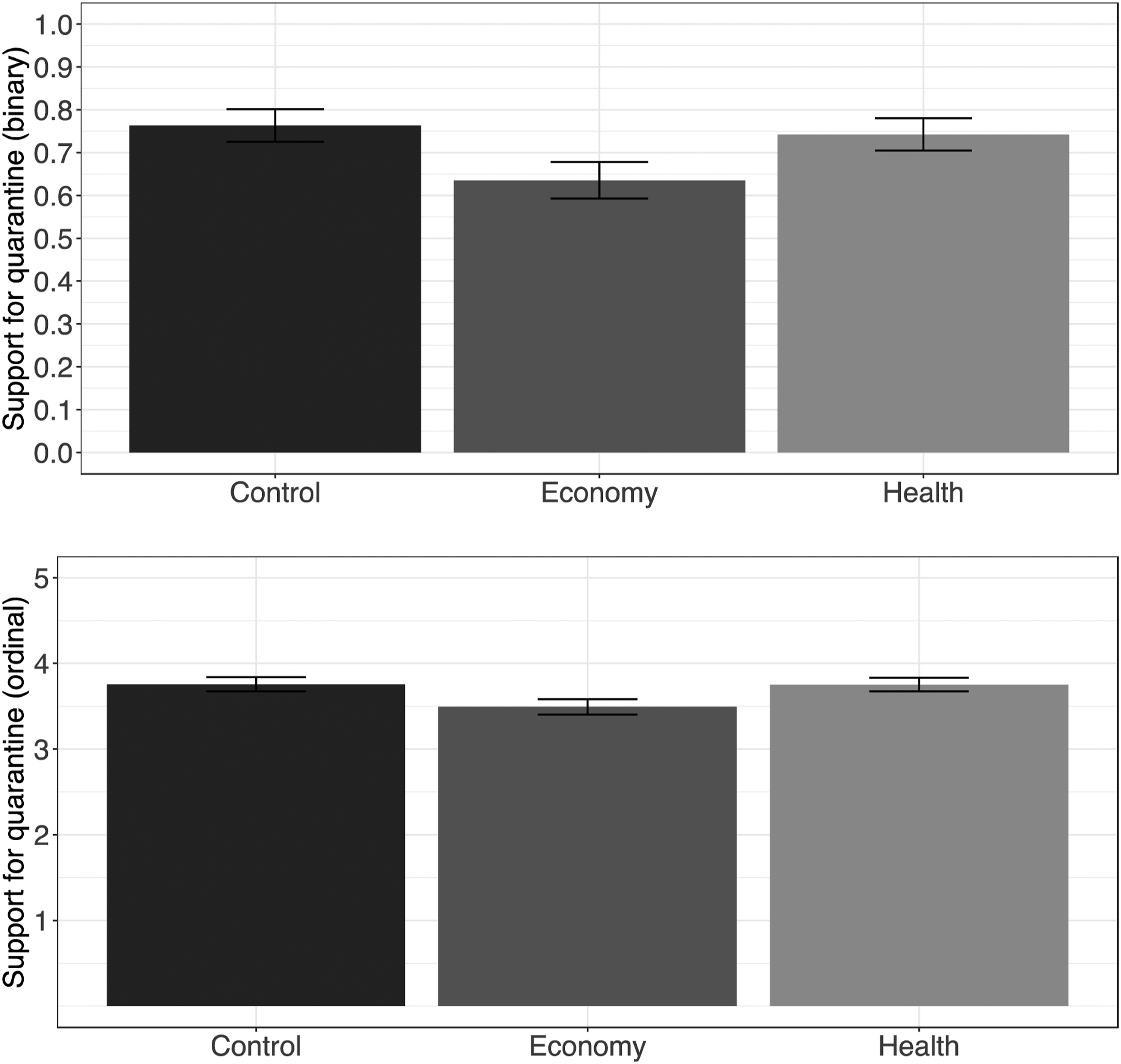
Support for the quarantine in the economic and control conditions.

Support for the quarantine in the health and control conditions.

Conversely, there is no evidence to claim that exposure to a health frame increases support for the quarantine. The results for the comparison between the health and control conditions are neither substantive nor significant.
In summary, we do not find evidence that the public health framing increases support for lockdown measures, which provides support for Hypothesis 1a. As discussed above, we cannot infer from this null result that public health messaging did not affect attitudes about containment measures. Concern about public health was the likely baseline attitude in May 2020, as Peruvians had been heavily exposed to public health communication from external sources before our survey was conducted. On the other hand, we find evidence showing that the economic frame has had an important effect of decreasing support for the quarantine, which corroborates Hypothesis 2. This is in line with our expectation that the economic frame might change respondents’ self-interest from concerns about public health (the likely baseline in May 2020) toward concerns about the economic consequences of the pandemic.
Discussion
Previous research conducted in OECD countries shows that people exposed to public health and economic frames during the COVID-19 pandemic tend to prioritize health over wealth (Hargreaves Heap et al., 2020). The results presented above suggest the opposite is true in a developing country with high levels of labor informality, where the population is less able to withstand a severe economic shock.
Why was the economic framing more effective than the health framing in changing public attitudes toward the quarantine in Peru? The large informal sector and income inequality that characterize low- and middle-income countries like Peru can explain why quarantine’s economic costs resonate so strongly with the population. In a setting where individual decisions to prevent COVID-19 infections can translate into instant income or job loss (in some cases exposing informal workers and their families to impending hunger and homelessness), it is only logical that economic fears outweigh health concerns. In fact, for many Peruvian citizens, “hunger is the number one enemy and utmost fear—greater, even, than getting infected with the virus” (Dinegro Martínez, 2020).
Wealthy countries have stronger welfare states that implemented emergency programs to offset the negative effects of quarantine measures, such as increasing unemployment benefits, distributing stimulus checks, or subsidizing companies to maintain their workforces (Birnbaum, 2020). Such large-scale policy interventions are not available in developing countries, which can lead to stronger and more rapid negative effects of lockdowns on people’s economic wellbeing (Evans and Over, 2020). While Peru—like most Latin American countries—has made remarkable progress in reducing poverty and expanding social policies in the past decade (Holland and Schneider, 2017), the lockdown has exposed the fragility and the truncated nature of the country’s social welfare state and the economic vulnerability of large segments of society—especially the informal sector—(Levy and Schady, 2013). In supplemental appendix H we check for heterogeneous treatment effects using respondents’ socioeconomic level and informality status to evaluate whether these characteristics help us to explain why survey participants in Peru are more sensitive to the economic treatment.
Conclusion
This paper investigates the effects of issue framing on lockdown policy preferences in a developing country. The results of a framing experiment embedded in a survey in Peru demonstrate that people’s attitudes toward the quarantine turn more negative when they are informed about the economic costs that easing the quarantine will help avert.
The policy implications of quarantine disapproval in one of the countries hardest hit by COVID-19 are disturbing. Developing countries, which already have a weak public health system to withstand the pandemic, are the same countries whose citizens could turn more defiant of preventive measures. If diminished support for quarantine under economic distress translates into lower compliance with these preventive measures (Hargreaves Heap et al., 2020), our findings suggest that developing countries might face serious difficulties in avoiding the rapid spread of the virus and the collapse of the healthcare system, even when governments promptly implement preventive policies. The welfare state’s weaknesses, which make developing countries more vulnerable to health crises, also make them less capable of enforcing containment rules and ensuring citizen compliance.
Given the compliance limitations that developing countries face due to their lack of social safety nets, messages effective at changing attitudes toward preventive measures are paramount. Our results suggest that public health messages that did not take into account the difficult situation of economically vulnerable people were unsuccessful. Careful messaging from government and experts could have, instead, conveyed to people that adherence to public health measures would allow for faster economic re-opening. Would such a hybrid framing, accompanied by efficient emergency relief programs, have changed people’s level of approval of COVID-19 lockdown measures? Future research should explore this follow-up question while also broadening the scope of public health measures investigated here. In particular, new studies could explore how these findings apply to other containment measures besides quarantine, such as mandatory mask-wearing or social distancing.
Supplemental Material
sj-pdf-1-rap-10.1177_20531680211051177 – Supplemental Material for Does issue framing shape support for COVID-19 lockdown measures? Evidence from a survey experiment in Peru
Supplemental Material, sj-pdf-1-rap-10.1177_20531680211051177 for Does issue framing shape support for COVID-19 lockdown measures? Evidence from a survey experiment in Peru by Miguel Carreras, Sofia Vera and Giancarlo Visconti in Research & Politics
Footnotes
Declaration of conflicting interests
The author(s) declared no potential conflicts of interest with respect to the research, authorship, and/or publication of this article.
Funding
The author(s) received no financial support for the research, authorship, and/or publication of this article.
Correction (March 2025):

Supplemental material
Supplemental material for this article is available online.
The replication files can be found at https://dataverse.harvard.edu/dataset.xhtml?persistentId=doi:10.7910/DVN/TPTA2P&version=DRAFT.
Notes
References
Supplementary Material
Please find the following supplemental material available below.
For Open Access articles published under a Creative Commons License, all supplemental material carries the same license as the article it is associated with.
For non-Open Access articles published, all supplemental material carries a non-exclusive license, and permission requests for re-use of supplemental material or any part of supplemental material shall be sent directly to the copyright owner as specified in the copyright notice associated with the article.
