



Abstract
This study investigates how the economic crisis associated with the COVID-19 pandemic impacted support for social assistance in Germany. We formulate our expectations drawing from the classical political economy literature on self-interest and the burgeoning research on the role of solidarity. On the one hand, we hypothesize that only low-income individuals impacted economically by COVID-19, who can benefit from social assistance, will support its expansion. On the other hand, we expect higher-income individuals affected economically by COVID-19 to be more supportive of social assistance, even though they do not benefit from it, and less likely to consider welfare recipients ‘undeserving’ compared to higher-income individuals not economically affected by the pandemic. We argue that first-hand crisis experiences update people’s beliefs about how luck impacts one’s economic situation in the presence of an exogenous shock. We combine observational and experimental data from an original survey collected in Germany in April 2021 to test our expectations. On average, low-income respondents appear to be the most vigorous supporters of social assistance, but their support is not conditional on their experience of the COVID-19 pandemic. Instead, we find that the support for more social assistance among affluent individuals depends on the economic impact of the pandemic. We experimentally manipulated the deservingness of welfare recipients and found that better-off respondents impacted by the pandemic were less likely to penalize even the most ‘undeserving’ welfare beneficiaries. We suggest that solidarity between classes in hard times may occur through a convergence of the deservingness perception among individuals. The article has broader implications for studying the effect of crises on solidarity and the conditional nature of class-based explanations for support for different welfare policies.
Introduction
The containment measures following the outbreak of COVID-19 in 2020–2021 had extensive distributional consequences in many European countries. Although losses were felt to some extent across the whole income distribution (Almeida et al., 2021), the economic consequences of the COVID-19 pandemic hit differently across society. Middle-class, highly-educated workers with permanent contracts were, on average, less likely to lose their jobs or suffer a significant loss of income compared to those in more precarious and often low-income employment (Adams-Prassl et al., 2020; Bonacini et al., 2021; Botelho and Neves, 2021) or to small business owners who shut down their businesses temporarily or permanently and found themselves in need of state support, as they did during the Great Recession (Bonoli et al., 2022; Sachweh, 2018).
Adverse economic shocks such as the one brought about by the pandemic tend to increase support for redistribution and welfare state programmes (Margalit, 2019). Did COVID-19 impact the support for the welfare state? Country-level studies indicate that the average support for redistribution and the welfare state hardly changed at the macro level (Ares et al., 2021; Ebbinghaus et al., 2022). Other studies focused on different groups, such as pensioners, unemployed people, and working parents, and assessed changing preferences at lower levels of aggregation (Enggist et al., 2022). In this article, we build upon the existing literature and argue that because the COVID-19 pandemic did not affect all individuals in the same way, it provides an excellent opportunity to understand better how economic shocks influence an individual’s support for social policies.
In this study, we investigate the economic impact of the COVID-19 pandemic on support for redistribution. We advance two possible explanations of why an economic shock may alter policy preferences. The first one builds on a fundamental assumption in political economy: individuals’ policy preferences are functions of their economic self-interest (self-interest hypothesis). Accordingly, we expect that a negative impact on one’s economic situation will increase support for social assistance, primarily among those who benefit from it. A second explanation postulates that those affected by the crisis adjust their attitudes toward others, expressing higher support for social assistance even if they do not stand to benefit personally (solidarity hypothesis). It is possible, we argue, that individuals who have experienced the consequences of the pandemic first-hand update their beliefs about the role that luck plays in determining a person’s economic condition, thereby reducing their emphasis on personal responsibility.
We test these hypotheses using original survey data collected from 1350 German citizens in April 2021. We chose to test the effect of the economic impact of COVID-19 on support for the expansion of social assistance because it is a tax-financed and means-tested benefit, requiring redistribution from richer to poorer citizens. In the first part of the analysis, we employ multiple linear regression to estimate the effect of COVID-19’s economic impact on support for expanding social assistance. We also use group-level interactions to explore how such effects vary between and within income groups. In the second step, we use data from a vignette experiment to tease out the mechanism underlying the relationship between an individual’s economic impact from COVID-19 and their support for social policies. We demonstrate that individuals economically impacted by the pandemic tend to support social assistance more strongly and discriminate less between ‘deserving’ and ‘undeserving’ welfare beneficiaries. We conclude that economic shocks softening ‘deservingness penalties’ is a plausible mechanism supporting the solidarity hypothesis.
Given our research design, we cannot demonstrate that individuals changed their preferences over time due to the pandemic. However, we argue that the significant difference in attitudes between individuals more or less impacted by COVID-19 within the same economic groups strongly suggests an effect of the crisis that deserves further exploration. Our findings indicate increased solidarity between the rich and poor in hard times, thereby contributing to research on conditions that lead to changes in the mass structure of the welfare state support (Rehm, 2016). Ultimately, we contribute to a better understanding of public policy preference formation dynamics in times of crisis and highlight the importance of considering alternative mechanisms beyond self-interest that could come into play during such times. We argue that this understanding is critical to appreciating how crisis periods reshuffle the demand for social policies, opening windows of opportunity to create cross-class coalitions supporting the welfare state (Enggist et al., 2022).
We introduce the existing literature on the impact of the COVID-19 pandemic on support for the welfare state. Then, we present our theoretical argument, distinguishing between self-interest and solidarity considerations and drawing upon the deservingness literature that underpins the latter. Our empirical analysis follows, initially utilizing observational data and subsequently conducting a deservingness experiment to disentangle the effect of COVID-19 on preference formation.
COVID-19 and support for social policies
Studies have provided ambiguous evidence regarding whether COVID-19 affected support for the welfare state. During the early stages of the pandemic, until mid-2020, the average support for social policy expansion at the country level remained relatively the same as for the pre-pandemic period (Ares et al., 2021; Busemeyer, 2021). Focusing on a more extended period after the pandemic was announced indicates a significant, albeit short-term, increase in support for unemployment and family policies (Ebbinghaus et al., 2022).
A central critique of these studies has been their focus on aggregate public opinion, whereas, contrastingly, literature on the demand for welfare state policies often disaggregates individuals into relevant economic and political groups along the lines of age, gender, party affiliation, and class groupings (Gingrich and Ansell, 2012; Häusermann, 2010; Rehm et al., 2012). For instance, it appears that German pensioners became more solidaristic during the pandemic, prioritizing increased spending on childcare over old-age support, and right-wing voters in Sweden and Spain became more supportive of unemployment benefits and active labour market policies (Enggist et al., 2022). In Germany, the shift in support for additional healthcare spending during the pandemic was heavily influenced by trust in the government and perceptions of individual government performance (Busemeyer, 2021). Underpinning the findings of these studies is the largely untested assumption that individuals affected differently by the pandemic prioritize their own or others’ interests.
It is helpful to consider other literature beyond welfare state scholarship, exploring how the pandemic affected individuals’ perceptions of society and their positions. Experimental studies show that respondents reminded of the pandemic are more tolerant of inequality due to luck (Cappelen et al., 2021) and less judgmental about who deserves government aid for emergency transfers (Bridgman et al., 2021). However, they also discriminate more between patients accessing intensive care units and vaccinations (Haderup Larsen and Schaeffer, 2021; Reeskens et al., 2021).
We integrate the evidence provided by these studies into our theoretical framework and argue that, along with economic self-interest, one channel through which an economic shock influences support for social policy is by updating individuals’ beliefs. This shapes their political beliefs and leads them to make more lenient deservingness considerations when assessing welfare state recipients. We will now introduce these two perspectives and the respective hypotheses.
Self-interest and solidarity: explaining the effect of COVID-19 on policy preference
Our theoretical reasoning begins considering a fundamental assumption in political economy literature: economic self-interest plays a crucial role in shaping individual political preferences. This perspective posits that an individual’s political preferences are influenced by various economic factors – where they stand in the job market, the potential risk of job loss, their rank in the income hierarchy, and their expected income trajectory (Iversen and Soskice, 2001; Mares, 2006; Meltzer and Richard, 1981). It follows that crises impacting job security, income, and future risk assessments – such as the COVID-19 pandemic – should influence attitudes toward redistribution.
Following the economic interest hypothesis closely, we should expect the COVID-induced economic shock to increase support for social assistance primarily among the poorer segments of the population (Alesina and La Ferrara, 2005; Meltzer and Richard, 1981). This is because only some are eligible for such assistance. Take Germany’s Arbeitlosengeld II scheme, for instance. To qualify, a person must be in ‘need of assistance’ (hilfebedürftig), meaning that they cannot support themselves solely through income, relatives, or savings. This effectively rules out average middle- and high-income individuals. So, because people generally support the expansion of social policies from which they benefit, and different socioeconomic groups gain from different policies, it makes sense for their levels of support to differ (Häusermann and Kriesi, 2015; Rueda, 2007).
Lower-income individuals are likelier to work in routine occupations via temporary agencies and short-term contracts. These positions are susceptible to economic fluctuations, affecting the demand for their labour (Bradley et al., 2003; Fabrizi and Mussida, 2009). Additionally, these individuals often navigate precarious employment conditions, making them more prone to unemployment spells. The intermittent nature of their work means that they are less likely to accumulate savings and, due to fragmented contributory records, less likely to qualify for unemployment insurance. This scenario increases their preference for tax-financed social assistance (Häusermann et al., 2015; Walter, 2010).
Conversely, high- and middle-income individuals often prefer universal policies from which they benefit rather than targeted ones (Bonoli et al., 2017; Busemeyer and Garritzmann, 2017; Cantillon and Van Lancker, 2013; Korpi and Palme, 1998; Pavolini and Van Lancker, 2018). When economic shocks such as the COVID-19 pandemic alter the distribution of risk, these groups may also demand increased income protection and cash transfers (Gingrich and Ansell, 2012; Rehm et al., 2012; Sachweh, 2018; Walter, 2010). However, given their higher likelihood to contribute to unemployment insurance, these individuals are also more likely to increase their support for such contributory programmes following an economic shock (Moene and Wallerstein, 2001).
With these insights from the self-interest perspective, we now propose the following hypothesis on the possible effect of the COVID-19 pandemic on support for social assistance:
Self-interest hypothesis: The higher the economic impact of COVID-19 on the respondent, the higher the support for social assistance among lower-income groups.
We consider an alternate scenario where the pandemic could increase support for social assistance for other income groups. This situation involves an economic shock, triggering a learning process that alters one’s perspective (Gerber and Green, 1999; Page and Shapiro, 2010). Individuals may revise prior assumptions and rethink their understanding of social risks, their impacts, and the principles underpinning their political beliefs, such as the role of luck in personal economic setbacks. Economic shocks can prompt a learning process that reshapes political views beyond immediate circumstances.
In line with this scenario, empirical evidence suggests that economic hardship experiences can reshape attitudes towards social assistance (Alesina et al., 2001; Margalit, 2019). For instance, Alesina et al. (2001) found connections between experiencing personal financial difficulties and increased support for redistributive policies. Similarly, Margalit’s (2019) thorough review indicates that large-scale economic shocks, like the one experienced during the pandemic, can significantly impact public opinion about welfare state interventions. This evidence suggests that the trauma and uncertainty associated with economic shocks may lead individuals to reconsider their previous stances on social assistance, thereby endorsing stronger safety nets. These findings corroborate the theory that economic crises can recalibrate public sentiment regarding social protection mechanisms.
Given these insights, we formulate the following hypothesis:
Solidarity hypothesis: The higher the economic impact of COVID-19 on the respondent, the higher the support for social assistance among higher-income groups.
Solidarity and deservingness: other-regarding motivations
In this section, we investigate the mechanism underpinning the solidarity hypothesis. Specifically, we examine how individuals revise their assumptions and reassess their understanding of social risks. This mechanism, referred to as the ‘deservingness heuristic’, is fundamentally grounded in the belief that one’s perception of the welfare beneficiaries’ deservingness significantly influences their support for redistribution policies (van Oorschot, 2000; Larsen, 2008). People are generally more inclined to support redistribution if they perceive the beneficiaries as deserving – those whom they believe have genuinely fallen on hard times through no fault of their own. In contrast, if individuals perceive the beneficiaries as undeserving – those they perceive as exploiting the system – their support for welfare provision diminishes. We argue that economic shocks like a pandemic can shift public perception of deservingness, making people more empathetic towards those affected and fostering a more inclusive understanding of social risk. Therefore, when economic crises trigger a reassessment of such perceptions, they can transform attitudes towards social assistance and foster solidarity.
We build on the idea that an individual’s perception of the beneficiaries of redistribution influences their support for the welfare state (Cavaillé and Trump, 2015). In this perspective, redistribution support is conditional on the givers’ perceptions of the receivers and is not dictated by income levels (Dimick et al., 2017). Deservingness penalties are more prevalent among lower-income and educated individuals, who hold more authoritarian views of society and are more punitive toward ‘undeserving’ beneficiaries (Attewell, 2021). Poorer individuals also have a higher need for redistribution, and their other-oriented attitudes can be overshadowed by personal need considerations such as resource competition with other beneficiaries. Conversely, wealthier and highly educated individuals holding more universalistic values (Häusermann and Kriesi, 2015) are less likely to deem individuals undeserving and better positioned to make other-oriented considerations (Dimick et al., 2017; Rueda and Stegmueller, 2016; Rueda, 2018; Cavaillé, 2015; Dimick et al., 2018; Armingeon and Weisstanner, 2021).
Scholars have suggested various ‘deservingness judgements’ scales to assess welfare beneficiaries. One essential reference is CARIN (Dimick et al., 2017; Rueda and Stegmueller, 2016; Rueda, 2018; Cavaillé, 2015; Dimick et al., 2018; Armingeon and Weisstanner, 2021). According to this scale, people are more likely to back redistribution if the beneficiaries lack Control over their circumstances, exhibit gratitude (Attitude), have contributed in some form to the benefit (Reciprocity), and identify similarly, such as by nationality (Identity), and express a genuine Need for the benefits (Meuleman et al., 2020).
We explain the mechanism behind the solidarity hypothesis building on the Control element of the CARIN scale. We connect it to the idea that sudden shocks to inequality can heighten social solidarity, as it exposes barriers to social mobility (Dimick et al., 2017; Magni, 2021). We argue that individuals during an economic shock are seen as less in control of their circumstances, and welfare recipients are judged less harshly. We contend that, amid the pandemic, beneficiaries were absolved from blame for their economic situation. Because we cannot compare deservingness perception before and after the pandemic, we hypothesize that individuals who felt the economic repercussions of the COVID-19 pandemic more strongly are less likely to penalize recipients of welfare programmes.
Deservingness mechanism: The higher the economic impact of COVID-19 on the respondent, the lower the deservingness penalty accorded to welfare beneficiaries.
Data and methods
We use data from an original survey fielded in Germany in May 2021 to test our expectations. Germany is a valuable case study, as it represents a typical continental European welfare state with a corporatist structure which ensures a sizeable middle-class base of recipients (Gingrich and Ansell, 2012; Rehm et al., 2012). We conducted an online survey of 1350 participants engaged through the research company Lucid. The final dataset comprises 1189 individuals from across Germany, with quotas for education, federal states (Länder) and age used to ensure representativeness. We reduce our sample to those aged between 18 and 65, thus capturing the working-age population. 1
The analytical strategy we adopt proceeds as follows. First, to test the self-interest and solidarity hypotheses, we run a multiple regression analysis and present marginal effects plots of COVID-19 on support for social assistance expansion for different income groups. Second, we analyse data collected through a vignette experiment to establish whether the economic impact of COVID-19 is associated with fewer deservingness penalties, thus unpicking the mechanism behind the solidarity hypothesis.
We measure support for social assistance (Arbeitslosengeld II) using an 11-point scale and asked respondents to indicate how much they agree with the following sentence:
How much do you agree that the state should increase Arbeitslosengeld II for people living with incomes below the national poverty threshold?
Our central independent variable is the economic impact of COVID-19. We measure this by asking the following question, for which the respondent could select a value between 0 (not at all) and 10 (to a very large extent):
Please indicate to what extent you believe the COVID-19 pandemic negatively affected your economic situation.
We adopt two measures of the primary socioeconomic variable of interest and income group. First, we ask to what extent the present income is sufficient to meet one’s needs (from now on, the economic situation). Second, we group the individuals into income level groups – low, medium, and high – based on demographic data. 2 In the final analysis, we present the findings using the economic situation, although we use the income group in a robustness check in the online appendix section I. We decided to use the economic situation instead of the income group because we think that in testing self-interest and solidarity hypotheses, it is theoretically more consistent to examine how COVID impacted the preferences of people who live comfortably or have difficulties rather than assuming it is so because of their income level. Albeit highly correlated, household income levels do not capture, for instance, the existence of dependants, housing costs or debits, which can influence the adequacy of an income.
To measure their economic situation, we asked the respondents how they would describe their feelings about living on their present household income, choosing between ‘living comfortably’, ‘coping’, ‘difficult’, and ‘very difficult’. Due to the spread of answers, with less than 10% of respondents stating that it was ‘very difficult’, we collapsed the latter two categories, which leaves three income groups ‘comfortable’, ‘sufficient’, and ‘difficult or very difficult’. As a robustness check, we run the analysis with all four categories, which does not substantially change the findings (Table A7, Figure A2).
To isolate the effects of the two main independent variables of interest, we control for several factors that could confound the expected relationship between COVID-19 exposure, income and support for the welfare state. These are age, education level and gender, as some groups within these categories are known to be hit disproportionally by the negative repercussions of the pandemic. Age is a numerical variable, whereas gender and education levels are categorical variables, the latter between low, medium, and high education based on demographic data for Germany. We also control for political ideology with a self-reported left–right scale from 1 to 10, with higher numbers signalling more right-wing ideology, as right-wing individuals are both less likely to support generous social expenditure and more likely to be strict regarding the deservingness criteria of others (Attewell, 2021). For simplicity, we run OLS regressions. Even though the dependent variable is not distributed normally, the sample is large enough and respects the Central Limit Theorem; that is, the distribution of the means of 1000 random subsamples (N = 50) is normally distributed (Figure A3). We run alternative specifications using ordered logit models to confirm robust results (in the online appendix Table A5).
In a second empirical step, we analyse data from a between-subjects vignette experiment embedded in the survey. The experiment was designed to isolate the effect of the main five CARIN deservingness criteria – ‘Control’, ‘Attitude’, ‘Reciprocity’, ‘Identity’, and ‘Need’ – developed in the extensive literature on the subject (Knotz et al., 2020; Reeskens and Van der Meer, 2019). To this goal, we standardized the vignette apart from the five deservingness criteria and fixed the gender as male. The combination of characteristics gives us 48 scenarios in a 2 × 2 × 2 × 2 × 3 full-factorial design. We fully randomized the vignettes so that each of the 1350 respondents had the same probability of being assigned to them. We predict the vignette assignment using several covariates to test the quality of the randomization (Figure A9). None of the covariates predicts vignette assignment, which indicates treatment is well randomized. Because we are interested in studying the difference between subjects, each respondent received a single vignette. Each vignette described a scenario where the fictional profile varied along CARIN criteria. After the vignette assignment, we asked respondents to express on an 11-point scale to what extent they agreed that the profile presented to them deserves to receive a cash benefit given to all unemployed people who became unemployed during the pandemic. The respondents were presented with the following text: Imagine a person from (Identity) [Germany/EU/Extra-EU]. He had been working as a (Reciprocity) [factory worker/project manager] for 2 years but lost his job 7 months ago [because of COVID-19/after receiving three warning notices] (Control). [He has no savings/He has enough savings](Need). So far [has applied for several new jobs/has not applied for a new job yet](Attitude).
Other countries have introduced a ‘COVID-19 Pandemic Unemployment Payment’ – an unconditional cash transfer of 200 euros per week for all who lost their jobs during the COVID-19 Pandemic. Imagine that your government is considering introducing the same benefit. To what extent do you agree this person deserves such a benefit?
The respondent could select a value between 0 (strongly disagree) and 10 (strongly agree).
We exploit these data to test our proposed deservingness mechanism. In this article, we focus on the Control element of the vignette and explore whether exposure to the economic effects of COVID-19 leads respondents to rely less on the deservingness criterion when discriminating between welfare recipients. The outcome variable of the vignette experiment is ideal for our test, as it represents the type of benefit which is most likely to receive support if the fictional character became unemployed because of the pandemic and least likely to receive support if the fictional character became unemployed because of his fault (negligence). For the analysis, 677 people read a vignette in which the fictional character lost his job because of COVID-19, and 673 people read a vignette in which the fictional character lost his job because of negligence. Suppose our hypothesis is correct, and the economic impact of COVID-19 leads respondents to rely less on the deservingness criterion. In that case, the difference in the level of agreement between these two groups should be larger for individuals who did not suffer the economic impact of COVID-19 than for those who did.
Analysis
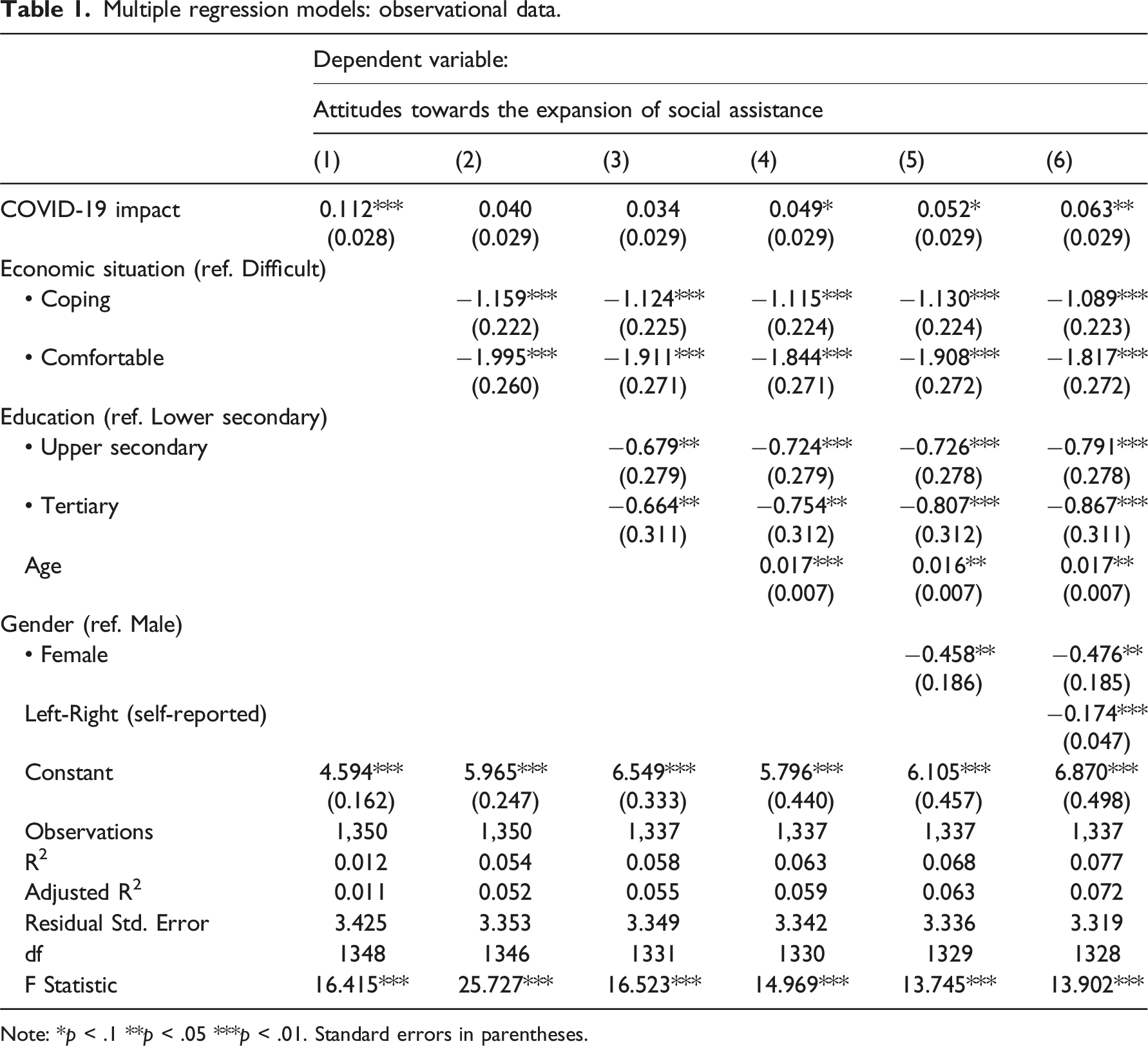
Multiple regression models: observational data.
Note: *p < .1 **p < .05 ***p < .01. Standard errors in parentheses.
The introduction of educational attainment in model 3 does not significantly change the picture. Individuals with at least upper secondary or tertiary education support social assistance less than individuals with lower secondary education. However, introducing all other control variables in models 4–6 introduces more nuance. It is worth noticing that the inclusion of the variable age and gender increases the magnitude of the impact, which becomes more prominent and significant again, suggesting that COVID-19 did not have the same impact for all demographic groups, arguably because age and gender tend to be associated with more secure employment. In terms of their impact on support for social assistance, older individuals are more supportive of social assistance expansion, even though COVID-19 had less impact on them and they tend to be sceptical of safety nets and prefer social insurance (e.g., old age), an indication that solidarity dynamics occurred during the pandemic (Enggist et al., 2022). Female respondents tend to support the expansion of social assistance slightly less than male respondents. Finally, as expected, right-wing individuals are less supportive of expanding social assistance. Overall, all things being equal, COVID-19’s impact on support for social assistance is positive and significant.
In model 7 (Table A1), we interact with the COVID-19 impact and income group to estimate the effect of COVID-19 on different income groups and evaluate the self-interest and solidarity hypotheses. The interaction terms in Model 7 capture the average difference in the effect of COVID-19 impact between the reference economic situation (Difficult) and the other economic situations (Coping and Comfortable) and are not directly interpretable. We plot the conditional marginal effects plots in Figure 1 to simplify interpretation. Figure 1 shows that for all income groups, the support for social assistance expansion differs significantly at the lower levels of COVID-19 economic impact. People coping with present income and living comfortably have significantly lower average support. Higher levels of COVID-19 economic impact are not associated with different support for social assistance in the ‘Coping’ and ‘Difficult’ groups. However, they are associated with higher support for social assistance among people living in comfortable situations. The marginal effect of COVID-19’s economic impact on support for social assistance by the economic situation of the respondent.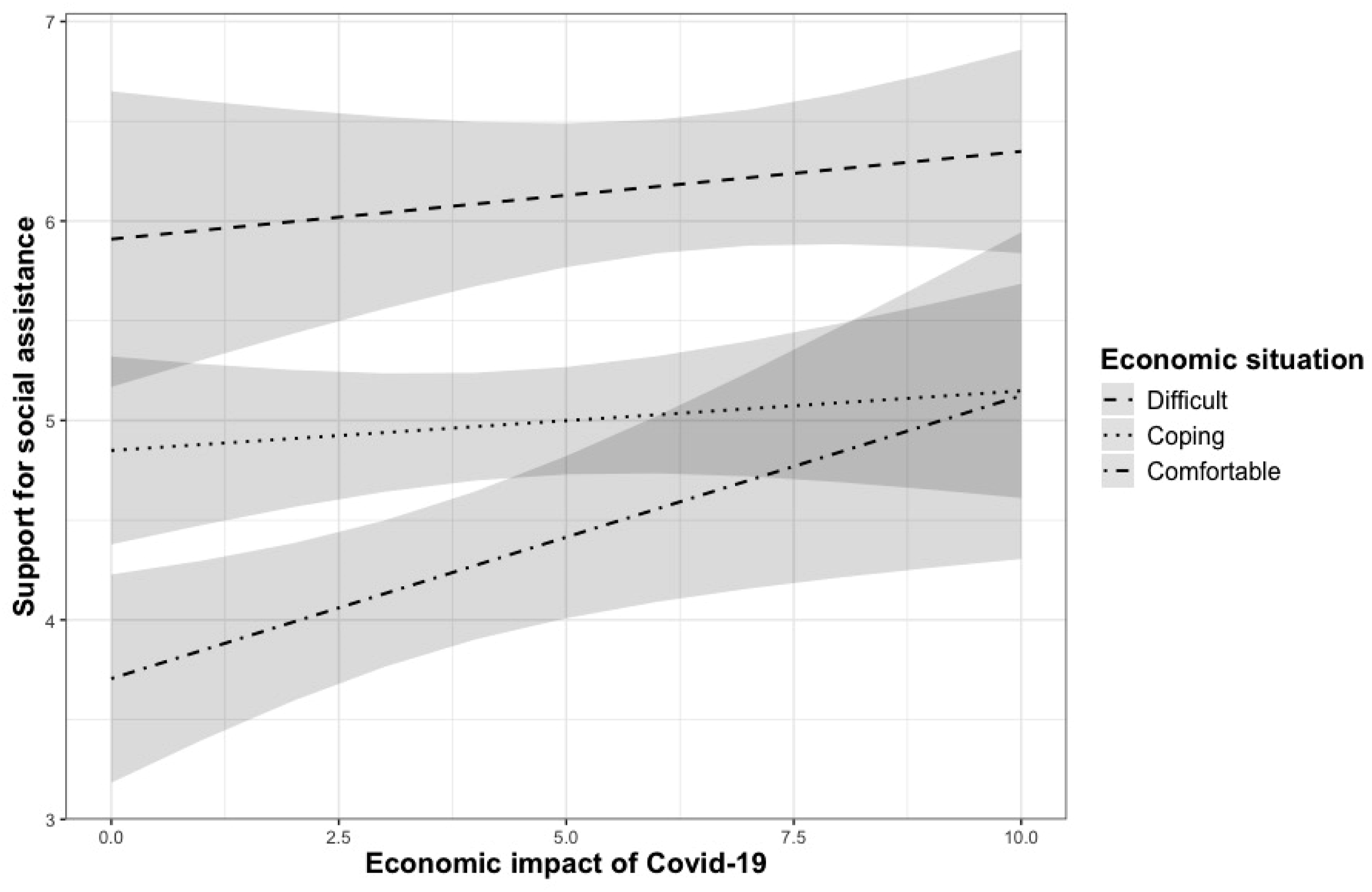
Contrary to what is predicted by the self-interest hypothesis, the analysis of the marginal effects suggests that the impact of COVID-19 does not increase support for social assistance among low-income groups. It increases it among individuals living in comfortable situations that do not benefit from it. These findings allow us to accept the solidarity hypothesis instead. In the next section, we explore a vignette experiment embedded in the survey that suggests that a change in perception of welfare recipients may explain why high-income individuals who do not benefit from social assistance increased their support for it after having experienced first-hand the economic consequences of the pandemic.
Self-interest or solidarity?
To investigate this further and to test the underlying mechanism of deservingness perceptions that undergird the solidarity logic, we turn to the results of a survey experiment. As described above, this vignette experiment allows us to assess how strongly respondents use deservingness criteria, mainly that of Control, when determining whether a recipient should receive an emergency benefit.
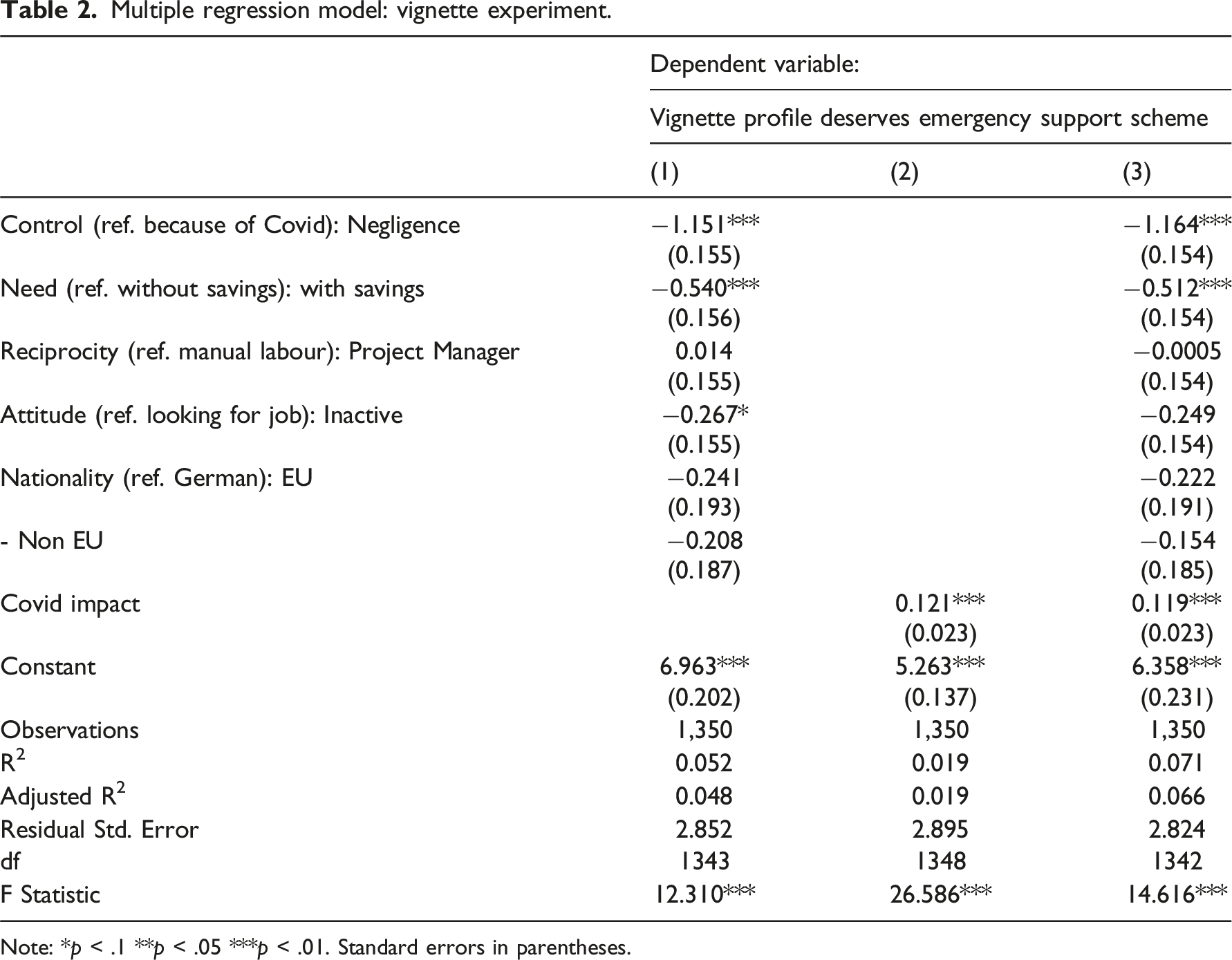
Multiple regression model: vignette experiment.
Note: *p < .1 **p < .05 ***p < .01. Standard errors in parentheses.
Regarding the size of the coefficients, it appears that the most significant deservingness penalty is given to those beneficiaries who lost their job because of negligence; of course, put differently, losing one’s job because of COVID-19 was judged particularly kindly by the respondents. This is expected in our theoretical framework and matches other studies on deservingness in healthcare (Busemeyer, 2021) and welfare receipt (Enggist et al., 2022). Interestingly, identity is not significant in any model, which suggests that in times of crisis, particularly given the role of control and need, the immigration status of an individual could become less critical – countering other findings in non-crisis times (Reeskens and Van der Meer, 2019). However, these elements are not the main focus of this article. Instead, it remains to be seen whether the personal economic impact of COVID-19 can explain differences between the deservingness penalties applied by the respondents.
In model 2, we regress the level of agreement on the impact of COVID-19. The impact of COVID-19 has a positive and significant coefficient, such that each unit increase in COVID-19 impact is associated with an increase in agreement for the emergency benefit of 1.2 per cent. Including all the variables together in Model 3 does not change the picture significantly; being experimentally manipulated, all variables are genuinely independent.
These results suggest that people who reported a considerable economic impact of COVID-19 apply fewer deservingness penalties to the profiles regardless of the characteristics of the beneficiaries, compared to respondents who were not affected by COVID-19 economically. We argued in the theory that the reason for ‘lowering the bar’ of deservingness might be because individuals update their preexisting beliefs about the ability of someone to cope with a crisis, realizing that people are less in control of their situation. To investigate this, Figure 2 presents a marginal-effects plot of an interaction effect between COVID-19 and control, using coefficients from Table A2 in the appendix. The plot shows that, for respondents reporting a low economic impact, there is a substantial difference in the deservingness penalties applied. Vignette profiles who lost their job because of negligence are considered much less deserving than individuals who lost their jobs because of COVID-19. This deservingness penalty for control reduces significantly for those respondents who suffered the economic impact of COVID-19, who tend to consider the negligent profiles significantly more deserving than those with no economic impact. The two curves converge at the top end of the COVID-19 impact scale. Hence, the control characteristic – strong and significant in the original models – becomes insignificant as a determinant of giving the recipient the benefit (Y axis). This offers evidence to support H3. Marginal effects of COVID-19’s economic impact on support for the emergency benefit, by vignette’s profile reason for losing the job.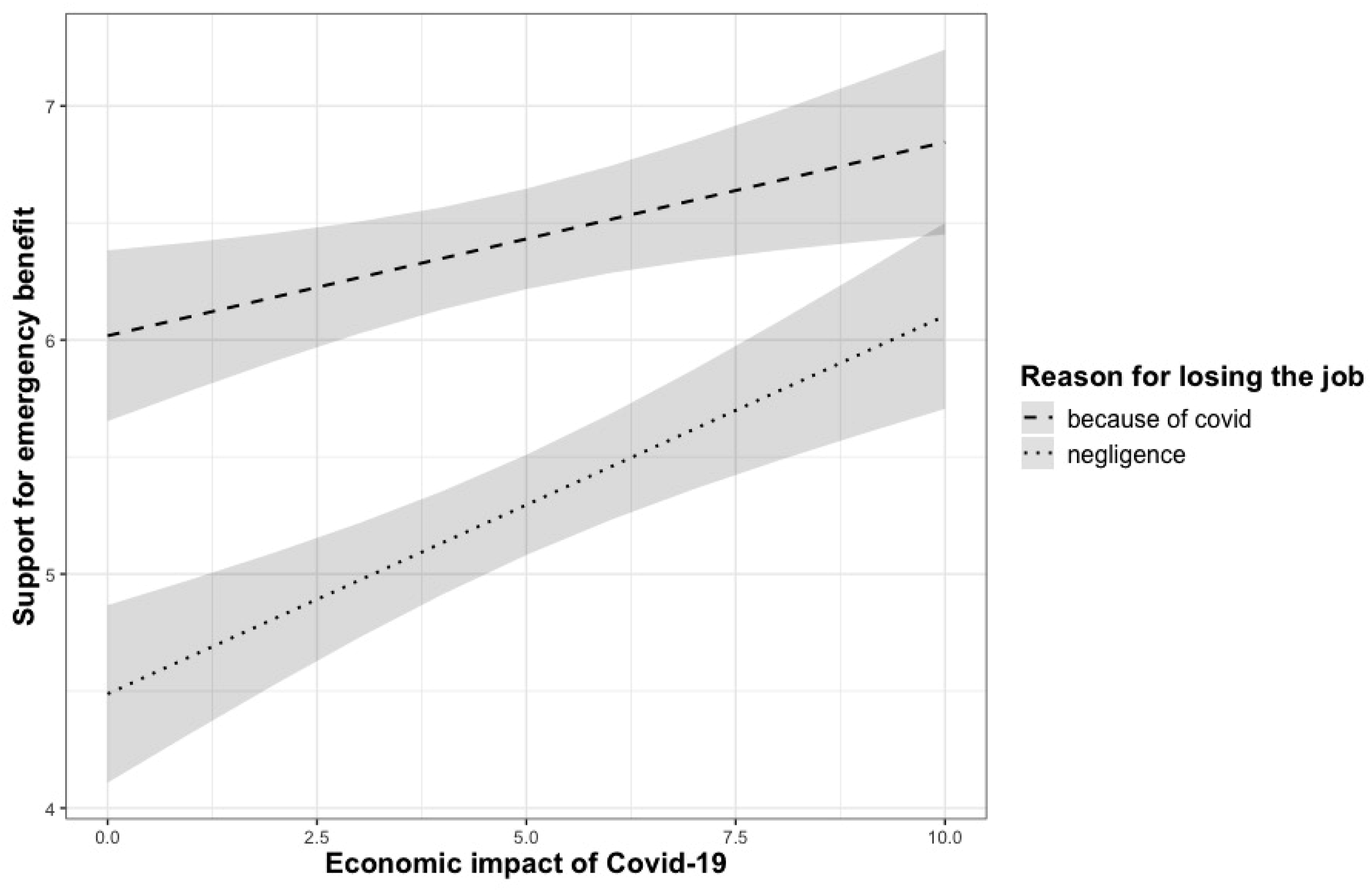
We split the sample according to their economic situation to check whether a specific group drives these findings (Table A3). Figure 3 contains the marginal effects for each economic group. The figure suggests that the ‘lowering the bar of deservingness’ mechanism seems universal and applicable to all three groups. However, it is much stronger for people coping or living in comfortable situations. These better-off individuals are likely to express more solidarity to recipients despite control if they have been affected by COVID-19, compared to similar individuals who were unaffected. Those living in challenging situations demonstrate a similar trend, but this is insignificant. This may be explained by the fact that people living in difficult economic situations often need redistribution themselves, which may overshadow other-oriented shifts to solidarity (Dimick et al., 2017; Rueda and Stegmueller, 2016; Rueda, 2018; Cavaillé, 2015; Dimick et al., 2018; Armingeon and Weisstanner, 2021). Due to our sample size, we report these results with caution. Marginal effects of COVID-19’s economic impact on support for the emergency benefit, by vignette’s profile reason for losing the job and respondent’s economic condition.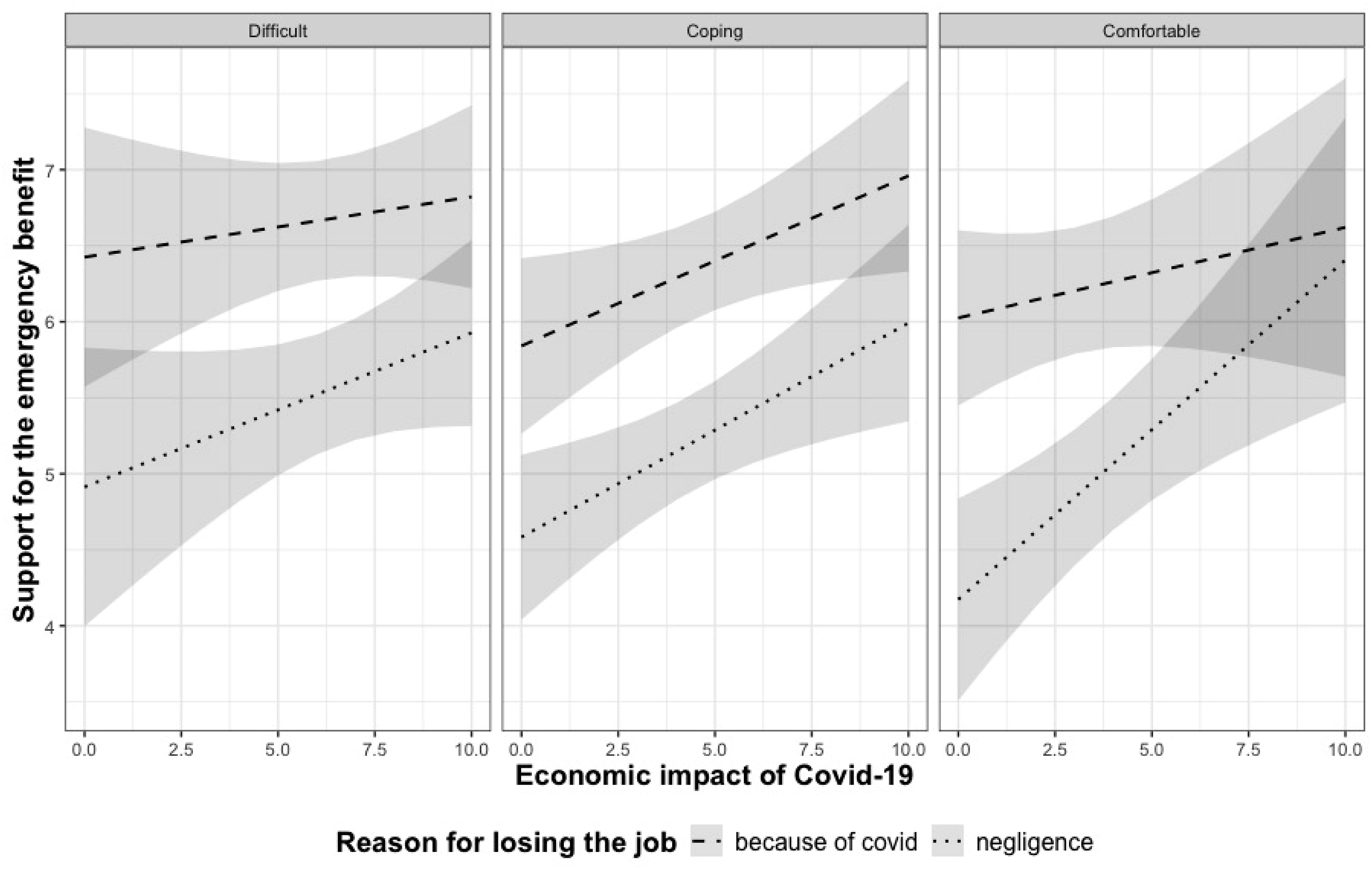
Discussion and conclusion
In this article, we asked whether and how the COVID-19 pandemic and its consequences can affect individuals’ support for social assistance, a welfare benefit requiring redistribution from rich to poor via taxation. As we could not measure individual policy preferences before and after the pandemic, we approximated the effect of COVID-19 by looking at the differences in preferences of individuals affected differently by the pandemic within the same economic groups. We investigated two competing hypotheses in the literature, namely whether economic self-interest guides demand, such that only people who benefit from redistribution would support its expansion in times of crises, or whether other individuals who would not benefit from social assistance increase support for it, thus expressing solidarity.
Contrary to the self-interest hypothesis, our regression results suggest that rather than higher support among the potential beneficiaries of social assistance, the economic impact of COVID-19 significantly increased support for social assistance among individuals living in comfortable situations. There are at least two plausible explanations for why we did not find support for the self-interest hypothesis. First, we encountered a ceiling effect, that is, lower-income respondents strongly support social assistance, even in non-crisis times. A second explanation is that among the most vulnerable group, there was a uniform increase in support for social assistance during the pandemic due to expectations of future risk of falling during hard times.
Our observational analysis shows that those living in comfortable situations support social assistance more strongly when they have experienced the economic effects of the COVID-19 pandemic first-hand, confirming our solidarity hypothesis. We argue that the first-hand experience of the pandemic economic effect updates individuals’ beliefs about the role of luck in determining personal economic situations. Thus, during the pandemic, people are seen as less in control of their situation, and welfare recipients are judged less harshly. We tested this underlying mechanism using data from a vignette experiment. We found that the experience of COVID-19 ‘lowers the bar’ of deservingness to such an extent that fictional characters who lost their job due to COVID-19 or negligence are seen as equally deserving of the emergency benefit by the respondents. We split the sample into three groups to show that this applies more to higher-income individuals than to those in difficult economic situations.
Taken together, our findings have important implications for studying exogenous shocks on demand for public policy. We show that crises not only disproportionally affect individuals along class lines. It also affects people within socio-economic groups differently, influencing their attitudes and, ultimately, the mass structure of support for social policies. Second, we contribute to the ongoing discussion of the demand side of welfare state politics and its increasing multidimensionality, especially in hard times. Particularly regarding social consumption policies (Beramendi et al., 2015), our findings suggest a convergence of preferences in times of crisis between income groups that opens a window of opportunity for policy reform.
A second significant contribution concerns the mechanisms driving such convergence. We argue that considering the solidary dynamics that unfold during a crisis is essential besides self-interest. Echoing studies such as Magni (2021), but concerning the case of social assistance expansion, we argue that higher support for social assistance among those who do not benefit from it is associated with their exposure to the economic fallout of the crisis. We theorize that this is due to the crisis lowering the bar against which they judge whether a beneficiary is deserving or undeserving, which leads to a convergence in the perception of deservingness between classes.
The study also has shortcomings worth mentioning. First, given the cross-sectional nature of our research design, the results should not be interpreted as evidence of the pandemic causing changing attitudes over time. Our results demonstrate differences in preferences within economic groups between those heavily impacted by the pandemic and those not, indicating a possible causal relationship that needs further exploration. Second, and related to the previous point, we cannot assess whether the preferences of lower-income groups have changed for all, regardless of their exposure to the economic impact of COVID-19. If this were the case, it would support the self-interest mechanism, even though we do not find evidence.
Even assuming a causal relationship between the pandemic experience and support for social assistance expansion, we could not assess whether this preference shift will crystallize into an average higher support in the long run. Given the magnitude of the disruption, it may be that the effect is only temporary and emotionally driven, and the support will regress to the average group level shortly, as longitudinal evidence suggests (Ares et al., 2021; Blumenau et al., 2021; Busemeyer, 2021; Ebbinghaus et al., 2022). The emotional and psychological impact of the pandemic, such as increased stress and anxiety, may have affected how respondents interpreted and answered survey questions. Changes in priorities and circumstances resulting from the pandemic, such as remote work and limited social interactions, could have altered respondents’ perspectives and priorities. The social and economic context of the pandemic, including job losses and financial instability, may have shaped respondents’ attitudes and behaviours, potentially impacting their survey answers. Information overload and uncertainty surrounding the pandemic may have influenced respondents’ beliefs and decision-making processes, affecting their responses. The desire to present oneself favourably or conform to socially desirable attitudes during the pandemic could introduce bias into survey responses. All these factors may impact to what extent the findings are temporary (that is, emotionally driven) or will crystallize into new stable preferences. Furthermore, there could be alternative explanations to solidarity driving higher support for social assistance. For example, growing support for redistribution may be caused by self-interested motivation, such as mitigating the negative externalities of income inequality (Rueda and Stegmueller, 2016).
Finally, while we are convinced that individuals being less strict in their deservingness consideration is a plausible mechanism explaining growing support for social assistance expansion, the outcome variables in the vignette experiment and the support for social assistance analyses are different; thus, we are unable to claim that more extensive support for social assistance observed is causally related to deservingness considerations. Furthermore, due to the limited spatiotemporal focus of our study, our findings cannot be directly applied to another context. The article aimed to identify one mechanism shaping redistributive preferences during the pandemic in Germany rather than to demonstrate its universality. Nevertheless, if true, this mechanism could be generalized to other contexts and crises, particularly advanced capitalist countries with mature welfare states. However, the research for causality and external validity should be the task for further research.
On balance, our findings uphold antecedent studies that emphasize the middle class’s role in the persistence of welfare regimes (Brooks and Manza, 2006; Gingrich and Ansell, 2012; Rehm et al., 2012) and further suggest that the readiness of whole societies – not just those in need – to support redistribution may pave the road for policymakers to mitigate the longer-term effects of the COVID-19 pandemic on inequality, should they choose to do so (Clark et al., 2021).
Supplemental Material
Supplemental Material - Cross-class solidarity in times of crisis: The economic impact of the COVID-19 pandemic on support for redistribution
Supplemental Material for Cross-class solidarity in times of crisis: The economic impact of the COVID-19 pandemic on support for redistribution in Simone Tonelli, Eloisa Harris and Franziska Deeg in Journal of European Social Policy
Footnotes
Acknowledgements
Earlier versions of the article were presented at the Political Economy Workshop of the University of Bremen, the doctoral colloquium of the Bremen International Graduate School of Social Science, the Conference on Economic and Social Science Research on COVID-19 Pandemic Issues organized by the Dr Hans Riegel Foundation and the Kaiserschild Foundation, the 28th International Conference of Europeanists in Lisbon and the Welfare and Economy Workshop of the University of Edinburgh. We want to thank all the participants of these events for their comments. In particular, we thank Macarena Ares, David Attewell, Nate Breznau, Gabriela de Carvalho, Jay Wiggan, Jochen Clasen, Margherita Cusmano, Johanna Fisher, Olga Poluektova, Philip Rathgeb for their thorough feedback and valuable recommendations on the research idea, survey design and questionnaire, and earlier versions of the manuscript. Furthermore, we thank Gabriela de Carvalho and Johanna Fischer for their input during the grant application.
Declaration of conflicting interests
The author(s) declared no potential conflicts of interest with respect to the research, authorship, and/or publication of this article.
Funding
The author(s) disclosed receipt of the following financial support for the research, authorship, and/or publication of this article: The data collection was funded by Dr Hans-Riegel-Stiftung, grant nr. AH-009-2009, EU Horizon 2020 - Marie Sklodowska Curie (713639) and Deutsche Forschungsgemeinschaft (374666841).
Ethical statement

Supplemental Material
Supplemental material for this article is available online.
Notes
References
Supplementary Material
Please find the following supplemental material available below.
For Open Access articles published under a Creative Commons License, all supplemental material carries the same license as the article it is associated with.
For non-Open Access articles published, all supplemental material carries a non-exclusive license, and permission requests for re-use of supplemental material or any part of supplemental material shall be sent directly to the copyright owner as specified in the copyright notice associated with the article.
