



Abstract
Can political incivility bolster support for American candidates? Conventional wisdom holds that it does and Donald Trump’s 2016 electoral victories demonstrate the power of uncivil rhetoric—particularly, when it is paired with racially intolerant rhetoric. However, recent studies have demonstrated that leveraging political incivility can backfire on elites. As such, it is unclear whether uncivil rhetoric has electoral value, or if its utility is bolstered when it is joined by intolerant rhetoric. Leveraging a survey experiment, I find that both political incivility and racial intolerance induce feelings of disgust. The presence of intolerance in a message weakens the effects of incivility on disgust for out-group elites, suggesting that multiple rhetorical norm violations result in diminishing (negative) returns. Moreover, the effects of intolerance on disgust are moderated by a subject’s level of racial resentment. These aversive reactions to incivility and intolerance reduce electoral support for the elite sponsoring the message. In-group candidates pay a larger electoral penalty, although the penalty for intolerance is moderated by subject racial resentment. I conclude that, contra claims that political incivility works, uncivil messaging serves as a strategic liability for candidates.
Does political incivility work as electoral strategy in American politics? Conventional wisdom suggests this is the case. Anecdotes abound of candidates bolstering their support by being uncivil toward the other side (e.g., Geer, 2006: 158–159). It is a common explanation for former President Donald Trump’s electoral successes in 2016 (e.g., (Nichols, 2018; Rosenwald, 2019). As Washington Post journalist Philip Bump argued in a 2018 column, “Trump’s incivility…is why he is president,” and that the “… racial edge [of Trump’s political incorrectness] is a real motivating factor in [some people’s] support for him,” (Bump, 2018).
Political incivility is typically conceptualized as a general style of communication—that is, discursive actions, such as name-calling, hyperbolic accusations, and shouting, that qualify as uncivil regardless of the target (Gervais, 2019). Much of our understanding of its effects stems from research in which political incivility is the only form of norm-violating rhetoric that is manipulated. Yet, as the above quote suggests, the presence of another rhetorical element, racial intolerance, could bolster the potency of political incivility as an electoral tool. 1
It is unknown whether the effects of incivility depend on whether it is paired with intolerance. The reasons for this lacuna are two-fold. First, there has been little research on the interactive effects multiple rhetorical norm violation. Second, although both concepts have received attention from researchers, there is much we do not understand about their effects in electoral contexts. I report the results of a survey experiment that show that, in contrast with conventional wisdom, political incivility and intolerance are more likely to harm than help electoral prospects, and that messages including both rhetorical elements are not any more efficacious.
Incivility and intolerance in electoral contexts
When it comes to the electoral effects of incivility, research is mixed. On the one hand, uncivil exchanges between candidates have been shown to reduce affect only toward the least-favored candidate (Mutz, 2015: 59–65) and aggravate affective polarization (Skytte, 2021). On the other hand, studies have found that rather than bolstering their standing, in-elites lose support for insulting the out-party (Costa, 2021; Druckman et al., 2018). This finding appears to apply to Trump, as well, whose support was not bolstered by his uncivil rhetoric, even among diehard supporters (Frimer and Skitka, 2018).
Notably, the studies that show evidence of polarization feature treatments in which both the out-group (or disfavored elite) and in-group (or preferred elite) are insulted (Mutz, 2015; Skytte, 2021). Yet while experimental studies which independently target the out-group have shown that in-group political incivility can have a backfire effect, precisely why political incivility does this is not clear. During a period of heightened affective polarization, in which partisans reputedly loath the partisan out-group (e.g., Iyengar et al., 2012), hostile rhetoric toward the out-group should, prima facie, produce electoral rewards. How do we explain the backfire effect? One potential explanation is that, as norm-violating behavior, political incivility generates feelings of aversion—particularly, disgust. Moral disgust can be triggered by non-purity norm violations, including rhetorical miscues. Incivility, cited as norm-violating discursive behavior, ostensibly fits this description (e.g., Mutz, 2015).
In political contexts, disgust triggers moral thinking, and prompts individuals to disassociate themselves from the object or person that triggers it (Hatemi and McDermott, 2012). This most obviously applies to out-group members. Yet there is reason to believe political incivility might induce disgust when in-group elites use it, too, and lead partisans to disassociate from the offenders. A central tenet of social identity theory is that, in response to a need for positive distinctiveness, individuals are motivated to protect and enhance group status (e.g., Tajfel and Turner, 1979). Concerns about group status include concerns about the group’s moral status (Täuber and Van Zomeren, 2012). As work in intergroup emotions theory has shown, in-group members are turned off by attacks on (disliked) out-groups deemed gratuitous (e.g., Maitner et al., 2006). When in-elites initiate hostile, norm-violating aggression, it undermines the perception of in-group moral superiority; it is viewed as degrading behavior, which can trigger disgust and lead co-partisans to distance themselves from the elite.
Might incivility function differently when it appears in a racially intolerant message? The answer would seem to depend on if intolerance also induces disgust. Whether Mendelberg’s (2001: 175–176) well-known thesis that modern candidates rely on indirect, implicit racial appeals to bolster support among white voters harboring racial resentment still holds in contemporary American culture is a matter of debate. On the one hand is evidence that disgust felt toward Trump—particularly his explicitly racist rhetoric—led whites to distance themselves from white identity after the 2016 election, including those harboring racial resentment (Jardina et al., 2021). On the other hand, there is evidence of increased acceptance of intolerant rhetoric among prejudiced whites (Newman et al., 2021; Reny et al., 2020). Valentino et al. (2018) find that while whites low in symbolic racism report anger and disgust with explicit intolerance, racially resentful whites no longer do.
Yet there may be circumstances when intolerance induces disgust even among resentful whites, and these feelings in turn hurt evaluations of elites. There are no manipulations of elite partisanship in the Valentino et al. (2018) experiments, but there is consistent evidence that out-group sponsored incivility triggers strong aversive reactions (Gervais, 2019), and that norm violations by in-group elites do not always elicit the same negative reactions (Mutz, 2015). It is reasonable to expect this applies to intolerance, as well, and that resentful whites may reject explicit racial cues when the message is otherwise incongruent with partisan allegiances.
Thus, there is reason to expect that, in general, (H1a) political incivility and (H1b) racial intolerance induce disgust, and that to the extent that they do, (H1c) incivility and intolerance should lead to cooler evaluations of the candidate offering the message featuring these forms of rhetoric, and (H1d) reduced willingness to vote for the candidate, regardless of the candidate’s partisanship. Additionally, (H2) resentful whites have aversive reactions to intolerance when offered in hostile messages by the out-party.
However, the main question is whether incivility is more potent when it accompanies a racially intolerant message. No previous work that I am aware of explores their combined effects—or the effects of multiple norm violations more generally. It stands to reason that if both separately induce disgust, when combined, this effect will be stronger. Partisans may forgive most norm violations by in-group elites, but there is also evidence that intensive in-group violations can induce a backlash—which implies that the more excessive the violation, the stronger the aversive reaction (e.g., Maitner et al., 2006). Thus, I will investigate if (RQ1) the combination of incivility and intolerance induces stronger aversive responses than they do separately.
Design
Experimental conditions.

Partisan leaners were treated as partisans, and pure independents were dropped from the study. To ensure asking questions gauging racial resentment would not influence reactions to the stimuli, a resentment battery was asked after the stimuli were delivered and the outcome variables were measured. From these items, measures of two dimensions of racism were formed: Cognitive Racism and Affective Racism (DeSante and Smith, 2020). Notably, there were no significant differences in the rates of racial resentment between the conditions, indicating the stimuli did not influence subjects’ views regarding race. Levels of racial resentment in the sample were similar to proportions seen in a nationally representative sample (see Online Appendix Table A5.1).
Subjects were asked to indicate, on 0–100 point scales, how the page made them feel. In addition to the emotions of anger and disgust, subjects were also asked how anxious, proud, sad, guilty, embarrassed, and hopeful the page made them feel. The ordering of emotions was randomized. Subjects were also asked to rate the candidate whose Facebook page they saw on a feeling thermometer (0–100), as well as how likely they would be to vote for the candidate if the candidate was running in a race they could vote in (1–5). See Online Appendix 4 for details on question wording and variable coding.
Results
Effects of incivility, intolerance, and in-group status on disgust.

OLS Models. Standard errors in parentheses.
*** p<0.01, ** p<0.05, * p<0.10.
While the main effects are informative, I expect that the in-group status of the sponsor of the message should moderate the effects incivility and intolerance. I also wish to see if incivility and intolerance have any interactive effects, and if racial resentment moderates reactions to racial intolerance. Columns 2 through 4 in Table 2 show several models with two-way and three-way interactions between incivility, intolerance, in-group status, and cognitive racism. Consistent across the models in Table 2 is that the level of disgust induced by intolerance does not depend on whether an in-group or out-group candidate adopted it. Disgust with in-group candidates was very low in the civility-control condition (m = 8.13, SD = 17.97). Compared with the civil-control condition, the mean level of disgust felt toward in-group candidates was about 16.7 points higher in the civility-intolerance condition (m = 24.82, SD = 30.89). The effect of intolerance was similar for out-group candidates: disgust was 20 points higher in the civility-intolerance condition (m = 47.52, SD = 36.05) than in the civility-control condition (m = 27.40, SD = 32.37).
The results for incivility were more complicated. There was no real difference in the level of disgust induced by in-group and out-group elite incivility (b = −4.40, SE = 2.80, t = −1.57, p = 0.116) when ignoring the intolerance condition (see Table 2, column 2). However, the effect of incivility is moderated by intolerance (b = −9.04, SE = 2.80, t = −3.23, p = 0.001). The incivility-intolerance interaction effect is in turn moderated by in-group status (b = 16.05, SE = 5.59, t = 2.87, p = 0.004) (see column 3 of Table 2). The left box of Figure 1 shows the results by condition for out-group candidates. The difference in the mean level of disgust going from the civil-control (m = 27.40, SD = 32.37) to the incivility-control condition (m = 60.04, SD = 33.14) is 32.6 points—about a third of the scale. The difference in the mean level of disgust between the civility-intolerance condition (m = 47.52, SD = 36.05) and the incivility-intolerance condition (m = 63.11, SD = 33.73), at 15.6 points, is less than half that effect. This is essentially diminishing (aversive) returns: for out-group elites, incivility generates less disgust when intolerance is present. Levels of disgust by condition. Bars are predicted margins, based on model in Table 2, Column 3. Error bars are 95% confidence intervals.
However, as shown in the right box of Figure 1, the level of disgust when an in-group candidate used incivility and intolerance (m = 44.20, SD = 36.42) was meaningfully larger than what is observed in the incivility-control condition (m = 28.69, SD = 31.62). There was no significant difference in the effect sizes of the two conditions (19.4 points and 20.6 points, respectively) when compared with the civility-intolerance and civility-control conditions. Thus, the diminishing returns for incivility do not occur when the candidate is from the partisan in-group. In other words, in-group status moderates the effect of incivility on disgust (b = −12.38, SE = 3.94, t = −3.14, p = 0.002), when the moderating effect of intolerance is accounted for. I will evaluate what this means for RQ1 in the discussion section.
The role that racial resentment plays in moderating the effects of intolerance and in-group status on disgust (H2) can also be seen in Table 2. In the fourth column, cognitive racism is interacted with intolerance and in-group status.
6
The main takeaway is that racial resentment moderates the effect that intolerance has on disgust (b = −2.35, SE = 0.87, t = −2.72, p = 0.007). As shown in Figure 2, even at high levels of cognitive racism (a score of 8, which is above the 90th percentile on the 10 point scale) intolerance increased disgust by six points, but this is substantially smaller than the 21 point effect among those with the lowest score on the scale. However, contrary to H2, this effect was not moderated by the candidate’s in-group status. Average marginal effects of intolerance on disgust, by level of racial resentment. Bars are average marginal effects, based on model in Table 2, Column 4. Error bars are 95% confidence intervals.
Effects of candidate messaging on candidate support.

OLS Models. Standard errors in parentheses.
*** p < 0.01, ** p < 0.05, * p < 0.10.

Candidate feeling thermometer scores by condition. Bars are predicted margins, based on model in Table 3, Column 2. Error bars are 95% confidence intervals.
Intolerance (Table 3, column 2) again moderates the effect of incivility (b = 7.07, SE = 3.39, t = 2.09, p = 0.037). Feeling thermometer scores are only about 7 points lower in the incivility-intolerance for the out-group (m = 18.70, SD = 25.05) than they are in the civility-intolerance condition (m = 26.00, SD = 26.63) (left box, Figure 3). It was the same effect size for in-group candidates, with thermometer scores decreasing 7 points from 45.58 (SD = 29.40) in the civility-intolerance condition to 38.55 (SD = 20.59) in the incivility-intolerance condition. Thus, as was the case with disgust, there is evidence of diminishing returns for incivility. However, with feeling thermometer scores, there is no evidence that the in-group status of the candidate moderates these effects (b = −1.73, SE = 4.71, t = −0.37, p = 0.714).
Notably, in-group status moderates the effect of intolerance (b = −6.82, SE = 3.31, t = −2.06, p = 0.039), with in-group elites receiving a larger penalty. For in-group candidates, thermometer scores are 14.5 lower points in the civility-intolerance condition (m = 45.58) than they are in the civility-control condition (m = 60.06). However, out-group thermometer scores decline by less than 8 points when racial intolerance is used, from 33.66 to 26.00.
The results are slightly different in the willingness to vote models. 10 While both incivility (b = −0.32, SE = 0.05, t = −6.26, p = 0.000) and intolerance (b = −0.30, SE = 0.05, t = −5.72, p = 0.000) have significant negative main effects (column 3 of Table 3). In the model featuring a full factorial (column 4), intolerance is not significant (b = 0.01, SE = 0.10, t = 0.05, p = 0.960). However, as with the feeling thermometer model, in-group status moderates the effect of intolerance (b = −0.57, SE = 0.14, t = −3.94, p =0.000). For the out-group, willingness to vote for the candidate does not change moving from the civil-control (m = 1.74, SD = 0.07) to the civil-intolerance condition (m = 1.74, SD = 0.07). For in-group candidates, it decreases by more than half a point, moving from 3.32 (SD = 0.07) to 2.76 (SD = 0.07) on the 5-point scale. The interaction between incivility and in-group status, as well as the three-way interaction incorporating intolerance, were again insignificant. Unlike the thermometer model, intolerance does not moderate the effect of incivility on willingness to vote.
Effects of candidate messaging on candidate support by level of racial resentment.

OLS Models. Standard errors in parentheses.
*** p < 0.01, ** p < 0.05, * p < 0.10.
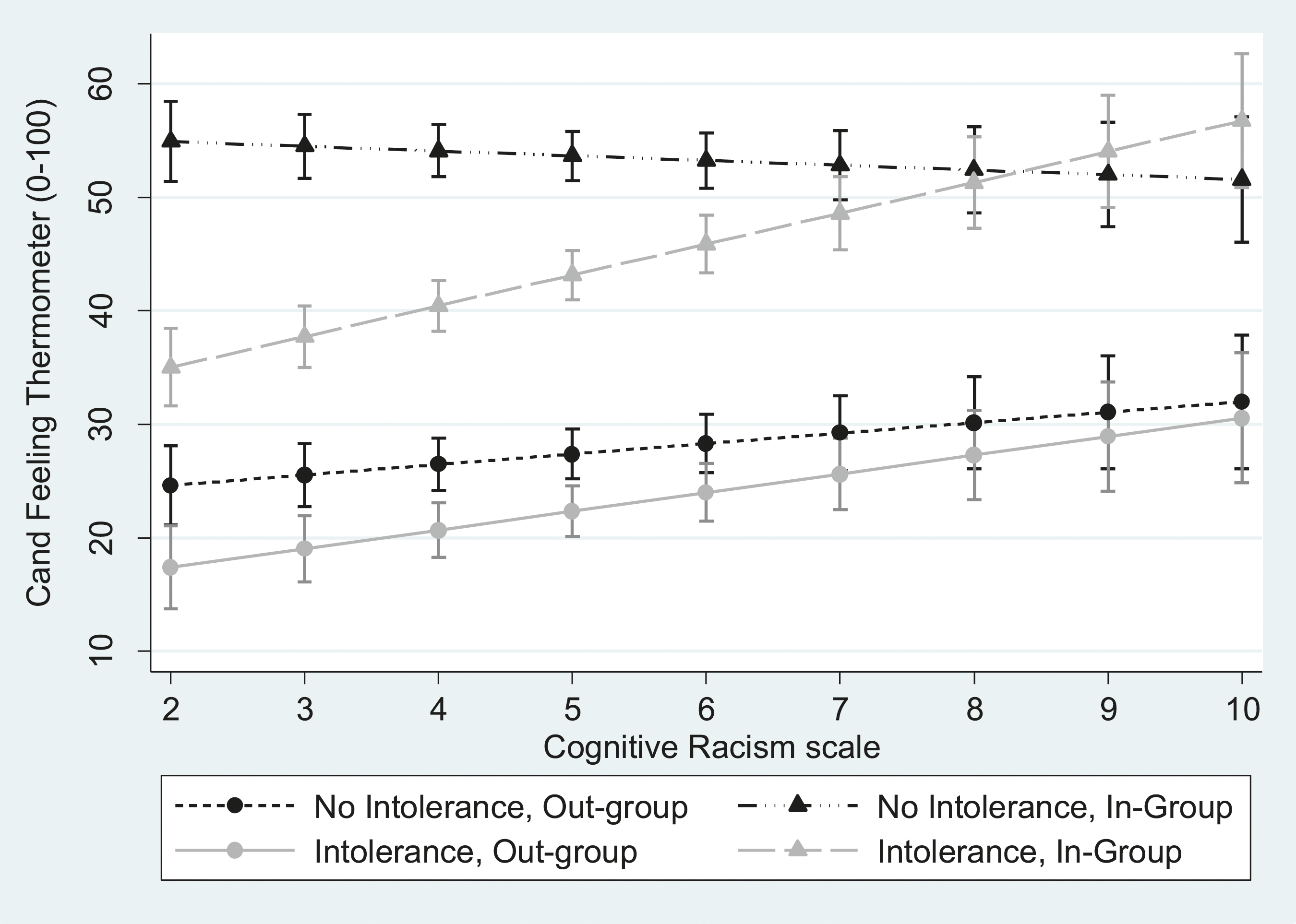
Effects of intolerance on candidate feeling thermometer scores by racial resentment and group status. Bars are predicted margins, based on model in Table 4, Column 3. Error bars are 95% confidence intervals.
Discussion
I aimed to test several claims related to the efficacy of electoral messaging featuring political incivility and racial intolerance. There is clear support for the first two claims: both (H1a) incivility and (H1b) intolerance induce feelings of disgust, and this occurs whether the candidate was part of the in-group or out-group. I predicted that these aversive feelings would translate into (H1c) reduced feelings thermometer scores for the candidate and (H1d) less willingness to vote for the candidate. H1c was clearly supported, but the results for H1d were mixed. While incivility reduced willingness to vote for both in-elites and out-elites, only in-group elites were punished for racial intolerance. Likewise, the negative effect of intolerance on feeling thermometer scores was much more evident for in-group candidates.
Why did not intolerant rhetoric do more damage to out-group candidate support? The aversive reaction to intolerance was smaller than that of incivility, and willingness to vote for the out-group candidate was low to begin with. It may be that the level of disgust was not large enough to move the needle much; although intolerance was successfully manipulated, perhaps it was not perceived as a particularly virulent form of racism. It is also possible that although the intolerant message might have been perceived as a personal attack for some subjects—that is, African Americans and Latinos—the uncivil attack on the partisan in-group might have been personal for all partisans, eliciting a larger effect overall.
The fact that the level of disgust induced by intolerance was not significantly different for in-group and out-group candidates helps explains the vote support results, too: in-group candidates are not given a significant break for intolerance, relative to out-group candidates, as they are for incivility. However, whereas vote support for out-group candidates begins close to the floor, significant damage can be done to in-group support. Consistent with work that has shown disgust induces social distance, use of intolerance results in partisans distancing themselves from in-group candidates, via feelings of disgust.
I also investigated whether (H2) aversive reactions to intolerance occur among racially resentful whites when offered by the partisan out-group. This hypothesis was not supported, as the group status of the elite did not moderate the level of disgust resentful whites felt toward intolerant rhetoric. Overall, intolerance increased disgust among whites relatively high on the cognitive racism scale—but this effect was small. Moreover, the decline in feeling thermometer scores and vote support for in-group candidates that occurs when intolerance was used shrinks as cognitive racism increases. Thus, consistent with previous work, explicit racial rhetoric elicits limited aversive reactions among resentful whites, and candidates do not pay much of an electoral penalty among this group for such rhetoric (Valentino et al., 2018).
Finally, I investigated the question of whether double norm violations worsen the aversive effects of uncivil rhetoric (RQ1). Generally, there is an additive effect, but incivility induces less aversion than it does when intolerance is absent, at least for out-group candidates. One potential explanation for this is that the level of disgust people feel toward rhetoric offered by candidates they have no prior knowledge of has a ceiling—or at least there is a ceiling for rhetoric as virulent as the treatments used in this study. Use of a single form of norm-violating rhetoric by out-group candidates brings people close to this ceiling. In-group candidates begin with lower levels of disgust—and so a single form of rhetoric is unlikely to being them as close to the upper limit. That said, additional investigations of double-norm violations and “ceiling effects” are warranted.
Ultimately, neither political incivility nor racial intolerance improves the standing of candidates. In most of the scenarios explored, the candidates are worse off for adopting norm-violating rhetoric. These results contribute to a growing body of research that demonstrates that elite incivility can backfire, even when elites are from one’s in-group (Costa, 2021; Druckman et al., 2018). They make clear that the utility of incivility in electoral contexts does not improve when it appears in a racially intolerant message. The results also identify a causal mechanism in aversive feelings, particularly disgust. When in-party bias, in terms of positive traits, is high (Iyengar et al., 2012), then it stands to reason that norm-violating behavior by in-elites violates perceptions of in-group moral superiority. Degrading behavior—such as uncivil and intolerant rhetoric—triggers disgust and thus the tendency to disassociate from the perpetrator. Despite claims to the contrary, such messaging serves as a strategic liability for candidates.
Supplemental Material
sj-pdf-1-rap-10.1177_20531680211050778 – Supplemental Material for The electoral implications of uncivil and intolerant rhetoric in American politics
Supplemental Material, sj-pdf-1-rap-10.1177_20531680211050778 for The electoral implications of uncivil and intolerant rhetoric in American politics by Bryan T. Gervais in Research & Politics
Footnotes
Declaration of conflicting interests
The author(s) declared no potential conflicts of interest with respect to the research, authorship, and/or publication of this article.
Funding
The author(s) disclosed receipt of the following financial support for the research, authorship, and/or publication of this article: This research was funded by Internal Research Awards Grant by the Office of the Vice President for Research, University of Texas at San Antonio.
Correction (March 2025):

Supplemental material
Supplemental material for this article is available online.
The replication files are available at https://dataverse.harvard.edu/dataset.xhtml?persistentId=doi:10.7910/DVN/NTFRZV&version=DRAFT.
Notes
References
Supplementary Material
Please find the following supplemental material available below.
For Open Access articles published under a Creative Commons License, all supplemental material carries the same license as the article it is associated with.
For non-Open Access articles published, all supplemental material carries a non-exclusive license, and permission requests for re-use of supplemental material or any part of supplemental material shall be sent directly to the copyright owner as specified in the copyright notice associated with the article.
