




Abstract
Why do citizens (not) support democratic innovations? Existing research shows that citizens mostly support such new ways of involving citizens in policy-making for instrumental reasons: the more a democratic innovation leads to outcomes they favour, the more likely they are to express support for it. However, it remains ambiguous why citizens care so much about favourable outcomes. This study disentangles the effect of outcome favourability on support for democratic innovations by testing two mechanisms: self-interest and sociotropy. It relies on three survey experiments on Dutch citizens’ support for a local democratic innovation (participatory budgeting) (N = 2,491). The results confirm that outcome favourability is important in explaining citizens’ support for participatory budgets (Study 1). We find evidence for both self-interest (Study 2) and sociotropy (Study 3) as drivers of the effect and present preliminary evidence that self-interest may trump sociotropy in citizens’ evaluations of democratic innovations.
Keywords
Introduction
Decreasing support for political institutions in Western democracies has put the topic of democratic reform high on the agenda of both academics and practitioners (Dryzek et al., 2019; Geissel and Newton, 2012). An increasingly popular approach to reform has been the implementation of democratic innovations (DIs) – that is, ‘institutions that have been specifically designed to increase and deepen citizen participation in the political decision-making process’ (Smith, 2009). Such new ways of involving citizens in decision-making are meant to address a long list of democratic ills, ranging from public distrust in political institutions to policy inefficiencies (Geissel and Newton, 2012; Papadopoulos and Warin, 2007). Part of the new public management agenda of good governance, DIs in Western democracies are often implemented by public administrations in a top-down fashion (e.g. Baiocchi and Ganuza, 2014). This raises the question to what degree citizens themselves actually support such reforms – and why (cf. Hibbing and Theiss-Morse, 2002; Stoker and Hay, 2017).
In recent years, the question why citizens (do not) support DIs has attracted increasing academic attention. An important finding in previous research is that citizens mostly judge DIs in terms of their outcomes. The more a DI leads to outcomes citizens (do not) favour, the more (less) likely they are to express their support for it. Empirical research on DIs has stressed the importance of such ‘instrumental considerations’ (Werner, 2020) for the support citizens express for DIs (Christensen et al., 2020; Landwehr and Harms, 2020) as well as for their willingness to accept the respective policy outcomes (Arnesen, 2017; Arnesen and Peters, 2018; Esaiasson et al., 2019). Yet, despite this sustained attention for instrumental considerations, it remains ambiguous why outcome favourability drives DI support. Instrumental considerations are not straightforward and may include self-interested as well as sociotropic motivations (that is, concerns with the wider community) (Kim, 2014). Research on economic policy attitudes and voting shows that not only a desire for personal material gains drives citizens’ attitudes and behaviour but that also their concerns with the state of the economy as a whole matter (Bechtel et al., 2014; Mansfield and Mutz, 2015). Other studies suggest instead that self-interest, defined as being motivated by goals ‘which bear directly on the material well-being of individuals’ private lives’ (Sears et al., 1980), trumps sociotropic considerations in citizens’ evaluations of policy proposals (Haselswerdt, 2020).These findings beg the question to what degree citizens’ instrumental considerations with regard to DIs similarly reflect a concern with personal material gains (i.e. self-interest), their community (i.e. sociotropic concerns), or both. While research on DI support consistently shows that instrumental considerations are important, it has yet to disentangle the underlying mechanisms.
In this research note, we for the first time empirically verify what drives citizens’ instrumental considerations in their evaluation of a DI. We focus on a DI that has been widely implemented across the globe (Sintomer et al., 2013): participatory budgets (PBs). To test our expectations, we rely on a series of survey experiments on Dutch citizens’ support for PBs at the local level. As this constitutes the first experimental study of citizen support for PBs, we start by testing to what extent it is driven by instrumental considerations (Study 1). 1 Next, we verify to what extent self-interest drives this effect (Study 2) and to what degree potential sociotropic considerations play a role (too) (Study 3). In the final section, we reflect on the generalizability of our findings to other DIs and suggest ways forward.
Experimental design and results
Our data come from three survey experiments on PBs conducted among citizens living in large municipalities in the Netherlands (Table 1). PBs allow citizens to decide how part of a public budget is to be spent. Dutch local governments have experimented extensively with PBs over the past decade in a wide variety of municipalities (Michels and De Graaf, 2010; van der Does & Bos, 2021). This follows a wider trend, with PB experimentation also taking place in other European countries, such as Germany (Schneider and Busse, 2019) and Spain (Font et al., 2015).
Overview of survey experiments.
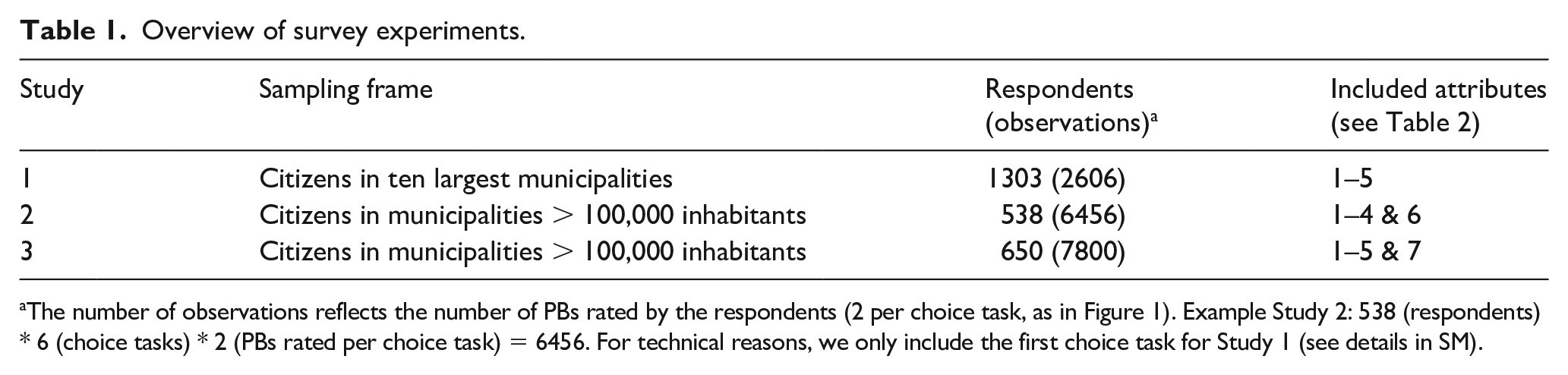
The number of observations reflects the number of PBs rated by the respondents (2 per choice task, as in Figure 1). Example Study 2: 538 (respondents) * 6 (choice tasks) * 2 (PBs rated per choice task) = 6456. For technical reasons, we only include the first choice task for Study 1 (see details in SM).
The survey experiments follow the logic of a conjoint analysis (Hainmueller et al., 2014). In all three experiments, we first asked respondents to imagine that the municipality they live in will implement a ‘neighbourhood budget’ (wijkbudget) in their neighbourhood next year. 2 This will allow residents to submit ideas for projects to improve the quality of life in their neighbourhood and to decide which of these will be awarded €50,000 and subsequently executed. They were told that the municipality now needs to determine what such a neighbourhood budget will look like. Respondents then performed a choice task six times.
Each time, they saw two juxtaposed neighbourhood budgets consisting of 5–6 attributes that randomly displayed one of the pre-specified levels (see example in Figure 1). The included attributes (Table 2) reflect, on the one hand, common design features of PBs and DIs more generally, and, on the other, relevant outcome-related aspects (Fung and Wright, 2001; Smith, 2009). 3 Underneath the two neighbourhood budgets, we then asked respondents to (a) choose their preferred neighbourhood budget and (b) give an approval rating for each of the two neighbourhood budgets on a seven-point scale (1: Completely disapprove; 7: Completely approve).

Example of a choice task in Study 1.
Attributes and levels in the experiments.

For the analyses presented here, we use the approval ratings as the dependent variable. We estimate the main effects in terms of average marginal component effects (AMCEs) (Hainmueller et al., 2014). AMCEs in our analyses can be interpreted as the difference an attribute’s level makes for the respondent’s approval rating on the seven-point scale relative to the attribute’s reference level. For details on the survey, experimental materials and analyses, see the supplementary material (SM).
Study 1 functioned as the baseline study. It sought to assess the relative importance of outcome favourability for citizens’ support for PBs compared to that of the various design features. To measure outcome favourability, we matched the displayed winning project (Table 2, attribute 5) to the respondent’s evaluation of the project in another survey question. This question asked respondents to what extent they would like to see each of the eight projects realized in their neighbourhood (1: not at all, 7: very much) (see SM for full wording). We treated scores above four as strong outcome favourability and all other scores as weak favourability. Figure 2 displays the results of Study 1. We find that respondents give significantly lower ratings to a PB that does not deliver a favourable outcome compared to one that does. The rating of PBs that result in unfavourable outcomes is, on average, 0.73 points lower on the seven-point rating scale. This makes it the strongest predictor of PB support among the included attributes.

Results study 1.
We ran five robustness checks. First, we performed the main analysis with post-stratification weights correcting for over- and under-sampling in terms of sex and age. This produced highly similar results (Figures A.12–13). Second, to assess to what degree our findings depend on our choice to focus on large urban areas, we ran the exact same survey experiment on a fresh sample of citizens living in Dutch municipalities with less than 100,000 inhabitants (N = 647 (respondents), 7764 (observations)). We only observed a slight, albeit significant, difference in the effect of outcome favourability: compared to citizens in large municipalities, the ratings of citizens living in small municipalities were 0.028 points higher for PBs with strong outcome favourability (Figure A.14). Third, we also ran the analyses on the full sample (including all of the six choice tasks). 4 The effects we observed were qualitatively highly similar (Figure A.11). Fourth, we examined respondents’ written responses to the question ‘You have just made several choices between different scenarios of possible neighbourhood budgets. Can you explain below in your own words on what you based your choices? Please be as detailed as possible’ (N = 1,218).We relied on an automated form of topic modelling – latent Dirichlet allocation (LDA) – which returns lists of words that tend to co-occur (cf. Hainmueller and Hopkins, 2015). We used a two-topic implementation of LDA to examine to what extent respondents used words related to the outcomes (Topic 1) and design features (Topic 2) to explain their choices. Topic 1 featured in 41.3% of the topics (Table A.3), confirming that outcomes are prominent in people’s thinking about PBs. Finally, we reran the analyses with an alternative, three-level specification of outcome favourability (1–2: weak; 3–5: moderate; 6–7: strong favourability). This results in substantively similar conclusions (Figure A.16).
Why, then, do respondents care so much about favourable outcomes? Study 2 used a different operationalization of outcome favourability to test to what degree it is driven by self-interest. In this version of the experiment, we asked citizens to rank a series of six projects to improve the quality of life in their neighbourhood (rather than to rate each project) before the choice tasks. This enabled us to identify a single project they valued the most. In the displayed neighbourhood budgets, the winning project always corresponded to the project ranked highest by the respondent. Above each choice task, this top-ranked project was displayed as follows: ‘Winning project in both neighbourhood budgets: [top-ranked project]’. As a measure of personal gains, we manipulated where the respective project would be executed: on one’s street, one street away, or four streets away (Table 2, attribute 6). If outcome favourability is indeed about self-interest in terms of personal gains, we should see that people give significantly higher scores to PBs that lead to the implementation of favoured projects executed closer to where they live (rather than further away from their home).
The results in Figure 3 suggest that a pursuit of personal gains indeed drives the effect of outcome favourability on DI preferences. The further away the implementation of the most favoured project is from the respondents’ own street, the lower the rating they tend to award to the PB. Whereas the implementation of the project one street away does not yet make a significant difference, its implementation four streets away from one’s street has a significant negative effect on the respondent’s expressed support for the PB. 5

Results study 2.
Study 3 assessed to what degree sociotropic considerations matter too and, in turn, may temper citizens’ self-interested considerations. We copied the structure of the experiment in Study 1 but added an attribute that captured incurred community costs in terms of the final costs of the winning project (Table 2, attribute 7). We discerned between PBs that managed to stick to the planned costs and PBs that spent 5, 25 or 50% more than planned (cf. Strebel et al., 2019).
Figure 4 summarizes the results. It indicates that extra-incurred community costs reduce the ratings respondents give to a PB. A budget overrun of 50% – in our experiment amounting to €25,000 – results in a 0.4 points lower rating compared to PBs that stick to the estimated costs of the winning project. This suggests that citizens’ sociotropic considerations also drive PB support. At the same time, we do not find evidence for a significant interaction between extra-incurred community costs and outcome favourability (Figure A.15). This suggests that even when the PB leads to higher community costs than planned, citizens’ ratings still tend to go up when it delivers a favourable outcome. Combined with the finding from Study 2 that self-interest tends to drive the effect of outcome favourability on support, this seems to suggest that citizens continue to care about their own material gains, regardless of whether the community has to bear higher costs (even though they prefer it does not have to). However, as we have less statistical power to estimate the interaction effect, this result is less robust (see the wider confidence intervals in Figure A.15).

Results study 3.
Discussion
The past decades have witnessed a strong push for democratic innovations to (re)involve citizens in policy-making(e.g. Geissel and Newton, 2012). Yet, we still know little about why citizens themselves (do not) support DIs. This paper has tried to address this gap by teasing out the effect of instrumental considerations on support for participatory budgets. In line with studies of other DIs, we find that instrumental considerations are important in explaining citizens’ support for PBs (Study 1). Our findings add to this that citizens seem to care so much about getting what they want mostly because they care about their own material gains (Study 2). While citizens also dislike higher costs for the wider community, we find preliminary indications that such sociotropic concerns do not mitigate the effect of self-interest on PB support (Study 3).
These findings have several limitations. First, our measures of self-interest and sociotropy remain only a first attempt at tapping these concepts in the context of DIs. We cannot rule out that some respondents may have associated cost overruns with a potential increase in municipal taxation or with inefficiency in general. Cost overruns might hence (partly) capture an egocentric motivational factor (i.e. fear of paying more taxes) and/or a general aversion to inefficiency. In addition, the phrasing of the attribute (i.e. ‘costs’) may have also partly driven the negative effect of cost overrun on PB support and led to an overestimation of the effect. 6 While we have reasons to believe our operationalization captured sociotropic concerns in this specific sample (see discussion in SM, Figure A.18), it therefore remains important for future research to operationalize sociotropy in a way that cancels out other motivational factors and that employs a less directional phrasing of the attribute. Similarly, while our measure of self-interest focused on the distance to the execution of a preferred, tangible policy outcome, we cannot ascertain whether respondents indeed interpreted that in terms of personal and/or material gains. This also warrants attention in future research.
In terms of design, our studies only allow for an indirect assessment of the relative contributions of self-interest and sociotropy to PB support. Prospective work could improve this by including attributes related to self-interest and sociotropy in a single study in order to facilitate a direct comparison of their effect sizes, ideally in a large enough sample to also test more robustly for a potential interaction effect. In terms of scope, our findings derive from experiments focused on a specific type of DI (PBs), in a specific context (the local level in the Netherlands). We considered this appropriate for a first empirical verification of the mechanisms driving the effect of outcome favourability on DI support, as it enabled us to keep contextual factors constant. At the same time, the findings may not apply to other DIs or contexts. For example, the personal and community gains/costs of DIs such as citizens’ assemblies and other deliberative mini-publics are often less clear than in PBs (Grönlund et al., 2014). Hence, it remains ambiguous to what degree the mechanisms driving the effect of outcome favourability on DI support would be similar for such DIs. We therefore hope that our studies will stimulate research on other DIs to assess the generalizability of the findings.
Supplemental Material
sj-pdf-1-rap-10.1177_20531680211024011 – Supplemental material for Why do citizens (not) support democratic innovations? The role of instrumental motivations in support for participatory budgeting
Supplemental material, sj-pdf-1-rap-10.1177_20531680211024011 for Why do citizens (not) support democratic innovations? The role of instrumental motivations in support for participatory budgeting by Ramon van der Does and Jaroslaw Kantorowicz in Research & Politics
Footnotes
Acknowledgements
We would like to thank the participants at the EP@L workshop in Lille in 2018 and the Hamburg Law & Economics Lecture in 2019, in particular Jerg Gutmann, Roee Sarel and Stefan Voigt, for their valuable comments. We also thank two anonymous reviewers and the editors for their helpful suggestions.
Correction (June 2025):
Declaration of conflicting interests
The authors declared no potential conflicts of interest with respect to the research, authorship, and/or publication of this article.
Funding
The authors disclosed receipt of the following financial support for the research, authorship, and/or publication of this article: This work was supported with a grant from CID The Hague, sponsored by City of The Hague, Leiden University, Delft University of Technology and The Hague University of Applied Sciences. Ramon van der Does also received grants from the Fonds spéciaux pour la recherche – Université catholique de Louvain (ADi/DB/10256.2018) and from the F.R.S.-FNRS (FC27855).
Supplementary materials
The supplementary files are available at http://journals.sagepub.com/doi/suppl/10.1177/20531680211024011. The replication files are available at  .
.
Notes
Carnegie Corporation of New York Grant
This publication was made possible (in part) by a grant from the Carnegie Corporation of New York. The statements made and views expressed are solely the responsibility of the author.
References
Supplementary Material
Please find the following supplemental material available below.
For Open Access articles published under a Creative Commons License, all supplemental material carries the same license as the article it is associated with.
For non-Open Access articles published, all supplemental material carries a non-exclusive license, and permission requests for re-use of supplemental material or any part of supplemental material shall be sent directly to the copyright owner as specified in the copyright notice associated with the article.
