



Abstract
Topic models are widely used in natural language processing, allowing researchers to estimate the underlying themes in a collection of documents. Most topic models require the additional step of attaching meaningful labels to estimated topics, a process that is not scalable, suffers from human bias, and is difficult to replicate. We present a transfer topic labeling method that seeks to remedy these problems, using domain-specific codebooks as the knowledge base to automatically label estimated topics. We demonstrate our approach with a large-scale topic model analysis of the complete corpus of UK House of Commons speeches from 1935 to 2014, using the coding instructions of the Comparative Agendas Project to label topics. We evaluated our results using human expert coding and compared our approach with more current state-of-the-art neural methods. Our approach was simple to implement, compared favorably to expert judgments, and outperformed the neural networks model for a majority of the topics we estimated.
Introduction
Political science scholars working with large quantities of textual data are often interested in discovering latent semantic structures in their document collections. Examples include legislative debates, policies, media content, manifestos, and open-ended survey questions. Political scientists increasingly use variations of probabilistic topic models (Blei et al., 2003) to summarize large text collections (see several recent examples: Baerg and Lowe, 2020; Bagozzi et al., 2018; Barnes and Hicks, 2018; Martin and McCrain, 2019; Mueller and Rauh, 2018; Munger et al., 2019; Pan and Chen, 2018). These models typically require the manual labeling of estimated latent dimensions. In practice, this means that researchers have to assign meanings to a list of words that these algorithms have identified as a latent “topic” – a requirement that is similar to labeling a dimension that emerges from a principal component analysis of some numerical data. This process of manual labeling is not scalable, may suffer from human bias, and is difficult to replicate.
In this article, we present a strategy for automatically labeling topics that is simple to implement, easy to replicate, and reduces the inherent human bias when labeling topics. Our strategy takes advantage of the fact that experts in our field have spent considerable time and resources to develop and refine codebooks for labeling text in different domains. Examples of such projects include the Comparative Agendas Project (CAP), work by the Manifesto Research Group, and the Congressional Bills Project. These codebooks contain predefined categories that are of interest to political scientists and typically include lengthy, written category descriptions to guide human coders. We argue that these well-defined codebooks contain a wealth of information that can be used to automatically transfer existing domain-specific knowledge to the process of topic labeling.
We illustrate the logic of our method with a large-scale topic analysis of the debates in the UK House of Commons from 1935 to 2014. We extracted 22 topics from this corpus, which we automatically labeled using the coding manual of the CAP (Bevan, 2014). We validated our results using human labeling of the topics by CAP expert coders (see Supplemental material). Our method applies more generally and could be easily extended to other areas with an existing domain-specific knowledge base, such as party manifestos, open-ended survey questions, social media analysis, and legal cases. Using our method, researchers in these fields can be more confident that the building blocks of their models are not an artifact of human coding decisions emerging from within the research process itself. In addition, by transferring labels from existing codebooks to estimated topics, our method allows for a tighter integration between the results of a text analysis and existing, domain-specific projects from which codebooks are drawn.
Related work
In the absence of roll-call data that can be used for ideal point estimation, scholars have turned to legislative speech to estimate policy positions, either by focusing on selected debates (e.g., Herzog and Benoit, 2015; Laver and Benoit, 2002) or through the analysis of all speeches during a legislative term (Lauderdale and Herzog, 2016). A parallel stream of the literature has used topic modeling to estimate the extent to which legislators speak on different topics (Quinn et al., 2010). Topic modeling is a class of models that estimate the underlying themes in a collection of documents. Originally proposed by Blei et al. (2003) in their seminal article on the latent Dirichlet allocation (LDA), various extensions of LDA have been developed (e.g., Blei and Lafferty 2006, 2007; Roberts et al., 2016; Teh et al., 2012).
Topic labeling is a key post-processing step of all probabilistic topic models. The topics that emerge from LDA and related methods are rankings of the words that appear in a corpus. Topic labeling is the manual step of assigning meanings to these word rankings. As a general rule, labels should be relevant, understandable, with high coverage inside topic, and discriminate across topics. Early research focused on generating labels by hand, using a set of top n words in a topic distribution (so called cardinality) learned by a topic model (Griffiths and Steyvers, 2004). This manual approach is not scalable, carries a high cognitive load in forming the topic concept and its interpretation (Aletras and Mittal, 2017), and also suffers from a potential bias of the human labeler (Lau and Baldwin, 2016).
An alternative approach is to implement a supervised topic modeling approach that limits the topics to a predefined set with their word distributions provided a priori (McAuliffe and Blei, 2008; Ramage et al., 2009). This approach is unable to pick up topics unknown beforehand (Wood et al., 2017). Keyword assisted topic models (Eshima et al., 2020) is a more recent development that allows seeding the topics with a dictionary of keywords, thereby constraining their generation and consequently composition. This supervised topic modeling approach can be used to generate meaningful topic labels via its supervision component. In contrast to this method, our proposed strategy does not constrain the topic estimation step, but instead uses external keyword lists to post hoc label topics.
Several automatic labeling approaches have been proposed in the literature that utilize external, contextual information, which is also the strategy we follow in this article. Mei et al. (2007) minimize the semantic distance between the topic model and the candidate label based on the phrases from inside documents. Lau et al. (2011) utilize various ranking mechanisms of the top n words and candidate labels from Wikipedia articles containing these terms. Most recently, Bhatia et al. (2016) have used word embeddings (Mikolov et al., 2013) to map topics and candidate labels derived from Wikipedia article titles, and then select topic labels based on cosine similarity and relative ranking measures.
Word embeddings pretrained on a large corpus, like Wikipedia, and deployed for topic labeling of PubMed abstracts as in Bhatia et al. (2016) are a simple form of general domain knowledge transfer. More generally, a machine learning framework captures the ability to transfer knowledge to new conditions, which is known as transfer learning (Pan and Yang, 2010). Our work builds on these earlier general approaches and develops a computationally quick and scalable topic labeling strategy that takes advantages of existing, domain-specific knowledge bases in political science.
Unsupervised topic modeling with transfer topic labeling
Our main idea is illustrated in Figure 1. The dotted box on the right-hand side illustrates traditional unsupervised topic modeling, which stops with estimated latent topics that need manual labeling. In our approach, we used outside expert codebooks to extract topic labels and associated keywords, which we then used to automatically label the estimated latent topics. Retaining human-in-the-loop or human interaction allows for adjustment of the labels for specific domains with sparse coverage in the source knowledge base.

Illustration of the application of unsupervised topic modeling with transfer topic labeling.
In the remainder of this section, we demonstrate the utility of this approach with speeches from the UK House of Commons over the period 1935 to 2014. We first explain how we have estimated latent, dynamic topics from the speeches. We then discuss how we have used the codebooks from the CAP as an existing knowledge base to transfer topic labels.
Estimating dynamic topics from House of Commons speeches, 1935–2014
Our data consist of the complete record of debates from the UK House of Commons during the period 1935–2014. All debates and information about speakers were downloaded from TheyWorkForYou, 1 a transparency website that provides access to parliamentary records and information about Members of Parliament (MPs). All data were downloaded in XML format and were further processed in Python.
The full data set consists of about 4.3 million floor contributions with an average of 49,720 contributions per year (min = 17,280, max = 118,500, SD = 17,596) and a total of 117,914 unique words. Within each session, we combined each MP’s contributions into a single text, excluding contributions that concern the rules of procedure or the business of the House, such as the reading of the parliamentary agenda or formal announcements. We also removed the traditional prayer at the beginning of each sitting and all contributions and announcements by the Speaker.
As part of the preprocessing, we applied stemming (reducing words to their root form), removed words that appeared fewer than 50 times and in fewer than 5 documents, removed punctuation, numbers, symbols, stopwords, hyphens, single letters, and a custom list of high-frequency terms. 2 The final data set from which we estimated topics included 47,524 documents (i.e., an MP’s concatenated speeches during a session) and 19,185 unique words.
We used the dynamic topic model (DTM) by Blei and Lafferty (2006) to estimate topics from the speech data. Like any unsupervised topic model, DTM requires setting the number of topics a priori. We followed the standard in the literature and picked the number of topics based on semantic coherence and exclusivity (c.f., Roberts et al., 2016). Based on these two metrics, we selected a model with 22 topics. 3
Extracting topic labels and keywords from expert codebooks
We used coding instructions from the CAP as our external source to extract topic labels and associated keywords. We selected the CAP because we expected the majority of parliamentary speeches to be on topics related to public policymaking. This attention to policy topics is the central interest to projects on the policy agenda, which have been active since the late 1990s (Baumgartner et al., 2013). What has been called the policy agendas code frame is a fuller articulation of policy topic ideas with a larger number of major topic codes, which aims at comprehensive coverage of any topic that is likely to appear.
While our demonstration of transfer topic labeling is limited to the CAP codebooks, we note that our method could be easily extended to other codebooks as long as they include written coding instructions or vignettes. Further, as we demonstrate below, our method for matching topic labels to estimated latent topics produces goodness-of-fit measures for each match, which allows for an evaluation of how well the topics derived from a codebook capture the estimated latent dimensions.
The codebook for the UK Policy Agendas Project includes 19 major topics with subtopics.
4
For each subtopic, the CAP codebook provides written examples of what is being included in each category. For example, category “1. Macroeconomics – 100: General domestic macroeconomic issues” is described as follows: the government’s economic plans, economic conditions and issues, economic growth and outlook, state of the economy, long-term economic needs, recessions, general economic policy, promote economic recovery and full employment, demographic changes, population trends, recession effects on regional and local economies, distribution of income, assuring an opportunity for employment to every person seeking work, standard of living.
Because the descriptions of CAP subtopics are relatively short, we combined all subtopics under a major topic label into a single document. We then applied tf-idf (term frequency–inverse document frequency) weighting to generate 19 weighted word lists (one for each major topic label), where the weight on each word reflected its importance to a topic label. 5 Table 1 provides an overview of the 19 topics together with their 10 highest ranked words.
Overview of Comparative Agendas Project topics.

Transfer topic labeling
We transferred topic labels from the CAP to the estimated latent topics through a pair-wise matching procedure that finds the most similar CAP topic word list for each latent dimension. For the CAP topics, the word lists were the aforementioned tf-idf-weighted word lists. For the DTM, we constructed one word list for each of the 22 estimated latent topics. 6
We restricted the CAP word lists to the top 150 words to eliminate low-ranked words and to make sure that all word lists had the same length. For the estimated target topics, we limited matching to the top 20 words, which we found maximized the average Jaccard index in a parameter search considering word thresholds from 10, 15, and 50. However, we note that using fewer or more than 20 keywords yields similar results to those reported in this article.
To identify the best matching topics, we used the Jaccard similarity coefficient, which is a widely used set-based similarity measure. Jaccard is simple and often used in text-based similarity calculations. Furthermore, as we did not expect repetition to affect our similarity measure, Jaccard was an appropriate choice for this specific task.
The Jaccard similarity coefficient is defined as the measure of similarity between two sets. It is calculated by taking the size of the intersection of two sets divided by the size of their union. The Jaccard index is bound between 0 and 1, with higher numbers indicating a greater overlap between two sets, as demonstrated in equation (1).

where
We calculated the Jaccard index for each pair of word lists consisting of one CAP topic and one estimated DTM topic. This resulted in 19 unique matches based on the highest calculated Jaccard value, where the CAP label was transferred to the estimated DTM topic.
Results and evaluation
Table 2 provides an overview of the 22 estimated topics together with their Jaccard index, the matched CAP topic label, and the top 20 words from each DTM topic. As a validation exercise, we recruited a group of CAP experts to label the word lists for each topic according to the CAP categorization. Seventeen experts who participated in this exercise were provided with an online survey in which they were asked to pick two labels from the CAP codebook (most appropriate and second most appropriate) for each estimated topic. We assessed the quality of expert labeling using Fleiss’s kappa measure of intercoder agreement. We also calculated the proportion of experts who agreed with the automatically selected topic label as their first or second choice. All measures are included in Table 2. We provide additional information on our expert coding validation exercise in the supplementary materials (see Section C).
Dynamic topic model topics with matched policy agenda topic labels and comparison to expert coding.

Note: Column “Prop. experts” is the proportion of experts who selected the same topic as the transfer-learning approach with their first or second choice.
Experts were tied between topic label “Energy” and “Labour and employment.” Fleiss’s kappa reported in this row is the average of the kappas for each label.
The majority of experts agreed with the automatic approach on 12 topic labels. The clearest example being the topic of agriculture (#1) where transfer labeling and all the experts identified farming and agriculture-related terms. Further, four topics showed sufficiently large agreement between experts across two choices and automatic labeling (#13 government operations and #14 social welfare). The banking topic was labeled by a total of 12% of experts, but it also showed significant disagreement across experts with Fleiss’s kappa at 0.3. For macroeconomics (#16) a majority of experts labeled it as transport, while 25% of the experts agreed with the automatic labeling of this topic as macroeconomics, which was their second choice (kappa = 0.46).
The remaining six entries in the table show complete disagreement between our automatic approach and experts. Not a single expert assigned the same label as the transfer-learning approach. These cases are difficult to explain as they both contain varied values for Jaccard and Fleiss’s kappa. The topics morph into concerns about representation and territorial identity, moving away from these political topic. With transportation the match was for regional policies in Wales and England, which is an amalgam of keywords on transport. Another crossover was for social welfare that combined with legislative procedures, which reflects the extent to which MPs focus on social welfare in asking parliamentary questions. The importance of this topic is that it comes up four times with different word formations. The experts were possibly using the government operations label for catch-all procedural issues (e.g., in #18 and #22), or fitting a label to a topic that is not represented in CAP, like Northern Ireland (#23). In the latter case, the algorithm arguably more correctly applied the label of civil rights and minority issues. We provide additional validation results in the supplementary materials.
Finally, we note that three CAP categories from Table 1 were not matched: environment, space science, and public lands and water management.
Robustness study
Bhatia et al. (2016) presented a neural embedding approach that used Wikipedia titles to generate and rank topics. The authors compared their model to state-of-the-art systems and found that it is “simpler, more efficient, and achieves better results across a range of domains” (9). This approach is still generally considered to be state-of-the-art for automatic topic labeling. We therefore chose to apply this approach as our robustness study, and to label the parliamentary debates, using both the out-of-the-box (Wikipedia) labels and domain-specific labels. This method combines document (doc2vec) and word (word2vec) embeddings to select the most relevant labels for topics. The doc2vec embedding of a title is the embedding of the document the label is associated with. Its word2vec embedding is the result of generating word embeddings for the title.
Following Bhatia et al. (2016), for all experiments we used the Gensim (Řehůřek and Sojka, 2010) implementation of both doc2vec and word2vec. To this end, titles were treated as single tokens (e.g., concatenating financial crisis into financial_crisis) and then the text of all of the Wikipedia articles were greedily tokenized. The word embeddings for the tokens were built using the SkipGram algorithm (Mikolov et al., 2013). To generate the candidates, given a topic, the cosine similarity between the title embeddings (generated by either doc2vec or word2vec) and each of the word embeddings for the top-10 topic terms was calculated and aggregated by taking the arithmetic mean.
The titles that yielded the highest similarity scores were selected as the most relevant labels for the topic. The generated labels were ranked based on letter trigram overlap between a given topic label and the topic words (Kou et al., 2015).
In addition to an out-of-the-box implementation of Bhatia et al. (2016), we replicated the pipeline with domain-specific embeddings instead of the Wikipedia labels. We extracted the domain-specific labels using the UK Policy Agendas Codebook (PAC), treating each file in the codebook as a document whose label is the filename. We built the embeddings for each title, following the same process for the Wikipedia labels.
For the PAC, only eight of the labels had word2vec embeddings, therefore the final scores achieved by them were higher than the other labels. As a result, candidates were limited to these eight labels. Moreover, we found that the quality of the embeddings was quite poor. This is likely to be due to the small size of the codebook: the PAC files contained a total of only 15,188 words.
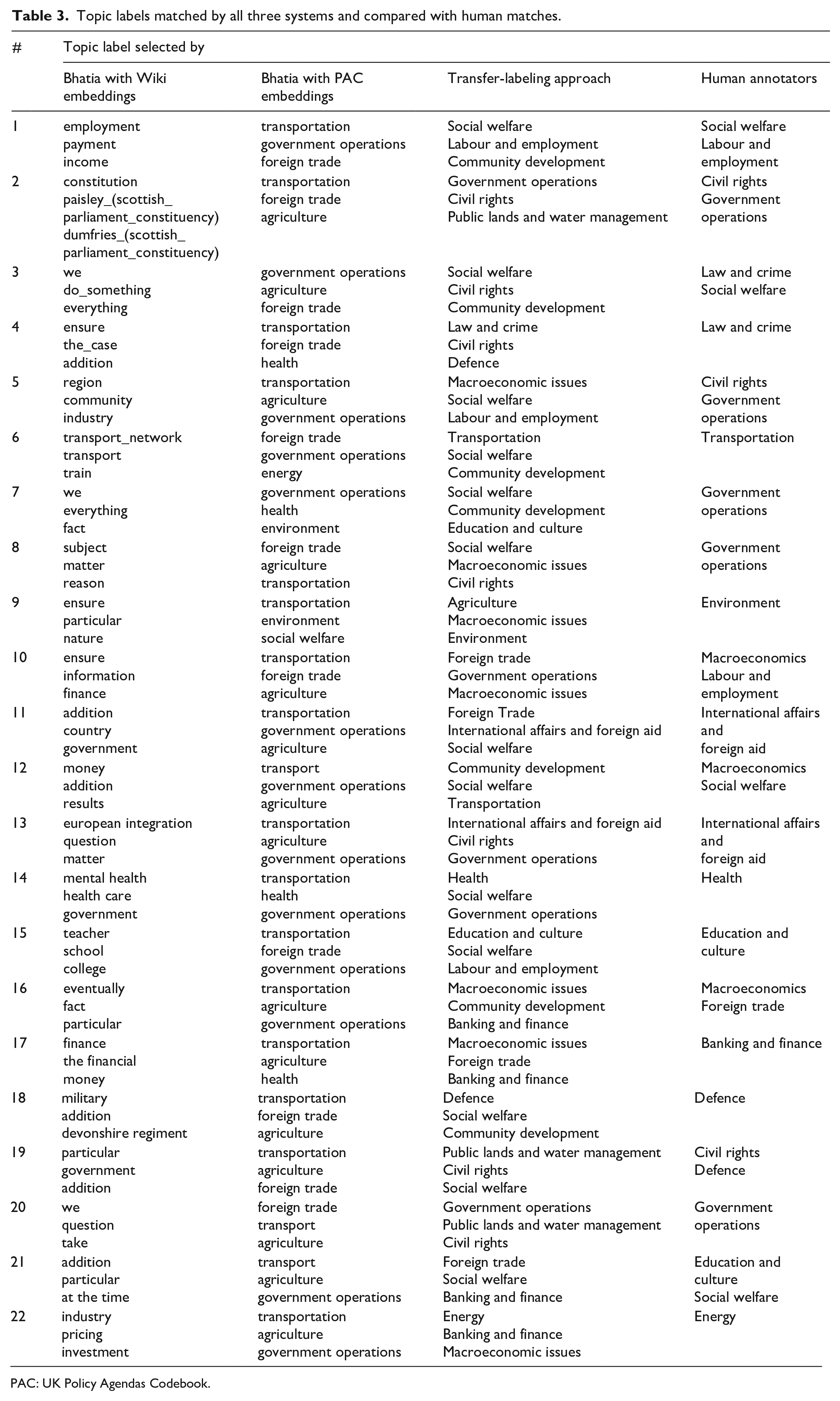
We evaluated these results by comparing the labels chosen by the models with labels chosen by two human annotators. The annotators were asked to choose the topics based on a list of labels generated using the UK PAC. We calculated interannotator agreement for the human labels based on a weighted Cohen’s kappa, which used a predefined table of weights to measure the degree of disagreement, and found a good agreement (0.51).
Table 3 provides an overview of the 22 estimated topics, side by side with the topics estimated by the model proposed by Bhatia et al. (2016). In the first two columns of Table 3, we present the top three ranked labels produced by the two models described in this section. We compared the labels to those chosen by the human annotators, presented in the fourth column. Where only one label is shown means the two annotators chose the same label.
Topic labels matched by all three systems and compared with human matches.
PAC: UK Policy Agendas Codebook.
As we can see in the table, most of the labels were not meaningful and did not match up with those chosen by the human annotators. The labels in Column 2 are more directly comparable with those of the transfer-labeling approach (Column 3) and those chosen by the human annotators (Column 4), as they were based on the PAC topics.
The labels matched with the transfer topic labels showed the strongest agreement with the human annotators. When looking at only the top ranked label, this matching approach had a kappa of 0.31 agreement with the first human annotator and 0.23 with the second. This agreement went up when the top three highest ranking labels were taken into account. In total, one of the top three ranked labels matched a human annotator’s choice for 16 out of 22 cases. In contrast, the PAC labels chosen by the neural model only matched the annotator’s choice in 5 out of 22 cases. This was a large improvement over the labels chosen by the neural methods, even with the domain-specific embeddings.
Conclusion
Treating text as data is an approach of increasing importance in political science. Natural language processing techniques developed in the computing sciences are routinely added to methodological toolkits. Topic modeling is a favorite tool of document summarizing. Political scientists often have to be creative in interpreting and labeling estimated topics; yet such labeling is also often difficult to replicate – a sine qua non of modern political science.
Arguably, the task of coding a small number of topics, as in the examples above, could be designed with sufficient reliability and replicability built in. However, in practice we often estimate models with a much higher number of topics. Increasing the number of topics makes human labeling less scalable and arguably increases the effects of human biases in labeling. In order to demonstrate the scalability of our approach, we estimated the topics on the full data set of parliamentary debates between 1935 and 2014.
To address the deficiency of current labeling techniques, and to have a better way of accommodating change over time, we presented a new method for topic labeling. Our approach provided an automatic labeling method that transferred the wealth of substantive knowledge accumulated in political science into labeling topic models. By doing so, it would allow researchers to integrate the results of a topic model into their existing coding framework. Our approach is also fully transparent and replicable, which would allow the bringing of human expertise to bear on difficult cases.
As part of the robustness analysis, we compared this method to current state-of-the-art neural network methods. Even when trained with in-domain embeddings, these methods did not adequately match topics and failed to correlate with human judgment. Furthermore, these methods are computationally expensive and time-consuming. At the same time we found our proposed method to be much faster and capable of producing more accurate labels. A full manual analysis of these labels showed high correlation with human experts.
An important limitation of our approach is that its success depends on the linguistic similarity and overlap in vocabulary between the corpus, from which topics are estimated, and the knowledge base used to pick labels. The analysis presented in this article worked well because the topics and words we expected to find in legislative speech were well captured by the CAP coding framework. Our method would be less applicable when trying, for example, to pick CAP category labels for topics estimated from Twitter messages. Another limitation is that reference topics extracted from existing knowledge bases need to be sufficiently distinct. If this is not the case, one may find that a small number of “catch all” reference topics will dominate the matching procedure. A possible avenue for future research is developing metrics that will inform researchers a priori how well an existing knowledge base is suited to extracting reference topics for a particular corpus. Another avenue is developing transfer methods that combine the versatility and linguistic context of neural embeddings with the computational simplicity of the Jaccard index we used.
While our proposed approach is simple and specific to the political domain, it could be extended to other domains where extensive and rich codebooks are available, such as party manifestos, open-ended survey questions, social media data, legal documents, and other research domains where topic models have made advances in recent years.
Supplemental Material
sj-pdf-1-rap-10.1177_20531680211022206 – Supplemental material for Transfer learning for topic labeling: Analysis of the UK House of Commons speeches 1935–2014
Supplemental material, sj-pdf-1-rap-10.1177_20531680211022206 for Transfer learning for topic labeling: Analysis of the UK House of Commons speeches 1935–2014 by Hannah Béchara, Alexander Herzog, Slava Jankin and Peter John in Research & Politics
Footnotes
Acknowledgements
All authors have contributed equally. We thank Stefano Gurciullo for collaboration and research assistance. We are graateful to Christina Fernandes for editorial work on the manuscript.
Declaration of conflicting interest
The authors declared no potential conflicts of interest with respect to the research, authorship, and/or publication of this article.
Funding
The authors disclosed receipt of the following financial support for the research, authorship, and/or publication of this article: We thank University College London for financial support through its Grand Challenges.

Supplemental material
Notes
Carnegie Corporation of New York Grant
This publication was made possible (in part) by a grant from the Carnegie Corporation of New York. The statements made and views expressed are solely the responsibility of the author.
References
Supplementary Material
Please find the following supplemental material available below.
For Open Access articles published under a Creative Commons License, all supplemental material carries the same license as the article it is associated with.
For non-Open Access articles published, all supplemental material carries a non-exclusive license, and permission requests for re-use of supplemental material or any part of supplemental material shall be sent directly to the copyright owner as specified in the copyright notice associated with the article.
