




Abstract
Does domestic contestation of European Union legitimacy affect the behaviour of the European Commission as an economic and fiscal supervisor? We draw on theories of bureaucratic responsiveness and employ multilevel and topic modelling to examine the extent to which the politicisation of European integration affects the outputs of the European Semester: the Country-Specific Recommendations. We develop two competing sets of hypotheses and test these on an original large-N data set on Commission behaviour with observations covering the period 2011–2017. We detect a twofold effect on the Commission's recommendations: member states that experience greater politicisation receive recommendations that are larger in scope but whose substance is less oriented towards social investment. We argue that this effect is best explained as an outcome of the Commission's institutional risk management strategy of regulatory ‘entrenchment’. The supranational agent issues additional recommendations while simultaneously entrenching on a stronger mandate substantively, which allows it to maintain its regulatory reputation and signal regulatory resolve to observing audiences.
Introduction
The Eurozone crisis and the subsequent overhaul of the European Union's (EU) system of economic governance have granted greater authority to EU institutions, especially in the area of policy implementation (Bauer and Becker, 2014; da Conceição-Heldt, 2016). The European Commission now plays a central role in the European Semester, the EU's annual economic and fiscal policy coordination cycle. As fiscal and economic supervisor, the Commission wields significant discretion in assessing imbalances in member states’ budgets and economies, and issues Country-Specific Recommendations (CSRs) to address the risks stemming from these imbalances for the wider EU economy (Armstrong, 2013; Scharpf, 2015; Seikel, 2016). CSRs drafted by the Commission must be endorsed by the Council, but the scope for amendment is restricted as this requires a qualified majority of votes (QMV) and is subject to the so-called ‘comply or explain’ principle. Both the scope and substance of EU interference in national economies and budgets have been heavily criticised for the strong focus on social retrenchment, or austerity, over social investment (e.g. Blyth, 2013), or ‘capacitating social policies […] that aim to maximise the returns on social expenditures in the form of active employment and social participation’ (Kersbergen et al., 2014).
More fundamentally, the legitimacy of this system of economic governance and the issuing of CSRs is further complicated by a context of tangible politicisation of European integration: ‘the growing salience of European governance, involving a polarisation of opinion, and an expansion of actors and audiences engaged in monitoring EU affairs’ (De Wilde et al., 2016: 4). European integration in general has gradually become a key issue in political conflicts along a transnational cleavage structure (Hooghe and Marks, 2018). This has, in turn, been integrated into existing national political conflict structures in country- and time-specific ways, and conflicts over the EU may flare up when politicised by domestic actors (Kriesi, 2016). Domestic political parties, especially the Eurosceptic extreme left and right, now explicitly profile on EU issues (Meijers, 2017; Meijers and Rauh, 2016). Citizens more deliberately vote for parties with strong pro- or anti-EU platforms and voice concerns over further integration in referendums (e.g. Brexit). The crisis has in itself also increased the salience of EU economic governance and eroded trust in EU institutions, further fuelling support for Eurosceptic parties (Baglioni and Hurrelmann, 2016; Hobolt and De Vries, 2016). Overall, the economic crisis has greatly increased the visibility of the EU, and the legitimacy of its system of economic governance is strongly contested.
The Semester thus tasks a powerful but politically conscious Commission with issuing sensitive recommendations to member state governments, while the role of the EU in the lives of its citizens is frequently questioned and politicised by domestic-level actors. Despite this, research has paid little attention to the consequences of such moments of ‘constraining dissensus’ (Hooghe and Marks, 2009) for the functioning of EU economic governance. Academic scholarship on the Semester has mostly focussed on the Semester's (im)balance between social and economic objectives (Azzopardi-Muscat et al., 2015; Zeitlin and Vanhercke, 2018), its capacity for policy learning (Dunlop and Radaelli, 2016; Zeitlin, 2016) and the implementation of CSRs by member states (Deroose and Griesse, 2014). Only Baerg and Hallerberg (2016) have studied the political determinants of CSR amendments in the Council, finding that political power and public Euroscepticism are strong determinants of successful weakening by member states of recommendations in the Council. Moreover, there are only a few studies on the influence of the politicisation of European integration on specific EU policy areas (e.g. see Rauh, 2016), and none on the stage of the implementation of community policy by EU actors. Our study contributes to the literature on economic governance by extending the focus to include the effects of politicisation and domestic politics on the supranational implementation of community policy. Simultaneously, it responds to calls in the literature on the politicisation of European integration and on public support for the EU to extend the treatment of these phenomena from dependent to explanatory variables, in order to uncover how they might act as constraints on European governance, and with what consequences for the efficiency and legitimacy of the EU (Hobolt and De Vries, 2016; Zürn, 2016).
We draw on theories of bureaucratic responsiveness to risk and stakeholder preferences to pull these literature streams together and examine the extent to which the politicisation of European integration (hereafter: ‘politicisation’) affects the way the Commission interprets its mandate as macroeconomic supervisor. Using data on all CSRs formulated by the Commission since the introduction of the Semester in 2011, we reveal a positive relationship between a member state's level of politicisation and the scope of recommendations targeting that country as formulated by the Commission. We also find that politicisation affects these recommendations in more substantive terms, with higher levels of country-specific politicisation resulting in fewer CSRs that advocate social investment. Here, we have purposefully only analysed Commission behaviour in the form of the CSRs proposed. As noted earlier, these may still be amended by the Council, but our analysis does not extend to CSRs in the form they are finally issued to national governments (cf. Baerg and Hallerberg, 2016).
The Commission as a responsive regulator: Risk and reputation
European economic integration has always been a story of mutual gains through increased cooperation, although stronger interdependence also increases cross-border economic risks. A common currency reduces cross-border trade barriers, but also creates new risks for member states as they lose the ability to adjust their exchange rates to protect their economies (Lane, 2012). The Semester grants the Commission a number of policy tools to regulate cross-border fiscal and economic risks, of which the CSRs are a comprehensive output that streamlines recommendations stemming from different measures into a single country-specific document.
Risk management by national regulators has been well studied, and the resulting theories offer insights into the way regulatory agencies employ their discretion during policy implementation to respond to external pressures (Alon-Barkat and Gilad, 2016; Black and Baldwin, 2012; Carpenter, 2010; Carpenter and Krause, 2012; Gilad, 2012, 2015; Jennings, 2009; Maor, 2011; Maor and Sulitzeanu-Kenan, 2016; Rothstein, 2006; Rothstein et al., 2006). A central tenet of these theories is that regulators aiming to manage the ever-growing number of risks to society face institutional risks as a by-product of their efforts. Issues rarely fit the regulatory frameworks that these actors develop, and regulators are dependent on complex institutional regimes making success difficult to achieve. Consequently, regulators have only a limited impact on the management of societal risks, and ‘the difficulty in satisfying conflicting demands on regulation, therefore, creates institutional risks that can threaten the legitimacy of regulatory organisations and their practices (Rothstein et al., 2006: 95).
Regulators employ various risk-management strategies depending on which type of risk they perceive to be the most threatening. Those mostly concerned with societal risk simply make decisions by weighing the impacts of societal risks against the likelihood that they occur (Black and Baldwin, 2012). For example, financial regulators will weigh up the societal impact of the insolvency of major financial intermediaries against the likelihood that such insolvency occurs, and then direct attention and resources accordingly. In other situations, they may be more concerned with institutional risks. These are specific risks to the institutional position of the regulator, rather than to society, and stem from developments that may weaken a regulator's future institutional position (Gilad, 2012). By signalling incompetence, regulatory failure may ultimately weaken an actor's institutional position. Similarly, regulators that ignore the preferences of their institutional overseers may face institutional repercussions. Consequently, institutional risk-sensitive regulators will prioritise tasks and allocate resources to mitigate such institutional risks which are inherent to the job of regulating risks to society (Rothstein, 2006).
In safeguarding its institutional position, a regulator's reputation is a vital asset. Stronger reputations result in greater discretion and autonomy (Carpenter and Krause, 2012), whereas a poor regulatory reputation may lead to a repeal of delegated competences or budget cuts. However, this regulatory reputation depends largely on the audience who, through interaction with the regulator, constructs it (Carpenter, 2010). It is the audience's assessment of a regulator's efficacy, expertise and legitimacy that shapes the regulator's reputation. Reputation-sensitive regulators will seek to safeguard and enhance this audience's positive judgement, and the (un)responsiveness to external signals will be guided by the regulator's institutionalised organisational identity (Gilad, 2015). Recent research into how regulators cope with reputational threats, and the institutional risk they face as a result of these, has found that they are responsive to public allegations of regulatory failure (Maor et al., 2013), public opposition (Alon-Barkat and Gilad, 2016; Jennings, 2009), political intervention (Gilad, 2015) and media attention (Maor and Sulitzeanu-Kenan, 2016).
In line with this, we would expect politicisation to be an institutional risk that warrants a response, i.e. a visible shift in the risk management strategy of a competence-seeking Commission. As politicisation increases the visibility of the Commission's behaviour and broadens its audiences, it effectively moves the implementation of community policy from ‘business as usual’ to ‘implementation under pressure’. When the level of politicisation is low, we would expect the Commission to be chiefly concerned with managing economic and fiscal (i.e. societal) risks. As politicisation increases, we would expect the Commission's sensitivity to institutional risks, and thus to external signals, to increase. Two previous studies that have investigated this relationship offer support to this notion in that they found that politicisation can affect the way individual Commission officials conceive the role of their institution in the wider process of European integration (Bes, 2017) and may lead the Commission to be responsive to a broader set of societal stakeholders when drafting EU policy (Rauh, 2016).
This leads us to our first, and central, expectation: that higher levels of domestic politicisation, and the institutional risks they pose, affect the Commission's behaviour as economic supervisor. When politicisation is low, the Commission is likely to use the CSRs in line with their original intention – as tools to manage the economic and fiscal risks in individual member states. As levels of country-specific politicisation increase, the Commission will seek to preserve its regulatory reputation by signalling key audiences, thus visibly differentiating in its treatment of member states where levels of politicisation are higher. Societal risk remains a key driver in CSR formulation, but institutional risk management is now of primary concern.
Despite their heuristic value, theories of risk responsiveness fail to offer context-specific hypotheses. Nevertheless, we can argue that politicisation may make it more difficult for the Commission to bolster its reputation as its legitimacy has traditionally been output-based (Schmidt, 2013) and it has to constantly reinterpret its mandate according to signals from key stakeholders (Rauh, 2016). The unique character of the Semester also creates additional institutional risks since the Commission issues invasive recommendations to the very entities that collectively decide its future institutional position. Not only may the Council collectively decide to repeal competences, but individual regulatees may also seek opt-outs from Commission supervision. Politicisation increases the likelihood of such undermining of the Commission's authority, not least because transfers of authority to the EU are a primary cause of the politicisation of European integration, with Eurosceptic actors being keen to reframe such transfers as ‘losses of sovereignty’ (Grande and Hutter, 2016).
In formulating observable implications for strategic Commission behaviour, we follow Rauh's (2016) approach and identify the key stakeholders, or audiences, that observe the Commission as it issues CSRs. The Semester has two categories of stakeholders: endogenous and exogenous. Endogenous stakeholders are the individual member state governments, i.e. the recipients of CSRs, and the Council, that is the member state governments collectively, from which the Commission receives its mandate to issue CSRs. These stakeholders are already involved structurally in the process leading up to the issuing of CSRs, with numerous points of interaction between the Commission, member state governments and the Council. However, when country-specific levels of politicisation change, so will the internal dynamics of the Semester, and the signals received by the Commission. For example, as Baerg and Hallerberg (2016) argue, country-specific increases in Euroscepticism strengthen the bargaining positions of national government vis-à-vis the Commission during CSR adoption in the Council.
Exogenous stakeholders, or the wider audiences that observe the Commission's actions in EU economic governance, are ‘the people’ and ‘the markets’ (Schmidt, 2014; Streeck, 2014). The ‘people’ consist of national and European electorates, interest groups and civil society, a public which is mostly fragmented along national borders. Together with national political parties, the ‘people’ form the locus where politicisation occurs: it is to this audience that Commission action has become more salient, and its response has been to polarise and mobilise. The ‘markets’ comprise globally operating actors, such as investors, pension funds, traders and bankers. This audience is predominantly concerned with economic and fiscal risks in member states: it seeks economic stability, as epitomised in the economic agendas of austerity and market deregulation, and the continuation of economic growth. Under ‘business as usual’, a Commission focus on economic risk will appease the ‘markets’ and leave the ‘people’ indifferent. However, as country-specific levels of politicisation increase, the ‘people’ will increasingly gain clout as a stakeholder in the implementation of community policy – increasing the pressure on the Commission to limit the unpopular austerity measures and create more widely dispersed social and economic benefits (Rauh, 2016). Given these divergent preferences, increasing politicisation implies that it is becoming extremely difficult for the Commission to simultaneously appease the ‘people’ and calm the ‘markets’.
Here, we propose two sets of competing hypotheses for Commission responsiveness to increasing levels of country- and time-specific politicisation, and by extension to institutional risk, that address both the scope and the substance of the CSRs proposed by the Commission. The first set assumes a Commission that is mainly concerned with mitigating domestic public opposition to EU (economic) governance. Seeking to appease the ‘people’, we assume the Commission to avoid purposefully fuelling further politicisation in its member states. Here, we would first expect the Commission to minimise the scope of its recommendations, as fewer recommendations imply less European interference in a country's domestic affairs. Second, when CSRs are issued, we predict a larger relative share to recommend social investment, as opposed to unpopular austerity measures or social retrenchment, in countries with relatively high levels of politicisation.
H1a: Member states with higher levels of domestic politicisation will receive fewer CSRs from the Commission. H1b: The CSRs received by member states with higher levels of domestic politicisation will contain a higher proportion of recommendations for social investment. H2a: Member states with higher levels of domestic politicisation will receive more CSRs from the Commission. H2b: The CSRs received by member states with higher levels of domestic politicisation will contain a lower proportion of recommendations for social investment.
The second set of hypotheses assumes a Commission that is also concerned with the institutional risk posed to itself by politicisation and responds by ‘entrenching’. Since regulatory favouritism will harm the Commission's reputation as a credible fiscal and economic watchdog, it may anticipate and avoid the political and economic backlash that might result from giving into politicised member states. Instead, in order to secure its reputation as an unwavering ‘guardian of the markets’, it may seek to send a strong signal of regulatory resolve, and independence from political influence, to other member states, the Council and the ‘markets’. An important aspect is that the Commission still speaks to the ‘people’ of other member states, i.e. signalling to German voters that it is not favouring Spanish voters or vice versa. We expect this scenario to have two observable implications. First, because successfully signalling regulatory commitment to economic objectives and political independence necessarily implies sending a strong signal, we expect the Commission to issue more recommendations in response to country- and time-specific increases in politicisation. Substantively, we expect an ‘entrenched’ Commission to ‘retreat’ to a position where its mandate is strongest in order to signal regulatory competence. Three features of CSRs suggest that entrenchment will reduce the relative share of CSRs recommending social investment issued to politicised member states (cf. Zeitlin and Vanhercke, 2018). These are: that recommendations on economic and fiscal objectives enjoy a stronger legal basis; that they stem from explicit procedures (the Macroeconomic Imbalance and Excessive Deficit Procedures) underpinned by detailed protocols; and that they are backed up by the possibility of sanctions. While individual regulatees may object if the Commission signals resolve too strongly, a simultaneous entrenchment towards a stronger mandate can shield it from such a critique.
Data and methods
We test these hypotheses using an original data set of CSRs formulated by the Commission containing data for 27 member states over the period 2011–2017. We analyse CSRs as formulated by the Commission before the Council has had the opportunity to alter or adopt them. Greece is not included as it was subject to Macroeconomic Adjustment Programmes (MAPs) for the entire observed period and did not receive any CSRs. 1 Cyprus, Ireland, Latvia, Portugal and Romania were subject to MAPs for one or more years and therefore did not receive CSRs in these years. These and other missing values were handled through listwise deletion. The final sample contained 169 observations (country-years).
Our first outcome variable, the scope of CSRs, is measured as the number of words used in formulating the substantive recommendations. This measure more adequately captures the scope of CSRs than simple recommendation counts since both the ‘number and level of detail of the recommendations reflect the scale of the challenges each Member State faces’ (European Commission, 2015). In this, we only ‘captured’ the CSRs themselves, and excluded the background and rationales provided in CSR documentation. We use a natural log transformed metric to reduce positive skew and high-end outliers, and aid interpretation (Gelman and Hill, 2007).
We use topic modelling, specifically latent Dirichlet allocation (LDA), to estimate the policy topics that most prominently feature in individual recommendations, adhering to the numbering in CSR documentation. As a class of Bayesian generative models, LDA models assume documents consist of multiple topics, and assume the terms in these documents to be a function of the presence or absence of a given topic (Blei, 2012; Grimmer and Stewart, 2013). After estimating the optimal number of topics, extracting and qualitatively validating them, we then identify those topics for which the CSRs specifically and explicitly recommend social investment over social retrenchment. Our second outcome variable captures the proportion of ‘social’ topics in the average recommendation in a given country-year (see the Online appendix for details).
All predictor variables that follow are lagged: that is, they are measured three to eight months before the Commission formulates CSRs. 2 This lag ensures that our predictors precede our outcome. Given the difficulties of constructing country-specific measures for salience and mobilisation, we operationalise our main predictor, politicisation, as the level of polarisation in citizen's opinions on the EU. Following Rauh (2016), we measure polarisation as the kurtosis of the distribution of citizen opinions on the EU, as calculated from the weighted individual-level responses to the Autumn Eurobarometer item: ‘In general, does the EU conjure up for you a very positive, fairly positive, neutral, fairly negative or very negative image?’. Kurtosis is a measure of the ‘heaviness’ of the tails of the distribution of opinions: lower values indicate more observations are further from the mean and thus indicate stronger polarisation. 3
As politicisation requires active political entrepreneurs who successfully mobilise the public on salient constitutive issues and a polarised public opinion (Hooghe and Marks, 2018; Hutter et al., 2016), we also include a dichotomous variable that captures whether a member state's political system includes a successful Eurosceptic challenger party that holds one or more seats in parliament. We used the 2014 Chapel Hill Expert Survey (CHES) to identify political parties scoring below four on a seven-point pro-integration scale (Bakker et al., 2015). Ray (2007) showed that parties scoring below four in the CHES data could be classified as either ‘soft’ or ‘hard’ Eurosceptic and we followed this reasoning.
The differentiated political power of member states has always been an important factor in EU decision making, and this affects a member state's chances of having CSRs weakened in the Council (e.g. Baerg and Hallerberg, 2016; Häge, 2013; Mattila and Lane, 2001; Tsebelis, 2013). We measured political power as the voting power of a member state in the Council, using the Shapley-Shubik index of power distribution under the Nice rules for 2011–2013 and under the Lisbon rules for 2014–2017. These indices are based on the probability that a member state is pivotal in turning a losing coalition into a winning one and are widely used in the literature on legislative bargaining (Hix and Høyland, 2011). Croatia is not included in the index, meaning that a country's estimated power may be slightly different to their true power in the period 2014–2017.
We rely on the main scoreboard indicators of the Macroeconomic Imbalance Procedure (MIP) to identify the main reason why the Commission would have formulated CSRs, i.e. the level of economic and fiscal risk in a member state. Each indicator is accompanied by an indicative threshold, which serves the Commission as a heuristic device to detect possible imbalances. For each indicator, we create a dichotomous measure that indicates whether a member state is in breach of the indicative threshold in a given year. 4 We acknowledge that, in practice, the formulation of CSRs is a highly complex and interactive process that necessarily requires a sophisticated reading of the scoreboard indicators, and that they are by no means applied mechanistically (European Commission, 2016). Nor is it our intention to outguess the Commission's assessment of these imbalances. Nevertheless, given the complexities of numerically assessing the economic or fiscal stance of a country, relying on breaches of these thresholds provides us with the most valid control variables possible, and covers the full breadth of fiscal and economic imbalances. The data for these indicators are taken from Eurostat. At the time of writing, data for indicators on private sector debt, credit flow and financial sector liabilities were not available for 2016. To prevent a total rejection of all 2017 observations, these indicators were not included in the models. We include a final dichotomous measure for a country's membership of the Economic and Monetary Union (EMU), since membership creates additional interdependencies between and additional obligations for member states and increases their exposure to imbalances in other EMU countries.
Finally, we control for three additional political factors that may influence the Commission's formulation of recommendations. First, if the Commission is responsive to polarisation, it may also be sensitive to the electoral cycle in a given member state. We therefore measure the closeness of elections as the number of months until the next election from the month in which CSRs are published. Further, the formulation of CSRs by the Commission may be affected by whether a member state's government is economically left- or right-oriented, and whether it is opposed to or supportive of European integration. We capture the former by taking the governing party's position on a 10-point left–right scale from the parliaments and governments database (ParlGov) by Döring and Manow (2016) and create a weighted measure for coalition governments. We use the same approach to measure government positions on European integration using the seven-point anti-pro integration scale from the 2014 CHES item mentioned earlier. A complete overview of predictors, including the MIP indicators and their indicative thresholds, and descriptive statistics is provided in the Online appendix. Moreover, all predictor variables are grand-mean centred to aid interpretability, and the continuous predictor variables are standardised by two standard deviations, placing them on a scale that is effectively bound between zero and one (Enders and Tofighi, 2007; Gelman and Hill, 2007).
We employ a series of fixed slope, random intercept multilevel models that account for the nested and cross-classified nature of the data (Schmidt-Catran and Fairbrother, 2016). Models with the prefix A use the log-transformed word count as an outcome, whereas models with prefix B indicate models that instead use the proportion of CSRs advocating social investment. In all cases, model 0 is the baseline model. Model 1 predicts the outcome using the MIP indicators, EMU membership and political power. Following this, model 2 subsequently introduces our main predictors of interest related to the politicisation of European integration. Model 3 adds the remaining political control variables. These final models are specified as follows:


Model fit statistics.
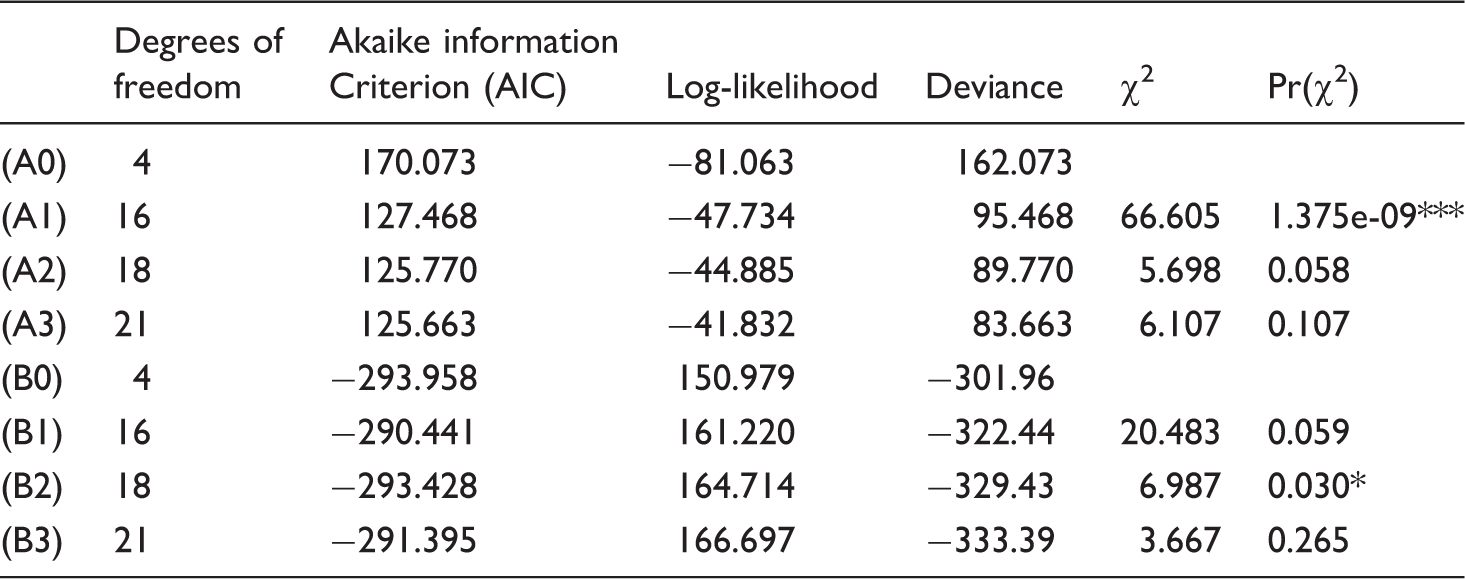
Note: N = 169; J = 26; K = 7.
*p < 0.05. **p < 0.01. ***p < 0.001.
Results
Multilevel models for the scope of Country-Specific Recommendations (CSRs).
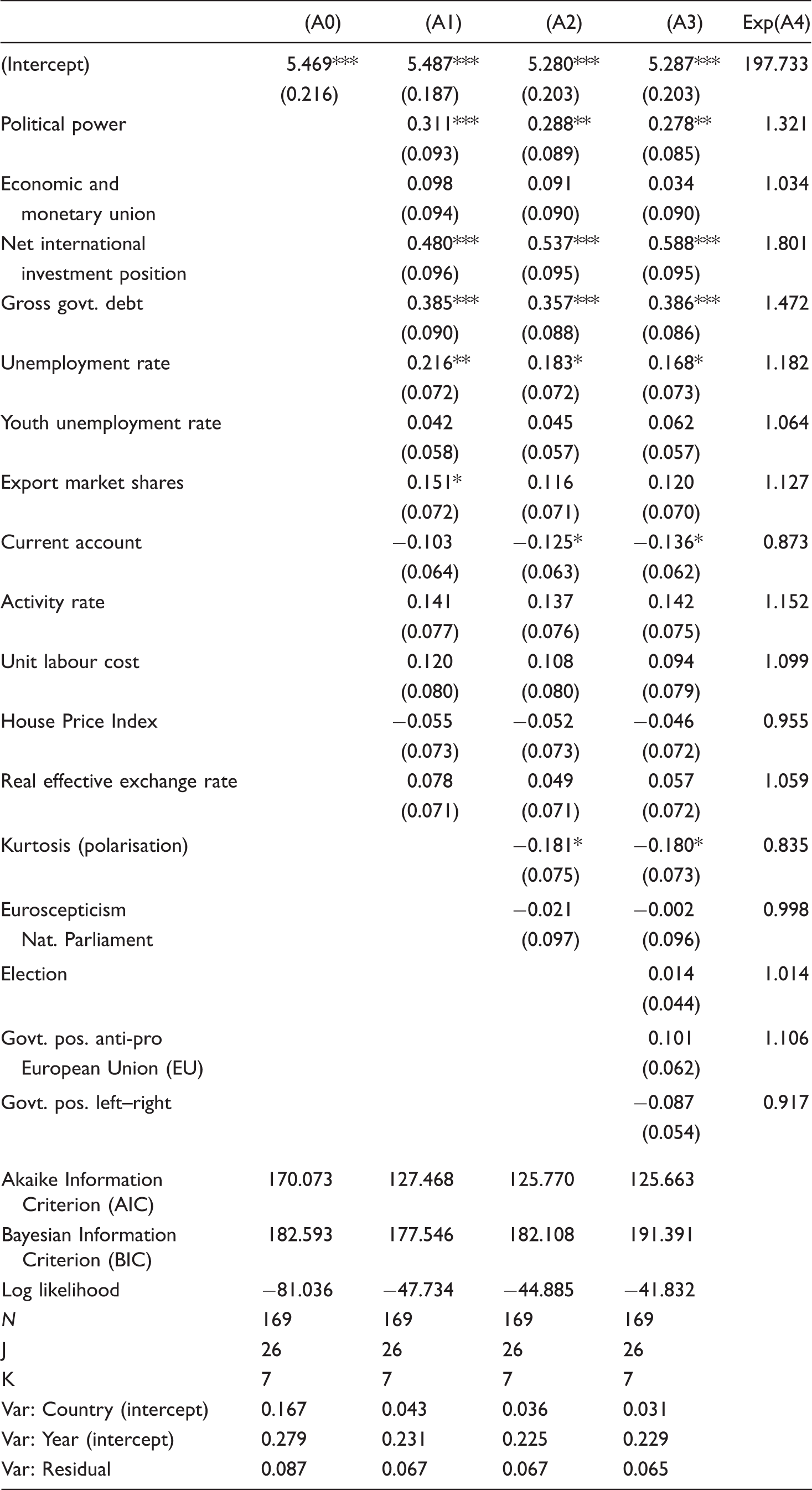
***p < 0.001; **p < 0.01; *p < 0.05.
Our results support H2a, and by extension fail to support H1a, in that member states with higher domestic levels of polarisation do receive more CSRs from the Commission. That is, the Commission issues more recommendations to member states who have higher levels of politicisation. Holding all the other predictors at their grand mean values, a one-unit increase in the kurtosis of the distribution of citizen opinions on the EU, which implies a significantly more consensual view of the EU, is associated with a 16.5% decrease in the scope of the CSRs. This change is equivalent to the difference in country means between France (−0.46) and Malta (0.25). As such, the Commission is responsive to polarisation when it drafts CSRs and increases the scope of its recommendations when faced with more polarised public opinions of the EU. However, the presence of a Eurosceptic challenger party in a national parliament does not affect the scope of CSRs.
Adding the political control variables to the model yields additional interesting results. First, the measure for the political power of a member state offers a reliable estimate that indicates that politically more powerful member states receive more recommendations. A one-unit increase in voting power is related to a 32.1% increase in the scope of CSRs proposed by the Commission. This change in political power in the Council is roughly comparable to the difference between Malta (2016 population: 420,000) and Poland (2016 population: 38,627,000). Second, neither the domestic electoral cycle nor the government's position on the EU and its economic preferences influence the quantity of recommendations they receive from the Commission. These findings are robust under varying model specifications, including those that include the originally omitted MIP scoreboard indicators for 2011–2016. They are also in line with those of Baerg and Hallerberg (2016) who found that Euroscepticism and political power significantly affect CSR amendments, but found no relationship between amendments and the remaining political measures.
CSRs are formally meant to address economic and fiscal imbalances in member states, and a number of the estimates for the MIP scoreboard indicators support this notion. Member states in breach of the indicative threshold for net international investment position (NIIP), which are in effect in debt to other EU member states, receive 80.1% more recommendations from the Commission. Similarly, member state governments with a gross debt exceeding 60% of gross domestic product (GDP) can expect a 47.2% increase in the number of issued recommendations. Further, member states exceeding the unemployment rate threshold receive 18.2% more recommendations. Surprisingly, member states experiencing current account imbalances receive 12.7% fewer recommendations. Breaches of the indicative thresholds for the other scoreboard indicators do not appear to lead to more, or fewer, recommendations. Finally, additional obligations and interdependencies resulting from Eurozone membership have no observable effect on CSR issuance. Given these findings, it is clear that the management of cross-border risks to other EU member states, and to the wider EU economy, is the dominant rationale behind the Commission's issuing of recommendations to member states.
Multilevel models for the share of recommendations on social investment.
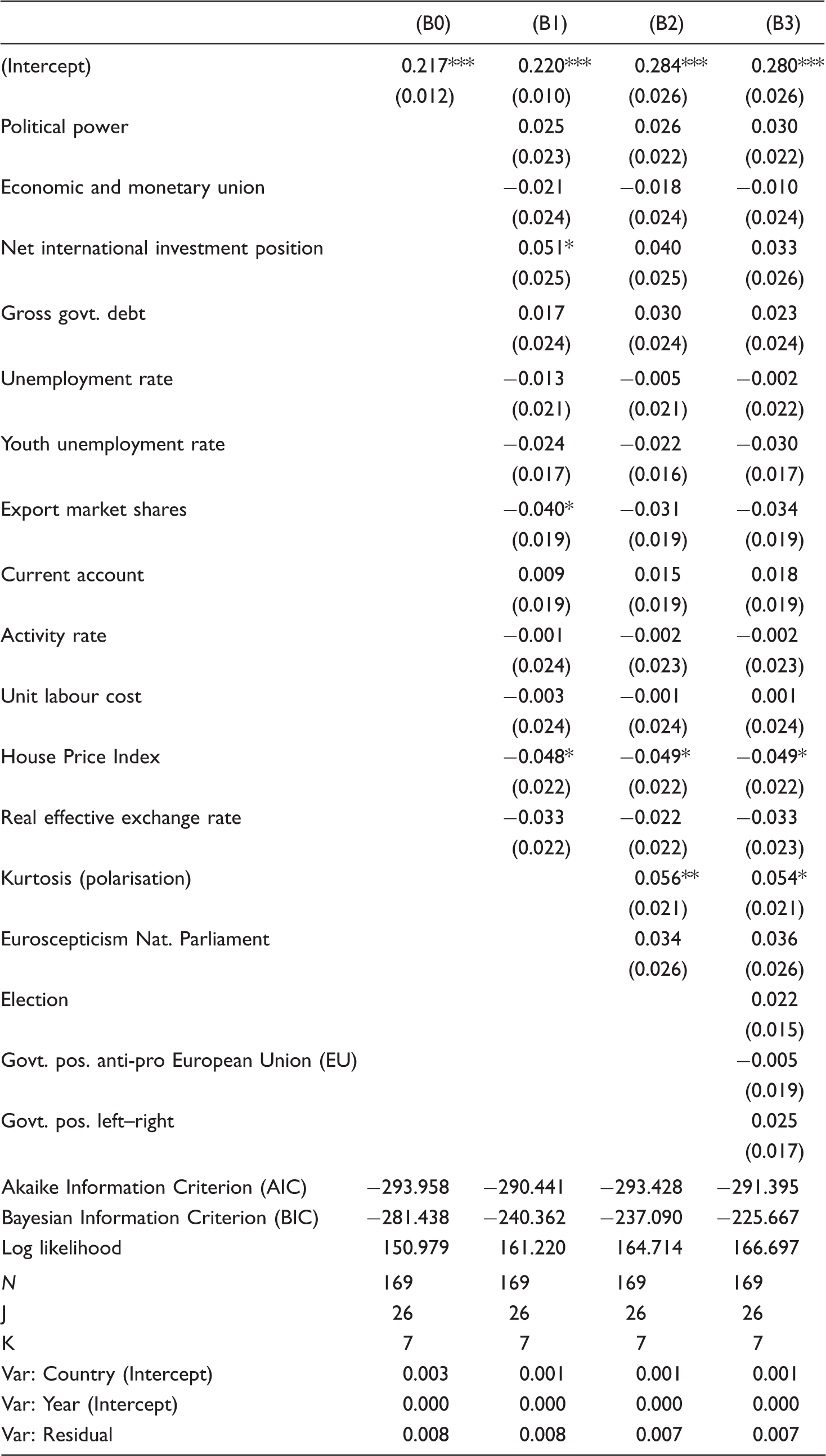
***p < 0.001; **p < 0.01; *p < 0.05.
To summarise, our statistical evidence indicates that, typically, member states receive more extensive recommendations from the Commission when: (a) their domestic public opinion on the EU is more polarised; (b) they wield more political power in the Council; (c) they are in breach of the indicative thresholds for the NIIP, government debt or unemployment rate indicators; and/or (d) they are not breaching the current account balance indicator. In terms of the substance of CSRs, a smaller proportion of the recommendations that a member state receives relate to social investment when domestic public opinion is more polarised or when it is breaching the MIP indicator for the House Price Index. Although neither model allows us to claim causality, there is some evidence against an endogeneity bias that is that the characteristics of the recommendations emanating from Brussels fuel further Euroscepticism amongst EU citizens. The fact that the annual geometric means for the scope of CSRs rose steadily from 256 words in 2011 to 533 words by 2014, before dropping significantly to 168 in 2015, while the annual means for polarisation levels across the EU member states rose from −0.03 in 2011 to −0.24 in 2013, but began declining a year earlier – to −0.17 in 2014 and −0.04 in 2015 – runs counter to an endogeneity bias being present. In conclusion, the evidence provided here offers credibility to the argument that increasing politicisation influences the Commission's application of economic and fiscal surveillance measures.
Conclusions and discussion
In this study, we have investigated to what extent the politicisation of European integration affects the implementation of EU community policy. We have approached this topic by examining the issuance of CSRs by the European Commission. We argued that the Commission, while using CSRs to regulate the economic and fiscal risks in EU member states, is also responsive to the institutional risks posed by the politicisation within them when it interprets its mandate as the EU's economic and fiscal supervisor. Based on two possible alternative responses by the Commission to this institutional risk, we offered two sets of competing hypotheses that varied in terms of the exogenous stakeholder, or audience, in whose eyes the Commission would be keenest to preserve its reputation: ‘the people’ or ‘the markets’ (Schmidt, 2014; Streeck, 2014). After controlling for the relevant sources of economic and fiscal imbalances in member states, we have shown that the Commission issues more CSRs to those member states where public opinion on the EU is more polarised. This finding strongly contradicts H1a. We also found some evidence that the Commission issues relatively few recommendations that advocate social investment to member states with high levels of polarisation, which fails to support H1b. That is, recommendations issued to member states with high levels of politicisation are less likely to urge social investment. Both these findings indicate that the Commission does react to higher levels of politicisation when it formulates and issues CSRs.
Moreover, our findings provide empirical support for both hypotheses H2a and H2b, which anticipated that the Commission would act as the ‘guardian of the markets’ in response to the institutional risk posed by politicisation at the domestic level. While our results do not allow us to draw definite conclusions regarding the intent behind this behaviour, we suggest that this response can best be explained as a form of regulatory ‘entrenchment’. By increasing the scope of its CSRs for countries with relatively high levels of politicisation, it sends a strong signal to other observing audiences of its regulatory resolve and political independence and reaffirms its reputation as a supranational ‘watchdog’ that remains determined to execute the task it was delegated. Simultaneously, the Commission is also able to entrench by issuing CSRs on those issues where it has a stronger mandate, which explains the greater focus on economic and fiscal objectives rather than social objectives for those member states where politicisation is higher.
Our findings constitute important contributions to our understanding of the workings of European economic governance. The EU's system of economic governance has never been a technocratic process in which rules were applied mechanistically, and political tinkering is often seen as a prerogative of member states (Amtenbrink and De Haan, 2003; Bauer and Becker, 2014; Scharpf, 2015; Seikel, 2016). Our contribution has identified a key driver behind the use of discretion by the European Commission, the main actor tasked with implementing these rules at the EU level: the issuing of CSRs is a highly political process and, as such, is susceptible to exogenous political forces. Our findings largely support those of Baerg and Hallerberg (2016) and indicate that politicisation processes not only affect individual actors, but also affect the wider inner workings of entire governance structures. Moreover, we have also shown that, in ‘speaking to the markets’ (Schmidt, 2014), European actors do not only rely on discourse and symbolic gestures, they also instigate concrete action.
Finally, we show that politicisation does not only have major consequences for the evident stages of policy formulation and legislative bargaining (Hoeglinger, 2016; Rauh, 2016; Wonka, 2016), but even affects the executive activities of the European Commission in its role as the EU's economic and fiscal supervisor. Our findings on the Commission's ‘entrenchment’ tie in with those of Bes (2017) and Rauh (2016), who both found a similar pattern of the Commission ‘entrenching’ behind a strong mandate. Bes (2017) found that increasing levels of politicisation push Commission officials towards acting on their mandate as a ‘supranational bureaucracy’ and becoming more pragmatic (and less policy entrepreneurial) in conceiving their institutional role. Rauh (2016) found that, under its mandate as the initiator of EU legislation on consumer policy, politicisation pushes the Commission to be responsive to a broader set of societal interests and hence to disperse societal policy outcomes that benefit a broader set of societal interests. In all these cases, ‘entrenchment’ may shield the Commission from scrutiny and may prevent the further fuelling of political conflict over EU issues at the domestic level.
Our findings are subject to a number of limitations. First, although we have studied Commission behaviour, this is only the starting point as CSRs may later be amended in the Council. Second, the management of economic and fiscal risks posed to European societies remains the most important explanatory factor in why the Commission issues CSRs, so the importance of the politicisation effect should not be overstated. We would also add that the insignificance of some of the MIP scoreboard indicators should not be seen as implying that the Commission is neglecting the economic dimension when implementing CSRs. Properly assessing the economic and fiscal risks in EU member states is infinitely more qualitative and complex than simply counting the breaches of indicative thresholds. In terms of capturing politicisation, we have focussed on polarisation and largely ignored both salience and mobilisation, in part because measuring the latter aspects across 27 EU member states is both difficult and language-sensitive. Our proxy for salience and mobilisation, i.e. the presence of a Eurosceptic challenger party, turned out to be a poor predictor of CSR characteristics, which suggests that the presence of Eurosceptic parties in national parliaments does not influence CSR formulation.
Lastly, and linking our findings to those of Baerg and Hallerberg (2016), an alternative explanation for our results could be that the Commission increases the scope of its CSRs for powerful and politicised member states in anticipation of such countries diluting their recommendations in the Council. While our design does not allow us to draw definite conclusions on the relative merits of these competing explanations for our findings, we offer three reasons why we believe the ‘entrenchment’ argument put forward in this contribution is the more compelling. First, Commission entrenchment could explain the responsiveness in terms of both scope and substance, whereas Commission anticipation does not. Second, the alternative explanation would suggest the presence of an interaction effect between the voting power and polarisation measures included in our analysis but, when tested, this effect was small and highly insignificant. Lastly, this alternative explanation raises the problem of equifinality: while the Commission may be anticipating amendments in the Council, the Council may equally be weakening the Commission's signals of entrenched regulatory resolve during the amendment process. Here, further research examining changes in inter-institutional dynamics under increasing levels of politicisation should prove highly rewarding.
This study has provided initial evidence for the existence of a politicisation effect on the implementation of community policy in the EU and has shown that the European Semester's recommendations are not solely the product of extensive and objective technical analysis. Grande and Kriesi (in Hutter et al., 2016) observe that politicisation is driven by the strategic attempts to politicise European integration and the EU by domestic political actors. Our contribution extends this argument by showing that European actors are not necessarily idle or passive subjects of politicisation, but that they actively develop counter-strategies to respond to developments in their political context. Whether such strategies will ultimately strengthen or harm the EU's fickle legitimacy remains to be seen.
Supplemental Material
eup-17-1372-File002 -Supplemental material for Bread and butter or bread and circuses? Politicisation and the European Commission in the European Semester
Supplemental material, eup-17-1372-File002 for Bread and butter or bread and circuses? Politicisation and the European Commission in the European Semester by Reinout A van der Veer and Markus Haverland in European Union Politics
Footnotes
Acknowledgements
We are very grateful to the audiences attending the 2017 workshop by the European Research Centre for Economic and Financial Governance (EURO-CEFG), the 2017 24th International Conference of Europeanists and a research colloquium by the Netherlands Institute of Government (NIG) for their helpful comments on earlier versions of this paper. Special thanks to Christian Rauh, Rene Repasi, Frank Schimmelfennig, Jeroen van der Waal, Jonathan Zeitlin plus two anonymous reviewers for their very helpful comments.
Funding
The author(s) disclosed receipt of the following financial support for the research, authorship, and/or publication of this article: This work was supported by the Netherlands Organisation for Scientific Research under the grant number 406.16.570.
Supplemental material
Supplemental material for this article is available online.
Notes
References
Supplementary Material
Please find the following supplemental material available below.
For Open Access articles published under a Creative Commons License, all supplemental material carries the same license as the article it is associated with.
For non-Open Access articles published, all supplemental material carries a non-exclusive license, and permission requests for re-use of supplemental material or any part of supplemental material shall be sent directly to the copyright owner as specified in the copyright notice associated with the article.
