




Abstract
Since the onset in early 2020 of the COVID-19 pandemic in the United States, mail-in voting rates in states that have held elections have surged, presumably reflecting the fact that voting by mail is a relatively safe mode of ballot casting during a public health crisis. Matters of health notwithstanding, postal delivery disruptions can place mail-in ballots at risk of rejection on the grounds of lateness. With Maine as a case study, we show that, in the past four general elections, over 10% of vote-by-mail ballots arrived at local elections offices either on Election Day itself or one day earlier. Moreover, of the vote-by-mail ballots most vulnerable to postal delivery disruptions, a greater share of them were cast by unaffiliated voters and Democrats than by Republicans. Our results highlight the fragility of voting by mail in light of concerns about the reliability of the United States Postal Service. While existing research shows that the opportunity to vote by mail is neutral with respect to partisanship, our results highlight an aspect of mail-in balloting that nonetheless has a partisan hue—the extent to which vote-by-mail ballots are vulnerable to mail delays.
Introduction
Since its onset in early 2020, the COVID-19 pandemic has changed the way that Americans cast their ballots. A number of states held primaries during the pandemic, among them Florida, Georgia, Maine, Nebraska, New York, Ohio, and Wisconsin. In all of these elections, the fraction of voters casting ballots by mail increased compared to previous elections, in some cases manifold. Ohio notwithstanding (its 2020 primary was essentially an all-mail election), the experience of Georgia—where 53% of voters cast mail-in ballots during the state’s June 2020 primary compared to less than 4% in the 2016 primary—is typical (Hood and Haynes, 2020). 1
The exigencies of social distancing that were in place during the 2020 primary season continued throughout the remainder of the 2020 election cycle, and record numbers of voters across the United States cast mail ballots in the November 3, 2020 presidential election. Indeed, the rise in vote-by-mail (VBM) ballots cast in 2020 primary elections may be a foreshadow of voting patterns in American elections in the future.
We know from Thompson et al. (2020) and Barber and Holbein (2020) that the opportunity to cast VBM ballots has a small effect on voter turnout but does not appear to have partisan consequences. Using different methodologies, these two studies show that the implementation of VBM in Utah and Washington and in California produced small jumps in overall turnout but not differentially across the two major parties.
Still, casting a VBM ballot is not the same as casting a ballot in-person, and one prominent feature that distinguishes the former is that VBM ballots are hostage to mail delivery in a way that in-person ballots simply are not. As Alvarez et al. (2008: 674) note, “The process of absentee voting is significantly different from that of precinct-based voting, in large part because absentee voting simply entails many more steps where the process may go awry.” Once an in-person “voter drops her ballot into the ballot box, she has little concern that her ballot will be challenged and go uncounted.” This is not the case for voters casting their ballots by mail. Even if a voter brings her ballot to a postal facility well in advance of an election, the ballot will only count if it arrives on time at a local elections office.
Late VBM ballots are rejected, and voters do not have the chance to fix, or cure, them. There is simply no recourse for a voter whose VBM ballot was mailed well in advance of Election Day but, due to a postal delivery delay, arrived late at a local elections office. Because VBM ballots in the United States rely on the United States Postal Service, they are vulnerable to delivery disruptions. 2 The vulnerability of mail ballots to postal delays is our focus, and in particular we seek to understand whether it, like overall participation in VBM voting, is neutral with respect to partisanship.
The extent of a VBM ballot’s vulnerability depends in part on when the ballot was sent by a voter to his or her local elections office. VBM ballots sent two weeks before an Election Day receipt deadline, for example, are not as vulnerable to mail delivery disruptions as ballots sent only a week before a deadline. Still, voters cannot control mail services, and the ultimate arbiter of whether a VBM ballot is late or on time is not the ballot’s mailing date but rather the date that the ballot arrives at its destination, a local elections office.
Thus, if the distributions of receipt dates of VBM ballots—that is, the dates on which local elections offices in a state receive these ballots—differ along party lines, then the vulnerability of a state’s mail ballots will not be neutral with respect to the partisanship. For example, if VBM ballots cast by Republicans tend to arrive at local elections offices well before ballots cast by unaffiliated voters or voters registered as Democrats, then it would follow that ballots cast by the latter two types of VBM voters are disproportionately vulnerable to mail delivery disruptions.
We explore these matters using the state of Maine as a laboratory. The relatively racially and ethnically homogeneous, but nonetheless sometimes competitive, battleground state is well-suited for considering partisan differences in ballot returns. Maine makes publicly available detailed election administration data on VBM ballots, allowing us to track the partisanship of each voter who casts a VBM ballot as well as the voter’s ballot receipt date. We consider patterns in VBM ballot receipt dates in the general elections of 2012-2018 of course we recognize that voting patterns in a national election held during a public health emergency may be fundamentally different from previous elections, and we leave for future research the matter of mail delivery delays in the 2020 general election.
We proceed as follows. In the next section, we briefly review literature on mail voting. We then turn to Maine and describe the data sources we bring to bear on this state. Our next section presents results, and the last section concludes.
Voting by mail in US elections
Voters in the United States cast ballots in one of two ways: in-person and by mail. In-person ballots can be cast on Election Day, during a state’s early voting period, or as a form of absentee voting. The latter category reflects the fact that some states permit in-person, early voting using absentee ballots, In-person absentee voting can involve ballots cast in the presence of local elections clerks. 3
Scholars have documented the growth in mail voting (Biggers and Hanmer, 2015; Gronke, 2013), the mechanics by which voting by mail and in-person voting differ (Ewald, 2009; Mann, 2014), how VBM ballots are returned (Menger and Stein, 2020), who switches to mail voting (Monroe and Sylvester, 2011; Smith and Sylvester, 2013), the compositional or turnout effects that occur when voters are offered the convenience of voting by mail (Barber and Holbein, 2020; Berinsky, 2005; Dubin and Kalsow, 1996; Fitzgerald, 2005; Hanmer and Traugott, 2004; Oliver, 1996; Patterson and Caldeira, 1985; Stein, 1998; Thompson et al., 2020), and, more broadly, whether voters in response to stimuli change how they cast their ballots (Hanmer et al., 2015; Hassell, 2017; Herron and Smith, 2014; Michelson et al., 2012).
With some exceptions, scholars have only recently turned their attention to variability in VBM late ballot rates and ballot rejection rates within and across states. For example, Menger and Stein (2018) present results of a set of randomized experiments carried out in Colorado that seeks to assess whether voters could be prompted to return their VBM ballots early, concluding that their treatments affected the ways that voters submitted ballots but not the timing of ballot submissions (see also Alvarez et al., 2008; Baringer et al., 2020; Hood and Haynes, 2020; Mann 2014; Shino, Suttmann-Lea, and Smith, forthcoming. The dependence of VBM voting on effective mail delivery is not remarkable, but the implications of this dependence have not been explored. Given the current political environment in the United States and fears about the efficacy of the nation’s postal service, our research in this area fills a notable hole. 4
Absentee voting in Maine
We now turn to Maine in particular, first characterizing the extent to which this state’s absentee voting system compares to related systems across the United States and then describing historical VBM trends in Maine. In the process of the latter we detail the data sources used in this article.
A comparative perspective on Maine’s absentee voting system
Prior to 2020, Maine was one of 34 states nationwide that permitted voters to request and cast mail ballots without needing an excuse. 5 The number of such “no excuse” states increased during the COVID-19 pandemic, as a variety of states (through legislation, executive actions, or court orders) expanded opportunities for voters to cast ballots via the mail, no excuse required. 6
Beyond the matter of which voters in Maine are permitted to vote by mail, Maine is one of 32 states that requires mail ballots to be received by local election officials no later than Election Day. 7 And, along with over four-fifths of states, information on Maine voters’ ballot return envelopes, including signatures, are matched against local jurisdictions’ voter registration records when said ballots are received by local elections officials. 8 Lastly, Maine mails out its domestic mail ballots 30 days ahead of elections and is thus one of 13 states that do this 30–45 days prior to Election Day; 23 states begin mailing ballots slightly earlier, and 14 states, slightly later. 9
Thus, Maine’s mail voting system is representative of mail voting procedures in most other states, and it fits easily into the mail voting classification scheme offered by Mann (2014) as a no-excuse “vote-by-mail” state, meaning that any registered voter may request and vote what the state refers to as an absentee ballot. Maine is not a universal mail voting state in which ballots are mailed to all registered voters. If a voter in Maine wishes to vote an absentee ballot in a given election, he or she must explicitly inform a local elections clerk of this prior to an election. 10
Mechanics of VBM voting in Maine
Absentee ballots mailed to voters in in Maine can be broken into three categories: VBM ballots mailed to elections officials after being completed; ballot delivered by hand to local elections clerks; and, ballots completed in the presence of elections clerks and then handed in.
We focus here on VBM ballots (i.e., those ballots both delivered to voters, and then returned by them, via mail), and this reflects our interest in the vulnerability of these ballots to potential postal delivery disruptions. The other types of absentee ballots that exist in Maine are not submitted by mail after being completed by voters. In Maine, as in a majority of states, the VBM ballot receipt deadline is the evening of Election Day. 11 VBM ballots that are received after this deadline do not count. There is no recourse, or “cure” option, for late VBM ballots in Maine.
The Maine Secretary of State maintains data on all three types of absentee ballots. For comparability with the November 2020 election, we focus on the general elections of 2012, 2014, 2016, and 2018, referring to these as the 2012 GE, the 2014 GE, and so forth. Our focus is general elections, as primary elections are potentially confounded by the fact that voters who participate in them are not all voting in the same elections. Since our goal is assessing whether VBM vulnerability is neutral with respect to partisanship, our analysis is based on elections in which voting opportunities are the same for every registrant.
For the four most recent general elections in Maine, we downloaded the state’s absentee voter file. 12 Table 1 describes the total number of VBM ballots received in each election as well as the number and associated percentage of these ballots received on time by elections clerks in Maine. 13
VBM ballots cast in Maine general elections.

Some of the on-time VBM ballots that contribute to the counts in Table 1 were rejected because, for example, they were missing signatures on their return envelopes. We ignore this issue here. The matter of on-time VBM (more generally, absentee) ballot rejection is important (e.g., Alvarez et al., 2008; Baringer et al., 2020; Shino, Suttmann-Lea, and Smith, forthcoming) but orthogonal to the matter of VBM ballot vulnerability due to mail delivery disruptions. Thus, when we speak of the receipt date of a given VBM ballot, this means the date that the ballot was received by a local elections clerk in Maine. Whether the ballot was ultimately rejected or not due to, say, a signature defect is not part of our analysis.
As shown in Table 1, some VBM ballots cast in Maine in the general elections of 2012, 2014, 2016, and 2018 arrived late. These ballots were rejected and did not count. Although our primary focus in this article is on-time VBM ballots that are vulnerable to small disruptions in mail delivery, ballots that were received by election officials just a few days after the state’s deadline in the four general elections provides additional insight into the impact of mail delivery delays, as will be clear shortly.
Results
We present results in two sections. First, we describe VBM ballot receipt patterns in general. These patterns highlight the fragility in Maine’s VBM system that is a consequence of the large number of VBM ballots in the state that in the past four general elections were barely on-time or barely late.
Second, we turn to the interaction of partisanship and VBM vulnerability to mail delivery disruptions. Our results in this vein show how VBM ballot vulnerability to mail disruption is correlated with voters’ partisan affiliations—and this applies to both VBM ballots that arrive immediately prior to Election Day and also those that arrive just after this receipt deadline.
When VBM ballots are received in Maine
VBM ballots received in Maine can be broken into two types: on time and late. Of on-time ballot arrivals, some are barely on time, a matter to which we now turn.
Vulnerable VBM ballot arrivals
Figure 1 describes VBM ballot receipts by day for the 2012 GE through the 2018 GE. The last day in each panel of Figure 1 is Election Day, and the first day, 31 days prior. Each of the panels in Figure 1 has two smoothers superimposed on it, and these smoothers summarize the ballot receipts on weekdays (open circles) and those on weekends (solid circles). It is evident that the receipts on weekends are different than those on weekdays: Sunday receipts (the second solid dot in each pair) are either zero or very close to zero, and Saturday receipts are relatively low as well. All four panels in Figure 1 share a common feature: weekday receipts of VBM ballots tend to increase as Election Day approaches albeit not always monotonically.

VBM ballot receipts in the 2012, 2014, 2016, and 2018 general elections.
Table 2 lists the total number of VBM ballots received in each of the four elections (“Total”), the number of ballots in each election that were received on Election Day itself (“Election Day”) or on the day before Election Day (“Day before”), and percentages for the latter two types of VBM ballots.
Vulnerable VBM ballots.
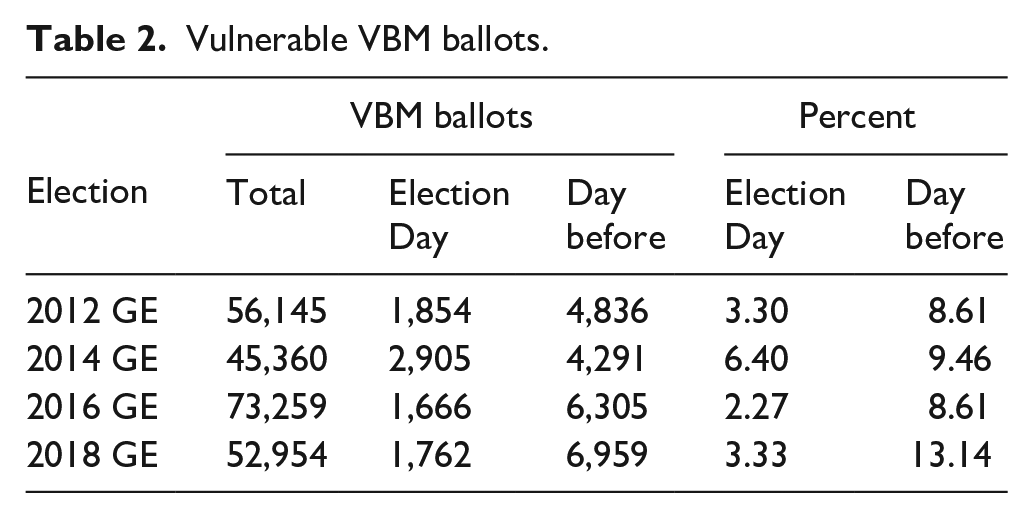
The percentages of VBM ballots received on Election Day range from two to six, and all ballots received on this day were vulnerable to even a one-day delay in mail delivery. In addition, the percentages of VBM ballots received one day prior to Election Day range from 8 to 13. Ballots received on this day were vulnerable to a two-day delay in mail delivery. That said, if one defines vulnerable VBM ballots as those ballots that would have been late had there been a mail delivery delay of two days, then it follows that the percentage of vulnerable VBM ballots cast in the four most recent general elections in Maine ranges from approximately 10% to 16%.
There is always some arbitrariness in stipulating a precise cutoff—here, two days—used to characterize what we define as vulnerable VBM ballots. The most conservative characterization of vulnerability would presumably posit that vulnerable ballots are only those that arrive on Election Day itself. Still, the United States Postal Service states that First-Class Mail normally takes “2–5 days” for delivery. This motivates our use of the lower bound of this range (two days) in our definition of VBM ballot vulnerability. 14
Table 2 illustrates the extent to which Maine VBM’s voting system is fragile. Based on historical general elections in Maine, what might seem like minor disruptions to mail delivery—one or two days—can cause over 10% of VBM ballots cast in the state to be rejected on the basis of lateness.
Late VBM ballots represent lost chances to exercise voting rights. From this perspective, even a single VBM ballot that is late due to a mail delivery disruption is an affront to the right to vote. Moreover, general elections in Maine tend to feature a variety of statewide contests, potentially for President of the United States, for a seat in the United States Senate, and so forth. Putting aside for the moment the matters of voting rights and the types of voters who cast vulnerable VBM ballots, if there are minor mail delivery disruptions in Maine during a general election month, a close election for a statewide contest could in principle end up having a margin smaller than the number of late VBM ballots. This could cause a crisis in electoral legitimacy.
Barely late VBM ballots
Thus far we have analyzed VBM ballots in Maine that arrived on time but barely so. We now consider VBM ballots in the state that were at most three days late. These ballots were rejected on the basis of lateness, and thus they cannot, strictly speaking, be characterized as vulnerable to postal delivery delays. However, barely late VBM ballots in Maine are similar to barely on-time ballots insofar as they all arrived in close temporal proximity to Election Day.
Table 3 reports by arrival day counts of late VBM ballots across our Maine elections of interest, focusing on ballots that arrived within three days of Election Day. The table also reports total percentages of ballots that arrived barely late. These percentages range from 0.19 to 0.92. This means, among other things, that close to 1% of VBM ballots cast in Maine in the 2018 GE were rejected on the grounds of being (barely) late.
Barely late VBM ballots.
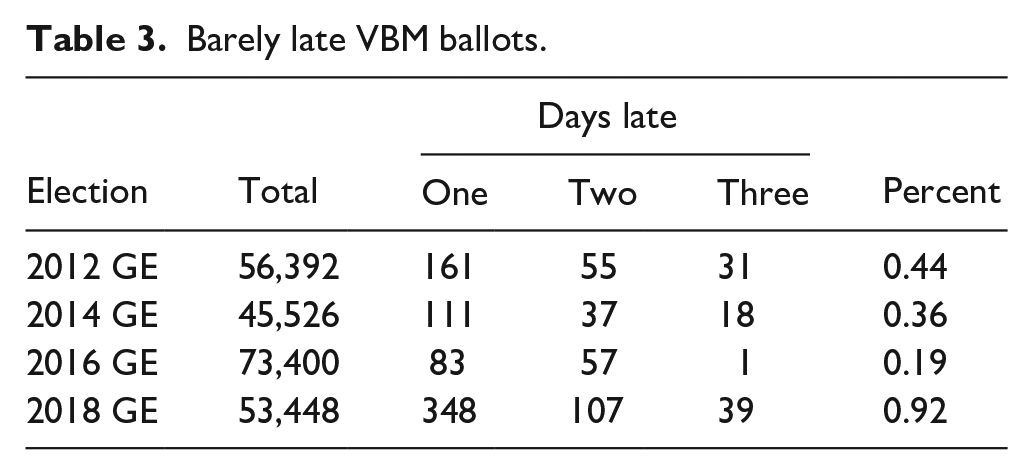
The percentages of ballots in Table 3 are much smaller than those in the vulnerable ballot category described in Table 2. Thus, there are more vulnerable VBM ballots cast in Maine (these ballots were at risk of rejection on account of timeliness) than actual barely late ballots (which were rejected). In terms of the overall collection of VBM ballots that arrive in Maine right around Election Day, the vast majority arrive immediately beforehand.
Partisan differences in VBM ballot vulnerability
Having shown how mail delivery disruptions in Maine have the potential to affect thousands of VBM ballots cast in the state, we now consider whether this might have partisan consequences. The analysis here has three components: (1) partisanship and VBM ballot vulnerability statewide in Maine; (2) partisanship and VBM ballot vulnerability in populous areas of Maine; and (3) partisanship and late VBM ballots in Maine.
Here we explore the matter of partisanship because we are interested in whether election outcomes themselves could in principle reflect shocks to mail delivery. Identifying winning candidates is how elections ultimately link voters to political representation. Thus, a necessary condition for election outcomes to be dependent on mail delivery is that the candidate choices made by VBM voters are correlated with the extent to which VBM ballots are vulnerable to mail delivery disruptions. We use partisanship as a proxy for voting behavior and candidate choices. It is not a perfect proxy, of course, but ballot secrecy prevents us from knowing how the votes on vulnerable VBM ballots are allocated among candidates.
Partisanship and VBM vulnerability in Maine
When individuals register to vote in Maine, they must provide party affiliations. These affiliations are shorthand for partisanship. Table 4 lists the partisanships of Maine’s VBM voters in our four elections, and it shows that the vast majority of VBM ballots were cast by Democrats, Republicans, and individuals unaffiliated with any political party. There is a scattering of voters registered with other political parties in our four absentee files (i.e., the Green Independent Party), but we ignore ballots cast by voters from third parties given their small sizes. Figure 2 breaks down daily VBM ballot receipts by partisan affiliation and by election. Each row in the plot is a set of three panels that corresponds to a single election. 15
VBM ballots and partisanship.


VBM ballot receipts by party in the 2012, 2014, 2016, and 2018 general elections.
Roughly speaking, Figure 2 shows that, starting a month before Election Day, Democratic and Republican affiliates have on weekdays increasing daily VBM ballot receipts (weekend VBM receipts are similar, but their numbers are small). As Election Day approaches, returns tend to drop. In some cases, the drop-offs are small, but in other cases, the VBM return counts of Democratic and Republican affiliates reach their maxima a week or so before Election Day. Unaffiliated VBM voters, however, present different patterns of daily VBM returns. Namely, their returns increase right up to Election Day.
These characterizations of trends are rough, relying on a small number of days. Accordingly, we now continue with our characterization of vulnerable VBM ballots as those returned on Election Day or the day prior. Table 5 breaks down these VBM ballots by election and partisanship, and the righthand column of the table reports the percentage of vulnerable VBM ballots by group.
Partisanship and VBM ballot vulnerability.

The magnitudes of the percentages in Table 5, ranging from approximately 9% to 20%, mirror patterns in overall VBM ballot vulnerability seen earlier. Moreover, there is one consistent pattern in Table 5: VBM ballots cast by individuals unaffiliated with a political party are more vulnerable to mail disruption than those cast by Democratic and Republican party affiliates.
This result could in principle be confounded by geography. Politically unaffiliated individuals in Maine may tend to reside in rural locations where mail delivery is more complicated than in urban areas of the state. 16 To check on this possible confound, Table 6 presents a version of Table 5 restricting attention to the eight most populous municipalities in Maine. 17 Even when we restrict attention to these Maine municipalities, politically unaffiliated VBM voters have the greatest rates of vulnerable VBM ballots.
Partisanship and VBM ballot vulnerability, populous areas only.

Our results on the relative vulnerability of VBM ballots cast by unaffiliated voters—which hold in Maine overall and in the state’s more populous areas—suggest that independent voters take longer to decide whom to support than their partisan counterparts. This is consistent with findings in Gopoian and Hadjiharalambous (1994), who show that late-deciding voters are less politically active than others. Our results are also consistent with Shino and Smith (forthcoming), whose findings imply that, the more partisan an individual, the greater the likelihood of voting prior to Election Day. It follows, then, that unaffiliated voters in Maine—who have played major roles in electing independent governors and United States senators—are likely to take more time returning their ballots (Brox and Giammo, 2009; Fournier et al., 2004; Gopoian and Hadjiharalambous, 1994; Shino and Smith, forthcoming).
Waiting until the last minute during a pre-election period to cast a ballot may be advisable in some instances: the later an individual votes, the more information he or she has on the candidates running for office and the lower the likelihood that he or she votes for a candidate who has withdrawn from an election (Meredith and Malhotra, 2011). However, this advice has its limitations when applied to VBM voting. VBM ballots, as we have emphasized throughout, can be rejected on the basis of lateness. Moreover, in a situation where mail reliability is a concern, VBM ballots returned close to Election Day are vulnerable to mail delivery disruptions. A voter contemplating this fact will have to balance the likelihood of casting a late (and rejected) VBM ballot with the additional information on candidates that comes with time.
Table 5 and the related Table 6 show that the percentage of Democratic VBM ballots that is vulnerable is often, but not always, lower than the percentage of Republican ballots that is vulnerable. However, this finding does not imply that, overall, mail disruption poses a low threat to Democratic ballots. Rather, in every election studied here, the number of vulnerable Democratic VBM ballots is greater than the number of vulnerable Republican ballots. This is evident in the counts of vulnerable VBM ballots in Table 5.
As an additional perspective on this point, Figure 3 plots daily Democratic-Republican VBM return differences for our four elections of interest. As in earlier plots, each point in the figure is either open (weekday) or closed (weekend). The size of each day’s point is proportional to the sum of the Democratic and Republican VBM ballots received on that day. Figure 3 contains weekday and weekend smoothers, and, as before, we focus on weekday VBM ballot returns. The implications of Figure 3 are threefold. First, VBM voting in Maine leans in a Democratic direction in comparison to a Republican direction: most points in the four panels of Figure 3 lie above zero. Second, the four elections depicted in Figure 3 had fundamentally different dynamics with respect to the partisanship of VBM ballot receipts:
In the 2012 GE, weekday receipts favored Democrats every weekday of the pre-election period but decreased over time.
In the 2014 GE, the beginning of the pre-election period favored Democratic VBM receipts, the middle favored Republican receipts, and the end, Democratic receipts.
In the 2016 GE, the beginning and end of the pre-election period were moderately pro-Democratic, but the middle of the period leaned heavily in this direction.
In the 2018 GE, VBM ballot receipts were pro-Democratic throughout the month before Election Day and became increasingly so as Election Day neared.
Third, the last few days of VBM ballot receipts in the 2012 GE through the 2018 GE featured more Democratic than Republican ballots. As characterized in Figure 3, in some cases the Democratic-Republican gap in VBM ballots in the few days prior to Election Day was stable and in some cases trended upward. Thus, mail delivery disruptions would have disproportionately affected Democratic ballots had they occurred in 2012, 2014, 2016, or 2018. In a sufficiently close election, this could be pivotal to an election outcome.
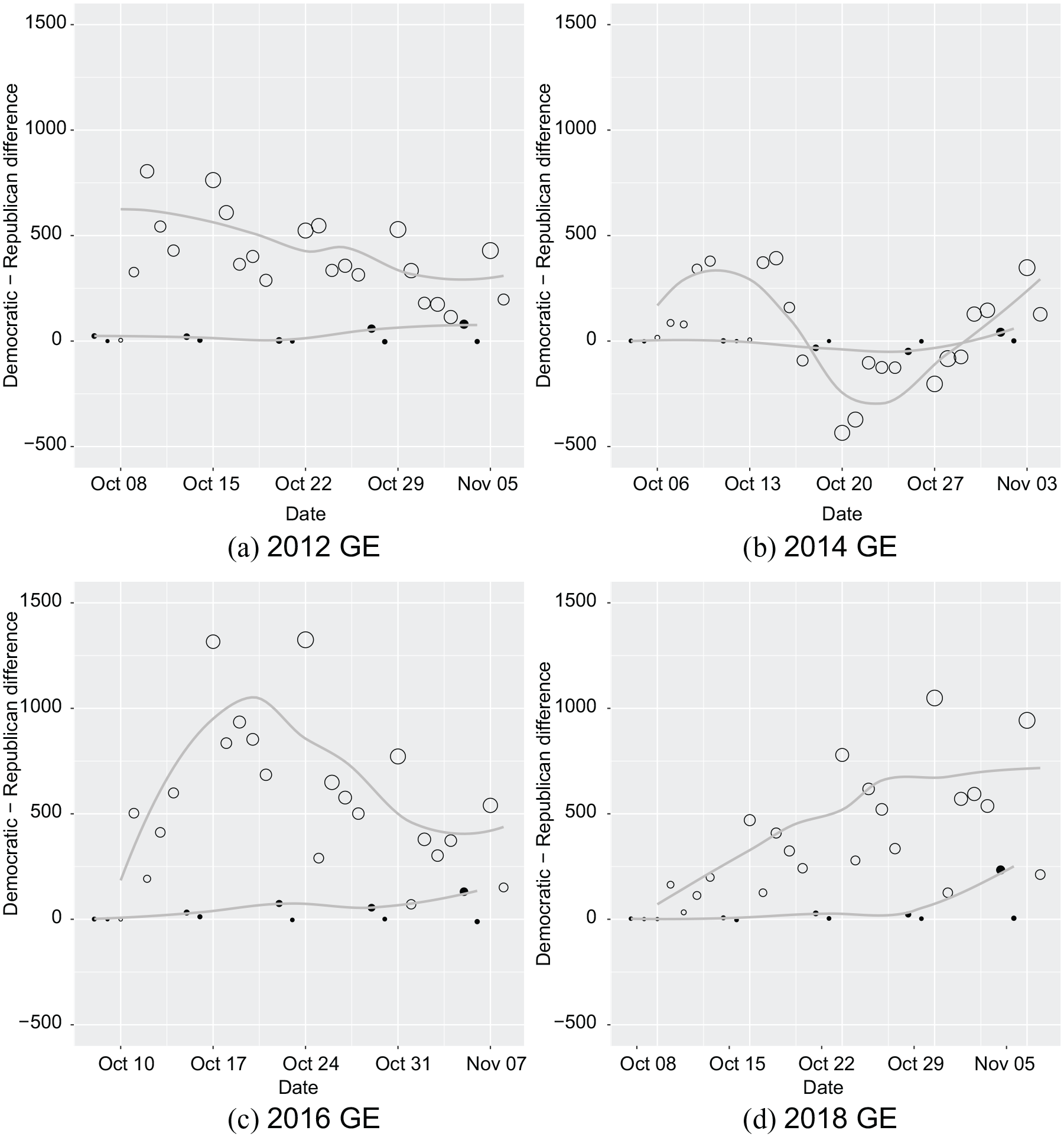
Partisan differences in VBM ballot receipts in the 2012, 2014, 2016, and 2018 general elections.
The partisan variability across elections that is evident in Figure 3 are beyond our scope. With few exceptions, scholars in election administration in the United States have not taken a serious interest in patterns of VBM ballot receipts prior to an election. Rather, and as we reviewed earlier, most studies of VBM voting in the United States focus on who votes by mail and how ballots cast this way differ from ballots cast in-person—not on when VBM voters cast their mail-in ballots. But the timing of votes is increasingly important; documenting what they call “overtime votes” (ballots counted after Election Day), Foley and Stewart (2015) find that such mail ballots are disproportionately Democratic, albeit not because of mail-in delays but rather on account of their being accepted provisional ballots.
Mobilization efforts by parties and social organizations can affect the timing of early votes (Hassell, 2017; Herron and Smith, 2012; Michelson, 2005), and, more broadly, messages about methods of ballot casting can influence how voters cast their ballots (Herrnson et al., 2019). Nonetheless, the relationship between party mobilization efforts and absentee voting, of which VBM voting is a part, is not clear (Berinsky et al., 2001; Karp and Banducci, 2001). Regardless, the matter of what causes the patterns we have documented in Figure 3 would be a valuable subject for future research. What is important for us is the fact that, whatever is driving those patterns, has implications for VBM ballot vulnerability.
Partisanship and barely late VBM ballots in Maine
Table 7 breaks down barely late VBM ballots by partisanship and election. As was done earlier, the ballots covered in the table are those that arrived within three days of Election Day. These ballots are described as “Barely late.” Other ballots are “Not barely late.”
Partisanship and late VBM ballots.

In all four elections in Table 7, the Democratic rate of barely late ballots is greater than the Republican rate. The extent of the partisan Democratic-Republican disparity is sometimes small (approximately 0.01 percentage points in the 2012 GE) but not always (approximately 0.12 percentage points in the 2018 GE). Also, in all four elections, barely late VBM ballot rates of unaffiliated voters are greater than corresponding rates for Democratic and Republican voters. These findings are consistent with the results on vulnerable VBM ballots that we described earlier. Thus, the same dynamics affecting vulnerable ballots are at work regarding barely late ballots. Barely late VBM ballots are not partisan-neutral, which is true of vulnerable VBM ballots as well.
Conclusion
We have studied the receipt dates of on-time and barely late VBM ballots cast in Maine in the state’s four most recent general elections. First, we explained how Maine’s mail-in voting environment is dependent on mail delivery, and based on this we presented data to the effect that, in historical elections, around 10% of VBM ballots cast were received barely on time. These ballots are vulnerable to small perturbations in mail delivery. Had there been a minor mail disruption in the 2012, 2014, 2016, or 2018 general elections in Maine, thousands of VBM ballots could have been at risk. We characterized this aspect of Maine’s VBM voting environment as fragile. While our analysis has focused on a single state, we have no reason to think that Maine is unique in the way that many VBM ballots cast in it arrive with no, or almost no, time to spare prior to a statutory receipt deadline.
In addition, we showed that VBM ballot vulnerability in Maine is not independent of party registration. The VBM ballots of politically unaffiliated voters are received later than those of Democrats and Republicans, leading to proportionally greater numbers of unaffiliated voters being vulnerable to late (and rejected) VBM ballots. Moreover, and in terms of raw numbers, there are more Democratic VBM ballots received very close to Election Day than there are Republican ballots, showing that there are more Democrats whose VBM ballots are vulnerable to postal disruptions than Republicans. These two points, as well as our conclusion that barely late (and thus rejected) VBM ballots cast in Maine are more Democratic than they are Republican, add a new dimension to the findings of Thompson et al. (2020) and Barber and Holbein (2020); namely, that the opportunity to vote by mail has partisan implications on account of a dependence on timely mail delivery.
Supplemental Material
sj-zip-1-rap-10.1177_2053168020981434 – Supplemental material for Postal delivery disruptions and the fragility of voting by mail: Lessons from Maine
Supplemental material, sj-zip-1-rap-10.1177_2053168020981434 for Postal delivery disruptions and the fragility of voting by mail: Lessons from Maine by Michael C. Herron and Daniel A. Smith in Research & Politics
Footnotes
Acknowledgements
The authors thank Nicolás Macri and two anonymous referees for comments on an earlier draft of this article.
Declaration of conflicting interests
The author(s) declared the following potential conflicts of interest with respect to the research, authorship, and/or publication of this article: Herron declares that he served as an expert witness on behalf of plaintiffs in the matter of Alliance for Retired Americans et al. v. Matthew Dunlap et al. (DKT NO. CV-20-95). Otherwise the authors declare no other potential conflicts of interest with respect to the research, authorship, and/or publication of this article.
Funding
The author(s) received no financial support for the research, authorship, and/or publication of this article.

Supplemental materials
Notes
Carnegie Corporation of New York Grant
This publication was made possible (in part) by a grant from the Carnegie Corporation of New York. The statements made and views expressed are solely the responsibility of the authors.
References
Supplementary Material
Please find the following supplemental material available below.
For Open Access articles published under a Creative Commons License, all supplemental material carries the same license as the article it is associated with.
For non-Open Access articles published, all supplemental material carries a non-exclusive license, and permission requests for re-use of supplemental material or any part of supplemental material shall be sent directly to the copyright owner as specified in the copyright notice associated with the article.
