




Abstract
Recent research has generated important new insights into the existence, behavior, and violent consequences of armed actors in civil wars. However, the lack of suitable information on actor relationships with the state means that studies have been forced to assume that armed groups are either pro-government or anti-government and remain that way for the duration of their existence. Both assumptions severely limit our understanding of the armed actors themselves, as well as the violent dynamics they produce. This article introduces the Government and Armed Actors Relations Dataset (GAARD), which provides detailed information on all major armed groups and their fluctuating alignment with the state between 1989 and 2007. GAARD identifies when armed groups fight with or against the government, and when they lack relationships with the government altogether. It further provides information on all changes in group alignments and documents when and how these occurred. We demonstrate that more than 25% of armed groups changed their alignments and showcase how this allows researchers to pursue original research on the drivers, dynamics, and outcomes of civil conflicts.
Introduction
Recent research on the study of armed actors 1 has generated important new insights into the existence, behavior, and violent consequences of rebel organizations (e.g., Cunningham et al., 2009; Cunningham et al., 2012; Fjelde and Nilsson, 2012) and armed pro-government groups (e.g., Ahram, 2011; Carey et al. 2013; Clayton and Thomson, 2016; Eck, 2015; Jentzsch et al., 2015). This important new approach towards carefully studying armed actors currently faces two limitations. First, rebel groups and pro-government militias are frequently conceptualized as a dichotomy, which fails to match group complexities on the ground (Otto, 2018; Staniland, 2017). Many contemporary wars feature groups that do not take sides, but nevertheless significantly influence conflict dynamics and outcomes (Barter, 2013). Second, quantitative analyses of civil conflict frequently assume fixed group relationships vis-à-vis the state. In reality, however, such relationships are often fluid and shifting. Qualitative studies underline how interactions between armed groups and the state can change from hostile confrontations to close collaboration (e.g., Christia, 2012; Day and Reno, 2014; Staniland, 2017, 2012). While research has started to explore when and why armed groups transition between fighting and supporting the government for selected conflicts (Johnston, 2007; Seymour, 2014), researchers lack the data necessary to uncover the shifting nature of group cooperation and hostility across conflicts.
This article introduces the Government and Armed Actors Relations Dataset (GAARD), intended to support researchers in overcoming the two outlined challenges. GAARD offers a comprehensive view on the possible shifts in alignments of armed groups. For instance, a group may start out as independent vigilantes without state cooperation, then become a pro-government militia, and may then switch sides and fight the government as a rebel group. To capture such changes, GAARD builds on the concept of group alignment, which focuses on the relationship between non-state armed actors and the government. The dataset distinguishes between pro-government, anti-government, and unaligned armed groups. GAARD tracks all major armed groups involved in civil conflict between 1989 and 2007, including each group’s history of alignment with the government as well as the nature of the alignment changes across time. It therefore provides a dynamic account of all major armed groups’ alignments across time and space.
Scope of GAARD
Major armed groups
In line with other datasets (e.g., Braithwaite and Cunningham, 2020; Cohen and Nordås, 2014), GAARD builds on the Uppsala Conflict Data Program (UCDP) to identify armed groups. GAARD’s population of interest is all armed groups that possess weapons, have a minimum level of organization, exist over a certain period of time, and are not part of the formalized state apparatus. To overcome limitations to which groups can plausibly be observed or classified, 2 GAARD captures major armed groups, defined as groups that have been involved in collective violence defined by UCDP’s 25 fatality threshold. GAARD traces all major non-state armed actors involved in civil wars and conflict related violence.
GAARD includes 506 major armed groups and records their alignments and alignment changes between 1989 and 2007. The group sample is based on the list of formally organized non-state armed groups recorded in the UCDP Actor Dataset (Version 2.1-2012). GAARD includes all armed actors recorded in the UCDP Armed Conflict Dataset (Gleditsch et al., 2002), the One-sided Violence Dataset (Eck and Hultman, 2007), and the Non-state Conflict Dataset (Sundberg et al., 2012). GAARD therefore also captures armed groups that do not have a contested incompatibility with a state but are involved in conflicts with other groups.
GAARD combines and complements the UCDP Actor list with information from the Pro-government Militia Database (PGMD, Version 1, Carey et al., 2013). 3 This allows GAARD to trace the alignments of armed groups and to provide cogent information on whether a group is pro-government, anti-government, or politically unaligned at any specific point in time. 4 In addition, GAARD records for all groups the formation and termination date as well as the type of termination. 5 The time coverage of GAARD is determined by the overlap of information between UCDP and PGMD, with the latter providing data until 2007 (Carey et al., 2013). 6
Government–armed group alignments
Classifications of armed groups differ widely. Researchers distinguish between insurgents, rebel groups, militias, warlords, terrorists, and organized criminals (e.g., Shultz et al., 2004; Krause and Milliken 2009, 2017). Some classify non-state groups according to their roles (Podder, 2013), targets (Schneckener, 2017), or political functions (Schuberth, 2015). Others focus on the groups’ goals or functions as liberators, separatists, reformers, warlords (Clapham, 1998; Reno, 2011), proxy forces (Ahram, 2011), death squads (Mazzei, 2009), vigilantes (Meagher, 2007), or counterweights (De Bruin, 2018).
While existing group taxonomies capture the variety of non-state armed actors, they tend to rely on non-exclusive categories or limit themselves to certain regions and contexts, reducing their usefulness for broader geographic or temporal comparisons (Carey and Mitchell, 2017). In addition, most taxonomies employed in large-N studies are static, not taking into account how actors change over time (Staniland, 2017). GAARD aims at being (a) sensitive to the changing alignments of armed actors, (b) parsimonious, and (c) amenable to large-N research.
To this end, GAARD focuses on an armed actor’s alignment vis-à-vis the national government. Alignment refers to an armed group’s visible action to support or to oppose the government. An alignment of a group does not have to be signified by formal agreement but can be delineated by a variety of behavioral activities (Wilkins, 2012).
We define an armed group’s alignment based on two criteria (see Figure 1). The first criterion evaluates if a group is linked to the government, indicated by a supportive relationship between both actors. The reference point for capturing the alignment(s) of an armed group is the national government of the country in which the group operates. 7 We follow Carey et al. (2013), who define groups as pro-government based on specific behavior and activities such as sharing information, funding, equipment or training with the government, undertaking shared operations, and/or holding political office. 8 Simply sharing the same enemy as the government, being tolerated by it, or not being opposed by it is not sufficient for a group to be classified as pro-government (Carey et al., 2013: 251). When armed groups are linked to the government and are not part of the official security apparatus, GAARD classifies them as having a pro-government alignment.

Alignment types.
The second criterion asks whether a group that is not pro-government has a contested incompatibility with the government—for instance, over territory and/or power (Gleditsch et al., 2002). We classify groups that militarily pursue their incompatibility with the government as having an anti-government alignment, signifying an opposing or hostile relationship between the group and the government. 9 If a contested incompatibility with the government is absent, GAARD categorizes a group as unaligned. Such armed groups are not linked to the government and have no contested incompatibility with the government (Barter, 2013; Schuberth, 2015). 10
Alignment changes
Focusing on alignments enables GAARD to capture fluctuating relationships between armed groups and the government. While alignment change is a prominent concept in research on party politics (e.g., Miller, 1991) and international relations (e.g., Wilkins, 2012), it has received surprisingly little attention in the study of civil war and political violence. To date, there is no typology of alignment changes by armed non-state groups. Moreover, while scholars have started to scrutinize why armed groups alter alignments (e.g., Christia, 2012; Staniland, 2012; Seymour, 2014), without comprehensive data, studies can only focus on specific alignment changes and are mostly restricted to small-N case comparisons. GAARD distinguishes between deliberate and contextual alignment changes. Alignment changes are assessed from the perspective of armed groups. GAARD assesses whether the armed group under study is the decisive initiator in changing its relationship towards the central government.
A deliberate alignment change occurs when an armed group collectively and intentionally changes its alignment with the central government during a civil conflict. In line with Staniland (2012: 19), a deliberate alignment change takes place when an armed group alters its pattern of targeting and operation. A contextual alignment change occurs when an actor other than the armed group itself causes a change in alignment with the government or if an armed group seizes power.
The categories of deliberate and contextual alignment changes seek to provide users with conceptual guidance. We recognize that the usefulness of this distinction rests on the specific research question at hand. GAARD therefore offers researchers full control over whether and how to aggregate the eight types that underlie deliberate and contextual alignment changes.
Types of deliberate changes:
Group joins the government side through a negotiated peace agreement.
Group defects from a negotiated peace agreement.
Group switches sides in a non-formalized way.
Types of contextual changes:
Group’s political affiliate loses power.
Group’s political affiliate assumes power.
Group loses government support.
Group reaches power itself.
Pro-government group is removed from power.
We identify and systematically code alignments and alignment changes using a variety of different sources, including policy papers, field research reports, scientific articles and books, and historical sources. This triangulation of information mitigates problems with inaccuracy or non-reporting, allowing GAARD to provide information on group alignments not contained in other datasets (Sundberg et al., 2012: 353). Critical coding decisions were made in consultation with country and conflict experts from various research institutions. Moreover, GAARD provides precision variables that report the solidity of information on each alignment change.
Finally, the scope of alignments and alignment changes captured by GAARD differs conceptually from a number of related phenomena such as rebel group alliances, coups, and military defections. We discuss these distinctions in great detail in Section 8 of the Codebook, Online Appendix.
Data structure and compatibility
To provide users with information at the highest possible resolution, GAARD’s unit of observation is the group-alignment-spell. Groups without alignment changes occupy one observation in the dataset. In contrast, a group that, say, undergoes one alignment change from pro-government to anti-government is recorded with two observations in GAARD. The first observation captures the group’s pro-government alignment whereas the second observation records the subsequent anti-government alignment. The alignment change is recorded at the end of the first alignment spell. The start and end date of both alignment spells are coded on the daily level. We also provide GAARD in the group-alignment-year format, and users can easily aggregate the data to the country-year level.
GAARD is fully compatible with existing group- and country-level datasets on conflict and violence. GAARD provides UCDP and PGMD actor IDs for each armed group, making it fully compatible with all UCDP datasets, PGMD, and a variety of other data resources such as, for example, the Non-state Actor Dataset (Cunningham et al., 2013), the ACD2EPR dataset (Wucherpfennig et al., 2012), the Sexual Violence in Armed Conflict Dataset (Cohen and Nordås, 2014), and the Foundations of Rebel Group Emergence Dataset (Braithwaite and Cunningham, 2020). Users can also link GAARD to the data by Powell and Thyne (2011) to identify those groups recorded in GAARD that are involved in coups. Finally, we locate each group in the country it operates in and provide Gleditsch and Ward (1999) country codes, which allows users to merge GAARD with country-level indicators used in the study of armed conflict and state repression.
Prevalence of alignment and alignment changes
Table 1 highlights the variation of group alignments recorded in GAARD. Roughly half of all group alignments were anti-government, while one third were pro-government. Among the groups that were active between 1989 and 2007, 15% were unaligned vis-à-vis the government at some point. Unaligned armed groups thus form an important actor category that require further research with respect to their role in conflict and post-conflict dynamics.
Frequency of alignments by type (1989–2007).
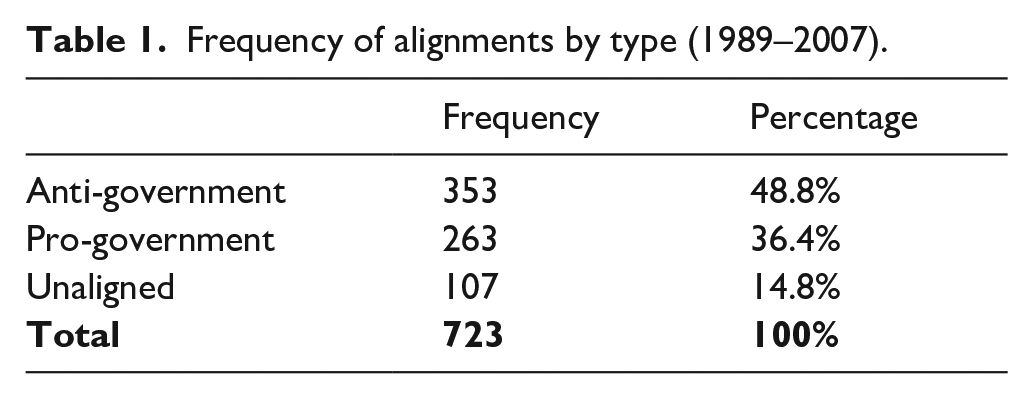
Figure 2 tracks the alignments of armed groups over time. While the number of anti-government groups remained relatively stable throughout the 1990s, there is a visible downward trend that commenced in the late 1990s and continued through the mid-2000s. GAARD also reveals that the number of pro-government groups rapidly increased with the end of the Cold War but has remained stable since then. In contrast, the number of unaligned groups has steadily increased. 11

Alignment trends.
Turning to alignment changes, Table 2 shows that almost 75% of all armed groups featured a consistent alignment towards the national government. In contrast, roughly 25% of the groups experienced at least one alignment change during their lifetime. A significant share of groups thus changed their relationship with the national government during their existence. GAARD also illustrates that if groups experience alignment changes, they often do so more than once. On average, a group changed alignment 2.8 times during the time period covered.
Frequency of alignment changes (1989–2007).

Figure 3 visualizes the directions in which groups change their alignments. The majority of alignment changes recorded in GAARD are groups that changed their alignment from anti-government to pro-government (49%). The second most frequent change is in the opposite direction, where pro-government groups became anti-government (31%). A small number of changes are undertaken by unaligned groups which became pro-government (7%), and by pro-government groups transitioning back to being unaligned (10%).

Directions of alignment changes.
Table 3 disaggregates the types of alignment changes observed in the period under consideration. While we associate the first three types with deliberate changes (about 44% of all recorded changes) and the others with contextual changes (56%), we encourage researchers to aggregate change types as they deem appropriate for their endeavors. The majority of deliberate changes are non-formalized (49 out of 95), while the contextual alignment changes are more evenly distributed.
Types of alignment changes (1989–2007).

Finally, alignment changes varied by region. In Sub-Saharan Africa, 31% armed groups changed their alignment at least once while 29% underwent alignment shifts in Asia. In Europe, the Middle East and North Africa, and Latin America, only 16% groups altered their alignment.
Alignment dynamics in Sierra Leone
To showcase the versatility of the GAARD, Figure 4 visualizes the histories of all armed groups active in Sierra Leone between 1989 and 2007. 12 Among the armed groups that existed in Sierra Leone, three were continuously pro-government and one was anti-government. The other four non-state groups underwent both deliberate and contextual alignment changes, which illustrates the fluidity of government–rebel group relationships.

History of major armed groups in Sierra Leone.
Defectors from the Sierra Leone army founded the pro-government Armed Forces Revolutionary Council (AFRC) in 1997. In the following year, the group was pushed out of power—a prime example of a contextual alignment change. In contrast, the Revolutionary United Front (RUF) started out as an anti-government group but became aligned with the AFRC, therefore experiencing two contextual alignments. The RUF became pro-government when the AFRC assumed power and was again made an anti-government group when the AFRC was ousted in 1998. In the three subsequent years, the RUF undertook three deliberate alignment changes. In 1999 it joined the Lomé peace agreement, then defected from it in 2000, and once again joined the Abuja agreement before being disarmed in 2002.
In contrast, the West Side Boys (WSB) experienced non-formalized, deliberate alignment changes. Formed as an anti-government group, it quickly became aligned with the government and helped fighting the RUF when the WSB leader Johnny Paul Koroma became a member of the government-installed Commission for the Consolidation of Peace. The WSB-government coalition broke in 2000. The group became anti-government and was eventually neutralized by British forces during “Operation Baras.”
The Kamajors group experienced two contextual alignment changes. Created by the government to fight the RUF in 1991, the group ended up on the anti-government side when the RUF, together with the AFRC, seized power in 1997. In 1998, the AFRC–RUF coalition was ousted from government and Ahmad Tejan Kabbah reinstalled as president. Consequently, the Kamajors again became pro-government while the ARFC and RUF once more turned anti-government. The complex trajectories of armed groups in Sierra Leone demonstrate how GAARD can help analyze the dynamic behavior of armed groups.
Conclusion
The ongoing conflicts in Syria, Pakistan, or the Democratic Republic of Congo demonstrate the complexity of “armed politics” (Staniland, 2017). They not only feature a multitude of actors but also armed groups that have changed their relations with the state. Building on significant advancements in research on conflict actors, this article introduces the Government and Armed Actors Relations Dataset (GAARD). GAARD provides systematic information on the changing alignments of armed groups. Its nuanced coding offers scholars detailed information on how and when groups oscillate between being pro-government, anti-government, or unaligned, thereby capturing the variability of non-state armed politics. Overall, GAARD highlights the large variation in alignments and alignment changes of armed groups around the globe.
We hope that GAARD will assist scholars in taking a closer look at conflict dynamics and outcomes. For instance, with GAARD researchers can systematically investigate how governments turn rebels into counter-insurgent forces and how alignment changes influence the escalation of violence. Moreover, pro- and anti-government groups often shape the paths of countries to sustainable peace. The information provided by GAARD can be used to connect conflict dynamics to post-conflict outcomes and to help assess where conflict resolution is likely to succeed.
Supplemental Material
sj-pdf-1-rap-10.1177_2053168020971891 – Supplemental material for Capturing group alignments: Introducing the Government and Armed Actors Relations Dataset (GAARD)
Supplemental material, sj-pdf-1-rap-10.1177_2053168020971891 for Capturing group alignments: Introducing the Government and Armed Actors Relations Dataset (GAARD) by Sabine Otto, Adam Scharpf and Anita R. Gohdes in Research & Politics
Supplemental Material
sj-zip-1-rap-10.1177_2053168020971891 – Supplemental material for Capturing group alignments: Introducing the Government and Armed Actors Relations Dataset (GAARD)
Supplemental material, sj-zip-1-rap-10.1177_2053168020971891 for Capturing group alignments: Introducing the Government and Armed Actors Relations Dataset (GAARD) by Sabine Otto, Adam Scharpf and Anita R. Gohdes in Research & Politics
Footnotes
Acknowledgements
We would like to thank the members of the Uppsala Conflict Data Program for their help and feedback throughout this project. We also thank Sabine Carey, Lee Seymour, Nils B. Weidmann, Paul Staniland, as well as our editor Kristian Skrede Gleditsch and four anonymous reviewers for helpful comments.
Declaration of conflicting interests
The author(s) declared no potential conflicts of interest with respect to the research, authorship, and/or publication of this article.
Funding
The author(s) disclosed receipt of the following financial support for the research, authorship, and/or publication of this article: This project has benefited from financial support by the Individuals, Societies, Cultures and Health (ISCH) COST Action IS1107 “European Network for Conflict Research” (ENCoRe) and the Graduate School of Decision Sciences, University of Konstanz.
Supplemental materials
The supplemental files are available at http://journals.sagepub.com/doi/suppl/10.1177/2053168020971891 The replication files are available at 
Notes
References
Supplementary Material
Please find the following supplemental material available below.
For Open Access articles published under a Creative Commons License, all supplemental material carries the same license as the article it is associated with.
For non-Open Access articles published, all supplemental material carries a non-exclusive license, and permission requests for re-use of supplemental material or any part of supplemental material shall be sent directly to the copyright owner as specified in the copyright notice associated with the article.
