




Abstract
The color revolutions in Eastern Europe and the recent waves of protests in the Middle East and North Africa show that nonviolent conflicts, like violent conflicts, spread across countries. Scholars argue that the idea of adopting nonviolent resistance travels across borders because dissidents learn from foreign protestors about the principles of nonviolent campaigns and their success in changing the status quo. However, the commonly used country-level data do not allow scholars to distinguish between these two learning mechanisms and to establish a causal association between exposure to information about nonviolent resistance and changing individuals’ attitudes. Therefore, we conduct an experimental survey to analyze and distinguish individuals’ responses to information about the principles of nonviolent campaigns and their higher prospects for success. Our findings show both types of information increase individuals’ evaluation of nonviolent resistance. However, exposure to information on the principles of nonviolent campaigns yields different results than exposure to information on the success rate of nonviolent campaigns.
Introduction
When do individuals tend to prefer nonviolent to violent resistance? Does providing information on the principles and success of nonviolent civil resistance influence individuals’ attitudes toward nonviolent movements? Existing empirical research (Braithwaite et al., 2015; Brancati and Lucardi, 2019; Gleditsch and Rivera, 2017) shows that nonviolent campaigns inspire nonviolent resistance in other countries. While the existing literature provides significant insights into the diffusion of nonviolent resistance, its focus on the country-level data limits its ability to draw reliable conclusions on whether and how individuals at home are influenced by the onset and success of nonviolent campaigns in other countries.
This study conducts a randomized experimental survey to explore whether and how providing information to individuals changes their attitudes toward nonviolent methods of resistance. The findings of our experiment show that providing information on the principles and success of nonviolent campaigns significantly increases individuals’ evaluation of nonviolent resistance. Nevertheless, the impact of information about the principles of nonviolent resistance is more robust than the effect of information on its success rate across different measures of attitudes. In fact, the participants who learn about the principles of nonviolent campaigns, as well as those who learn about the success rate of these campaigns, are more likely to adopt nonviolent resistance, allocate more resources to it, and believe it is more efficient than violent resistance. However, only providing information on the principles of nonviolent campaigns also significantly changes the participants’ attitudes about the morality advantage of nonviolent resistance and how much time it requires to achieve its goals.
Our findings contribute to the ongoing research on the scientific study of nonviolent resistance in two major ways. First, we use social learning theory to derive testable hypotheses about how receiving information on nonviolent campaigns changes attitudes toward nonviolent methods at the individual level. Most of the research on nonviolent campaigns 1 has relied on the country-level data, making it difficult to evaluate the micro-mechanisms through which the diffusion of nonviolent resistance happens. It is not clear whether the existing strong statistical relationship between nonviolent campaigns in foreign countries and at home is due to correlation or causation. Addressing the micro-level mechanisms of diffusion has become more significant since recent findings by Brancati and Lucardi (2019) challenge the existing literature on the diffusion of democracy protests. Also, Weyland’s (2019) critical response to their work invites scholars to be more specific about the micro-level mechanisms of nonviolent conflict diffusion. Our experimental data at the individual level is the first step in exploring the micro-level mechanisms of the diffusion of nonviolent movements.
Second, our study shows that exposure to information on the principles of nonviolent campaigns yields different results than exposure to information on the success rate of nonviolent campaigns. The participants who received information on the principles of nonviolent campaigns changed their attitudes toward nonviolent resistance on all different measures of nonviolent attitude compared to those who received information on the success rate of nonviolent resistance. Therefore, the type of information that individuals receive about nonviolent resistance affects the changes in their attitudes toward it.
Theoretical expectations
Chenoweth and Stephan’s (2011) findings that civil resistance campaigns are twice more successful than violent ones inspired a new wave of scientific research on the nonviolent methods of resistance over the past decade. Research on nonviolent movements has improved our understanding of the dynamics (Butcher and Svensson, 2016), effectiveness (Lehoucq, 2016), and outcomes (Bayer et al., 2016; Celestino and Gleditsch, 2013) of civil resistance.
This literature also finds a diffusion effect for nonviolent campaigns (Braithwaite et al., 2015; Gleditsch and Rivera, 2017). In fact, as with violent conflict, 2 nonviolent resistance in foreign countries—primarily in neighboring ones—increases its probability at home. Within violent conflict literature, Salehyan and Gleditsch (2006) and Salehyan (2009) explain how forced displacement and transnational rebels contribute to the risk of conflict contagion. However, nonviolent conflict literature has not adequately explored mechanisms through which nonviolent resistance spreads to other countries. Indeed, country-level statistical findings in this literature provide little information on the micro-level mechanisms of the diffusion of nonviolent campaigns.
Studies on the diffusion of nonviolent resistance assume that one possible way of its spread is the learning process. Braithwaite et al. (2015) and Gleditsch and Rivera (2017) underline the importance of learning about the principles of nonviolent campaigns in their diffusion across borders. Braithwaite et al. (2015) also discuss and explore the link between the spread of nonviolent campaigns and information about their success chance. Despite the agreement on the diffusion of nonviolent campaigns in the literature, these country-level studies rely on an underlying micro-level assumption: exposure to information about nonviolent resistance can increase individuals’ evaluation and thus increase the probability of adopting it as a form of dissent. However, these assumptions are not tested, and related micro-level mechanisms remain underexplored. Does providing information on nonviolent resistance change individuals’ attitudes? If yes, can information about the principle of nonviolent resistance increase support for it? Or, do individuals need to learn the success rate of nonviolent campaigns to support it? Below, we use social learning theory to develop two testable hypotheses about two potential ways through which nonviolent campaigns can cross borders: learning about the “principles” of nonviolent campaigns and learning about their “success” rate compared to violent ones.
Social learning theory (Bandura, 1977) explains that individuals learn and emulate behaviors they observe in other people. This theory has a broad application in different fields of social science and received empirical support in criminology (Hirschi and Gottfredson, 1983), economics (Mobius and Rosenblat, 2014), management (Sims and Manz, 1982), and communication studies (Bandura, 2001). Similarly, individuals’ exposure to the principles of nonviolent resistance can contribute to their learning about nonviolence, and thus their interest in emulating this behavior. In other words, individuals get a sense of nonviolent resistance once they have received information on what it is. Therefore, it is reasonable to believe that information about the principles of nonviolent resistance can change individuals’ beliefs on this method of resistance.
Social learning does not necessarily require direct and in-person interactions with other people. It can also be acquired through reading or hearing. This helps explain the emulation of nonviolent campaigns before the expansion of broadcast media. Print media provide information on the principles of nonviolent resistance in other countries and help activists learn about it when access to broadcast media is limited. Nowadays, due to the presence of online social media platforms, news on political dissent and resistance methods can travel across the world in a few minutes. Even opposition groups in autocratic countries, where media freedom is limited, can hear about and learn from foreign anti-government movements (Weidmann and Rød, 2019).
Therefore, if a group of discontented citizens learn that the people in another country, especially a neighboring one with cultural similarities, use nonviolent resistance, we expect that they will show more interest in nonviolent resistance and are more likely to emulate it. Drawing on the literature on the diffusion of nonviolent movements as well as existing theories of learning in broader social science, we expect that:
Hypothesis 1. Receiving information on nonviolent campaigns makes respondents more likely to view nonviolence positively relative to violent resistance.
Besides learning about the principles, some studies underscore the role of information about the success of nonviolent movements. For example, Braithwaite et al. (2015) argue that nonviolent campaigns diffuse because individuals are expected to participate in anti-government protests if they see indications of a higher likelihood of success. 3 A critical factor in social learning theory is “vicarious reinforcement,” which explains the imitation of specific behaviors (Schultz and Schultz, 2016). According to Malouff and Rooke (2008, p.1000), “[v]icarious reinforcement occurs when (a) an individual observes another person (a model) behave in a certain way and experience a consequence perceived as desirable by the observer, and (b) as a result, the observer behaves as the model did.” Braithwaite et al. (2015) implicitly apply the “vicarious reinforcement” theory and underscore the importance of success in the spread of nonviolent methods of resistance across borders. Therefore, if individuals need to learn about the desirable consequence of a specific action to change their attitudes, then learning about the principles of nonviolence is not sufficient to increase support for nonviolent resistance. Instead, only information about the success rate increases individuals’ evaluation of nonviolent resistance.
Hypothesis 2. Receiving information on the success of nonviolent campaigns makes respondents more likely to view nonviolence positively relative to violent resistance.
Experimental design
Consistent with our theoretical arguments, we conducted a randomized lab experiment to evaluate how individuals’ attitudes toward nonviolent methods of resistance change in response to two types of information: the principles of nonviolent campaigns and their better success rate compared to violent ones. The survey was conducted online using the Qualtrics web platform at one of the largest US public universities in two rounds, after applying and receiving Institutional Review Board approval. In the first round, in June 2016, 129 students participated in the study. After another round of recruitment in November and December of 2016, another 331 students took the survey, bringing the total number of attendees to 460. Of these, 23 participants (5%) did not finish the experiment. This could be due to technical problems or a personal decision, as the participants could leave the experiment at any moment, so the total size of the sample is 437. The participants are randomly allocated almost equally among these three groups; the numbers in the control, treatment 1, and treatment 2 groups are 150, 148, and 146, respectively. 4
The participants were randomly assigned to one control group and two treatment groups: principles and success. Participants in each of these groups watched a short video clip. The treatment clips were obtained from the International Center on Nonviolent Conflict’s (ICNC) YouTube channel, but the participants only watched the clips without any mention of the ICNC. The first treatment group, the principles group, watched a clip in which a research member from ICNC talks about the principles of nonviolent methods. The clip explains how the civil resistance works mainly by discussing how it challenges the legitimacy of the status quo and raises the cost of maintaining it for the ruling coalition. The second treatment group, the success group, watched a clip on the success rate of nonviolent methods in which a research member of ICNC explains why nonviolent movements tend to be more successful than violent ones, and how this is supported empirically. The control participants were also asked to watch a clip on international relations. By showing the control group a clip about international relations, we ensured that all three groups were exposed to a comparable environment. Before watching these clips, the participants answered a battery of questions about their demographic and socio-economic background, their political knowledge, and their familiarity with and interest in commonly known figures of violent and nonviolent resistance such as Martin Luther King, Malcolm X, and Che Guevara. After watching the clips, they were asked to assume they are a member of a society with a lack of democratic institutions or weak democratic institutions and answer five questions about violent and nonviolent methods of resistance:
How do you prefer violent resistance to nonviolent resistance? (Preference for nonviolence)
How do you, as a political leader of an opposition movement, allocate your resources to violent and nonviolent methods of resistance? (Allocation to nonviolence)
How do you evaluate the efficacy of nonviolent resistance vis-a-vis violent resistance? (Efficacy of nonviolence)
How do you evaluate the morality of nonviolent resistance vis-a-vis violent resistance? (Morality of nonviolence)
How do you evaluate the time-consumingness of nonviolent resistance vis-a-vis violent resistance? (Time-consumingness of nonviolence)
The respondents are asked to respond to these questions on a continuous scale from 1 to 10, with 10 being the highest. This also allows us to depart from the common dichotomous approach in the literature whereby the member of opposition decides between pure violent and pure nonviolent methods. These five questions are used as different proxies for measuring the participants’ attitudes toward nonviolent resistance compared to violent resistance. The details of the experiment—including surveys and clips—and the descriptive plots of answers are presented in the Online Appendix.
Results
We use the Ordinary Least Squares (OLS) method to estimate the effect of control and treatments on attitude formation of individuals while including a set of control variables in our model:

In our equation,
Table 1 presents 5 the estimated results. The findings show that participants who watched the treatment clips on the principles and success rate of nonviolent resistance show a higher level of support for it across all measured attitudes. The respondents’ answers to what they think about the moral superiority and time-consumingness of nonviolent methods reveal an interesting pattern. The positive changes in the respondents’ attitude from the principle group are statistically significant for all measured outcomes. However, the positive changes in support for nonviolent resistance in the success group are statistically significant only for three measured attitudes: preference for nonviolence, allocation to nonviolence, and efficacy of nonviolence. Therefore, the participants who watched the clip about the core principles of nonviolent resistance express a stronger belief that this method is morally superior and show a lower level of support for the claim that nonviolent resistance is more time-consuming than violent resistance.
Ordinary Least Squares regression.

Standard errors in parentheses; *p < 0.10, **p < 0.05, ***p < 0.01.
Figure 1 shows the estimated coefficients and their confidence intervals for the treatment dummy variables. This plot facilitates comparing the size of these estimated coefficients. Except for the morality and time-consumingness questions, there is not a consistent pattern in support of a larger effect for either type of information. Moreover, the plot shows that the estimated results are not statistically different across the treatment groups.
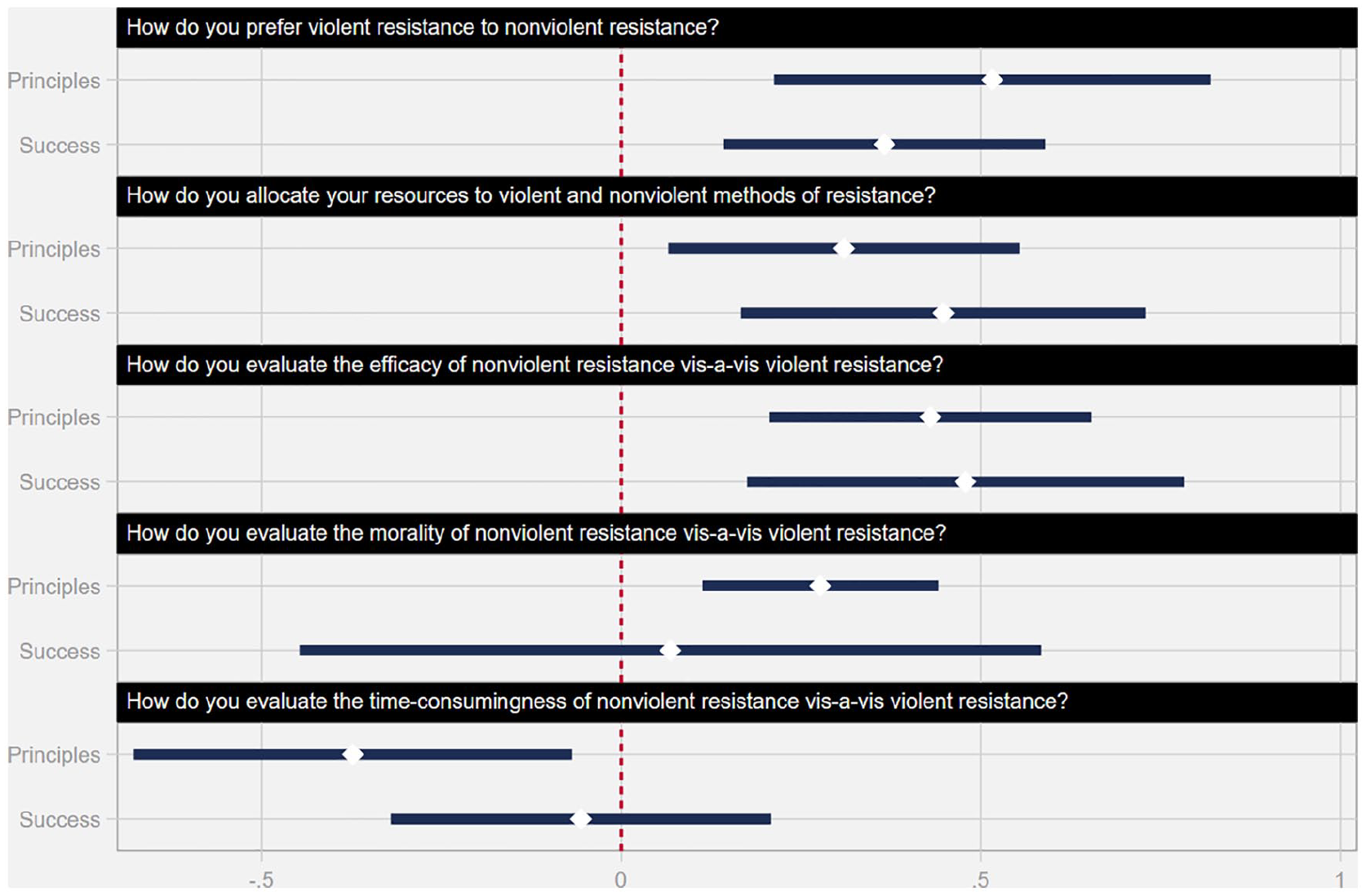
Estimated treatment effects using OLS.
We also plotted the substantive effects of the control and treatment clips on the participants’ attitudes toward nonviolent resistance. The plot, Figure 2, presents a more insightful picture of how treatment clips affect the participants’ attitudes across different measures. The predicted outcomes show that the participants in treatment groups express a relatively more positive attitude toward different dimensions of nonviolent resistance. The only exceptions are the participants’ predicted attitude toward the morality and time-consumingness of nonviolent resistance when they watched the clip about its success. Indeed, the estimated intervals for these two responses overlap with the estimated intervals for the control groups, suggesting that these two groups are not statistically different.
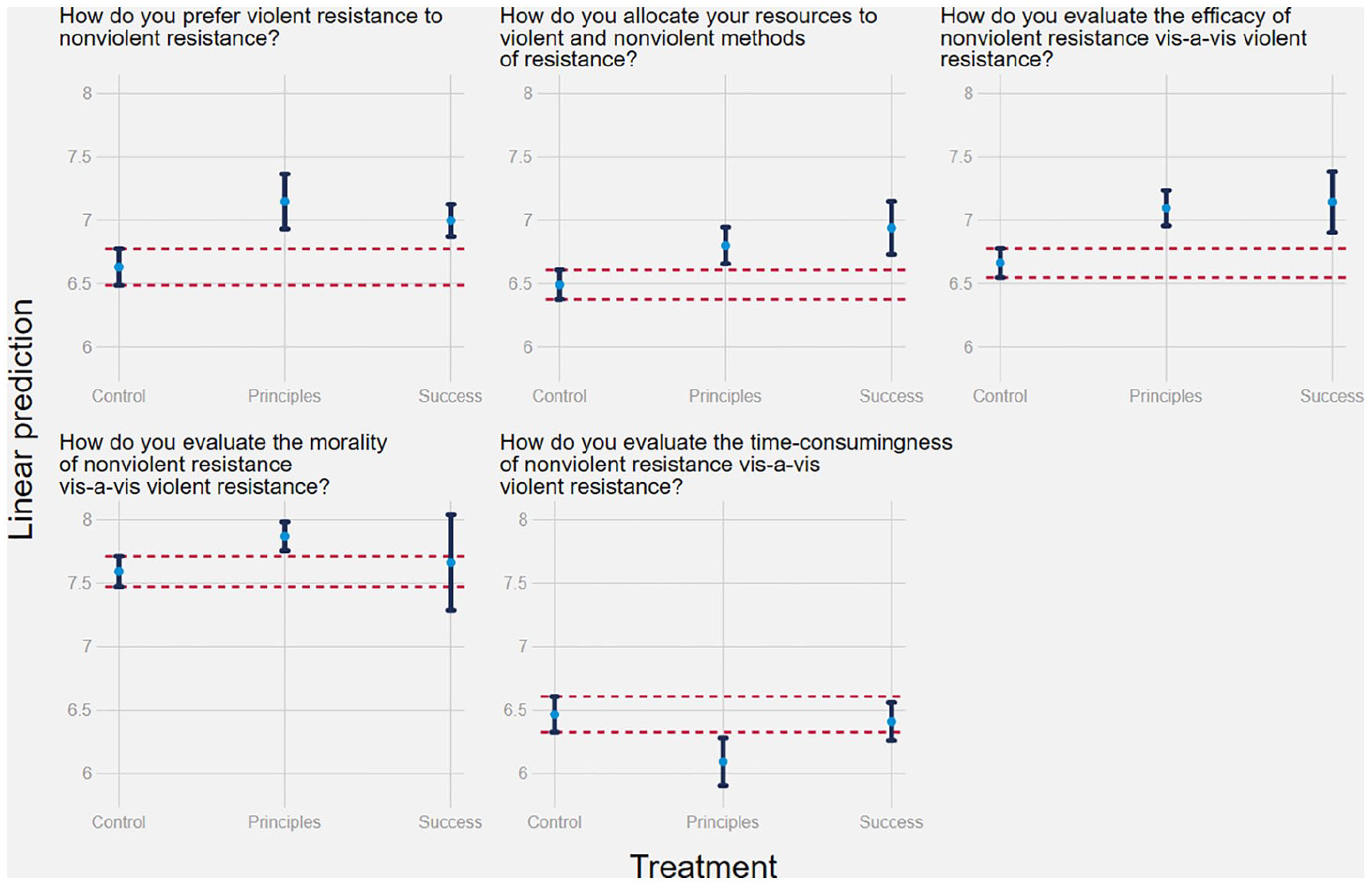
Attitude toward methods of resistance across control and treatment groups.
Table 2 summarizes the differences between the predicted probability for the participants in the treatment groups and the predicted probability for the participants in the control group. These results show that the treatment clips changed the participants’ attitudes toward nonviolent resistance between 3.7% and 7.7%, depending on the measure. These changes might seem modest, yet we should consider that the stimuli in this experiment are short clips about nonviolent resistance. A longer session of exposure to information about nonviolent resistance and in-person discussion about it might increase the positive effects.
Change in predicted probability across the control and treatment groups.
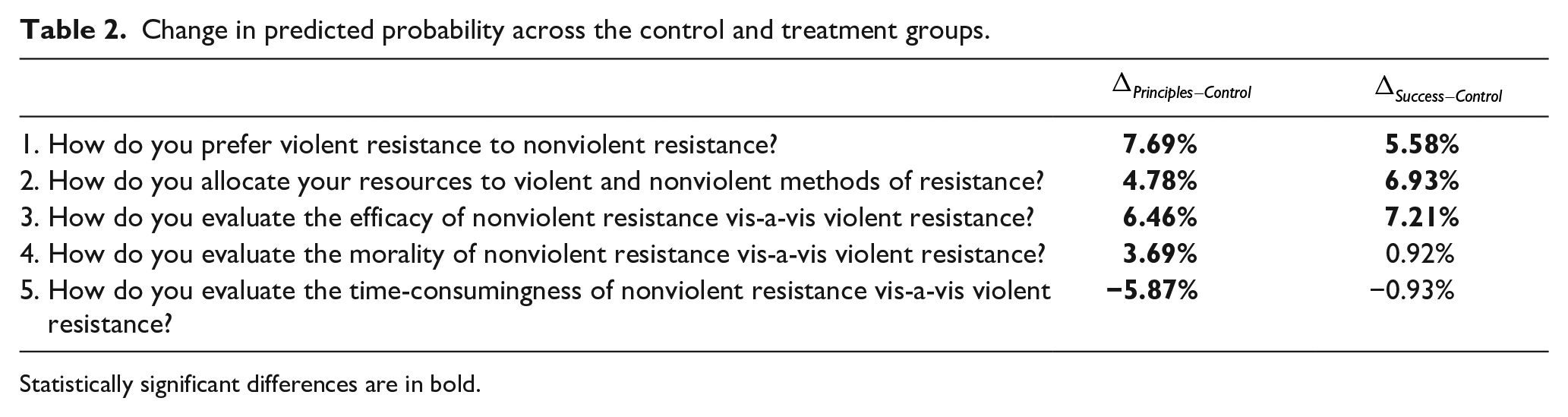
Statistically significant differences are in bold.
Conclusion
We conducted an experimental study to examine one possible way through which nonviolence can diffuse: changing citizens’ attitudes across borders. While the literature finds empirical support for temporal and geographic clusters of nonviolent campaigns, there has been a limited number of studies about the underlying mechanisms, mostly due to lack of micro-level data. This article contributes to this literature by conducting an experimental survey to explore whether providing information about the principles and success rate of nonviolent resistance changes individuals’ attitudes about the methods of resistance. In general, our study supports the previous speculations that information and learning about nonviolent resistance can change individuals’ attitudes toward it. Nevertheless, our empirical findings are more robust for providing information about the principles of nonviolent resistance vis-a-vis its success rate.
Besides, our findings have policy implications for advocates and practitioners of civil resistance. The findings could help advocates of nonviolent campaigns to improve their activities on the promotion of nonviolent resistance. Also, the results provide key insights for political and social activists in non-democratic countries. Civil resistance activists can utilize digital networks to provide information on the principles and success stories of nonviolent resistance for citizens to strengthen their belief in civil resistance campaigns, and thus possibly improve their resilience and success chance.
This article also suggests several directions for further research. A constant concern about laboratory experimental findings with college students as respondents is whether a dataset of college students can yield unbiased and generalizable results (Mintz et al., 2006; Sears, 1986). This is a legitimate concern since research shows that the demographic composition of experimental studies across colleges is different (Lupton, 2019). More importantly, college students do not demographically represent the general public. For some demographic factors, such as gender and prior interests in nonviolent resistance, we explored their conditional effects on the association between learning about nonviolent resistance and attitudes toward it (see the Online Appendix). We find, for instance, while male and female participants in the control groups have similar attitudes toward methods of resistance, women show higher support for nonviolent resistance in response to information about it. This result, indeed, encourages further studies with a more diverse sample to evaluate the external validity of our findings.
Furthermore, while our results advance the literature on nonviolent resistance, caution should be exercised with regard to drawing behavioral conclusions about the results: attitude does not necessarily bear on action. The attitude–behavior gap has long been well explored by various studies in different social science fields (for example, see Gross and Niman, 1975; Jerolmack and Khan, 2014). The gist of the argument is that individuals’ behavior is not necessarily consistent with their expressed belief (Kuran, 1989). Therefore, we cannot assume that attitude and behavior are strongly correlated. As a result, we should avoid conflating attitude and action. Likewise, we believe that information on nonviolent resistance changes individuals’ attitudes, but it might not necessarily change their behavior. Future research may focus on behavioral dimensions of exposure to information and nonviolent resistance.
Finally, although we found that information on the principles and success of nonviolent campaigns makes individuals more likely to support nonviolent resistance, we only evaluate this effect in the short term. Further studies, therefore, are required to study for how long these positive effects persist, and particularly, whether the impact of information on the principles and success rate of nonviolent campaigns fades at a different rate.
Supplemental Material
Online_Appendix – Supplemental material for Learning about principles or prospects for success? An experimental analysis of information support for nonviolent resistance
Supplemental material, Online_Appendix for Learning about principles or prospects for success? An experimental analysis of information support for nonviolent resistance by Babak RezaeeDaryakenari and Peyman Asadzade in Research & Politics
Footnotes
Acknowledgements
The authors are grateful for helpful discussions and feedback from Jonathan Pinckney and participants of the School of Politics and Global Studies Seminars at Arizona State University. We also thank Kim Fridkin, Director of the School of Politics and Global Studies Experimental Laboratory at Arizona State University, and Maciej Bartkowski, Senior Director for Education and Research at the International Center on Nonviolent Conflict, for their support during and suggestions about the design and conduct of the experiment. We would also like to thank three anonymous reviewers and the editor for their helpful and constructive comments.
Declaration of conflicting interests
The author(s) declared no potential conflicts of interest with respect to the research, authorship, and/or publication of this article.
Funding
The author(s) received no financial support for the research, authorship, and/or publication of this article.

Supplemental materials
The replication files are available at https://dataverse.harvard.edu/dataset.xhtml?persistentId=doi%3A10.7910%2FDVN%2FB7J76Y&showIngestSuccess=true
Notes
Carnegie Corporation of New York Grant
The open access article processing charge (APC) for this article was waived due to a grant awarded to Research & Politics from Carnegie Corporation of New York under its ‘Bridging the Gap’ initiative.
References
Supplementary Material
Please find the following supplemental material available below.
For Open Access articles published under a Creative Commons License, all supplemental material carries the same license as the article it is associated with.
For non-Open Access articles published, all supplemental material carries a non-exclusive license, and permission requests for re-use of supplemental material or any part of supplemental material shall be sent directly to the copyright owner as specified in the copyright notice associated with the article.
