



Abstract
Do disadvantaged ethnic groups favor violent over nonviolent conflict tactics? To understand when and why civil war breaks out, we need to study violent and nonviolent forms of conflict together, using analytical tools that can account for the choice between them. Yet, most large-N analyses of the causes of civil war do not account for nonviolent conflict, and vice versa. Because the mechanisms held to link horizontal inequalities to civil war closely resemble those used to explain largely nonviolent social movements, this article studies group disadvantages, political violence and nonviolent resistance together. To reduce concerns about selection bias in horizontal inequality research, it extends the analysis to socially as well as politically relevant groups around the world. A consensus is emerging that politically disadvantaged ethnic groups shun nonviolent tactics, because they lack ties to people close to the regime and its institutions. This article challenges the consensus, by showing that political group disadvantages predict nonviolent as well as violent forms of conflict. Groups’ economic status helps explain tactical choices. Among economically advantaged groups, political disadvantages increase the risk of nonviolent conflict. Among the economically disadvantaged, they facilitate violence. This pattern is strongest in situations where no policies are in place to remedy group disadvantages, in authoritarian and less economically open societies, and in analyses that account for conflicts of low intensity, to capture onsets early. The results point to the importance of economic and other forms of leverage, which have been largely overlooked in the econometric literature.
Keywords
Introduction
Do disadvantaged groups who fight for change prefer violent over nonviolent tactics? In 2012, thousands of opposition supporters in Guinea, most of them from the politically disadvantaged Peul group, took to the streets to protest decisions made by the Malinke-dominated government in preparation for elections (Knutsen, 2013). Despite arrests and tear gas, demonstrations remained peaceful throughout the year. The economically and politically disadvantaged Lari in Congo, on the other hand, took to arms directly to renew their challenge of the Mbochi-dominated government in 2002 (GROWup, 2021).
To understand when and why civil war breaks out, we need to study violent and nonviolent forms of conflict together, using analytical models that can account for the choice between them. Most large-N analyses of the causes of civil war do not account for nonviolent conflict. In their binary approach to civil war, the zero (‘no war’) category conflates situations with no collective agency with situations where the agency takes a nonviolent form, potentially missing important aspects of mobilization. Correspondingly, most studies of nonviolent conflict account for violent conflicts indirectly at best, with references to other studies or separate regression models. This practice leaves us unable to distinguish the dynamics of general mobilization from the choice of one form of contention over another.
For this reason, it is unclear whether horizontal (intergroup) inequalities facilitate all mobilization outside conventional political channels, or specifically civil war and other violent tactics. Both cases have been made and supported by empirical evidence. Recently, the perspective that disadvantaged ethnic groups will look to violence, because they lack the political leverage required to succeed with nonviolent action, is gaining traction.
This article challenges the emerging consensus. It investigates whether ethnic group disadvantages influence the initial choice that groups make between violent and nonviolent conflict tactics. Group disadvantage denotes an ethnic group’s inferior position in an unequal society and encompasses all sources of economic and political differentiation between groups (see Stewart, 2002: 10). 1 Conflict is defined broadly as disruptive direct action where ordinary people join forces to challenge the government (cf. Tarrow, 2011: 6–9 on contentious action). This covers violent and nonviolent, large- and small-scale, sustained and short-lived collective action over all claims, but not conventional politics, such as voting or interest group activities. 2
The article adopts a group level perspective and highlights the interaction between grievances and opportunity structures that is inherent in horizontal inequality explanations. Increasingly, scholars note that grievances and opportunities are not competing explanations of conflict, but work together in complex ways (Bara, 2014). All forms of disadvantage can give group leaders and members motive. But different forms and combinations of group disadvantage come with different implications for the opportunity to succeed with different tactics, and therefore different expectations for conflict.
The emerging consensus is that disadvantaged groups are unlikely to use nonviolent tactics because they lack political leverage, that is, interpersonal ties to people close to the regime and its institutions. Yet, while political leverage is important, there are other sources of leverage that aspiring movements can draw on to make up for a lack of political inclusion. This article argues that political disadvantages increase nonviolent as well as violent conflict. Which tactic politically disadvantaged groups choose is conditional on a specific kind of leverage – the economic leverage that comes with economic group advantage. Economically advantaged groups often have more leverage than economically disadvantaged groups. This leaves them better placed to contest political disadvantages with nonviolent conflict tactics. 3
To reduce common concerns about selection bias in horizontal inequality research, I test the propositions with the All Minorities at Risk (AMAR) dataset. The analysis moves beyond the common restriction to politically relevant ethnic groups and covers 317 socially relevant groups in the 1987–2006 period. Contrary to the emerging consensus, it shows that political disadvantage is associated with the onset of nonviolent as well as violent conflict. Interaction analyses reveal a complex empirical picture, with some evidence that economic leverage affects the choice of tactics. The support is clearest when no policies are in place to remedy group disadvantages, in authoritarian and less economically open societies, and when accounting for small-scale conflicts. These findings imply, first, that economically advantaged groups prefer to work within the system if there is a chance of succeeding with conventional politics. Second, non-economic sources of leverage, such as international support and interethnic coalitions, are important. Third, the results underscore the importance of capturing conflict onsets early and question the reliance on participant thresholds and maximalist campaigns in the literature.
Finally, policy initiatives that aim to reduce organized violence in fragile countries by improving the situation of disadvantaged ethnic groups should be particularly concerned with the economic situation of groups with combined economic and political disadvantages, which makes them prone to violence.
Horizontal inequality and conflict: General mobilization or tactical violence?
Horizontal inequality research emerged to tie together previously contested inequality and ethnic diversity explanations of civil war, by showing that socio-economic and political differences between ethnic and other strong identity groups increase the risk of civil war (Cederman, Weidmann & Gleditsch, 2011; Østby, 2008) and other forms of political violence (Fjelde & Østby, 2014; Hillesund, 2019). Most horizontal inequality researchers agree that objective disadvantages must be mediated through collectively perceived grievances to lead to violent challenges against the government. Members of disadvantaged groups must identify with their group, compare it to other groups, find their disadvantage unjust but changeable, and blame the state (Cederman, Gleditsch & Buhaug, 2013). Group elites and movement leaders often help bring this about by framing the issues so they resonate with people. Ethnicity, broadly defined to cover salient linguistic, religious and racial differences, is a potent resource in this regard. Finally, grievances are more likely to spur action when pre-existing networks provide trust, leadership, communication networks and sanctioning mechanisms (for more on mechanisms, see Cederman, Gleditsch & Buhaug, 2013).
The combination of economic and political disadvantage is particularly potent (Cederman, Gleditsch & Buhaug, 2013). Economic disadvantages motivate ordinary group members to challenge the status quo. But it often takes a political disadvantage for a group’s elite to decide to take the lead, because it restricts their access to the political arena (Langer, 2005). The elite may desire political power, or also want to improve the group’s situation. The larger share of the elite that is denied access to various political arenas – executive power, local political office, civil service, police, army – the more likely organized collective action becomes. In politically advantaged groups, the elite is more reluctant to jeopardize their advantage by leading a fight against the government, even if ordinary group members are motivated by economic disadvantage. But exceptions exist. Sometimes elites risk their advantaged positions to fight, or leadership emerges from below, from labor unions or grass-root organizations.
In the horizontal inequality literature, the need to study violent and nonviolent conflicts together has received scant attention. Empirically, this leaves the literature ill-suited to disentangle whether horizontal inequalities facilitate all mobilization, or the choice of violent over nonviolent tactics. Civil conflict researchers borrow extensively from social movement theory. Researchers thus invoke similar mechanisms (collective action framing, pre-existing mobilizing structures) to describe how group disadvantages spur a range of conflict outcomes; from civil war to nonviolent demonstrations, sit-ins and petitions (reviews in Cederman, Gleditsch & Buhaug, 2013; Tarrow, 2011). By implication, either horizontal inequality facilitates both violent and nonviolent conflict without influencing tactics, or the standard horizontal inequality–civil war explanation is missing a piece that links disadvantage to violence. Below, I present two perspectives that take opposite views on this.
Previous studies of how economic and political group disadvantages affect nonviolent conflict cannot readily answer the question. Empirically, they show negative, positive and zero relationships (Butcher & Svensson, 2016; Chenoweth & Ulfelder, 2017; Cunningham, 2013; Gleditsch et al., 2021; Gurr, 1993; Thurber, 2018). Many do not account for violent outcomes (Chenoweth & Ulfelder, 2017), or compare violent and nonviolent conflicts at the country level (Bartusevičius & Gleditsch, 2019; Butcher & Svensson, 2016; Gleditsch et al., 2021), far from the actors making tactical choices.
Among the studies that model violent and nonviolent conflicts together, to account for tactical choice, two represent what I will call the general mobilization perspective. Cunningham (2013) and Bartusevičius & Gleditsch (2019) extend key findings on political violence to nonviolent conflict, and show that political group disadvantages facilitate both. Something else must be determining tactics. They measure disadvantages in the EPR tradition, as groups’ exclusion from the executive, and the size of the largest discriminated group in a country, respectively.
Other researchers maintain that politically disadvantaged groups rarely initiate nonviolent action. They opt for violence instead. This tactical violence perspective springs from the literature on nonviolent conflict (Chenoweth & Ulfelder, 2017; Schaftenaar, 2017; Stephan & Chenoweth, 2008) and a notion central to the study of campaign success: leverage. While violent movements coerce the government through death and destruction, the success of nonviolent movements depends on leverage – the ability to make the networks the state depends on for its power put pressure on the state or withdraw support (Schock, 2005: 144–145). The movements work to induce loyalty shifts among elites, security forces and third parties, via persuasion, disruption and non-cooperation. Their chance of succeeding is higher the more people and identity groups they span (Chenoweth & Stephan, 2011). The more extensive and diverse the social ties between a movement’s organizational core and the wider society – across ethnic groups, classes – the more viable nonviolence becomes (Thurber, 2019).
It can be difficult for movements motivated by horizontal inequality to mobilize large and diverse enough followings to succeed with nonviolent tactics. Their claims are often group-centered and narrow, because it is easier to build narratives and solidarity within well-defined ethnic boundaries than in multi-ethnic coalitions. It takes fewer people to gain coercive power over the government with deaths than with non-cooperation (Gleditsch et al., 2021).
Add to this that political disadvantages come with limited political leverage. Politically disadvantaged groups have fewer interpersonal relationships with elites in state institutions. This hampers their efforts to induce loyalty shifts in the political elite and security services, and public opinion is less likely to turn against government repression (Thurber, 2018). Empirically, Thurber (2018) shows that politically excluded ethnic groups are less likely than senior partners in government and dominant groups to participate in maximalist campaigns of nonviolent resistance, and more likely to use violence.
The tactical violence perspective is the most theoretically developed and nuanced of the two perspectives, and the most rigorous test to date supports this proposition. 4 Correspondingly, there is some consensus developing that disadvantaged ethnic groups do not use nonviolent resistance. There are few studies on the topic, however. 5 This article challenges the consensus.
Challenging the consensus: Economic leverage and tactical choice
This article’s key assumption is that group leaders make a choice between violent and nonviolent tactics, in a minimally rational attempt to maximize movement success. 6 Group unity is a strong assumption (Pearlman, 2011), but it is more plausible for the initial choices nascent movements make than over movement life spans.
The literature review raises the question of why disadvantaged ethnic groups would ever use nonviolent tactics. The emerging consensus seems to be that they rarely will. My argument against it is threefold. First, most of the mechanisms we hold to link political exclusion to civil war come from research on largely nonviolent social movements, and several studies suggest exclusion increases both violent and nonviolent conflict (Bartusevičius & Gleditsch, 2019; Cunningham, 2013). Second, beyond domestic political inclusion and personal connections in state institutions, group leverage depends on what networks the government relies on and what kind of pressure or persuasion they respond to. This means the opportunities for nonviolent conflict are tied to international and economic structures, not just domestic politics. Third, initial tactical choices could be more heterogenous than the ‘maximalist’ and mature campaigns that are usually studied (cf. Lewis, 2017). Thurber (2018)’s findings could mean that excluded groups fail to ‘scale up’ their nonviolent conflict activity to full-blown campaigns, rather than discard nonviolent tactics at the outset. In line with this, Butcher & Svensson (2016) find that while state-led discrimination does not affect (or might even reduce) maximalist nonviolent campaigns, it tends to increase nonviolent demonstration events measured with less strict criteria for sustained activity over time and maximalist demands.
In sum, I expect political disadvantage to provide a motive for contentious action and facilitate mobilization, but not to alter the opportunity structure enough to explain initial tactics.
If political disadvantages facilitate both tactics, what can explain the choice between them? This article highlights a crucial distinction – which has been largely overlooked in the literature on nonviolent conflic – between politically disadvantaged groups with different economic status. Differences in economic status shape groups’ opportunity structure because it shapes their economic leverage. Economically advantaged groups typically have more economic leverage, which leaves them better placed to succeed with nonviolent tactics.
Economic leverage has many sources. In general, large groups, and those with a strong presence in geographical areas and occupations central to the economy, are better able to pressure elites and governments with nonviolent strikes and boycotts. Sometimes disadvantaged groups have leverage, because they make up a large part of the workforce in low-paid jobs that are central to the economy or the day-to-day functioning of society, such as waste management. But on average, comparing otherwise similar groups, socio-economically advantaged groups should be able to hurt the elite and government more with strikes and boycotts than the disadvantaged. Thus, while all politically disadvantaged groups lack political leverage, an economic advantage can give such groups substantial coercive power, in the form of economic leverage.
In some cases, co-ethnics in the economic elite can pressure the government directly. But often, even the wealthiest members of politically excluded groups will not have the government’s ear. More importantly, advantaged groups can put indirect pressure on the government, by using strikes and boycotts to hurt larger parts of the elite and population. Groups with combined economic and political disadvantages, on the other hand, tend to lack both political and economic leverage. While their elites should be motivated to challenge the status quo, they are less able than other disadvantaged groups to coerce the government with nonviolent means, and therefore more likely to choose violence.
If there were perfect substitution between tactics, I would expect negative relationships between political disadvantage and violence among the economically advantaged, and between political disadvantage and nonviolence among the economically disadvantaged, as groups steer away from the tactic not indicated by their economic status. That is, if practically all economically advantaged groups, once mobilized, turned to nonviolent tactics, and all economically disadvantaged groups to violence. Because such deterministic conditioning is unrealistic, I do not formulate separate hypotheses for these associations. For Hypothesis 2 to hold, however, political disadvantage must contribute more to increasing the likelihood of nonviolent than violent conflict. For Hypothesis 3, it must contribute more to violence.
Sri Lankan Tamils illustrate the predictions. They have been excluded from executive power since independence, but started out with a socio-economic advantage. Accordingly, they fought their political disadvantage with nonviolent means, after setbacks in conventional politics. Sit-ins and the use and threat of strikes in 1956 made the Sinhalese government promise the Tamils regional councils with comprehensive powers, but the pact was broken. In 1961, strikes and sit-ins paralyzed the administration for months, but were thwarted by brutal repression and anti-Tamil riots (Sivakumar, 1989: 124–126). Tamil opposition turned increasingly violent in the 1970s, following more setbacks in conventional politics. While many factors contributed – such as disillusioned youth and power struggles – the socio-economic balance had also shifted dramatically. Government policies left Tamils under-represented in white-collar, civil service and public sector jobs they had previously dominated, and restricted access to higher education (Sivakumar, 1989: 127–130). This left them with a combined disadvantage and limited economic leverage, and the theory predicts violence.
Several other politically disadvantaged, but economically advantaged groups have used nonviolent tactics that depend on economic leverage. Examples include the Bamileke strikes (ghost towns) in the pro-democracy movement in Cameroon (1991), and the threats of general strike voiced by Latvians in their campaign for independence from the USSR (1989–91) (Global Nonviolent Action Database, 2019).
An explanation of tactics needs to account for the role of the state. Importantly, economic leverage may influence state repression, which is an important part of the opportunity structure. The state is the movements’ main opponent. Its motive is to preserve the status quo by keeping disadvantaged groups in their place, but it will weigh the benefit of this outcome against the cost of conflict and the repression required to keep them in line. Economically disadvantaged groups probably anticipate more severe repression than advantaged groups, because their lack of economic leverage makes them less costly to repress. Assuming that many groups respond to (anticipated) repression with violence, the state repression and economic leverage mechanisms pull in the same direction: for economically disadvantaged groups, political disadvantages should increase the risk of violence. 7
The theoretical argument is not logically restricted to situations where economic disadvantages came before political disadvantages. In this article, political disadvantage is the explanatory variable and economic disadvantage the moderator for two main reasons. First, economic horizontal inequality is arguably more static. While the roots of inequality vary across countries, economic disadvantages often have longstanding causes and change slowly over time (Alesina, Michalopoulos & Papaioannou, 2016; Tilly, 1998). Second, the article aims to explain movements’ initial choice of tactics. It follows from the theory that new political disadvantages make the onset of organized conflict particularly likely. With new leadership comes a fresh eye on leverage and tactics. Changes in economic status are more likely to influence tactical changes for existing movements. While the theory has implications for this, they are hard to disentangle empirically from the dynamics of ongoing conflict. In the robustness section, I test for asymmetric effects.
Research design
I test the hypotheses with data on 317 ethnic groups from the All Minorities at Risk (AMAR) dataset (AMAR, 2018; Birnir et al., 2018) across 121 countries (Table A-5) from 1987 to 2006. 8 The unit of analysis is ethnic group year. The AMAR sampling frame covers all socially relevant groups in a country: groups whose members share some distinguishing cultural feature (language, religion, customs), where membership is determined primarily by descent and recognized as important by both members and non-members (Birnir et al., 2018: 223). 9 AMAR covers all the ethnic groups from the Minorities at Risk (MAR) project, plus a random sample of additional groups, drawn to correct for selection bias (Birnir et al., 2018). It is weighted to account for stratification by population and region (Birnir et al., 2018: 208–211) and the overrepresentation of MAR groups. A total of 268 of the groups in the analysis have a match in the Ethnic Power Relations Project (EPR-ETH, v.2014, see GROWup, 2021; Vogt et al., 2015). Most studies of horizontal inequality cover only such politically relevant groups, i.e. those that are represented in the national political arena or actively discriminated against. 10
I construct binary measures of group disadvantage from the discrimination indices in AMAR (see Table A-3). Political disadvantaget-1 flags groups that experience substantial under-representation in political office or participation. Economic disadvantage t-1 denotes significant poverty or under-representation in desirable occupations. The available documentation (Minorities at Risk Project, 2009) suggests their coding falls broadly in line with the approach of Stewart (2002: 10), highlighting multiple sources of differentiation among groups. This makes them more comprehensive than most measures in the quantitative literature. They account for economic differentiation due to access to land, education and health care, in addition to income, wealth and occupation, and differences in political participation due to voting rights, organization and representation in the civil service, military and police, as well as political office. I lag the variables by one year, to capture disadvantages that precede conflict in time. As an alternative specification, I reassign cases where remedial policies are in place to the reference category.
To my knowledge, AMAR is the only dataset that records ethnic groups’ participation in both violent and nonviolent conflict, for small-scale as well as large-scale conflict. 11 A group is coded as participating in conflict if a campaign against the government was initiated by an organization claiming to represent the group’s interest, if it concerned issues of particular concern to the group, or if group members were present in substantial numbers. I construct four binary dependent variables. Large-scale violence flags participation in campaigns of terrorism, guerilla activity and civil war. All violence adds local rebellion, sporadic terrorism and political banditry. All nonviolence flags demonstrations, rallies, strikes and riots. Large-scale nonviolence denotes the events with 10,000 participants or more. 12 Because I am interested in tactics chosen at the outset of a conflict spell, each variable flags conflict years preceded by some time without the relevant kind of conflict. The period of calm required to code the onset of a new conflict is two years for large-scale conflict and one for the ‘all conflicts’ variables.
Large-scale conflict onset by disadvantage
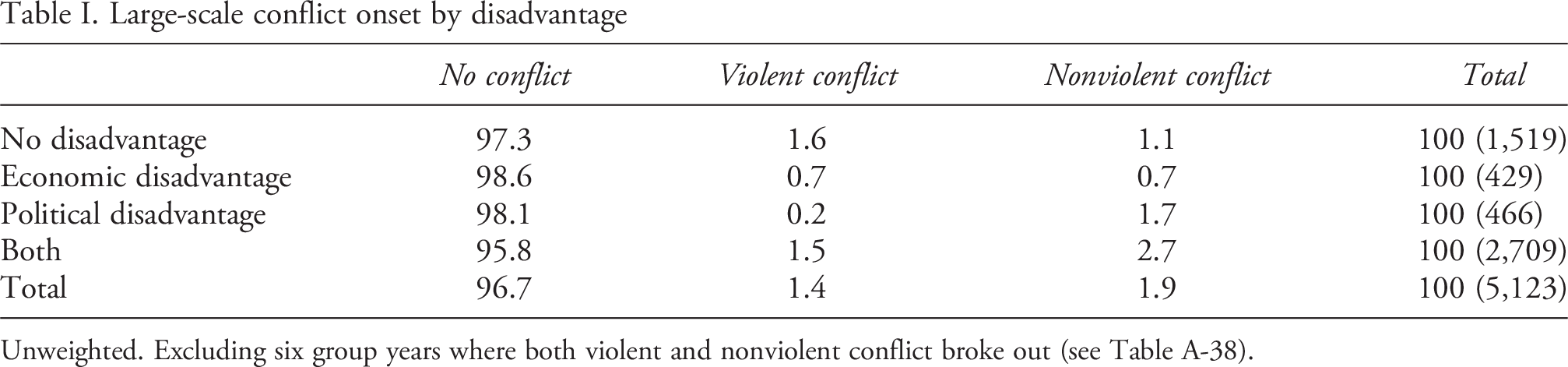
Unweighted. Excluding six group years where both violent and nonviolent conflict broke out (see Table A-38).
AMAR does not distinguish between riots and demonstrations. The nonviolence variables therefore include riots, which is arguably a violent, if not necessarily armed, tactic. Many riots begin as nonviolent protests, however. Since this analysis is on initial tactics, the categorization is not that misleading. Riots that did not start out as nonviolent work against the expected relationship between combined disadvantages and violent conflict, making this test more conservative.
The nonviolent conflict variables do not cover consumer boycotts, nonviolent interventions (sit-ins, blockades), social non-cooperation (hunger strikes) or political non-cooperation (election boycotts). Nonviolent intervention could be an interesting alternative for disadvantaged groups, as it relies more on pure disruption than on political and economic leverage. For that same reason, however, it is not the most relevant tactic for testing the economic leverage mechanism. In addition, these tactics are often used in combination with demonstrations.
The AMAR conflict and disadvantage measures offer an important complement to a literature that relies heavily on the EPR and UCDP/PRIO Armed Conflict Dataset (Gleditsch et al., 2002). It is a strength that the AMAR measures rely on more multifaceted definitions of the inequality concepts. On the one hand, this comes at the cost of more coder discretion, for example in deciding when under-representation is substantial. On the other hand, AMAR allows me to extend analysis beyond politically relevant groups, to ease concerns about selection bias, and investigate small- as well as large-scale conflict. Importantly, this article reproduces central relationships from previous studies. This suggests the measures capture the same underlying concepts. In the online appendix, I compare and discuss AMAR and EPR measures of disadvantage (Table A-4).
I use two estimation strategies. First, multinomial logistic regression with group-clustered standard errors. This is standard for articles that model the choice between violent and nonviolent conflict together (Cunningham, 2013; Thurber, 2018). By including both tactics in the same empirical models, I avoid conflating ‘zeroes’ with and without substantial agency. Second, to account for the panel structure in the data, I report probit models with random intercepts. 13 To avoid conflating ‘zeroes’ with and without mobilization, I exclude nonviolent conflicts from the violence model, and vice versa. 14 Because my research question concerns initial tactics, I drop years of ongoing conflict, and thereby violence that breaks out during nonviolent conflict (in the second year or later), and vice versa, from all models (except in Table A-23). I also drop observations where both kinds of conflict broke out in the same year. They are few, and less suited for investigating initial choices, because the group-year setup does not tell us which tactic came first.
The many sources of horizontal inequality make the treatment assignment process complex. Larger populations, industrialization and autocracy may increase wealth and power differentials between ethnic groups in a country, while also influencing their ability to coerce the government with violent or nonviolent means (Butcher & Svensson, 2016). I therefore control for countries’ urban population (Ln urban population; UN DESA Population Division, 2018), total population and wealth (Ln population, Ln GDP per capita t-1 ; Heston, Summers & Aten, 2011), economic growth (GDP growth t-1; Gleditsch, 2002) 15 and regime type (V-Dem Electoral democracy indext-1 ; Coppedge et al., 2021). In the online appendix, I add region dummies (Table A-35).
On the group level, I include the variables Relative group size, which records the group’s share of the country’s population, Concentrated group, which flags groups with a majority of members living in the same region, and the cubic polynomial of the number of years since the group last participated in violent or nonviolent conflict, all from the AMAR dataset. Smaller groups should be easier to keep out of power and discriminate over longer periods of time without undermining the legitimacy of a regime, and they face a mobilization disadvantage, especially for nonviolent coercion, which relies on strength in numbers. Groups concentrated within a region should be easier than dispersed groups to discriminate, via the allocation of infrastructure projects etc., without making the discrimination explicitly ethnic. But they provide an advantage for nascent rebellions (and some nonviolent movements), which rely on the support of the local population to operate undercover.
Fundamentally, groups’ relative economic and political status depends on a complex interplay between climatic and geological conditions, colonialism and historical power relations. While it is not obvious that these factors influence current-day conflict through channels other than group disadvantage, another structural condition might: peripheral location. Groups with homelands located far from a country’s capital are more likely to be politically and economically disadvantaged than other groups. They should also be better placed to succeed with guerilla-style rebellions, and less able to coerce with nonviolent means (Gleditsch et al., 2021). No existing measure of peripheral location covers all AMAR groups, but for politically relevant groups with a discernable settlement area, I control for travel time to the nearest large city (GROWup, 2021; Tollefsen, Strand & Buhaug, 2012; Uchida & Nelson, 2009) as a robustness test.
To guard against reverse causality, I lag the disadvantage variables one year. 16 Economic disadvantages often have complex historical, climatic and geographic roots (Alesina, Michalopoulos & Papaioannou, 2016), and are remarkably durable (Tilly, 1998). This reduces concerns about reverse causality. Politically, the government may decide to pre-emptively include or exclude ethnic groups that they consider potentially rebellious, however. To investigate this, Wucherpfennig, Hunziker & Cederman (2016) instrumented for political exclusion with an interaction between French/British colonial history and distance to the capital. They found that in Africa, ‘naïve’ regression analyses underestimate the causal relationship between exclusion and civil war, suggesting governments pre-emptively include groups more often than they exclude them. Extending the argument to account for the interaction between types of disadvantage, such pre-emptive inclusion should be most likely among groups that are economically advantaged, since the government can expect them to be able to finance more comprehensive violence or disrupt the economy more with nonviolent tactics. My design is therefore a conservative test for the relationship between political disadvantage and conflict among the economically advantaged.
Empirical analysis
The empirical analysis supports Hypothesis 1 (Table II, Model 1–3): political disadvantages are associated with nonviolent conflict. In the model with random intercepts, they are associated with violent conflict too. The association with nonviolence challenges the emerging consensus that ethnic groups do not contest their disadvantages with nonviolent tactics. It may be that their nonviolent activities rarely scale up to sustained and maximalist campaigns, but this should not be confused with tactical choice. It mirrors findings from civil war research on the importance of including small-scale conflicts (Lewis, 2017).
Politically disadvantaged ethnic groups seem to look beyond interpersonal ties within state institutions, to other forms of leverage. Next, I investigate whether economic status can explain the tactical choices of groups contesting politically disadvantages. I expect economic advantages to facilitate nonviolent tactics and disadvantages to encourage violence. The analysis uncovers a more complex picture, where both economic and other forms of leverage are important.
Large-scale conflict onset
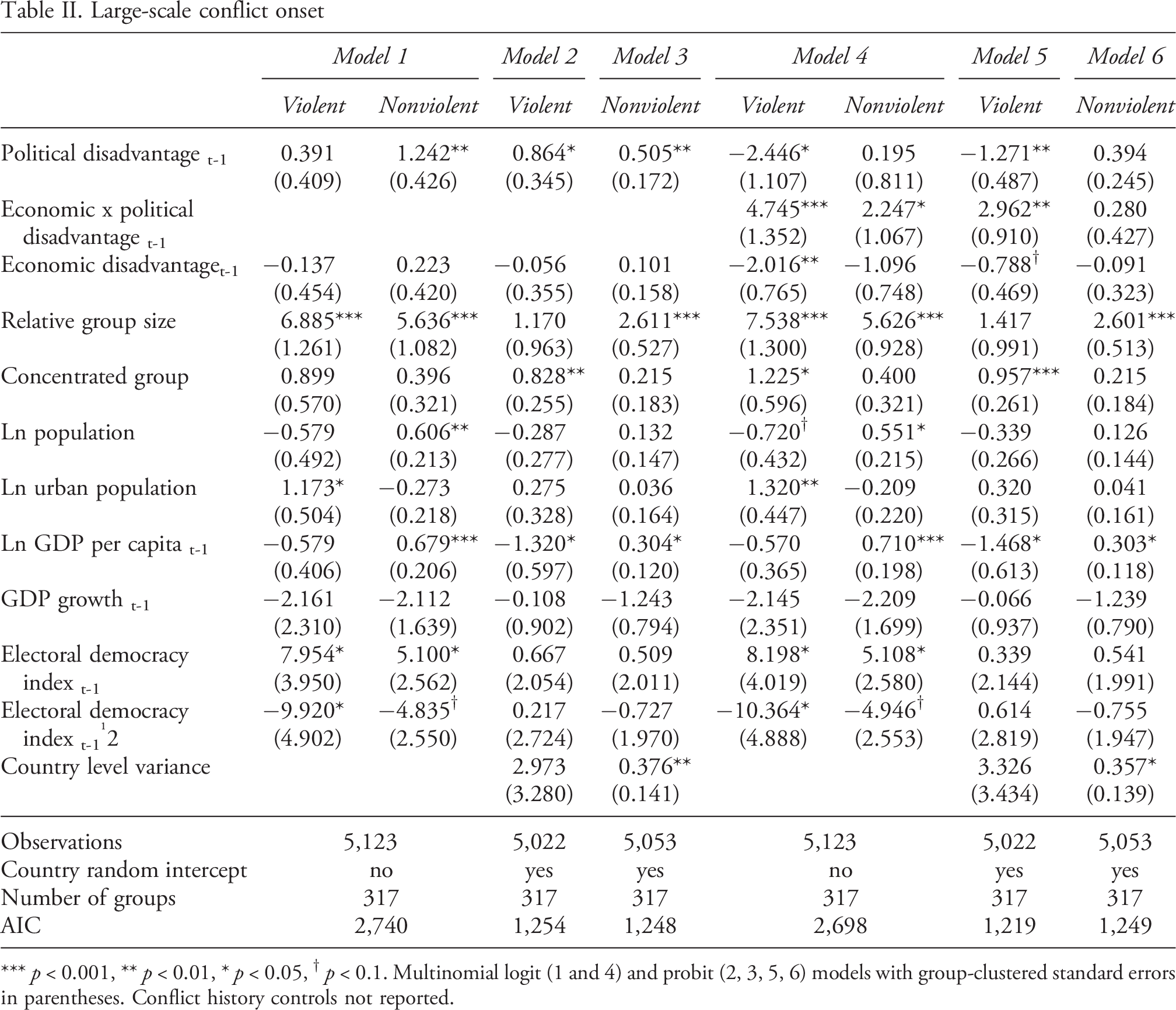
*** p < 0.001, ** p < 0.01, * p < 0.05, † p < 0.1. Multinomial logit (1 and 4) and probit (2, 3, 5, 6) models with group-clustered standard errors in parentheses. Conflict history controls not reported.
Economically advantaged groups: Tactical nonviolence
The analysis shows that when economically advantaged groups experience political group disadvantage they steer away from violence, but it is not immediately clear whether they opt for nonviolent conflict, as Hypothesis 2 predicts (Table II, Model 4–6). The coefficients for nonviolence are small and not statistically significant. Predicted probabilities point in the same direction: the slope for nonviolence is positive, but less steep than the negative slope for violence (Figure 1). 17
Two alternative specifications show clearer support for Hypothesis 2: I find positive relationships between political disadvantage and nonviolent conflict among the economically advantaged in analyses that restrict the disadvantage variables to situations where no remedial policies are in place (p = 0.08; Table A-14) or include small-scale conflicts (p < 0.01; Table A-16). This has important implications. First, ethnic groups working to have their disadvantages redressed have a third tactical option: they can work within the system with more conventional political means (Cunningham, 2013). The findings suggest that when there is some hope of achieving political redistribution with conventional politics, as indicated by the presence of remedial policies, economically advantaged groups prefer to work within the system.
Second, the groups initiate nonviolent conflicts that do not escalate (scale up) beyond the participation Predicted probability of conflict by political disadvantage, conditional on economic status. 95% CIs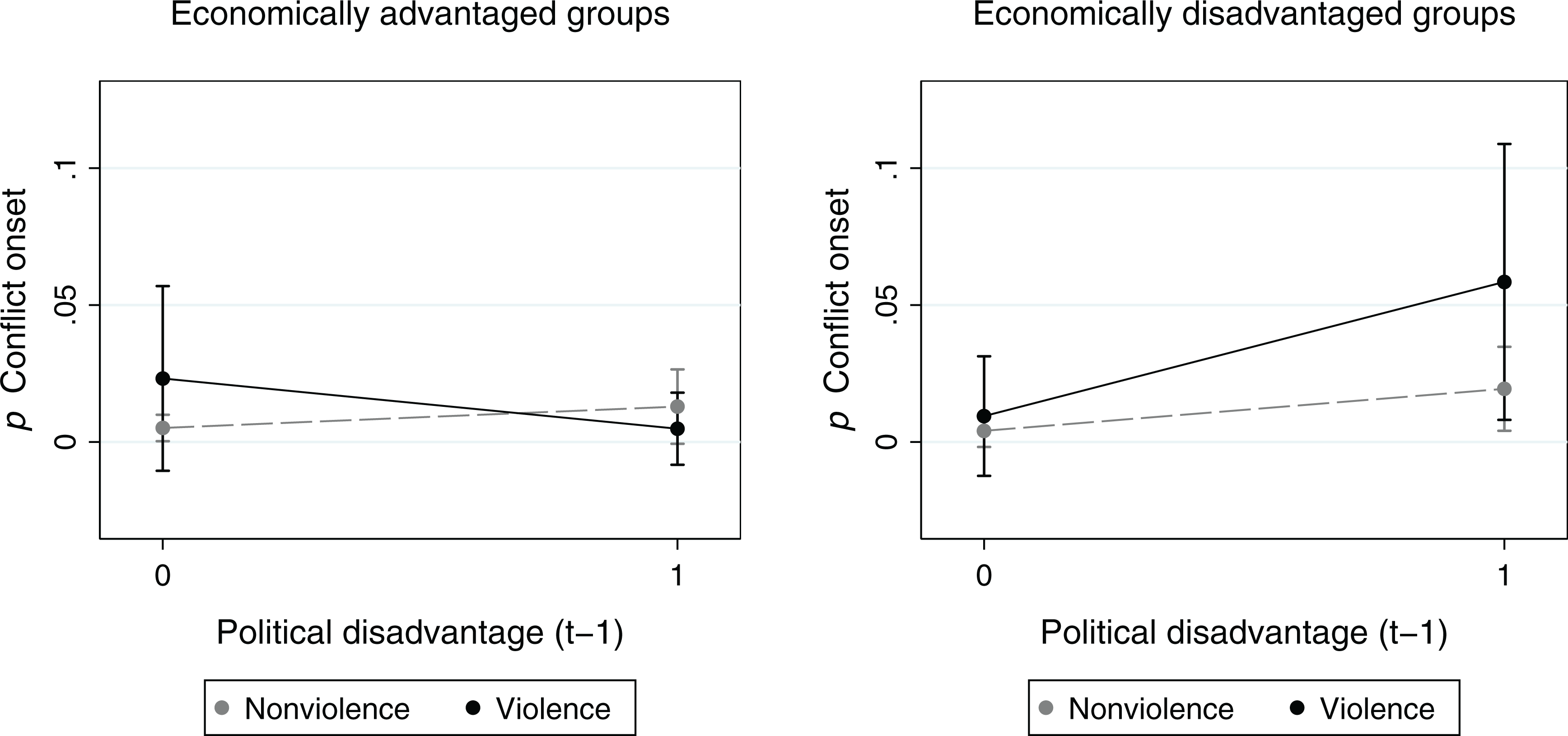
Economically disadvantaged groups: General mobilization
Among economically disadvantaged groups, I expected political disadvantages to increase the use of violence, primarily (Hypothesis 3). Yet empirically, it increases both violent and nonviolent conflict. 18 In Figure 1, the predicted probability rises more steeply for violence, but this is largely due to influential observations (Figure A-2).
Interestingly, both relationships are driven by situations of disadvantage where remedial policies are in place, and by large-scale conflicts (especially for violence) (Table A-14 and A-16). Unlike economically advantaged groups, the economically disadvantaged probably do not feel like they can afford to wait out the political process when remedial policies do not provide quick results. Also, some remedial policies are symbolic in nature, some may be seen as ‘too little, too late’, or as attempts to coopt the group without addressing its core grievances, and some have the unintended consequence of reinforcing identity cleavages.
The resulting conflicts often escalate quickly, becoming large-scale within the first year. This could suggest a repression mechanism is in play, whereby governments are more likely to intervene with force early against these most disadvantaged groups, because they pose little political or economic threat. Such repression can lead to backlashes that increase mobilization.
The case for economic and other leverage
If economic advantages steer politically disadvantaged groups towards nonviolent tactics when they step outside conventional political channels (Hypothesis 2), but economic disadvantages do not drive them towards violence (Hypothesis 3), where does that leave the economic leverage mechanism? Advantaged groups appear to realize that their economic leverage helps offset their lack of political leverage. But since the economically disadvantaged do not respond to their corresponding lack of economic leverage, we have to consider alternative explanations.
The latter groups could be looking for alternative sources of leverage elsewhere than in relative economic status. The Anti-Apartheid and American civil rights movements illustrate how ethnic groups with combined disadvantages may coerce their governments with nonviolent tactics. First, relatively large groups and groups with a strong presence in low-status occupations that are central to the day-to-day functioning of society can impose substantial economic costs, despite being economically disadvantaged. This seems more likely in societies where groups with different status depend on each other. Vogt (2018) shows that what he calls socially integrated or stratified multiethnic countries, such as the former colonial settler states, experience less organized armed conflict than more segmented societies. He holds up interdependence between ethnic groups as part of the explanation. The social integration of ethnic groups (in South Africa, the United States and Latin American countries) means that dominant groups depend more on marginalized groups for labor supply than in segmented societies (such as Cameroon, Iraq or Sri Lanka) (Vogt, 2018: 115). This gives marginalized groups economic leverage. Second, the international support and interethnic solidarity played a part in both movements. In their absence, it seems less likely that most leaders of groups with combined economic and political disadvantages would find they have enough leverage to embark on serious nonviolent protest.
To begin to disentangle the economic leverage mechanism from alternative explanations, I run the analysis on key subsamples. First, on groups that have limited economic leverage for reasons other than economic status: relatively small groups (less than 5% of the population) and groups that are not geographically concentrated (less than 50% live in the same region). 19 The relationship between political disadvantage and nonviolent conflict loses statistical significance in both specifications, regardless of economic status (Table A-17–18, RI models). In line with the economic leverage mechanism, it is driven by groups that derive leverage from relative size and concentration.
Second, I use a measure of economic openness to roughly proxy reliance on international support. I exclude the most open economies from the analysis: those with a KOF Globalization Index (Gygli et al., 2019) score above 50 (Table A-19). Among the less open economies, I expect the regimes to rely less on international support and be somewhat less worried that the opposition movements win the international community over. As expected, the random intercept models show support for the economic leverage mechanism in this subsample. The relationship between political disadvantage and nonviolent conflict among the economically advantaged approaches statistical significance in the large-scale model (Hypothesis 2). Among the economically disadvantaged, political disadvantage is related only to large-scale violence (Hypothesis 3). This lends support to the idea that the reason there is a relationship between political disadvantage and nonviolent conflict among the economically disadvantaged in the full sample is that groups gain leverage through international support. They know their government cannot afford to tarnish their international reputation by repressing nonviolent protests too heavy-handedly and that important networks close to the government will pressure the government or withdraw support if international sanctions are on the table. Thus, where governments rely less heavily on the global economy, I find more empirical support for the economic leverage mechanism.
The most open economies share other traits that make it hard to disentangle this moderating effect from other factors. I leave it to future research to properly disentangle causality, but in a final subsample, I look at another factor that tends to overlap with openness: regime type. I exclude countries classified by V-Dem as liberal or electoral democracies from the analysis (Coppedge et al., 2021). Regime type is meant to proxy the usefulness of domestic alliances. In democracies, the networks the regime relies on for its power are generally larger than in autocracies. The number of useful alliances a group can forge, to get access to people that are in or are connected to those networks, are therefore larger. In autocracies, the possibility of finding an ally outside your ethnic group that can help you succeed with nonviolence is a less available source of leverage. As expected, the effect of political disadvantage on nonviolent conflict among the economically disadvantaged disappears in this subsample (Table A-20, RI model). Thus, the positive relationship in the full sample is driven by situations where ethnic groups have many potential domestic allies to draw on to gain leverage with nonviolent action.
Overall, the analysis provides some support for the hypothesized economic leverage mechanism, but suggests that other forms of leverage are important too. In democracies and the most globalized economies, even the most disadvantaged groups, with combined economic and political disadvantages, can draw on other sources of leverage, such as international and interethnic alliances, to counteract their lack of domestic political and economic leverage. When we strip these options away by restricting the sample to authoritarian and less open countries, we reveal the importance of economic leverage.
Area under the ROC curve (AUC)
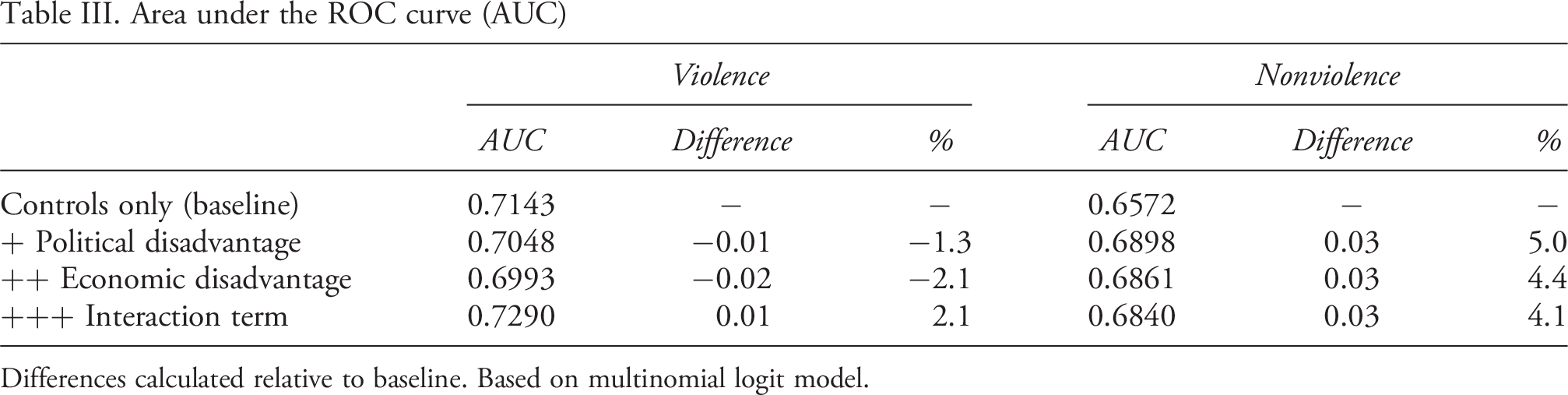
Differences calculated relative to baseline. Based on multinomial logit model.
The findings challenge the tactical violence consensus. Political disadvantages can make ethnic groups opt for nonviolent conflict tactics, not just violence. This is easily missed by researchers who focus on exclusion, maximalist campaigns and domestic political leverage, to the detriment of economic, international and interethnic forms of leverage.
The evidence for economic leverage is consistent with a state repression explanation. As discussed above, the two go hand in hand. They are difficult to disentangle in a design that relies on the distinction between economic advantage and disadvantage. Repression should work against the unexpected relationship between political disadvantage and nonviolent conflict among the economically disadvantaged, however. It may not be surprising, then, that this relationship is driven mainly by the most open and democratic countries, where movements can expect less extreme repression. Yet, while it is important to acknowledge the potential causal role of state repression in the empirical pattern we observe, the findings make little sense if we do not also consider leverage – in its economic and other forms. After all, we need to explain why groups want to use nonviolent tactics in the first place. A lower risk of state repression is hardly reason enough, if the groups lack the means to coerce the government.
Cross-validation and robustness
To avoid overfitting and overreliance on statistical significance, I run tenfold cross-validation, repeated ten times, and calculate the average area under the receiver operating characteristic curve (AUC; Table III). Comparing a baseline model with only control variables to models adding the disadvantage variables one by one, I find that disadvantage improves our ability to predict large-scale violent conflict moderately when the interaction term is added, while the ability to predict nonviolent conflict improves once political disadvantage is added, with no additional gain from the interaction term. This is consistent with the regression results.
Restricting the analysis to the original MAR groups reveals small but important differences (Table A-29), suggesting the concerns about selection bias in MAR are justified. A restriction to groups with a match in EPR-ETH v.2014 does not show the same bias (Table A-30). This is good news for the large literature that relies on data on politically relevant ethnic groups, but should be treated with some caution. The AMAR sample does not cover all EPR groups and was drawn to be representative for socially relevant groups.
Results hold up when I include dummies for world regions (Table A-35), to account for time-invariant country characteristics that cluster in space, and for time periods (Table A-36), in case the end of the Cold War or the War on Terror changed the prevalence of ethnic conflict and governments’ calculus regarding ethnic discrimination. The findings remain robust when controlling for the time it takes to travel from the groups’ settlement area to the nearest large city (Tollefsen, Strand & Buhaug, 2012; Uchida & Nelson, 2009) to proxy peripheral location (in the EPR sample; Table A-30).
To evaluate the range of bias that could be introduced by systematic missing values, I give all the observations that are missing on one or both disadvantage variables the minimum (Table A-24) and maximum (Table A-25) value. The results hold up to both specifications. The main pattern holds when excluding countries with few observations (Table A-28), relaxing the definition of onset to one preceding year without conflict (Table A-22), and including years of ongoing conflict in the analysis (Table A-23), by coding them as zero instead of missing. The latter allows tactical shifts to enter the analysis in the form of nonviolent conflicts that start within a violent conflict spell, and vice versa.
Next, I split the sample by economic status. This allows the effects of the control variables to differ for advantaged and disadvantaged groups (Table A-32). The results for political disadvantage are generally consistent with the interaction model. As discussed above, the leverage argument does not give different expectations depending on which disadvantage came first. But to allow for the possibility of asymmetry in mechanisms, I split the sample by political status and take a cursory look at the effect of economic disadvantage (Table A-33). Among the politically advantaged, I do not expect increased conflict, as group elites have little incentive to take the lead (Langer, 2005). The evidence supports this. Among the politically disadvantaged, I expect an increase in the use of violence, and possibly a decrease in the use of nonviolence, as the groups are motivated by economic disadvantage to act but dissuaded by their lack of leverage from the use of nonviolent tactics. I find support for an increase in violence. More research is needed to rule out the possibility that when economic disadvantages arise on top of political disadvantages, they lead to violence through other causal processes than tactical substitution.
Conclusions
Do disadvantaged ethnic groups favor violent over nonviolent conflict tactics? To distinguish factors that facilitate the overcoming of the collective action problem from those that influence the form a conflict takes, this article studies violent and nonviolent conflicts together, using the AMAR dataset to reduce concerns about selection bias.
Contrary to the emerging consensus, the analysis shows that political disadvantages are associated with the onset of nonviolent conflict. The empirical picture is complex. A context of economic group advantage leaves politically disadvantaged groups better positioned to succeed with nonviolent tactics because it gives them economic leverage. They steer away from violence and opt for nonviolent tactics. This pattern is clearest when small-scale nonviolence is accounted for, and for disadvantages that are not accompanied by remedial policies. The groups seem to prefer to work through regular political channels as long as they see any chance of success there. A context of economic group disadvantage, and the limited economic leverage it comes with, makes groups prefer violence, but only when few other sources of leverage are available – that is, in less open economies and autocracies. In the full sample, even these most disadvantaged groups often opt for nonviolent tactics when contesting a political disadvantage.
In the full sample, then, the combination of economic and political disadvantage is associated with both violent and nonviolent tactics. What can explain the choice between them? Beyond the economic status, openness and regime type explanations discussed here, future research could investigate whether the groups that use nonviolent tactics are the more cohesive disadvantaged groups (Pearlman, 2011), or those that find a ‘bridging issue’ with other groups, such as a spike in food prices (Abbs, 2020), that allow for intergroup coalitions. In this article, I leave it at the conclusion that contrary to the emerging consensus, ethnic groups can and do use nonviolent conflict tactics when they step outside conventional political channels, but that their movements often do not amount to full-blown campaigns.
Certain limitations point to other avenues for future research. First, beyond the relatively static grievance and opportunity structures studied here, we need research on more immediate triggers of violent and nonviolent tactics. Second, we need to know more about when initially nonviolent movements turn violent. Third, to further disentangle the mechanisms of general mobilization from those of tactical choice, we need better data on small-scale conflict, to capture them even earlier, and on ethnic groups’ participation in conventional politics, to distinguish them better from the cases of little or no collective action that belong in the reference (‘no conflict’) category. This would allow for better tests of the proposition that economically advantaged groups prefer to work within the system. Increased attention to conventional politics should also increase attention to regime type as a context variable, which this article only begins to explore.
Fourth, the field would benefit from an empirical exploration of the role of the state and the dynamic aspects of the inequality–conflict relationship. Some disadvantaged groups may choose initially nonviolent protest to gauge the regime’s willingness to repress, then make broader strategic decisions based on that response (Pierskalla, 2010). To properly disentangle the leverage and repression mechanisms we need time series data on the targeted repression of specific movements, beyond the maximalist NAVCO movements, and ethnic groups, beyond the AMAR discrimination measures.
Finally, policy initiatives that aim to reduce the risk of violence by improving the situation of disadvantaged ethnic groups should focus on the economic situation of groups with combined disadvantages, in autocracies and less open economies, because these groups are most likely to choose violent over nonviolent tactics.
Footnotes
Replication data

Acknowledgements
I would like to thank Scott Gates, Håvard Mokleiv Nygård, Kathleen Gallagher Cunningham, Ursula Daxecker, Charles Butcher, the Conflict & Change group at UCL, and anonymous reviewers for excellent comments and discussion, and Agatha Hultquist for data and coding assistance.