




Abstract
We identify and investigate a fundamental puzzle in contemporary mediation of armed conflicts. Although the preparedness of international mediators has increased, the proportion of armed conflicts that receive mediation has not increased, but decreased. Using quantitative data on the occurrence of mediation between 1989 and 2013, our analysis suggests that this puzzling contradiction cannot be explained by conflicts being more fragmented, intractable or internationalized. Instead, we argue that the puzzling decline of mediation can be explained by a mismatch between supply and demand in the international mediation ‘market’. Although there are more mediators available, the rise in the number of conflicts involving Islamist armed actors, coupled with increased reliance on terror-listing, especially since 2001, has placed a growing number of conflicts beyond the reach of international mediators. Our findings challenge the conventional belief that the post-Cold War era is characterized by high mediation rates and point to the need to develop the practice of mediation to maintain its relevance in the contemporary conflict landscape.
Introduction
Over the last decades, states, international organizations and other actors have mobilized to build a stronger infrastructure in support of conflict mediation. Paradoxically, this mobilization has not translated into more mediation. The number of armed conflicts in which a third party intervenes to facilitate a negotiated solution has stagnated and, in recent years, gone into decline. This presents a puzzle: why are so few conflicts mediated when the capacity to mediate is greater than ever before?
In this study we seek to place this puzzle on the research agenda and to make a preliminary assessment of the most promising candidate explanations. We conceptualize mediation occurrence as a function of supply- and demand-side conditions and investigate whether empirical shifts in these conditions can account for the increasing shortfall in mediation. 1 We employ data from the Uppsala Conflict Data Programme (UCDP) covering the period between 1989 and 2013 and carry out descriptive comparative analysis supported by statistical modelling (presented in the online appendix). 2
We find that the puzzle can be explained by a mismatch between supply and demand in the international mediation ‘market’. Although there are more mediators available, the changing nature of armed conflict, specifically the increasing involvement of Islamist actors, has made mediation applicable to fewer cases. In parallel with the rise of Islamist armed conflicts, key norms and international practices of conflict management have changed, privileging stability and counterterrorism over conflict resolution. We identify the increasing use of proscription of armed groups through terror-listing as a key mechanism linking the changing nature of conflicts to the decline in mediation. We demonstrate empirically that Islamist armed conflicts, which are less likely to receive mediation, make up a larger proportion of the population of armed conflicts, and that conflicts that involve terror-listed actors are considerably less likely to receive mediation. Our analysis provides statistical corroboration for arguments about shifts in international norms (Howard and Stark, 2018) and case studies arguing that terrorist proscription creates obstacles for peace negotiations (e.g. Haspeslagh, 2013; Toros, 2008).
Although we cannot determine conclusively whether it is the changing nature of conflicts or the changing norms of conflict management that best explain the decline in mediation, our initial analysis suggests that it is primarily the latter; terror-like violence has not increased, and before terror-listing became commonplace, mediation rates of conflicts involving Islamists did not differ significantly from other conflicts.
In the following, we explain the puzzle of mediation occurrence and then briefly discuss the main rival explanations. We find that the decline in mediation cannot be attributed to the increased fragmentation, protractedness or internationalization of civil conflict, nor that it is likely to be the result of the uneven regional distribution of mediation capabilities. We also consider and debunk the possibility that the observed trends are artefacts of the data.
A puzzling relationship
Mediation is on the decline. Figure 1 exhibits the yearly count of conflicts and mediated conflicts since the end of the Cold War. 3 Both follow declining trends and the proportion of conflicts that receive mediation is decreasing (see also Figure 2). 4 In the last 15 years, two-thirds of armed conflicts did not receive mediation. Although some scholars have made passing references to declining mediation trends (Beber, 2010; Svensson and Wallensteen, 2016), the pattern has largely gone unnoticed in the literature. Rather, the conventional interpretation is that mediation is on the increase, reaching a historically high rate during the post-Cold War years (DeRouen et al., 2011; Greig and Diehl, 2012). For example, according to Gowan and Stedman (2018: 175), the post-Cold War period is characterized by a ‘dramatic rise in mediation in civil wars’. This interpretation is not incorrect, but it emerged from data with a limited temporal scope. Our more expansive data suggest that the 1990s may have been an outlier decade, with historically high rates of mediation, rather than a ‘new normal’.

Yearly count of conflicts and mediated conflicts, 1989–2013.
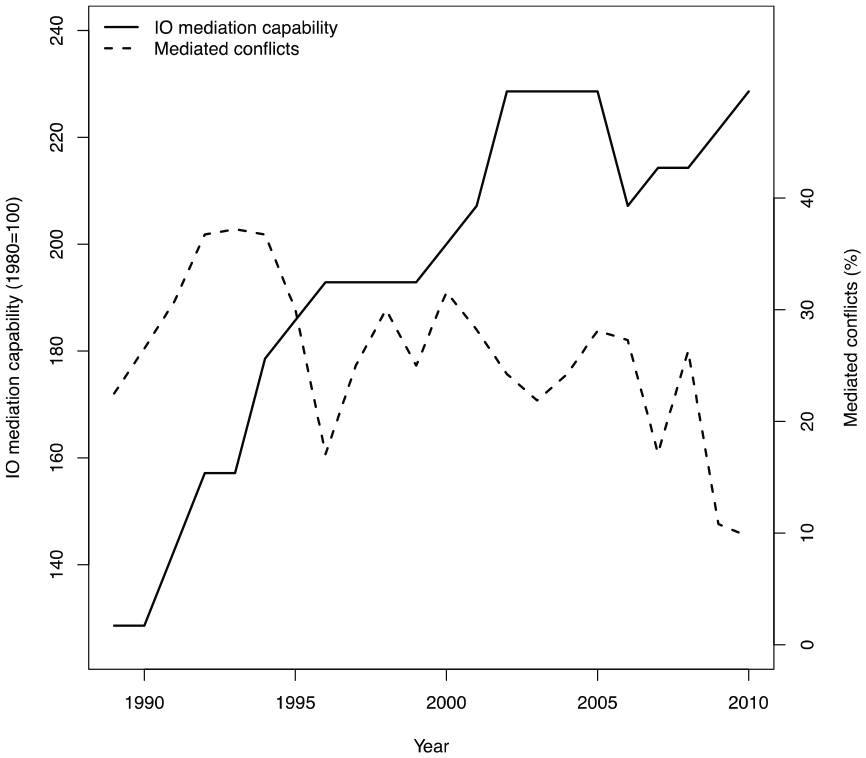
Aggregate index of institutionalized mediation capabilities for 21 intergovernmental organizations (1980=100) and mediated conflicts (percentage of all conflicts), 1989–2010.
This trend is surprising, given the concurrent trend of increasing mediation capacities. The last few decades have witnessed a mobilization in support of international mediation. Not only has there been a profusion of willing mediators (Crocker et al., 2001), there has also been increasing investment in mediation preparedness, reflected in the proliferation of mediation support units, networks and training (Herrberg et al., 2015). Longitudinal data on mediation capacity development substantiates this trend. Although there are no systematic data sources on the mediation capabilities available to states, Lundgren (2016) provides an index measure of the mediation intervention capabilities available to 21 intergovernmental organizations, factoring in bureaucratic structures and expertise in support of mediation, showing that there is a general trend of accumulating capabilities (Figure 2). For example, the Department of Political Affairs, the bureaucratic body that supports most of the UN’s mediation missions, saw its budget rise six-fold between the 1990s and the early 2010s.
Based on what we know from previous research, we would have expected such increases in technical mediation capacity to lead to more mediation. For example, Gowan and Stedman (2018: 172) portray a development of mediation and mediation capacity that go hand in hand, as an indication that conflicts are treated in a standard way: ‘The ascendancy of mediation as a frequent, almost automatic international response to civil wars over the last thirty years, as well as the development of institutions and technical capacity in peacemaking and peace-building, suggests that a new international regime for treating civil wars took hold in the 1990s.’ By contrast, we show that the two trends go in opposite directions, suggesting a puzzling relationship. Although the international system has added mediation capabilities, mediation incidence has not followed suit.
Why so few contemporary armed conflicts are mediated – existing explanations
How can we account for this puzzling pattern? For mediation to occur, a willing mediator and belligerents ready to engage with the mediator need to exist. It is, therefore, useful to think of mediation occurrence as a function of both supply-side factors pertaining to the incentives and capabilities of prospective mediators and demand-side factors pertaining to the incentives of the belligerents. Either or both of these may contain explanations for the observed shift in mediation.
On the demand side, research has pointed to factors such as the nature of the dispute and the power balance between incumbents and insurgents (e.g. Clayton and Gleditsch, 2014; Greig and Regan, 2008). A significant part of this discussion builds on Zartman’s (2001) notion of ‘ripeness’, indicating that belligerents’ demands for external mediation will increase when they find themselves in a ‘mutually hurting stalemate’, that is, a costly and ineffective military situation. On the supply side, research has suggested that mediation occurrence is a function of third-party interest, geographic proximity and mediator capability (Greig and Regan, 2008).
From this perspective, the temporal shift in mediation incidence must stem from temporal shifts in supply and demand factors in the population of ongoing conflicts. On the demand side, if the population of conflicts is adding cases less likely to develop into ‘ripe’ situations, it could help to explain why international mediation has been less frequently applied. On the supply side, if the population of conflicts is becoming dominated by cases that external mediators find less interesting, or are incapable of reaching, it could feasibly explain why overall mediation rates are decreasing.
If the nature of conflicts is changing, how can it help to explain declining mediation rates? Previous research has identified a number of ways in which armed conflicts have changed in contemporary times. Some point to fragmentation, leading to a proliferation of veto-players that can create obstacles for mediators (e.g. Cunningham, 2006). Others point to the increasing intractability and extended duration of contemporary conflicts (e.g. Fearon, 2017). A third line of thought emphasizes increasing internationalization as the key change in the landscape of armed conflicts (Melander et al., 2016).
Our analysis casts doubt on these factors as plausible explanations for the mediation puzzle. Theoretically, it is unclear why trends of fragmentation, intractability and internationalization would decrease the space for mediation. If anything, the opposite should be true. Fragmented conflicts would most certainly be more difficult to end through peace agreements, but a higher number of conflictual relations should increase, not decrease, the need and opportunity for mediators. Duration should, theoretically, be associated with a higher chance of a negotiated settlement (Mason and Fett, 1996), and because the length of a conflict increases its costs, it should incentivize primary and third parties to come to the negotiating table. In addition, although previous research (e.g. Regan, 2002) has demonstrated that conflicts with outside interventions last longer, it is conceivable that internationalization would increase the likelihood of mediation. For example, Greig (2005) shows that involvement by one or more of the great powers predicts mediation, and Lundgren and Svensson (2014) show that mediation between belligerents that receives external support is more likely to facilitate agreement.
Our empirical analysis reinforces the theoretical suspicion that these trends cannot account for the decline in mediation (see online appendix). First, we examined the possibility that the decline is explained by increasing fragmentation of civil conflict. Our data show that conflict fragmentation, defined by dyad count per conflict, has not changed significantly during the post-Cold War era, undermining this as an explanation for a shift with a clear temporal dimension (Figure A1). Second, we explored whether the decline of mediation was due to an increase in protracted conflicts. We found that although the average duration (time since outbreak) of conflicts increased from 9.7 years in 1989 to 14.1 years in 2013, there is no evidence that protracted conflicts receive less mediation (Figure A2). Third, our analysis suggests that internationalization does not provide a convincing independent explanation. When controlling for conflict characteristics, internationalized conflicts do not have a lower chance of receiving mediation than other conflicts (Table A1 and Figure A3).
Why so few contemporary armed conflicts are mediated – radicalization and proscription
Instead, we suggest another explanation. The decline in mediation is driven by a subset of conflicts, that is, Islamist conflicts, which are extremely under-mediated and on the rise. 5 The increase is quite dramatic. Although only 8% of conflicts were classified as Islamist in 1989, the proportion increased to 56% by 2013. The increasing prevalence of Islamist armed conflicts has been noted (Gleditsch and Rudolfsen, 2016; Svensson and Nilsson, 2018), but not linked to mediation occurrence. Our data show that conflicts fought over Islamist incompatibilities exhibit lower (and decreasing) mediation probabilities. Figure 3 demonstrates how the number of Islamist conflicts increases and the number of mediated Islamist conflicts decreases, leading to a widening mediation gap for this type of conflict. Only 14% of conflict years with Islamist claims received mediation after 2001, compared with 37% of conflict years in which neither side had made such claims. This difference is statistically significant, even when controlling for type of conflict, intensity, rebel strength, region and period-specific fixed effects (Table A1). Given that Islamist conflicts represent an expanding share of all conflicts, their low mediation rates may help explain part of the puzzle.

Islamist conflicts (1989–2015) and mediated Islamist conflicts (1989–2013).
The occurrence of Islamist armed conflicts is closely associated – as a cause, but also to some extent as a consequence – with the ‘War on Terror’ (WOT), the wide-sweeping military campaign launched in response to the 9/11 attacks, and the concomitant prevailing norm of not ‘talking to terrorists’. As Howard and Stark (2018) have suggested, shifting norms of conflict management have led to a situation in which more conflicts are seen through a securitized prism and in which armed actors are labelled as terrorists. Terror-listing decreases both the demand for mediation and the supply of mediators. Previous research (e.g. Haspeslagh, 2013; Toros, 2008) shows that proscription via terror-listing can place legal restrictions on contacts with conflict actors. It also tends to strengthen ‘hawks’ over ‘doves’ in intra-insurgency competition, decrease perceptions that a negotiated ‘way out’ exists and create reputational problems for third parties reluctant to be seen as legitimizing terror groups. Indeed, the military framing of the problem of terrorism implicit when referring to the WOT places high political costs on mediation in certain conflicts: Many mediators would think twice before engaging with actors deemed illegitimate by the UN or powerful countries, leading to a ‘chilling effect’ that reduces mediation.
To examine if our data support this interpretation, we identified conflicts with links to terrorism and assessed their mediation status. 6 As can be seen in Figure 4, the proportion of conflicts in which at least one actor is designated as a terrorist organization by the UN has increased dramatically. At the start of our observation period, no such conflicts existed; at the end, two-fifths of all conflicts involve such actors. Remarkably, of the 95 conflict years involving terror-listed actors, only 2 received mediation, suggesting that terror-listing does, indeed, have a considerable ‘chilling effect’ on international mediation. 7
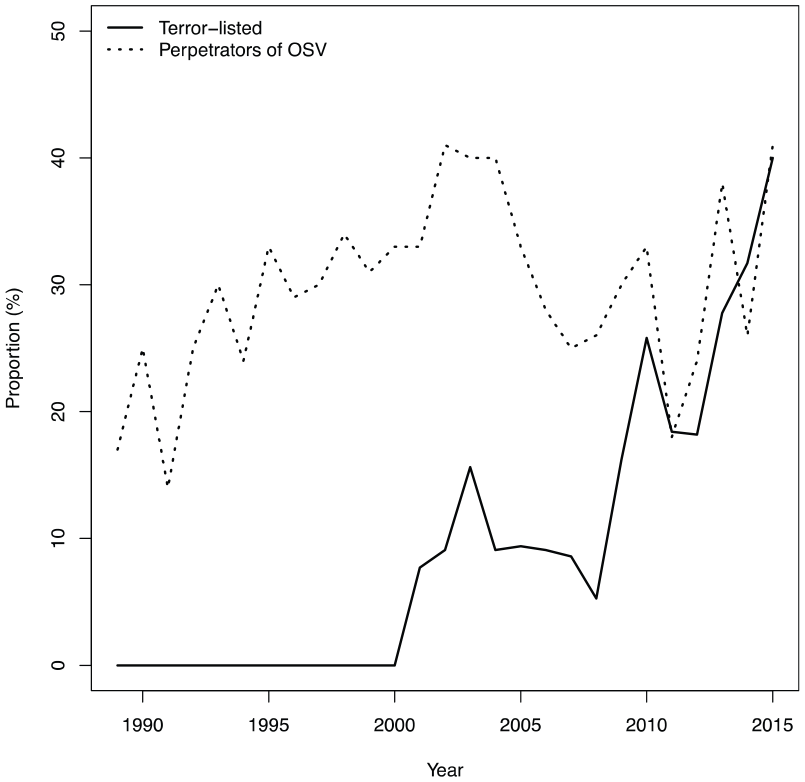
Proportion of conflicts in which at least one actor is included on the UN’s terror list and share of conflicts that involve perpetrators of one-sided violence 1989–2015.
Importantly, our analysis indicates that this change is primarily driven by shifts in the practice and norms of conflict management rather than changes in the conflicts themselves. Two patterns in the data support this conclusion. First, the number of actors using one-sided violence against civilians – a reasonable proxy for the use of terrorist tactics – is relatively constant over time (Figure 4). Second, prior to 2001, Islamist conflicts were not less likely to receive mediation than other conflicts (Table A1, Figure 3). In other words, it is the international community’s response to conflicts that exhibit one-sided violence or involve Islamist armed actors that has changed, leading to a diminished role for mediators in these cases.
Do we really know that mediation is in decline?
Before drawing this article to a close, we want to briefly discuss the robustness of the main finding we have presented: the decline of mediated conflicts. Three concerns need to be addressed here.
First, can the observed trend be an artefact of the data? If observing mediation has become more difficult, for example, similarly, we would observe a declining aggregate trend. We do not think this is a convincing explanation. If a temporal reporting bias exists, it is more likely to affect earlier periods. Indeed, it would be expected that the risk of missing data is lower in the post-2000 period than in earlier years, which is central to our argument, both because globalization has made remote locations more accessible and because the presence of social media makes it more difficult for informal or secret mediation initiatives to escape notice. It is, therefore, unlikely that the observed trend is a result of a temporal reporting bias. Analysis on alternative data, sourced from the International Crisis Behaviour dataset (Brecher and Wilkenfeld, 2000) and reported in the online appendix, supports this conclusion. We also replicated the main trend, aggregating mediation episodes at the dyad level rather than at the conflict level (Figures A4 and A5).
Second, it is possible that there is a geographic mismatch in the distribution of mediators and mediation capabilities, with some regions receiving fewer than others. Because the European conflicts had an above-average mediation rate, their disappearance from the universe of conflict cases would imply a decrease in the average mediation rate. Similarly, Asia, which has low mediation rates, has not experienced a dramatic reduction in the number of conflicts, with the implication that its pool of under-mediated conflicts remains longer in the population of conflicts, reducing the overall mediation rate. However, even though discrepancies exist with regard to available regional mediator resources (again, Europe has the most and Asia the least), it does not provide an explanation as to why global actors such as the UN would mediate less in certain regions and, likewise, it does not tell us why regional mediators would not be willing to mediate in other regions (for example, the EU has been willing to serve as a mediator for Asian conflicts).
Third, it should be recognized that our investigation of the mediation puzzle has been confined to high-level mediation (Track 1). We have not studied mediation at lower levels (Track 2 or Track 3). Substitution effects, by which informal and local mediators fill the gap left when formal mediators disengage, cannot be excluded. Unofficial mediators may have particular possibilities of engaging with Islamist actors, for example, including by more easily overcoming the obstacles of terror-listing.
Conclusions
This study has established a puzzling contradiction in contemporary mediation. Although the preparedness of international mediators has increased, the proportion of conflicts that receive mediation is stagnant or decreasing. We examined candidate supply- and demand-side determinants for the observed pattern. We found that the observed shortfall is unlikely to stem from fragmentation, protractedness or internationalization. Scrutinizing the robustness of the findings, we found that neither regionalization of conflict mediation capacities nor reporting bias provide satisfactory explanations for the observed decline.
Instead, we have suggested that the increasing prevalence of Islamist armed conflicts is the most prominent explanation behind this contradictory trend. Over the last two decades, conflicts in which at least one side made self-proclaimed Islamist demands have become both more common and increasingly unlikely to experience mediation. We identified terrorist proscription as a related mechanism; conflicts that involve terror-listed actors are considerably less likely to receive mediation. Because the international community has become increasingly willing to terror-list actors, this has placed an increasing number of conflicts beyond the reach of international mediators. The observed pattern is linked to a discontinuity in mediation rates around the turn of the millennium. Our explanation linking these two phenomena is the WOT, that is, the campaign against terror organizations, frequently with Islamist ideologies, that was initiated in the wake of the 9/11 attacks and which paved the wave for a normative shift in the international community’s approach to conflict management.
Our results point to further important implications for the study of mediation. First, it suggests that the increase in mediation experienced in the first decade after the end of the Cold War (DeRouen et al., 2011; Gowan and Stedman, 2018; Greig and Diehl, 2012) may be a historical anomaly, rather than the start of an era with consistently high mediation rates.
Second, although previous research has characterized the mediation field as a ‘crowded stage’ (Crocker et al., 2001), our analyses suggest that there is still plenty of room for engagement. Despite the increasing mediation capabilities around the world, about two-thirds of all conflicts experience no international mediation whatsoever in a given year.
Finally, from a policy perspective, it is contradictory that western countries, the key architects behind the mobilization of international mediation capabilities, are also the most ardent pursuers of anti-terror sanctions. Whereas rhetoric and funding have increasingly supported diplomatic solutions via mediation, the range of conflicts to which such tools can be applied is diminished by the growing use of another instrument, terror-listing, which effectively places many conflicts beyond the reach of mediation. If the practice of mediation is to remain relevant for managing and resolving armed conflicts in the future, there is a need to find ways of broadening the scope of involvement.
Supplemental Material
Explanatory_memo – Supplemental material for The surprising decline of international mediation in armed conflicts
Supplemental material, Explanatory_memo for The surprising decline of international mediation in armed conflicts by Magnus Lundgren and Isak Svensson in Research & Politics
Supplemental Material
Mediation_shortfall_replication_revised – Supplemental material for The surprising decline of international mediation in armed conflicts
Supplemental material, Mediation_shortfall_replication_revised for The surprising decline of international mediation in armed conflicts by Magnus Lundgren and Isak Svensson in Research & Politics
Supplemental Material
Online_appendix – Supplemental material for The surprising decline of international mediation in armed conflicts
Supplemental material, Online_appendix for The surprising decline of international mediation in armed conflicts by Magnus Lundgren and Isak Svensson in Research & Politics
Footnotes
Acknowledgements
We thank Frederic Stephen Pearson, David Cunningham, Pamela Aall and two anonymous reviewers for helpful comments.
Authors’ note
Previous versions of this article were presented at the 2017 International Studies Association Annual Meeting and the 2017 Folke Bernadotte Mediation Research Workshop.
Declaration of conflicting interests
The author(s) declared the following potential conflicts of interest with respect to the research, authorship, and/or publication of this article: Research for this article was carried out in connection with the project ‘Resolving Jihadist Conflicts? Religion, Civil War and Prospects for Peace’.
Funding
The author(s) disclosed receipt of the following financial support for the research, authorship, and/or publication of this article: This study was supported by Riksbankens Jubileumsfond through grant NHS14-1701:1.

Supplemental materials
Notes
Carnegie Corporation of New York Grant
This publication was made possible (in part) by a grant from the Carnegie Corporation of New York. The statements made and views expressed are solely the responsibility of the author.
References
Supplementary Material
Please find the following supplemental material available below.
For Open Access articles published under a Creative Commons License, all supplemental material carries the same license as the article it is associated with.
For non-Open Access articles published, all supplemental material carries a non-exclusive license, and permission requests for re-use of supplemental material or any part of supplemental material shall be sent directly to the copyright owner as specified in the copyright notice associated with the article.
