




Abstract
Of all atrocities committed by state actors in 20th century Europe, the systematic killings by Nazi Germany were arguably the most severe and best documented. While several studies have investigated the impact of the presence of concentration camps on surrounding communities in Germany and the occupied territories in terms of redistribution of wealth and property, the local-level impact on voting behaviour has not yet been explored. We investigated the impact of spatial proximity to a concentration camp between 1933 and 1945 on the likelihood of voting for far-right parties in the 2013 and 2017 federal elections. We find that proximity to a former concentration camp is associated with a higher vote share of such parties. A potential explanation for this finding could be a ‘memory satiation effect’, according to which voters who live in close proximity to former camps and are more frequently confronted with the past are more receptive to revisionist historical accounts questioning the centrality of the Holocaust in the German culture of remembrance.
Introduction
Of the salient political conflicts that reshaped political competition at the beginning of the 21st century, many are rooted in historical events that lie decades and sometimes centuries in the past. In many cases, these conflicts pit the right to remember past wrongs of territorial or ethnic communities that have been historically marginalized, discriminated and prosecuted against the desire of members of the majority to maintain a particular narrative of a country’s history. However, often these conflicts about how to remember the past also divide society along partisan lines. A substantial body of literature demonstrates that historical events and institutions tend to cast a shadow long after they have ceased to exist, particularly if they involved conflict and violence (Acemoglu et al., 2011; Charnysh and Finkel, 2017).
In this context, we investigated the long-term political impact of the most extreme case of state mass violence – the Holocaust. While any intellectual engagement with the Holocaust should have the victims at its centre, it is also pertinent to analyse its impact on political outcomes in the country responsible for the crimes. We analysed the impact of one of the most visible and prominent symbols of the crimes conducted under the National Socialist dictatorship in Germany: former concentration camps. In particular, we were interested in the impact of living in spatial proximity to a former camp on voting for a far-right party (FRP). Our reasons for choosing this empirical design are twofold: first, physical monuments can be considered a particularly prominent and contentious object of memory, as their presence is visible to everyone in the area and permanent in time (Wüstenberg, 2017). Second, we believe that the impact of the Holocaust on electoral behaviour in Germany deserves particular attention. While there has long been a consensus on German responsibility and the centrality of the Holocaust for German history, this view is now challenged. We thus believe that the German case can tell us a lot about the dynamics of the long-term impact of mass violence and its interaction with political competition in shaping collective memory.
Perhaps surprisingly, we found that the vote share of far-right parties increased as we moved closer to a former concentration camp. Arguably, being repeatedly reminded of an in-group transgression led some voters to be receptive to a revisionist historical narrative that negates the centrality of German guilt. We thus found (indirect) evidence for a ‘political satiation’ effect, in which repeated exposure to cues of in-group responsibility led to higher receptiveness for a revisionist narrative rather than a ‘resilience effect’, in which being reminded of past crimes decreases the likelihood of voting for the far right.
How memory persists: resilience or satiation?
Until now, the largest and most systematic act of state-induced mass violence, the Holocaust, has received rather limited attention by political scientists in terms of its long-term effect on political attitudes and behaviour. One of the few scholarly works focusing specifically on the long-term impact of mass killings in the context of the Holocaust is a recent article by Charnysh and Finkel (2017). The authors analysed the impact on the surrounding communities of the Nazi death camp Treblinka, in Poland, where Germans murdered nearly a million Jews. They show that communities located closer to the camp experienced a property boom, which eventually led these communities to show higher support for an anti-Semitic party, the League of Polish Families. We complement their paper by asking a related question, namely how the crimes of the Nazi dictatorship have impacted on voting behaviour in Germany, the country of the perpetrators.
In so doing, we also hope to contribute to the general literature on far-right voting. This now extensive literature has identified factors such as political opportunity structures (Arzheimer and Carter, 2006), economic grievances such as unemployment (Golder, 2003) and anti-immigrant sentiments (Van der Brug et al., 2005) as determinants of the electoral success of FRPs, even though the interaction between these different factors is complex and multidimensional (Golder, 2016). While there are some studies that focus on the historical antecedents of the success of FRPs, as mentioned above, we aim to provide an original contribution to the literature on far-right voting by focusing on the role of the spatial location of sites of mass violence and the politicization of a country’s culture of memory.
Remembering the Holocaust, the systematic killing of more than 6 million Jewish people and other minorities, has long been considered a defining feature of the raison d’état of the Federal Republic of Germany. The process of remembrance went through several phases. While the initial post-war period was characterized by denial and unwillingness to give a voice to the victims, the student-led revolts of the late 1960s and centre-left governments of the 1970s brought about the preconditions for an active questioning of the past and critical engagement with German guilt (Wüstenberg, 2017: 33). As Art claims, this contestation has given rise to two ‘frames’ of German history: a ‘contrition frame’, focusing on the victims and the responsibility resulting from German guilt, and a ‘normalization frame’, promoted by the right, arguing that discussions of German guilt had to end to allow the country to develop a ‘normal’ national identity (Art, 2005: 10).
Facilities previously serving as concentration camps can be considered one of the most prominent and powerful places of memory relating to the Holocaust. Memorials, places of remembrance or lieux de mémoire are arguably distinct from other forms of memory such as public debates or events in that they are permanent fixtures with which every resident or visitor of the area is confronted (Wüstenberg, 2017: 11). This high visibility makes memorials particularly prone to be subjects of societal mobilization and contestation (Wüstenberg, 2017: 11). We thus hypothesized that spatial proximity to such a lieu de mémoire would have a lasting impact on vote choice in the German context.
We had two distinct hypotheses about the direction of the relationship between living in spatial proximity to a former concentration camp and voting for an FRP. Our first hypothesis was that voters living in close proximity to a former concentration camp would be less likely to vote for such a party. We refer to this as the ‘resilience hypothesis’. In terms of a contemporaneous effect, being constantly reminded of the consequences and extent of German crimes might make voters resilient to any attempts of minimization of German crimes or a ‘normalization frame’. We also believed that there was an additional and related historical mechanism driving such an effect. After the liberation of concentration camps in 1945, the allied powers to varying degrees engaged in denazification measures, mostly carried out at the local level. This experience could have become a shared memory passed down through generations, leading to an aversion to far-right politics and any attempts to qualify or minimize the crimes.
However, revelations about in-group transgressions might also prompt defensive responses and minimization of in-group complicity (Branscombe et al., 2007). We term this the ‘satiation hypothesis’. Satiation as a psychological concept refers to the phenomenon that repeated exposure to a semantic stimulus – in this context embodied by former camps as places of memory – weakens the reaction and receptiveness of a subject to such assertions. Could reactions of defensiveness and minimization of in-group complicity be especially pronounced for those who have received a particularly strong ‘treatment’ of remembrance culture by living close to a former camp? In any case, we would expect both mechanisms to be especially pronounced in – or indeed even limited to – West Germany, as long-ranging debates on how the Holocaust should be remembered were restricted to the Federal Republic of Germany. The German Democratic Republic (GDR) considered itself anti-fascist and thus by definition not responsible for the crimes of the National Socialist dictatorship (Art, 2005: 43). In the next section, we describe our research design to test the resilience and satiation hypotheses empirically.
Data and research design
Our outcome of interest was the percentage of votes obtained by FRPs in the 2013 and 2017 German federal elections. We considered as far-right parties the following political formations: The Nationaldemokratische Partei Deutschlands (NPD), Die Rechte, Die Republikaner and Pro Deutschland. All of these parties have a clear far-right profile or even ties to Neo-Nazi groups. The status of the Alternative fuer Deutschland (AfD) is less clear. Initially founded as a liberal-conservative party in 2013 in opposition to Eurozone bailouts, the party has moved continuously to the right and is now considered an FRP by many observers (Arzheimer and Berning, 2019; Schmitt-Beck, 2017). More recently, members of the more radical wing of the party have openly challenged Germany’s culture of memory. In consecutive regional elections, the presence of the AfD had a strong mobilizing effect on former non-voters who consider themselves right wing (Hobolt and Hoerner, 2019). Furthermore, research has shown that there was a correlation between the vote share of the Nationalsozialistische Deutsche Arbeiterpartei (NSDAP) and votes for the AfD in 2017, but not in 2013 (Cantoni et al., 2019). Moreover, the AfD tends to do well in districts in which FRPs were successful in the past (Schwander and Manow, 2017). We thus ran two models, one without and one with the AfD. Analysing both the 2013 and 2017 elections allowed us to assess whether the emergence and transformation of this party at the fringe of the German party system had an impact on the potential memory satiation effect. Our expectation was that the new party had become increasingly attractive for voters who were critical of Germany’s culture of memory in the latest election. Furthermore, we focused on the two most recent elections to increase the robustness of our models. The election data were aggregated at the Gemeinde level, the smallest administrative division of local government having corporate status and powers of self-government in Germany.
Figure 1 shows the spatial distribution of radical-right support across Germany in the 2013 (left panel) and 2017 federal elections (right panel). The figure for the 2013 election excludes the vote share of the AfD, whereas the 2017 figure depicts the election results for radical-right parties including the AfD.
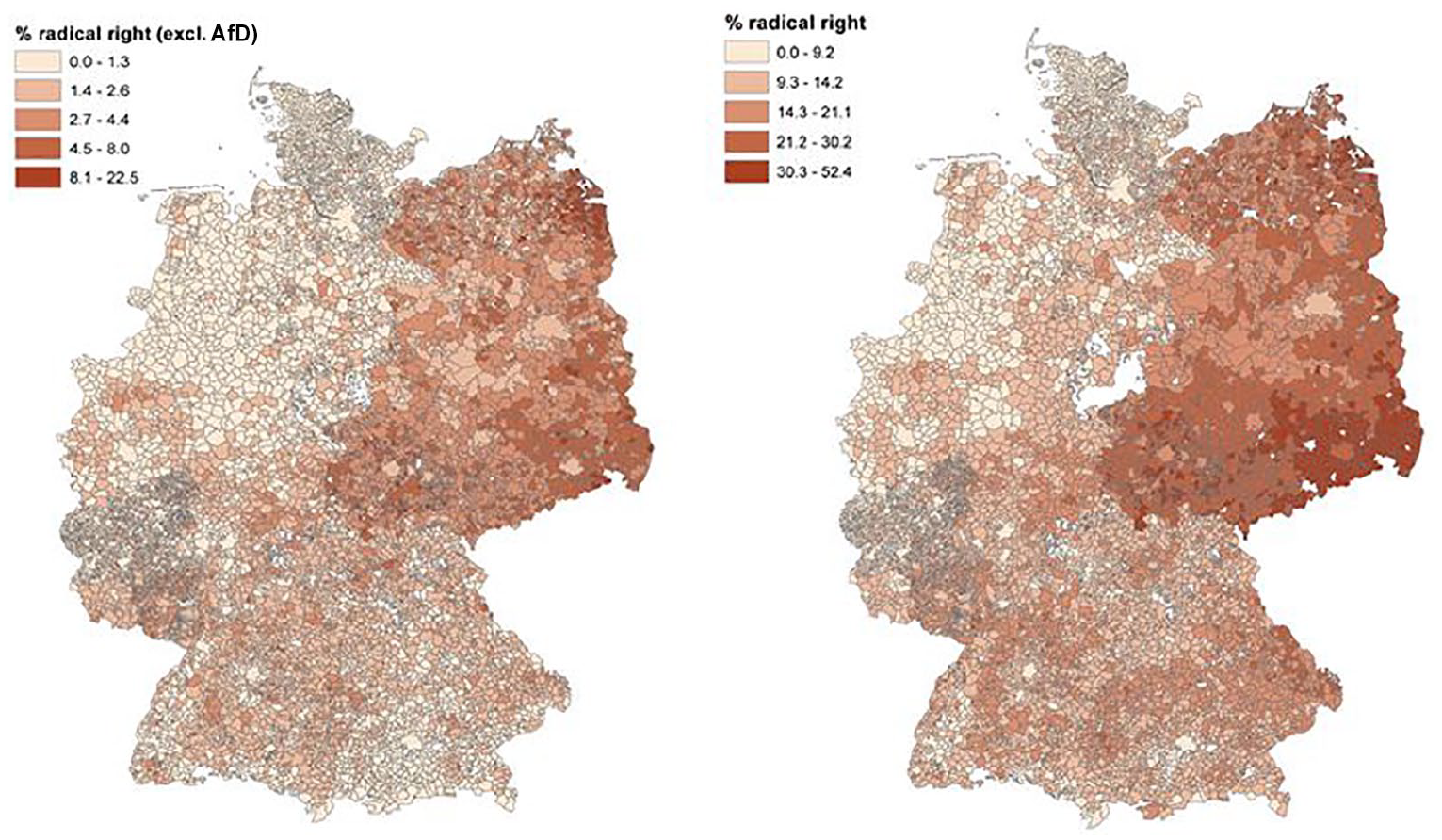
Spatial distribution of support for FRPs (Gemeinde level) in the 2013 (left) and 2017 federal elections.
Similarly, Figure 2 shows the distribution of our outcome of interest, that is, radical-right support in 2013 and 2017 at the Gemeinde level. For 2017, the data include the vote share of the AfD. Both distributions are single peaked, although the 2017 density has a longer right-hand tail, which essentially depicts the increase in support for the AfD.

Distribution of radical-right support (2013–2017).
As already detailed, we exploited the fact that some geographical units are closer to concentration camps than others. For each Gemeinde, we calculated the distance between each polygon’s centroid and the closest concentration camp (in metres). Given that German Gemeinden are small geographical units (the average size is 31 km2), the centroid is an accurate representation of its characteristics. Figure 3 shows the distribution of distances to the nearest camp in metres (left panel) and the log of the distance (right panel). As we expected the effect of the distance to be non-linear, we used the latter as our main explanatory variable.

Distance between a Gemeinde’s centroid and the closest concentration camp.
Figure 4 shows the distribution of concentration camps in Germany, as well as support for the extreme right in the 2013 federal election at the Gemeinde level. Data on the location of concentration camps were made available by the Holocaust Memorial Museum in Washington D.C. in the context of the Geographies of the Holocaust project (Knowles et al., 2014). As can be seen, although the camps are spatially concentrated in East Germany, they are generally equally scattered across the territory. One major concern for our analysis was the potentially endogenous location of concentration camps across German geography. That is, concentration camps were unlikely to be built at random. In contrast, it is likely that certain observed and unobserved characteristics drove the location of camps across space. (We explore this assumption in Section C of the Online Appendix.) However, the analysis did not reveal a systematic pattern.

Extreme right-wing support in the 2013 election and the location of concentration camps.
Our empirical models also controlled for a variety of additional indicators. 1 The control variables were divided into two categories: variables that allowed us to control for the political and socioeconomic characteristics of the Gemeinden in the 1930s and variables that captured the characteristics of the same regions in Germany in 2013 and 2017. We employed areal interpolation to match the territorial units from 1930 and the contemporaneous boundaries. The Gemeinde data were retrieved from the federal electoral office Bundeswahlleiter (Bundeswahlleiter, 2013, 2017), while the shapefiles for the 1930 elections were retrieved from the Demographic Research Census Mosaic Project (Census Mosaic, 2019). In order to account for missing values in the historical data, we imputed data from the five nearest polygons using spatially weighted averages at the level of modern municipalities.
Regarding the first set of controls, we included the percentage of votes obtained by the NSDAP (1930), the percentage of the Jewish population (1925) and the percentage of factory workers (1933). As shown by previous work (e.g. Falter, 1981) voting patterns persist over time. Therefore, we were interested in examining the impact of being close to a concentration camp net of previous political alignments (see also Online Appendix B). The electoral results of the 1930 election were taken from the historical dataset compiled by Hänisch (1989). 2
Both models included the following controls at the Gemeinde level: first, the percentage of men. As shown by political behaviour literature, men are more likely to support radical right-wing parties than women (Immerzeel et al., 2015). Second, the percentage of Catholics: as recently shown by Spenkuch Joerg and Philipp (2018), Catholic regions were far less likely to vote for the NSDAP than their Protestant counterparts. Third, we included the percentage of non-Germans, as anti-immigrant sentiment is identified in the literature as a potential factor benefiting FRPs (Van der Brug et al., 2005). This information was taken from the 2011 census. Finally, all models included the following additional controls: a dummy for areas in the former GDR, the (log of the) population density as well as Laender dummies (the states in the German federal system). Descriptive statistics can be found in Online Appendix A.
Results
Did the radical right receive more electoral support in Gemeinden located close to former concentration camps? Table 1 shows the effect of the (log of the) distance between a municipality’s centroid and the closest concentration camp across different model specifications and years (2013 and 2017). For each year, we ran separate models that took the vote share of the AfD into account and omitted it respectively. For 2017, we expected the effect to be stronger when the AfD was included, as the party attracted a substantial amount of support among far-right voters and switched to a rhetoric that explicitly called into question Germany’s culture of memory. Table 1 presents the different models. For each specification we included the models with and without an interaction between distance to a concentration camp and the dummy for a Gemeinde in East Germany, the former communist GDR.
The effect of distance to a camp on radical right-wing voting.
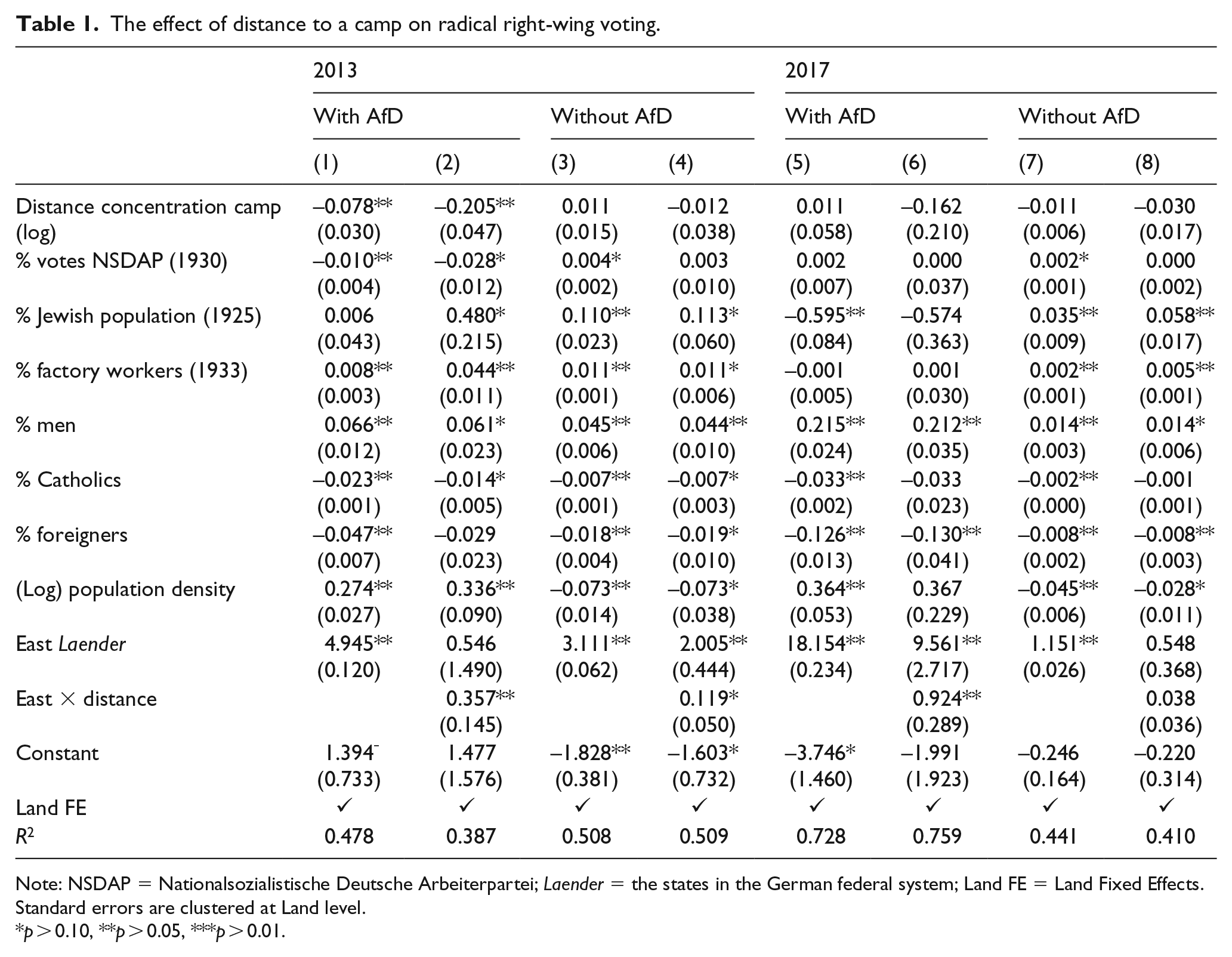
Note: NSDAP = Nationalsozialistische Deutsche Arbeiterpartei; Laender = the states in the German federal system; Land FE = Land Fixed Effects.
Standard errors are clustered at Land level.
p > 0.10, **p > 0.05, ***p > 0.01.
Looking at 2013, we observe that distance to a concentration camp has a negative and significant effect, especially in West Germany. That is, when we move away from a concentration camp, the electoral support received by radical-right parties in the western part of the country goes down. The effect of the interaction is significant both when the dependent variable includes support for the AfD and when it does not. We found that the magnitude of the effect of being close to a camp was larger when we did not include the vote share of the AfD.
We observe similar results when we focus on the 2017 election: being close to a concentration camp is associated with stronger support for the radical right. Yet, in this case we can observe an interesting difference: when the dependent variable does not include the AfD votes, the interaction ceases to be significant. This pattern could be explained by the capacity of the AfD to concentrate the majority of the support of far-right voters, particularly given the shift in its rhetoric that explicitly called Germany’s culture of memory into question.
Figure 5 plots the predicted support of radical-right parties as a function of distance to a concentration camp in 2013 (left plot) and 2017 (right plot). The increase in AfD support becomes obvious from the change in the y axis: average support is substantially higher in 2017 than in 2013.

The effect of being close to a concentration camp on the radical-right vote.
The left plot visually shows that Gemeinden located close to concentration camps in West Germany gave a larger share of the votes to radical-right parties than those municipalities located far away (figures based on models 2 and 6). The effect is once again significant and negative in West Germany and not in the former GDR. According to our model, in the West, in places located near the camp (within 200 m), the radical right received on average 7.3% of the votes. In contrast, if a Gemeinde was 1 km away from a concentration camp, the predicted support for radical-right parties decreased to 7%. The right panel of the figure plots the same interaction but using data from 2017. As the figure shows, the pattern is the same.
Concluding remarks
This paper provides an empirical contribution on the relationship between living in spatial proximity to a former concentration camp and voting for a radical-right party in Germany. Our interest in this question was motivated by a now rich literature on the long-term effects of institutions, historical events and in particular cases of mass violence on political outcomes. The Holocaust represents a singular case of state-induced mass violence given its severity and, at the very least, indirect awareness of the crimes of large sections of the German population. Debates about the position of the Holocaust in Germany’s national identity and culture of memory have been an integral part of post-war (West) German politics. It thus seems reasonable to expect that a long-term effect on electoral behaviour continues to exist.
The particular focus of our empirical setup was spatial proximity to former concentration camps as these facilities arguably represent some of the most visible and permanent fixtures of the German culture of remembrance. Our results are in line with Charnysh and Finkel (2017) and suggest that the vote share of radical-right parties is on average higher in municipalities in close proximity to a former camp. Our supposition is that ‘memory satiation’ could be driving this effect, that is, individuals repeatedly confronted with in-group transgressions become more receptive to alternative narratives in a process of cognitive dissonance. Interestingly, we only found this effect in West Germany, where the contrition frame was much more dominant in the political discourse compared with the East. Moreover, we found that as the AfD as a new party moved to the right between the 2013 and 2017 elections and increasingly used a rhetoric explicitly targeted at dismantling the contrition frame, the overall effect of our dependent variable became stronger but was only significant when we included this new party in the analysis of the later election. Arguably, this finding supports our case, as it shows that the magnitude of the effect of proximity to a former camp is dependent on the strength of the political entrepreneurs challenging the prevalent culture of memory. Future research could build on our findings to conduct a more fine-grained analysis, for example by incorporating additional elections, by distinguishing between different types of camps or by analysing individual-level data that could provide a handle on the psychological mechanisms behind the proposed memory satiation effect.
Supplemental Material
Hoerner_Jaax_Rodon_Appendix – Supplemental material for The long-term impact of the location of concentration camps on radical-right voting in Germany
Supplemental material, Hoerner_Jaax_Rodon_Appendix for The long-term impact of the location of concentration camps on radical-right voting in Germany by Julian M. Hoerner, Alexander Jaax and Toni Rodon in Research & Politics
Supplemental Material
Replication – Supplemental material for The long-term impact of the location of concentration camps on radical-right voting in Germany
Supplemental material, Replication for The long-term impact of the location of concentration camps on radical-right voting in Germany by Julian M. Hoerner, Alexander Jaax and Toni Rodon in Research & Politics
Footnotes
Acknowledgements
The authors are indebted to the Holocaust Memorial Museum in Washington D.C. for providing the data on the spatial location of concentration camps. The authors are also grateful to Chris Anderson, Sara Hobolt, Simon Hix, Jae-Jae Spoon, Christopher Wratil as well as the attendees of the Political Behaviour Seminar in the London School of Economics Department of Government and the 2018 Conference of the European Political Science Association for their comments.
Declaration of conflicting interests
The author(s) declared no potential conflicts of interest with respect to the research, authorship, and/or publication of this article.
Funding
The author(s) received no financial support for the research, authorship, and/or publication of this article.

Supplementary materials
Notes
Carnegie Corporation of New York Grant
This publication was made possible (in part) by a grant from the Carnegie Corporation of New York. The statements made and views expressed are solely the responsibility of the author.
References
Supplementary Material
Please find the following supplemental material available below.
For Open Access articles published under a Creative Commons License, all supplemental material carries the same license as the article it is associated with.
For non-Open Access articles published, all supplemental material carries a non-exclusive license, and permission requests for re-use of supplemental material or any part of supplemental material shall be sent directly to the copyright owner as specified in the copyright notice associated with the article.
