




Abstract
Does an internationally unpopular president reduce support for US foreign policy? This article examines how President Trump’s endorsement influences foreign policy preferences abroad. A nationally-representative survey experiment is conducted on Japanese attitudes concerning the government’s response to the recent North Korean missile launches. It is found that leadership credibility has a significant impact on the public. Japanese citizens are less likely to support an aggressive response to North Korea when it is endorsed by President Trump. The effect of leadership credibility, however, may not be entirely distinct from general anti-American sentiments. These results indicate that, even in high politics related to national security, Trump’s lack of credibility abroad hinders allies’ ability to cooperate with the USA by eroding domestic support, but it is difficult to separate the Trump effect from broader attitudes toward the USA.
Introduction
Does global distrust of the president have a meaningful impact on US foreign policy? President Trump entered the White House with a widely reported lack of international credibility. This shortage of confidence was particularly strong in the US’s major allies. 1 In Japan, for example, only 24% of the public believed that President Trump would “do the right thing when it comes to international affairs” (Wike et al., 2017: fig. 2). This number is a sharp contrast from President Obama, who enjoyed high levels of public support abroad. It is uncertain, however, how this lack of credibility influences US foreign policy.
Some academics and political adversaries of the president have highlighted the possible negative consequences of an unpopular executive. It has been argued that the USA is damaging its international image and ability to build support for its preferred policy positions with major allies. 2 Elizabeth Saunders (2017) refers to this as a rot in relationships that may force foreign officials facing domestic pressure to separate from Trump. Joseph Nye more directly claims that “Donald Trump’s presidency has eroded America’s soft power” (Nye, 2018: para. 1).
Supporters of the president and realists, however, maintain that, particularly concerning issues of security, the global popularity of the executive is not an important factor influencing foreign policy outcomes. Allies and their electorates will support policies in their best interest regardless of attitudes toward President Trump. Furthermore, a focus on strong power will enhance the US’s global position. When discussing the Trump administration’s budget blueprint, for example, the director of the Bureau of Management and Budget stated that the president wants to “send a message to our allies and to our potential adversaries that this is a strong-power administration,” highlighting the government’s skepticism towards the importance of soft power (as cited in Taylor et al., 2017: para. 2).
Yet others contend that the decline of the US’s global position is a more general trend that predates Trump. Twelve years prior to election of President Trump, for example, Nye (2004) argues that decades of war and perceived hypocrisy in policy have damaged the US’s global reputation. In this vein, a number of scholars and political elites view Trump as a symptom of a decline in US hegemony, not the cause (Drezner, 2019).
Does an unpopular president reduce international support for US goals? Is this effect distinct from general anti-American sentiment? To examine these questions, this article employs a survey experiment testing the effect of elite endorsements on public support for the US’s preferred policy position. The survey experiment is conducted in Japan six weeks after the North Korean missile launch in 2017. During this time, the Japanese public faced an imminent security threat of additional missile launches. While many studies rely on hypothetical situations and vignettes which limit external validity, this study leverages a real security issue and employs a national sample.
It is found that an endorsement from President Trump reduces support for an aggressive response to the North Korean missile test, the US’s preferred position at the time. Association with President Trump reduces public support for the US’s preferred policy position on a major issue concerning national security. On the other hand, there is only limited support for the claim that the effect of a Trump endorsement is distinct from general anti-American sentiments.
The US president and foreign policy
Soft power, or “getting others to want the outcome you want,” is believed to be an important facet of US diplomacy (Nye, 2004: 5). The US president, through official state visits, televised speeches, and recently social media, promotes US policy abroad (Marra et al., 1990; Nitsch, 2007; Lebovic and Saunders, 2016). The executive can thus have a major impact on US soft power by building international support for US foreign policy. 3 If the president is perceived as untrustworthy, however, it may be difficult to win over international audiences.
Source characteristics, for example, are routinely found to influence attitude change. The speaker’s credibility, trustworthiness, public approval, likeability, and ideology have all been shown to influence the effectiveness of persuasion (Druckman and Lupia, 2000; Mondak, 1993; Zaller, 1992). Trump’s lack of credibility could thus directly undermine the promotion of US policy where he is viewed as untrustworthy. To test this direct effect, the leadership-credibility hypothesis is made:
Hypothesis 1 (Leadership credibility): Endorsement of a policy by President Trump will lead to a reduction in international support for the policy position.
If leadership credibility impacts international support for US policies, it is important to consider whether this is a distinct effect from anti-Americanism in general. Individuals who dislike or are skeptical of the US may oppose US policies as a result (Bush and Jamal, 2015). The US’s image around the world has been damaged by decades of war and controversial policies, not necessarily the perceived credibility of the current administration. The US president may simply be viewed as an extension of the US government and thus the executive may not provide a distinct source cue. To examine this possibility, the following two hypotheses are made:
Hypothesis 2 (Anti-Americanism): Endorsement of a policy by the US government will lead to a reduction in international support for the policy position.
Hypothesis 3 (Distinct effect): The effect of an endorsement of a policy by President Trump is different than the effect of an endorsement by the US government on international support for the policy position.
2017 North Korean crisis
On August 29, 2017, North Korea (DPRK) launched a Hwasong-12 missile over the Japanese island of Hokkaido. This was North Korea’s first missile launch over Japanese territory. The DPRK had previously projected rockets over Japan but maintained that those launches were for satellites and not aggressive acts, making this launch a significant issue for Japanese security and domestic politics. Two weeks later, the DPRK launched a second missile, setting off Japan’s national warning system in affected areas and generating a significant amount of public concern. At 6 AM, alarms sounded announcing missiles had been launched, millions of people received text messages warning of “missiles passing” and the possibility of dangerous debris, train stations posted warning signs and delays, and TV networks offered live coverage of areas under the missile’s path. The missile threat from North Korea is a significant security threat to the Japanese public and garnered considerable national attention.
The missile crisis further became part of a larger political debate concerning Japanese security and provided the backdrop for the 2017 general election. Prime Minister Abe was a vocal supporter of President Trump’s approach on the issue and stressed the importance of applying more pressure to North Korea. Abe previously built his political career by taking a strong position against the DPRK concerning the abductions of Japanese citizens and framed the election as a public mandate for his policy on North Korea, emphasizing that Japan has been betrayed by North Korea in the past when attempting dialogue. Abe faced little internal opposition. The LDP’s coalition partner, Komeito, supported the LDP’s position by stressing that Abe is the best leader to handle the issue.
Likewise, Abe faced little external opposition. The Democratic Party of Japan, the major opposition party, collapsed prior to the election. Some critics of the ruling administration accused Abe of using the North Korean threat to further ambitions to revise Japan’s constitution. Others expressed concerns of overcommitment to US policy that may entrap Japan in unwanted conflict. Opposition parties, however, offered no policy suggestions on North Korea beyond increased dialogue. 4
Case selection
Japanese public support for applying pressure to North Korea provides an ideal case for testing the impact of President Trump on international support for US foreign policy. First, this case offers a difficult test of the influence of President Trump’s international image. Because it is a major security issue, it is likely that individuals are more concerned with solving the problem than political ideologies. Furthermore, as a result of the importance of the event, it is expected that the population has formed stronger attitudes about the Korean peninsula than other foreign policy preferences. Strong attitudes are more difficult to influence, thus biasing the results toward a null finding (Howe and Krosnick, 2017). 5 Moreover, Trump’s position is supported by Abe, who has a significant amount of credibility concerning the North Korean issue.
Second, President Trump and the State Department took a clear public position following the missile launch, encouraging the international community to apply stronger pressure to North Korea. President Trump iterated in a number of tweets and public speeches that the international community needed to apply pressure to North Korea. While not specifically directed to Japanese citizens, Trump’s tweets receive regular news coverage in Japan. Furthermore, there is a Twitter feed with over 86,000 followers that provides Japanese translations of President Trump’s tweets. 6 Similarly, the State Department released a North Korea policy statement in September 2017 indicating a commitment to applying maximum pressure and encouraging all nations to adhere to sanctions and terminate trade relations with North Korea (Thornton, 2017). Differences in the effect of a Trump and US endorsement can thus not be attributed to policy differences.
Research design
To test the above hypotheses, an embedded survey experiment is conducted on a national sample of Japanese adults. The survey is administered by Survey Sampling International (SSI), and the sample (n = 1,000) is recruited to match the Japanese population’s gender and age. 7 The survey was fielded from October 27 to November 6, 2017, about six weeks after the second missile launch.
The timing of the survey is significant for three reasons. First, after the successful test of the Hwasong-15 on November 28, many believed it was no longer necessary for the DPRK to fire additional missiles as they had demonstrated their capabilities to launch a nuclear weapon. 8 The Japanese public after November 28 was thus less likely to feel the threat of an imminent launch. 9 Second, following the final launch, the State Department shifted to a softer public stance than the White House, creating a possible tension between the preferred policies of the White House and the State Department. The Secretary of State, for example, stated on December 12 that, “from the diplomatic side we’re ready to talk anytime North Korea would like to talk, and we’re ready to have the first meeting without precondition” (Tillerson, 2017: para. 69). This difference in public policy stance has the potential to influence the cue of an endorsement by the president or the US government as there is no longer a clear unified position. Third, the Japanese election ended on October 22 and the issue was no longer highly politicized. The timing of the survey thus allows us to gauge Japanese public opinion when future launches are imminent, when the State Department and White House presented a uniform policy, and when the issue was no longer dominated by domestic politics.
Subjects are asked their policy preference concerning the Korean Peninsula with the following question: “As you have most likely heard, North Korea recently launched missiles over Japan. Concerning Japan’s response to the situation, which of the following statements comes closest to your own position?” Respondents are given a choice between applying pressure to North Korea, focusing on dialogue, and no preference. 10
Subjects are randomly assigned to the three experimental groups: the Trump-endorsement group, US-endorsement group, and a control group. The control group only receives the above measure of policy preference toward North Korea. This provides the baseline to compare the effects of the treatments.
The treatment groups receive a prime directly before responding to the policy preference measure. The prime is an elite endorsement of applying pressure, which was the US’s stated goal at the time. The Trump-endorsement group receives a policy endorsement from President Trump: “As you have most likely heard, North Korea recently launched missiles over Japan. The US President Donald Trump has argued that talking will not work and encouraged all states to apply more pressure on North Korea”. The US-endorsement group, conversely, is given the same endorsement, not from the president, but from the US government.
Results
The results of the analysis are presented in Table 1. In the control group, which did not receive any manipulations, a majority of citizens, 56%, prefer Japan apply pressure. This is consistent with a general shift in the societal discourse that has embraced a stronger security position with North Korea over the previous decade (Lee, 2016). Furthermore, respondents seem to be knowledgeable of and have strong attitudes concerning the issue. Less than 13% of respondents indicated a “don’t know” response. In the same survey, for example, about 20% of respondents chose “don’t know” on a trade-related foreign policy question. 11
Policy preference by experimental group.

Notes: Observed frequency with row percentage in parenthesis.
Consider the leadership-credibility hypothesis by comparing the preferences of the control group to the Trump-endorsement group. The only difference between the groups is the endorsement of applying pressure attributed to President Trump. The Trump endorsement reduces support for applying pressure to North Korea from 56% to 48%. Results from a chi-squared test indicate a high level of confidence that the groups are not homogenous, χ2 (2, n = 667) = 9.77, p = .01 (Table 2).
χ2 Test of homogeneity (control and Trump treatment).

Notes: Observed frequencies with row percentages in parenthesis. Adjusted standardized residuals are listed in brackets.
The χ2 statistic, however, does not specify how the groups differ. To verify where the effect is occurring, adjusted standardized residuals are calculated. 12 The residuals specify the difference between the observed and expected counts in each cell. Adjusted standardized residuals are calculated by dividing the residuals by the estimated standard error and allow for a comparison of residuals across cells. The sign of the residual indicates the direction of the difference. We would thus expect a negative residual for “applying pressure” in the Trump treatment. As anticipated, the residual is negative, indicating a reduction in support for an aggressive policy in the Trump treatment (Table 2). Furthermore, the residuals have a standard normal distribution and can be interpreted as z-scores, which provide a level of confidence in the results. There is a high level of confidence in the negative effect of a Trump endorsement on applying pressure, p < .05. Interestingly, the Trump endorsement does not increase support for dialogue but rather drives respondents to an uncertain response.
It is also important to consider the substantive effects of the treatment. Substantive effects are examined using Cramér’s V (φc). A φc above .1 is typically considered substantively meaningful (Cohen, 1988: 222). The effect of the Trump treatment is thus important but small, φc = .12.
An endorsement by the US government generates a reduction in support for pressure and an increase in a preference for dialogue, as predicted by the anti-Americanism hypothesis, but there is little evidence that the groups are different, χ2 (2, n = 668) = 3.76, p = .15 (Table 3). Furthermore, the effect size is relatively small, φc = .08.
χ2 Test of homogeneity (control and US govt. treatment).
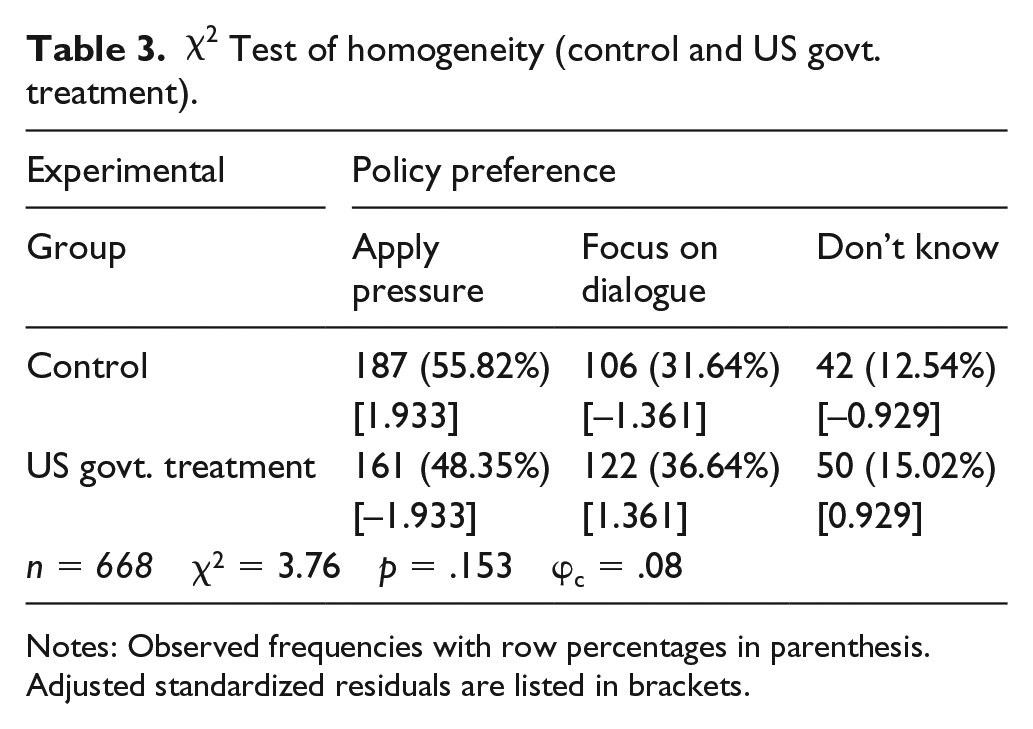
Notes: Observed frequencies with row percentages in parenthesis. Adjusted standardized residuals are listed in brackets.
A final analysis considers Hypothesis 3. Is the effect of a Trump endorsement distinct from a US government endorsement? To examine this relationship, the distribution of policy preferences in the Trump treatment is compared with the distribution of policy preferences in the US government treatment (Table 4). The results suggest only a modest difference between the treatment effects. First, there is evidence that the groups are not homogenous, χ2 (2, n = 665) = 5.44, p = .07. Second, considering the adjusted residuals, while there is no difference in support for “applying pressure” between the treatments, individuals in the Trump treatment are more likely to select a “don’t know” response than those in the US government treatment, p < .05. The substantive difference between the treatments, however, is relatively minor, φc = .09. 13
χ2 Test of homogeneity (US govt. treatment and Trump treatment).
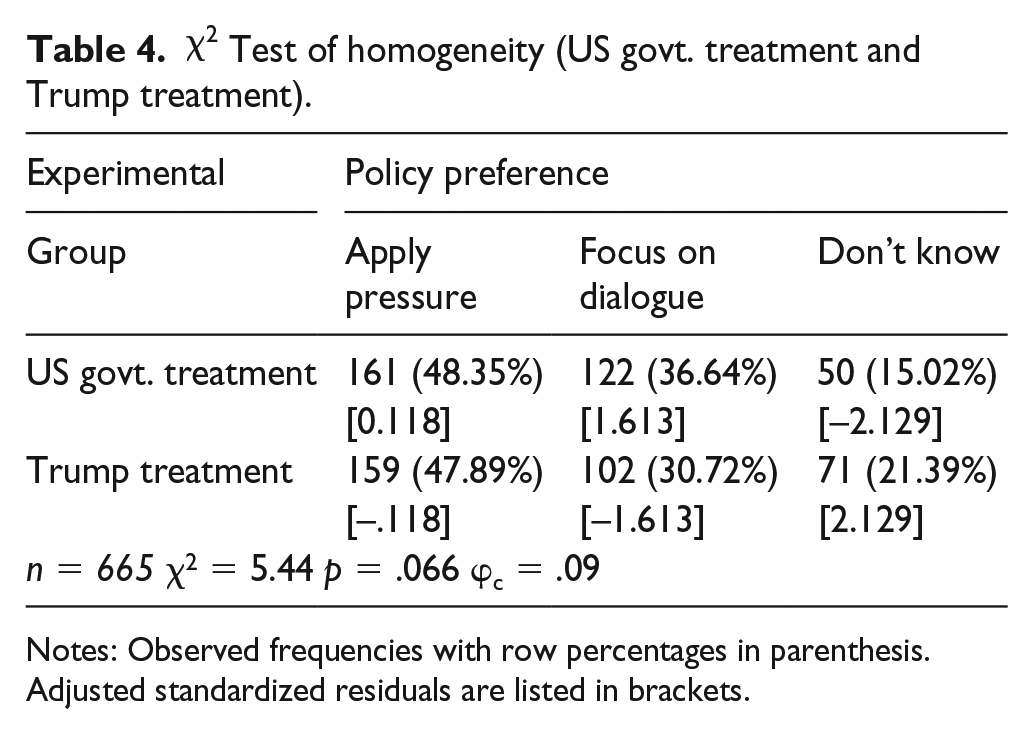
Notes: Observed frequencies with row percentages in parenthesis. Adjusted standardized residuals are listed in brackets.
Discussion
The above findings from a survey experiment in Japan indicate that a lack of leadership credibility reduces support for a preferred US policy under the Trump administration in Japan. There is, however, only limited evidence that this effect is distinct from anti-Americanism. A lack of source credibility is found to generate more uncertainty about policy preferences than anti-Americanism. There are, as usual, a number of caveats that should be considered.
First, while this study focuses on direct effects related to persuasion, it is also important to consider possible indirect effects of an unpopular president. The US president may indirectly influence US soft power by impacting perceptions of the USA. The Japanese government, for example, has maintained detailed data on public attitudes toward the USA in a yearly survey conducted since 1978 (Cabinet Office of Japan, 2017). Interestingly, Japanese attitudes do not match a story of declining US soft power. Affinity towards the USA remains relatively stable over the time period and is increasing slowly from a low point in the mid-1980s. Japanese attitudes, however, may be somewhat sensitive to the US president. For instance, there is a large bump in 2009, affinity towards the USA rises from 73.3% to 78.9% over the year. This increase may be attributed to the election of Obama, who enjoyed a strong reputation in Japan. Similarly, there is a noticeable fall in 2017, affinity towards the USA declines from 84.1% in 2016 to 78.4% in 2017. This reduction may be associated with Trump’s electoral victory.
Second, while the results show that association with Trump reduces public support for a policy position, this is not meant to suggest that US foreign policy will be unsuccessful under the current administration. President Trump may influence foreign policy through mechanisms other than public approval, such as signaling (Yarhi-Milo, 2018). Furthermore, the President has strong credibility with other allies, such as Israel, and is viewed positively in a number of countries with weaker ties to the USA, most notably Russia. This popularity could enable domestic leaders in countries typically viewed as US adversaries to reach compromises that were previously not supported by the public.
Third, a Trump endorsement reduces support for the US preferred policy in Japan but drives respondents to a “don’t know” response. This suggests that the Japanese public is not anti-Trump but uncertain about Trump’s capabilities. If Trump demonstrates credibility in handling the North Korean situation or another international crisis, it is likely that the effect of a Trump endorsement on public opinion would change.
Finally, it is important to note that the degree to which a lack of leadership credibility influences foreign policy outcomes is difficult to quantify. Governments can and do pursue strategic interests independent of public opinion, particularly on issues related to national security (Keohane and Katzenstein, 2007). Democratically elected governments, nevertheless, should be constrained to some extent by public opinion (Sobel, 2001). In extreme cases, policies endorsed by President Trump may become politically untouchable for foreign leaders concerned about maintaining domestic support. At a minimum, governments will have to expend more political capital to build domestic support for US policies—in essence, the rot in relationships described by Saunders (2017).
Supplemental Material
RR_Appendixes – Supplemental material for Leadership credibility and support for US foreign policy: Experimental evidence from Japan
Supplemental material, RR_Appendixes for Leadership credibility and support for US foreign policy: Experimental evidence from Japan by Eddie Hearn in Research & Politics
Footnotes
Acknowledgements
The autor would like to thank Ammar Shamaileh and Kai Quek for providing helpful feedback on the project as well as the anonymous reviewers and editors whose comments and sugesstions greatly improved the quality of the text. A previous version of this research was presented at the 2018 APSA Annual Meeting.
Declaration of conflicting interest
The author(s) declared no potential conflicts of interest with respect to the research, authorship, and/or publication of this article.
Funding
The author(s) disclosed receipt of the following financial support for the research, authorship, and/or publication of this article: This work is supported by JSPS KAKENHI Grant Number 17K18268.

Supplemental materials
Notes
Carnegie Corporation of New York Grant
The open access article processing charge (APC) for this article was waived due to a grant awarded to Research & Politics from Carnegie Corporation of New York under its ‘Bridging the Gap’ initiative.
References
Supplementary Material
Please find the following supplemental material available below.
For Open Access articles published under a Creative Commons License, all supplemental material carries the same license as the article it is associated with.
For non-Open Access articles published, all supplemental material carries a non-exclusive license, and permission requests for re-use of supplemental material or any part of supplemental material shall be sent directly to the copyright owner as specified in the copyright notice associated with the article.
